⚡ In short
More than 75% of the world's food crops depend on pollinators such as bees. In Japan alone, their work is worth about 470 billion yen a year. Yet flying insects in German nature reserves declined by 76% in 27 years. We explain the causes, the impacts, and what each of us can do.
Apples, strawberries, melons, pumpkins, almonds, coffee—many of the crops that brighten our tables would fail to bear enough fruit without pollinators, the small creatures that carry pollen from flower to flower. According to the assessment by IPBES, the intergovernmental body often called the "IPCC for biodiversity," more than 75% of the world's leading food crops depend at least in part on pollinators for their yield or quality.
The leading players are bees. Beyond honey bees, the world holds some 20,000 known bee species—bumblebees and solitary wild bees among them—with around 400 species living in Japan. Yet declines of these "invisible workers" are now being reported around the world. In German nature reserves, the total biomass of flying insects fell by 76% in 27 years, and it has been suggested that more than 40% of invertebrate pollinator species may be facing extinction.
In this article, we first confirm with hard numbers the role pollinators play in our food and ecosystems, then look carefully—based on primary sources—at the reality and causes of their decline, the countermeasures under way in the world and in Japan, and what each of us can start doing today.
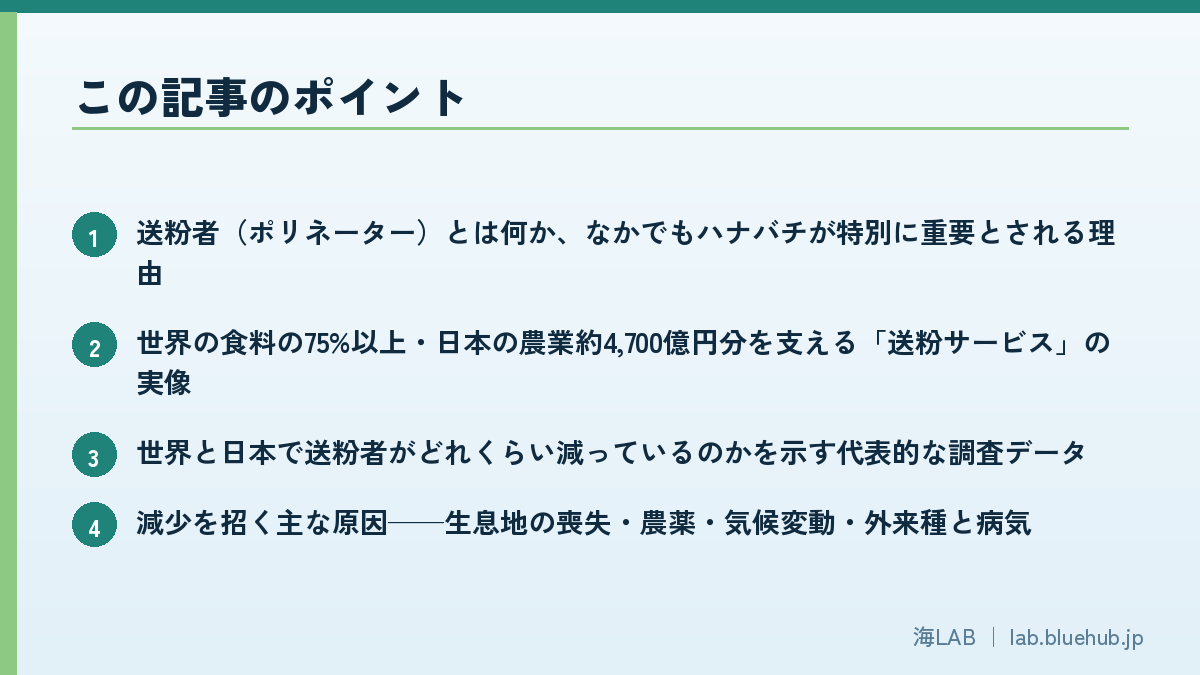
What you will learn in this article
- What pollinators are, and why bees in particular are considered so important
- The reality of the "pollination services" behind more than 75% of the world's food and about 470 billion yen of Japanese agriculture
- Key survey data showing how much pollinators are declining in the world and in Japan
- The main drivers of decline—habitat loss, pesticides, climate change, invasive species and disease
- Where EU and Japanese policies stand, and how to protect pollinators at home and when shopping
What Are Pollinators? The Creatures That Carry Pollen and Create Harvests
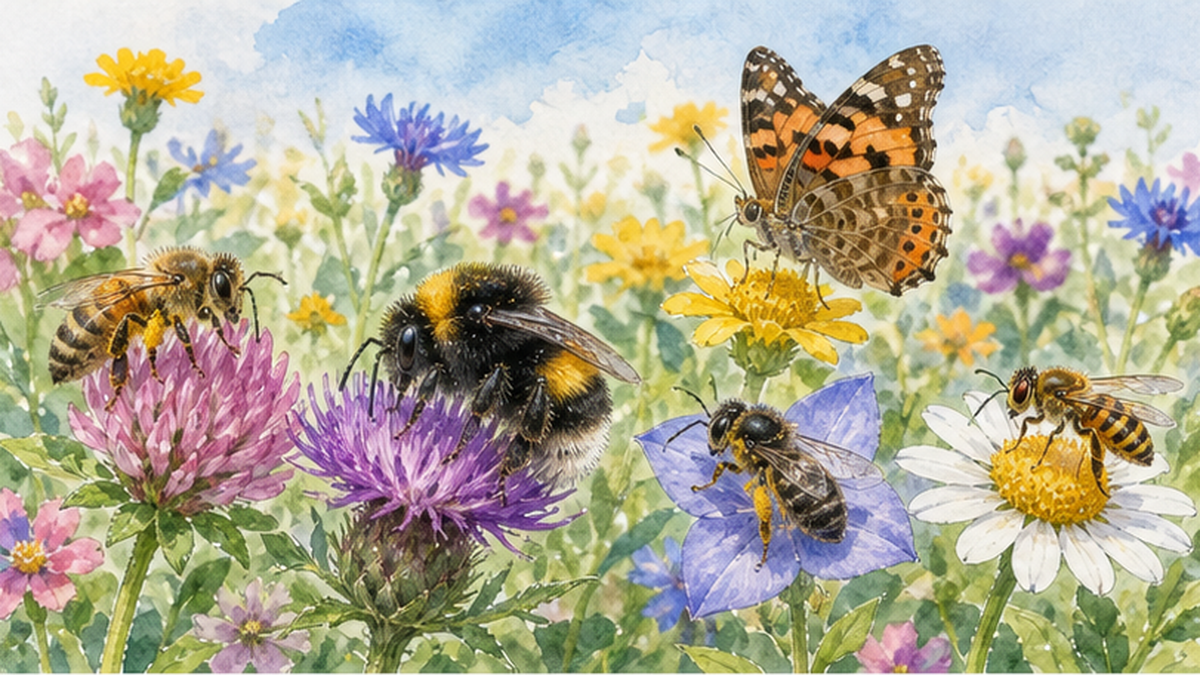
Pollinators are animals that carry pollen from the stamens to the pistils of flowers, helping plants reproduce. Because plants cannot move on their own, many species evolved to attract animals with rewards of nectar and pollen, letting the pollen ride on their visitors' bodies. The diversity of flower colors, shapes, and scents is the product of more than 100 million years of coevolution with pollinators.
How pollination works: passing life along in exchange for nectar
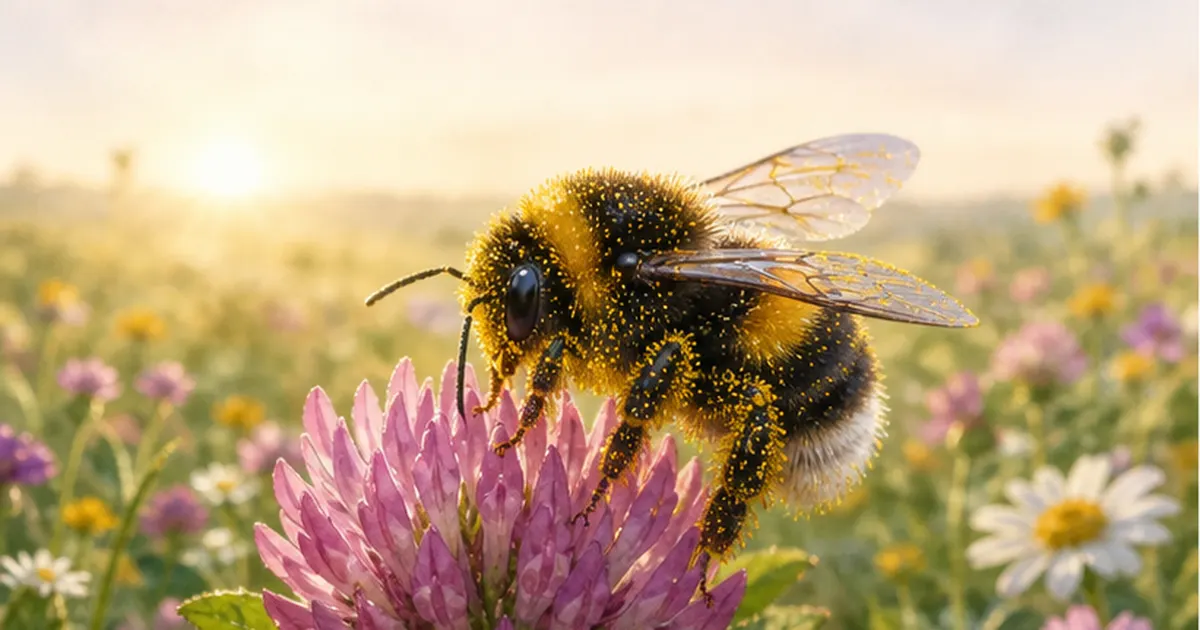
When a bee crawls into a flower seeking nectar, pollen sticks to the hairs on its body. When it visits the next flower, that pollen touches the tip of the pistil, pollination succeeds, and fruit and seeds can form. A single honey bee is said to visit hundreds to thousands of flowers a day, and this patient shuttling sustains orchard harvests and the generational renewal of wildflowers. When pollination is insufficient, plants not only fail to fruit—misshapen and undersized fruits increase and quality drops.
About 20,000 species worldwide: pollinators beyond the honey bee
The first pollinator that comes to mind is the honey bee, but the reality is far more diverse. About 20,000 bee species are known worldwide, with roughly 400 in Japan. Butterflies and moths, flies such as hoverflies, beetles—and in the tropics even hummingbirds and bats—also carry pollen.
- Honey bees—the western honey bee and the Japanese honey bee. They live in colonies and are widely used for beekeeping and crop pollination
- Bumblebees—round, furry bodies let them work in low temperatures. Masters of "buzz pollination" for tomatoes, they are indispensable in greenhouse farming
- Solitary bees—mining bees, leafcutter bees, mason bees (such as the hornfaced bee) and others. Wild bees that nest alone, they are by far the majority in species count
- Beyond bees—butterflies, moths, hoverflies, beetles and more: important supporting players that cover the weather and hours bees dislike
Japan's two honey bees: the western and the Japanese honey bee
Two species are called "honey bees" in Japan. The western honey bee, introduced for beekeeping in the Meiji era, collects nectar prolifically and is easy to manage, making it the mainstay of honey production and crop pollination. The native Japanese honey bee, by contrast, nests in tree hollows in the wild and is deeply adapted to Japan's environment, with defenses such as the "hot defensive bee ball," in which workers engulf a hornet and kill it with heat. The Japanese honey bee is also an important pollinator of satoyama woodland flowers, and its presence is a barometer of the richness of Japan's ecosystems.
Buzz pollination: the bumblebee's exclusive skill
The flowers of tomatoes, eggplants, and blueberries produce little nectar and lock their pollen inside tube-shaped anthers. What shakes that pollen free is the bumblebee's "buzz pollination." Clinging to the flower, the bee vibrates its whole body with its flight muscles, rattling pollen out through the anther's pores. Honey bees cannot perform this trick. This is why bumblebees are considered irreplaceable workers in greenhouse tomato production—before their introduction, growers pollinated each flower by hand with hormone treatments or electric vibrating tools.
Key points
- Pollinators are animals that carry pollen and help plants reproduce—bees, butterflies, hoverflies, birds, bats, and more
- About 20,000 bee species exist worldwide and around 400 in Japan; wild solitary bees make up the vast majority
- The diversity of flower colors and shapes is a jewel of biodiversity crafted by 100+ million years of coevolution with pollinators
75% of the World's Food Relies on Pollinators: The Numbers from IPBES
The first systematic global evaluation of pollinators' importance was the "Assessment Report on Pollinators, Pollination and Food Production," published in 2016 by IPBES, the Intergovernmental Science-Policy Platform on Biodiversity and Ecosystem Services. Compiling scientific knowledge from around the world, the report showed in concrete figures how much our food depends on a quiet hum of wings.
More than 75% of food crops, about 90% of wild flowers
According to the report, more than 75% of the world's leading food crops depend at least in part on animal pollination for yield or quality. Wind-pollinated staple grains like rice and wheat are exceptions, but many of the crops that enrich our tables—fruits, vegetables, nuts, coffee, cacao—cannot exist without pollinators. Furthermore, about 90% of wild flowering plants depend on animal pollination to set seed. If pollinators vanished, not only agriculture but the vegetation of hills and fields itself would fail to renew its generations.
Wind vs. insect pollination: staples survive, but the table loses its color
Plants are pollinated either by wind or by animals (mainly insects). Staple grains—rice, wheat, corn—are wind-pollinated, so the caloric foundation of our diet would hold even without pollinators. But many fruits, vegetables, and nuts, our sources of vitamins and minerals, are insect-pollinated. The pollinator crisis, then, is less a "famine crisis" than a crisis in which color and nutritional diversity drain away from our tables. Keeping this distinction in mind allows a realistic risk assessment, free of both exaggeration and complacency.
Economic value of 235–577 billion dollars a year
IPBES estimated the economic value pollinators contribute to global crop production at 235–577 billion US dollars per year—on the order of tens of trillions of yen. Moreover, the volume of agricultural production dependent on pollinators has grown by about 300% over the past 50 years; our food system is deepening its reliance on them. This mismatch—deepening dependence while pollinators decline—is the heart of the problem.
Dependence varies by crop: coffee and cacao rely on pollinators too
"Dependence" comes in degrees. Some crops, like cacao, bear almost no fruit without pollinators; others, like apples, almonds, watermelons, and pumpkins, see yield and quality swing widely; still others, like strawberries, produce more deformed fruit when pollination is incomplete. Your morning coffee, chocolate, apple juice—strip away the pollinators' work and our tables become surprisingly bleak. Put the other way around, pollinator conservation is not only "nature protection" but a practical investment in food culture and farm economics.
| Indicator | Figure | Source |
|---|---|---|
| Food crops partly dependent on pollinators | More than 75% | IPBES (2016) |
| Wild flowering plants dependent on animal pollination | About 90% | IPBES (2016) |
| Economic value of pollinators to crop production | 235–577 billion USD per year | IPBES (2016) |
| Growth in pollinator-dependent agricultural output (past 50 years) | About 300% | IPBES (2016) |
| Invertebrate pollinators possibly facing extinction | Over 40% (regional assessments) | IPBES (2016) |
What is IPBES?
IPBES is an intergovernmental body that conducts scientific assessments of biodiversity and ecosystem services. It is the "biodiversity counterpart" of the IPCC in climate science, with more than 140 member countries including Japan. The 2016 pollinator assessment was the first thematic assessment IPBES completed.
Japanese Agriculture and Pollinators: Invisible Workers Worth 470 Billion Yen a Year
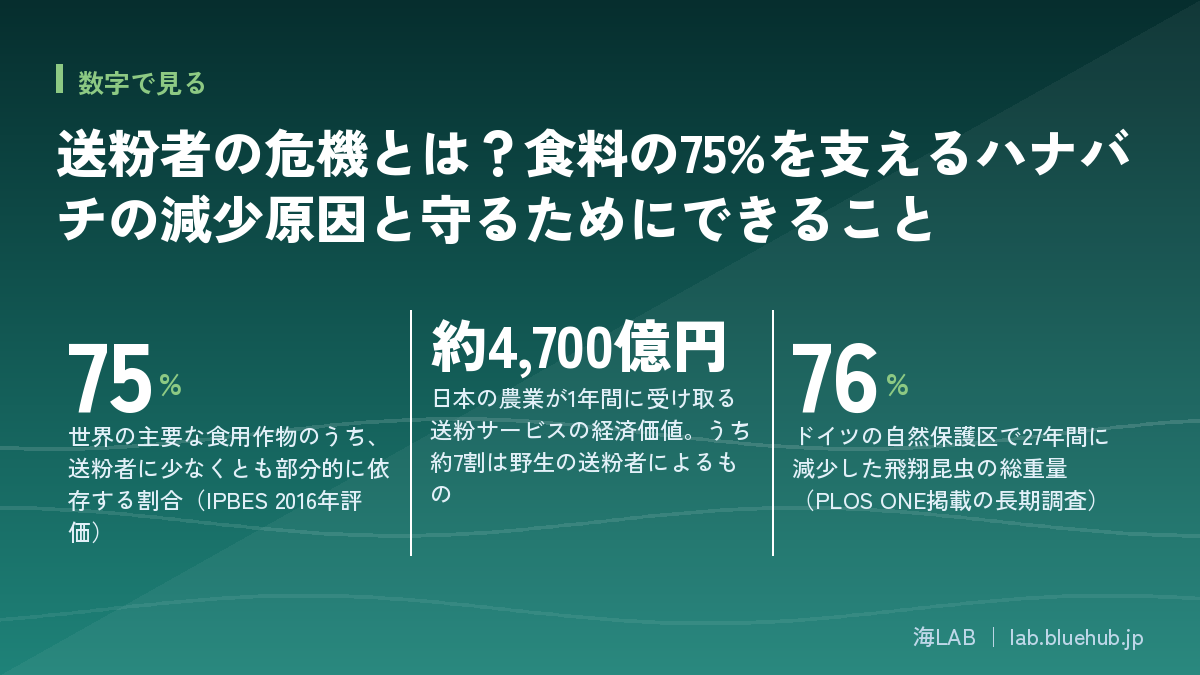
What about Japan? In 2016, the National Institute for Agro-Environmental Sciences (now part of NARO) produced the first nationwide estimate of the economic value of pollination services to Japanese agriculture. The result: pollination services were worth about 470 billion yen as of 2013—equivalent to 8.3% of Japan's crop production value (about 5.7 trillion yen).
About 70% of the work is done by wild pollinators
The most striking finding: about 70% of that 470 billion yen—roughly 330 billion yen—is provided not by managed honey bees but by wild pollinators. Their contribution is largest for rosaceous fruit trees such as apples, fruit vegetables such as melons, and solanaceous crops such as tomatoes; some prefectures depend on wild pollinators for up to 27% of their crop production value. In other words, Japanese agriculture receives hundreds of billions of yen of work each year, free of charge, from wild bees that no one keeps or manages.
Honey bees for strawberries, bumblebees for tomatoes
In greenhouse horticulture, pollinators are also a "production input." Bringing western honey bee hives into strawberry and melon greenhouses at flowering time is standard technique, and the Ministry of Agriculture, Forestry and Fisheries (MAFF) coordinates supply and demand for pollination bees together with prefectures and beekeeping associations. In recent years, mite-borne disease and natural disasters have left little slack in supply, and shortages have occurred.
Fruit-growing regions also have "local workers" other than honey bees. In apple-producing areas such as Aomori Prefecture, a solitary bee—the hornfaced bee (mamekobachi)—has long been used for pollination. It nests readily in bundles of reed tubes placed in orchards, tolerates rain and low temperatures, and works intensively during apple bloom, remaining an active complement to honey bees today. It is a globally noteworthy tradition of humans and wild bees working side by side.
Tomato pollination is the bumblebees' domain. From the 1990s, the European buff-tailed bumblebee was imported and widely used in greenhouse tomatoes, but over concerns about escaped populations affecting native bumblebees and plants, it was designated an Invasive Alien Species under Japan's Invasive Alien Species Act in 2006, restricting its keeping and import without the Environment Minister's permission. A transition to the native black-tailed bumblebee (kuromaruhanabachi) is now under way. Depending on a foreign pollinator created a different ecological risk—a case that symbolizes how thorny the pollinator problem can be.
Key points
- Japan's pollination services are worth about 470 billion yen a year, 8.3% of crop production value
- About 70%—roughly 330 billion yen—comes from wild pollinators; some prefectures depend on them for up to 27% of output
- Honey bees pollinate strawberries and bumblebees pollinate tomatoes, amid supply crunches and invasive-species issues
How Much Are Pollinators Declining? What the Data Show
We often hear that "bees are disappearing"—but what do the data actually show? Let us look at the leading global and regional studies.
Over 40% of invertebrate pollinators may face extinction
According to the IPBES assessment, in regions where assessments are possible, more than 40% of invertebrate pollinator species—chiefly bees and butterflies—may be facing extinction. Among vertebrate pollinators such as birds and bats, 16.5% were assessed as threatened. In Europe, about 9% of wild bee species are assessed as threatened, but more than half of species lack sufficient data for assessment, so the true picture may be considerably worse.
Flying insects down 76% in 27 years in German reserves
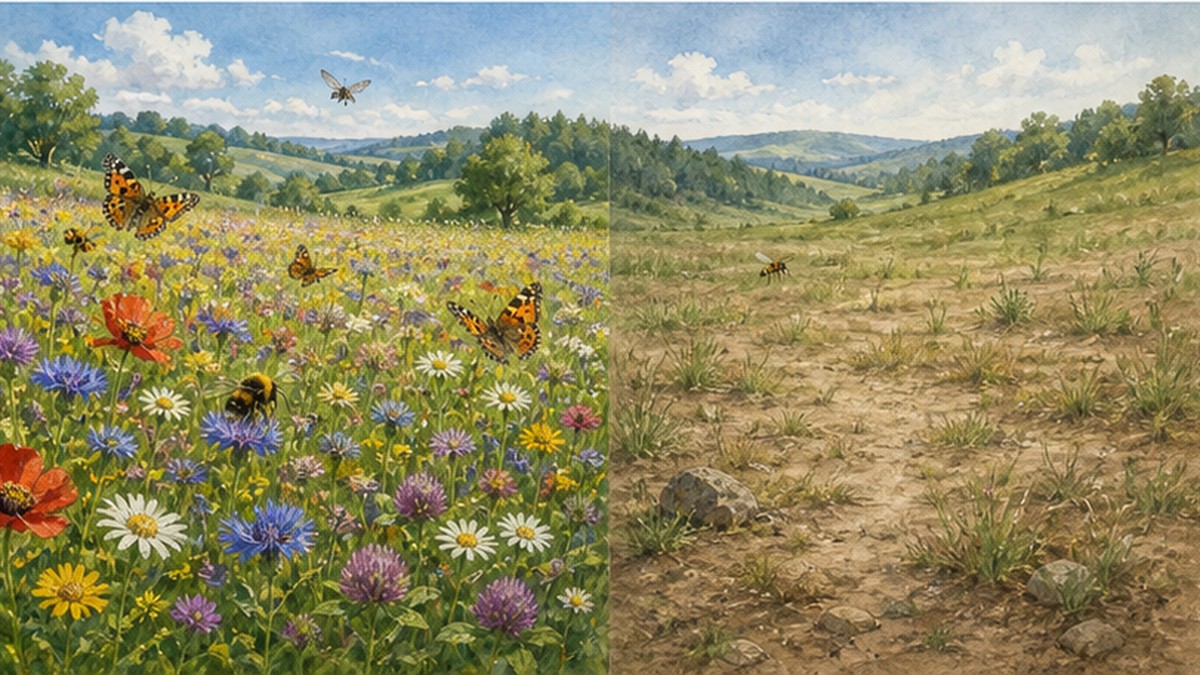
A shock came in 2017 with a long-term German study published in the journal PLOS ONE. Using Malaise traps in 63 nature protection areas, researchers measured the total weight of flying insects continuously from 1989 over 27 years—and found a seasonal average decline of 76%, reaching 82% in midsummer when insects are most abundant. And the study sites were not developed land but the interiors of nature reserves. The decline was too large to explain by weather or land-use change alone, and it became a wake-up call to the world that insects, pollinators included, are quietly vanishing.
In North America, a bumblebee is now an endangered species
Looking at individual species makes the crisis concrete. In North America, the rusty patched bumble bee—once an utterly common species—crashed within about two decades and in 2017 became the first bumblebee listed for protection under the U.S. Endangered Species Act (ESA). In Japan too, researchers point to shifting distributions of cold-adapted bumblebees and deteriorating habitats for wild bees as satoyama landscapes are developed and grasslands shrink.
Managed honey bees are increasing globally—why that is no reassurance
There is, however, a surprising counterpoint. According to FAO statistics, the world has about 100 million managed honey bee colonies, and their number actually grew by about 85% between 1961 and 2017. But regional differences are large: colonies increased in Asia, South America, Africa, and Oceania while declining in North America and Europe. In the United States, "colony collapse disorder" (CCD)—worker bees abruptly vanishing from their hives—struck repeatedly from autumn 2006, dealing a heavy blow to beekeeping.
The crucial point is that managed honey bees are "livestock" that humans can multiply. The growth is centered on one managed species, the western honey bee, and it does not offset the decline of the wild bees that make up the vast majority of species. As noted above, about 70% of Japan's pollination services are provided by wild pollinators. Judging from managed-bee statistics alone that "bees are increasing, so all is well" is dangerous.
Japan's challenge: a data gap
In Japan, managed honey bee colonies are tracked in livestock statistics, but long-term nationwide surveys of wild bee populations are very scarce. Even though wild pollinators are estimated to provide about 70% of pollination services, we lack the data to say with confidence whether these workers are increasing or decreasing. Germany's 76% figure moved the world precisely because of patient monitoring that measured the same way for 27 years. Alongside research institutions' surveys, the spread of citizen science—where the public submits observation records—is expected to be a key to filling this gap.
Points of caution
- "Managed honey bees increasing" and "wild pollinators declining" are different stories—do not confuse what the statistics cover
- Long-term insect monitoring data remain scarce; the full extent of decline may be underestimated
- Japan also lacks nationwide population data for wild bees; sustained surveys are a pressing need
Why Are They Declining? Five Compounding Causes
There is no single culprit behind pollinator decline. IPBES concludes that multiple factors combine to press pollinators into a corner. Let us examine the main causes in turn.
Understanding the causes correctly is the starting point
Simplistic claims circulate from time to time—"mass bee deaths are caused by electromagnetic waves," "one pesticide is to blame." What scientific assessments consistently point to, however, is a compound crisis in which multiple factors overlap. The weight of each cause also differs by region and species. That is exactly why what matters is not hunting for a single villain but verifying the evidence factor by factor and stacking up measures that work.
1. Habitat loss and food shortage
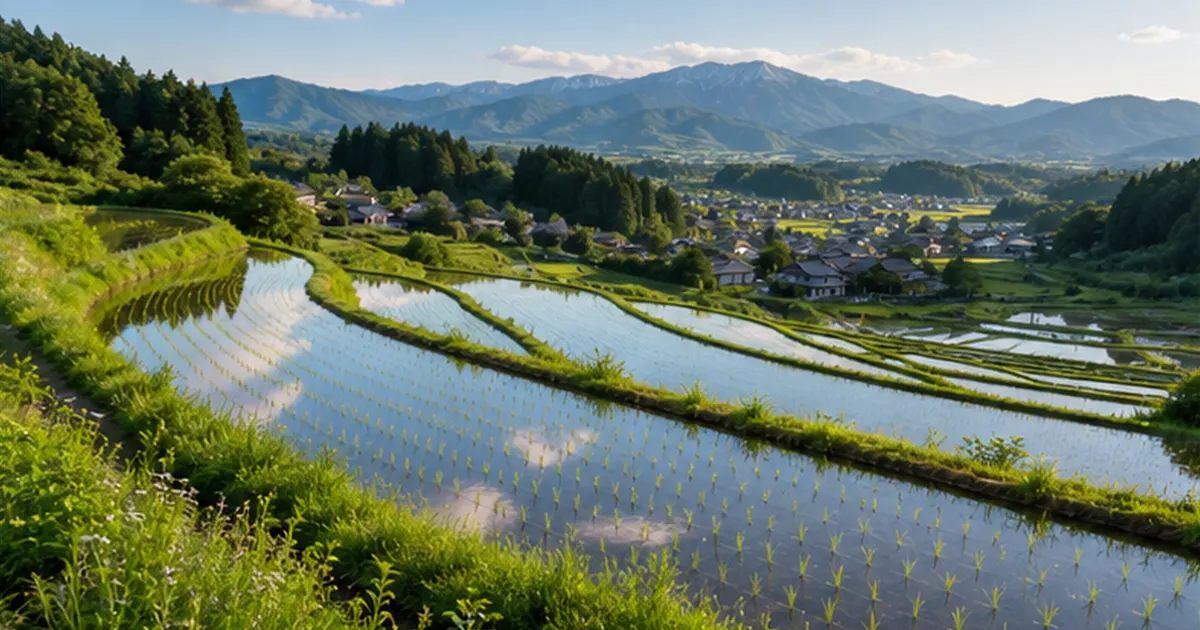
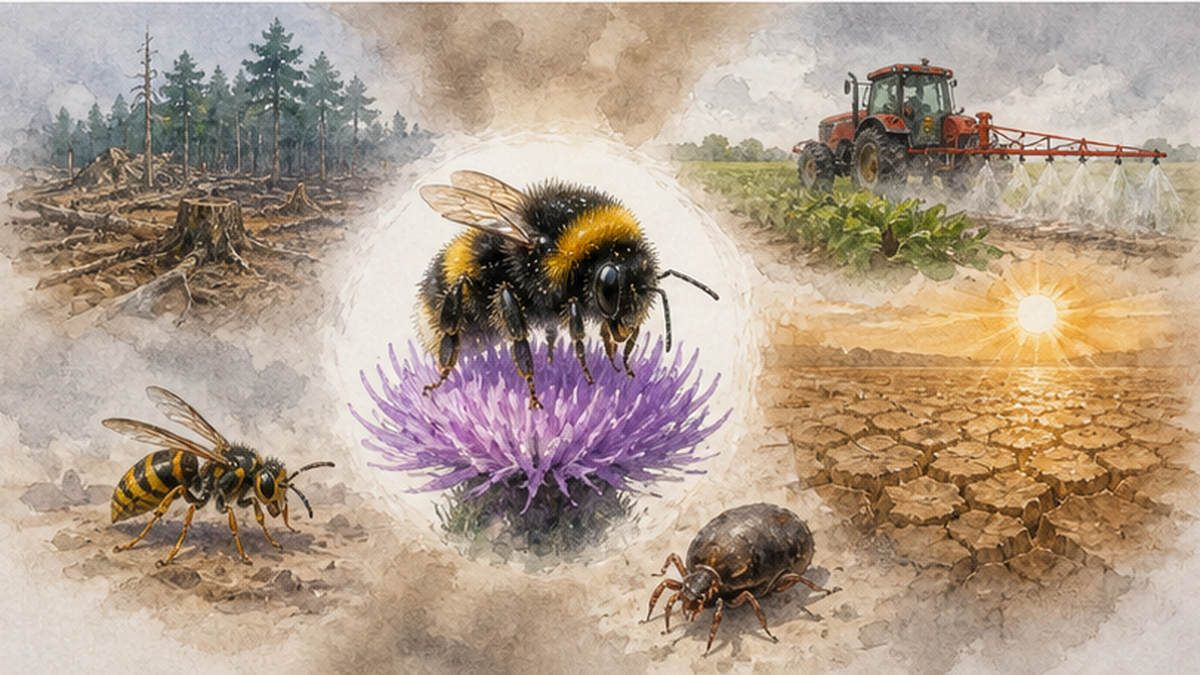
The largest driver is habitat loss through land-use change. When grasslands, satoyama woodlands, field margins, and coppices are lost to development or farm abandonment, bees lose both nesting sites and the diverse flowers that bloom without interruption from spring to autumn—home and food supply at once. Intensive agriculture that grows a single crop over vast areas floods the land with bloom for a few weeks and turns it into a "flower desert" the rest of the year, a harsh environment for wild pollinators. In Japan, the biodiversity nurtured by rice paddies and their footpaths is well known, and the loss of grassland-like environments to abandonment and land consolidation hurts bees as well.
2. Pesticides: the global debate over neonicotinoids
Neonicotinoids, systemic insecticides, permeate plant tissues and leave residues even in pollen and nectar. Experiments have shown that even sublethal doses impair bees' homing and learning abilities, and in 2018 the European Food Safety Authority (EFSA) concluded that three major neonicotinoids pose risks to both honey bees and wild bees. In response, the EU banned outdoor use of imidacloprid, clothianidin, and thiamethoxam in 2018. Japan has not banned these three substances, but under the re-evaluation system introduced by the 2018 revision of the Agricultural Chemicals Regulation Act, scientific reassessments with strengthened evaluation of impacts on honey bees are proceeding in turn. Pesticide impacts have also been noted in the decline of dragonflies in rice paddies, raising questions of care for insects in wetlands and flower fields alike.
When thinking about pesticides, it is also important not to reduce the issue to "farmers are the problem." Pesticides are a technology that has protected crops from pests and supported stable food supplies; the real challenge is reconciling pest control with care for pollinators. Indeed, practical options keep growing: integrated pest management (IPM), which combines natural-enemy insects and pheromone products to minimize spraying, and application timed to hours or growth stages when bees are not active.
3. Climate change, 4. invasive species, 5. disease and mites
- Climate change—"phenological mismatch" arises as flowering times and pollinator activity fall out of sync, and cold-adapted bumblebees are being pushed back from the southern edges of their ranges
- Invasive species—alien pollinators and plants compete with natives. Japan's buff-tailed bumblebee is a prime example: designated an Invasive Alien Species over concerns about competition and hybridization with native bumblebees
- Disease and parasitic mites—the Varroa mite weakens colonies while transmitting viruses, a worldwide threat. Cases of pathogens spreading from managed honey bees to wild bees have also been reported
In recent years, attention has also turned to light pollution affecting nocturnal pollinators. Moths and other night-shift pollinators are drawn to streetlights and facility lighting, their natural flower-visiting behavior disrupted—and field experiments in Europe report reduced pollination of night-blooming plants. Watching only the daytime pollinators means missing part of the picture.
The causes multiply together
These factors interact rather than act alone. Bees weakened by poor nutrition, for instance, are less resistant to pesticides and disease, and as climate change shifts distributions, they encounter new pathogens. That is why countermeasures, too, must come in combination—not as one-off fixes like pesticide rules alone or protected areas alone.
What Happens When Pollinators Decline? Impacts on Our Tables and Ecosystems
Pollinator decline is not a distant event deep in nature—it is already surfacing on farms as a ceiling on yields.
In the U.S., yields of major fruit crops are already pollination-limited
A study led by Rutgers University and published in 2020 in Proceedings of the Royal Society B examined pollination and yield for apples, highbush blueberries, sweet cherries, tart cherries, almonds, watermelons, and pumpkins at 131 farms in the United States and Canada. It confirmed that for apples, both cherries, and blueberries, yields are being held below their potential for lack of pollination. Notably, wild bees provided roughly as much pollination as managed honey bees. Pollinator shortage is not a "future concern" but a production loss already under way.
Strawberries are a familiar example. Each tiny "seed" on a strawberry's surface is an individual fruit (achene), and every one of them needs pollination. Uneven pollination makes only the pollinated parts swell, producing misshapen berries that taste the same but lose much of their market value as off-grade produce. The main reason growers bring honey bees into their greenhouses is less about yield than about reliably producing well-shaped, sellable fruit. The quality of pollination translates directly into farm income and food waste.
Nutritional quality at risk: a matter of vitamins, not calories
Even if pollinators decline, wind-pollinated rice, wheat, and corn remain, so humanity would not starve overnight. But pollinator-dependent fruits, vegetables, and nuts are key sources of vitamins A and C, folate, calcium, and antioxidants. Degraded pollination services are, more than a calorie problem, a problem of nutritional quality—one that could affect health through micronutrient deficiencies.
When pollination became an industry: almonds and migratory beekeeping
The growing scarcity of pollinators has turned pollination itself into big business. In California, which produces most of the world's almonds, enormous numbers of hives are trucked in from across the country every February for the bloom, and for beekeepers, pollination rental fees now outweigh honey as the main source of income. Yet long-distance transport and concentration in a landscape with only one crop's flowers stress the bees themselves through unbalanced nutrition and disease exchange—symbolizing the fragility of agriculture that outsources its pollination.
A cascade reaching 90% of wild plants
The impacts do not stop at agriculture. About 90% of wild flowering plants depend on animal pollination, so fewer pollinators mean less seed production in the wild; fewer plants in turn affect the birds and mammals that feed on their fruits and leaves. The bond between flowers and pollinators is the foundation of ecological networks, and its erosion could be the start of a cascade that slowly eats away at the biodiversity of forests, grasslands, and satoyama as a whole.
If pollinators declined sharply
- Production and quality of fruits, vegetables, and nuts would fall, driving up prices and shrinking growing regions
- Sources of vitamins and minerals would thin out, potentially widening nutritional inequality
- Seed production of wild plants would drop, rippling through ecosystems from plants to insects to birds and mammals
Countermeasures in the World and Japan: Regulation, Strategy, and Fieldwork
As the data on the crisis accumulate, the international community and national governments have begun to act. Let us look at three levels: regulation, strategy, and on-farm practice.
The international community: World Bee Day and national strategies
By a 2017 General Assembly resolution, the United Nations designated May 20 as World Bee Day, and awareness efforts for pollinator conservation continue with FAO at the center. Beyond its 2018 outdoor-use ban on the three neonicotinoids, the EU is advancing the "EU Pollinators Initiative" to halt pollinator decline, and the United Kingdom, United States, France, and others have drawn up national pollinator protection strategies.
Japan: the Green Food System Strategy and supply coordination
In Japan, the Green Food System Strategy adopted by MAFF in 2021 set a target of reducing chemical pesticide use by 50% on a risk-equivalent basis by 2050. Its pillars include developing new pesticides to replace conventional ones, neonicotinoids included, and spreading integrated pest management (IPM). For pollination honey bees, MAFF operates a system that pools supply-demand information with prefectures and beekeeping associations and coordinates transfers to areas facing shortages. The switch from the invasive buff-tailed bumblebee to the native black-tailed bumblebee is also being supported through subsidy programs.
In research as well, pollinators have become an international priority. Following the IPBES assessment, many countries have joined "Promote Pollinators," an international coalition for sharing national policies and research, advancing standardization of monitoring methods and field verification of conservation measures on farmland. The world is entering a phase of scaling up what is scientifically confirmed to work—which measures, where, and by how much.
On the farm: keeping flowers in bloom
Studies abroad show that "flower strips" of wildflowers planted along field edges, hedgerows, and cover crops increase wild pollinators and improve pollination of adjacent crops. Small practices add up—mowing field margins and fallow land less aggressively, avoiding pesticide applications during bloom, leaving bare ground and dead wood for nesting—turning farmland from a "flower desert" into a "pollinator corridor." Japan's rural infrastructure, such as irrigation ponds and paddy footpaths, is being rediscovered as part of such corridors.
Key points
- The UN designated May 20 as World Bee Day; the EU banned outdoor use of three neonicotinoids
- Japan's Green Food System Strategy targets a 50% risk-based reduction in chemical pesticides by 2050
- Flower strips, IPM, and the switch to native bumblebees—field-level measures are spreading worldwide
What We Can Do: Pollinator Conservation Starting on the Balcony
Pollinator conservation is not only a matter for vast farmlands and protected areas. In city gardens, on balconies, and even in our shopping baskets, there is a surprising amount we can do.
You might think, "What difference can a few flower pots make?" But urban greenery matters more to pollinators than you would expect. Studies abroad report cases where city gardens and community allotments with a continuous variety of blooms support as many bees as the surrounding farmland. If home gardens, balconies, and school and park flowerbeds connect like stepping stones, a whole city can become a "stepping-stone corridor" for pollinators.
Plant flowers: continuity matters more than quantity
What is hardest on bees is a long season with no flowers at all. A garden or planter where something is always blooming from spring through autumn is worth more to pollinators than a flowerbed that is gorgeous for just a few weeks in spring. Native wildflowers and herbs (shiso, lavender, rosemary, and the like) offer accessible nectar and pollen, and simple single-petaled flowers tend to serve pollinators better than double-petaled ornamental varieties.
Choices in daily life
- Go easy on home pesticide use—above all, avoid spraying insecticides on plants in bloom; if you must, choose evening hours when pollinators are not active
- Support with your shopping—choosing produce from environmentally friendly or organic farming, and domestic honey, is a vote for producers who care for pollinators
- Do not be too afraid—bees intent on gathering nectar rarely sting unless grabbed; learn the respectful distance of quiet observation away from nests
- Observe and record—citizen science that records which bees visit which flowers is a real contribution to pollinator research starved of data
"Bee hotels": offering a place to nest
Alongside flowers for food, what is missing is places to nest. Many solitary bees nest in holes in dead branches, in bamboo tubes, or in bare ground. A "bee hotel"—bundled bamboo tubes or drilled wood blocks hung under the eaves—is a garden conservation staple in Europe, and the reed-tube nests of Japan's hornfaced bees are its distinguished forerunner. If you install one, fix it in a south-facing spot sheltered from rain and replace the tubes every few years to prevent disease build-up. If stings worry you: solitary bees have little instinct to defend their nests and are considered extremely non-aggressive.
Actions you can start today
- Plant two or three nectar plants with different flowering periods on your balcony or in your garden
- Stop spraying insecticides on plants in bloom; when necessary, choose the time and place carefully
- On May 20, World Bee Day, share the story of pollinators with family and friends
- Photograph the bees and butterflies visiting flowers and look up their species—observation is the first step of conservation
Conclusion: a small buzz underpins our tables and ecosystems
Pollinators support more than 75% of the world's food crops and about 470 billion yen of Japanese agriculture. Their decline—as Germany's 76% biomass loss and the U.S. yield-limitation research show—has already begun as a real-world loss. The causes are a compound of habitat loss, pesticides, climate change, invasive species, and disease; the countermeasures, likewise, can only be stacked up at every scale, from international regulation to farm flower strips to a planter on the balcony. The next time you see a bee alight on a flower, pause for a moment. That small buzz is the sound of an irreplaceable worker quietly holding up our tables and the Earth's ecosystems.
Summary of this article
- Pollinators support more than 75% of the world's food crops and about 90% of wild plants, worth 235–577 billion dollars a year
- Japan's pollination services are worth about 470 billion yen a year, about 70% provided free by wild pollinators
- Flying insects fell 76% in 27 years in German reserves; over 40% of invertebrate pollinators may face extinction
- The causes compound: habitat loss, pesticides, climate change, invasive species, disease. The EU banned outdoor use of three neonicotinoids
- Japan's Green Food System Strategy targets a 50% cut in pesticide risk; at home, nectar plants and pesticide care make a difference
References and Sources
- IPBES – Assessment Report on Pollinators, Pollination and Food Production (2016)
- National Institute for Agro-Environmental Sciences (now NARO) – Economic valuation of pollination services in Japanese agriculture (2016 press release)
- Ministry of Agriculture, Forestry and Fisheries, Japan – On pollination insects (supply, demand, and management of honey bees and bumblebees)
- Ministry of the Environment, Japan – The buff-tailed bumblebee (Invasive Alien Species profile)
- Hallmann et al. (PLOS ONE, 2017) – More than 75% decline over 27 years in total flying insect biomass in German protected areas
- Reilly et al. (Proceedings of the Royal Society B, 2020) – Study showing that yields of major U.S. crops are limited by insufficient pollination
- FAO – World Bee Day
- Ministry of Agriculture, Forestry and Fisheries, Japan – Green Food System Strategy
* Ordered by reliability: government and academic institutions > peer-reviewed papers > specialist organizations > trusted media