⚡ In short
The intertidal zone swaps between sea and air twice a day. How do shore organisms adapt to swings in drying, heat, salinity and oxygen, and why do they line up in zones? A guide with Connell's and Paine's classic studies.
Rocky ground that is swapped between sea and air about twice a day by the tides: the intertidal zone. The tide pools left behind are small, harsh seas where temperature, oxygen, pH and salinity can change greatly within hours.
Even so, many organisms live here, and they are arranged in stripes by height on the shore. This article explains how, through three lenses: adaptation to drying and heat, behavior, and competition and predation.
It also introduces the classic barnacle and sea star experiments and links them to tips for observing Japan's rocky shores.
What you will learn
- Features of the intertidal zone and tide pools
- The body and molecular mechanisms that resist drying and heat
- Behavior that avoids harsh conditions
- Why organisms line up in zones
- The keystone species concept
- Climate change and observation manners
The intertidal: a home whose environment flips twice a day
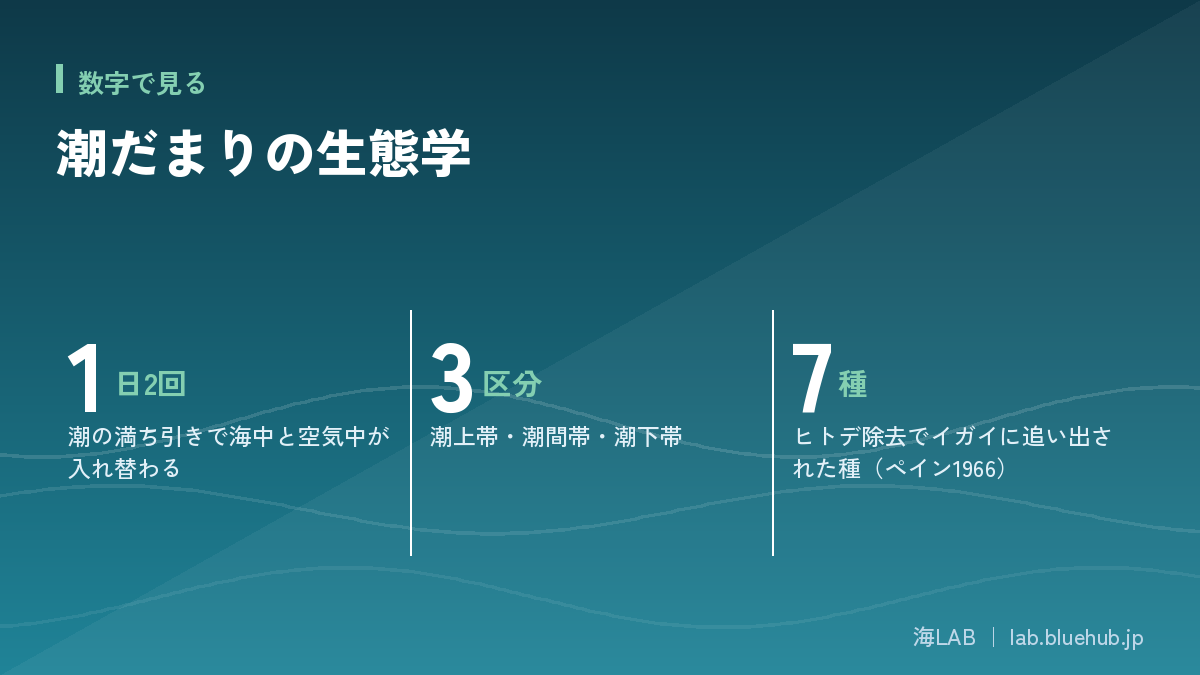
Walk on a rocky shore and you find places that are seabed at high tide and dry land at low tide. This is the intertidal zone. As the tide rises and falls, the same rock moves between sea and air about twice a day. For living things it is among the most changeable homes in the world, with temperature, drying, salinity, oxygen and wave force shifting within hours.
Three zones: supratidal, intertidal, subtidal
For a first look at tide pools, see Tide Pool Exploration; for the ecosystem as a whole, see The Tide Pool Ecosystem.
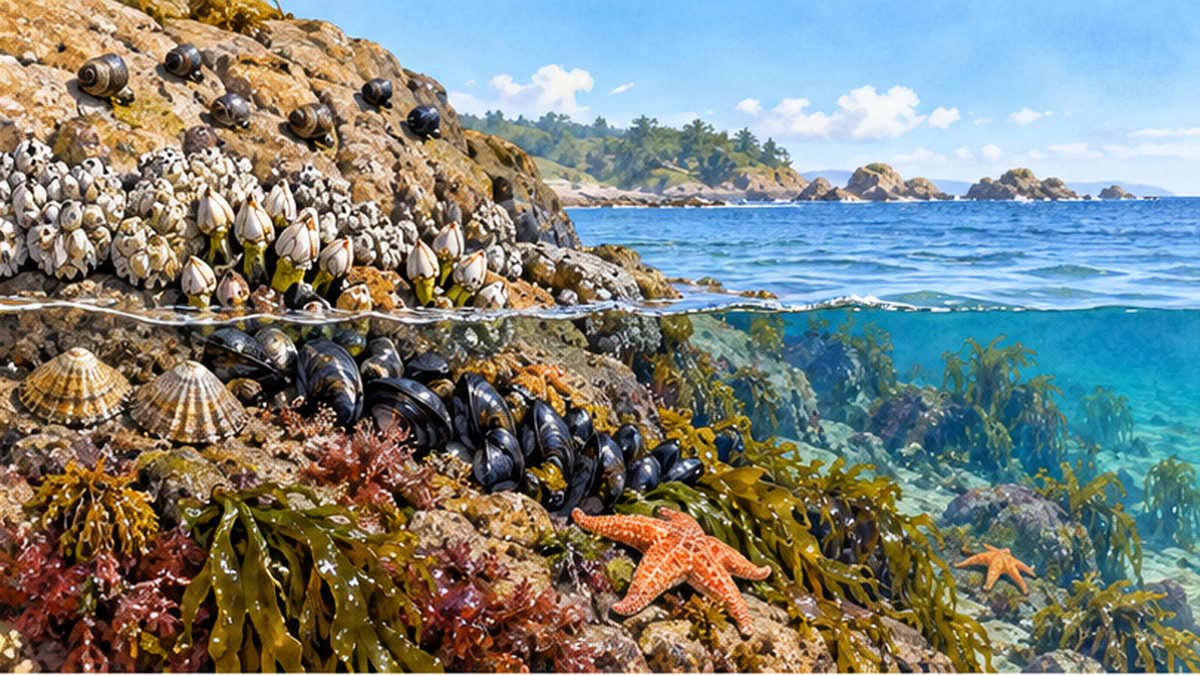
A rocky shore is roughly divided into the supratidal zone (reached only by spray), the intertidal zone (moving between sea and air between high and low tide) and the subtidal zone (always underwater). Tide pools are hollows in the intertidal rock that keep seawater at low tide.
| Zone | State at low tide | Main stress | Example organisms |
|---|---|---|---|
| Supratidal | Almost always in air (spray only) | Strong drying, sun, rain | Periwinkles, sea slaters |
| Upper intertidal | Mostly in air | Drying, heat, salinity change | Barnacles, goose barnacles |
| Middle intertidal | About half in air, half underwater | Drying and waves | Mussels, limpets |
| Lower intertidal | Exposed only briefly | Predation, competition | Seaweeds, sea stars, urchins |
Tidal height sets the environment
According to materials from the Kanagawa Prefectural Museum of Cultural History, at low tide summer heat, winter cold, rain, river water and waves act directly on the intertidal zone, and the substrate and interactions between organisms then determine distribution over small areas. Even on one rock, a difference of a few tens of centimeters in height greatly changes the time spent underwater. This height is the main reason intertidal organisms line up in stripes.
Key points of this chapter
- The intertidal alternates between sea and air twice a day
- Tidal height is the main driver of zonation
- Tide pools are small seas that keep water at low tide
Tide pools as small seas: water that changes within hours
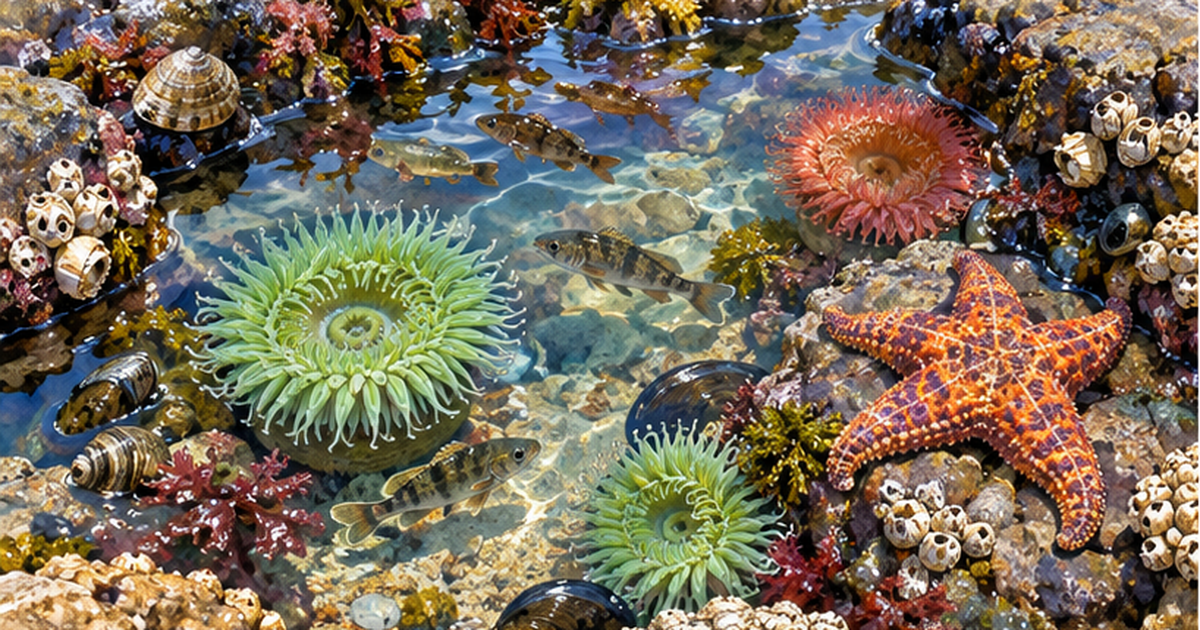
At low tide, seawater is left in hollows in the rock. Unlike the open sea, a tide pool holds little water, so conditions become extreme. The main players are four: temperature, oxygen, pH and salinity.
Oxygen and pH rise by day and fall by night
A study on San Juan Island in the United States reported that in tide pools at low tide, dissolved inorganic carbon and alkalinity decreased while pH, temperature and dissolved oxygen increased. By day, photosynthesis by seaweeds and microalgae takes up carbon dioxide and releases oxygen. At night photosynthesis stops while animals and microbes keep respiring, so carbon dioxide rises, pH falls and oxygen declines.
Seawater is well buffered, so pH rarely reaches extreme values, but a study of summer salt marsh ponds reported daily swings in a range of about pH 7 to 8.5. Some tide pools have also been observed with pH above 9 in summer. Results vary greatly with pool size, height and sun exposure.
| Time | What happens | Change in the pool |
|---|---|---|
| Daytime low tide | Active photosynthesis, heating by sun | Oxygen up, pH up, temperature up |
| Nighttime low tide | Photosynthesis stops, respiration only | Oxygen down, pH down (sometimes hypoxia) |
| Rain or high tide | Fresh water enters or seawater refills | Sudden salinity drop / reset |
Salinity changes, but less than temperature
According to a report by WHOI researchers, the daily change in tide pool salinity is smaller than that of temperature or oxygen. However, salinity moves greatly for a time when heavy rain brings fresh water, or when strong sun evaporates water and makes it saltier. Pools higher on the shore are more affected.
Height and size create different worlds
A link has also been noted between pool elevation and the layering (stratification) of temperature, salinity and oxygen. A shallow pool high on the shore has a long wait until the next high tide, so it is exposed to extremes. A pool low on the shore is flushed quickly and stays close to the open sea. This is why pools on the same shore have different residents.
Observation tips
- Compare the activity in the same pool at midday and in the evening
- Look for differences in residents between high and low pools
- If you have a thermometer, measure sunny and shaded water
Enduring drying and heat: physiology and body design
The higher an organism lives, the longer it is exposed to air at low tide. A 2022 review by Leeuwis and Gamperl in Oceanography and Marine Biology: An Annual Review summarizes how animals of the upper intertidal cope with stresses of air exposure such as drying, heat, freezing, hypoxia and salinity change, through both evolutionary adaptation and flexible (plastic) responses.
Closing the shell to keep water in
Barnacles, mussels and limpets reduce water loss by closing their shells or plates. Some snails seal the shell opening to reduce evaporation. During low tide they stay still and lower their metabolism to save energy.
Heat shock proteins and antioxidant enzymes
It is known that heat shock proteins and antioxidant enzymes help organisms tolerate heat. Heat shock proteins protect proteins that become fragile in heat and help repair them, acting as molecular chaperones. Species living in more stressful places tend to ramp up such molecules faster.
Seaweeds that revive after drying out
Some seaweeds can recover water and restart photosynthesis when they are submerged again after severe drying. Sea lettuce (Ulva) and laver (Porphyra) are known examples. They survive low tide by drying out and photosynthesize and grow rapidly at high tide, a two-step way of living.
Tolerance has a cost
Raising stress tolerance has a price: less energy for growth, reproduction and immunity. Adapting to harsh conditions is not free. Because of this trade-off, no all-purpose species can endure everything, and different species divide up the shore.
Three patterns of adaptation
- Form: closing the shell, clinging tightly to rock
- Molecules: protecting cells with heat shock proteins and antioxidant enzymes
- Behavior: moving to shade or damp places
Moving away: using the environment through behavior
When body design alone is not enough, mobile organisms get through by changing place. Unlike fixed barnacles and mussels, snails, crabs and fish can move with the tide and the sun.
Taking shelter in damp refuges
Mobile animals such as snails and crabs move at low tide to refuges such as rock crevices, under seaweed and damp shade. This avoids direct sun and drying. In the intertidal, the choice of microhabitat can decide life or death.
Vertical movement with seasons and waves
A study in Taiwan reported that a species of limpet has its distribution limited by physiological limits, namely summer heat and drying at low tide, and moves up and down seasonally with wave height to reduce drying stress. When waves are high, spray keeps higher levels damp, so the animals can reach higher positions.
Limpets that go home
Some limpets go out at high tide to graze algae on the rock and return to their own "home spot" before low tide. The strategy is to fit the shell tightly to the rock and protect water. This homing is also thought to rely on an internal rhythm that anticipates the tide.
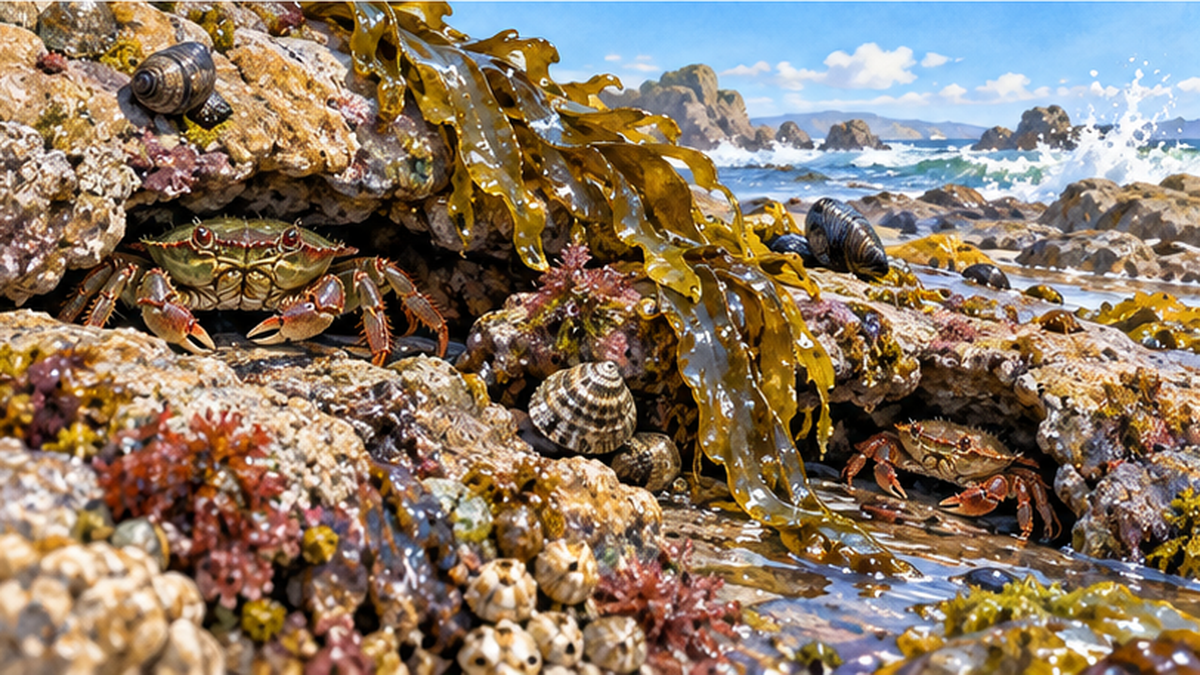
- Fixed organisms: close the shell and cluster to hold water
- Mobile organisms: shelter in damp refuges
- Moving up and down with the tide to avoid drying
Why zones form: competition and predation set the lower limit
Why intertidal organisms line up in stripes has long interested ecologists. One famous answer is that the upper limit is set by physical stress and the lower limit by relations between organisms.
Connell's barnacle experiment (1961)
In a paper published in 1961, the American ecologist Joseph Connell studied two barnacles (Chthamalus and Balanus) on Scottish rocky shores. The fast-growing Balanus is weak against heat and drying and cannot live high on the rock. Chthamalus can live high up, but is excluded from the lower zone when Balanus takes the space. Connell moved Chthamalus to lower positions and showed that it survived without competitors but died when they were present.
| Limit | Determining factor | Barnacle example |
|---|---|---|
| Upper limit | Physical environment such as heat and drying | Balanus cannot tolerate drying in the upper zone |
| Lower limit | Interactions such as competition and predation | Chthamalus is excluded by Balanus in the lower zone |
However, this "physical above, biological below" pattern does not always hold, and later studies have revised and debated it. Conditions change with wave exposure and the presence of predators on each shore.
Paine's sea star removal and the keystone species
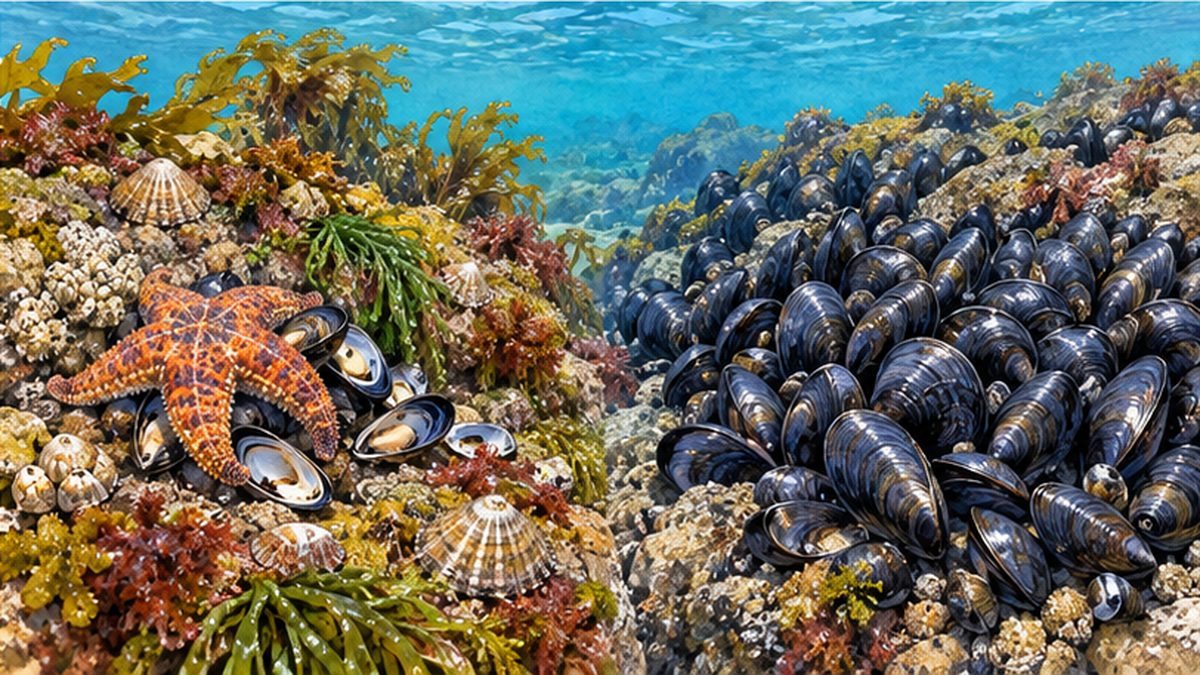
Another famous study is the experiment by the American ecologist Robert Paine. On a rocky shore in Washington State, he removed the predatory sea star (Pisaster ochraceus). Its prey, the mussel (Mytilus californianus), increased and nearly monopolized the rock surface, and seven other attached species were pushed out. Reported in a 1966 paper, this result showed that a predator near the top of the food web supports diversity of the whole community.
In a 1969 paper Paine proposed calling such a species a keystone species. A keystone is the stone at the top of an arch; if it is removed the whole structure collapses. At the same time, there has been critical examination of how the 1966 paper is interpreted and how the keystone concept spread, and in 2016 Lafferty and Suchanek discussed how the concept became widespread.
What is a keystone species?
A species that, even if few in number, has a large effect on the structure and diversity of the whole community. The intertidal sea star is a classic example.
Organisms to see on Japan's rocky shores
If you go at low tide, Japan's rocky shores are an excellent place to check these ideas with your own eyes. Here are organisms that are easy to observe, seen through the lens of adaptation.
Common species in the upper to middle zone
Materials from the Kanagawa Prefectural Museum of Cultural History introduce the striped barnacle and a white-striped barnacle as typical of the upper to middle intertidal of inner bays, and note that another barnacle tends to be common in the lower part. Even close relatives live at different heights, because each species has different limits of drying and heat it can tolerate.
Safety and manners when observing
- Check low tide times and tide levels in a tide table, and always turn back before the tide rises
- Wet rock is slippery, so wear non-slip footwear
- Return organisms to where you found them, and put rocks back if you turn them over
- Follow the rules of places where collecting is banned or restricted, and where fishing rights apply
When observing, notice not only the stripes but also that the shell color and shape of the same species differ by place. In wave-exposed places some species have lower, flatter bodies, a clue to shape differences matching the environment.
What you can do today
- Look up the low tide time at a nearby shore
- Photograph which organisms live at each tidal height
- Compare your records with field guides or local nature observation sites
Climate change and tide pools: beyond the extremes
Intertidal organisms that live in extreme environments are often assumed to be very tolerant. But many species are also thought to already live near their limits. So when water temperature rises or heatwaves occur, even a small change may have a large effect.
Living near the limit
As the Taiwan limpet study shows, summer heat and drying at low tide set the upper limit of distribution. If summer air or sea temperatures rise, the upper limit may move down and the habitable range may shrink. However, actual effects differ by species, place and wave exposure and cannot be generalized.
For sudden rises in sea temperature, see Impacts of Marine Heatwaves.
Combination with ocean acidification
Tide pool pH swings widely between day and night, so tide pool organisms may be more used to variation than open-sea organisms. Even so, it has been pointed out that acidification combined with heat could be a harsh condition for shell building in shellfish and barnacles. Research in this field continues.
Protecting the sea close to us
The intertidal is also the sea people can reach most easily. Trampling, overcollecting, hardening of shorelines and litter affect tide pools. The more people observe, the more important manners become.
Summary of this article
- The intertidal is an environment where drying, heat, salinity and oxygen change greatly within a day
- Organisms adapt through three ways: body, molecules and behavior
- The upper limit is often set by the physical environment, the lower by competition and predation
- The keystone sea star supports community diversity
- Climate change effects differ by species and place, and research continues
References and sources
- Leeuwis & Gamperl (2022) Adaptations and plastic phenotypic responses of marine animals to the environmental challenges of the high intertidal zone – Oceanography and Marine Biology: An Annual Review
- Revisiting Paine's 1966 sea star removal experiment – USGS / Menge et al.
- How the Keystone Species Concept Transformed Ecology – JSTOR Daily
- Intertidal ecology – Wikipedia (overview)
- Kanagawa Prefectural Museum of Cultural History (intertidal distribution) – Vertical distribution of barnacles
- Shimane Prefecture environmental learning material (rocky shore) – Supratidal, intertidal, subtidal
- Connell (1961) Ecology 42:710-723 – Distribution of Chthamalus stellatus and interspecific competition
- Frontiers in Environmental Science (2019) – Daily oxygen and pH cycles in tidal pools and ponds
* Ordered by reliability: government and academic institutions > peer-reviewed papers > specialist organizations > reliable media