⚡ In short
A "school biotope" — a pond or wetland built in a corner of a schoolyard — is a German-born idea that took root in Japanese education. Drawing on Eco-School certification and real cases from Kawasaki, Musashino, and Minato, this article traces how creatures return to a finished pond and how schools keep up maintenance over the long term.
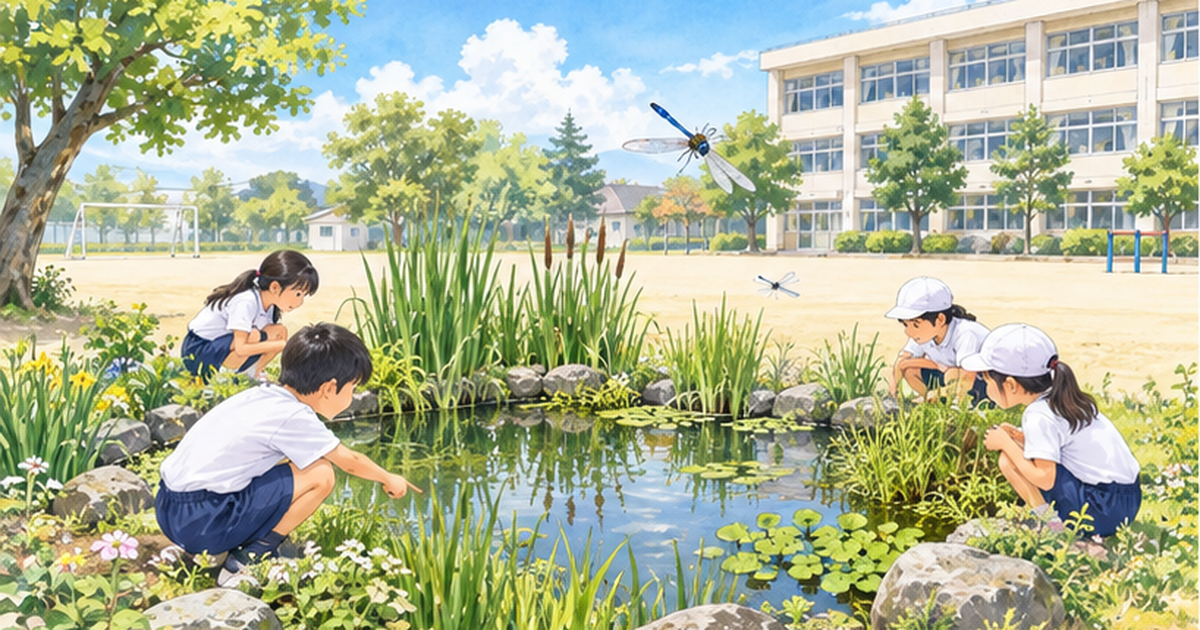
In a corner of a concrete-covered schoolyard, a small pond or wetland is quietly alive. Known as a "school biotope," this kind of waterside space has spread to elementary, junior high, and high schools across Japan as a place where children can step out of the classroom and meet living creatures right away.
The word "biotope" combines the Greek words for "life" (bios) and "place" (topos), referring to a coherent habitat space where specific organisms can live. It is said to have been proposed by the German zoogeographer Friedrich Dahl, and spread in Germany in the 1970s alongside rising concern over environmental problems. In Japan too, from the late 20th century onward, boards of education and local governments across the country began creating ponds and grasslands in schoolyards and on rooftops.
However, digging a pond and filling it with water does not make living creatures gather right away. It takes time for the water quality to stabilize, for insects and birds to arrive from the surroundings, and for plants to take root. And even after completion, if left unattended, a biotope can fall into disrepair within a few years. This article traces the process from the administrative push of the Eco-School system, through how creatures actually return to a newly built pond, to the ongoing work of maintaining it afterward — using concrete cases from Kawasaki, Musashino, and Minato.
What you'll learn from this article
- The definition of a school biotope and how the German-born concept spread into Japanese education
- How administrative systems such as the Eco-School certification support schools' waterside projects
- The concrete process by which creatures come to settle after a pond or wetland is built
- Ways to keep up maintenance after completion, and real examples of local-government support
- How a schoolyard pond is part of an ecological network connecting to local rice paddies and wetlands
What is a school biotope?
The definition of a biotope and its role at school
A biotope is a coherent habitat space where the plants and animals originally native to a specific area can live. A school biotope applies this concept to a corner of a school's grounds — the schoolyard or a rooftop — where a pond, wetland, grassland, or small woodland is artificially created. As industrialization and urbanization erase familiar waterside and green spaces, school biotopes have spread as an attempt to bring back a piece of that lost ecosystem within the school itself.
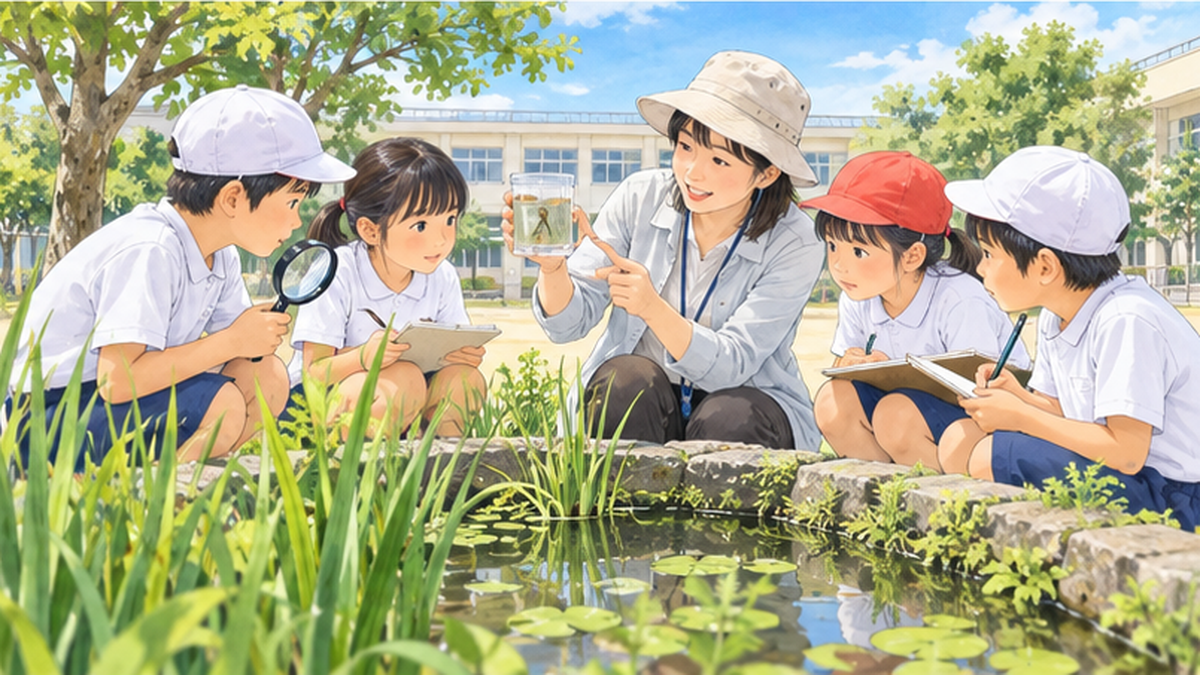
School biotopes serve two main roles. One is ecological restoration — securing habitat for plants and animals that are disappearing locally. The other is educational: giving children daily contact with nature, and nurturing rich sensitivity and curiosity through observation and care of living things. Musashino City's own introduction page states that the biotope experience "stimulates children's intellectual curiosity and nurtures spontaneous inquiry" and "cultivates the sense of nature and of the seasons that is part of Japanese culture."
Why put a wetland in a schoolyard?
The value of building a waterside space on school grounds goes beyond simply increasing the number of living creatures. It connects easily to integrated studies and science classes, and serves as an entry point for learning about the natural environment of the wider region.
- Being within easy reach of the classroom makes daily, continuous observation easier
- It fits naturally into science and integrated-studies curricula and can be used to teach the changing seasons
- Even within the limited space of a schoolyard, a small ecosystem can form once water, soil, plants, and creatures are all present
- It can become part of an "ecological network" connecting to local rice paddies, rivers, and park greenery
At the same time, if educational goals are prioritized too heavily and visual liveliness becomes the aim, there is a risk of bringing in creatures that do not naturally belong to the area. Conversely, pursuing pure ecological restoration too strictly can turn the space into something like an off-limits nature reserve that children hesitate to approach. In practice, most school biotopes are searching for an operating style suited to their own circumstances, balancing these two goals.
The origin of the word "biotope" and its legal roots
The word "biotope" itself is a coinage said to have been proposed by the German zoogeographer Friedrich Dahl, and it came into wide use in Germany in the 1970s as environmental problems grew more serious. Germany's Federal Nature Conservation Act, enacted in 1976, explicitly included the protection, maintenance, development, and restoration of biotopes, establishing a national legal framework to support ecosystem conservation.
This concept was introduced to Japan, and from the late 20th century (the 1990s) onward, various types of biotopes drawing on local nature — from tidal flats, wetlands, and rivers to woodlands modeled on satoyama — were built across the country. The school biotope can be positioned as one form this movement took when applied to the limited grounds of an educational facility.
The Eco-School system: an administrative push
What is Eco-School Plus?
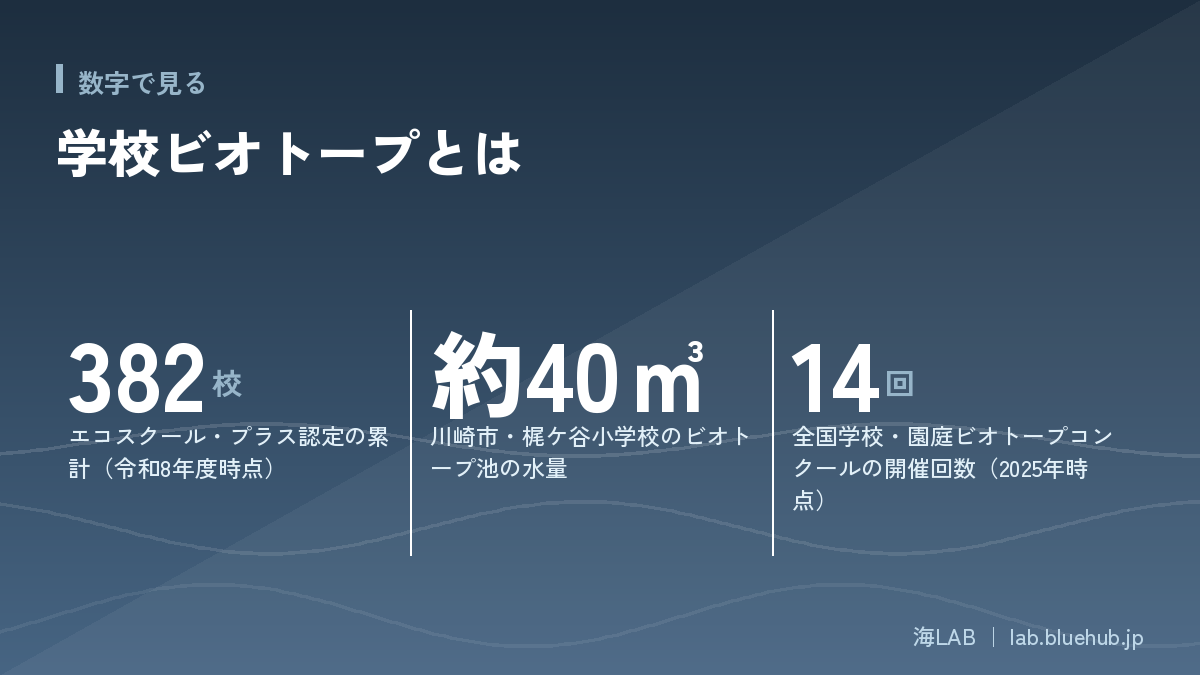
"Eco-School Plus" is the framework through which the national government supports the development of "environmentally considerate school facilities," which include school biotopes. It is jointly run by four ministries — the Ministry of Education, Culture, Sports, Science and Technology (MEXT), the Ministry of Agriculture, Forestry and Fisheries, the Ministry of Land, Infrastructure, Transport and Tourism, and the Ministry of the Environment — and certifies school facilities equipped with solar power, rainwater use, greening, and biotopes, among other features. Launched in FY2017, the program certified 37 new schools in FY2026, bringing the cumulative total to 382 schools.
What 382 cumulative schools show, and what came before
Eco-School Plus's predecessor, the "Eco-School Pilot Model Project," ran from FY1997 (Heisei 9) through FY2016, and certified a cumulative 1,663 schools. While the scope and certification criteria differ between the two periods, this shows that environmentally considerate school facility development has continued for nearly 30 years, from the late 1990s to today. Biotopes have been one of the facility features adopted by many certified schools throughout that time.
| Program name | Period | Administered by | Cumulative certifications |
|---|---|---|---|
| Eco-School Pilot Model Project | FY1997–FY2016 | MEXT and others | 1,663 schools cumulative |
| Eco-School Plus | FY2017–present (current program) | Joint program of MEXT, MAFF, MLIT, and the Ministry of the Environment | 382 schools cumulative (FY2026) |
Certification is a support system, not a requirement
Many schools build and run biotopes on their own without ever receiving Eco-School certification. The certification system is a mechanism that makes it easier to access financial and technical support — it is not a prerequisite for building a biotope.
A biotope is one menu item among several
The "environmentally considerate school facilities" targeted by Eco-School Plus are not limited to biotopes. Solar power systems, rooftop and wall greening, rainwater storage tanks, and school buildings with improved insulation are among the multiple elements eligible for certification, all contributing to energy savings or environmental education. Among these, the biotope stands out for its strength in environmental education through direct contact with living creatures — a different kind of contribution from capital-investment items like solar power.
Schools aiming for certification typically do not apply on their own; rather, plans are developed through the local board of education or facilities department, timed to coincide with new construction or renovation of the school building. Building or renovating a biotope is usually positioned as part of that larger facility plan rather than treated as a separate budget line. For an existing school that wants to add just a biotope later on, it is often more realistic to look outside the certification system — toward a local government's own environmental education budget, or a support program like Minato City's expert dispatch service.
Planning and designing a waterside space
Setting a basic policy: modeling on local native species
Practitioners involved in school biotopes repeatedly emphasize the importance of a "basic policy." Unlike ordinary landscaping aimed at making an attractive pond or flower bed, what determines whether something deserves to be called a biotope is whether it is modeled on the vegetation and creatures that originally lived in that area. Surveying what creatures live in nearby rivers, rice paddies, and woodlands, and setting a policy to recreate a waterside space true to that locality, is the first step.
Pond types and safety design
Several construction methods exist for the pond itself, chosen according to the size of the site, budget, and the maintenance system available. Because children approach the site daily, safety considerations such as water depth and fencing are also essential in the design.
| Pond type | Characteristics | Points to watch |
|---|---|---|
| Concrete/mortar | Durable, with great freedom of shape | Higher initial cost; can look artificial, requiring extra effort to help plants take root |
| Waterproof sheet (liner) | Relatively easy to install and can keep costs down | Watch for the sheet degrading or tearing over time; needs regular inspection |
| Natural infiltration / clay ground | Makes use of the local soil as-is | Water level can be unstable, making level management during dry spells a challenge |
Safety considerations
- Keep the water shallow to reduce the risk of falls and drowning
- Avoid steep edges or slippery stonework, and secure stable footing for observation
- Set clear rules in advance so that younger children do not approach the pond unsupervised
Thinking about water sources and plant selection
The water source also needs to be decided at the design stage. Using tap water as-is requires time to let the chlorine dissipate, while relying on a rainwater tank means preparing for water-level drops during dry spells. Some schools, like Kajigaya Elementary, dig a well to secure a stable flow of water — the water source is chosen to fit the site's specific conditions, sometimes combining more than one source.
The aquatic plants chosen also matter. Selecting them purely for visual appeal risks introducing non-native species. It is preferable to prioritize native emergent and floating-leaf plants that actually grow in nearby rivers and rice paddies, and to make selections with advice from local landscaping professionals or nature-observation instructors.
What matters most is the "basic policy."
— Hiroyuki Kawakita, "What Exactly Is a School Biotope? Part 2" (note.com)
This point matters most when weighing construction costs and schedules. If the policy is left vague and the work is simply handed to a contractor, the result tends to be a generic, off-the-shelf-looking pond, and it becomes difficult to add a sense of "local character" afterward. Putting into words, at the design stage, what kind of waterside space the school is aiming for — with teachers, parents, and local nature-observation groups involved — ultimately leads to a build with fewer costly do-overs.
The first year: from filling the pond to welcoming creatures
Digging, waterproofing, and filling: the basic steps
Once the design policy is settled, actual construction begins. The general flow has much in common with building a small waterside feature at home.
- Digging: excavate to the planned shape and depth
- Waterproofing: create a layer with concrete or a waterproof sheet to prevent leaks
- Placing soil, gravel, and stones: create the unevenness that gives creatures places to hide and lay eggs
- Filling with water: fill the pond and let it sit for several days to a week so water quality and chlorine settle
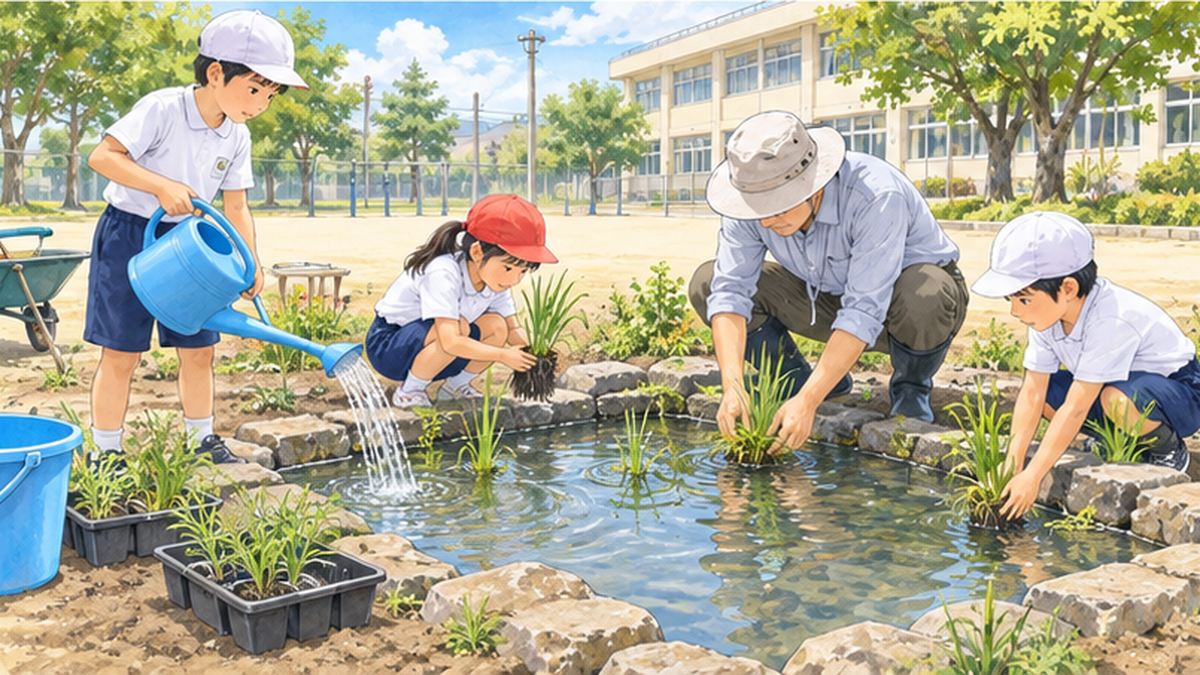
- Planting aquatic plants: plant mainly native species, including emergent and floating-leaf plants
- Introducing and watching over creatures: add a small number of creatures, such as medaka killifish, and wait for others to arrive naturally
Introducing a wide variety of creatures immediately after filling the pond can kill them off due to sudden water-quality changes or an unbalanced environment. First letting the water and plant environment settle, then gradually welcoming creatures, is an order of operations emphasized consistently — whether for a small home waterside feature or a school pond.
The first creatures to arrive
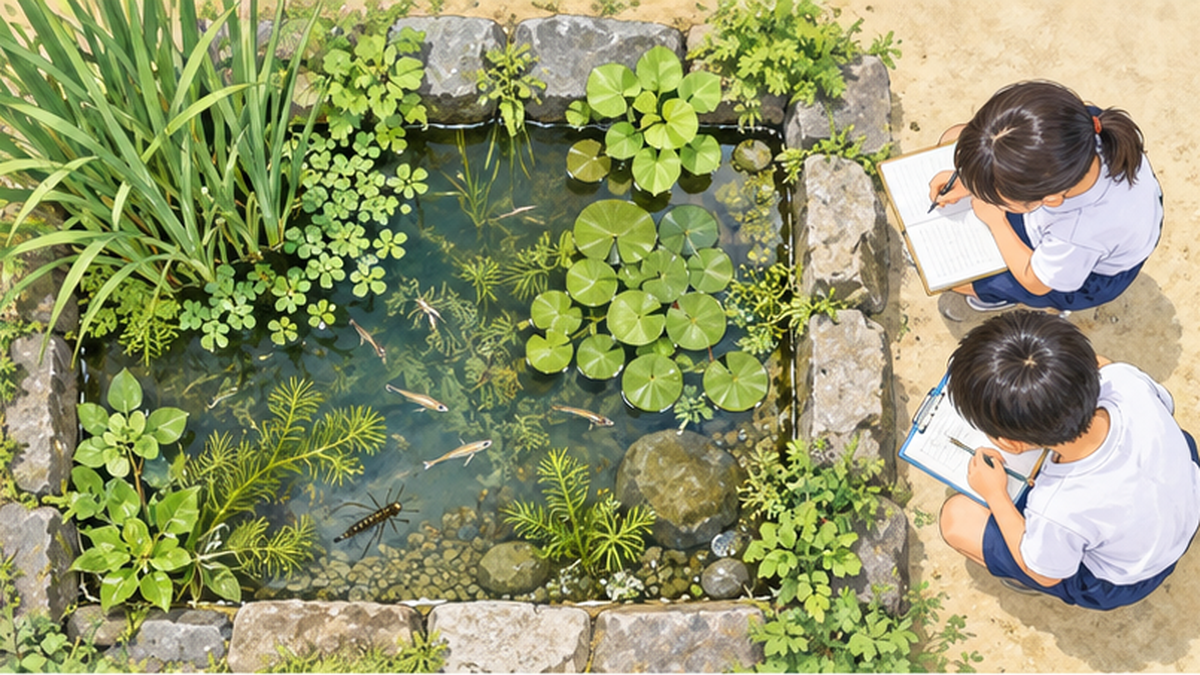
Once the pond is complete and a water surface exists, creatures start arriving on their own, without anyone bringing them in. Water striders skimming the surface and adult dragonflies flying above the water are typical examples. Dragonflies lay eggs on the water's surface, and by the following year, nymphs can be found. The presence of these creatures that arrive "under their own power" — flying in on their own wings — is itself evidence that, even within the confined space of a schoolyard, an ecosystem connected to the surrounding environment is beginning to function.
Before visible creatures increase, there is a stage in which microorganisms and plankton develop in the water, gradually stabilizing water quality and oxygen levels. Only once this foundation is in place do visible creatures — shellfish, aquatic insects, and the fish and frogs that feed on them — join in turn. The reason a newly built pond can look like it is in a "quiet period" for the first few months to a year is that this invisible change is happening first.
As explained on Kawasaki City's own page, continuing an annual survey of a completed biotope makes it possible to keep a record of how the types and numbers of creatures change over time. This record serves as material for management decisions — such as noticing the arrival of invasive species or changes in rare species — and for students, it becomes a learning achievement in its own right: a history of the pond that they have built up with their own hands.
Living with drought and heavy rain
A completed pond keeps being affected by day-to-day weather. If the water level drops too far during a hot summer break, creatures may be at risk of drying out; conversely, if heavy rain from a typhoon causes the pond to overflow, muddy water can spill beyond the level assumed in the original design. Building seasonal checkpoints into the management manual from the planning stage — such as assigning someone to check the pond during long school breaks, or checking water level and turbidity before and after heavy rain — makes it easier to respond to sudden trouble.
A record of creatures settling in: the case of Kajigaya Elementary, Kawasaki
The revival of the "Secret Base of Living Things"
Behind the school building at Kawasaki Municipal Kajigaya Elementary School lies a biotope pond holding about 40 cubic meters of water. It was originally donated in 2003 as a commemorative project for the school's 20th anniversary, but over the years the pump broke down, the water stopped flowing, and the pond fell into disrepair. In December 2009, the pond was reconstructed by the students themselves: first-graders rescued the creatures still living in the pond, then hand-dug a well upstream to replace the broken pump and restore the flow of water. After its revival, the pond was named the "Secret Base of Living Things" ("Ikimono Himitsu Kichi") by student vote.
Check the primary sourceSchool Biotope Introduction: Kajigaya Elementary | Eco City Takatsu (Kawasaki)A government page describing the revival of the "Secret Base of Living Things" and the creatures recorded there.🔗 city.kawasaki.jpCreatures that have been recorded
In the revived biotope pond, the following creatures have been recorded.
- Medaka killifish, pond snails
- Nymphs of several dragonfly species, including the black-and-yellow darner (Anax parthenope) and the scarlet skimmer group
- Japanese common toads and Japanese five-lined skinks
- Butterflies (including activities in which students search for the host plants their larvae prefer)
- Water striders
In third-grade science classes, the pond is used four times a year, once each season, as a place to observe how the creatures change. The school also runs a separate "Operation Pool Nymph Rescue," held in FY2017 and FY2018, in which dragonfly nymphs that had grown in the school's swimming pool were rescued before the pool was cleaned — giving students, across both the biotope pond and the pool, opportunities to engage with the seasonal changes of living creatures. What stands out about this case is that a single pond has remained a science-education resource spanning multiple grade levels for more than a decade since its reconstruction.
What the Kajigaya Elementary record shows is that, viewed over a decade or more, even a single pond's role gradually changes. A pond that began as a donated commemorative gift, after going through a crisis of disrepair and pump failure, became something students themselves rescued and rebuilt — shifting from a mere object of observation to "a place we protected ourselves." The history of its management has itself become part of the teaching material.
The long work of maintenance after completion
Not letting it end with construction
Practitioners of school biotopes consistently point out that the real challenge lies not in construction but in what comes after: maintenance. Because a biotope condenses an entire ecosystem into a small space, leaving it untended can cause certain plants to overgrow and cover the pond, or allow invasive species to move in and crowd out native ones — and the balance can collapse in a short time. Where a policy of avoiding herbicides and pesticides is followed, thinning overgrown plants and removing invasive species essentially has to be done by hand.
If you leave it alone, things get bad.
— Hiroyuki Kawakita, "What Exactly Is a School Biotope? Part 2" (note.com)
This warning is not an exaggeration. A small pond holds far less water than a natural water body and has almost no external buffer, so even a small delay in maintenance can quickly lead to worsening water quality or an unchecked bloom of a single species. Given the nature of schools as institutions, staff turnover at the start of each school year is unavoidable. That is precisely why it makes sense not to rely solely on individual enthusiasm, but to prepare handover documentation and a system involving people across multiple years as a practical measure for sustaining maintenance.
The risk of maintenance breaking down
- When the teacher in charge is transferred, management methods and know-how may fail to be passed on, and the pond can fall into disrepair
- Water-level management and plant upkeep during long breaks like summer vacation are easy to neglect
- If the pond's role as "integrated-studies teaching material" fades, it tends to slip in priority and get put off
Local-government support: the case of Minato City
To ease this ongoing maintenance burden, some local governments support school biotopes by dispatching experts. Tokyo's Minato City runs a "School Biotope Support Program," dispatching experts from its Environment Division to public and private schools, kindergartens, and nurseries alike that manage a biotope.
- Guidance for managers: advice on biotope maintenance and management methods
- Observation sessions for children: surveys and observation events for the creatures within the biotope
- Study sessions for instructors: environmental-education training for childcare workers and teachers
In FY2025, the program provided manager guidance to 3 facilities, observation sessions for children to 6 facilities, and study sessions for instructors to 2 facilities. It is a system in which local government works alongside schools to support maintenance work that a school alone often struggles with due to a lack of specialized knowledge or staff.
A good fit with "schools open to the community"
People long involved in school biotope practice also point out that biotopes fit well with the theme of "schools open to the community." Rather than simple greening, it is important to carefully set a "basic policy" of planting trees and flowers modeled on the local natural vegetation — and the warning that neglecting maintenance leads to a pond falling into disrepair is repeated again and again. Rather than a school shouldering everything alone, loosely sharing the management workload with parents, local volunteers, and outside experts is a realistic option for keeping a biotope going over the long term.
A place of learning: classes and a nationwide contest
Use in integrated studies and science classes
As with the seasonal observation work done in Kajigaya Elementary's third-grade science classes, biotopes are used as teaching material in science, life studies, and integrated-studies classes. Observing the same location throughout the four seasons lets students experience, first-hand, an annual cycle of creatures emerging, growing, and overwintering — a kind of value that is hard to get from a textbook alone. Musashino City had equipped all 12 of its municipal elementary schools with biotopes by FY2005, building a system for environmental education used across every school.
The National School & Kindergarten Biotope Contest
To connect these individual school efforts and honor outstanding examples, the Japan Ecosystem Association (a public interest incorporated foundation) hosts the "National School & Kindergarten Biotope Contest." Begun in 1999 and held once every two years, the contest reached its 14th edition in 2025. Schools, kindergartens, and nurseries bring their own biotope initiatives, and awards including the Minister of the Environment Award are given out. In the 2023 contest, Gunma Prefectural Fujioka Kita High School received the top honor, the Minister of the Environment Award.
Check the primary sourceNational School & Kindergarten Biotope Contest | Japan Ecosystem AssociationOfficial site for the contest, held since 1999 every two years, with a list of past award winners.🔗 biotopcon.orgHaving a "stage" like the contest to present on also helps sustain motivation for the day-to-day work of observation and maintenance. Learning about other schools' efforts also becomes an opportunity to share ideas about construction and management.
The National School & Kindergarten Biotope Contest originally began in response to requests from the field — "please introduce us to good examples" — around the time biotopes started being taken up in elementary-school integrated studies. The reason this contest has continued for so long lies in how it has connected what tends to be closed, school-by-school biotope activity to a nationwide stage for presentation and sharing.
The very process of putting together contest application materials becomes a learning opportunity for students. Looking back and organizing what creatures were observed and when, and what maintenance work was done and when, is an exercise that reframes students' own activities on a longer timescale than any single observation session. Regardless of whether a school wins an award, the process of revisiting records for the application has value in itself.
How a schoolyard pond connects to the local ecosystem
Musashino City: choosing to equip every school
In many municipalities, one school takes the lead in building a biotope, and the practice gradually spreads to other schools from there. Musashino City, by contrast, took the approach of equipping all 12 of its municipal elementary schools with biotopes by FY2005. Rather than stopping at individual efforts school by school, this reflects a stance of raising the baseline for environmental education across the entire city.
A network with rice paddies and wetlands
A schoolyard biotope is not a facility that is complete in itself. As shown by the natural arrival of dragonflies and butterflies, it also serves as a "relay point" for creatures moving to and from nearby rice paddies, wetlands, and rivers. Across Japan there are already initiatives that treat rice paddies as artificial wetlands nurturing living creatures — as described in our article on the creatures of Japan's rice paddies — as well as places that make use of the power of wetlands registered under the Ramsar Convention to purify water and sustain life, as covered in our piece on Japan's Ramsar wetlands. A small schoolyard pond, too, can be understood as sitting at the far end of this kind of regional waterside network.
Japan, for instance, is home to more than 200 dragonfly species, and as described in our article on dragonflies in Japan, rice paddies and irrigation ponds support the life of their nymphs. The dragonflies that arrive at a school biotope, too, only reach the schoolyard because of this broader regional habitat. Put another way, an increase in schoolyard ponds means one more "stepping stone" habitat for local dragonflies and butterflies. As with the case of the rice paddies of Sado Island that have long supported the crested ibis, the idea of deliberately preserving room for other living creatures within human living spaces is a shared thread, regardless of scale.
Seeing a schoolyard biotope as part of a "surface," not a single "point"
A single school's pond may look small on its own, but seen together with local rice paddies, wetlands, and rivers as a "surface," it becomes part of an ecological network that survives within the city. When discussing the value of a school biotope, it is worth keeping this regional connection in view.
A role that matters more in urbanized areas
In municipalities that have urbanized further, such as Musashino City and Minato City, school grounds are increasingly likely to be one of the few remaining substantial patches of green and water left in the area. In places where housing development has reduced the familiar rice paddies and woodlands nearby, a school biotope is often the first "real" waterside space children ever encounter. Even within the limited space of a schoolyard, securing a place for living creatures within a city points in the same direction as the conservation of tidal flats and wetlands.
For those who will get involved from here
What schools and communities can do
For a school that already has a biotope, it is worth first checking the current management setup and keeping records — construction date, plants used, a list of creatures observed — that can be handed over even if the responsible staff member changes. For those building one for the first time, it helps to start from the following points.
- Survey what creatures live in nearby rivers, rice paddies, and park greenery beforehand, and set a policy for a waterside space that reflects the local area
- Check whether programs such as Eco-School Plus, or a local government's expert-dispatch program, are available to use
- Avoid bringing in a wide variety of creatures right after construction; wait for the water and plant environment to settle first
- Build it into the science and integrated-studies curriculum, and create opportunities for continuous observation
- Look into other schools' practices, such as through the National School & Kindergarten Biotope Contest
The meaning of keeping records
The reason the Kajigaya Elementary and Musashino City cases remain accessible today is that the history of construction and the creatures observed were written down and preserved, whether on a government webpage or in a school's own records. The steady accumulation of daily observation notes and photographs becomes the material that lets people describe the value of a place ten or twenty years later. For anyone getting involved going forward, building a habit of keeping records — rather than making flashy capital investments — is the foundation for sustaining a biotope over the long term.
What the Kawasaki, Musashino, and Minato cases introduced in this article have in common is that none of them treated construction as a one-time event: each accumulated records over many years, and at times the students themselves carried out reconstruction. The practice of maintaining a waterside space that reflects the local nature, even within the confined space of a schoolyard, may not change the global ecosystem in any large way. But the experience of feeling a connection to nature through a single, familiar pond will likely continue to quietly shape how those children relate to the environment once they become adults.
Small waterside spaces you can make at home
You don't need a school-scale biotope to create a small waterside space at home, using a planter or a water-lily tub. Filling it with water and letting it sit for several days to a week so the water quality settles, then starting with just a few medaka killifish, follows the same basic steps as building a school pond. Even a small tub on a balcony can, over time, attract water striders or wild birds. Just as with a schoolyard's waterside space, the experience of nurturing a small ecosystem in a familiar place can be started at home too.
A school biotope is not something that is finished the moment construction ends. After a quiet period following the filling of the pond, creatures gradually settle in, and even as the people responsible for management change over time, it becomes part of the schoolyard's scenery over a span of ten or twenty years. What the cases of Kawasaki, Musashino, and Minato show is that what sustains that long span of time is students' daily observation, along with the steady, shared work of management divided among schools, local governments, and communities.
A first step
- Observe a nearby rice paddy, pond, or river and try recording what creatures you find
- If your school or community has a biotope, look into who manages it and whether it takes part in any contest
- Try building a small waterside space on a balcony or in a garden, and record how it changes as creatures arrive
References & Sources
- Ministry of Education, Culture, Sports, Science and Technology, and other ministries – Eco-School certification results
- Kyoiku Katei Shimbun (Education & Family Newspaper) – "343 schools now certified under Eco-School Plus"
- Musashino City – "Part 4: Schools with Biotopes"
- Kawasaki City (Eco City Takatsu) – School biotope introduction: Kajigaya Elementary
- Kawasaki City (Eco City Takatsu) – What is a biotope?
- Minato City – School Biotope Support
- Japan Ecosystem Association (public interest incorporated foundation) – National School & Kindergarten Biotope Contest
- Jomo Shimbun (online edition) – "Gunma's Fujioka Kita High School wins top Minister of the Environment Award at the National School & Kindergarten Biotope Contest"
- National Institute for Environmental Studies, Environment GIS – "Biotope" environmental technology explainer
- Hiroyuki Kawakita (note.com) – "What Exactly Is a School Biotope? Part 2"
※ Listed in order of reliability: government/academic institutions > peer-reviewed papers > specialist organizations > reliable media