⚡ The answer in 30 seconds
- Seabird conservation means protecting recovering species like the albatross while reducing threats from plastic, bycatch and invasive species.
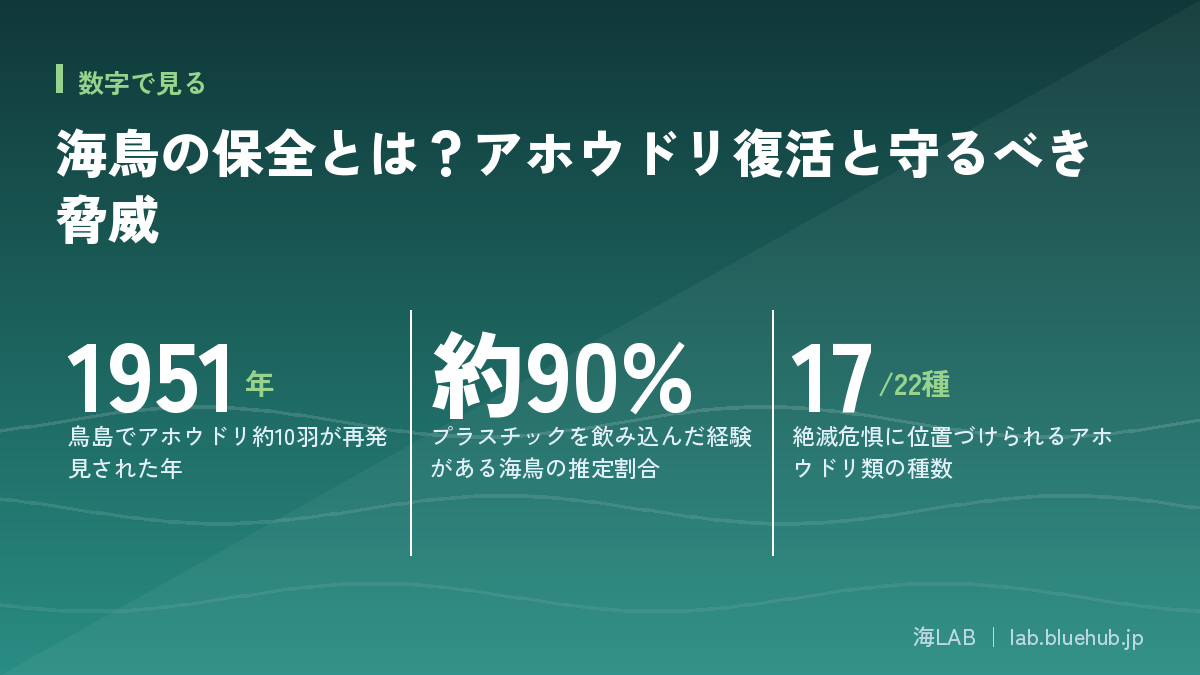
- The Short-tailed Albatross was rediscovered in 1951 and, after decades of conservation, the Torishima population is reported to exceed 9,500 birds.
- About 90% of the world's seabirds are estimated to have swallowed plastic.
- Cutting plastic waste and choosing sustainable seafood in daily life helps protect seabirds.
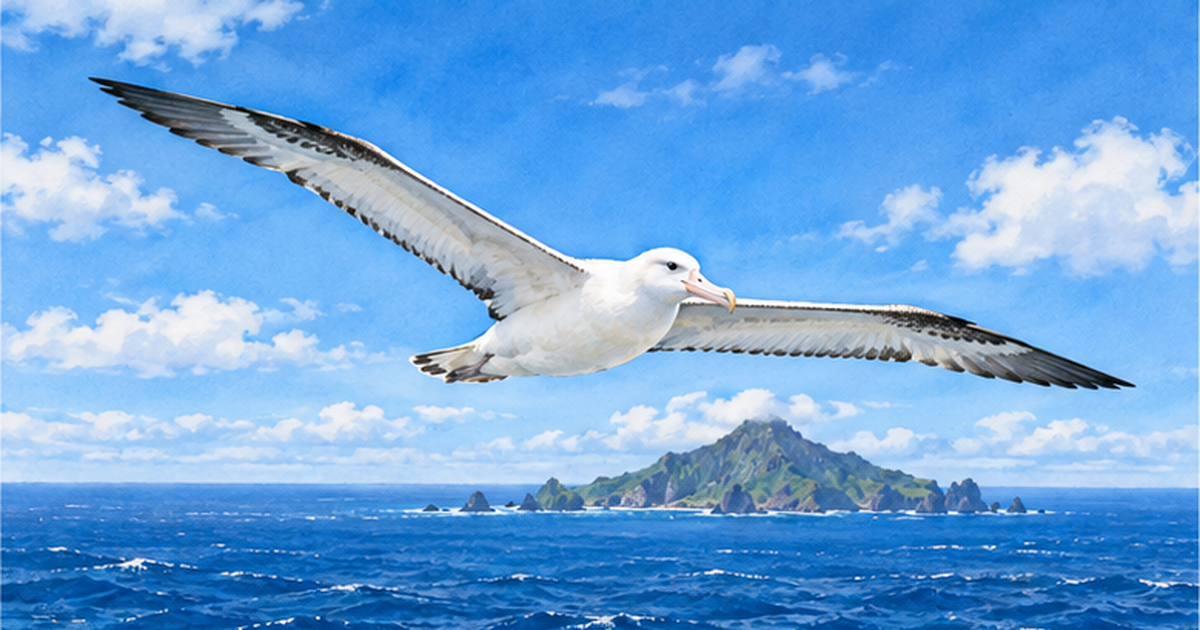
The albatross, with its huge wings, was once reported extinct, yet it returned thanks to rediscovery and long-term conservation. Its story shows that people can help nature recover.
Yet seabirds still face mounting problems: swallowing plastic debris, bycatch in fishing gear and invasive species on their breeding islands. Seabirds are also indicators of ocean health, and their plight tells us about the state of our seas.
This article traces the albatross's recovery and the threats facing seabirds, and what each of us can do, based on public agencies and research papers.
What you'll learn in this article
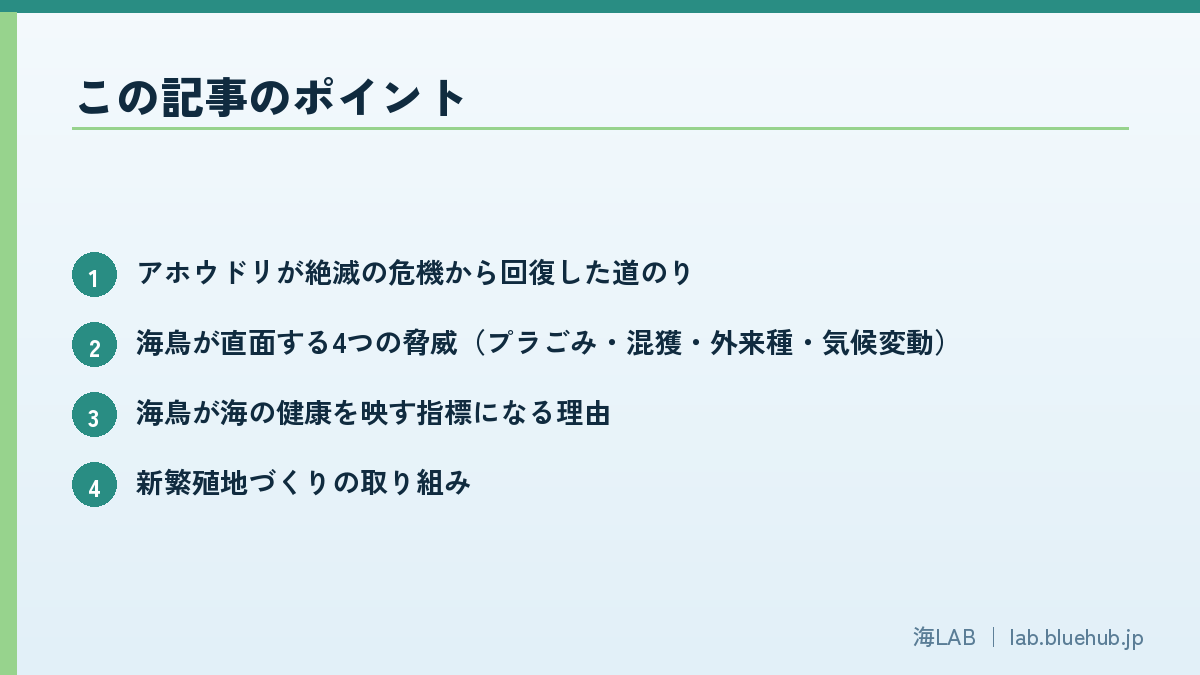
- How the albatross recovered from the brink
- The four threats seabirds face (plastic, bycatch, invasive species, climate change)
- Why seabirds reflect the health of the sea
- Efforts to create new breeding sites
- Everyday actions you can take
What are seabirds? Linking sea and land
Definition and lifestyle
Seabirds spend most of their lives at sea and feed on marine life. They include albatrosses, shearwaters, murres, auklets, boobies and black-tailed gulls, and several hundred species are known worldwide. Most come ashore only to breed, mainly on remote islands with few predators, and spend the rest of the year traveling thousands of kilometers over the open ocean.
Some albatrosses have wingspans over two meters and can glide for hours without flapping, which lets them find scattered food across vast seas. But they usually lay just one egg, and raising a chick can take nearly half a year, so their numbers grow very slowly.
How being long-lived and slow-breeding becomes a weakness
Many seabirds live long and take several years to nearly a decade to mature. Because they raise few young over a long breeding life, accidental deaths of adults hit the whole population hard. This is why bycatch and invasive species, described below, can be so damaging.
Key points about seabirds
- Spend most of their lives at sea and come ashore only to breed
- Usually raise only one chick per breeding attempt, so recovery is slow
- They travel across wide seas, so protection by one country alone is not enough
Carriers of nutrients between sea and land
Seabirds bring food from the sea to their islands and supply nitrogen and phosphorus to the land through droppings, regurgitated food and carcasses. Studies in many places report that plants grow well in breeding colonies and that insects and soil organisms are richer too. Seabirds are quiet links that let marine nutrients support land ecosystems.
Main groups of seabirds
It helps to sort seabirds into a few big groups. Albatrosses, shearwaters and storm-petrels belong to the order Procellariiformes; they live on the open ocean and are good at finding food by smell. Gulls and terns are often seen along coasts, including Japanese harbors. Murres and auklets swim underwater with their wings, chasing fish. Penguins are also seabirds in a broad sense, having developed diving ability instead of flight.
Japan stretches north to south and sits where the Kuroshio and Oyashio currents meet, so it hosts everything from northern murres to subtropical boobies. Many island breeding sites are designated as natural monuments or national parks and serve as the front line of conservation.
Seabirds around the world today
Assessments by BirdLife International and others indicate that seabirds are among the bird groups with the highest share at risk of extinction. Besides being long-lived and slow-breeding, they are affected by human activities at both breeding islands and ocean feeding grounds. Land birds can often be saved by protecting habitat, but seabirds cross borders, so international cooperation is essential. The international Agreement on the Conservation of Albatrosses and Petrels (ACAP) was created for this reason.
The albatross story: from feather hunting to rediscovery and recovery
Overhunting since the Meiji era and the 'extinct' report
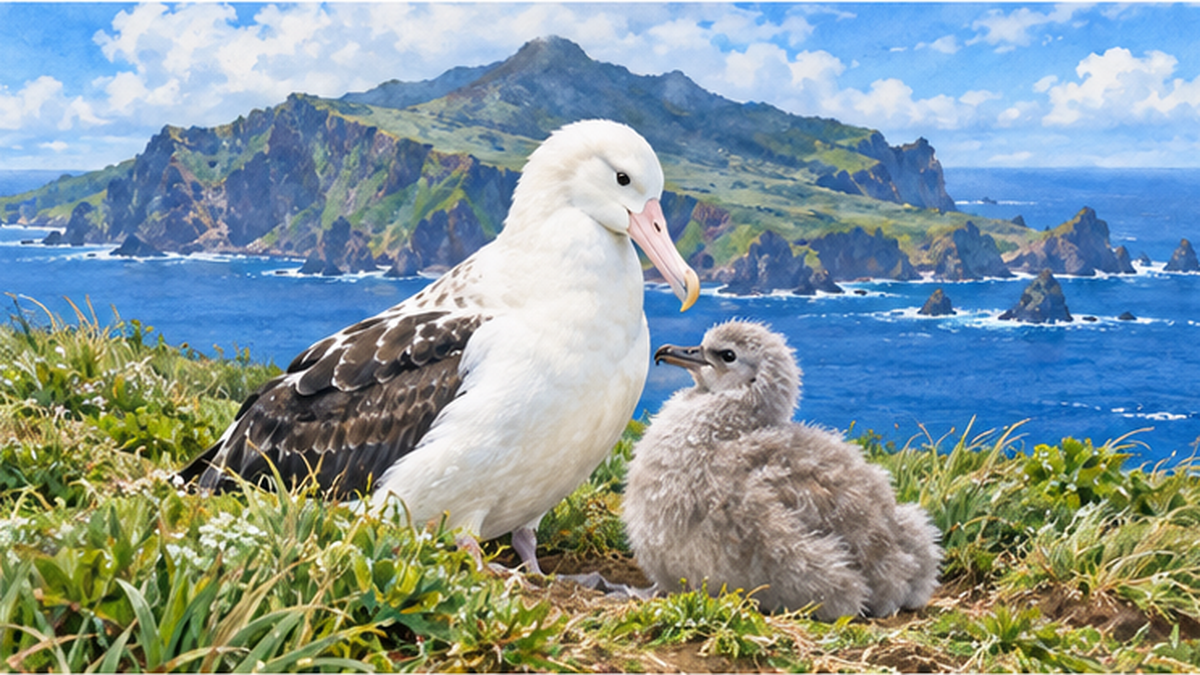
Japan's main albatross breeding site was Torishima in the Izu Islands. From the Meiji era on, birds were taken in huge numbers for the overseas feather trade, with losses estimated at millions. A volcanic eruption on Torishima in 1939 added to the decline, and in 1949 the species was reported as probably extinct.
Rediscovery in 1951 and Hiroshi Hasegawa's 42 years
In 1951, however, about 10 birds were rediscovered on Torishima, and Japan's conservation work began. From 1976, Hiroshi Hasegawa (later professor emeritus at Toho University) carried out surveys and conservation under the Yamashina Institute for Ornithology, continuing for 42 years until the 125th survey in November–December 2018.
Three phases: recovery, development and expansion
The conservation work is organized into three phases. The 'recovery phase' (1976–1991) improved slopes at the old breeding ground to stabilize nesting. The 'development phase' (1992–2007) created a new colony in a safer place and lured young birds to increase pairs. The 'expansion phase' (from 2008) spreads the species by moving chicks born on Torishima to the Ogasawara Islands and rearing them there.
| Period | Phase | Main efforts |
|---|---|---|
| 1976–1991 | Recovery | Improving slopes at the old colony and stabilizing nesting |
| 1992–2007 | Development | Luring young birds to a new colony to increase pairs |
| 2008– | Expansion | Hand-rearing chicks moved to Ogasawara and forming a new breeding site |
How far has the population recovered?
The estimated population passed 3,000 in 2012 and has kept growing. In the 2024–25 breeding season about 1,300 chicks fledged on Torishima, and the estimated Torishima population is reported to exceed 9,500 birds. A bird once called extinct has returned to the thousands through long-term human effort, a success story watched worldwide.
Why figures differ
Total albatross numbers differ between sources depending on what is counted: Torishima only, including the Senkaku Islands, breeding pairs, or all individuals. When quoting, check the year and the range of the figure.
Chick growth and parental care
Albatross chicks are fed by parents who regurgitate food gathered at sea. Parents travel for days, sometimes weeks, to distant waters and return to the nest in turns. Fledging takes about six months, and fledged young drift at sea for several years without returning to land. Only those that survive this long immature period join the breeding population, so recovery takes time.
Attraction with decoys and sound
To create new breeding sites, conservation teams set out albatross decoys and play calls to tell young birds that the site is safe. Birds tend to gather where others are, so this helps form colonies. The method is also used in seabird conservation worldwide.
Lessons from the history of overhunting
The sharp decline of the albatross shows the danger of using up a resource for short-term economic value. Millions of birds were lost for the temporary profit of feathers, and recovering the numbers has taken decades of steady effort. The lesson also applies to modern use of fish and forest resources.
Terms worth knowing
- Colony: a place where seabirds breed in groups
- Philopatry: the tendency to return to the birthplace to breed
- Decoy: a model used to attract birds
New breeding site on Mukojima, Ogasawara: preparing for volcanic risk
Why Torishima alone is risky
Torishima is an active volcano, and an eruption could wipe out the colony. Having breeding concentrated in one place is a major risk for the species, so a plan was made to create a second breeding site on a safer island.
Moving and hand-rearing chicks
From 2008 to 2012, chicks born on Torishima were moved to Mukojima in the Ogasawara Islands and reared by hand. Because chicks strongly return to where they fledged, the aim was to make them remember the new island as home.
Natural breeding after eight years
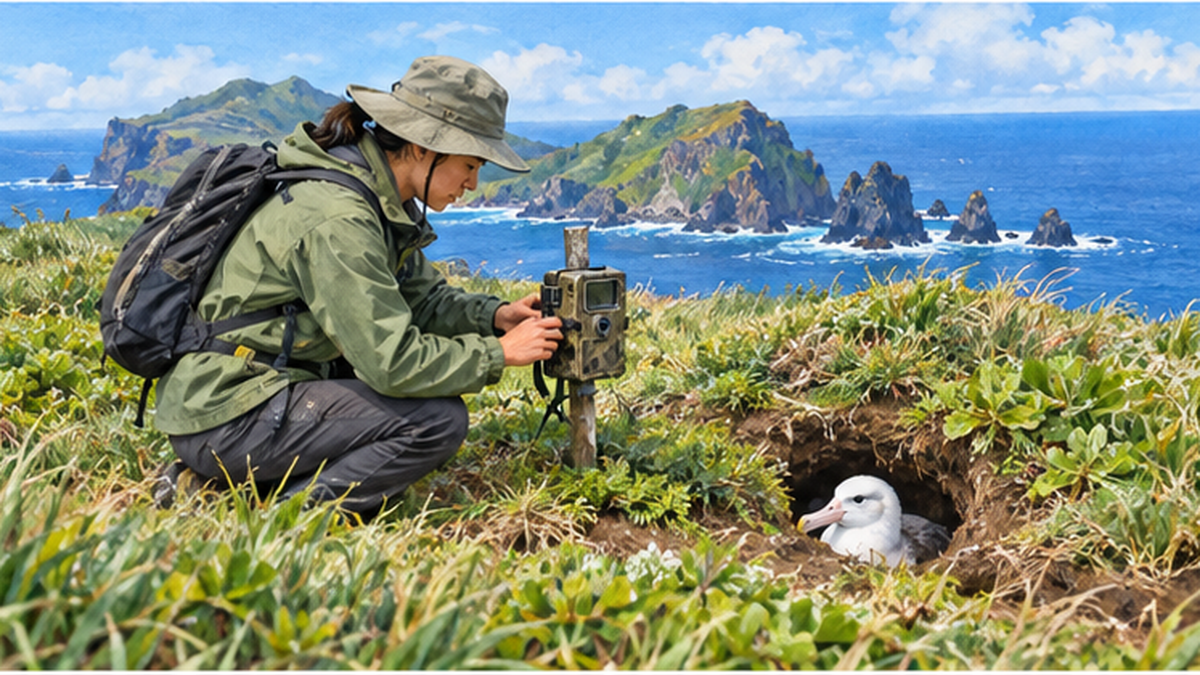
In 2016, eight years after the transfers began, the first chick born naturally on Mukojima was confirmed. Recently three chicks fledged in each of two consecutive years, so the new site is slowly taking root. Numbers are still small, and it will take a long time to become a stable population.
What conservation teaches us
- Long-term continuous surveys and dedicated people were the key to success
- Spreading risk by increasing the number of breeding sites is important
- Recovery takes decades
What a new breeding site means
A new site like Mukojima acts as insurance against losing everything to an eruption on Torishima. Breeding on several islands also spreads the effects of disease and extreme weather, and more sites help maintain genetic diversity.
The Ogasawara Islands and seabirds
The Ogasawara Islands are a precious World Natural Heritage site where many seabirds breed alongside endemic plants and animals. Measures against invasive species and rules for visitors protect nature across the islands, and creating the albatross site is part of this environmental conservation.
A challenge: numbers are still small
Fledglings on Mukojima number only a few a year in recent records. This is small compared with the over 1,000 on Torishima, but the fact that natural breeding has been established is itself major progress. The next challenge is to increase breeding pairs and grow a stable population.
Swallowing marine plastic: 90% of seabirds have eaten it
What a global study found
A 2015 study by Wilcox and colleagues in PNAS shocked the world. It estimated that about 90% of seabirds alive today have swallowed plastic, and that plastic has been confirmed in about 60% of species. If current trends continue, it predicted that 99% of species will be affected by 2050.
Ingestion was under 5% of individuals in 1960 but reached about 80% in 2010, rising rapidly in step with plastic production.
Why do they mistake it for food?
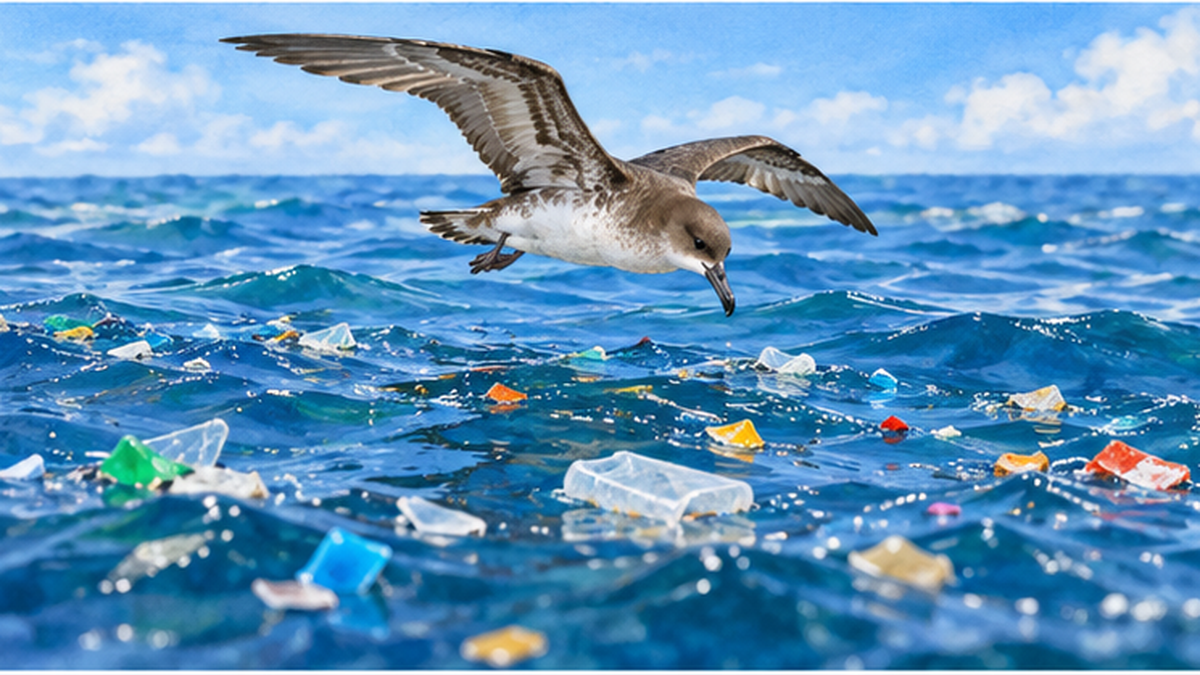
Seabirds are said to be attracted not only by the look of plastic but by its smell. Plastic floating at sea gets covered with algae, and the sulfur compound dimethyl sulfide it gives off may act as a cue that food is nearby. High ingestion rates have been reported especially in shearwater-type birds that find food by smell.
What happens inside the body
Swallowed plastic is not digested. It stays in the stomach, creating a false feeling of fullness and reducing food intake. It can injure or block the stomach and intestines, and parents pass it on to chicks by regurgitation. Over the long term, chemicals from plastic and poorer nutrition are concerns. For details, see our article on seabird plastic ingestion.
Effects on chicks
Food that parents collect at sea sometimes contains plastic. Large amounts of plastic have been found in the stomachs of chicks before fledging at breeding sites around the world.
Around Japan
The seas around Japan are known for high concentrations of microplastics, and Japan is among the countries with a large amount of debris washing ashore. Reducing single-use plastic and collecting waste from rivers and coasts also protects seabirds. For how plastic breaks down at sea, see plastic degradation in the ocean.
Microplastics and chemicals
Plastic in the sea is broken up by ultraviolet light and waves into microplastics under 5 mm. The smaller it gets, the more it is taken in by fish and zooplankton as well as seabirds, and it may accumulate in top predators through the food web. Plastic also readily adsorbs organic pollutants, and research is examining whether these are released inside animals that eat it.
Surveys at breeding sites
At breeding sites around the world, researchers examine regurgitated food and stomach contents of dead birds and record the amount and type of plastic. The results are shared internationally as a clue to the state of marine debris. Some seabird species are even used officially as indicators of marine litter in certain countries and regions.
Directions for solutions
The fundamental solution is to reduce the amount of plastic entering the sea. International talks on a plastic pollution treaty are under way, and Japan has introduced measures such as charging for plastic bags and the Plastic Resource Circulation Act. Both individual action and policy are needed to keep cutting leakage.
Three things you can do today
- Carry your own bag and bottle
- Refuse single-use straws and cutlery
- Sort and recycle bottles and packaging
Bycatch: the difficulty of coexisting with fisheries
What is bycatch?
Bycatch means catching unintended animals in fishing gear. For seabirds, a typical case is in longline fishing, where birds go for baited hooks, get hooked, and are dragged under and drowned. It also happens in gillnet and trawl fisheries.
Numbers on the impact of bycatch
Of the 22 albatross species, 17 are listed in threatened categories (Vulnerable, Endangered, Critically Endangered) on the IUCN Red List, and accidental death in fisheries is regarded as the most widespread cause of decline. Estimates suggest that high-seas longline fishing alone kills tens of thousands of seabirds each year.
| Measure | Description | Expected effect |
|---|---|---|
| Tori lines (bird-scaring lines) | Towing long streamers from the stern to keep seabirds away from hooks | Reduces approaches by birds going for bait |
| Night setting | Setting hooks at night when seabirds are less active | Reduces bycatch of daytime-active seabirds |
| Weighted lines | Adding weights so hooks sink quickly | Shortens the time hooks stay near the surface |
| Offal and discard management | Avoiding dumping waste overboard | Reduces attraction of birds to vessels |
Japan's fisheries and measures
Japanese distant-water tuna longliners have introduced bycatch mitigation such as tori lines at the request of international fisheries management bodies. Many measures are low-cost and effective, and cooperation from fishers and spreading the techniques are key. For sustainable fisheries, see also overfishing and stock collapse and food use of bycatch fish.
What consumers can do
- Choose seafood certified by schemes such as MSC
- Support fisheries that work on bycatch measures
- Take an interest in where and how your fish was caught
Frameworks for international cooperation
Seabird bycatch crosses borders, so international frameworks address it. The Agreement on the Conservation of Albatrosses and Petrels (ACAP) and regional fisheries management organizations (RFMOs) ask members to adopt mitigation measures. Japan is involved in these measures through tuna fisheries management bodies and others.
Advances in technology
Attaching small transmitters to seabirds shows which waters overlap with fishing vessels. This helps identify high-risk areas and seasons so measures can be focused there. Trials of recording bycatch with onboard cameras and analyzing it with AI have also begun.
Protecting together with fishers
Bycatch measures will not last if they only burden fishers. Sinking hooks quickly can reduce lost bait and even improve catch efficiency in some cases. Fishers and researchers working together to find practical methods leads to coexistence of conservation and fishing.
Invasive species at breeding sites: rats, cats and goats on islands
Ground-nesting birds are defenseless
Many seabirds evolved to nest on the ground or in burrows on islands without predators. They therefore have almost no defense against introduced mammals such as rats, cats, pigs and goats. Eggs and chicks are eaten, and goats can strip vegetation and destroy burrows.
Rats as a cause of extinction
Island studies show that rats are among the biggest causes of seabird extinction and endangerment, with estimates that rats were involved in about 60% of seabird extinctions. The black rat, brown rat and Pacific rat are considered the most damaging invasive rats.
Examples of removal and recovery
Eradication projects removing rats and cats from islands have been carried out around the world, and many cases have reported seabird breeding recovering afterward. Japan is also working on invasive mammal control on remote islands. For the bigger picture, see invasive marine species.
Things to keep in mind
- When visiting islands or seabird colonies, do not carry living things or seeds on baggage or shoes
- Do not bring pets or plants to islands
- Follow local rules and guides
Cats, goats and other invasive species
Besides rats, feral cats are known to have caused great damage to seabirds on remote islands. Control of feral cats is under way on the Ogasawara Islands, Amami-Oshima and elsewhere. Goats strip vegetation and destabilize the ground, sometimes collapsing the burrows of storm-petrels and other birds.
The difficulty of eradication
Eradicating invasive species from an island needs thorough work over a wide area and is costly, but once it succeeds the effects last. Invasive mammals have been successfully eradicated from hundreds of islands worldwide, and seabird recovery has been confirmed in many places.
The idea of biosecurity
Eradication is pointless if animals invade again. Biosecurity, a system to keep rats and others from landing from ships and cargo, is therefore important. Basic measures such as checking baggage before traveling to an island and fitting rat guards to ships are effective.
The role of seabirds as indicators of the marine environment
Why they work as indicators
Seabirds sit high in the food chain, eating fish, squid and zooplankton. When the amount or distribution of prey changes, it shows quickly in breeding success and body condition. Counting nests and chicks at breeding sites lets us track the state of a wide sea continuously at relatively low cost.
Examples of monitoring
Long-term records of seabird breeding success are used worldwide as clues to rising sea temperatures, changes in prey from fishing, and marine pollution. Research also analyzes stomach contents and feathers to examine accumulation of plastic, heavy metals and organic pollutants.
Relation to climate change
Changes in sea temperature shift where prey fish live and affect seabird breeding. Sea-level rise and high waves also threaten to flood nesting sites on low islands. For ocean warming, see ocean warming and changing currents.
Japanese seabirds as indicators
On Japan's islands, black-tailed gulls, streaked shearwaters and rhinoceros auklets breed in large colonies. Watching their breeding over many years lets us infer changes in prey around them. In years when prey fish are scarce, chicks grow poorly or more parents abandon breeding.
The potential of citizen science
Seabird monitoring also relies on citizens, not only researchers. Counting dead seabirds washed ashore and sharing bird-watching records provide valuable data on long coastlines. Even posting an observation can sometimes help conservation.
30by30 and seabirds
Under the international goal to conserve 30% of land and sea by 2030 (30by30), seabird breeding and feeding areas are candidates for important conservation targets. The idea of including important sea areas in protected areas based on seabirds' ranges is spreading.
What we can do: five actions to protect seabirds
In daily life
- Reduce single-use plastic and sort waste properly
- Join clean-ups of beaches and riverbanks
- Choose certified sustainable seafood
- Follow rules and manners when watching seabirds and keep away from nesting sites
- Take an interest in the work of seabird conservation groups and research institutes and share it
Manners when enjoying observation
Seabirds can be enjoyed easily from ferries, tour boats and coasts. At breeding sites, if a startled parent leaves its nest, eggs and chicks may be taken by predators or exposed to cold. Follow the rules and watch quietly from a distance.
Learning in schools and communities
Learning that combines beach clean-ups and seabird watching is a good chance for children to feel the connections of the sea. Counting and recording collected litter by type also becomes science learning about the local coast.
For the next generation
The albatross's return shows that conservation can bear fruit. That this success was supported by one researcher's 42 years of effort also teaches the value of persistence. For a future where the next generation lives with seabirds, what matters is that we learn, choose and act now.
Widening your learning
Albatross conservation began with one researcher's passion and recovered to the thousands with the support of government, research institutions and communities. Meanwhile, plastic, bycatch, invasive species and climate change still weigh heavily on seabirds worldwide. Even small individual actions matter when we, as people who share the sea, learn, choose and speak up.
Summary of this article
- The albatross recovered to the thousands after rediscovery and long conservation
- About 90% of seabirds are estimated to have swallowed plastic
- Bycatch and invasive species are serious threats to slow-breeding seabirds
- Seabirds also reflect the health of the sea
References and sources
- Yamashina Institute for Ornithology Albatross Newsletter No.1 – History of albatross conservation
- Yamashina Institute for Ornithology press release (June 2024) – Albatross breeding status
- Yamashina Institute for Ornithology – Information on albatross conservation
- Wilcox et al. (2015) PNAS – Global projection of plastic ingestion by seabirds
- ACAP (Agreement on the Conservation of Albatrosses and Petrels) – News on plastic ingestion
- ACAP: review of rat impacts on tropical islands – Invasive rats and seabirds
- IUCN Red List – Conservation status of albatrosses
- BirdLife International – Seabird bycatch mitigation
- Ministry of the Environment, Japan – Natural environment and protection of rare species
Ordered by reliability: government/academic institutions > peer-reviewed papers > specialized organizations > reputable media