⚡ The answer in 30 seconds
- Ship recycling is the process of dismantling retired ships and reusing their steel and other materials; how it is done has a major impact on the sea and on workers.
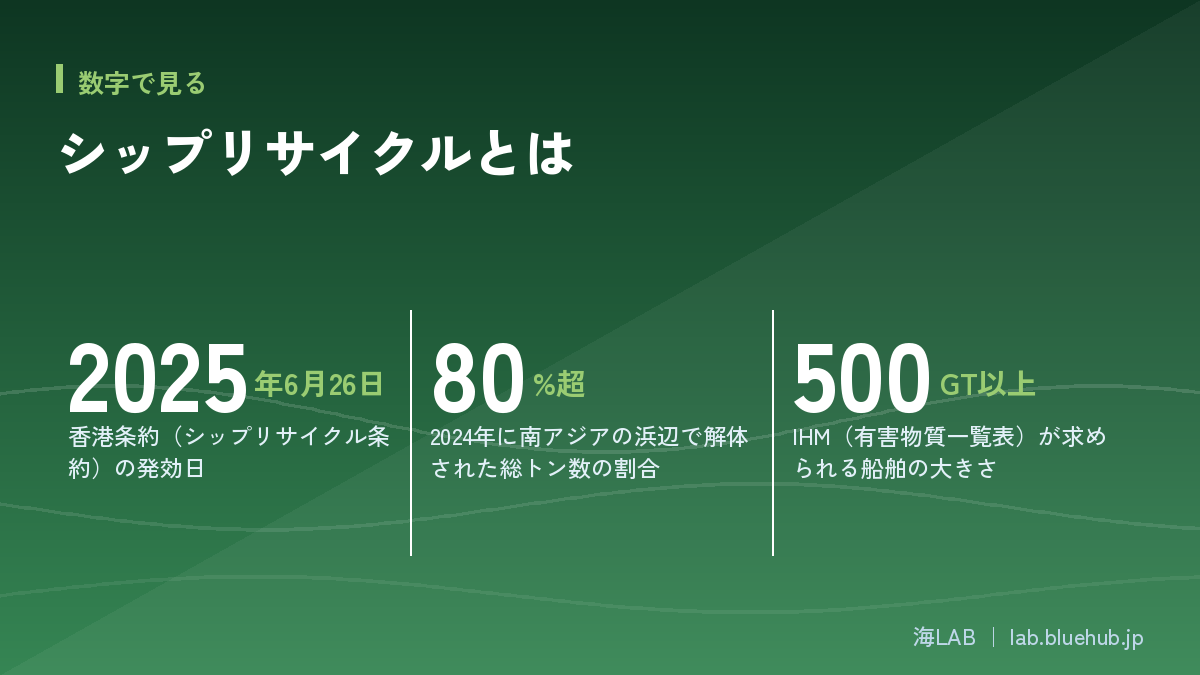
- The Hong Kong Convention entered into force on June 26, 2025, requiring ships of 500 gross tons and above to carry an Inventory of Hazardous Materials (IHM) and to be dismantled at authorized facilities.
- In 2024, more than 80% of the gross tonnage dismantled worldwide was broken up on beaches in three South Asian countries, and accidents and marine pollution remain concerns.
Where and how are ships dismantled when their service ends? The Hong Kong Convention, in force since June 26, 2025, brought a common global rulebook to a ship's "last voyage."
Many ships are cut apart by hand on South Asian beaches. The steel is put to good use as a resource, but the work also carries accidents and marine pollution.
This article organizes how ship recycling works, the international rules, the responses in Japan and the EU, where the steel goes, and the remaining challenges, based on primary sources from governments, international organizations, and NGOs.
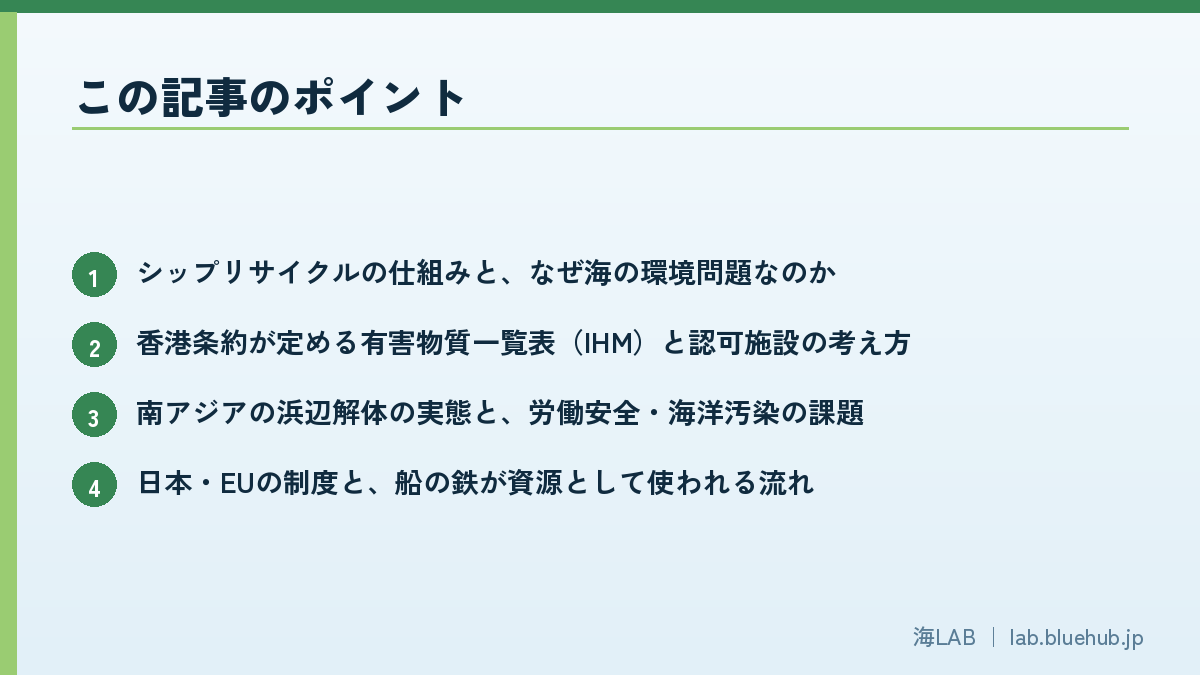
What you'll learn in this article
- How ship recycling works, and why it is a marine-environment issue
- The Hong Kong Convention's Inventory of Hazardous Materials (IHM) and authorized facilities
- Beach-breaking in South Asia: the reality, and the labor-safety and marine-pollution issues
- The systems in Japan and the EU, and how the steel from ships is reused
- Challenges that remain after entry into force, and what each of us can do
What Is Ship Recycling? From Retirement to Resource
A ship is a giant mass of steel
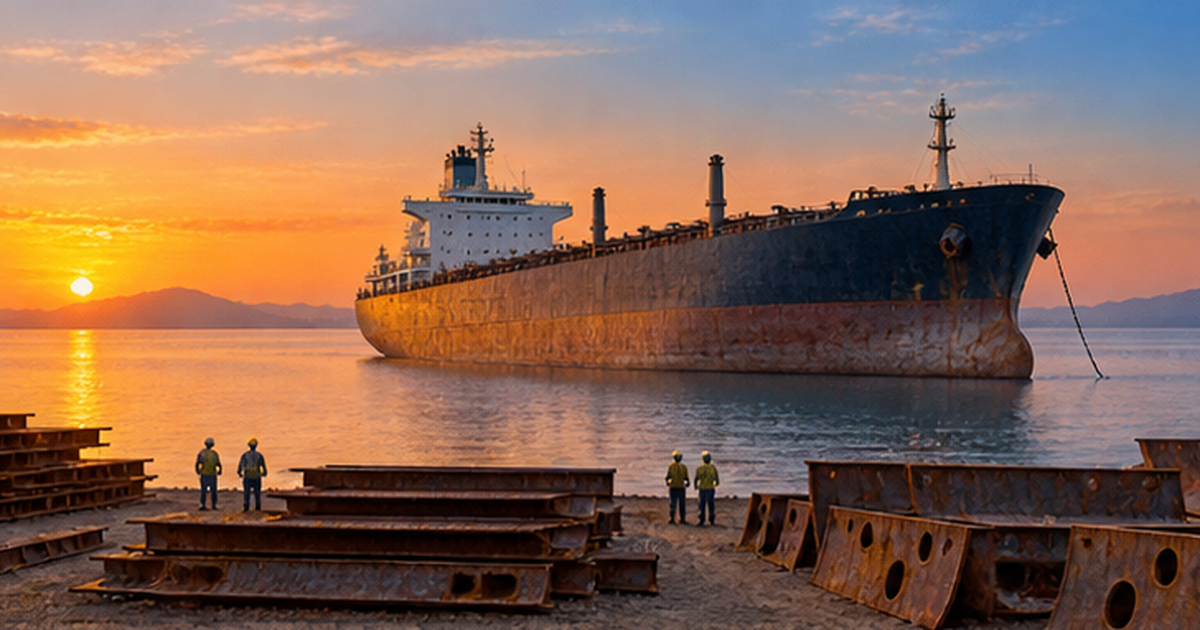
Cargo ships and tankers are retired after roughly 20 to 30 years of service because of aging or declining economics. Most retired ships are dismantled and their steel and other materials reused. This whole flow is called "ship recycling." Japan's Ministry of Land, Infrastructure, Transport and Tourism (MLIT) also explains that more than 90% of a ship is built from recyclable materials.
Most of a merchant ship's weight is steel. Steel plates and pipes recovered in dismantling are melted in electric furnaces or processed as they are, and reborn as construction rebar and machine parts. Using scrap generally emits less carbon dioxide (CO2) than mining new iron ore and smelting it in a blast furnace. In this sense ship recycling is part of the circular economy and also supports decarbonization.
How the sea connects to ship recycling
You may think, "Isn't dismantling a matter for land?" But many ships are broken up by running them directly onto a beach. Oil and hazardous substances can flow into the sea with the tides, so ship recycling is an issue directly tied to the coastal marine environment.
- Handling of fuel oil, lubricants, and ballast water left on the hull
- Organotin antifouling agents that were once in hull paint
- Hazardous substances such as asbestos, PCBs, and ozone-depleting substances
- The safety of workers at the yards, and the impact on surrounding tidal flats and mangroves
Key points of this article
- Ship recycling has two sides: resource circulation, and the marine environment and human rights
- With the Hong Kong Convention entering into force on June 26, 2025, international rules became legally binding for the first time
- Japan led the proposal and adoption of the convention and has also built domestic legislation
Following the dismantling process
Many steps lie between a ship's retirement and its becoming a resource. First, the owner sells the ship through a breaker or broker (a "cash buyer"). Once the buyer is set, the ship makes a final voyage to the breaking site. On arrival, fuel, stores, and oily water are removed, and then the hull is cut into large blocks.
The blocks are cut into smaller steel plates and sections and sorted as scrap. Engines, pumps, cables, and interior materials such as glass and rubber are also separated by type. The more carefully this sorting is done, the more resources can be reused and the less is thrown away.
Three main dismantling methods
- Beaching: the ship is run onto the shore at high tide and dismantled in the intertidal zone during low tide. Capital cost is small, but containment is difficult
- Pier-side (alongside) method: the ship is moored at a quay and dismantled with cranes. Floors and drainage are easier to manage
- Dry-dock method: the ship is placed in a dry dock for dismantling. Containment is the most reliable, but the cost is high
Where in the world are ships dismantled?
South Asian beaches are the center
According to the NGO Shipbreaking Platform's 2024 data, 409 ocean-going commercial vessels were sold for scrap in 2024. Of these, 255 large ships were broken up on the beaches of Bangladesh, India, and Pakistan, accounting for more than 80% of the gross tonnage dismantled worldwide.
| Country / region | Main breaking area | Characteristics |
|---|---|---|
| Bangladesh | Around Chattogram (Chittagong) | Mainly beaching. Supports domestic steel demand, but accidents are frequent |
| India | Alang, Gujarat | One of the world's largest breaking sites. Recent facility upgrades and moves toward EU approval |
| Pakistan | Gadani | Mainly beaching. Environmental and labor issues have been pointed out |
| Türkiye | Aliağa | Many EU-approved facilities; dismantling mainly alongside quays |
| China, Europe, etc. | Various | Smaller volumes than South Asia |
Why South Asia?
There are three main reasons. First, low labor costs let breakers pay higher prices for ships. Second, there is domestic steel demand to absorb the recovered steel. Third, beaching needs little capital investment, which keeps the cost of environmental and safety measures low. For an owner, selling to the yard that pays the most was the rational choice for the same ship.
Because of this structure, a distortion has long persisted: places with weaker environmental and labor rules are more price-competitive. That is the background to calls for international rules.
2024 in numbers
- Ocean-going commercial vessels sold for scrap: 409
- Large ships broken up on beaches in three South Asian countries: 255 (over 80% of gross tonnage)
- Deaths at South Asian breaking sites: 9; injuries: 45 (NGO count)
- Source: the NGO Shipbreaking Platform's 2024 list
- The figures are counts based on public information, and it is pointed out that some accidents may not have been captured
Scrap prices and how the market works
The sale price of a ship for scrap depends heavily on steel market prices (price per light displacement ton). When scrap demand is high and South Asian steelmakers are buying actively, beach-breaking yards can easily offer high prices. Owners tend to choose the highest bidder for economic reasons, and the root of the problem is that safety and environmental care are hard to reflect in the price.
Also, many ships are re-flagged to flags such as Panama or Saint Kitts and Nevis, or resold to intermediaries, just before the final sale. It is therefore pointed out that the original owner or cargo owner has difficulty knowing where the ship was finally dismantled.
What Happens at the Yards: Labor Safety and Marine Pollution
Accidents and health harm
In beach-breaking, enormous hulls are cut apart by hand with torches. Falling heavy objects, gas explosions, falls from height, and inhalation of toxic fumes are constant risks. In 2024, the NGO reported a major explosion while dismantling a tanker at a yard in Chattogram, Bangladesh, in which six workers died and six were seriously injured.
It is not only accidents. Long-term health harm from asbestos dust, lead in paint, and residual oil wears workers down without showing in the statistics. A lack of protective equipment and working without being told where hazardous substances are have made the harm worse.
Pollution flowing into the intertidal zone
Beach-breaking takes place in the intertidal zone (the shore between high and low tide). Without containment such as concrete floors and oil-water separation, oil, heavy metals, and paint flakes soak into the tidal flat and spread offshore with the tide. Mangroves and tidal flats are also spawning and nursery grounds for fish and shellfish, so coastal fisheries could be affected.
| Pollution source | Main substances | Impact on the sea |
|---|---|---|
| Residual oil and fuel | Heavy oil, lubricants | Contamination of shores and tidal flats; suffocation of organisms |
| Antifouling paint | Organotin (TBT), etc. | Reproductive abnormalities in shellfish; persists for a long time |
| Insulation and interiors | Asbestos, PCBs | Health harm from dust and leaching |
| Metals and paint flakes | Lead, mercury, cadmium | Accumulate in sediment and enter the food chain |
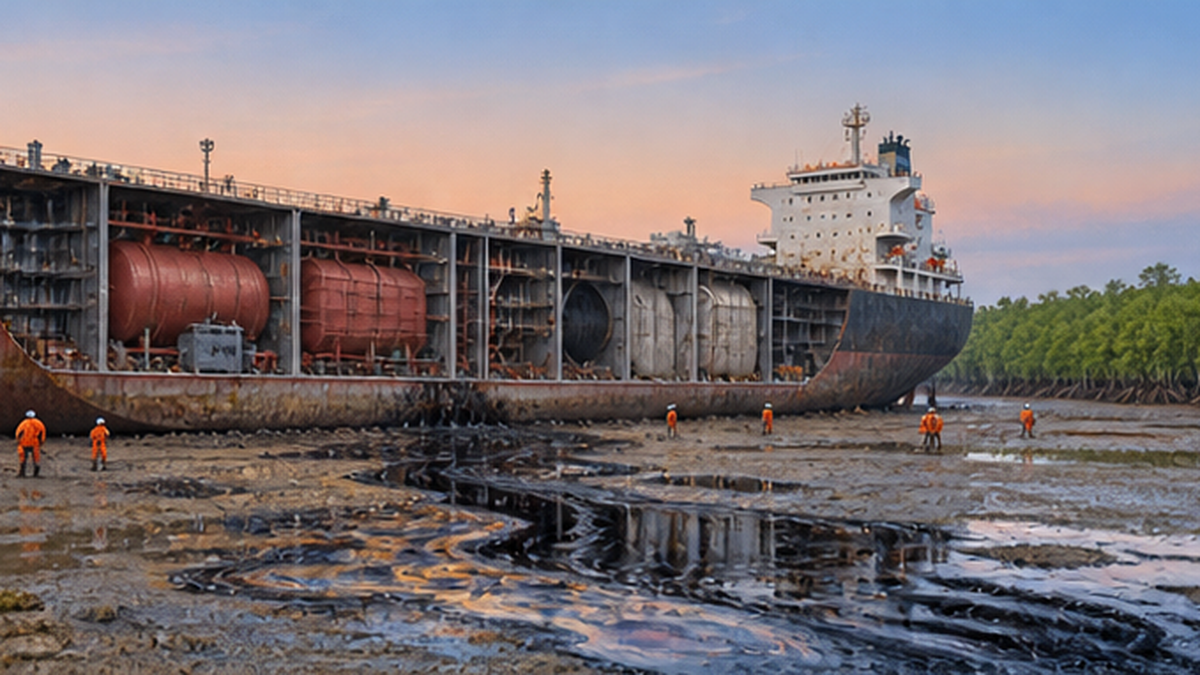
The workers' view: who works there, and under what conditions?
Many yard workers are migrants from poor rural areas, working on unstable daily wages. They often work without adequate contracts or insurance, and cases have been reported in which no compensation was paid after an accident. The convention's requirements include workers' health and safety, but whether this is observed on site depends on the capacity of supervising authorities and the attitude of operators.
In recent years in Bangladesh as well, courts and the government have shown decisions to halt yards that fail to meet environmental and safety standards, signaling moves to strengthen domestic regulation. The convention's entry into force also gives such reforms an international backing.
The Core of the International Rules: The Hong Kong Convention
Adopted in 2009, in force June 26, 2025
Its official name is the "Hong Kong International Convention for the Safe and Environmentally Sound Recycling of Ships, 2009." The International Maritime Organization (IMO) adopted it in 2009, but entry into force required conditions such as ratification by 15 or more states, ratifying states representing at least 40% of world merchant shipping tonnage, and a maximum annual recycling volume over the previous 10 years of at least 3% of those states' merchant tonnage, so it took a long time. These conditions were met and it entered into force on June 26, 2025. Ratification by Bangladesh and Liberia is reported to have given the final push.
According to the IMO, there are 24 parties at entry into force, including major flag states such as Japan, Liberia, the Marshall Islands, and Panama, and four major recycling states — Bangladesh, India, Pakistan, and Türkiye — together representing 57.15% of world merchant tonnage.
The three pillars the convention requires
- Ship design and operation: restrict the use of hazardous substances and keep track of where they are on board
- Authorization of recycling facilities: only facilities authorized by the national authority can accept ships covered by the convention
- Certification and survey: ships of 500 gross tons and above carry an Inventory of Hazardous Materials (IHM) and demonstrate compliance through surveys and certificates
Examples of substances the convention prohibits or restricts
- Asbestos
- Polychlorinated biphenyls (PCBs)
- Ozone-depleting substances
- Organotin antifouling paints (TBT, etc.)
Japan's role
According to MLIT, as environmental pollution and industrial accidents in India, Bangladesh, and elsewhere became international problems from the 1990s, Japan urged the recycling states to join a convention and has played a leading role from the proposal through adoption to the fulfillment of the entry-into-force conditions. Japan is one of the world's leading ship-owning nations and is in a position to raise the convention's effectiveness.
Understanding the convention in three stages
The convention envisions three stages: when a ship is built, when it is in operation, and when it is dismantled. At construction, new use of hazardous substances is avoided and the IHM is prepared. In operation, the IHM is updated with each modification or repair and confirmed at surveys. At dismantling, the owner consults the facility to draw up a ship recycling plan, and permission to dismantle is issued only to a ship that is ready.
Recycling facilities are also required to prepare a plan for safe and environmentally sound work (a ship recycling facility plan), train workers, manage hazardous substances, and prepare for emergencies. In other words, the convention is a system that places responsibility on both the sending side (flag states) and the receiving side (recycling states).
The Inventory of Hazardous Materials (IHM): a ship's "ingredient list"
What is the IHM?
The IHM (Inventory of Hazardous Materials) is a list recording the type, amount, and location of hazardous materials used in a ship. Because workers can know in advance "where the asbestos is" and "which paint contains organotin," it is basic information for protecting workers and preventing pollution.
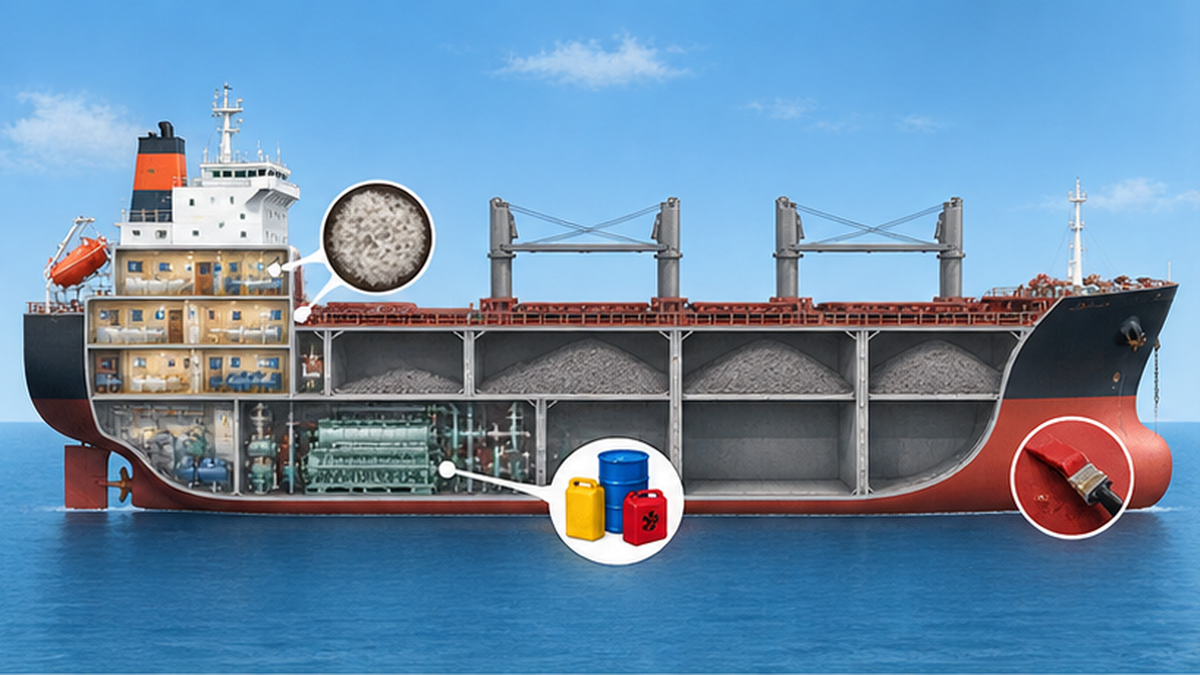
The IHM has three parts. Part I covers hazardous materials in the ship's structure and equipment (maintained from construction), Part II covers wastes generated during operation, and Part III covers stores and the like. Of these, new and existing ships are mainly required to have Part I; Parts II and III are added to complete it before dismantling.
When is it required?
| Target | Deadline for carrying IHM Part I (guide) |
|---|---|
| New ships | From ships whose building contract date is June 26, 2025 or later, keel-laying date is December 26, 2025 or later, or delivery date is December 26, 2027 or later (any one of these) |
| Existing ships (already in service) | Required from June 26, 2030 |
In other words, even ships sailing today are required to build their "ingredient list" toward 2030. Owners and shipyards are collecting statements from equipment makers that a given part contains no hazardous substances.
Why building an IHM is hard
- A single ship uses tens of thousands of parts
- Gathering material information from suppliers takes a great deal of effort
- For ships traded second-hand, past records may have been lost
How substances are treated in IHM Part I
IHM Part I distinguishes, following the lists in the convention's appendices, between prohibited or restricted substances (asbestos, PCBs, ozone-depleting substances, organotin compounds) and substances that must be listed above a certain content (heavy metals such as lead, cadmium, hexavalent chromium, and mercury, and brominated flame retardants). In practice, parts are checked one by one from drawings and equipment specifications, and samples are taken and analyzed where necessary.
Building this "ingredient list" for ships resembles efforts in other industries that handle chemicals. A ship is an assembly of parts, so a system for sharing information across the whole supply chain decides success or failure.
Japan and the EU: Domestic Law and the European "Approved List"
Japan's Ship Recycling Act
In June 2018, Japan enacted the "Act on the Appropriate Implementation of Recycling of Ships (Ship Recycling Act)." It applies to ships of 500 gross tons and above ("specified ships") and requires owners to prepare and maintain an inventory of hazardous materials and to have ships dismantled at authorized facilities. Some provisions were enforced early, in April 2019, and full operation is proceeding in step with the convention's entry into force.
MLIT takes the view that the convention's entry into force makes it smoother to replace aging ships with new ones and also contributes to decarbonization within the circular economy. If an environment for safely retiring old ships is in place, it becomes easier to replace them with newer, more fuel-efficient ships.
The EU Ship Recycling Regulation
The EU brought Regulation (EU) No 1257/2013 into force on December 30, 2013. Large commercial ships flying the flag of an EU member state may only be recycled at approved facilities on the "European List." For a long time the list was mainly facilities in the EU and Türkiye, with none from South Asia.
In recent years, listing facilities that use the beaching method has been debated, and it has been reported that the European Commission proposed adding two Indian yards in Alang (YSI Recyclers and Shree Ram) to the list. Some praise the substantive improvements, while others criticize it as a lowering of standards to accept beaching.
| Aspect | Hong Kong Convention | EU Regulation |
|---|---|---|
| Scope | Ships of 500 GT and above (of convention parties) | Large commercial ships flying an EU member state flag |
| Recycling facilities | Facilities authorized by authorities | Only facilities on the European List |
| Hazardous materials | Carry an IHM | Inventory of hazardous materials (under the EU rules) |
| Character | A global minimum standard | Aims at stricter implementation than the convention |
Points raised by NGOs
- NGOs criticize the Hong Kong Convention for not excluding beaching and for standards that are not sufficient
- Even with the convention in force, improvement will not progress unless practice on site follows
- The focus is whether the EU can maintain a higher standard than the convention
Support for developing countries and the flow of funds
Recycling states need large funds to move to facilities that meet the standards. Japan has indicated it will support the development of a final waste disposal site in Bangladesh and similar efforts. Without a destination for hazardous waste, improving the facilities alone would stall at final disposal.
Internationally, in addition to capacity-building support such as the IMO's SENSREC, some private financial institutions are making loans to recycling facilities conditional on meeting environmental and safety standards. If the flow of money is linked to the standards, improvement accelerates.
Efforts by Japanese Shipping Companies, Shipyards, and Recycling States
Moves by owners and shipyards
Japanese shipping companies are working to obtain IHM approval for the ships they own. Ahead of entry into force, the Japan Maritime Daily reported that about 80% of the inventories for Japanese-flag ocean-going ships had been approved (New Year 2025 issue). More shipyards are adopting designs that avoid hazardous substances from the building stage or that show where they are used.
As the decarbonization of shipping advances (switching fuels to LNG, methanol, and ammonia), securing a way to retire old ships safely has become directly tied to fleet renewal plans. For more, see Decarbonizing International Shipping: IMO Rules and Ammonia and Methanol Fuels.
Upgrades in recycling states
With financial support from the Norwegian government, the IMO launched the SENSREC project (Safe and Environmentally Sound Ship Recycling), supporting institutional development and capacity building in Bangladesh and Pakistan. Developing concrete floors and oil-water separation facilities and training workers are among the challenges.
In Alang, India, more facilities are claiming compliance with the Hong Kong Convention. At the same time, concern has been reported that breaking demand and jobs may decline, and a new challenge is emerging: how to reconcile higher environmental standards with local employment.
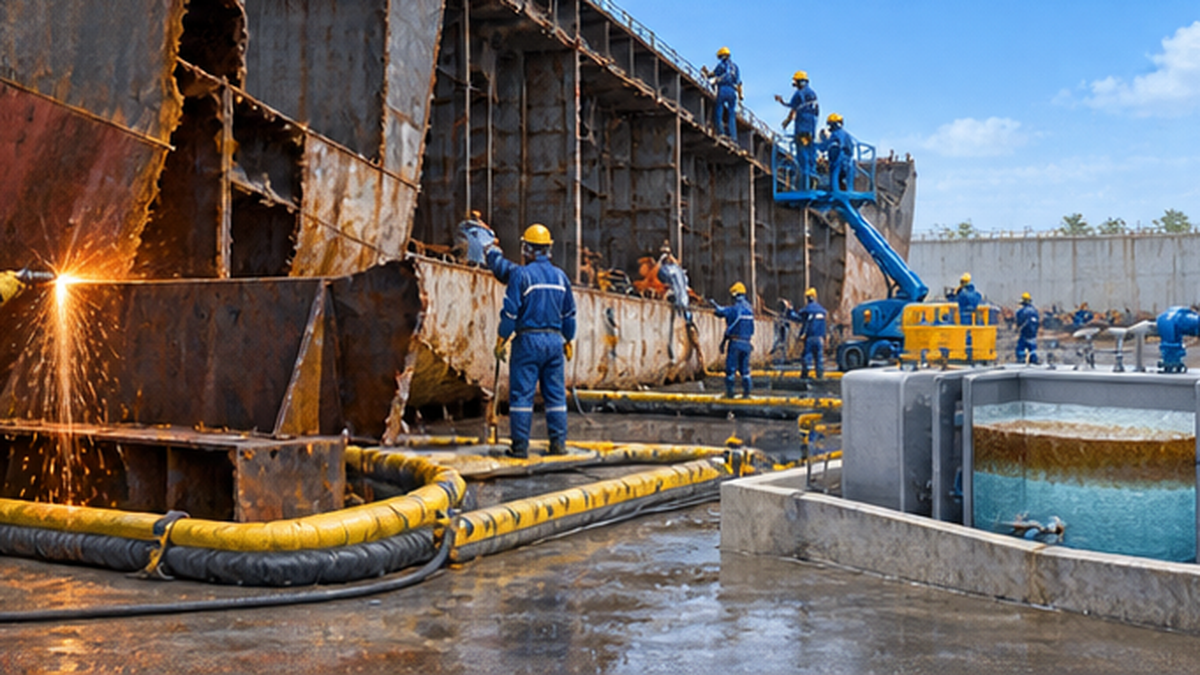
A Marine-Learning View: Why Protect Tidal Flats and Mangroves
Tidal flats and mangroves are spawning and nursery grounds for marine life and also natural breakwaters that protect coasts from typhoons and storm surges. They also attract attention as storehouses of carbon, known as "blue carbon." If pollution from breaking sites damages the functions of these coastal ecosystems, fisheries, disaster prevention, and the climate are affected too.
Ship recycling may look like a faraway matter, but it is the final step of the sea transport we all use. As long as the goods around us are carried by ships, we are indirectly connected to how a ship's life ends.
Where Does the Steel Go? Resource Circulation and Decarbonization
What is ship steel used for?
Part of the steel from dismantled ships is used as it is for construction materials and machine parts, and the rest is melted in electric furnaces to become new steel. According to research by Climate Catalyst and others, about half of the steel recovered in Alang, India, is used directly for fabricating pipes and bars, and about a quarter is reprocessed at re-rolling mills.
In Bangladesh, ship-breaking scrap is reported to account for a large share of domestic steel supply. Estimates vary, but iron recovered from ships is said to support a substantial part of domestic steel demand. For this reason, raising environmental standards calls for a gradual transition that takes the steel supply and jobs into account.
From the CO2 viewpoint
Compared with making iron from ore in a blast furnace, melting scrap in an electric furnace generally emits less CO2. Climate Catalyst analyzes that scrap from ship breaking could contribute to lowering the carbon intensity of India's steel sector. However, if the electric furnace's power comes from coal the reduction is small, so it must be considered together with decarbonizing electricity.
| Material | Main reuse | Notes |
|---|---|---|
| Steel plate and sections | Building materials, electric-furnace feedstock | Requires removal of paint and hazardous substances |
| Non-ferrous metals (copper, aluminum) | Cables, machine parts | Sorting and recovery take much effort |
| Equipment and fittings | Second-hand market | Need to confirm they meet safety standards |
| Waste oil and waste | Treatment, incineration, etc. | Proper treatment facilities are essential |
In the same way, recycling of fishing nets and small electronics is also deeply connected to the marine environment. Reading A Complete Guide to Used Fishing Net Recycling and What Is Urban Mining? Recovering Gold and Rare Metals from Small Electronics together gives the whole picture of a circular society.
Common questions
"Will beach-breaking disappear once the convention is in force?" — No, not immediately. The convention requires authorization of facilities and compliance with standards, but does not prohibit the method itself. However, facilities that cannot meet the standards will be unable to accept ships covered by the convention, so weeding out and improvement are expected to progress over time.
"Are all old ships covered?" — The convention covers ships of 500 gross tons and above; warships and government non-commercial ships and the like are excluded. For existing ships, there is a transitional period for carrying an IHM toward 2030.
Remaining Challenges: The Real Contest After Entry into Force
1. How to treat the beaching method
The Hong Kong Convention does not itself prohibit beach-breaking. What it requires is that authorized facilities meet the set standards. NGOs argue that dismantling in the intertidal zone is hard to contain and that environmental impact cannot be avoided. Recycling states, for their part, are looking for a route to compliance while upgrading equipment step by step.
2. Can the "sale loophole" be prevented?
There is concern that owners will sell ships to facilities in countries outside the convention or change flags to avoid regulation. To prevent this, the EU has discussed mechanisms that apply even when the flag is changed and stronger owner responsibility.
3. Who bears the cost?
Safe and environmentally sound dismantling lowers the sale price. How the cost is shared among owners, shipyards, cargo owners, and consumers is still undecided. In some quarters, a "ship recycling fund," in which dismantling costs are set aside at construction or during operation, is under discussion.
4. Monitoring and disclosure on site
Even with a convention, it is meaningless unless we confirm that it is observed on site. Third-party inspection, publication of dismantling records, and reflecting workers' voices are important. The list the NGOs publish each year serves this monitoring role.
What we can do
- Look at dismantling destinations and policies in the ESG reports of shipping, shipbuilding, and trading companies
- Take the view of choosing companies that take responsibility for a ship's "exit"
- Learn about ship recycling and tell others
- Read articles on resource circulation and the marine environment and use them as a starting point for action
Conclusion: Making a Ship's Last Journey Safe and Kind to the Sea
Ship recycling is an issue with both a "good side" — the circulation of steel as a resource — and a "shadow side" — industrial accidents and marine pollution. With the Hong Kong Convention entering into force on June 26, 2025, common rules with legal force began to operate worldwide for the first time.
- More than 80% of the gross tonnage dismantled in 2024 was broken up on beaches in three South Asian countries
- The convention requires ships of 500 gross tons and above to carry an IHM (Inventory of Hazardous Materials)
- Japan led the proposal and adoption of the convention and has also built domestic legislation
- The EU requires dismantling at approved facilities on the European List, and debate continues
- After entry into force, practice on site, monitoring, and cost sharing are the real contest
The huge ships floating on the sea have supported our lives through shipping. In what form they say farewell to the sea and to people's lives at the very end will become one yardstick of shipping's credibility from now on.
Summary of this article
- Ship recycling is an issue that requires thinking about resource circulation, the marine environment, and human rights together
- International rules began to operate with the Hong Kong Convention (in force June 26, 2025)
- The IHM and authorized facilities are the pillars of the system
- Challenges: how to treat beaching, cost sharing, and monitoring on site
References and sources
- MLIT press release: Entry into force of the Ship Recycling Convention confirmed – Confirmation of entry into force on June 26, 2025, and Japan's role
- IMO: New era for ship recycling as Hong Kong Convention enters into force – Entry-into-force date, 24 parties, 57.15%, SENSREC
- IMO: The Hong Kong International Convention for the Safe and Environmentally Sound Recycling of Ships – Overview of the convention
- MLIT: Enforcement of the Ship Recycling Act – Overview of the domestic law
- ClassNK: Overview and practice of the Ship Recycling Convention – IHM requirements and timing
- NGO Shipbreaking Platform: Platform publishes list of ships dismantled worldwide in 2024 – Ships dismantled and accidents in 2024
- EU規則 Regulation (EU) No 1257/2013 – EU Ship Recycling Regulation
- Climate Catalyst: Turning the Tide: Ship Recycling as a Source of Green Steel in India – Steel use and decarbonization in India
Ordered by reliability: government/academic institutions > peer-reviewed papers > specialized organizations > reputable media