⚡ In short
Stag beetle larvae feed on deadwood broken down by white-rot fungi, sustaining the forest's nutrient cycle. The world's deadwood releases 10.9 Gt of carbon a year, with insects involved in about 29%. Meanwhile, releasing imported stag beetles risks hybridization and competition. A primary-source guide to their role as decomposers and the keeper's responsibility.
The stag beetles we meet in summer woodlands are "jewels of the forest," beloved by children and adults alike. Yet for all their popularity, surprisingly little is known about the work they do in the forest. Stag beetle larvae grow by feeding on decaying wood (deadwood) broken down by fungi—they are "forest decomposers," key players in the cycle that returns dead trees to the soil.
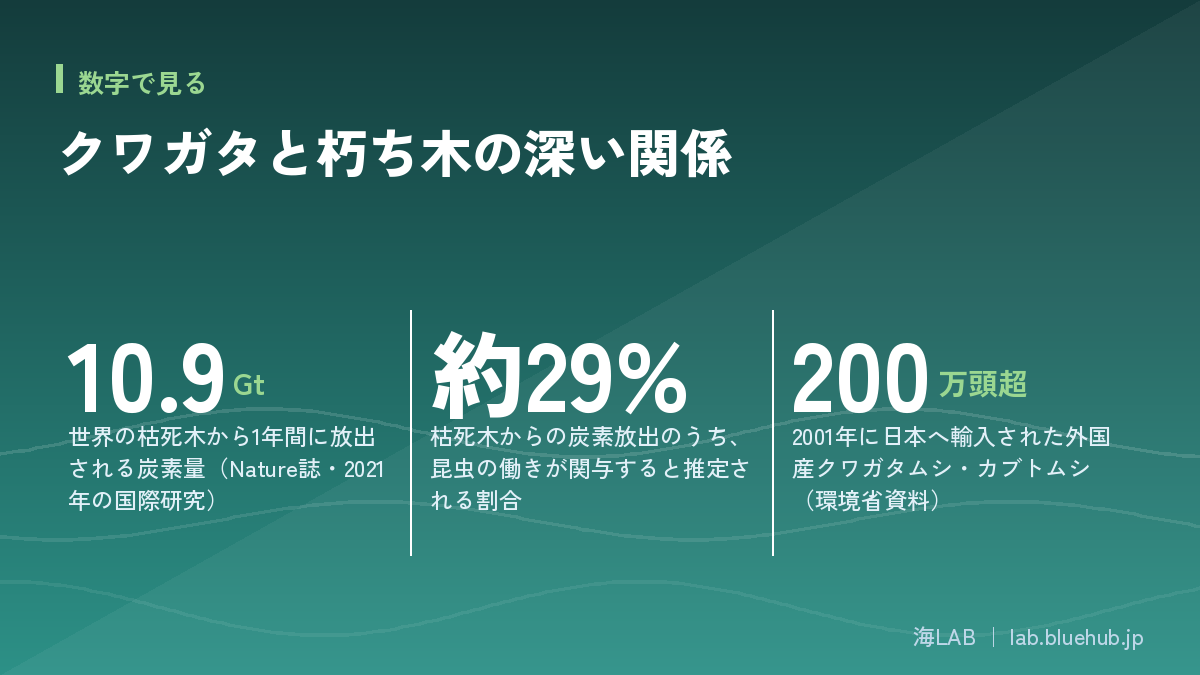
According to an international study published in Nature in 2021, the deadwood in the world's forests releases about 10.9 gigatonnes (Gt) of carbon every year, and insects are estimated to be involved in about 29% of that flux. "Deadwood insects" like stag beetles are genuine ecosystem engineers built into the planet's carbon cycle.
At the same time, the release of imported foreign stag beetles into the wild is creating serious risks of hybridization and competition with native species. Starting from the science of stag beetles and rotting wood, this article digs into the transformation of Japan's satoyama woodlands, the now-threatened Japanese giant stag beetle, and the responsibilities of beetle keepers—drawing on primary sources such as Ministry of the Environment documents and peer-reviewed research.
What you will learn in this article
- How stag beetle larvae use decaying wood and white-rot fungi to grow
- The role deadwood plays in forest biodiversity and the carbon cycle
- Why the Japanese giant stag beetle became a Vulnerable species—satoyama change and collection pressure
- The hybridization, competition, and hitchhiking-mite risks of releasing foreign stag beetles
- Stag beetles protected under Japan's Species Conservation Act, and the rules keepers must follow
What Kind of Insect Is a Stag Beetle? Most of Its Life Is Spent Inside Rotting Wood
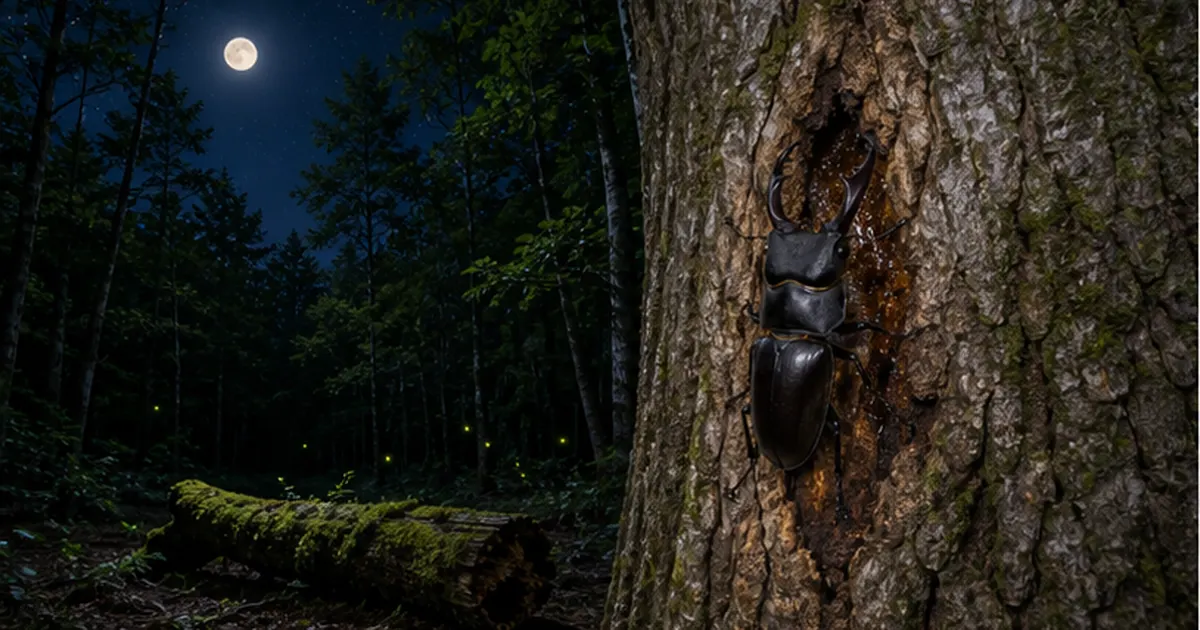
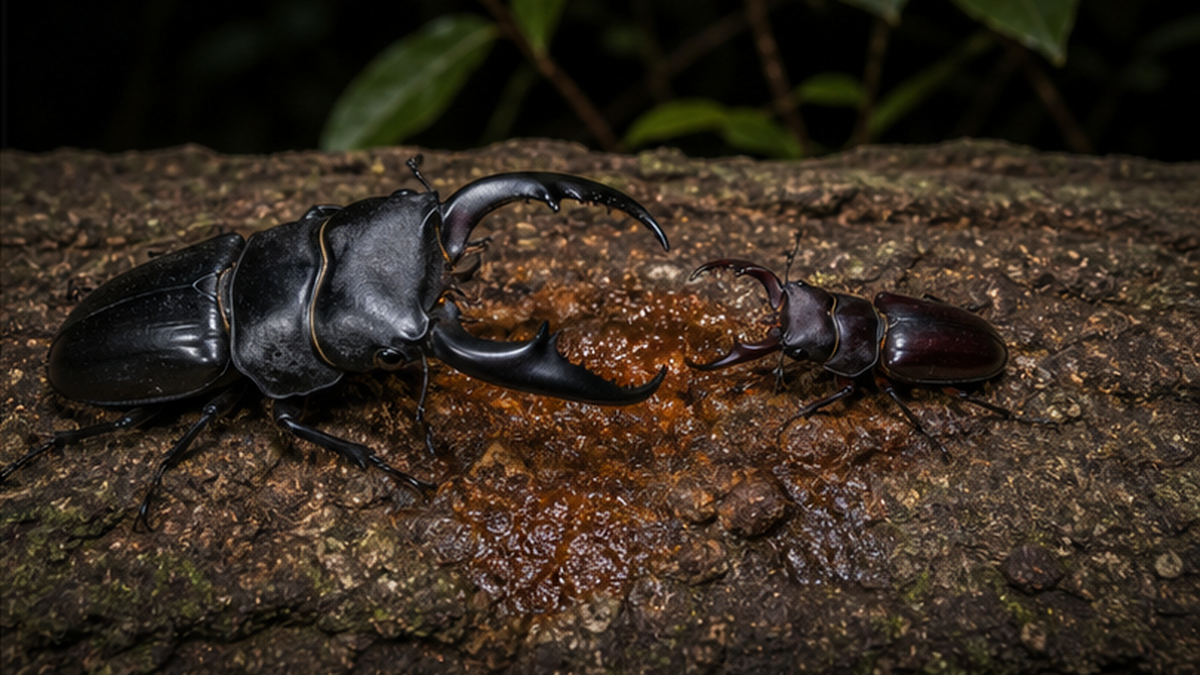
Stag beetles are members of the family Lucanidae in the order Coleoptera, with about 1,500 species worldwide and about 40 species in Japan, including island subspecies. Their most striking feature is the male's magnificent weapon-like mandibles; the Japanese name "kuwagata" comes from their resemblance to the crest ornaments on samurai helmets. Alongside rhinoceros beetles, they are Japan's iconic summer insects, with well-known species including the sawtooth stag beetle, the mountain stag beetle (Miyama), the little stag beetle (Kokuwagata), the flat stag beetle (Hirata), and the Japanese giant stag beetle (Ookuwagata), once nicknamed the "black diamond."
The adult stage is only the "second half of life"
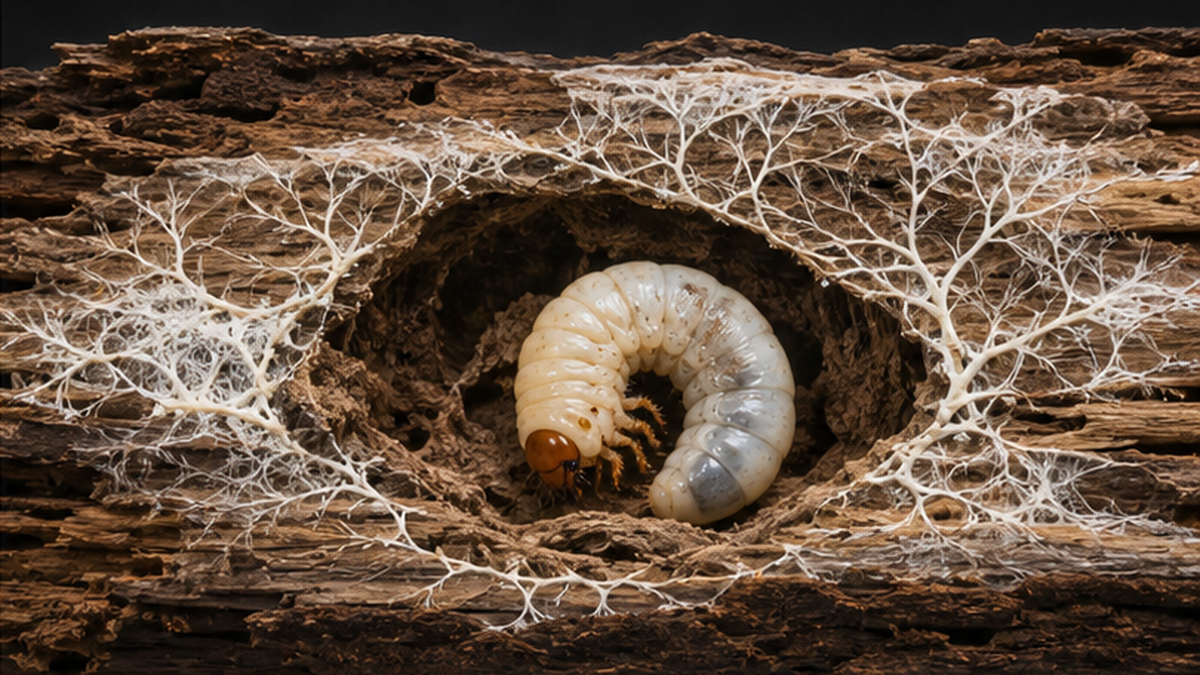
The adults gathering at tree sap get all the attention, but measured in time, most of a stag beetle's life is spent as a larva inside rotting wood. Females lay eggs in dead, decaying trees—standing snags, fallen logs, and stumps—and the hatched larvae eat their way through the wood's interior, taking one to several years to mature depending on species and environment. In other words, both the stag beetle's "cradle" and its "dining table" are dead trees.
Without dead trees, stag beetles cannot survive
This is the crucial starting point of this article. For a stag beetle, a forest is not a "tidy forest" made only of living trees. A forest where stag beetles can breed is one where dead trees and fallen logs are left in place and fungi are busy decomposing them. If every dead tree and fallen log is removed from a park or satoyama woodland, the landscape may look neat, but the homes of stag beetles and all the other "deadwood-dependent creatures" are lost.
Even the sap that adults feed on is a joint work of insects
The sap that adult beetles feed on is itself a product of interactions among living things. The sap of sawtooth oaks and konara oaks does not simply ooze out on its own: in most cases it flows because larvae of the carpenter moth or longhorn beetles have wounded the trunk, and then yeasts and other microbes colonize and ferment it, producing that distinctive sweet-sour smell. Carpenter moth larvae are even thought to maintain the wounds in order to prey on small insects drawn to the sap—making them, so to speak, the "proprietors of the sap bar." Stag beetles, rhinoceros beetles, drone beetles, hornets, and great purple emperor butterflies are all regulars at this bar. A single sap-flowing tree hosts a miniature ecosystem—stag beetles live within a web of relationships with other creatures, in the rotting wood of their larval days and at the sap sites of their adult lives alike.
The difference from rhinoceros beetles is a difference in "decay stage"
The oft-drawn comparison with rhinoceros beetles also becomes clearer when viewed through the lens of rotting wood. Rhinoceros beetle larvae eat humus—leaf mold and compost-like material in which decomposition has progressed almost to soil. Stag beetle larvae, by contrast, eat wood at an intermediate stage of decay that still holds its shape. Though both are "insects that eat dead trees," they occupy different legs of the decomposition relay and thus avoid competing for food. Their adult lifespans contrast too: rhinoceros beetles die within a single summer, while little and flat stag beetles can overwinter and live two to three years, and Japanese giant stag beetles commonly exceed three years in captivity. Growing slowly and living slowly—that is the stag beetle's sense of time, and the rotting wood that sustains it is likewise the product of long, slow years of decay.
Key points
- There are about 1,500 stag beetle species worldwide and about 40 in Japan
- Most of their life is the larval stage inside rotting wood—dead trees are both "cradle" and "dining table"
- Stag beetles cannot breed in an "overly tidy forest" with no dead trees or fallen logs
The Larva's Diet Is "White-Rotted Wood"—A Partnership with Fungi
We casually say "the larvae eat wood," but they do not grow by gnawing on sound, living timber. Cellulose and lignin, the main components of wood, are extremely resistant to breakdown, and most animals cannot digest them. The key players here are wood-decay fungi—relatives of mushrooms. Stag beetle larvae can only turn wood into nutrition by eating decayed wood that fungi have already "prepped" to a certain degree.
White rot vs. brown rot—which do stag beetles choose?
Wood-decay fungi fall into two broad types. Brown-rot fungi, which turn wood brown, mainly break down cellulose and leave the recalcitrant lignin behind. White-rot fungi, which turn wood whitish, belong to the small group of organisms that can decompose even lignin. Most stag beetles are known to prefer "white-rotted wood" processed by white-rot fungi for egg-laying and feeding. This contrasts with rhinoceros beetle larvae, which favor leaf-mold-like material at a more advanced stage of decay.
| Item | White-rotted wood | Brown-rotted wood |
|---|---|---|
| Main decomposers | White-rot fungi (relatives of turkey tail, shiitake, etc.) | Brown-rot fungi (relatives of brown crumbly rot fungi, etc.) |
| Components broken down | Both lignin and cellulose | Mainly cellulose (lignin remains) |
| Appearance of the wood | Whitish, soft, and fibrous | Reddish-brown, cracking into blocks |
| Main insects that use it | Stag beetle larvae and others | Used by rhinoceros beetles and others as decay advances |
Larvae eat both the "wood" and the "fungus"
So what in the rotting wood actually nourishes the larvae? A study of the digestive enzymes of little stag beetle larvae, published in a journal of Japan's coleopterological society, confirmed activity in the larval gut of enzymes that break down the wood components cellulose and xylan, as well as enzymes that break down β-1,3-glucan, a component of fungal cell walls. Moreover, the analysis suggested the larvae may be primarily using the fungal matter growing in the rotting wood rather than the wood itself. Stag beetle larvae, then, are at once "wood eaters" and "fungus eaters"—they cannot live without their three-legged race with fungi.
Species-specific tastes in rotting wood divide up the niches
"Rotting wood" is not one thing: tree species, diameter, moisture, stage of decay, and contact with the ground all create very different environments, and stag beetle species share the limited resource by differing in their preferences. Mountain stag beetles favor cool, moist wood in highland forests; flat stag beetles use thick, damp wood in riparian groves; little stag beetles use everything down to thin dead branches in city parks. Some species, like the Nebuto stag beetle, depend on fermented, mud-like sap deposits or special humus. This fine partitioning of tastes is exactly why some 40 stag beetle species can coexist in Japan's limited forests. Conversely, it means that supporting diverse stag beetles requires a forest stocked with deadwood in all its forms, from thick fallen logs to slender dead branches. In a uniformly groomed forest, even if some dead trees remain, only a few species can make a home there.
Trivia: the "mycelium bottle" in beetle keeping applies this ecology
The "mycelium bottles" used in stag beetle rearing are sawdust inoculated with white-rot fungi (mainly oyster mushroom relatives) and left to decompose. They artificially reproduce the larva's natural diet of white-rotted wood and fungal matter, and they made rearing and breeding large individuals of species like the Japanese giant stag beetle far easier.
Rotting Wood Is the Forest's Nutrient-Cycling Hub—Stars of the "Decomposition Relay"
Between a tree's death and its return to soil lies a "decomposition relay" spanning many years and many creatures. First, primary borers such as bark beetles enter beneath the bark, opening pathways for fungi. Once white-rot fungi begin breaking down the wood, stag beetles arrive to lay eggs, and their larvae dig galleries as they feed. Those galleries become corridors for the next decomposers—termites and giant wood roaches—and decay accelerates further. As the wood loses its original form, rhinoceros beetle and flower chafer larvae, earthworms, and soil fauna join in, and the tree finally returns to the forest floor.
- Death and fall: the tree dies from typhoons, snow, or age; bark beetles and fungi move in
- White rot advances: white-rot fungi decompose the wood, lignin and all, into soft white-rotted material
- Stag beetles arrive: females lay eggs; larvae feed for one to several years, extending galleries
- Decay accelerates: termites, giant wood roaches, and others enter via the galleries, fragmenting the wood
- Return to soil: rhinoceros beetle larvae and soil fauna consume the humus; nutrients return to the forest soil
Far more creatures depend on deadwood than you might imagine
Organisms that, like stag beetles, depend on deadwood for at least part of their life cycle are collectively called "saproxylic organisms," and the beetles alone number an enormous count of species. Deadwood is food, but also egg-laying habitat, overwintering quarters, shelter, and the source of nest holes for woodpeckers and small animals. A 2025 study of spruce forests in southern Sweden reported that production forests poor in deadwood had significantly lower saproxylic beetle diversity than nature reserves, with the gap widest for red-listed species. The quantity and quality of deadwood serve as a "yardstick" for a forest's biodiversity.
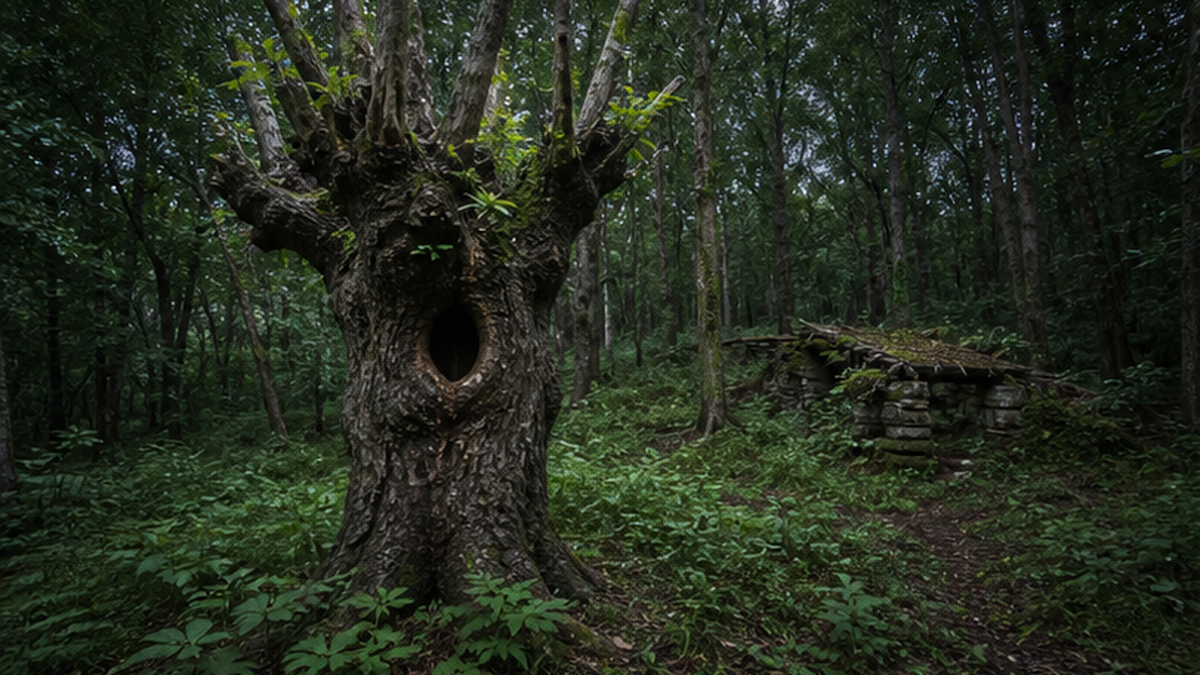
What about Japan's forests? Forests cover about 70% of the country, but roughly 40% of that is cedar and cypress plantations grown for timber, and in production forests where thinned and harvested wood is hauled out, thick deadwood rarely remains for long. Meanwhile, in the satoyama coppice woodlands abandoned after the war, aging konara and sawtooth oaks are now beginning to die, and mass die-offs from Japanese oak wilt (a disease carried by the oak ambrosia beetle) are occurring across the country. Japan today is a patchwork of places with "too much" and "too little" deadwood, and forest management that decides where and how much deadwood to retain—while balancing safety and scenery—is what future forest stewardship requires.
Rotting wood is both a "cafeteria" and an "apartment building"
Deadwood's value goes beyond food. Woodpeckers excavate holes in standing snags, and the abandoned cavities pass on to giant flying squirrels, Japanese dwarf flying squirrels, owls, and varied tits as nests. Gaps in the bark become day roosts for bats; the undersides of logs are overwintering sites for amphibians and snakes; beneath the bark overwinter ladybugs, longhorn beetles, and adult stag beetles. Slime molds creep across the surface of rotting wood, mosses and lichens take hold, and seedlings of the next tree generation sprout atop fallen logs in "nurse log regeneration." A single dead tree is livelier after death—an "apartment building for living things." The shift in Western forest ecology toward calling deadwood "habitat trees" rather than mere dead matter reflects this re-appraisal of its value.
In short, the intuition that "a forest full of dead trees is a neglected forest" is not necessarily true from a biodiversity standpoint. Just as forests store rain and feed rivers (see how headwater conservation forests work), the decomposition of deadwood enriches forest soil and lays the foundation for raising the next generation of trees.
Deadwood and the Carbon Cycle in Numbers—Insects Involved in 29% of Global Decomposition
Seen at planetary scale, deadwood decomposition is also an enormous flow of carbon. In 2021, an international team led by Dr. Sebastian Seibold of the Technical University of Munich published a study in Nature that ran standardized field experiments at 55 forest sites on six continents to quantify, at global scale, deadwood decomposition rates and the contribution of insects.
The method was simple but massive. Wood of identical specification was placed in forests around the world—some pieces freely accessible to insects, others enclosed in mesh cages that excluded only insects—and the loss of mass was compared over several years. With researchers worldwide following the same protocol, the study separated "decomposition by microbes alone" from "decomposition with insects," mapping the global picture across climate zones. The results showed that decomposition speed depends strongly on temperature and humidity; that in tropical forests insects clearly accelerate decay (median insect-driven mass loss of 3.9% per year); and that in cold regions the insect effect is small or can even slow decomposition.
10.9 gigatonnes of carbon released from deadwood each year
By the study's estimate, the deadwood in the world's forests releases 10.9 ± 3.2 petagrams (= gigatonnes) of carbon per year through decomposition. That is a natural carbon flow comparable in magnitude to annual emissions from fossil fuel combustion (roughly 10 gigatonnes). About 93% of the release comes from fast-decomposing tropical forests, and the work of insects such as termites and beetles—combining direct feeding and interactions with microbes—was estimated to be involved in about 29% of the total.
Decomposition is not a "bad thing"
Hearing "carbon is released" may sound like bad news, but this is the healthy circulation of carbon that forests fixed with solar energy, and the released nutrients feed the growth of the next trees. What the researchers actually warn is that if climate change and biodiversity loss reduce the decomposer insects, the balance of this carbon cycle itself could shift in unpredictable ways. Conserving "deadwood insects," stag beetles included, may look unglamorous, but it bears on the stability of the planet's material cycles.
This perspective also connects to the much-discussed global decline of insects. Declines of pollinating bees and butterflies make headlines, but decomposer insects living quietly inside rotting wood are hard even to census, and their losses easily go unnoticed. Yet as this chapter has shown, the material cycling they perform operates at planetary scale. In Europe, roughly one-fifth of assessed saproxylic beetles are evaluated as threatened with extinction, and conserving these "inconspicuous decomposers" is becoming a pillar of biodiversity policy alongside pollinator conservation. Japan, with its culture of familiarity with stag beetles, is rare in the world in how readily public affection can be channeled into their conservation.
Deadwood is a key component of the forest carbon cycle, and insects, together with microorganisms, play a functionally important role in its decomposition.
― Paraphrased from the abstract of Seibold et al. (2021) Nature 597, 77-81
Satoyama Change and the Japanese Giant Stag Beetle—How the "Black Diamond" Became Threatened
Japan's coppice woodlands were once cut on 15-to-30-year cycles for firewood and charcoal and maintained by "coppicing"—letting new shoots regrow from the stumps. Sawtooth and konara oaks cut repeatedly grew into thick, hollow-riddled trunks called "daiba-kunugi," oozing sap and carrying decayed sections at once. These human-tended satoyama giants were prime real estate for stag beetles, above all the Japanese giant stag beetle.
The fuel revolution transformed satoyama and its stag beetles
But when the energy transition of the 1960s—the "fuel revolution"—erased demand for firewood and charcoal, the coppices stopped being cut; some were developed into housing and farmland, others were abandoned and darkened into dense forest. In neglected satoyama, bamboo groves expanded and the generational turnover of the oaks stalled. Great sap-and-hollow trees like the daiba-kunugi were no longer renewed, nor was the supply of rotting wood, and stag beetle habitat quietly shrank. Like the creatures of the rice paddies, stag beetles were residents of a nature that had been maintained precisely because people kept using it.
The Japanese giant stag beetle is Vulnerable on the national Red List
The emblem of all this is the Japanese giant stag beetle. It is listed as Vulnerable (VU) on the Ministry of the Environment's Red List and appears as threatened in several prefectural Red Data Books. The causes of decline are the loss of habitat through development and abandonment of satoyama coppices, compounded by excessive collection pressure during the stag beetle boom. In the 1990s, when specimens fetched high prices, collectors splitting host trees with axes and blitzing sites at night became a problem across the country; Fukuoka Prefecture's Red Data Book records marked declines driven by the loss of habitat trees and collection pressure.
The giant stag beetle boom of the late 1990s was, in hindsight, an extraordinary fever. A few extra millimeters of body length multiplied prices by orders of magnitude, and the market overheated to the point where a large wild individual was reported to have fetched 10 million yen. The "black diamond" nickname dates from this era. Prices later settled as mycelium-bottle rearing made large captive-bred individuals easy to produce, but the boom left real scars. Locality information shared on the internet sent collectors swarming to famous sites, habitat trees were damaged, and some local populations vanished. Moreover, if captive-bred individuals distributed nationwide are released outside their original locality, they cause the same "genetic disturbance" among domestic regional populations as foreign species do. The boom's legacy leads directly into the next chapter's release problem.
The Risks of Releasing Foreign Stag Beetles—Hybridization, Competition, Hitchhiking Mites
In 1999, most foreign stag and rhinoceros beetles were determined not to fall under the "injurious animals" of Japan's Plant Protection Act, effectively liberalizing live imports. Pet imports surged: according to Ministry of the Environment documents, total imports in 2001 exceeded 2 million beetles. Large foreign stag beetles became available even at home-improvement stores—and with that came the growing problem of "release," owners setting unwanted beetles loose in the wild.
| Species | Imports in 2001 (estimated) |
|---|---|
| Atlas beetle | Over 200,000 |
| Giant flat stag beetle (Dorcus titanus subspp.) | About 100,000 |
| Caucasus beetle | Over 60,000 |
| Alcides flat stag beetle | Over 50,000 |
The greatest risk is hybridization—genes cannot be taken back
The Ministry of the Environment's document lists hybridization with native species (genetic pollution) first among the ecological risks of foreign stag beetles. In captive experiments, Palawan and Java giant flat stag beetles hybridized with the native flat stag beetle, and the grandis giant stag beetle hybridized with the native Japanese giant stag beetle—and the resulting F1 hybrids were confirmed fertile. Furthermore, an individual believed to be a wild hybrid between the Sumatran giant flat stag beetle and the native flat stag beetle has been found in the field: the risk is not confined to the laboratory. The Southeast Asian and Japanese populations have evolved separately for millions of years; if hybridization spreads, the genetic integrity unique to Japan's flat stag beetles can never be restored.
What makes hybridization so vexing is that hybrids are almost impossible to distinguish by appearance. Native flat stag beetles, foreign subspecies, and their hybrids show only tendencies in size and mandible shape; reliable identification requires DNA analysis. Even as hybridization advances in the wild, no one can tell by looking, and the region's genetic distinctiveness is quietly replaced. The erasure of millions of years of evolutionary record is "invisible"—that is what makes genetic pollution different from visible environmental destruction like dumped garbage or clear-cut forests, and what makes it frightening.
Competition for food, and the "invisible passengers" on their bodies
Hybridization is not the only risk. Large foreign species use the same sap runs and rotting wood as natives, so physically superior exotics may squeeze natives out in competition for feeding and egg-laying sites. Imported individuals also carry mites and parasites from their places of origin on their bodies, and these could transfer to and affect native stag beetles. Even tropical species are considered potentially capable of surviving Japan's winters, so the comfort of "it's too cold for them to establish" does not hold.
Foreign stag beetles have fallen through the regulatory cracks
Surprisingly, despite these documented risks, most foreign stag beetles are not designated as Invasive Alien Species under Japan's Invasive Alien Species Act, and their import, sale, and keeping remain legal today. Behind this lie the difficulty of retroactively regulating creatures already circulating in the millions and the weight of impacts on hobbyists and the industry; the Ministry of the Environment's materials have stressed education of keepers and dealers over import restrictions. The foreign stag beetle problem thus continues as an issue entrusted to the morals of each individual keeper rather than to law. Buying one is easy, yet releasing that one beetle into the wild can leave irreversible consequences—the gap between the casualness of the pet and the gravity of the risk is the most dangerous part of this problem.
"Setting it free" is not kindness
- Releasing foreign stag beetles invites hybridization and competition with natives and introduces parasites
- Because hybrids are fertile, genetic pollution cannot be recalled once it spreads
- Even with domestic beetles, releasing them somewhere other than where they were collected destroys regional genetic distinctiveness
- If you can no longer keep a beetle, consult the shop, an insect museum, or your municipality—never, ever release it into the wild
Laws and Rules—Stag Beetles Protected by the Species Conservation Act
Some stag beetles are protected by law from collection and trade. The Okinawa marubane stag beetle, which lives in the Yambaru forests of northern Okinawa Island, declined sharply from habitat loss and collection pressure and was designated in 2016 as a National Endangered Species under the Species Conservation Act (Act on Conservation of Endangered Species of Wild Fauna and Flora). For designated species, capture and killing—and in principle transfer and sale—are prohibited, with heavy penalties for violations: up to 5 years' imprisonment or a fine of up to 5 million yen for individuals.
"Collecting because it's rare" pushes species to the brink
Marubane stag beetles are a narrowly specialized group whose larvae can grow only in particular well-decayed wood and soil-like humus ("flake"). In the forests of Yambaru and the Nansei Islands—now inscribed as a World Natural Heritage site—poaching of rare stag beetles has become a problem, and forest-road patrols are conducted. The market logic of "rare = sells high" generates collection pressure that pushes rare species further toward the edge, a pattern repeated since the days of the giant stag beetle boom.
In the Yambaru forests, poaching of the Yambaru long-armed scarab—Japan's largest beetle, a National Natural Monument and National Endangered Species—has also been a long-standing problem, and the Ministry of the Environment's ranger office and the local forestry cooperative continue road patrols. Marubane stag beetles can live only in mature forests where special humus accumulates as great chinquapin and oak trees decay. Once lost, such forests take centuries to recover. Collection pressure does not merely "reduce individuals": in the course of searching, collectors break apart rotting wood and humus, destroying the habitat itself—a double blow to rare species.
- Okinawa marubane stag beetle: designated a National Endangered Species in 2016; collection, transfer, and sale prohibited in principle
- Penalties: individuals face up to 5 years' imprisonment or fines up to 5 million yen (may be combined); corporations face fines up to 100 million yen
- In special protection zones of national parks and Natural Monument sites, insect collecting itself may be restricted even for non-designated species
- Watch also for municipal conservation ordinances and rules banning collection in parks and reserves
How should everyday collecting be enjoyed?
On the other hand, collecting common species like sawtooth and little stag beetles within the rules, and observing and keeping them, has real value as a gateway to nature. What matters is checking in advance for regulated species and no-collection areas, not damaging host trees or rotting wood, not taking home more than you need, and—once you decide to keep a beetle—keeping it to the end. "Log splitting" collection, which breaks apart rotting wood to extract larvae, destroys the very breeding places of stag beetles and demands particular restraint.
Alternatives to collecting are spreading, too. Night watching—quietly patrolling sap runs after dark; catch-and-release observation events using banana-and-shochu traps checked in the morning; citizen science, photographing beetles with a smartphone and posting to wildlife-recording apps. An encounter with stag beetles can be plenty rich without taking them home. Observation records posted online become valuable data for researchers tracking range shifts and alien-species invasions—play that doubles as a contribution to conservation. From "the joy of catching" to "the joy of investigating"—expanding the repertoire of ways to enjoy beetles together with your children is the secret to a long relationship with stag beetles.
What We Can Do—"Keeping Them for Life" Is the Best Forest Conservation
Tracing the relationship between stag beetles and rotting wood reveals a simple truth: before any grand conservation campaign, small individual choices work. Keep the beetle you own until the end of its life. When you see dead trees and fallen logs in the forest, don't think "messy"—imagine the creatures living inside. These two things alone will surely change the stag beetle's future.
Five actions you can start today
- Whether foreign or domestic, keep the beetles you raise responsibly for their whole lives
- If you can no longer keep one, never release it—consult the shop, an insect museum, your municipality, or a school
- Before collecting, check the Ministry of the Environment and municipal websites to confirm the species and site are not regulated
- No log-splitting collection or damage to host trees; leave rotting wood and fallen logs as "forest treasure"
- Join local satoyama conservation work and coppice maintenance (cutting and coppicing) as a volunteer
Passing on "forests with rotting wood" to the next generation
In Europe, deliberately retaining deadwood in production forests is becoming standard biodiversity practice, and in Japan, efforts to cut and use satoyama coppices again and to leave fallen logs in parks as "eco-stacks" are beginning to spread. The stag beetle is the symbol of such forests—tended, yet with dead trees left standing. The summer-night scene of a child meeting a stag beetle rests on a decades-long forest cycle: white-rot fungi decompose the wood, larvae eat it, and the nutrients return to the soil.
Close to home, piling pruned branches and logs in a corner of a garden or school biotope—an "eco-stack"—is real conservation. Within a few years fungi move in, and little stag beetles may come to lay eggs. In satoyama volunteering, the old practice of cutting sawtooth and konara oaks for coppice regrowth is reviving across the country; the cut wood becomes firewood and shiitake bed logs, while the remaining stumps and offcuts become the next homes for stag beetles. The satoyama wisdom of using and protecting at the same time can still be relearned today through this familiar insect.
Summary: stag beetles are a barometer of the forest cycle
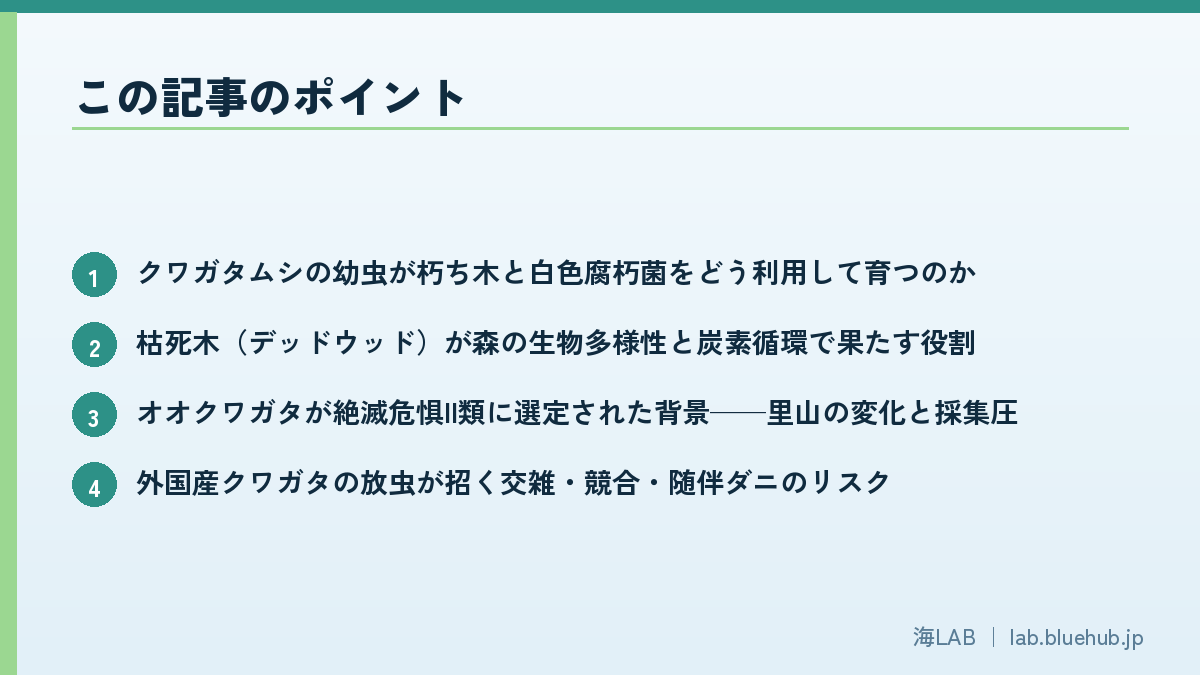
- Stag beetle larvae are "forest decomposers" that eat wood broken down by white-rot fungi, living upon a symbiosis with fungi
- The world's deadwood releases about 10.9 Gt of carbon per year, with insects involved in about 29%—deadwood insects are agents of the planet's carbon cycle
- The Japanese giant stag beetle became Vulnerable through satoyama change and collection pressure; the Okinawa marubane stag beetle is protected from collection by the Species Conservation Act
- Releasing foreign stag beetles risks hybridization, competition, and parasites; "keeping them for life" is the greatest act of conservation
- Forests with dead trees and fallen logs are forests rich in biodiversity—learn to see rotting wood as "forest treasure"
References and Sources
- Ministry of the Environment, Japan – Points of Caution on the Characteristics and Handling of Foreign Stag Beetles (Invasive Alien Species Act insect group meeting document)
- Ministry of the Environment, Japan – List of National Endangered Species (Species Conservation Act)
- Ministry of the Environment, Kyushu Regional Office – Collection and domestic trade are prohibited under the Species Conservation Act (awareness material on the Okinawa marubane stag beetle and others)
- Seibold et al. (2021) Nature – The contribution of insects to global forest deadwood decomposition (quantified at 55 sites on 6 continents)
- Kogane (Japanese coleopterological journal) – Are stag beetle larvae xylophagous or mycophagous? Analysis of the polysaccharide-degrading enzyme system of little stag beetle larvae (2016)
- Fukuoka Prefecture Red Data Book – Japanese giant stag beetle (reasons for threatened listing and decline factors)
- Oita Prefecture – Red Data Book Oita: Japanese giant stag beetle
- Annals of Forest Science (2025) – Comparative study of deadwood availability and saproxylic beetle diversity in Norway spruce stands in southern Sweden
※ Ordered by reliability: government and academic institutions > peer-reviewed papers > specialist organizations > trusted media