⚡ The answer in 30 seconds
- Submarine cables carry over 99% of intercontinental traffic; the seafloor, not satellites, is the main route for international communication.
- About half of cable faults are caused by fishing; shark bites were reported as zero in 2007–2014.
- Environmental impact is considered small, but route selection and handling after removal remain subjects of study.
- Cables can also serve as instruments: SMART cables aim to monitor tsunamis and climate change.
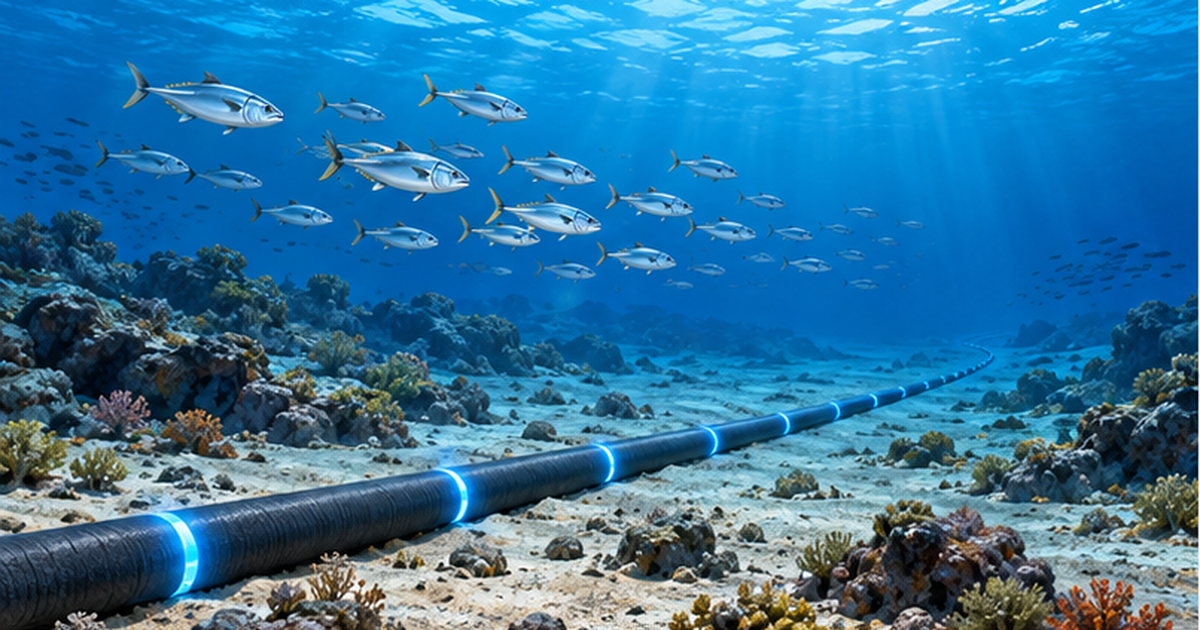
When you watch an overseas video on your phone, the data reaches you not through the sky but along the seafloor. The cables supporting international communication are only about 2 cm thick, yet they connect the world while facing fishing, anchors and earthquakes.
This article covers cable structure and installation, environmental impact, coexistence with fisheries, and the move toward SMART cables that observe the ocean, drawing on materials from the ICPC, UNEP-WCMC and JAMSTEC.
Figures differ by source and counting method, so we distinguish what is well established from what is estimated.
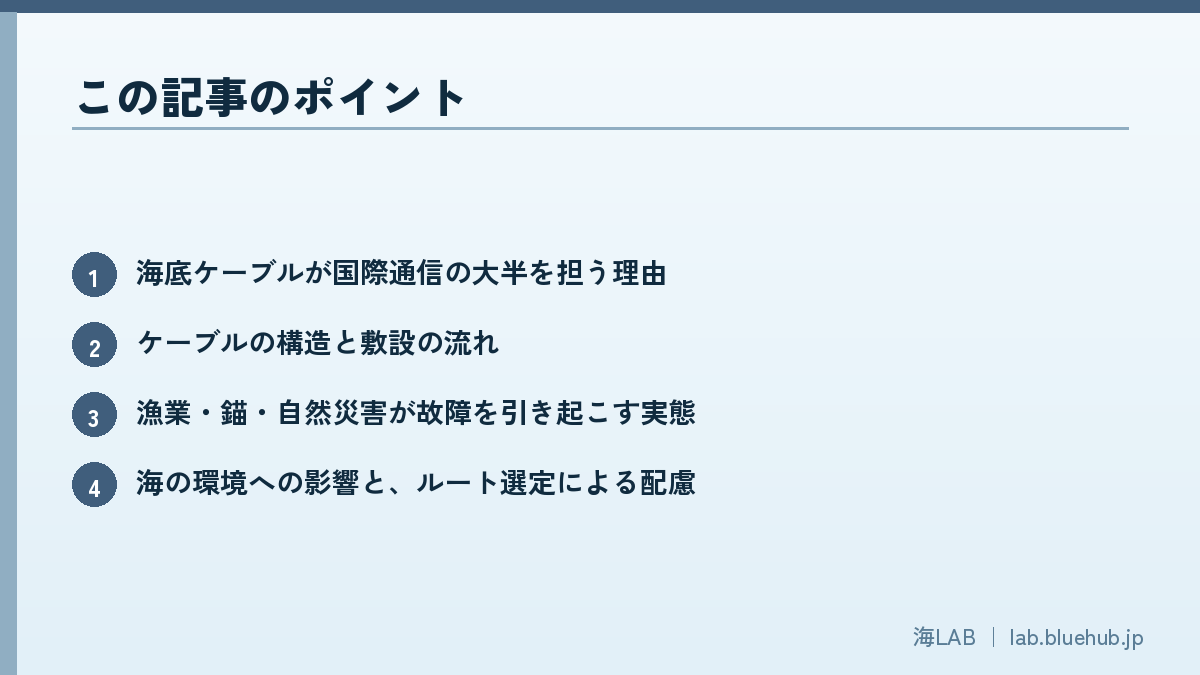
What you will learn
- Why submarine cables carry most international communication
- Cable structure and how installation works
- How fishing, anchors and disasters cause faults
- Environmental impacts and care in route selection
- The role of SMART cables and Japan's DONET and S-net
What Are Submarine Cables? The Ocean's Blood Vessels for the Internet
International communication runs along the seafloor, not through satellites
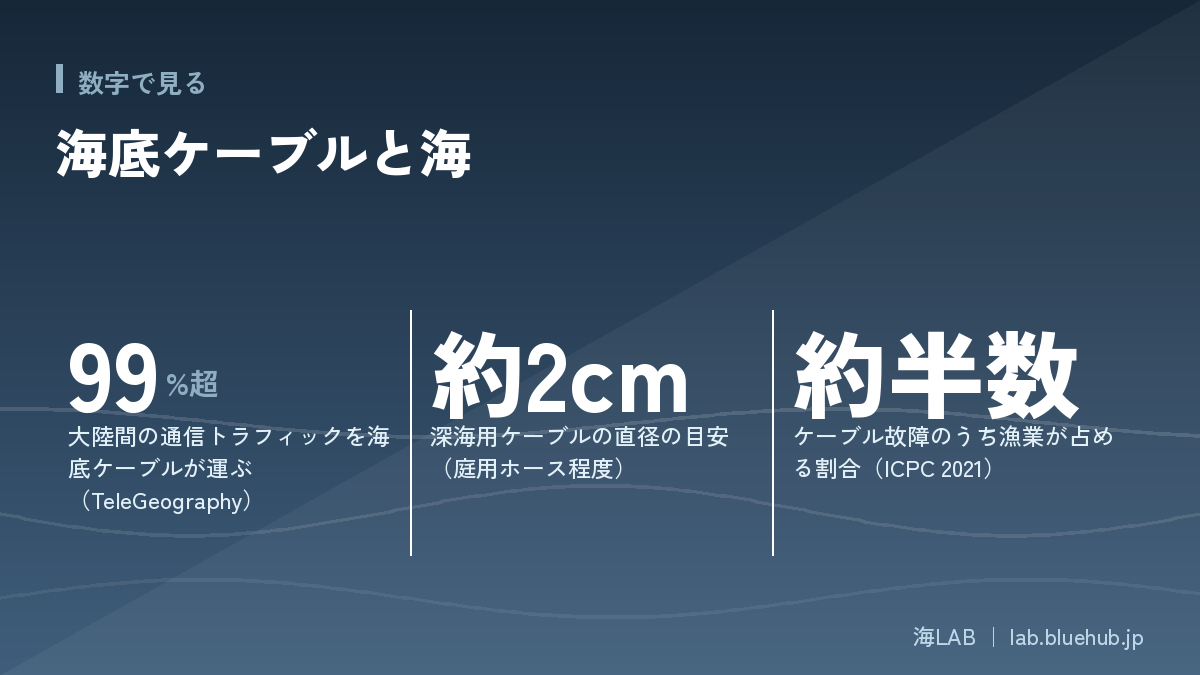
When you open an overseas website or make an international video call, the data does not fall from the sky. Most intercontinental communication travels through optical fiber cables laid on the seabed. The research firm TeleGeography says it can confirm that submarine cables carry more than 99% of intercontinental traffic, while noting that it cannot calculate an exact share because satellite traffic data is not public. "Almost all" is therefore a fair description, but not a figure that can be pinned down to decimals.
Secondary reports citing TeleGeography often put the number of operating submarine cable systems at about 570 (with dozens more planned), and the total length at well over one million km. Counts differ depending on how systems are counted and whether planned cables are included, so it is safest to think of the scale as "hundreds of cables, over a million km."
Inside the cable: surprisingly thin
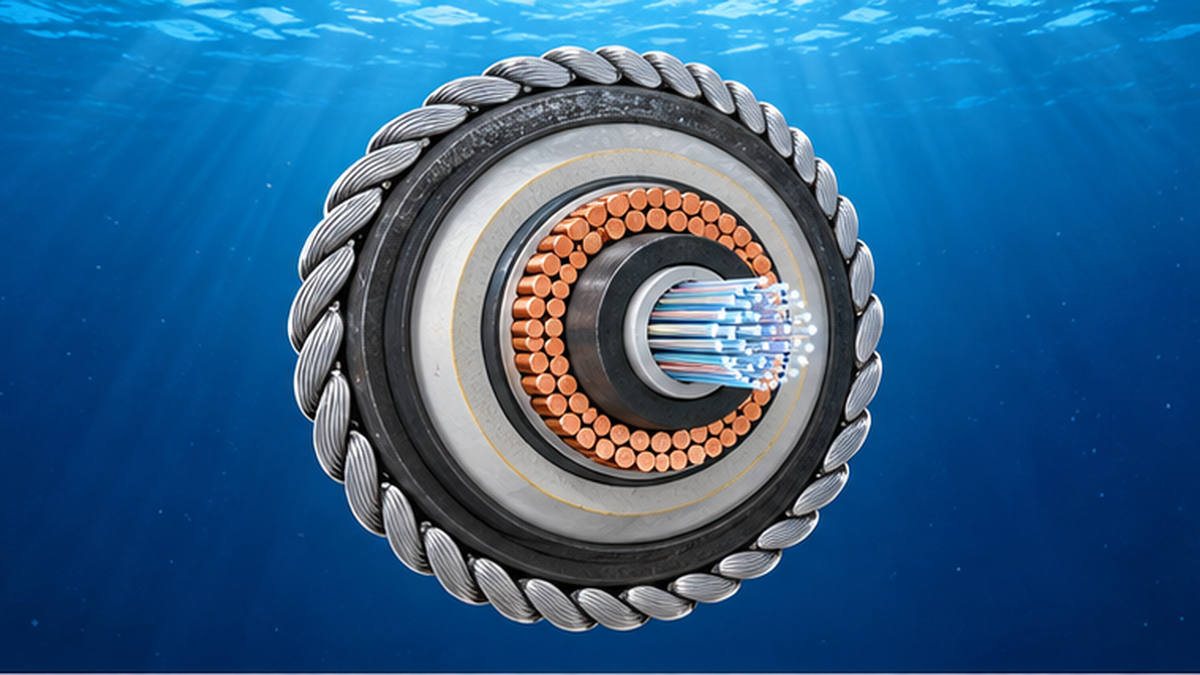
Deep-sea cables are often described as about the thickness of a garden hose, around 2 cm in diameter. An optical fiber sits at the center, surrounded by a copper tube that carries power and an insulating polyethylene layer. In shallow, rough waters where fishing gear and anchors can reach them, extra steel-wire armor is added to make the cable thicker and tougher.
Because light signals weaken over long distances, repeaters are inserted every few dozen kilometers. Power for them is supplied from landing stations on shore through the copper tube inside the cable. With no power source at sea, the cable is both a communication path and a power line.
- Optical fibers: silica glass as thin as a hair, carrying data as pulses of light
- Copper power tube: sends power to the repeaters
- Insulation and waterproof layers: protect the interior from seawater
- Steel-wire armor: shallow sections only, to withstand impacts from fishing gear and anchors
Key points so far
- Over 99% of intercontinental traffic uses submarine cables (TeleGeography)
- Deep-sea cables are only about 2 cm across
- Repeaters are powered through a copper tube in the cable
History: From Telegraph Cables to Optical Fiber
The transatlantic telegraph of the 1850s
The history of submarine cables goes back to the 19th-century telegraph. In 1858 a telegraph cable was laid across the Atlantic and congratulatory messages were exchanged between the Queen and the U.S. President. But it failed within weeks, and reliable transatlantic communication was established only with the cable laid in 1866. Cables of this era could carry only very short messages per day.
The optical fiber era
After telephone cables, the transatlantic fiber-optic cable TAT-8 entered service in 1988. Advances in optical amplifiers and wavelength-division multiplexing then increased the capacity of a single cable by orders of magnitude. Recently, cables advertising hundreds of terabits per second have appeared, driven by video streaming and the spread of cloud services.
| Period | Event | Significance |
|---|---|---|
| 1858 | Transatlantic telegraph cable (failed shortly after) | Showed the potential of undersea communication |
| 1866 | Transatlantic telegraph cable with stable operation | International communication took hold |
| 1988 | TAT-8 (transatlantic optical fiber) | Start of large-capacity digital links |
| 2000s onward | Higher capacity through multiplexing and amplification | Foundation of the video and cloud era |
Today, in addition to telecom carriers, large cloud companies increasingly invest in and lay cables for their own use. This changing ownership structure is an important trend in the field.
How Cables Are Laid: Cable Ships and Seabed Preparation
Route survey and installation
Installation begins with a seabed survey. Acoustic mapping identifies steep slopes, faults, undersea volcanoes, bedrock, and existing cables and pipelines. Avoiding busy fishing grounds and anchorages is also an important condition.
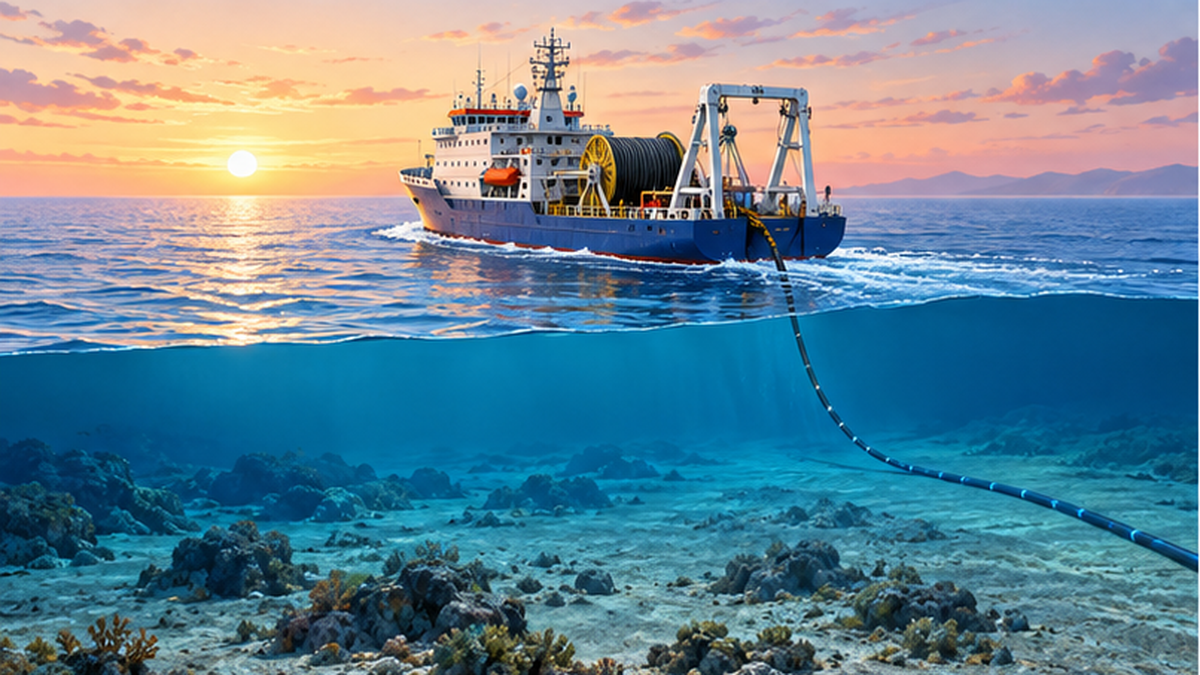
Along the chosen route, a dedicated cable ship pays out thousands of kilometers of cable stored in its hold. In shallow water, a machine such as a plow digs into the seabed and buries the cable below the seafloor surface. According to a presentation by International Cable Ship, shallow-water cables are buried about 1 to 3 m below the seabed. In deep water, the cable is basically just laid on the seafloor and settles under its own weight and the water pressure.
Landing stations: where sea meets land
Cables come ashore at landing points near beaches or ports and connect to terrestrial networks at landing stations. In Japan, Chikura on the Boso Peninsula and Shima in Mie Prefecture are known as major landing sites on the Pacific side. Facing the Pacific, Japan serves as a gateway to North America and Asia.
How Do Submarine Cables Affect the Marine Environment?
Impact is "small, but not zero"
In 2009 the UNEP World Conservation Monitoring Centre (UNEP-WCMC) and the International Cable Protection Committee (ICPC) jointly published Submarine Cables and the Oceans: Connecting the World, summarizing how the cable industry interacts with the marine environment. In April 2025 a sequel report was published, reviewing the literature on how installing, operating and removing cables could affect marine biodiversity, along with mitigation measures.
The ICPC describes the environmental footprint of cables as small. This includes an industry viewpoint, so it should be read with a neutral eye. Possible impacts include the following.
- Disturbance during installation: temporary disturbance of bottom-dwelling life and turbidity from burial and seabed contact
- Fragile ecosystems such as seagrass beds and coral reefs: avoidance through route selection is the basic approach
- Effects during operation: electromagnetic fields and heat have been studied, but conclusions showing major effects are currently limited
- Removal or abandonment: how to handle cables no longer in use is a challenge
Route selection is the main environmental measure
In practice, the most effective step is the route-planning stage. Measures include avoiding coral reefs, seagrass beds, protected areas and spawning grounds, and scheduling work outside breeding seasons. This also helps reduce the friction with fisheries discussed in the next chapter.
How to view environmental impact
Many see cables as imposing less load on the seabed than ship pollution or bottom trawling, but some questions remain under study, such as effects on specific ecosystems and what happens after removal.
What Breaks Cables? Fishing, Anchors and Natural Disasters
Human activity is the biggest cause
However sturdy, cables do fail. In its 2021 material, the ICPC states that of more than 5,000 faults in its database, fishing accounts for nearly half and natural hazards for less than 10%. An older analysis reported that anchoring and fishing together caused 65 to 75%. Trawl gear in particular, with its doors (otter boards) dragged along the seabed, is said to put heavy force on cables.
Do sharks bite cables?
The idea that sharks bite cables is famous, but according to the ICPC, fish and sharks caused less than 1% of faults up to 2006 and zero reported faults between 2007 and 2014. Improvements in cable design are thought to have all but removed the risk of fish bites.
| Cause | Approximate share (ICPC) | Notes |
|---|---|---|
| Fishing | About half | Contact with trawl doors, etc. |
| Anchors | 65–75% together with fishing in an older analysis | Dragging anchors, emergency anchoring |
| Natural hazards | Under 10% | Submarine landslides, earthquakes, currents |
| Component failure | About 5% in one analysis | From an older analysis |
| Unknown | 10–20% in one analysis | — |
Examples of natural disasters
In the 2011 Great East Japan Earthquake, several cables were damaged, including those between Tokyo and Sendai; one analysis says at least six cables were damaged, with more than a dozen breaks in total. Because operators could reroute traffic, the impact on the internet was relatively limited. In the January 2022 Tonga volcanic eruption, the international cable was severed and international communication was cut for about five weeks; repair was completed on February 22. It showed the risk faced by island nations that depend on a single cable.
Coexisting with Fisheries: Protected Zones and Rules
Cable protection zones
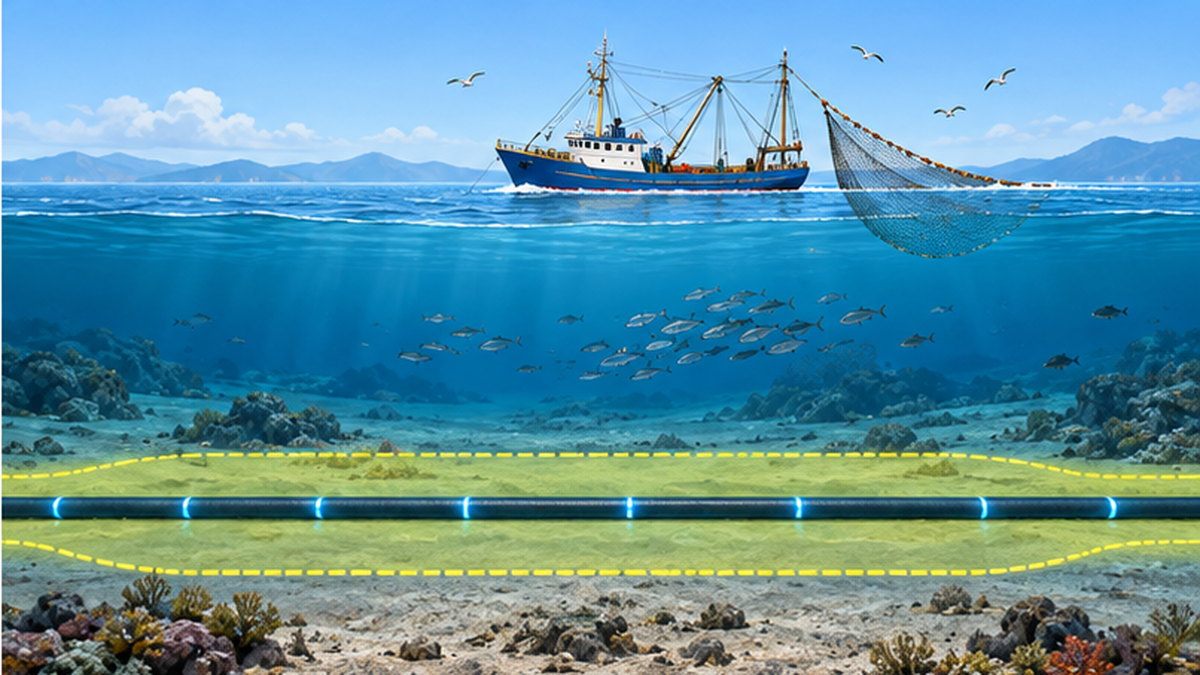
To prevent collisions between fisheries and cables, countries have set up cable protection zones. In New Zealand's Hauraki Gulf, for example, a mapped corridor bans fishing and anchoring to protect an international communications cable. In Scotland's Shetland Islands, after an incident in which a trawler was reported to have damaged a cable, a proposal was made for a protective seabed corridor.
In Japan too, sea areas with cables are marked on nautical charts and made known to fishers and ships. Cables are generally laid after consultation with fishing cooperatives and compensation, and cooperation with fishers is the foundation for protecting them.
Benefits for fishers
Avoiding cables when fishing is a burden, but cables that support communications also benefit the fishing industry: transmitting sea-condition data, digitizing catch records, and providing internet to remote fishing villages. They serve as infrastructure linking sea and land.
What fishers and ships should keep in mind
- Check cable positions on nautical charts
- Do not drop anchor near cables (except in emergencies)
- If something that looks like a cable is caught in nets or anchors, do not cut it; contact the responsible authority
Cables That Observe the Ocean: SMART Cables
Turning communication cables into observation instruments
Submarine cables can serve not only for communication but also as ocean sensors. In 2012 the ITU, the WMO and UNESCO's Intergovernmental Oceanographic Commission (IOC) launched a joint task force (JTF) that promotes SMART cables. SMART is said to stand for "Science Monitoring And Reliable Telecommunications," and the concept is to build temperature, pressure and seismic (acceleration) sensors into cable repeaters.
If a network of about one million km of cable with thousands of repeaters could be used, climate indicators such as ocean heat content, ocean circulation and sea-level rise could be monitored continuously at modest added cost. A 2019 paper in Frontiers in Marine Science showed through simulations that cable-based pressure and seismic-acceleration sensors could improve tsunami warning lead times and earthquake information. These are, however, expectations; operational results remain to be verified.
Japan's seafloor observation networks
Japan has seafloor observation networks for earthquakes and tsunamis that use cable technology. DONET of the Japan Agency for Marine-Earth Science and Technology (JAMSTEC) covers the Nankai Trough, and S-net of the National Research Institute for Earth Science and Disaster Resilience covers the Japan Trench off Tohoku. S-net is known as a large system linking 150 observation stations with about 5,500 km of cable. For more on tsunami preparedness, see Tsunami Disaster Prevention Basics.
Communication and observation together
With SMART cables and Japan's DONET and S-net, cables are expanding from lines that carry information to lines that measure the ocean.
Future Challenges: A Crowded Sea, Decarbonization and Security
Competition for sea space with offshore wind
The seabed is becoming a place where telecom cables, power cables, offshore wind, seabed resource development and fisheries overlap. How to coordinate crossings between wind-farm transmission cables and telecom cables, and the effects of turbine foundation work, is a challenge ahead. For Japan's offshore wind trends, see the offshore wind article.
Security and redundancy
In recent years damage to submarine cables has increasingly made international news, and the risk of communication loss is debated from a security standpoint. Distinguishing accidents from deliberate acts is difficult and conclusions should be cautious. What is certain is that redundancy through multiple reroutable paths is thin in regions that depend on a single cable, like Tonga.
Within the sustainable use of the ocean
Submarine cables reflect the challenge of using the ocean in harmony with it rather than using it up. Like ghost gear, the management of man-made objects left on the seabed is a shared theme.
What you can do starting today
- When you see "cable cut" in the news, look at the cause and the time to restore
- Learn the background of sea-use rules (anchoring, fishing)
- Read ocean news with infrastructure and observation in mind
References
- TeleGeography「Do Submarine Cables Account For Over 99% of Intercontinental Data Traffic?」 – Fact-check of the 99% intercontinental traffic claim
- TeleGeography「What happens when submarine cables break」 – Cable faults and repair
- ICPC (International Cable Protection Committee) publications – Materials on cable protection and the environment
- UNEP-WCMC / ICPC『Submarine Cables and the Oceans: Connecting the World』 – Cables and the marine environment (2009)
- SMART Cables Joint Task Force(ITU/WMO/UNESCO-IOC) – The SMART cable concept
- Howe et al. (2019) SMART Cables for Observing the Global Ocean – Frontiers in Marine Science
- Fibre Systems「Sharks don't dine on subsea fibre optic cables, says ICPC」 – ICPC's view on shark damage
- Computerworld「Don't blame sharks for Asian Internet problems」 – Share of fault causes
- The Record「Tonga submarine cable repaired」 – Cable restoration after the Tonga eruption
- Data Center Knowledge「Japan Quake: Multiple Undersea Cables Damaged」 – Great East Japan Earthquake and submarine cables
* Ordered by reliability: government and academic bodies > peer-reviewed papers > specialist organizations > reliable media