⚡ In short
Among Japan's 200 "Meisui Hyakusen" (100 Famous Waters), many sacred springs have been protected for centuries alongside shrine rituals and dragon-god legends. This article traces, through primary government and academic sources, how faith and local customs such as turn-based irrigation rules preserved these water sources.
A "go-shinsui" (sacred water) quietly welling up at a mountain shrine is not merely a scenic spot — it carries centuries of water-source conservation wisdom that has sustained local life.
In 1985, Japan's Environment Agency (now the Ministry of the Environment) selected the "Meisui Hyakusen" (100 Famous Waters) based not only on water quality and quantity, but also on whether local residents were engaged in conservation activity. In other words, much of the spring water that survives as "famous water" today is water that someone has enshrined and kept protecting. Dragon-god legends, rain-praying and rain-stopping rituals, and the turn-based water distribution known as ban-sui — these were "rules" that local communities devised before scientific water management existed. They were systems in which practical necessity and faith were fused, designed to avoid conflict over water and hand down limited resources to the next generation.
This article traces, based on primary sources from the Ministry of the Environment, the Ministry of Agriculture, Forestry and Fisheries, and the Ministry of Land, Infrastructure, Transport and Tourism, how faith and water became intertwined in Japan, and how that structure connects to water-source conservation today. We will look at the Meisui Hyakusen system, the origins of dragon and water-deity worship, local rules such as ban-sui and iriai (common land) rights, and the conservation activities carried on today, with concrete examples throughout. The sense of awe that treated water sources as sacred ground also acted, as a result, as a brake on reckless development and excessive water withdrawal. We will read this as another logic of water-source conservation, distinct from modern water management focused purely on efficiency.
What you'll learn in this article
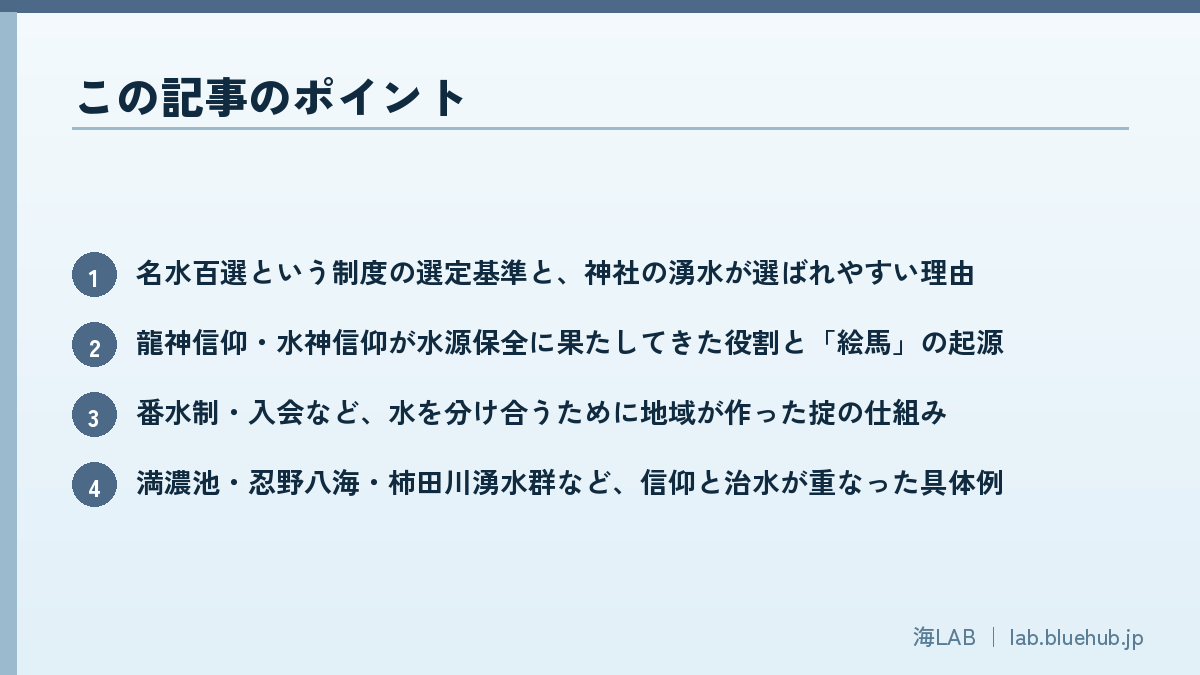
- The selection criteria of the Meisui Hyakusen system, and why shrine springs are often chosen
- The role dragon and water-deity worship played in water-source conservation, and the origin of ema votive plaques
- How local rules such as ban-sui and iriai were built to share water fairly
- Concrete cases where faith and water management overlapped, such as Mannō Pond, Oshino Hakkai, and the Kakita River springs
- Today's citizen-led conservation activities and the challenges ahead
Meisui Hyakusen: Why "Waters of Prayer" Were Selected
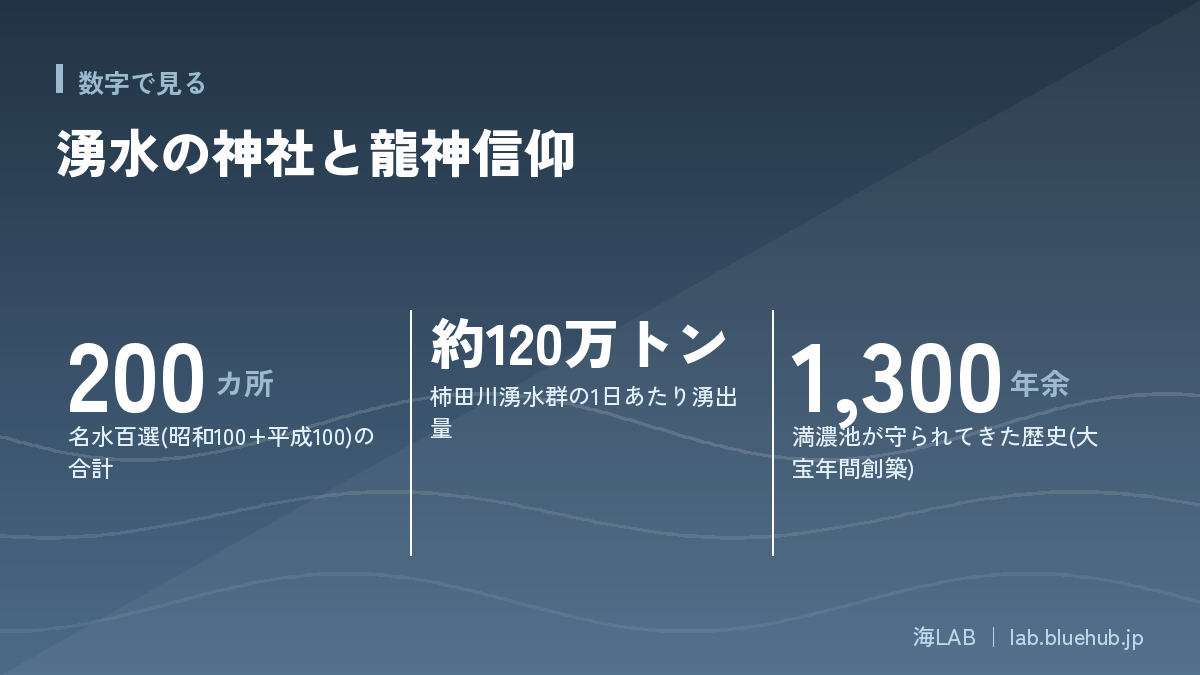
The "Meisui Hyakusen" (100 Famous Waters) is a list of 100 springs, rivers, and groundwater sources across Japan, selected by the Environment Agency (now the Ministry of the Environment) in March 1985. In 2008, a further 100 sites not overlapping with the original list were selected as the "Heisei Meisui Hyakusen," bringing the total to 200. Even now, nearly 40 years after the first selection, many municipalities and tourism associations call themselves "towns of famous water" and use the designation as the core of their regional branding. "Famous water stamp rallies," and local specialty products made with the water — sake, coffee, somen noodles, and more — continue as tourism promotion strategies in many selected areas. In 2015, the Ministry of the Environment even ran a "Meisui Hyakusen Election," a ranking-style campaign by category to promote the appeal of these waters.
The Criteria Go Beyond "Water Quality"
Selection required not only good water quality and quantity, but also surrounding scenery, accessibility to the water, and, crucially, ongoing conservation activity by local residents. The Heisei list added further criteria: "the state and tradition of water use" and "distinctive features such as historical background or rarity." In other words, Meisui Hyakusen is not simply a ranking of untouched natural springs — it is also a ranking of "how people have protected the water." Judging purely by water-quality test results, there are springs not on the list that are just as good or better. What often keeps them off the list is the absence of the human element: conservation activity. Alongside routine water-quality data recorded by government monitoring and research institutions, the selection documents also require descriptions of things like the frequency of cleanup activities, whether festivals are held, and whether local dishes made with the spring water have been passed down. It is this culture, which numbers alone cannot capture, that has determined selection.
- Good water quality and quantity
- Well-preserved surrounding scenery
- Accessibility, allowing people to get close to the water
- Ongoing conservation activity by local residents
- Continuity in the state and tradition of water use (Heisei list)
- Distinctive features such as historical background, rarity, or fame
| Category | Year selected | Number of sites |
|---|---|---|
| Showa Meisui Hyakusen | 1985 (Showa 60) | 100 sites |
| Heisei Meisui Hyakusen | 2008 (Heisei 20) | 100 sites |
| Total | — | 200 sites |
The Ministry of the Environment is considering a "Reiwa" Meisui Hyakusen
Reports indicate the Ministry of the Environment is considering a new selection that places greater weight on "utilizing the water's edge," such as environmental education for children and recreational use like water play. As of September 2026, however, no official selection results have been announced.
How Water-Deity and Dragon-God Worship Began
Japan's dragon-god (ryūjin) worship, in which dragons are deified as spirits governing water, rain, wind, rivers, the sea, and natural phenomena, is thought to have formed from the fusion of the dragon concept introduced from China with Japan's indigenous snake worship and water-deity worship. The dragon god was seen as a being that freely moved between heaven and earth, governing the forces of nature itself — both a guardian deity protecting against natural disasters and a deity of abundance bringing fruitful harvests. The natural flow itself — rain falling on the mountains, flowing down valleys, becoming rivers, and reaching villages — could be understood as the very form of the dragon god. When drought continued, rain-praying rituals were held across the country to calm the dragon god's wrath; when rain continued too long, rituals to pray for it to stop were held instead. For agricultural communities, these rituals were among the few proactive acts available against uncontrollable weather, and regardless of outcome, they are also thought to have served to maintain community cohesion.
Rituals to Pray for Rain and Pray for It to Stop
Niu Kawakami Shrine in Nara Prefecture is said to have been founded in 675 CE by Emperor Tenmu, and has long been regarded as a shrine with miraculous power for "praying for rain and praying for rain to stop." Its Upper Shrine enshrines Takaokami-no-kami, who governs rainfall; its Middle Shrine enshrines Mizuhanome-no-kami, who presides over wells and irrigation; and its Lower Shrine enshrines Kuraokami-no-kami, symbolizing groundwater and water sources — a three-shrine structure covering every aspect of water. The Upper Shrine calls itself the "grand head shrine of dragon-god worship" and continues to draw worshippers today as the wellspring of water-deity faith. What is notable is that two opposite prayers — for rain and for rain to stop — were directed at the same deity, the same shrine. Too much water and too little water alike threaten human life. Precisely because of this, the deity who "gives" water and the deity who "withholds" it were enshrined as one and the same, and a well-balanced middle ground itself became the object of prayer.
Black horses, white horses, and the origin of ema
- During the Heian period, the imperial court offered black horses to shrines when praying for rain, and white horses when praying for rain to stop
- Records show 42 such offerings at Niu Kawakami Shrine versus 5 at Kifune Shrine, suggesting Niu Kawakami was the center of water-deity worship
- Live horse offerings gradually gave way to painted or wooden horses, which is considered one of the origins of today's ema votive plaques
Water Worship at Kyoto's Kifune and Shimogamo Shrines
Kyoto's Kifune Shrine was also positioned as a center for the imperial court's rain-praying and rain-stopping rituals after the relocation of the capital to Heian-kyo. Located near the headwaters of the Kifune River, it enshrines Takaokami, the god of water, and to this day retains water-related traditions such as the "mizu-uranai" fortune-telling slips read by floating them on water. Within the grounds of Kyoto's Shimogamo Shrine, the Tadasu no Mori forest has long been revered as a place where clear water wells up, and as sacred ground at the headwaters of the Kamo River. The "Mitarashi Pond" within the grounds, fed by this spring water, is said by some to be one of the birthplaces of mitarashi dango skewered dumplings — an example of how sacred water and everyday food culture can be connected. Such links between "sacred water" and "everyday food" are not rare, and show how water worship continues to live on today through tourism and food culture.
| Shrine | Location | Deity / worship | Background |
|---|---|---|---|
| Niu Kawakami Shrine (Upper, Middle, Lower) | Yoshino District, Nara Prefecture | Takaokami, Mizuhanome, Kuraokami | Said to have been founded in 675 CE; a center for rain-praying and rain-stopping rituals, receiving black and white horse offerings from the imperial court |
| Kifune Shrine | Kyoto City, Kyoto Prefecture | Takaokami | After the relocation to Heian-kyo, positioned as one center of the court's rain-praying and rain-stopping rituals |
| Shimogamo Shrine (Tadasu no Mori) | Kyoto City, Kyoto Prefecture | Kamotaketsunumi-no-mikoto and others | Tadasu no Mori has long been revered as sacred ground at the spring-fed headwaters of the Kamo River |
Dragon Legends Across Japan and Okinawa's Water Worship
Water-deity and dragon-god worship was never limited to the old capitals of Nara and Kyoto. Dragon legends and water worship tied to local water sources have been handed down across the country. Here we look at representative examples: the kuzuryū (nine-headed dragon) worship of Hakone and Togakushi, Hakusan worship, and the water worship of Okinawa's maritime culture. It is fascinating that, apart from the state-organized rain rituals developed in the capital, water worship rooted in each region's terrain and way of life developed along its own lineage.
Kuzuryū (Nine-Headed Dragon) Worship: Hakone and Togakushi Shrines
Kuzuryū Shrine, within the grounds of Hakone Shrine in Kanagawa Prefecture, enshrines the nine-headed dragon god as guardian of Lake Ashi. According to legend, the priest Mangan subdued a poisonous dragon that had been ravaging the lake; as he did so, the dragon's head split into two, then three, and eventually became a dragon with nine heads, reborn as the guardian deity. Togakushi Shrine in Nagano Prefecture is likewise centered on kuzuryū worship; the enshrined Kuzuryū Ōkami (also called Kuzuryū Gongen) originally appears in legend as a monstrous nine-headed, one-tailed serpent, and has long been believed to bring divine favor for rain-praying and for blessing children. The kuzuryū is regarded as the "king of all dragons," the highest in rank among dragon deities, and is worshipped across the country as a symbol of the power to control water. At Kuzuryū Shrine in Hakone, a monthly festival is held on the 13th, and a "lake festival" in which worshippers approach by boat across Lake Ashi is also well known. These rituals serve as a tourism draw while also functioning, each month, as a device to reaffirm gratitude toward Lake Ashi as a water source.
Hakusan Worship: The Sacred Mountain That Feeds Rivers Like the Tedori and Kuzuryū
Shirayama Hime Shrine in Ishikawa Prefecture is the head shrine of more than 3,000 Hakusan shrines nationwide. Tradition holds that in 717 CE, the monk Taichō of Echizen (present-day Fukui Prefecture) first climbed Mount Hakusan, and the following year enshrined an inner sanctuary at its summit, marking the beginning of Hakusan worship. The Tedori, Kuzuryū, Nagara, and Shō rivers — all of which have their headwaters on Mount Hakusan — are major rivers supporting agriculture and daily life across the Hokuriku region, and gratitude for this abundant water is said to underlie Hakusan worship. Revering the mountain itself as sacred ground has, as a result, also helped protect the forests at its headwaters. Hakusan worship later became linked with Shugendō mountain asceticism, and multiple pilgrimage routes (zenjō-dō) toward Hakusan were developed from the Kaga, Echizen, and Mino directions. Along these routes, many shrines and ascetic sites were placed to watch over the water sources, resulting in the entire mountain range being protected as an object of worship.
Suwa Taisha's Omiwatari: The Path the Dragon God Walked on Ice
At Lake Suwa in Nagano Prefecture, when the lake freezes over completely, a natural phenomenon called "omiwatari" can occur, in which the ice cracks and rises into ridges running from the south shore to the north. It is said to be the path taken by the male deity Takeminakata-no-kami of Suwa Taisha's upper shrine to visit the goddess Yasakatome-no-kami of the lower shrine. The cracks in the ice form ridges roughly 30 cm to 1.8 m high, and their appearance, direction, and timing were traditionally used as a ritual divination of the year's weather and harvest.
At Yatsurugi Shrine in Suwa City, records of the omiwatari's appearance have been kept almost without interruption for over 580 years, from 1443 to the present. Such a long-running natural observation, maintained as a folk ritual, is considered rare even by global standards.
Years with "no appearance" are increasing due to climate change
In recent years, warmer winters have meant Lake Suwa more often fails to freeze over completely, leading to repeated declarations of "akenoumi" (the open sea), meaning no omiwatari appeared. It was reported that the phenomenon again failed to appear in the 2026 season, marking eight consecutive years without an omiwatari. The 580-year record is now also drawing attention as an indicator of climate change.
Okinawa's Water Worship: Kaa Wells and Utaki
Okinawa, part of Japan's maritime culture, also has its own distinct tradition of water worship. Before modern water systems became widespread in the 1960s, island life was supported by springs and wells called "kaa" and spring facilities called "hii-jaa." Kaa were maintained by local communities and used as drinking water, wash water, water for cleaning farm tools and produce, irrigation water, and firefighting water; elderly residents can still be seen today offering incense and prayers at some of them. In addition, "utaki," the ritual and worship sites of Ryukyuan Shinto, are found throughout the islands, and in many cases a spot where water wells up has been enshrined as an utaki. This way of revering water from both land and sea offers a perspective that captures the whole Earth — not just the ocean, but the water cycle on land as well. After the spread of modern water systems, most kaa are no longer used for drinking, but many remain as the focus of local events and cleanup activities. Maintaining wells and springs not merely as "water sources" but as "places of prayer" shares a structure in common with the water worship of mainland Japan.
| Shrine / worship | Location | Water body | Background |
|---|---|---|---|
| Hakone Shrine / Kuzuryū Shrine | Hakone, Kanagawa Prefecture | Lake Ashi | Said to have been founded when the priest Mangan subdued a poisonous dragon and enshrined it as the nine-headed dragon god |
| Togakushi Shrine | Nagano City, Nagano Prefecture | Waters around Mount Togakushi | Enshrines Kuzuryū Ōkami (Kuzuryū Gongen); worshipped for rain-praying and blessing children |
| Shirayama Hime Shrine (Hakusan worship) | Hakusan City, Ishikawa Prefecture | Tedori, Kuzuryū, and other rivers | Opened in 717 CE by the monk Taichō; worship is rooted in gratitude for the Hokuriku rivers that have their headwaters on Mount Hakusan |
| Suwa Taisha / Yatsurugi Shrine | Suwa City, Nagano Prefecture | Lake Suwa | Continues a ritual recording the omiwatari phenomenon since 1443, over 580 years |
Water worship takes different forms in different regions
- Inland mountain worship often reveres the "mountain that gives birth to water" itself as sacred ground (e.g., Hakusan worship)
- Shrines near the old capitals became linked to the imperial court's rain-praying and rain-stopping rituals, taking on a more public character (e.g., Niu Kawakami Shrine, Kifune Shrine)
- In island regions, a strong tradition remains of enshrining the wells and springs themselves as sites of daily life (e.g., Okinawa's kaa and utaki)
Fuji's Spring Waters and Pilgrimage: Oshino Hakkai and the Kakita River Springs
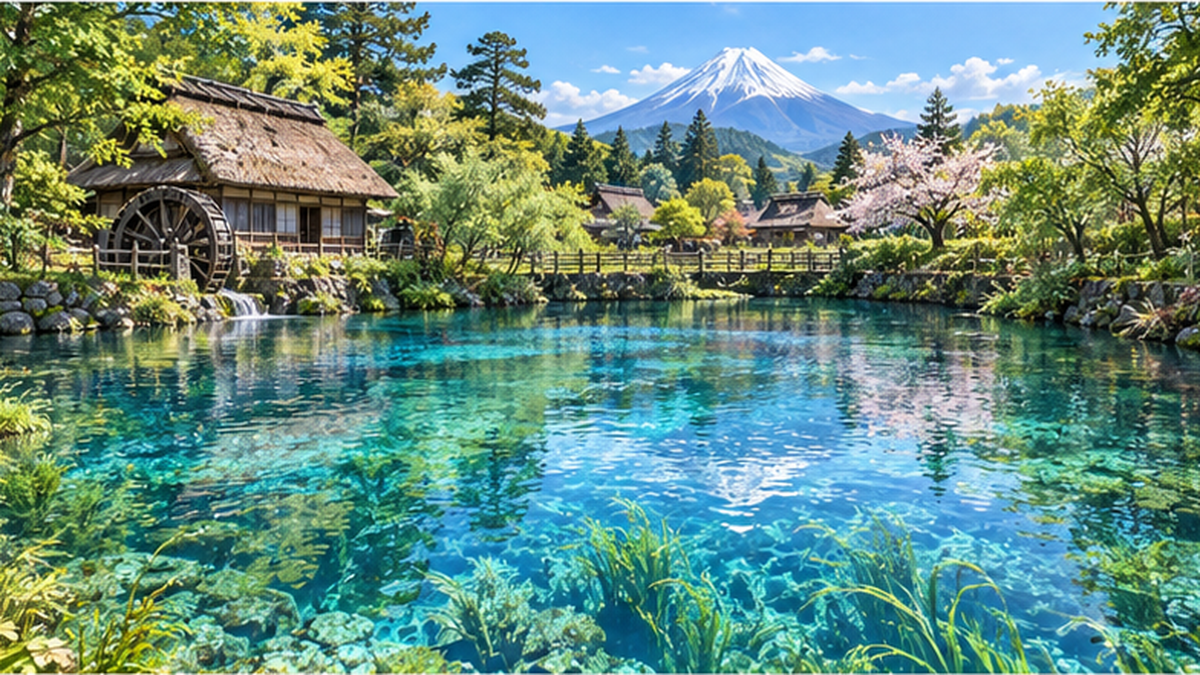
The link between faith and spring water is also deeply tied to mountain worship. Oshino Hakkai in Yamanashi Prefecture consists of eight spring-fed ponds sourced from the underground flow of Mount Fuji, and is designated as one of the component assets of the Fuji World Cultural Heritage site. It is valued not simply for its scenic beauty, but as a pilgrimage site integrated with Mount Fuji worship. Fuji-kō was a form of Mount Fuji worship that spread among common people in the Edo period; believers formed mutual-aid associations called kō, pooled funds, and sent representatives on pilgrimages to climb the mountain. Oshino Hakkai, where pilgrims performed the purification ritual of mizugori to wash away impurity before the climb, functioned as a kind of "frontline base to purify body and mind before the main event."
Oshino Hakkai: A Site of Purification for Fuji-kō Pilgrims
Also called the "eight original lakes of Mount Fuji," Oshino Hakkai was a pilgrimage site where Fuji-kō believers, before climbing Mount Fuji, performed mizugori to wash away impurity. Circling the eight ponds in sequence was itself built into the practice of faith. Among the eight, the representative Wakuike pond is known for its rich spring flow, at a depth of about 4 meters, and stands as the pond most representative of Oshino Hakkai. Each pond, including Deguchi-ike and Nigori-ike, carries its own distinctive origin story and legend. The eight ponds were likened to the eightfold teachings of Buddhism and collectively called "hakkai" (eight seas), with the belief that circling each one in turn completed a single act of ascetic practice. Today it is known as a tourist destination, but the many visitors drawn by the clarity of its water are not unrelated to this lingering faith.
The Kakita River Springs: Said to Have the Largest Flow in East Asia
The Kakita River springs in Shizuoka Prefecture boast one of the largest flows among the springs around Mount Fuji, said to discharge roughly 1.2 million tons of groundwater per day from dozens of large and small outlets. Rain and snow falling on Mount Fuji seep into the ground and, after being filtered over many years, emerge as spring water; the high clarity of the water draws many organisms, including baikamo water crowfoot and kingfishers. It, too, is on the Meisui Hyakusen list and functions as a water reservoir for eastern Shizuoka Prefecture. Despite its short overall length, the Kakita River nurtures a valuable ecosystem designated as a natural monument of Japan, and the local area has built a park with walkways allowing visitors to observe the springs up close.
The Wisdom of Sharing Water: Ban-sui and the Rules of Iriai
Beyond faith, communities also spent long stretches of time devising practical rules for "sharing" water. Kagawa Prefecture, with its dry Seto Inland Sea climate, is a leading example. With low annual rainfall and no large rivers to rely on, reservoirs and finely tuned rules for distributing water fairly have long determined the very survival of the region.
Kagawa's Reservoir Culture and "Incense-Stick Water"
Kagawa Prefecture built more than 4,000 reservoirs during the Edo period alone, developing a system in which water flowed from large parent reservoirs to smaller child reservoirs through networks of channels. Under the "ban-sui" turn-based distribution system, a custom called "senkō-mizu" (incense-stick water) determined the order of water use based on the time it took for an incense stick to burn down. Disputes over changes to weir structures, the fairness of distribution facilities, and the order of turns sometimes escalated into actual water conflicts, according to records. These strict and intricate water-sharing customs were built up over time to distribute limited water efficiently across the whole plain. Such customs were often passed down orally rather than in writing, with village elders or water-association officers responsible for their operation. Ban-sui was not merely a technical rule — it was also a mechanism that made visible the "trust within the community" over who used how much water and when.
Mannō Pond: Japan's Largest Reservoir, Rebuilt by Kūkai
Mannō Pond in Mannō Town, Kagawa Prefecture, is one of Japan's largest irrigation reservoirs, said to have first been built during the Taihō era (701–704). In 821 CE (Kōnin 12), the Buddhist priest Kūkai (Kōbō Daishi) undertook its reconstruction, using the most advanced engineering techniques of the time to complete what is considered Japan's first arch-shaped embankment in a short period. With a circumference of about 20 km, a storage capacity of 15.4 million tons, and an irrigated area of roughly 3,000 hectares, it was registered in 2016 as a World Irrigation Heritage site by the International Commission on Irrigation and Drainage — the first such designation in Shikoku. The very fact that the name of a single engineer, Kūkai, survives in legend shows that this reservoir has been treated not merely as a piece of civil infrastructure, but as an object of communal memory and faith. Mannō Pond has suffered several collapses throughout its history, each time rebuilt through community-wide effort. Records of major collapses and reconstructions remain even from the Edo period, showing that maintaining the reservoir has itself remained a shared undertaking spanning generations.
| Item | Details |
|---|---|
| First built | Said to date to the Taihō era (701–704) |
| Reconstruction | 821 CE (Kōnin 12): rebuilt into an arch-shaped embankment by Kūkai (Kōbō Daishi) |
| Scale | Circumference approx. 20 km, storage capacity 15.4 million tons, irrigated area approx. 3,000 ha |
| Designation | 2016: World Irrigation Heritage (first in Shikoku) |
Iriai Land and Customary Water Rights: A System of Shared Management
Behind these water-sharing systems lies "iriai," a uniquely Japanese custom of communal use. A group of residents in a given area (a village community) had the right to enter forested or open land (iriai land) to obtain resources needed for production and daily life, and to manage and use it jointly — this is known as iriai rights. For agricultural water as well, "customary water rights" were established region by region, socially recognized as legitimate based on a record of repeated, ongoing use. Unlike ownership rights, which belong to an individual, this is a system premised on collective protection and collective sharing. Before the Meiji era it operated as village custom, and after Meiji its legal status changed as formal institutions were developed, but the basic idea of managing water as something "belonging to everyone" has carried over into the operation of today's land improvement districts and water associations. Modern land improvement districts can be seen as an institutionalized form of the old iriai and ban-sui spirit, and the basic structure of shared management by union members has changed little even now that legal systems are in place.
Faith and Water Coexisting in Globally Important Agricultural Heritage
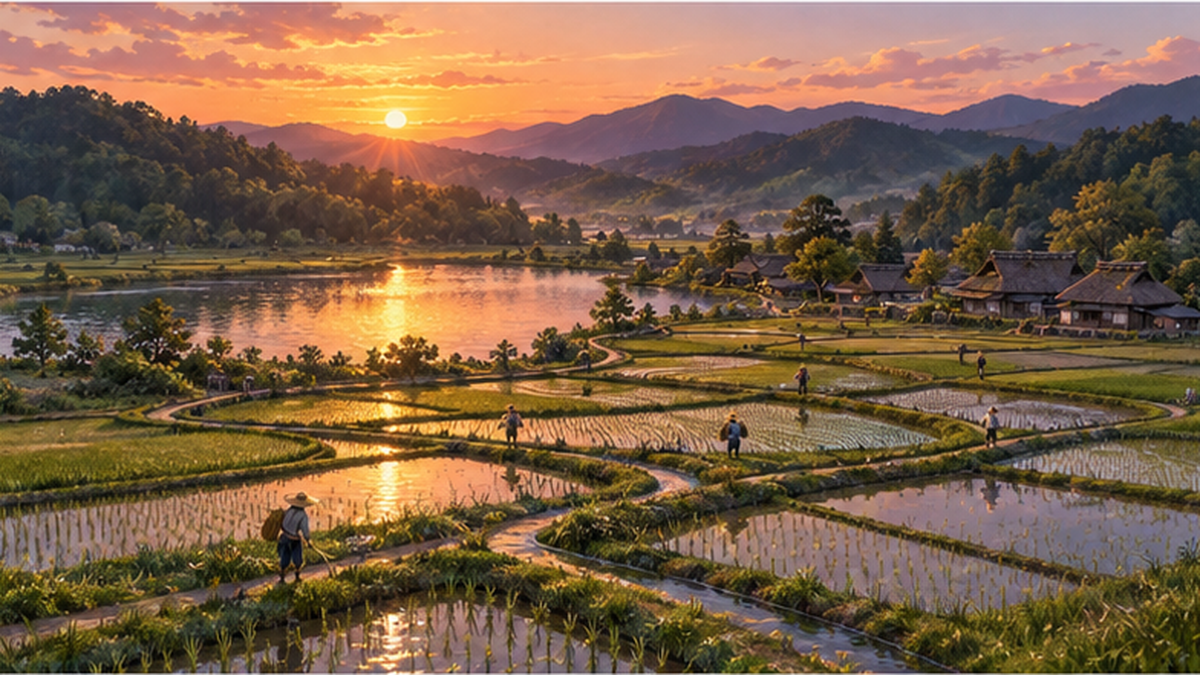
Mechanisms for protecting water sources were never self-contained within a single reservoir or shrine — they functioned as a single system connecting the mountains, the villages, and the sea. The Noto Satoyama and Satoumi region of Ishikawa Prefecture is one area recognized under the Globally Important Agricultural Heritage Systems (GIAHS), evaluated as an integrated whole encompassing terraced-field rice farming, the sun-drying of rice sheaves known as haza-boshi, lacquer cultivation and tapping that supports Wajima lacquerware, traditional agehama-style salt production, ama female divers, and traditional net-fishing techniques — primary industries across the Noto Peninsula that make use of the blessings of both mountain and sea. The way human activity has accumulated along the flow of water, from its source through the rice paddies and out to the sea, contributed to this international recognition. GIAHS is a designation from the UN Food and Agriculture Organization (FAO), distinctive for evaluating traditional agriculture together with the related land use, biodiversity, and culture as an integrated whole. Noto's Satoyama and Satoumi was one of the earliest regions in Japan to receive GIAHS recognition.
Water-Source Forests and the "Green Dam" Theory
The foundation that allows springs and famous waters to flow steadily is the forest on the mountains. The function by which forests absorb rainwater into the soil and gradually release it into rivers over time is called "water-source conservation" (suigen-kan'yō), and is popularly described as a "green dam." This function of the forest is inseparable from the spring water long enshrined as Meisui Hyakusen or go-shinsui. The fact that many shrines are accompanied by a chinju-no-mori (guardian forest), which in turn has also served as a water-source conservation forest, is evidence that faith and practical benefit have overlapped. For a more detailed look at this mechanism, see How Water-Source Forests Work: The Mechanism by Which Forests Store Rain and Release It into Rivers, and the Reality of the "Green Dam" Theory. Unlike plantation forests grown for fuel or timber, chinju-no-mori have often been maintained for long periods as sacred ground where logging is restricted. As a result, they help preserve the soil's water-retention capacity, and are thought to have had the effect of stabilizing the volume of nearby springs.
Rice Paddies and Wetlands as Vessels for "Prayerful Water"
Rice paddies and wetlands have functioned not merely as sites of production, but as artificial waterside habitats nurturing diverse living creatures. Paddies teeming with frogs, loaches, and aquatic insects have also been tied to festivals praying for a good harvest and rituals welcoming the rice-paddy deity. For more on the conservation of Japan's 54 Ramsar Convention wetlands, see What Are Ramsar Convention Wetlands? The Reach of Japan's 54 Sites and the Power of Wetlands to Purify Water and Nurture Life. What rice paddies have achieved goes beyond food production — they also serve as temporary retention basins during heavy rain and help recharge nearby groundwater. Paddies as places of faith and paddies as disaster-prevention infrastructure cannot really be separated.
Not Taking Too Much: Where Faith and Practice Align
Wisdom about not "taking too much" applies not only to water sources but to the resources water provides, and it too remains in many places tied to faith. Traditional fishing techniques such as cormorant fishing, weir (yana) fishing, and ama diving combined a philosophy of resource management with respect for water and living creatures. Customs such as visiting a shrine before beginning a fishing trip, or setting fixed no-fishing periods or zones, were not mere superstition but a form of accumulated experiential knowledge aimed at preventing resource depletion. This wisdom of our predecessors is also discussed in What Cormorant Fishing, Weir Fishing, and Ama Diving Teach Us: The Wisdom of Predecessors Who Avoided Overharvesting.
If ban-sui and iriai rights were rules for "sharing water fairly," the etiquette of traditional fishing was a rule for "not depleting resources." Both share a common feature: they were sustained not primarily by punishment, but by trust and mutual observation within the community, and by a religious sense of awe. Hesitation to interfere with a water source regarded as sacred ground, and fear of the dragon god's wrath, also functioned, as a result, as a brake against reckless development and excessive water withdrawal. The tradition of recording a natural phenomenon like Lake Suwa's omiwatari as a religious ritual shares, in a broader sense, the same structure. Rather than trying to control nature to suit human convenience, it was a system for noticing change early by observing nature's own "signs" year after year.
What happens when these rules are lost
As depopulation and aging reduce the number of people available to maintain irrigation channels or dredge reservoirs (ike-boshi), embankments deteriorate and water quality tends to decline more readily. The fact that "ongoing conservation activity by local residents" is a condition for Meisui Hyakusen selection is, in a sense, a reflection of how easily the human effort supporting the water — not just the water itself — can be lost.
Water-Source Conservation Carried On Today
Many of the springs selected for Meisui Hyakusen are still maintained today through cleaning, water-quality testing, and grass-cutting carried out by local neighborhood associations, preservation societies, and shrine parishioner organizations. A growing number of shrines, such as Niu Kawakami Shrine, which calls itself the "grand head shrine of dragon-god worship," are actively promoting water-deity worship itself as a cultural and tourism resource. Such outreach goes beyond simple tourism promotion — it also plays an educational role in conveying the origins and importance of water sources to younger generations. Volunteer groups that conduct regular water-quality testing, and local governments that organize "water-source exploration tours" for children, are also expanding a different kind of engagement — one grounded in scientific understanding rather than religious awe. At the same time, as shown by cases like the omiwatari, where a 580-year record is increasingly interrupted by climate change, faith and tradition alone cannot protect everything. Combining local community effort with scientific monitoring is increasingly needed for water-source conservation going forward.
What We Can Do
How to engage with water sources
- When visiting a Meisui Hyakusen site or sacred spring, avoid bringing food, drinks, or detergents that could affect water quality
- Follow local rules when drawing water, such as container limits or designated times
- Consider joining cleanup activities run by local canal-protection or reservoir-conservation groups
- Look into local government or NPO activities, such as tree planting and undergrowth clearing, to conserve water-source forests
Good water quality and quantity, and ongoing conservation activity by local residents.
— From the Ministry of the Environment's Meisui Hyakusen selection criteria
Conclusion: The Infrastructure That Faith Protected
Meisui Hyakusen, dragon-god worship, ban-sui, iriai — these are not scattered cultural episodes, but region-by-region answers to a shared challenge: how to allocate limited water, keep it clean, and pass it on to the next generation. Even now, with modern water and sewage networks in place, what ultimately protects spring water and famous waters is the community's will to treat it as "our own water."
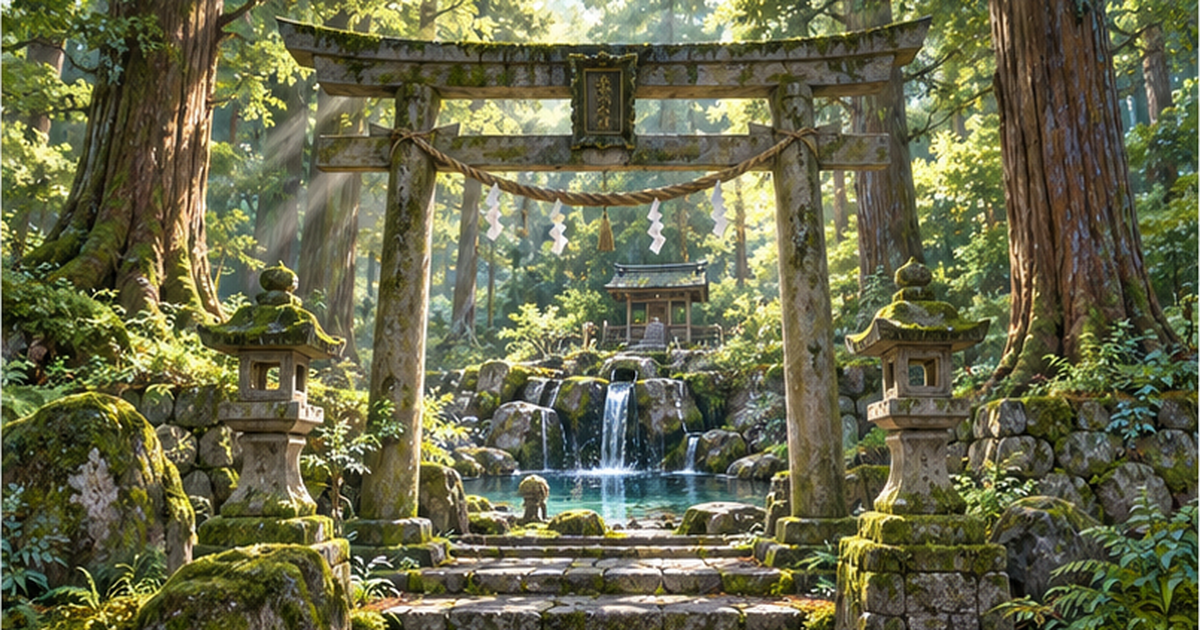
When we see water quietly welling up beyond a shrine's torii gate, it can help to remember that it is not merely scenery — it stands on the accumulation of fine-grained rules like ban-sui, awe of the dragon god, and conservation efforts sustained across generations. Keeping that in mind may change, even slightly, how we relate to water sources going forward. The Ministry of the Environment's own selection criterion — "ongoing conservation activity by local residents" — is not the language of faith, but it can also be understood as a modern-day restatement of the role long carried by dragon-god worship and ban-sui.
Summary of this article
- Meisui Hyakusen (200 sites total) has been selected based not only on water quality but on local conservation activity
- Dragon-god and water-deity worship was incorporated into the imperial court's rain-praying and rain-stopping rituals, and became one origin of ema votive plaques
- Fuji's spring waters, including Oshino Hakkai and the Kakita River springs, were also pilgrimage sites of faith
- Ban-sui, iriai, and customary water rights were practical rules communities built to share water fairly
- Alongside water-source forests and traditional fishing, water-source conservation today is still sustained by local community activity
References
- Ministry of the Environment – Meisui Hyakusen (100 Famous Waters)
- Ministry of the Environment – Heisei Meisui Hyakusen list
- Ministry of Agriculture, Forestry and Fisheries – History of agricultural water and water rights
- Ministry of Agriculture, Forestry and Fisheries – Mannō Pond, Japan's foremost agricultural reservoir attributed to Kōbō Daishi
- Ministry of Land, Infrastructure, Transport and Tourism – Classification of water rights and customary water rights
- Yamanashi Prefectural Mt. Fuji World Heritage Centre – List of component assets
- Shizuoka University Center for Integrated Research and Education of Natural Hazards – The Kakita River and the Mishima spring cluster
- Niu Kawakami Shrine (Upper Shrine), Grand Head Shrine of Dragon-God Worship – Official shrine website
- Kagawa Prefecture – Agricultural technology and traditional culture: "Sanuki, Kingdom of Reservoirs"
※ Listed in order of reliability: government / academic institutions > peer-reviewed papers > specialized institutions > reputable media