⚡ In short
Stargazing starts simply by looking up at the night sky. From beginner tips that need no equipment to the 2026 meteor shower calendar and why stars are still visible in cities, based on primary sources from Japan's Ministry of the Environment and National Astronomical Observatory.
No telescope, no camera needed. Stargazing can start tonight, simply by stepping outside and looking up. 2026 is a great year for meteor showers: both the August Perseids and December Geminids can be observed without any interference from moonlight. Even without an observatory or specialized equipment, choosing a good night and doing a little preparation is enough to enjoy a naked-eye astronomical show.
It's easy to assume "you can't see stars because you're in the city," but that's largely due to artificial lighting, known as light pollution. Japan's Ministry of the Environment has surveyed night sky brightness since fiscal 1988 and found that first-magnitude stars and planets remain well observable even from urban areas. That said, enjoying faint objects like the Milky Way is worth a trip to darker skies in the suburbs or countryside. Japan also has internationally certified "Dark Sky Places," and more people are choosing starry skies as a travel destination.
Based on primary information from Japan's National Astronomical Observatory (NAOJ) and the Ministry of the Environment, this article walks through the basics of tonight's observation, the 2026 meteor shower calendar, how to enjoy stargazing in both cities and rural areas, and the "Dark Sky Places" where stars shine most beautifully in Japan. Like the ocean and nature, the night sky is close at hand yet endlessly deep the more you learn about it.
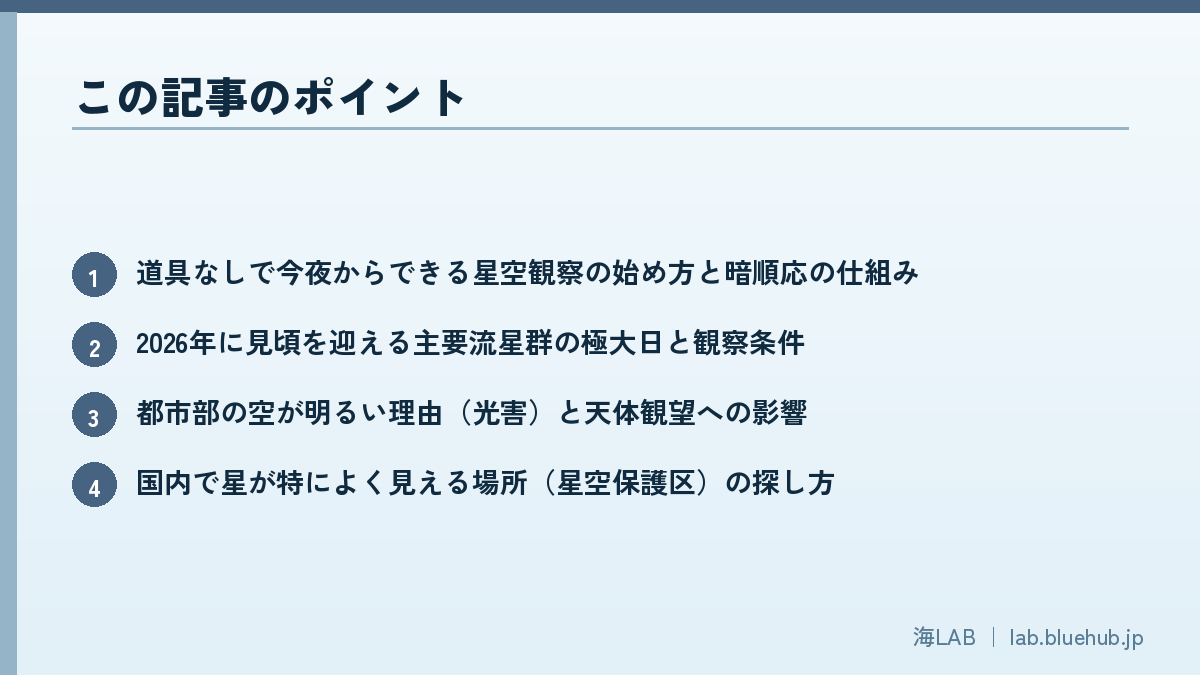
What you'll learn in this article
- How to start stargazing tonight with no equipment, and how dark adaptation works
- Peak dates and viewing conditions for the major 2026 meteor showers
- Why city skies are bright (light pollution) and its effect on stargazing
- How to find especially clear, dark places to observe stars in Japan (Dark Sky Places)
- How to find representative constellations by season
- Clothing, safety, and local resources to keep enjoying stargazing long-term
Where to start with stargazing
You don't need an expensive telescope to start stargazing. The first step is finding a dark spot away from streetlights and house lights, and giving your eyes time to "dark-adapt." In fact, most astronomy fans first experience naked-eye constellation watching, and telescopes or binoculars can wait until interest deepens. Start with somewhere you can reach tonight, such as a nearby park, riverbank, or balcony. Even without any special plans, stepping outside for just ten minutes after dinner is enough to notice first-magnitude stars or the changing phases of the moon. Building this small habit is the easiest way to naturally learn how the night sky changes with the seasons. Simply paying a little attention on a clear night — wondering "what will I see tonight?" — adds a small pleasure to daily life. When starting out, begin with the moon and particularly bright stars, then gradually expand your gaze to fainter ones; this approach is less likely to lead to frustration.
Why dark adaptation takes 15-20 minutes
When your eyes move from a bright place to a dark one, it takes about 15-20 minutes for your pupils to dilate and your retinal sensitivity to increase. This is a physiological process in which rod cells in the retina, which detect light, gradually raise their sensitivity to match the dark environment. Because looking at a smartphone screen resets this dark adaptation, it's standard practice to keep screen brightness at a minimum or use a red light during observation. Once dark adaptation is complete, faint stars and the dim glow of the Milky Way that were invisible at first will gradually become clear. Even if it feels like "there are fewer stars than expected" right after you start, resist the urge to move to another spot and keep looking up patiently — the experience of seeing more and more stars as your eyes adjust is itself one of the pleasures of stargazing.
Easy-to-find stars for beginners
The trick to learning constellations is to memorize one bright, easy-to-recognize star or shape first, then use it as a reference point to trace other constellations. The Big Dipper in the northern sky is easy to find year-round, and extending a line through the two stars at the end of its bowl leads to Polaris, the North Star, which barely moves. Once you know where Polaris is, you can determine the four cardinal directions and use them as a starting point to find other constellations. There are said to be 88 constellations in total, but there's no need to memorize them all from the start. Learning just one or two landmark constellations per season, and confirming you can find them again the following year, is enough to steadily deepen your understanding of the night sky.
- Northern sky: the Big Dipper and the nearly motionless Polaris beyond it
- Summer nights: the "Summer Triangle" formed by Vega (Lyra), Altair (Aquila), and Deneb (Cygnus)
- Winter nights: Orion's Belt, and the "Winter Triangle" formed by Sirius and Procyon
- Planets: Venus (the "morning star" or "evening star") and Jupiter are bright and easy to spot with the naked eye
First stargazing checklist
- A planisphere or a smartphone constellation app
- A red LED light (a flashlight covered with red cellophane also works)
- A picnic sheet and warm clothing (nights get cold even in summer)
- Binoculars (great for enjoying the Milky Way and star clusters)
- A warm drink and insect repellent (for extended outdoor observation)
The 2026 meteor shower calendar
Meteor showers are astronomical events that occur at roughly the same time each year. A meteor is the flash of light produced when a speck of dust scattered along a comet's orbit plunges into Earth's atmosphere and burns up at high speed. Every time a comet approaches the sun, ice and dust gradually flake off its surface and spread out in a band along its orbital path. When Earth crosses that band, dust particles enter the atmosphere all at once, producing many meteors in a short period — that's a meteor shower. The dust grains are typically only a few millimeters across, but because they slam into the atmosphere at tens of kilometers per second, they burn up brightly in an instant. According to Japan's National Astronomical Observatory, 2026 is a rare year in which two of the "three major meteor showers" — the Quadrantids, Perseids, and Geminids — namely the Perseids and Geminids, can both be observed under moonless, favorable conditions. Since how well a meteor shower can be seen depends heavily on the moon phase each year, 2026's simultaneous good conditions for both showers have drawn attention among astronomy fans.
Perseids (August)
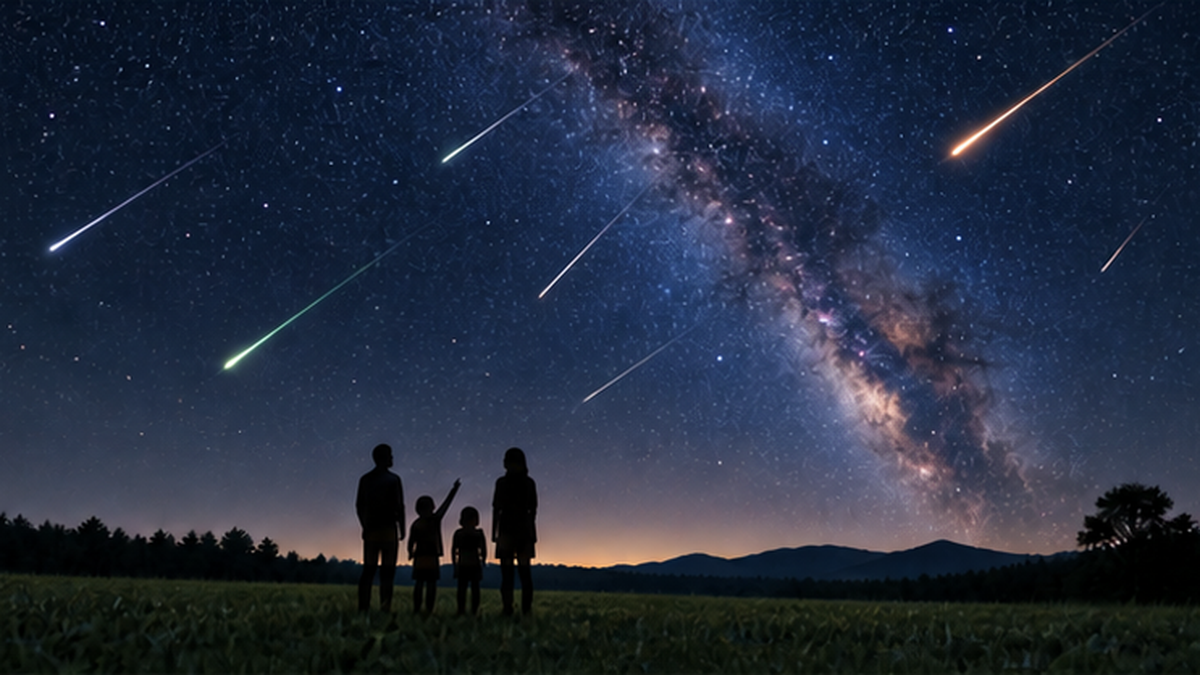
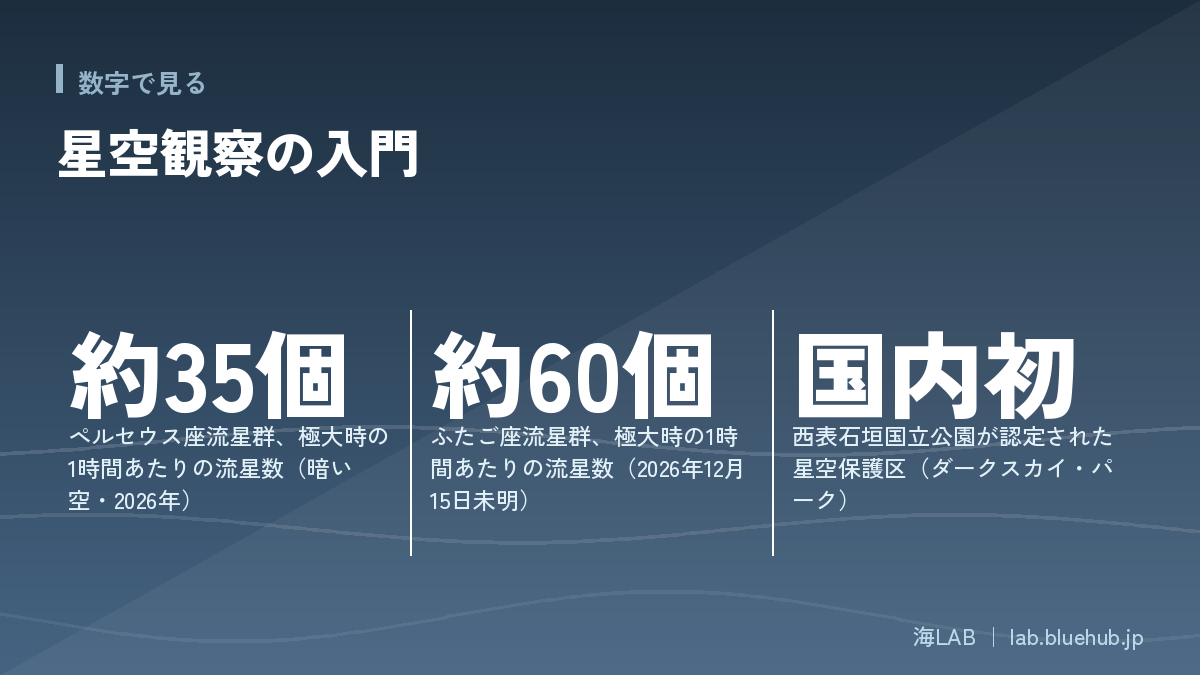
The 2026 Perseids are expected to peak around 11:00 a.m. on August 13 — daytime in Japan, so the best viewing window is actually the night before, from late night on August 12 through dawn on August 13. Because the peak coincides with the new moon, there's no interference from moonlight at all, and around 35 meteors per hour are expected under a dark sky. The timing also overlaps with summer vacation, making it ideal for family camping trips or observation during visits to hometowns. The Perseids originate from dust left by Comet Swift-Tuttle; although the radiant point lies in the direction of the constellation Perseus, meteors actually appear across the whole sky, so there's no need to stare only at the radiant. The relatively comfortable summer temperatures are another reason this shower is so popular.
Geminids (December)
The 2026 Geminids are expected to peak around 11:00 p.m. on December 14. As the radiant rises higher, the most meteors are expected between midnight and 2:00 a.m. on December 15. Since the moon sets around 9:00 p.m. that night, there's no moonlight interference, and around 60 meteors per hour are expected under a dark sky — the highest count among the three major showers. The active period spans roughly December 4 to 17, and observation is also recommended starting around December 11, before the peak. Because winter nights get bitterly cold due to radiative cooling, extra attention to warm clothing is essential. Unlike most meteor showers, the Geminids originate not from a comet but from the asteroid Phaethon, and are known for producing many bright, relatively slow-moving meteors. Meteor counts start rising in the early evening, so you can begin observing around 9:00 p.m. without waiting until midnight — an advantage compared with other showers.
| Meteor shower | 2026 peak | Best viewing window | Conditions |
|---|---|---|---|
| Perseids | Around 11:00 a.m., Aug 13 | Late night Aug 12 - dawn Aug 13 | New moon, favorable |
| Geminids | Around 11:00 p.m., Dec 14 | Midnight - 2:00 a.m., Dec 15 | No moonlight, favorable |
Tips for watching meteor showers
- Scanning the whole sky, not just the radiant, helps you spot more meteors
- Face the darkest direction with city lights behind you
- Lying down lets you watch comfortably for longer without neck strain
- To photograph meteors, bring a tripod and a camera with a bulb (long-exposure) mode
Why are city night skies so bright? (Light pollution)
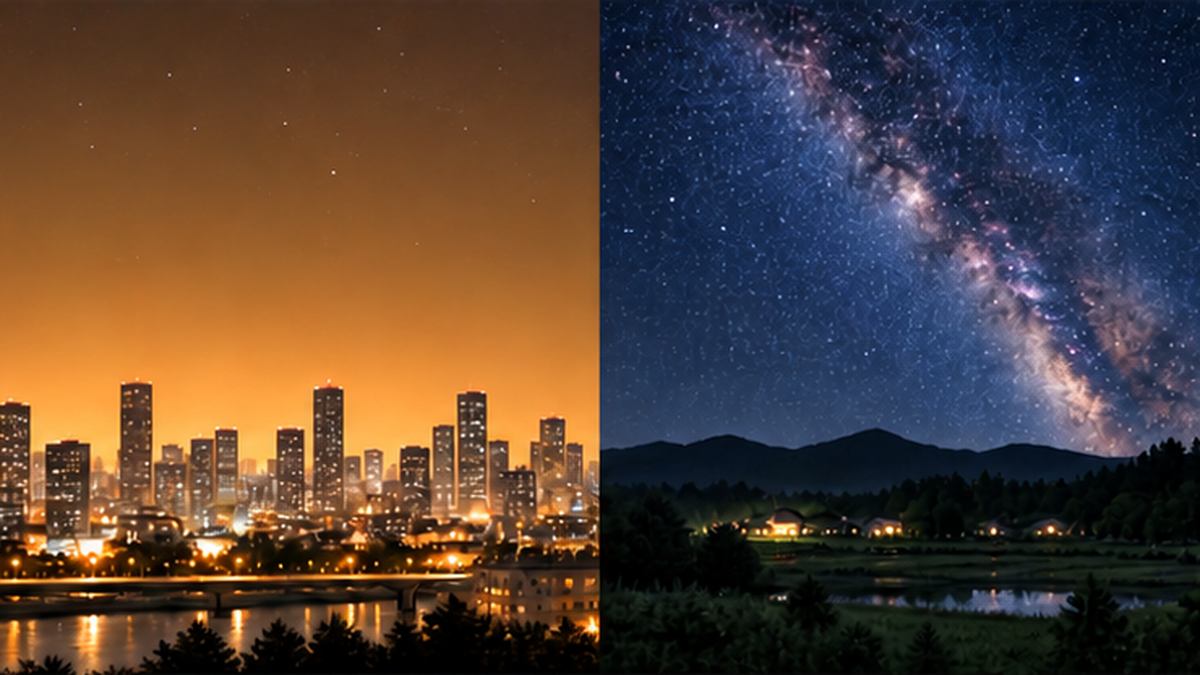
The main reason people feel "you can't see stars in the city" is a phenomenon called light pollution. According to Japan's Ministry of the Environment's definition, light pollution refers to negative effects on the surrounding environment and astronomical observation caused by improperly installed or directed lighting. Light from streetlights and signs scatters off dust and water vapor in the atmosphere, brightening the entire night sky. This phenomenon is also called "sky glow," observed as a dome of light hovering over cities. Photos of Earth at night taken from satellites clearly show major metropolitan areas glowing bright orange, making the spread of light pollution easy to visualize. Beyond its impact on astronomical observation, light pollution has also been linked to disrupted behavioral rhythms in nocturnal animals and altered flight paths for migratory birds, affecting ecosystems more broadly. In recent years, more municipalities have adopted "shielded" streetlights that direct light only where needed, reducing light leakage into the night sky while maintaining public safety. Such lighting improvements also reduce electricity consumption, drawing attention as a way to balance environmental impact with crime prevention.
The Ministry of the Environment's stargazing project
Japan's Ministry of the Environment ran the "National Continuous Observation of the Starry Sky" for 25 years, from fiscal 1988 through fiscal 2012. Since then, it has partnered with the Hoshizora Kodan (Starry Sky Corps) to continue biannual, citizen-participation surveys of night sky brightness each summer and winter, using both the naked eye and digital cameras. The survey aims to raise awareness of light pollution and atmospheric conditions, and observation data has accumulated nationwide. Participants photograph the night sky near their homes with a digital camera and submit the data to the Ministry, making it a form of citizen science that requires no specialized knowledge. The long-term data accumulated is also a valuable record for tracking how night sky brightness has changed alongside urbanization and evolving lighting technology. This grassroots, citizen-participation research also serves as foundational data supporting policy discussions on light pollution measures. Some participants report that the experience of consciously looking up at the sky has prompted them to reconsider the lighting and environment around their own homes.
What you can still see in cities
Even with light pollution, bright planets like Venus and Jupiter, and first-magnitude stars like Sirius and Vega, remain fully observable with the naked eye from urban areas. In fact, bright objects like the moon and planets are less affected by city lights and can be enjoyed even from an urban balcony. On the other hand, viewing faint objects like the Milky Way or dim star clusters and nebulae is more effective away from city lights. A good approach is to start by observing bright objects in the city to get comfortable with stargazing, then venture to darker places once your interest deepens. Rooftop observation events at urban planetariums and science museums are often centered on the moon and planets, which are less affected by light pollution — a good way to get your first taste of stargazing.
Places in Japan with especially clear starry skies
Dark, low-light-pollution skies can be internationally certified as "Dark Sky Places." In Japan, Okinawa's Iriomote-Ishigaki National Park received provisional certification in the "Dark Sky Park" category in 2018, and after several years of improvements to meet lighting standards, was officially certified in May 2026. In Asia, it is only the third such site, following South Korea's Yeongyang Firefly Eco Park and Israel's Ramon Crater — a certification achieved through years of effort, including overhauling lighting fixtures and gaining cooperation from local residents.
The Dark Sky Place at Iriomote-Ishigaki National Park
The certified area spans 46,653 hectares of land across all of Taketomi Town and the northern part of Ishigaki Island in Okinawa Prefecture. Despite its low elevation, the area has little artificial light due to the absence of large nearby cities, and its latitude allows a partial view of the Southern Cross, making it one of Japan's premier stargazing destinations. Local operators increasingly offer starry sky tours, creating an environment where visitors with no astronomical knowledge can safely enjoy guided observation. Achieving official certification took years of work replacing road lighting and facility lights with low-light-pollution alternatives, with residents, local government, and tourism operators working together to protect the night sky. Certification as a Dark Sky Place isn't a one-time achievement — it requires ongoing effort to maintain lighting standards. Beyond Iriomote-Ishigaki, other regions across Japan are increasingly promoting low light pollution and investing in stargazing tours and events, as star-focused tourism continues to grow.
How to find dark places
Even without an officially certified Dark Sky Place nearby, it's possible to find dark spots close to home. Satellite imagery in map apps and online "light pollution maps" can give you a rough idea of which areas near you are darker. Simply taking a short trip on a day off to a mountain area or seaside park is often enough to notice a dramatic difference in the number of visible stars compared with the city.
- Keep distance from streetlights and major roads (at least a few kilometers)
- Choose elevated or coastal spots with few obstructions
- Check the moon phase and aim for the days around the new moon
- Check humidity and transparency in addition to cloud cover in the forecast
Safety precautions
- Avoid traveling or staying alone in dark, remote areas — go with others
- Don't enter private property or restricted areas
- Always bring a flashlight and spare phone battery
- If observing at a campsite, follow Leave No Trace principles
When observing overnight at a beach campsite, being mindful not to harm the natural environment is essential. For practical tips, see Practicing the 7 Leave No Trace Principles for Beach Camping. Following basic etiquette, like properly extinguishing campfires and packing out trash, ensures the next visitor can enjoy the same beautiful night sky.
Finding constellations by season
The constellations visible change with the seasons. Because Earth orbits the sun, the direction you look up at night reveals a slightly different sky each season. Memorizing a few landmark constellations lets you get a rough sense of direction and season without needing a planisphere or app. As you get used to it, you'll start to feel the changing of the seasons through the shifting constellations, deepening the pleasure of looking up at the night sky. Japan enjoys stable seasonal climates for observation, and starting on a comfortable spring or autumn night, rather than the peak of summer or winter, is one way to ease into stargazing without strain.
| Season | Representative constellation/landmark | Tips for finding it |
|---|---|---|
| Spring | Leo, Arcturus (Boötes) | Easy to find by extending the curve of the Big Dipper's handle |
| Summer | The Summer Triangle (Lyra, Aquila, Cygnus) | Three bright stars near the zenith form a triangle |
| Autumn | The Great Square of Pegasus | With few standout stars, look for the square shape first |
| Winter | Orion, the Winter Triangle | Orion's Belt is the easiest landmark to spot |
Using constellation apps
Apps that show which constellation you're pointing at are useful for beginners learning how constellations relate to one another spatially. Since screen brightness interferes with dark adaptation, it's best to use a red filter or night mode alongside them. After confirming a rough position with an app, put the phone away and spend time tracing the stars with your own eyes. Many apps use GPS and directional sensors to show, in real time, which constellation lies in the direction you're pointing, and can be used to plan ahead even through clouds — useful for preparing on days with uncertain weather.
How to find planets
Along with constellations, it's worth learning the movement of planets. Venus shines brightly low in the western sky after sunset, or in the eastern sky before dawn, long cherished as the "evening star" or "morning star." Jupiter and Saturn are also bright enough to see with the naked eye, and with binoculars you can sometimes faintly make out Jupiter's moons or the silhouette of Saturn's rings. Unlike the fixed stars that form constellations, planets shift position day by day, so observing them every few days lets you notice their movement more clearly. Ancient peoples took note of these irregular movements and treated planets as special objects distinct from other stars. Even today, planetary positions change year to year, so checking a monthly astronomy app or magazine tells you exactly when and where to look.
Stepping up to binoculars and telescopes
Once you're comfortable with naked-eye stargazing, consider stepping up to binoculars or a telescope. There's no need to jump straight to an expensive telescope — many astronomy fans start with affordable binoculars and move on to a telescope only once their interest deepens. Choosing equipment gradually, based on purpose and budget, is the surest way to avoid regret.
Binoculars are the ideal first step
Binoculars for astronomy are often recommended as a first purchase because they're versatile enough for daytime use as well. Since too much magnification causes image shake, 7x-10x magnification with an aperture (lens diameter) of around 40mm is considered easy to handle. With binoculars, you can enjoy the individual stars of the Pleiades cluster — which appears as a single point to the naked eye — and the faint clusters of stars embedded in the Milky Way. They're also easy to carry, making them a convenient companion for trips and camping. If you already own binoculars for bird watching, you can often use them as-is for stargazing, so it's worth trying your existing pair before buying new equipment.
How to choose a telescope
The basic rule for choosing a telescope is to prioritize aperture (light-gathering power) over magnification. A larger aperture reveals fainter objects, but also increases size and price. Beginner-friendly refractor and reflector telescopes that are easy to assemble and handle are widely available, and the thrill of seeing craters on the moon, Saturn's rings, or Jupiter's moons with your own eyes is an experience photos and videos can't replicate. Before buying, it's worth visiting a local astronomy shop or observation event to try equipment firsthand and confirm it's easy to use. Because many beginners get tired out before observation even begins due to difficulty assembling equipment or locating objects, choosing a model with automatic tracking features or simple controls helps avoid frustration.
Guidelines for choosing equipment
- For a first purchase, binoculars (7x-10x, roughly 40mm aperture) are recommended
- For telescopes, prioritize aperture (light-gathering power) over magnification
- Try equipment firsthand at an observation event or astronomy shop before buying
- A tripod stabilizes the image for both binoculars and telescopes
Judging weather and timing
What determines whether a stargazing outing succeeds is often less about telescope quality and more about correctly judging weather and timing. Even on a seemingly clear night, atmospheric moisture (transparency) and thin high clouds can dramatically affect how well stars are visible. To avoid traveling to a dark spot only to find clouds or haze blocking everything, it's worth checking a few things in advance. If you're planning to travel far by car or train to observe, it's reassuring to compare multiple forecast services right up until the last moment and keep a backup date in case the weather changes suddenly.
Cloud cover, transparency, and seeing
Cloud cover is the first thing to check in a weather forecast, but it's not enough on its own. Astronomy fans also pay close attention to two other indicators: "transparency" (the clarity of the atmosphere) and "seeing" (the steadiness of the atmosphere). Low transparency reduces the number of visible stars, while poor seeing makes stars appear to flicker. In recent years, astronomy-focused weather services and apps that combine cloud cover, transparency, and seeing into a single view have become more common. Transparency tends to improve right after a typhoon passes or a cold front moves through, as the upper atmosphere gets replaced with fresh air. Conversely, during seasons with heavy yellow dust or pollen, more particles fill the air, and stars can appear dimmer even under clear skies — knowing these seasonal tendencies improves your ability to predict good conditions.
Making a habit of checking the moon phase
On nights close to a full moon, strong moonlight makes the Milky Way and faint meteors harder to see. Conversely, around the new moon, the entire sky becomes darkest, offering ideal conditions for observing faint objects. For events with a clearly defined count, like meteor showers, whether the peak date coincides with a favorable moon phase is the single biggest factor separating a "good year" from a "poor year." Most smartphone calendar and astronomy apps display the moon phase, so it's worth making a habit of checking it when planning an observation.
Pre-observation checklist
- Check the weather forecast for cloud cover and precipitation probability
- If available, also check transparency and seeing information
- Check the moon phase and prioritize dates near the new moon
- Check the local temperature and dress accordingly (mountain and coastal areas are often several degrees cooler than urban areas)
Recording the night sky with your smartphone
Many people want to keep a photographic record of the night sky they observed. Recent smartphones come equipped with night modes designed for nightscapes and astrophotography, and with a tripod, you can now capture meteors and star fields to some extent. Serious astrophotography uses a DSLR camera and an equatorial mount, but trying it first with a smartphone is a great entry point. Sharing your photos on social media can also connect you with others who were observing the same night from a different location, adding a different kind of enjoyment to solo observation.
Basic smartphone camera settings
When shooting the night sky, first secure your smartphone on a tripod or stable surface to prevent camera shake. On models with night mode or a "pro mode" (manual exposure), setting shutter speed to a few to a few dozen seconds and keeping ISO sensitivity moderate tends to produce less noisy photos. To capture a meteor shower, frame a wide area that includes the radiant, and use burst shooting or a time-lapse function so you're less likely to miss the moment a meteor streaks by.
Etiquette while shooting
When shooting in the dark, be considerate of other observers so as not to dazzle them. Keep your smartphone screen brightness to a minimum, and shield the screen with your hand when checking photos afterward to reduce glare. When setting up a tripod, also be mindful not to block pathways or other people's line of sight.
Relying on certified guides and local observatories
If learning on your own feels difficult, joining an observation event hosted by a public observatory or science museum is a great option. Japan has a private certification called "Stargazing Guide (Star Sommelier)," and certified guides host observation events and give talks at observatories and community centers nationwide. The experience of looking through a telescope while listening to an expert's explanation offers knowledge and excitement that's hard to gain on your own.
What is a certified stargazing guide (Star Sommelier)?
The Stargazing Guide certification system is a private Japanese qualification that develops scientific understanding of the night sky, observation skills, and the ability to share the wonder of the stars with others. As of January 2025, more than 8,000 people have been certified. There are two levels — associate guide and guide — and certified operating organizations across the country hold training courses and observation events. Checking event listings at local science museums and planetariums often reveals opportunities to join observation events led by these certified guides. These events often teach not just constellations and meteor showers, but also practical know-how like how to use a telescope or take astrophotographs — hands-on learning that's hard to get on your own.
An unexpected link between the moon and the ocean
Looking up at the night sky, you may notice that the moon's phases are not just an astronomical phenomenon — they also affect living creatures on Earth. The moon's gravity plays a major role not only in stargazing but also in the ocean. The mechanism behind coral's mass spawning on full-moon nights is explained in Why Does Coral Spawn All at Once?, and how tidal movements are harnessed for power generation is covered in What Is Tidal Current Power Generation?. Looking up at the sky and understanding marine ecosystems or renewable energy are, in fact, deeply connected interests. If stargazing sparks your awareness of the moon's phases and the tides, you may come to appreciate the rhythms of nature around you even more richly.
Section summary
- If self-study feels uncertain, make use of observation events at public observatories and science museums
- "Stargazing Guide (Star Sommelier)" is a nationwide certification system hosting observation events
- Local observatory information can be found on municipal and science museum official websites
- Moon phases are a global phenomenon connected to both coral spawning and tidal power generation
References and Sources
- National Astronomical Observatory of Japan, Sky Events 2026 – Explanation of 2026 astronomical events and meteor showers
- NAOJ, Perseids Peak (August 2026) – Peak time and viewing conditions
- NAOJ, Geminids Peak (December 2026) – Peak time and viewing conditions
- Ministry of the Environment, "Look at the Stars": About Light Pollution – Definition of light pollution and the stargazing project
- Ministry of the Environment, FY2025 Summer Stargazing Observation – Overview of the night sky brightness survey
- Ishigaki City, Official Certification of the Iriomote-Ishigaki National Park Dark Sky Place – Background on Japan's first Dark Sky Park certification
- DarkSky Japan, Official Certification of Iriomote-Ishigaki National Park – Certification criteria and scope of the Dark Sky Place
- Stargazing Guide Certification System – Overview of the Stargazing Guide (Star Sommelier) certification
- Star Sommelier Organization (NPO) – The organization operating the Stargazing Guide certification system
* Listed in order of reliability: government and academic institutions > peer-reviewed papers > specialized organizations > reputable media