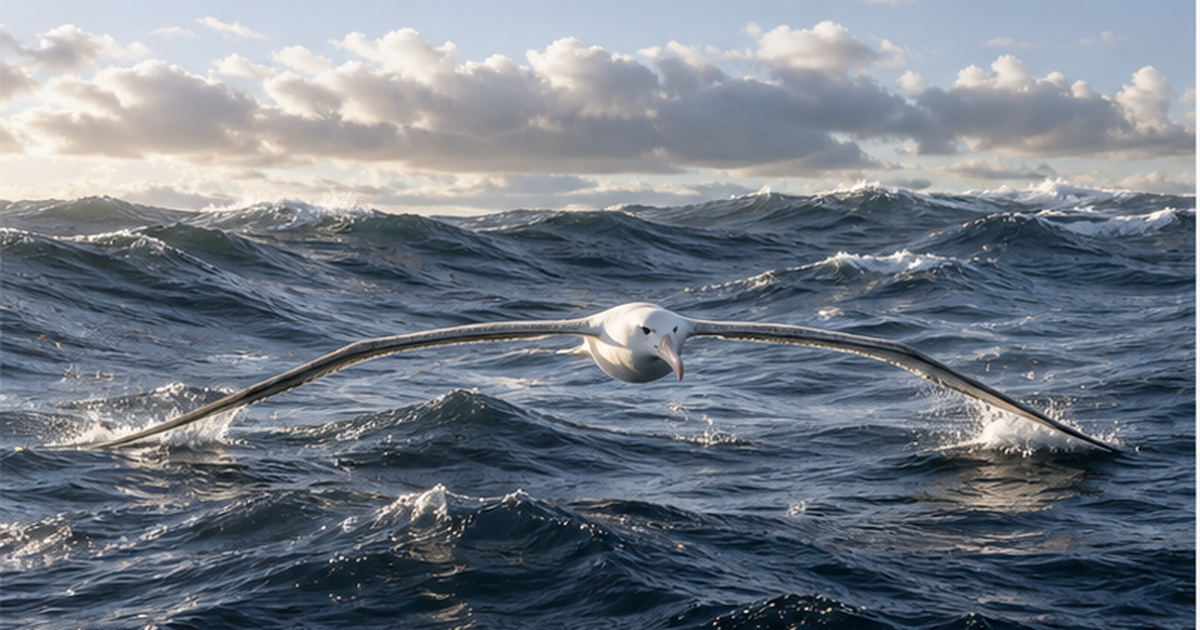
A large white bird glides across the sea, barely moving its wings. The short-tailed albatross has a wingspan of 213 to 229 cm, and its relative the wandering albatross can reach 3.5 meters, among the largest of any living bird. Yet with all that wing, it does not flap. For hours, sometimes for days, it crosses open ocean on wind alone.
This is not a matter of effort. It is the result of mastering a piece of physics: extracting energy from the wind gradient that forms just above the sea surface. Known as dynamic soaring, the technique is refined enough that glider designers and drone researchers still study it as a model.
The albatross is also a symbol of conservation in Japan. Hunted for its feathers until it was reported extinct, it was rediscovered on Torishima in the Izu Islands with only a handful of survivors. More than seventy years later, in the 2025-26 breeding season, the Torishima population finally passed 10,000 birds. Out on the open ocean, however, longline hooks still await. This article moves from the physics of flight through breeding ecology to the front line of the relationship between people and seabirds.
What you'll learn in this article
- How dynamic soaring lets albatrosses fly without flapping, and the wind conditions it requires
- The body design behind it: slender wings, a shoulder-locking tendon, and tube nostrils
- Why a slow life history - first breeding at age seven, one egg a year - raises extinction risk
- The conservation story that took Torishima from a declared extinction to over 10,000 birds
- The bird-scaring line invented by Japanese fishers, and the three main bycatch mitigation measures
- What the 2020 proposal of the Senkaku albatross means for conservation
What Kind of Bird Is the Albatross? Basic Data on the Ocean's Gliding Master
Let us start with an outline of the bird. In Japan, "ahodori" refers to a single species in the albatross family of the order Procellariiformes: the short-tailed albatross, Phoebastria albatrus. It is designated a Special Natural Monument of Japan and a National Endangered Species of Wild Fauna and Flora, and the Ministry of the Environment Red List classifies it as Vulnerable.
A 2.2-meter wingspan and a body weight of 4 to 5 kg
According to the Yamashina Institute for Ornithology, the short-tailed albatross has a wingspan of 213 to 229 cm and weighs 4 to 5 kg. It is not especially light for its wing area. In fact its wing loading, the weight each square meter of wing supports, is high among birds. That works in its favor for maintaining a fast gliding speed. This is a body built not to hover gently but to slide quickly.
The trade-off is takeoff. On flat ground with no wind it needs a run-up, and it relies on cliffs and slopes to catch the wind. That is part of why breeding colonies tend to sit on steep, wind-exposed coastal terrain.
| Item | Short-tailed albatross | Notes |
|---|---|---|
| Wingspan | 213-229 cm | Among the largest of living birds |
| Body weight | 4-5 kg | Comparable to a large goose |
| Age at first breeding | 5 years at the earliest, around 7 on average | Adult plumage takes 8-10 years |
| Eggs laid | One egg, once a year | A failure means waiting until the next year |
| Incubation | 64-65 days | Pairs alternate in shifts of 10-20 days |
| To fledging | About 4.5 months | Includes a fast of several weeks before fledging |
| Longevity record | Raising a chick at age 31 | A Laysan albatross has been recorded at 66 |
The world's 22 albatross species and their lopsided distribution
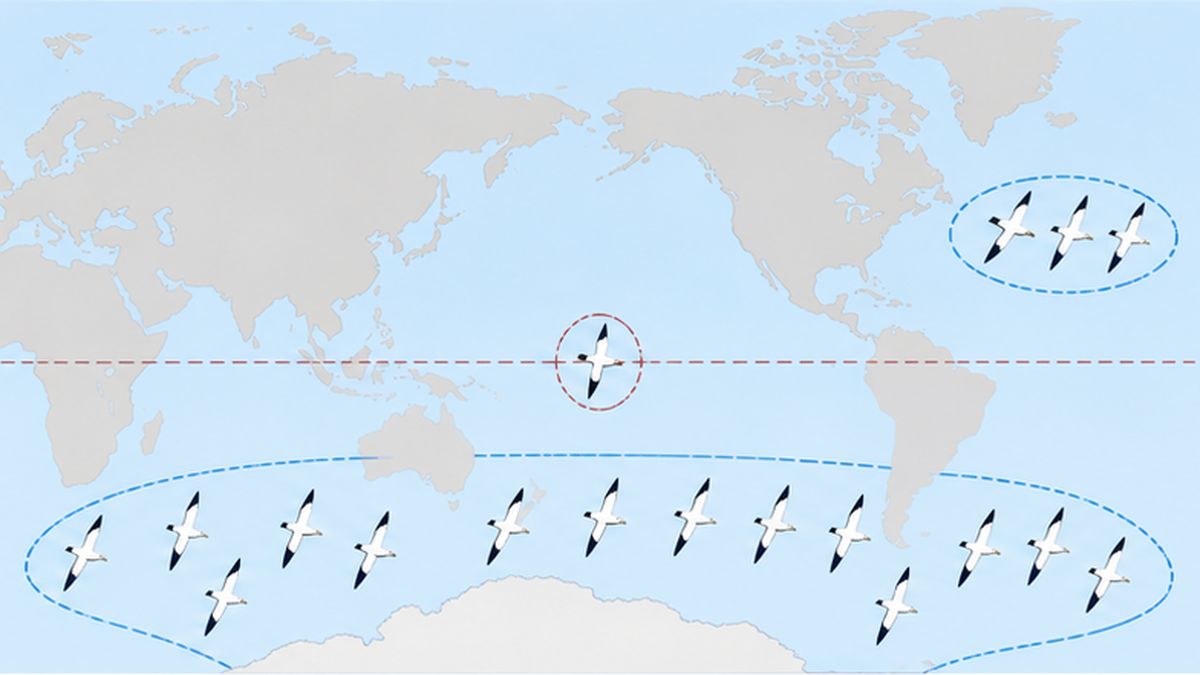
The albatross family contains 22 known species, of which 18 live in the Southern Hemisphere, one near the equator, and only three in the Northern Hemisphere. The concentration in the south is no accident. The belt of persistent westerlies circling Antarctica, known to sailors as the Roaring Forties and the Furious Fifties, is an ideal environment for the way these birds fly.
The three species breeding in the Northern Hemisphere - the short-tailed, Laysan, and black-footed albatrosses - all center their lives on the North Pacific. Japan's islands are globally important breeding grounds for this North Pacific group.
Where an unflattering Japanese name came from
The Japanese name "ahodori" is said to derive from the fact that the birds did not flee when people approached them at their colonies. A bird that evolved on remote islands with no predators had no reason to be wary of a two-legged creature. That trait later invited the mass slaughter described below. The name is less a flaw in the bird than a record of how people treated its lack of fear.
In recent years some have proposed the alternative name "okinotayu," evoking a performer dancing gracefully far out at sea. It is sometimes used in conservation circles as a name better suited to the bird.
Key points so far
- The short-tailed albatross is a large seabird with a 2.2-meter wingspan, a Special Natural Monument of Japan and listed as Vulnerable
- Of 22 albatross species, 18 live in the Southern Hemisphere, where strong westerlies suit their flight style
- It lays only one egg a year and first breeds at around age seven, an extremely slow pace even among birds
Thousands of Kilometers Without Flapping: The Physics of Dynamic Soaring
The most striking thing about albatross flight is that it keeps going with almost no flapping. For most birds flight is the costliest thing they do, yet measurements including heart rate suggest that an albatross in flight expends little more energy than one resting at the nest. The secret lies in dynamic soaring, which exploits the structure of wind near the sea surface.
The key is the wind shear layer above the sea
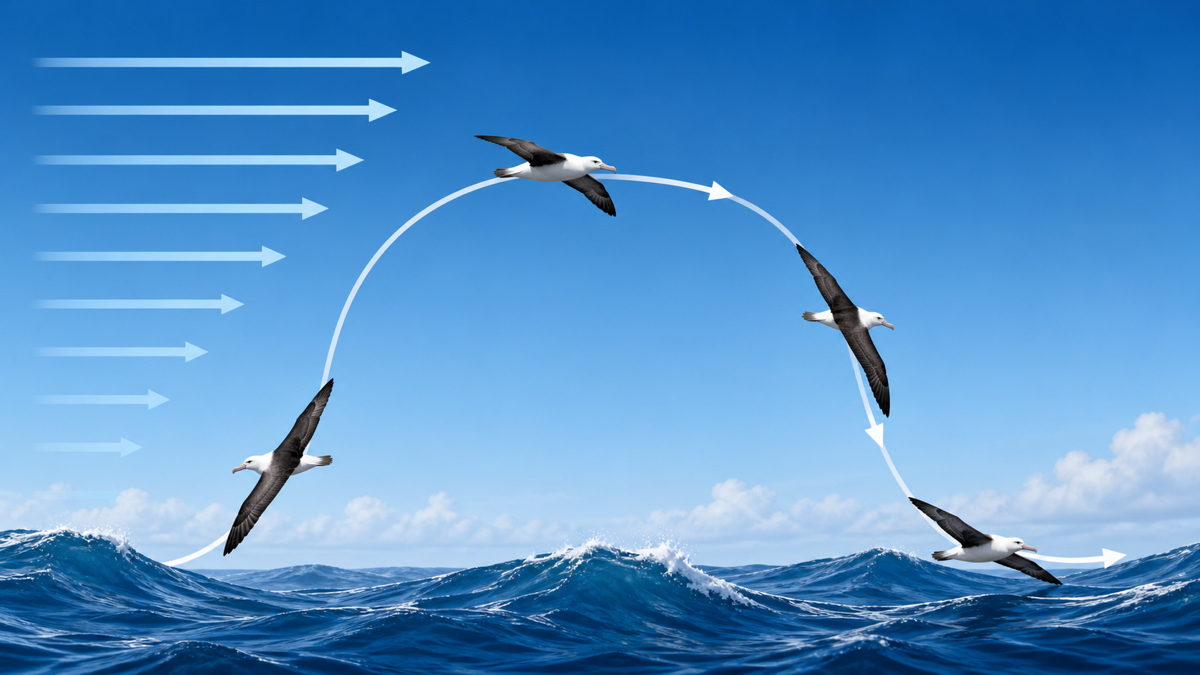
Just above the water, friction slows the wind. Near the surface it is almost calm, and wind speed increases with height. This vertical gradient in wind speed, or wind shear, is the albatross's fuel tank. The usable energy is stored in a layer perhaps a dozen or so meters thick.
Crucially, what the bird harvests is not an updraft. The principle differs from the thermals used by kites and eagles. The albatross gains airspeed by crossing between layers moving at different speeds.
The four phases of an S-shaped maneuver
Tracks recorded by GPS loggers form a series of S shapes running across the wind. One cycle lasts from a few seconds to a dozen or so. It breaks down into four stages.
- Climb: rising diagonally upwind from near the surface. Entering faster-moving air increases airspeed
- Upwind turn: at around 10 meters, a banked turn of roughly 90 degrees to head downwind
- Descent: gliding down while heading downwind. Moving into slower air again yields relative speed
- Turn in the wave trough: another turn of about 90 degrees back into the wind, completing the cycle
The height energy lost in the climb is recovered from the wind shear in the descent. Because that balance comes out slightly positive, the bird keeps flying without spending its own fuel on flapping. In real flight much of the gain is dissipated by drag, so the bird glides in a state close to energy neutrality.
Wind of at least 3 meters per second
Theoretical models indicate that sustaining dynamic soaring requires wind of roughly more than 3 meters per second. Below that, the energy available from the shear layer falls short of losses to drag. Observations show wandering albatrosses still flying in very light winds, apparently supplementing with the orographic lift generated by wave swells.
Stronger wind makes flight easier. Birds have been reported sustaining about 20 meters per second, or 72 km/h, across the wind. Covering 500 to 1,000 km in a day is possible because of this sustained high-speed gliding.
| Wind conditions | How the bird flies | Notes |
|---|---|---|
| Under 3 m/s | Uses lift from waves; more flapping | Foraging efficiency tends to drop |
| 3-10 m/s | Typical dynamic soaring | Chains S shapes to progress across the wind |
| Over 10 m/s | Fast gliding, around 20 m/s across the wind | The Southern Ocean westerlies are ideal |
Why crosswind flight is fastest
Counterintuitively, an albatross makes its best speed not downwind but across the wind. The reason is the same as why a sailboat outruns a dead run on a reach: the geometry lets the bird gain energy in both the climb and the descent. Tracking data showing seabirds zigzagging rather than heading straight for a destination reflect this choice of the faster bearing.
Applications in engineering
The principle of dynamic soaring is being applied to long-endurance unmanned aerial vehicles and glider design. In radio-controlled gliding, pilots using wind shear along ridges have set speed records above 800 km/h, a demonstration of just how efficient the albatross's method is in theory.
A Body Built for Soaring: Slender Wings and a Locking Shoulder
A superb way of flying comes packaged with the body that supports it. The albatross is specialized to an extreme degree for one purpose: gliding over open ocean.
Very slender wings with a high aspect ratio
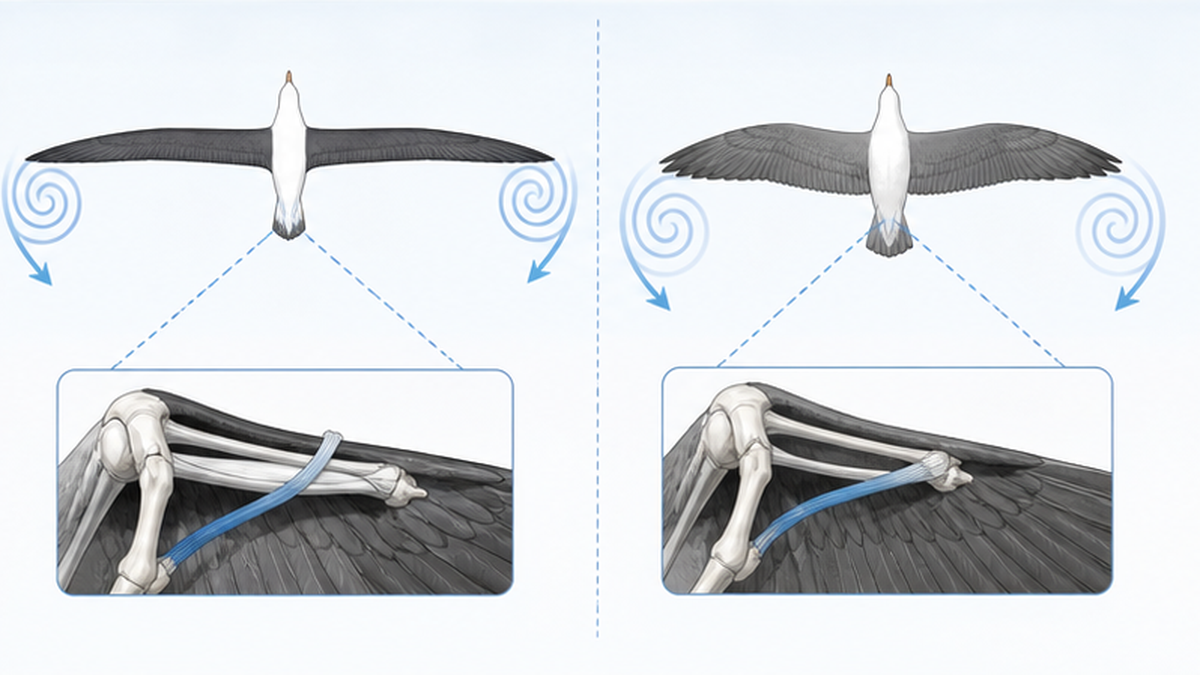
Albatross wings are narrow and thin from front to back, in other words high aspect ratio wings. This is the same shape as a glider's main wing, and it minimizes the vortices shed at the wingtips, meaning induced drag. As a result the glide ratio, the horizontal distance covered per meter of altitude lost, is estimated at around 20. In theory, 100 meters of height would carry the bird 2 km.
The weakness of this shape is poor maneuverability. Stopping in mid-air or turning on the spot is not in its repertoire. As we will see, the bird-scaring line used against bycatch is an invention that turns this very weakness to advantage.
A tendon that locks the wing open
Holding a wing extended would normally mean using muscle continuously. Albatrosses, however, have a tendon mechanism in the shoulder that mechanically locks the wing in the extended position. Like a folding umbrella that catches once fully opened, it lets the bird hold its wings level with almost no muscular effort. The low cost of dynamic soaring would not be possible without it.
Tube nostrils and salt glands: equipment for life at sea
Albatrosses and their relatives are collectively called tubenoses. Tube-shaped nostrils project along the top of the bill, and concentrated saltwater is expelled through them. They can drink seawater because salt glands above the eyes concentrate the excess salt and drain it out through those tubes. It is one reason they can spend weeks at sea with no fresh water.
Tubenoses are also known for a well-developed sense of smell. Research shows they respond to dimethyl sulfide (DMS), a compound released when phytoplankton are grazed by zooplankton, allowing them to detect prey-rich waters from tens of kilometers away. It amounts to a map of the ocean drawn in scent.
Body design in summary
- High aspect ratio wings mean low drag and a glide ratio of roughly 20
- A shoulder tendon lock holds the wings open with almost no muscular effort
- Tube nostrils and salt glands allow the bird to drink seawater and stay at sea for long periods
- A keen sense of smell helps locate prey-rich waters from far away using cues such as DMS
- The weakness is maneuvering. Hovering and sharp turns in the air are difficult
For a contrast in how far a seabird's body can specialize, consider penguins, which evolved to "fly" underwater instead. Two opposite designs from the same starting point (see Why penguins can dive so deep and so long).
Life Across the Open Ocean: Foraging Trips and Circumnavigations
What dynamic soaring makes possible is not merely long flight. It is the ability to search a thinly provisioned ocean at a cost that still pays off. Distances that would bankrupt a land bird are, for an albatross, an ordinary commute.
Thousands of kilometers in a single foraging trip
Tracking with GPS and geolocators has revealed just how large their ranges are. Even during the breeding season, a single foraging trip covers hundreds to thousands of kilometers and lasts from several days to about two weeks. While one parent guards the egg or chick, the other heads for distant waters.
Outside the breeding season the range expands further. Short-tailed albatrosses born on Torishima have been tracked to the Bering Sea, the waters around the Aleutian Islands, and off the west coast of North America. Though called a Japanese bird, it is in practice an international species that uses the entire North Pacific.
A circumnavigation in 46 days
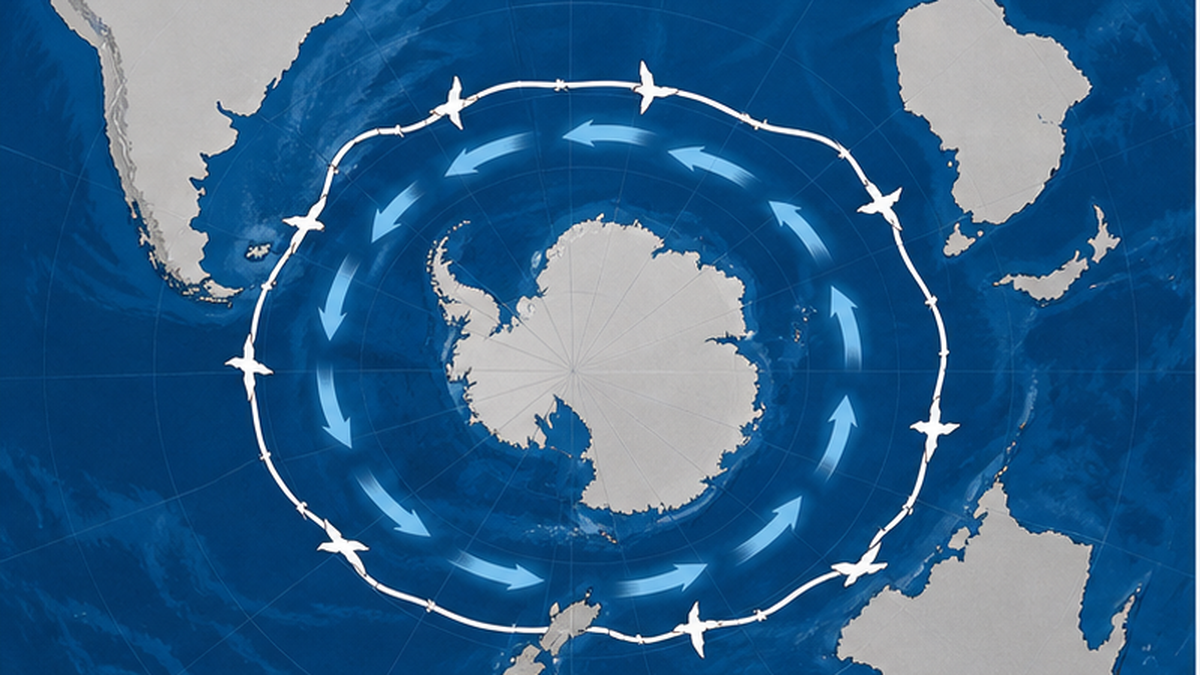
Southern Hemisphere species offer even more dramatic records. A grey-headed albatross carrying a tracking device was reported in 2005 to have circled the globe in as little as 46 days. Riding the westerlies around Antarctica, some individuals complete several laps during the non-breeding season. A bird that does not flap is going around and around the planet.
What they eat
Their main prey is squid, fish, and crustaceans. They are not strong divers, and most food is taken by surface feeding, picking items from at or near the surface. Squid that rise at night, dead fish floating on the surface, and scraps left by other predators are all important.
This habit of picking up whatever floats leads directly to two serious problems. One is taking baited hooks thrown from fishing vessels; the other is swallowing drifting plastic mistaken for food. Lighters and bottle caps have repeatedly been found in the stomachs of North Pacific albatross chicks. An efficient strategy has been turned against them by human waste.
The pitfall of surface feeding
- Drifting plastic is mistaken for prey and fed to chicks, as stomach content surveys confirm
- Baited hooks are taken in the moments after longlines are set, before they sink
- The habit of gathering around vessel discards further increases encounters with fishing boats
Mistaking floating human-made objects for food follows the same pattern in sea turtles (see The life cycle and conservation of sea turtles).
A Slow Life History: Betting Everything on One Egg
Alongside flight, the rhythm of breeding is essential to understanding this bird. Biologists call this pattern a slow life history: produce few young, raise them long, and live long.
First breeding at around seven, one egg a year
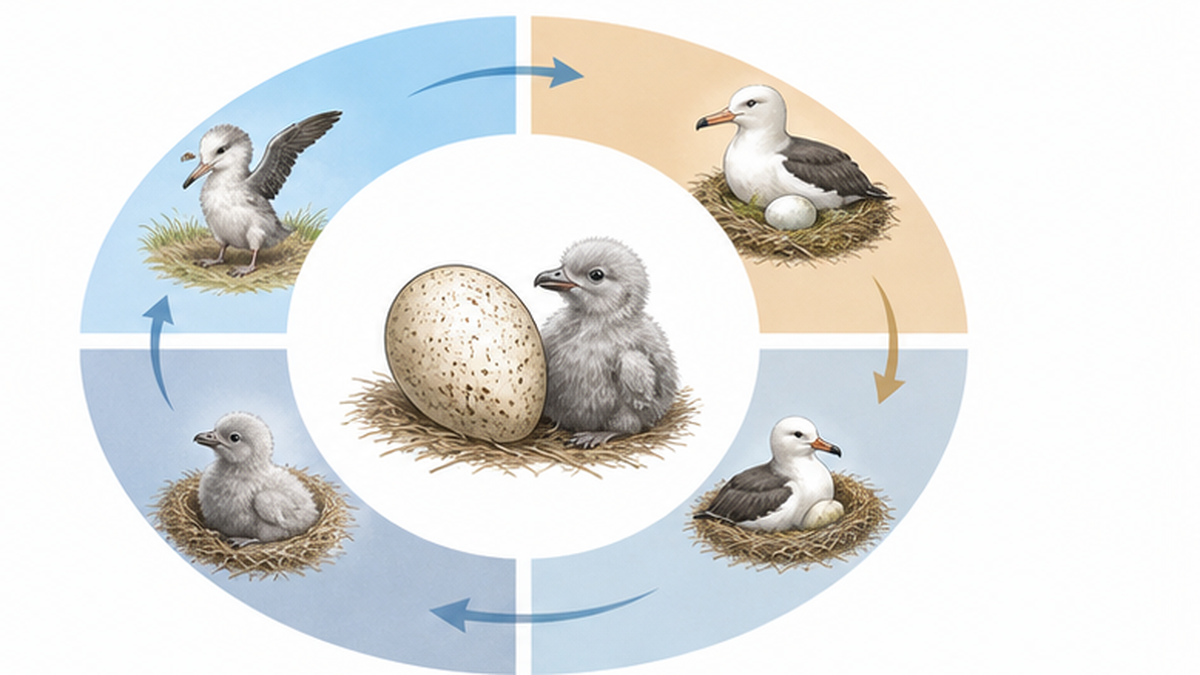
Short-tailed albatrosses begin breeding at five years old at the earliest, around seven on average. Adult white plumage takes 8 to 10 years to develop. Even once breeding, they lay a single egg, once a year. If the egg breaks or the chick dies, there is no second chance that season.
This is the opposite of a sparrow, which breeds several times a year with several eggs each time. It is a strategy optimized for remote islands without predators, where adults simply do not die. High adult survival is the entire premise - and that single fact is what makes the bycatch problem so severe.
Incubation of 65 days, fledging at 4.5 months
Incubation lasts 64 to 65 days. The pair take turns, with shifts of 10 to 20 days and sometimes as long as 25. That means one parent sits on the egg for more than three weeks in a state close to fasting, while the other gathers food hundreds of kilometers away.
From hatching to fledging takes about 4.5 months. Just before fledging the parents stop delivering food, and the chick exercises its wings through several weeks of fasting. From laying to fledging, more than half a year goes into a single chick.
Courtship dances and lifelong partnerships
Albatrosses generally breed with the same partner for life. Young birds visit the colony for several years before they breed, practicing the dance. Wings spread, bill clattering, neck stretched to the sky - the sequence is performed in unison, and birds choose partners whose timing matches their own. The repertoire differs by species and is used in identification.
Once a pair forms, they spend years refining their coordination, an investment only a long-lived bird can make. A short-tailed albatross has been confirmed raising a chick at 31, and a related Laysan albatross holds a remarkable longevity record of 66 years.
What a slow life history means
For a bird that lays one egg a year, the loss of an adult matters on an entirely different scale. If a single experienced breeder dies, the dozen or more chicks it would have raised are lost with it. That is why keeping adults alive matters even more than protecting eggs and chicks.
Back From the Brink: Slaughter and Recovery on Torishima
Japan's albatross conservation history is dramatic even by world standards. It is the record of a bird once reported extinct returning to a population of 10,000.
Hunted for feathers, then declared extinct
From the Meiji era onward, colonies on Torishima in the Izu Islands and elsewhere were subjected to mass hunting for feathers used in bedding and ornament. The birds' lack of fear translated directly into ease of capture. Millions are thought to have been taken, and after the Second World War no breeding could be confirmed. The species was reported extinct.
Torishima is also an active volcano, and eruptions have repeatedly devastated the colony. Hunting and volcanism together drove the bird into a corner.
Rediscovery in 1951 and the slow start of protection
Then, in 1951, a few individuals were rediscovered on Torishima. Because young birds spend several years at sea before returning to breed, some had escaped the hunts. From there began a long program of restricted access, designation as a Natural Monument and later a Special Natural Monument, and improvement of the breeding habitat.
The Torishima colony sat on a steep slope where erodible volcanic soil and sparse vegetation meant eggs and chicks rolled out of nests or were buried by landslides. Restoring vegetation and guiding the birds to safer ground became necessary.
The decoy operation: building a new colony with models and sound
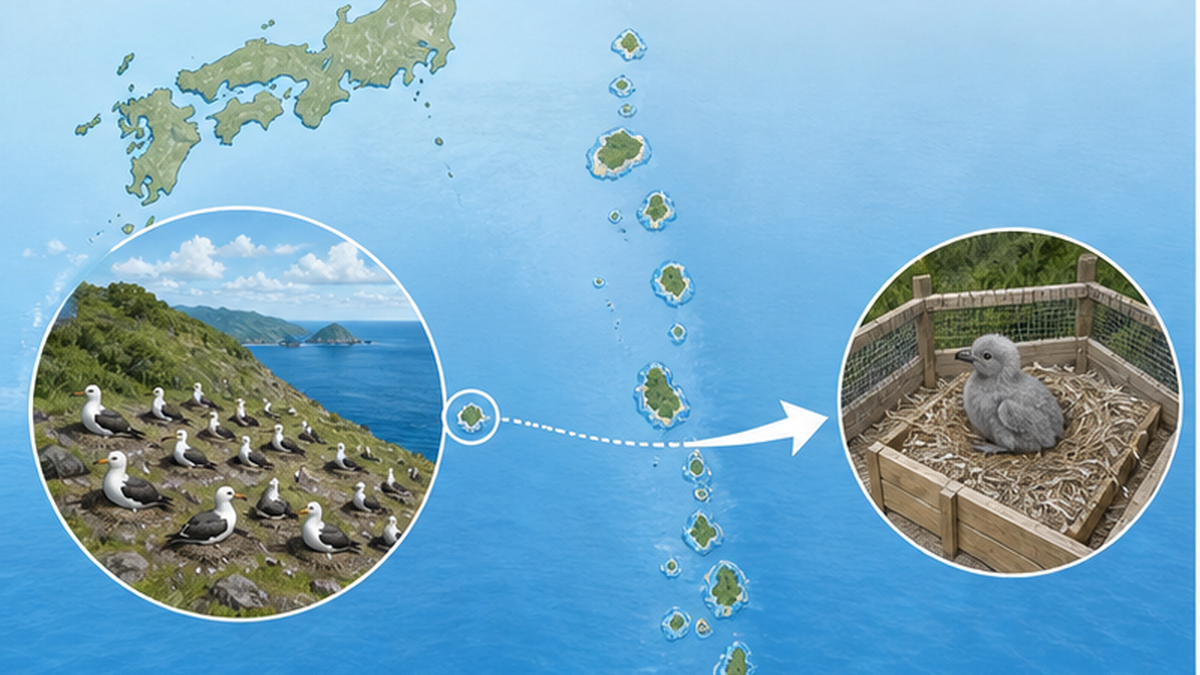
In the early 1990s the Yamashina Institute for Ornithology began a rarely attempted project: using decoys and recorded calls to draw the birds to a safer site called Hatsunesaki. Up to 90 model albatrosses were arranged on a suitable slope and calls were played. Colonial seabirds choose breeding sites where others are already present, and the operation exploited that instinct.
It worked, and a new colony took hold at Hatsunesaki. Then from 2008 to 2012 came a further project: chicks hatched on Torishima were carried to Mukojima in the Ogasawara Islands and hand-reared until fledging. Because chicks return to the place from which they fledged, the aim was a second colony independent of the volcanic island - insurance against catastrophe.
And then, 10,000 birds
The patient work shows in the numbers. Breeding season surveys by the Yamashina Institute for Ornithology counted 1,337 chicks on Torishima in the survey running from November 2024 to March 2025, with an estimated total population of about 9,500. In the 2025-26 breeding season, the population finally passed 10,000. A recovery that began with a few dozen birds has taken more than seventy years to reach this point.
Mukojima is producing results too. Birds raised in the translocation matured, returned, and began breeding. In recent years three pairs have bred there, producing three chicks in each of two consecutive seasons - an important sign that the new colony is moving toward self-sufficiency.
| Period | Status of the Torishima population | Key events |
|---|---|---|
| Meiji era to prewar | Reduced from millions | Mass hunting for feathers |
| Around 1949 | No breeding confirmed | Reported extinct |
| 1951 | A few individuals rediscovered | Protection begins |
| From 1992 | On a recovery path | Decoy operation establishes the Hatsunesaki colony |
| 2008-2012 | - | Chick translocation and hand-rearing at Mukojima |
| 2024-25 | 1,337 chicks, about 9,500 birds estimated | Yamashina Institute breeding season survey |
| 2025-26 | Estimated over 10,000 | Population passes 10,000 |
What this recovery teaches
- Create conditions where adults survive, and even a slow-life-history bird can recover within decades
- Not depending on a single colony spreads the risk from volcanoes and disasters
- Attraction using decoys and recorded calls is now applied to other seabird conservation efforts
The Biggest Threat: Longline Bycatch and a Japanese Solution
While protection at colonies advances, most albatross deaths today happen out at sea. The cause is bycatch in longline fisheries, in which animals that are not the target of the fishery are caught on hooks unintentionally.
Why they end up on the hooks
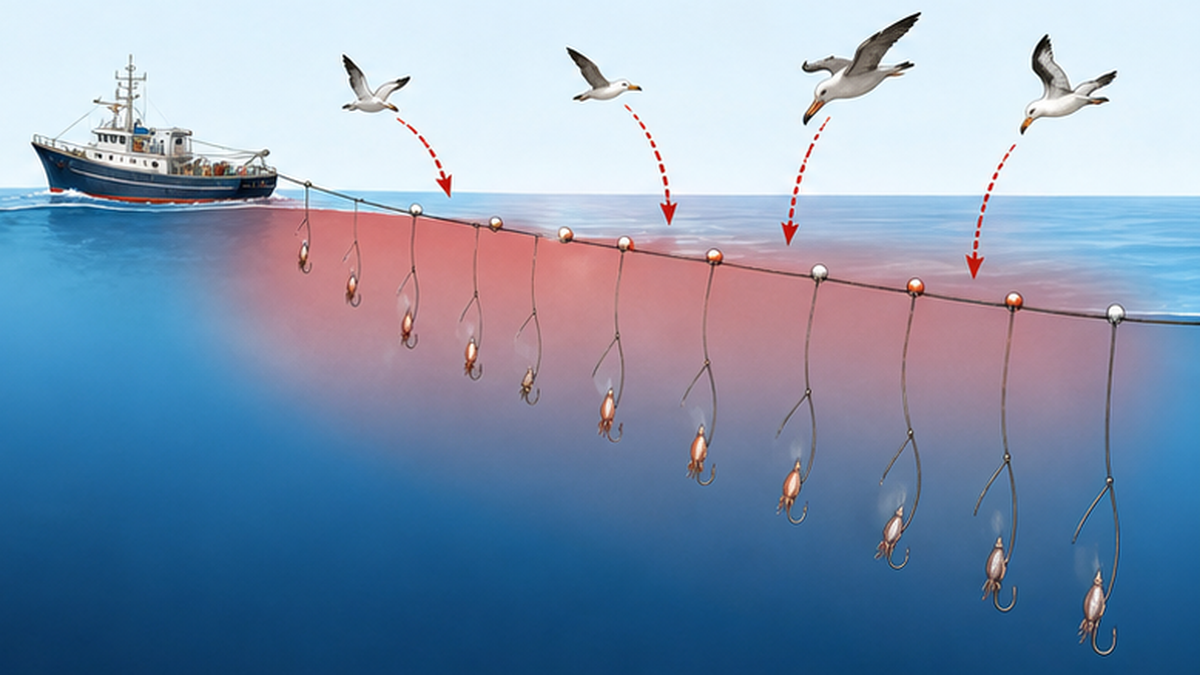
Longlining sets a long mainline carrying many branch lines and hooks. A single tuna longline operation puts thousands of hooks in the water. The danger lies in the seconds to minutes after setting, while baited hooks drift near the surface. To a bird that feeds by picking things off the surface, this looks like an excellent meal. Swallowing it means a hook in the throat and being dragged under by the sinking line.
International estimates put losses at up to 100,000 albatrosses a year from longline fisheries, with at least 160,000 seabirds of all kinds killed annually. As the previous section showed, the death of an adult is decisive for a bird that lays one egg a year. The IUCN Red List classifies 15 of the 22 albatross species as threatened, with bycatch considered the leading cause.
The bird-scaring line, invented by Japanese fishers
One of the most widely adopted responses worldwide is the bird-scaring line, or tori line, devised by Japanese fishers. The design is strikingly simple: tow a rope 100 to 150 meters long from the stern with streamers hanging from it like a curtain. As the rope flutters above the water, birds find it difficult to enter the airspace above the baited hooks.
It works precisely because albatrosses have wings built for gliding rather than maneuvering. Slender wings are ideal for soaring but poor at stopping in mid-air or threading past obstacles. The design limitation described earlier becomes a safety device. It is a fine example of detailed knowledge of an animal's form turning directly into effective conservation technology.
Three mitigation measures and the international rules behind them
Current international frameworks require tuna longline fisheries to combine at least two of three measures: bird-scaring lines, weighted branch lines, and night setting. Each addresses a different part of the problem.
| Measure | How it works | Purpose |
|---|---|---|
| Bird-scaring line (tori line) | Tows a 100-150 m rope hung with streamers | Keeps birds out of the airspace above baited hooks |
| Weighted branch lines | Adds weights so bait sinks quickly | Shortens the time bait sits within reach of birds |
| Night setting | Sets the line at night when birds are less active | Reduces encounters in the first place |
| Hook shielding devices | Covers the hook point, releasing at a set depth | Added by WCPFC in 2018 as a stand-alone option |
On the policy side, the FAO adopted the International Plan of Action for Reducing Incidental Catch of Seabirds in Longline Fisheries (IPOA-Seabirds) in 1999, asking countries to draw up national plans of action. Japan produced such a plan and has revised it since. The Agreement on the Conservation of Albatrosses and Petrels (ACAP) handles scientific evaluation of mitigation measures and their diffusion among member states.
What remains unsolved
The measures do work. Fleets that implement them properly report large reductions in bycatch. But the remaining problems are clear: monitoring is hard to enforce on the high seas, illegal, unreported and unregulated (IUU) fishing implements nothing, and observer coverage that would verify compliance is low in some regions.
In other words, this has shifted from a technology problem to a question of whether compliance can be verified. Electronic monitoring with onboard cameras, and seafood procurement built on traceability, are drawing attention as the next step.
Where bycatch mitigation stands
- The technology is settled. Combining bird-scaring lines, weighted branch lines and night setting greatly reduces bycatch
- The challenge is implementation and monitoring. Measures do not operate on the high seas or in IUU fishing
- Electronic monitoring with onboard cameras and seafood traceability are the next focus
The Senkaku Albatross: When One Species Became Two
In 2020, research fundamentally updated our understanding of this bird: what had been treated as a single species in fact contains two. The work came from Masaki Eda of the Hokkaido University Museum and colleagues.
Two lineages that diverged about 600,000 years ago
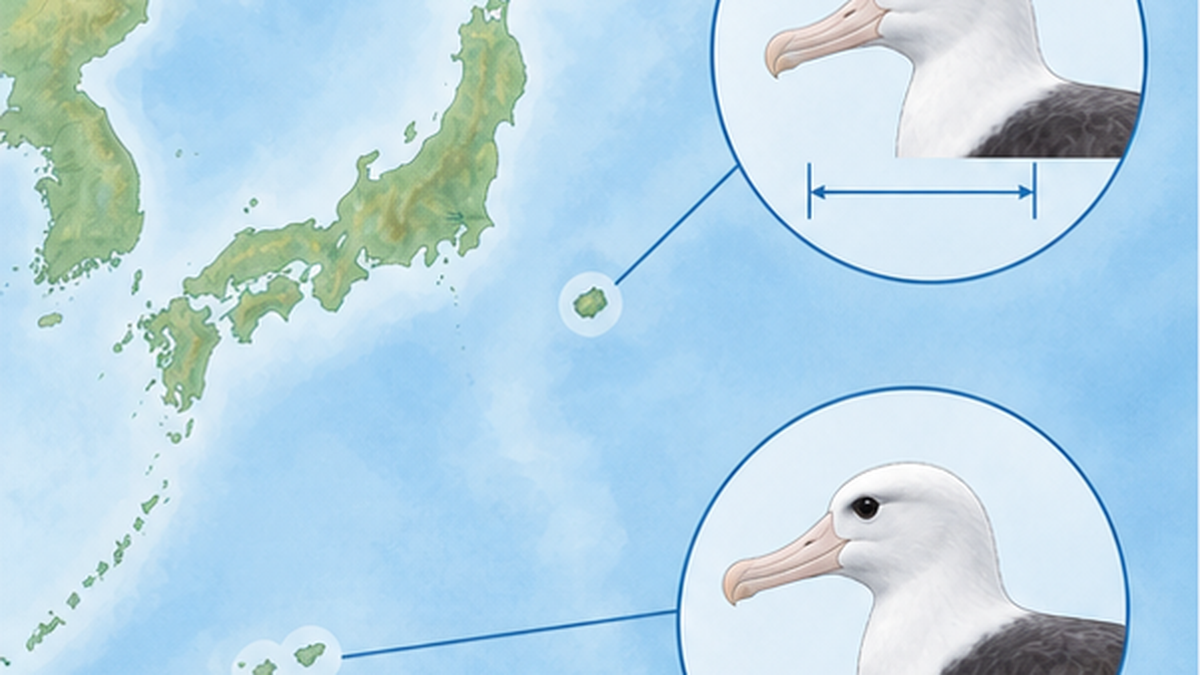
Breeding colonies fall into two main groups: Torishima in the Izu Islands, and the Senkaku Islands. It had long been known that the two carry fundamentally different mitochondrial DNA haplotypes, with a difference larger than that between other related species in the albatross family. The divergence is estimated at around 600,000 years ago.
Ecological differences have also been reported. Chicks in the Senkaku population are estimated to fledge about two weeks earlier than those on Torishima, and even when breeding at the same site, birds tend to choose mates of their own type. In effect, genetic exchange is blocked.
Morphology settled the question
The team measured and compared bill length, body weight and other traits between the two types. The result: the Torishima type was larger in most measurements, while the Senkaku type had a relatively longer bill. With differences confirmed in morphology, genetics and ecology alike, the conclusion was that the two should be treated as separate species.
The team proposed that the name short-tailed albatross be reserved for the Torishima type, with the Senkaku type called the Senkaku albatross.
What this means for conservation
A change in classification is not an academic footnote. It carries the practical consequence that the unit of conservation changes. The recovery to about 10,000 birds has been discussed as a single figure, but split in two, that figure belongs almost entirely to the Torishima type.
The Senkaku population, meanwhile, was estimated at roughly 109 to 162 breeding pairs in a 2020-21 survey using satellite imagery. It may have increased compared with past surveys, but because no landing surveys have been conducted, the current situation is not precisely known. A population of a few hundred birds concentrated in a single breeding location would remain extremely fragile.
| Short-tailed albatross (Torishima type) | Senkaku albatross (Senkaku type) | |
|---|---|---|
| Main colonies | Torishima in the Izu Islands; Mukojima in the Ogasawara Islands | The Senkaku Islands |
| Estimated size | Over 10,000 in the 2025-26 breeding season | 109-162 pairs (2020-21, satellite imagery) |
| Morphology | Larger in most measurements | Relatively longer bill |
| Fledging timing | - | Estimated about two weeks earlier than Torishima |
| Survey status | Field surveys every season | No landing surveys; current status unknown |
When classification changes, so does conservation
As one species with 10,000 birds, you can say it has recovered. As two, one may number 10,000 and the other only a few hundred. Protecting biodiversity also means finding differences that were previously invisible, and taking responsibility for each of them.
Meeting and Supporting Albatrosses
We have covered the physics of flight through to the front line of conservation. To close, here are a few ways to bring the bird closer. Knowing about a crisis matters, but so does finding the bird fascinating and coming to like it, which is where conservation often begins.
Where to see albatrosses in Japan
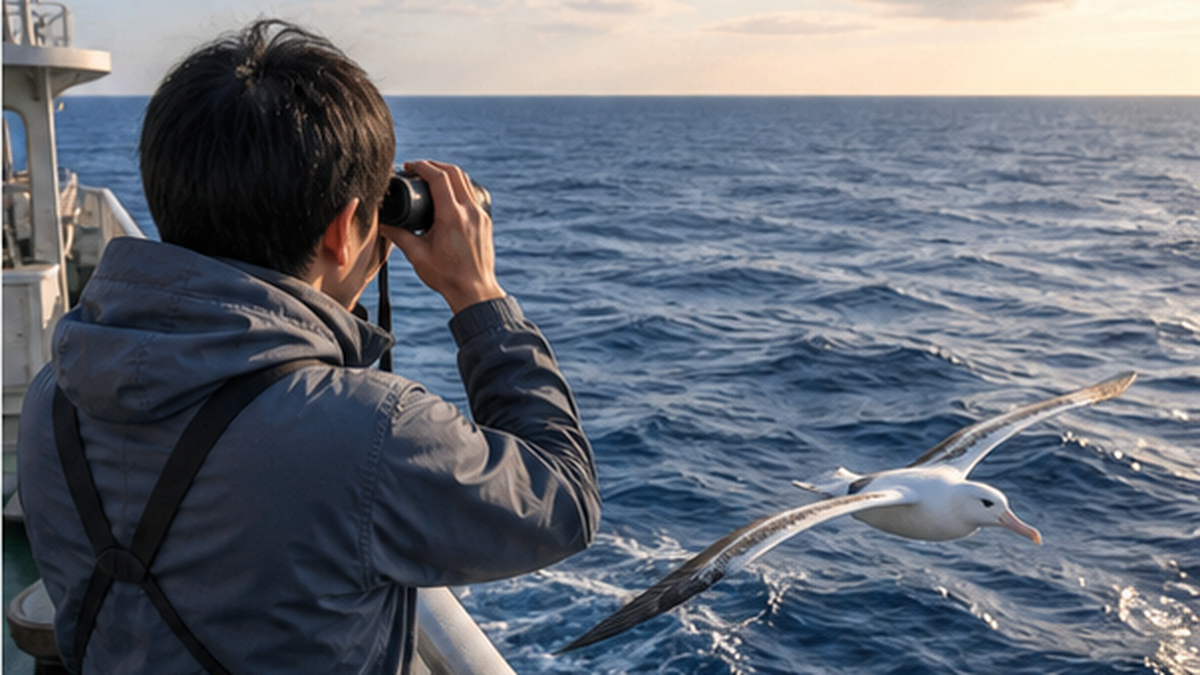
Torishima, the breeding site, is an uninhabited volcanic island closed to the public. However, the related black-footed and Laysan albatrosses can be seen in offshore waters around Japan. Long-distance ferries bound for the Izu or Ogasawara Islands, or dedicated pelagic birding trips, offer a good chance of watching one glide past the vessel.
The first clue for identification is whether the bird glides without moving its wings. Gulls mix in flapping; albatrosses hold their wings level and trace arcs just above the surface. Watch from a ship and the S-shaped path described in this article plays out in front of you.
Three things we can do
- Pay attention to the seafood you choose: choosing seafood from fisheries that work on bycatch mitigation and traceability supports the implementation of measures at sea. Getting into the habit of checking certification labels and gear information is a first step.
- Keep plastic out of the ocean: plastic fragments turn up repeatedly in the stomachs of albatross chicks. Floating litter sits exactly where surface-feeding birds can reach it most easily.
- Learn about and support survey and conservation work: the surveys run by the Yamashina Institute for Ornithology and others rest on patient seasonal fieldwork. Reading their reports is itself a form of support through attention.
Seabirds as indicators of ocean condition
The short-tailed albatross uses a vast swath of the North Pacific. Its condition and foraging success reflect the distribution of squid and fish, and thus the state of the ocean as a whole. Seabird tracking data help reveal where prey concentrates and how the marine environment is changing. Protecting seabirds also means keeping watch on the productivity of the sea itself.
Migratory birds also share the need for conservation across borders. Shorebirds that depend on tidal flats as stopovers face the same structural problem (see Shorebirds and the crisis of tidal flats).
Article summary
- The short-tailed albatross is a large seabird with a 2.2-meter wingspan that soars without flapping by using the wind shear layer above the sea
- Slender high aspect ratio wings, a shoulder tendon lock, tube nostrils with salt glands, and a keen sense of smell support life at sea
- A slow life history - first breeding around age seven, one egg a year - means the death of an adult hits the population hard
- Reported extinct after feather hunting, the Torishima population passed 10,000 in the 2025-26 breeding season after decoy operations and translocation to Mukojima
- The biggest threat is longline bycatch. The Japanese-invented bird-scaring line and two other measures are spreading, but monitoring remains the challenge
- In 2020 the Senkaku population was proposed as a separate species, the Senkaku albatross, reopening the question of what unit conservation should address
References and sources
- Ministry of the Environment, Japan | Short-tailed Albatross (Nature and Biodiversity) – Conservation and propagation programs and status as a National Endangered Species
- Ministry of the Environment Red List | Short-tailed Albatross – Assessment as Vulnerable (VU)
- Yamashina Institute for Ornithology | Prospects for the Recovery of the Short-tailed Albatross – Primary source on ecology, the history of Torishima, the decoy operation and breeding surveys
- Yamashina Institute for Ornithology | Report on this season's breeding survey – 1,337 chicks and about 9,500 birds estimated on Torishima; status at Mukojima
- Hokkaido University | Two species found within the Special Natural Monument short-tailed albatross – Proposal of the Senkaku albatross (Associate Professor Masaki Eda, Hokkaido University Museum)
- Fisheries Agency of Japan and Japan Fisheries Research and Education Agency | Seabird bycatch and its management – Content of mitigation measures and international management frameworks
- Japan Fisheries Research and Education Agency | Tori-pole: a seabird bycatch mitigation method created by Japanese fishers – Technical documentation on the structure and effectiveness of bird-scaring lines
- Royal Society Open Science | Observations and models of across-wind flight speed of the wandering albatross – Flight models of dynamic soaring and observations of crosswind speed
- Journal of Experimental Biology | Experimental verification of dynamic soaring in albatrosses – GPS-based verification of dynamic soaring
- BirdLife International | Albatross – Conservation status of the 22 albatross species and estimates of bycatch losses
* Listed in order of reliability: government/academic institutions > peer-reviewed papers > specialized organizations > reliable media