⚡ In short
Bats make up about a fifth of all mammal species. They provide pest control worth billions of dollars to U.S. agriculture and drive pollination and seed dispersal that regenerate tropical forests. This article unpacks the real, often misunderstood value of these unsung allies.
Bats flying silently through the night sky often strike people as eerie. Lurking in caves and under old eaves, emitting ultrasound as they move through the darkness, they have long been a recurring motif in horror films and vampire legends. Scientifically, however, bats eat pests, carry pollen, and disperse seeds — they are providers of "ecosystem services" whose economic and ecological value can be measured in hard numbers.
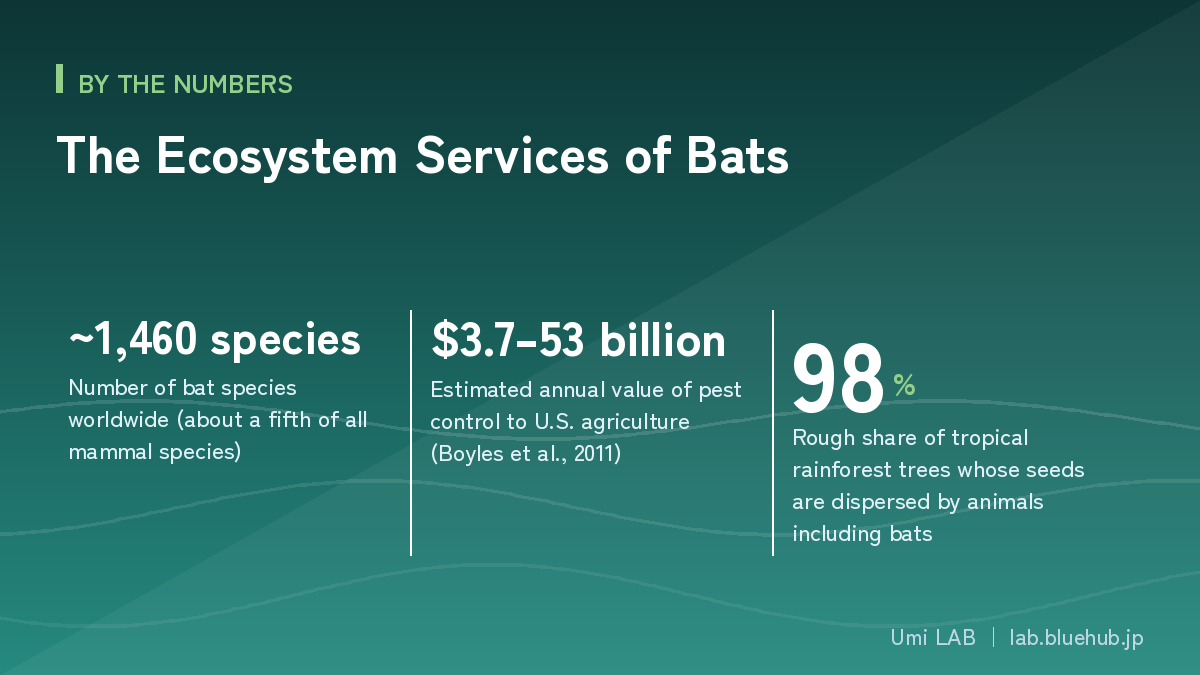
In 2011, a team of U.S. researchers estimated that the pest-control value bats provide to agriculture is worth $3.7 billion to $53 billion per year (a median of roughly $22.9 billion). This figure aggregates reduced pesticide use and avoided crop damage, showing that bats act as an "invisible pesticide sprayer." When the estimate was published in the journal Science, it drew international attention to bat population decline not merely as a conservation issue but as a matter directly tied to agricultural economics.
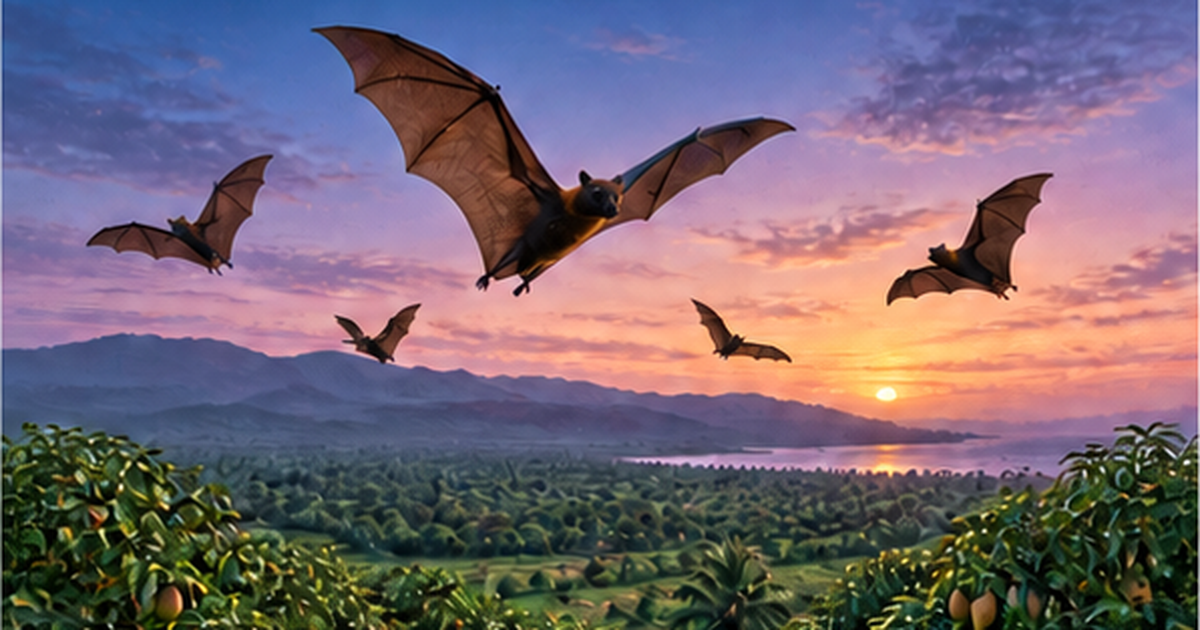
In tropical regions, meanwhile, fruit-eating bats such as flying foxes visit flowers and fruit, carrying out pollination and seed dispersal that support forest regeneration and fruit cultivation. Plants tied to our tables and favorite treats — durian, bananas, and agave (the source of tequila) — are among those that depend on bat visits. This article organizes the evidence behind these ecosystem services, explains why bats are considered beneficial animals, and looks at the threats they now face.
What you'll learn in this article
- The scientific basis for calling bats "beneficial animals" (pest control, pollination, seed dispersal)
- How the economic value of bats to U.S. agriculture is estimated, and how large it is
- Concrete examples of pollination and seed dispersal by tropical bats
- Risks posed by bat population declines, including white-nose syndrome
- The state of bat conservation in Japan, including the Bonin flying fox
- Common misconceptions about bats (blood-sucking, disease transmission) and how to think about them
What Are Bats? A Fifth of All Mammal Species
Bats belong to the order Chiroptera, the only group of mammals capable of true flight. Around 1,460 species are known worldwide, accounting for a bit over a fifth of all mammal species (roughly 6,500). They are the second most species-rich mammalian order after rodents, and are found on nearly every continent and island except Antarctica. Body sizes range enormously, from tiny species just a few centimeters long to large flying foxes with wingspans reaching 1.7 meters.
Two Broad Feeding Groups: Insectivores and Fruit-Eaters
Bat diets broadly fall into two categories: insectivorous species that eat moths, beetles, and other insects, and frugivorous (nectar-feeding) species that eat fruit and flower nectar. Insectivores make up the majority worldwide, accounting for roughly 70% of species. Flying foxes (family Pteropodidae), found in tropical and subtropical regions, are mainly fruit- and nectar-feeding and play a major role in pollination and seed dispersal. The two groups play very different ecological roles — insectivorous bats act as predators, while fruit-eating bats act as pollinators and seed dispersers, each supporting plants and agriculture in distinct ways.
- Insectivorous bats: widely distributed across temperate and tropical regions, regulating populations of nocturnal insects such as moths, beetles, and stink bugs
- Fruit- and nectar-feeding bats: distributed in tropical and subtropical regions, serving as pollinators and seed dispersers
- A small number of vampire bats: only three species, found in Central and South America, that feed on livestock blood
Echolocation: A Remarkable Ability
Most insectivorous bats emit ultrasonic pulses from their mouth or nose and use the returning echoes to sense the position of surrounding objects and prey — an ability known as echolocation. This lets them accurately catch tiny insects just a few millimeters across while flying through pitch-black caves or the night sky. Researchers use devices called "bat detectors" to record and analyze these ultrasonic calls for species identification and population surveys.
Only Three Species Are True "Vampire Bats"
- Of the roughly 1,460 bat species worldwide, only three species — including the common vampire bat — actually feed on blood, and all are found in Central and South America. Bats in Japan and most other regions are insectivorous or fruit-eating and do not attack people.
The Economic Value of Pest Control: Up to $53 Billion a Year in U.S. Agriculture
Among bats' ecosystem services, pest control has the strongest economic evidence behind it. In 2011, a team led by U.S. ecologist Justin Boyles published a paper in the journal Science that systematically estimated the value of pest control that bats provide to U.S. agriculture. It was a landmark study that, for the first time, translated a bat's ecological role into a nationwide economic value, and it has since become a starting point for much subsequent research and policy discussion.
The Boyles et al. (2011) Estimate: $3.7–53 Billion a Year
The estimate derives economic value by working backward from the volume of pests bats consume to the pesticide costs farmers would otherwise have paid and the crop damage that would have occurred without pest control. Because the figures vary by region, crop, and assumed scenario, the result is presented as a wide range of $3.7 billion to $53 billion, with roughly $22.9 billion cited as a median benchmark. This amount has been noted to rival the scale of major U.S. agricultural subsidy programs, underscoring that bats function as "free pest-control infrastructure."
| Item | Detail |
|---|---|
| Estimated range | $3.7–53 billion per year |
| Median benchmark | Approx. $22.9 billion |
| Calculation method | Sum of reduced pesticide use and avoided crop damage |
| Scope | U.S. agriculture overall (cotton, corn, etc.) |
A Concrete Example: $741,000 a Year in Texas Cotton Fields
As a concrete example, a study of cotton fields in south-central Texas found that bats preying heavily on bollworm larvae, a major cotton pest, provided an effect equivalent to eliminating an entire round of pesticide spraying. The combined net benefit of this pest control and the avoided crop damage was calculated at roughly $741,000 per year. Similar research in Australia's cotton industry has reported that insectivorous bats significantly suppress pest populations, providing farmers with economic value that cannot be ignored.
Why Bats Are Called an "Invisible Pesticide Sprayer"
- A single bat is thought to consume an amount of insects equal to roughly half its own body weight, or more, in a single night. In colonies numbering in the thousands or millions, this adds up to an enormous quantity of pests removed each night. This sustained predation pressure functions as a substitute for chemical pesticide application, which is precisely what makes it possible to translate into monetary economic value.
Pest Control Also Confirmed in Cornfields
Similar research has accumulated for crops beyond cotton. In the U.S. Corn Belt, bats have been reported to prey on adult European corn borer moths, indirectly suppressing larval crop damage. Much of this research quantifies the pest-control effect through field experiments comparing plots where bats were temporarily excluded with plots where they were not, offering data-based evidence rather than mere speculation.
Extending to Vineyards and Orchards
Economic evaluation of pest-control services is not limited to the United States. A study of vineyards in Chile quantitatively demonstrated that bat predation on pests prevents declines in grape quality, delivering concrete economic benefits to growers. For crops like wine grapes, where quality is directly tied to price, even a small reduction in pest damage can have an outsized effect on revenue, and evaluation of bats' pest-control services is advancing from a farm-management perspective as well.
Pollination and Seed Dispersal That Sustain the Tropics
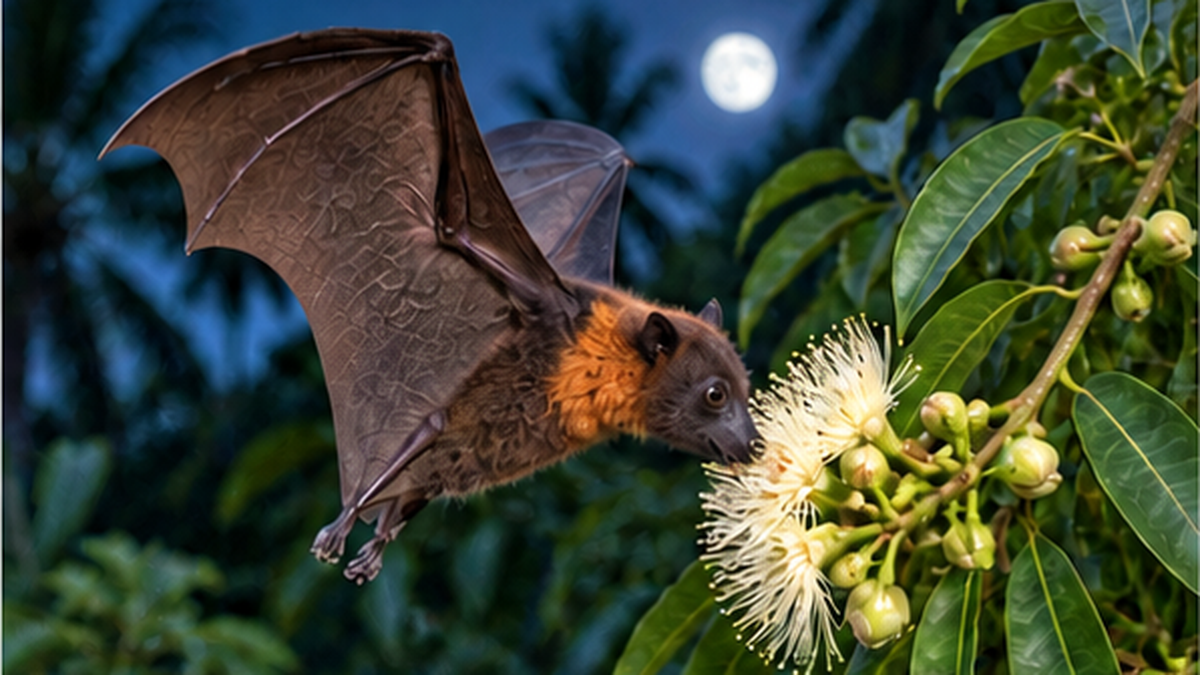
In tropical and subtropical regions, fruit- and nectar-feeding flying foxes play an important role in supporting plant reproduction. Their two main contributions are pollination, carrying pollen as they move from flower to flower, and seed dispersal, eating fruit and excreting the seeds elsewhere — solving, respectively, the plant's challenges of fertilization and range expansion.
Bananas, Mangoes, Durian, and Bats
Some tropical fruit trees produce flowers adapted specifically for bat pollination, a syndrome known as chiropterophily. Such flowers typically share features that attract bats — strong nighttime fragrance, wide-open corollas, and abundant nectar. Durian, bananas, mangoes, and agave (the source of tequila) — plants closely tied to our everyday food and drink — are among the commercial crops known to benefit from pollination by flying foxes. In Southeast Asia, the contribution of flying foxes to durian pollination has drawn particular attention, and the relationship between roost conservation near orchards and crop yield has become a subject of research.
Seed Dispersers That Regenerate Rainforests
In tropical rainforests, many tree species depend on animals such as birds and mammals for seed dispersal, with animal-dispersed species making up over 90% of tree species by some estimates. Within this network of animal dispersers, bats act as "pioneer seed dispersers," carrying seeds first into cleared land, secondary forest, and other open habitats during the early stages of forest regeneration. While birds tend to favor open, bright areas, bats can move freely through darkness, so they tend to actively carry seeds into logged areas and farmland margins that birds often avoid — a distinct contribution valued in forest recovery.
Key Points from This Section
- Tropical bats support plant reproduction and forest regeneration through both pollination and seed dispersal
- Some commercial crops, such as durian and agave, depend on visits from bats
- Bat seed dispersal is especially important in the early stages of forest regeneration on cleared land
Some Bats Migrate Long Distances
Some bat species undertake seasonal "migrations" of several hundred kilometers or more. Migratory flying foxes move across wide areas of the tropics and subtropics as the flowers and fruit they feed on shift with the seasons, also acting as "pollen couriers" that carry pollen between distant plant populations. This is thought to promote crossbreeding between genetically distant populations, indirectly contributing to the maintenance of genetic diversity in plants as well.
Bats in Japan and the State of Conservation
Japan is home to around 35 bat species, most of which are insectivorous and are thought to contribute to pest control in rice paddies, satoyama landscapes, and riverbanks. The Japanese pipistrelle, commonly seen flying over residential areas on summer nights, is one of Japan's most familiar bats and preys heavily on mosquitoes and other small insects. At the same time, the ecology of many species, particularly cave-dwelling ones, remains poorly understood, and building basic data on population trends and habitat status remains a conservation challenge.
The Bonin Flying Fox: Japan's Only Fruit-Eating Bat
The Bonin flying fox, found in the Ogasawara (Bonin) Islands, is Japan's only resident fruit-eating flying fox. It has been designated a Nationally Endangered Species under Japan's Act on Conservation of Endangered Species and is the subject of a protection and propagation program by the Ministry of the Environment. Because it forms small, isolated populations on islands such as Chichijima and Hahajima, it is vulnerable to typhoons and habitat loss. As a species that disperses seeds of native plants within this unique ecosystem, ongoing population monitoring and conservation measures are being developed.
Coexistence with Bats in Agricultural Water Tunnels
Japan's Ministry of Agriculture, Forestry and Fisheries has been surveying and conserving cave-dwelling bat habitats, with particular attention to agricultural water tunnels. Aging water tunnels, being dark and having stable humidity, can function as alternative roosts to natural caves, and land-improvement projects are exploring measures such as surveying bat presence before renovation work and securing alternative roosting spaces.
Things You Can Do
- Avoid needlessly destroying old eaves or tree hollows that serve as bat roosts
- Limit excessive pesticide use in gardens and home vegetable plots to make use of bats as natural predators
- If you spot a bat, observe it quietly from a distance rather than approaching or disturbing it
- Take part in local nature observation events or bat surveys to help track population status
The Surprising Role of Urban Japanese Pipistrelles
Pest control by bats is not limited to rural areas. The Japanese pipistrelle, a small species roughly 5 centimeters long commonly seen in Japanese residential neighborhoods, preys on mosquitoes and small moths that swarm on summer nights. Some local governments and researchers have noted that maintaining pipistrelle habitat may also be meaningful from the standpoint of controlling mosquito-borne diseases, suggesting that preserving urban green spaces and park trees could indirectly support pest suppression through bat habitat.
White-Nose Syndrome: A Disease That Has Killed Millions of Bats in North America
Part of why bats' ecosystem services have drawn attention is a growing sense of crisis over population declines in some regions. In North America, a fungal disease called white-nose syndrome has spread among hibernating bats since the late 2000s. A white, mold-like fungus grows on the muzzle and wings, causing metabolic disruption and depleted energy reserves during hibernation, and has led to sharp population declines in some species. The pathogen is believed to have been absent from North America originally, and may have been introduced between caves through human activity.
How Population Decline Affects Agriculture
The Boyles et al. (2011) study also drew attention by warning that, if declines from white-nose syndrome continue, the loss of agricultural pest-control services could lead to increased pesticide use and greater crop damage. The loss of an ecosystem service tends to go unnoticed while bats remain healthy and active, becoming visible only once populations fall below a critical threshold and crop damage begins to rise. This structure — a hidden benefit that is noticed only once it's gone — illustrates precisely why the concept of ecosystem services matters for measuring the value of nature.
| Threat | Main affected regions | Effect on bats |
|---|---|---|
| White-nose syndrome (fungal disease) | North America | Mass mortality in hibernating colonies, local extinctions |
| Roost loss (cave development, logging) | Worldwide | Loss of breeding and wintering sites |
| Collisions with wind turbines | North America, Europe | Mortality among migratory bats |
Wind Power Expansion and Bat Collisions
As wind power expands globally as part of climate action, collisions between migratory bats and turbine blades have been reported in North America and Europe. Fatalities tend to cluster under specific weather conditions, such as calm nights following the passage of a low-pressure system during migration season, and operational measures such as raising the turbine cut-in speed to temporarily halt rotation under those conditions have been studied and adopted as mitigation strategies. Finding ways to reconcile the expansion of renewable energy with bat conservation remains an ongoing need.
Why the "Ecosystem Services" Framework Matters for Evaluating Bats
Efforts to translate bats' pest control and pollination into economic value rest on the concept of ecosystem services — a framework for making the benefits of biodiversity visible. International frameworks such as the Intergovernmental Science-Policy Platform on Biodiversity and Ecosystem Services (IPBES) organize nature's benefits into categories such as provisioning, regulating, cultural, and supporting services, aiming to inform policy decisions.
Pest Control and Pollination as Regulating Services
Within this classification, bats' pest control and pollination fall under "regulating services." Regulating services refer to benefits humans receive from organisms indirectly regulating environmental processes such as air, water, and soil, and are characterized by being hard to see until they are lost, at which point they register as economic loss. The bat example is frequently cited in ecology and environmental economics as a leading case of quantifying this kind of hard-to-see regulating service.
Other Animals That Also Support Forests Through Seed Dispersal
Seed dispersal is not unique to bats — terrestrial animals such as jays and bears also contribute to forest-building. As introduced in our article on animals that carry seeds, animal-mediated seed dispersal is a mechanism common to forest regeneration worldwide, and bats play a distinct role within it owing to their nocturnal, flying habits, differing from birds and terrestrial mammals. When multiple animal species disperse seeds in overlapping ways, forests are thought to gain greater resilience against a wider range of environmental changes.
The Value of Putting Numbers on Nature's Hidden Benefits
- Presenting benefits as economic value makes it easier to convey the need for bat conservation to policymakers and agricultural stakeholders
- At the same time, care is needed not to overlook ecological and cultural values that cannot be converted into monetary terms
Limits and Caveats of Ecosystem Service Valuation
Methods for expressing ecosystem services in monetary terms have their limits. The value of pest control depends on fluctuating pesticide and crop prices, so estimates shift as market prices at the time of calculation change. Moreover, not every role bats play can be converted into monetary value — long-term, indirect values such as ecosystem stability and impacts on future generations are difficult to capture in numbers. Many researchers caution that economic valuation is just one tool for communicating the need for conservation, not the sole yardstick for measuring the full picture of ecosystem services.
International Bat Conservation Efforts and What We Can Do
Sustaining the ecosystem services bats provide requires conserving the species themselves. Internationally, agreements such as EUROBATS (the Agreement on the Conservation of Populations of European Bats), which protect migration routes across borders, along with domestic legal protections for roosting caves and buildings, are being advanced in various countries. For migratory species, conservation measures confined to a single country are insufficient — breeding grounds, wintering sites, and migration routes all need to be covered through international cooperation.
Endemic Species Conservation in the Bonin Islands
In Japan, as introduced in our article on endemic species of the Ogasawara Islands, island endemics including the Bonin flying fox face compound threats from invasive species and shrinking habitat. Even for flying animals like bats, island ecosystems separated by ocean support only small populations, meaning localized disasters or disease outbreaks can have devastating effects on an entire population — which is why conservation priority remains high.
Everyday Conservation Actions Anyone Can Take
Bat conservation is not solely a matter for experts. Small, cumulative actions — not needlessly destroying tree hollows or old houses that serve as roosts, joining community bat-watching events to help record population status, and limiting pesticide use in home gardens to make use of bats as natural predators — help sustain local bat populations, which in turn supports the ecosystem services that agriculture and forests continue to receive.
Summary of This Article
- Bats provide three ecosystem services: pest control, pollination, and seed dispersal
- U.S. agriculture alone is estimated to receive up to $53 billion a year in economic value from bats
- Population declines from diseases such as white-nose syndrome pose a direct risk to the loss of these ecosystem services
- In Japan too, conservation of endemic species such as the Bonin flying fox is underway
Misunderstood Bats: Disease Vectors and Beneficial Animals at Once
Bats are sometimes studied as reservoirs for emerging infectious diseases, and this association can reinforce an image of them as dangerous animals. When news coverage highlights cases where a virus is believed to have spilled over from bats to humans, it can trigger indiscriminate destruction of roosts in some areas. As discussed above, however, the economic and ecological balance overwhelmingly favors bats as beneficial animals, and reckless extermination can backfire by increasing pest populations and harming fruit production.
Balancing Risk and Benefit
Vigilance about infectious disease risk and recognition of bats' value as ecosystem service providers are not mutually exclusive; both need to be considered together. A practical, sustainable approach is a two-pronged one: maintain basic distance from wild bats — not touching them directly with bare hands or disturbing their roosts — while still conserving the habitats that serve as their roosting sites. Many local governments and public health authorities likewise promote coexistence-based guidance, urging people not to touch or approach too closely rather than calling for extermination.
References and Sources
- Boyles et al. (2011) "Economic Importance of Bats in Agriculture" (summary of research published in Science) – Estimate of the pest-control value bats provide to U.S. agriculture
- USDA - Economic Impact of Bats – USDA explanation of the economic value of bats
- Japan Ministry of the Environment: Bonin Flying Fox Protection and Propagation Project – Conservation plan for this Ogasawara endemic bat species
- Japan Ministry of Agriculture, Forestry and Fisheries: Agricultural Water Tunnels and Bats – Conservation of cave-dwelling bats and land-improvement projects
- Rutgers NJAES - Ecological and Economic Importance of Bats in Integrated Pest Management – The role of bats in integrated pest management
- Quantifying ecological and economic value of pest control services provided by bats in a vineyard landscape of central Chile – Quantitative evaluation of bats' pest-control value in Chilean vineyards
- Insectivorous bats provide significant economic value to the Australian cotton industry – Economic value of bats to the Australian cotton industry
※ Ordered by reliability: government and academic institutions > peer-reviewed papers > specialist organizations > reputable media