⚡ The answer in 30 seconds
- A best-before date indicates taste and quality; food does not suddenly become inedible after it (a use-by date concerns safety).
- The one-third rule is a business custom, not a law: shelf life is split into thirds, with delivery due in the first third and sale until the second third.
- The number of firms easing delivery deadlines, using year-month labels, or extending best-before periods keeps growing; as of October 2025 each stands at roughly 360–390 firms.
Some food disappears from store shelves while still perfectly edible. One reason is not a law but a distribution custom: the "one-third rule."
This rule creates another set of deadlines—a delivery deadline and a sales deadline—before the best-before date arrives. The longer a product's shelf life, as with canned seafood and fish paste products, the larger the gap becomes.
Drawing on publications from the Consumer Affairs Agency, the Ministry of Agriculture, Forestry and Fisheries, the Ministry of the Environment, and UNEP, this article sorts out what best-before dates mean and where reform of business customs stands today.
What you will learn in this article
- The difference between use-by and best-before dates
- How the one-third rule works and why two deadlines arrive before the date
- Breakdown of Japan's food loss (2.31 million tonnes from business)
- The three pillars: eased delivery deadlines, year-month labels, longer best-before periods
- The scale of global food waste and what we can do
A best-before date is not a "safety deadline": let's sort out the terms first
Perfectly edible products vanish from supermarket shelves. The cause lies not in the food's quality but in customs of distribution. Canned seafood, kamaboko fish cakes, frozen processed foods, and dried goods from the sea are no exception. This article uses official sources to explain how the one-third rule works and where efforts to review it stand.
Definitions of use-by and best-before dates
Under Japan's Food Labeling Standards, the use-by date (shohi kigen) is the date up to which a food, when stored by the prescribed method, is judged free of the risk of losing safety through spoilage or other deterioration in quality. It appears on perishable foods such as bento boxes, sandwiches, and fresh sashimi, with a period of roughly five days or less.
The best-before date (shomi kigen), by contrast, is the date up to which all expected qualities of a food, when stored by the prescribed method, can be fully maintained. It appears on foods that deteriorate relatively slowly, such as snacks, canned goods, retort pouches, ham, and sausages. The key point is that food does not immediately become inedible once the best-before date passes.
| Item | Use-by date | Best-before date |
|---|---|---|
| Meaning | Date until which food can be eaten safely | Date until which food tastes best (quality is maintained) |
| Examples | Bento, prepared bread, fresh confectionery, fresh sashimi | Canned goods, fish paste products, dried goods, retort food, sweets |
| After the date | Better not to eat | Not immediately inedible |
| Typical period | Roughly five days or less | Longer than that |
How are dates set?
Manufacturers set dates based on microbiological, physicochemical, and sensory tests (checking taste, aroma, and appearance). Rather than printing the entire period over which quality held in testing, they normally apply a safety factor below 1 to set a shorter date. A guideline of "0.8 or higher" has traditionally been used. For example, if quality holds for 10 months in testing, multiplying by 0.8 gives a label of 8 months.
In March 2025 (Reiwa 7), the Consumer Affairs Agency published its "Guidelines for Setting Food Date Labels." Press coverage and commentary describe it as dropping the old numerical guideline of "0.8 or higher" in favor of asking for appropriate settings suited to each food's characteristics and its manufacturing and distribution environment. If safety factors become easier for companies to revisit, best-before periods may lengthen.
Key points of this section
- A use-by date concerns safety; a best-before date concerns quality
- A best-before date already includes a margin: the tested period multiplied by a safety factor
- Expired does not mean discard immediately; judge by appearance, smell, and storage conditions
What is the one-third rule? A distribution custom that divides shelf life into thirds
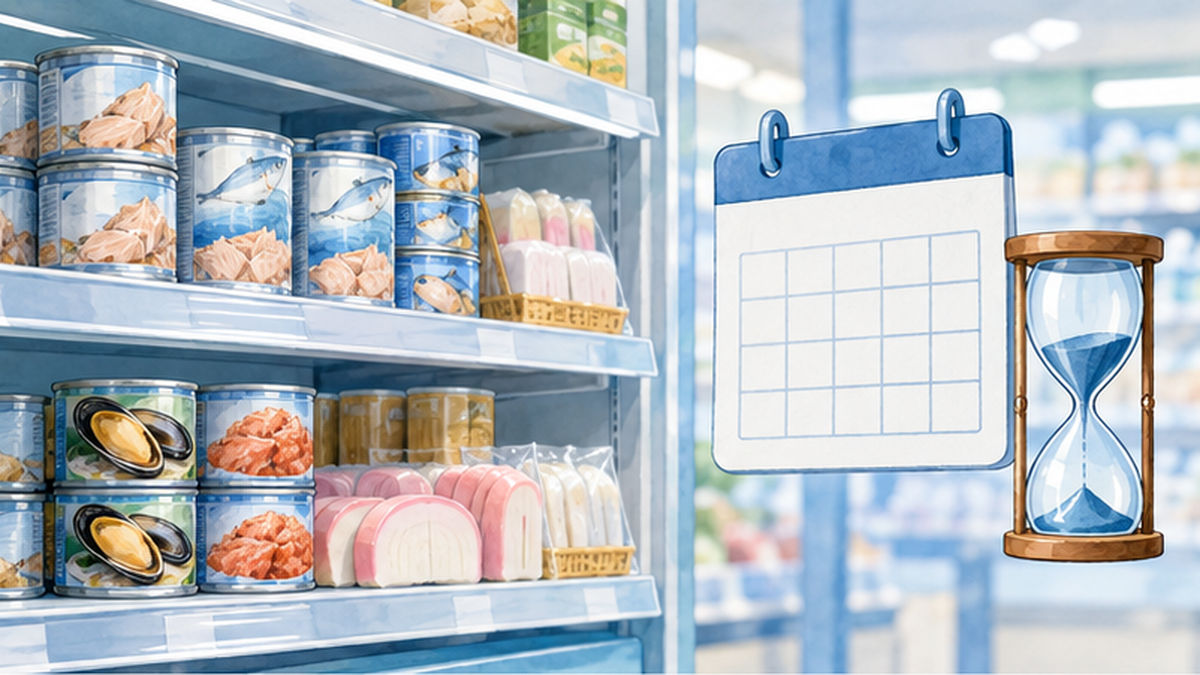
Japan's food distribution has a custom, established by industry practice rather than by law, called the "one-third rule." It divides the period from the manufacturing date to the best-before date into three: products must be delivered to retailers within the first third and sold by the end of the second third. The remaining period has been regarded as time for consumers to eat the food at home.
A worked example
Take canned food with a six-month shelf life. The delivery deadline to retailers is within two months of manufacture, and the sales deadline is the end of month four. A product past its sales deadline is pulled from the shelf even though two months remain before its best-before date. In other words, two "distribution deadlines" arrive before the best-before date.
| Shelf life | Delivery deadline (one-third rule) | Sales deadline (two-thirds elapsed) | Delivery deadline (one-half rule) |
|---|---|---|---|
| 3 months | 1 month after manufacture | 2 months after manufacture | 1.5 months after manufacture |
| 6 months | 2 months after manufacture | 4 months after manufacture | 3 months after manufacture |
| 12 months | 4 months after manufacture | 8 months after manufacture | 6 months after manufacture |
Why did this rule arise?
According to Ministry of Agriculture, Forestry and Fisheries materials, the practice spread through a combination of consumers' preference for newer products, retailers' desire for fresher goods, and the judgment that strict delivery deadlines keep one's own inventory safe for longer. It was not created with ill intent; it is the accumulation of rational decisions by companies trying to reduce their own risk. Yet when everyone tightens in the same direction, the result is a contradiction: more waste across the whole food chain.
Comparison with other countries
In commonly cited comparisons, the United States uses about one-half of shelf life, Europe about two-thirds, and the United Kingdom about three-quarters as delivery deadlines. Figures vary by industry and company and are only a guide, but many explanations agree that Japan's one-third is relatively strict.
Note
The one-third rule is a business custom, not a law. It has no legal force and operates through agreements with trading partners and retailers' ordering conditions. That is why companies have room to relax it.
Japan's food loss today: 4.64 million tonnes, of which 2.31 million from business
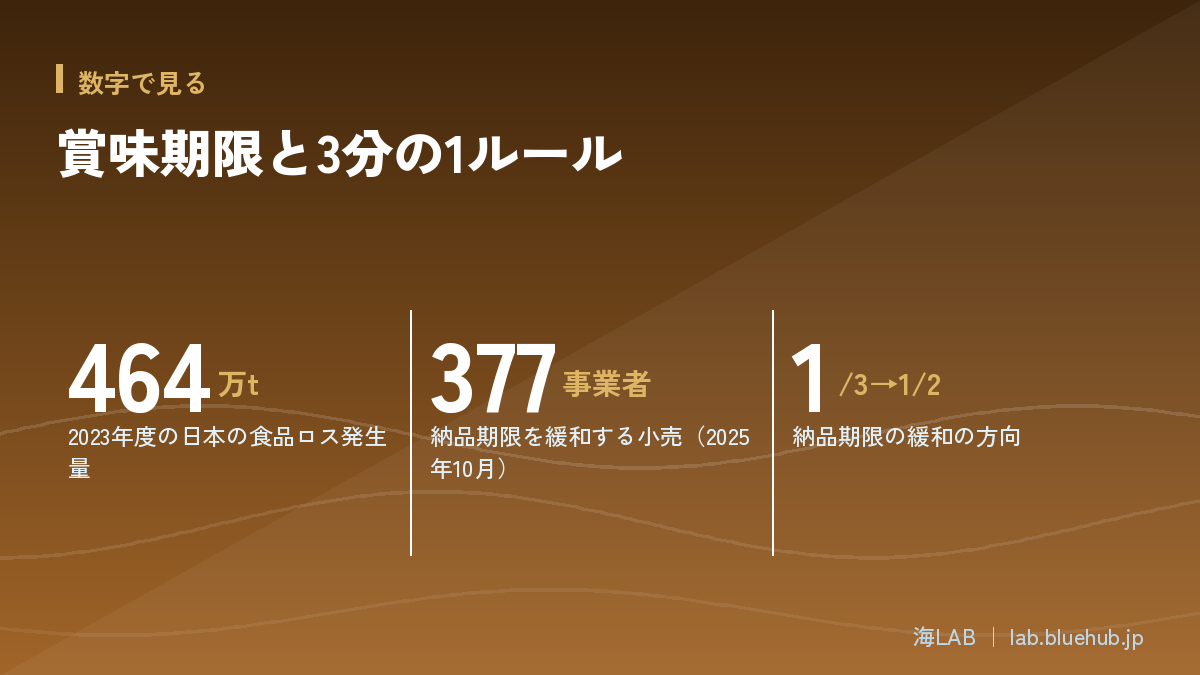
According to estimates by the Ministry of the Environment and the Ministry of Agriculture, Forestry and Fisheries, Japan's food loss in FY2023 (Reiwa 5) was about 4.64 million tonnes, down about 80,000 tonnes (about 1.7%) from about 4.72 million tonnes the year before. About 2.33 million tonnes came from households and about 2.31 million tonnes from businesses.
Breakdown of business food loss
Of the 2.31 million tonnes from business, food manufacturing is the largest at about 1.08 million tonnes (about 47%), followed by food service at about 660,000 tonnes (about 29%), food retail at about 480,000 tonnes (about 21%), and food wholesale at about 90,000 tonnes (about 4%). The large share of manufacturing may seem surprising. At the manufacturing stage, off-spec products, returned unsold goods, and expired inventory arise. Delivery conditions, including the one-third rule, are linked to a structure that produces food loss at the boundaries between manufacturing, wholesale, and retail.
| Category | Amount (FY2023) | Share of business total |
|---|---|---|
| Food manufacturing | About 1.08 million t | About 47% |
| Food service | About 660,000 t | About 29% |
| Food retail | About 480,000 t | About 21% |
| Food wholesale | About 90,000 t | About 4% |
| Business total | About 2.31 million t | 100% |
Household food loss and targets
For households, direct disposal is about 1.00 million tonnes (about 43%), leftovers about 970,000 tonnes (about 41%), and excessive removal (such as peeling too thickly) about 360,000 tonnes (about 16%). The government has set a target of 2.73 million tonnes of business food loss by FY2030 (half the FY2000 level). The FY2023 figure of 2.31 million tonnes is already below this level. Continued effort is still needed to reduce the total, including household loss.
For household food loss, see our article Food Loss in Japanese Households. For ideas from retail, see Reducing Food Waste at Supermarkets, and for convenience stores, Food Loss at Convenience Stores.
Three pillars of reform: eased delivery deadlines, year-month labels, longer best-before periods
As reform of business customs to cut food loss, the Ministry of Agriculture, Forestry and Fisheries promotes three measures together: easing delivery deadlines, consolidating best-before labels, and extending best-before periods. The number of participating firms is published for these and for a fourth indicator, donations to food banks and similar groups.
① Easing delivery deadlines
This means relaxing the one-third rule to, for example, one-half, to lengthen the period in which delivery is allowed. Retailers lead this effort. The number of food retailers easing delivery deadlines, as published by the Ministry, rose from 339 in October 2024 to 377 in October 2025.
② Consolidated best-before labels (year-month labels and grouped-day labels)
For foods with a shelf life over three months, the date may be shown as a year and month instead of year, month, and day. For example, a label of "2027.3" means the date runs through the last day of that month. There is also "grouped-day labeling," which groups dates into units such as ten days. With full dates, a product with an earlier date than one already delivered cannot be delivered and has nowhere to go. With year-month labels, products made in the same month share the same date and can be delivered. The number of firms using year-month or ten-day labels rose from 350 in October 2024 to 365 in October 2025.
③ Extending best-before periods
Manufacturers extend best-before periods through improved packaging or production methods, or by redoing quality tests. The number of firms working on extensions rose from 359 in October 2024 to 393 in October 2025.
| Initiative | October 2024 | October 2025 | Change |
|---|---|---|---|
| Easing delivery deadlines (retail) | 339 firms | 377 firms | +38 |
| Year-month / grouped-day labels | 350 firms | 365 firms | +15 |
| Extending best-before periods | 359 firms | 393 firms | +34 |
| Donations to food banks and children's cafeterias | 482 firms | 529 firms | +47 |
Why the three pillars are needed together
- Even if manufacturers extend dates, effects stay limited if retailers' delivery deadlines remain strict
- Even with year-month labels, products with nowhere to go remain if retailers enforce the one-third rule
- Waste falls when manufacturers, wholesalers, and retailers act together, not just one of them

Seafood and best-before dates: the situation for canned, paste, and frozen products
Foods from the sea show an especially wide variety in how dates are set. Sashimi and fresh fish carry use-by dates, canned seafood and dried goods carry best-before dates, and frozen foods carry best-before dates, so even "fish" is treated differently. Here we focus on processed foods that are particularly exposed to business customs.
The longer the shelf life, the greater the impact of business customs
With the one-third rule, the longer a food's shelf life, the more striking the contradiction of being pulled from shelves "with months still remaining." For products such as canned goods and retort pouches with shelf lives of several years, the lines drawn for delivery and sales deadlines can differ by several months to more than a year. Canned seafood, with its high shelf stability, is also useful as a disaster stockpile, so flexible handling of dates is far from unimportant.
Year-month labels and logistics
Year-month labels have a side benefit: because stock need not be separated by date, handling in warehouses and shipping is reduced. If each customer requires "only this date or later," the same product must be sent to selected destinations. With a wider date range, the same lot can be shipped together, improving delivery efficiency. Note, however, that because the range widens, the real deadline is the end of the labeled month, which is the shortest.
The whole picture of seafood food loss
In seafood, off-cuts from processing, underused fish, and non-standard products also cause food loss. Reviewing business customs addresses only the "entrance and exit of distribution"; reducing loss from catch to processing needs other measures too. See also our articles on Seafood Food Loss and Using Underused Fish.
Choosing frozen and canned foods
Frozen and canned foods also help reduce household food loss through their long shelf stability. Not reaching to the back for the newest date and taking from the front what you will eat soon also helps shelf stock turn over.
Loss caused by excessive freshness: consumers, retailers, and returns
Business customs are not maintained by businesses alone. Consumers choosing "products with newer dates" in part supports retailers' strict ordering conditions.
The effect of reaching to the back
When products with newer dates are lined up at the back of a shelf, many people avoid the front and take from the back. The Consumer Affairs Agency and the Ministry of Agriculture, Forestry and Fisheries urge shoppers to choose the front items with nearer dates if they will eat them soon, called "temae-dori." Individual choices are small, but together they can reduce the disposal of products nearing their dates in stores.
The chain of returns and disposal
The practice of retailers returning products past their sales deadline to wholesalers is also considered a cause of loss. Returned products are already past the sales deadline, so reselling them at another store is difficult, and most are discarded. Along with easing delivery deadlines, correcting returns and improving order accuracy (demand forecasting) are also needed.
| Situation | What tends to happen | Direction of review |
|---|---|---|
| Manufacturer → wholesaler | Products with older dates cannot be delivered | Year-month labels, eased delivery deadlines |
| Wholesaler → retailer | Products past sales deadlines are returned | Correcting return practices, better order accuracy |
| In the store | Back items are taken and front items remain | Temae-dori, discounted sales |
| Household | Unopened food is thrown out after its date | Understanding what dates mean, finishing food |
Discounts and food banks as outlets
Products nearing their dates can be used through discounted sales or donations to food banks and children's cafeterias. The number of firms donating food to food banks and children's cafeterias reached 529 as of October 2025, up 47 from the previous year. However, these are measures at the exit, and they must advance together with review measures that prevent loss at the entrance.

A global view: food loss is a planetary issue
Food loss is not only a Japanese problem. The UN Environment Programme's "Food Waste Index Report 2024" estimates that in 2022 about 1.05 billion tonnes of food, roughly 19% of the food made available to consumers worldwide, was wasted.
Global breakdown
According to the report, households accounted for about 631 million tonnes, food service about 290 million tonnes, and retail about 131 million tonnes. Household waste per person is estimated at about 79 kg a year. Food loss and waste is also said to account for about 8–10% of global greenhouse gas emissions.
| Category | Waste (2022, estimate) |
|---|---|
| Households | About 631 million t |
| Food service | About 290 million t |
| Retail | About 131 million t |
| Total | About 1.05 billion t (about 19% of food supplied) |
SDG Target 12.3
Target 12.3 of the Sustainable Development Goals (SDGs) calls for halving per capita global food waste at the retail and consumer levels by 2030 and reducing food losses along production and supply chains, including post-harvest losses. Japan's 2030 targets lie within this current.
Producing food uses water, land, energy, and ocean resources. Reviewing business customs around best-before dates is a realistic step toward not wasting fish already caught or crops already grown. Sustainable use of fishery resources and food loss reduction are two sides of the same issue.
What the global figures show
- Households are at the center of waste, accounting for about 60%
- Business customs in retail and food service shape how loss is designed in at the entrance
- Japan's business-sector target is progressing, but efforts must continue, including for households
What we can do: living well with best-before dates
Reforming business customs is work for companies, but consumer behavior can also change the flow. It is not difficult; it is an accumulation of small everyday choices.
When shopping
- Choose the front products with nearer dates for food you will eat soon (temae-dori)
- Check the stock in your refrigerator and pantry before shopping to avoid duplicate purchases
- Stock long-life canned and dried goods with a rolling stockpile, buying more only as you use them
When storing
- Follow the storage method shown (refrigerate, avoid direct sunlight, etc.). The date applies only "when stored correctly"
- After opening, check the post-opening storage method and days rather than the printed date
- Freeze freezable foods in small portions before the date
When eating and deciding
For food past its best-before date, it is important to judge for yourself by checking appearance, smell, taste, and storage conditions. However, do not take risks with food past its use-by date, perishable food, or food left a long time after opening. Remember: a best-before date is a guide to taste, and a use-by date is a guide to safety.
Three actions you can take today
- Choose "front products" when shopping
- Rearrange your refrigerator so items nearest their dates come first
- Review your stockpile of canned and dried goods
For businesses, a realistic first step is to discuss extending dates, adopting year-month labels, and easing delivery deadlines with trading partners. Updating how society views best-before dates will lead to a food future that does not waste the ocean's bounty.
Summary: changing business customs means valuing food
A best-before date shows the period over which a food's quality is maintained. In distribution, however, a separate "other deadline," the one-third rule, exists apart from the best-before date and has caused still-edible food to be removed from shelves and warehouses.
- Food loss in FY2023 was about 4.64 million tonnes; business accounted for about 2.31 million tonnes, with manufacturing about 47%
- The one-third rule is a business custom, not a law; the US is said to use about 1/2 and Europe about 2/3
- Eased delivery deadlines (377 firms), year-month labels (365 firms), and extended best-before periods (393 firms) are spreading (October 2025)
- About 1.05 billion tonnes of food is wasted worldwide each year (UNEP, 2022)
- Consumers can contribute through temae-dori, proper storage, and a correct understanding of dates
Customs and systems are made by people, so people can change them. Knowing what a best-before date means is the first step. The next time you pick up food, remember the meaning beside the date: expected quality is maintained.
References
- MAFF, "Review of Business Customs" – Number of firms easing delivery deadlines, using year-month labels, and extending best-before periods
- Consumer Affairs Agency, "Publication of FY2023 Food Loss Estimates" – Breakdown of 4.64 million tonnes of food loss
- Ministry of the Environment, "Publication of Japan's Food Loss Estimates (FY2023)" – Business and household estimates
- Consumer Affairs Agency, "Guidelines for Setting Food Date Labels" (March 2025) – How dates and safety factors are set
- Consumer Affairs Agency, "History of the Food Date Labeling System" (May 2024) – Definitions of use-by and best-before dates
- Consumer Affairs Agency, FY2020 White Paper on Consumer Affairs (summary), "Toward Solving the Food Loss Problem" – Overview of the food loss problem
- UNEP Food Waste Index Report 2024 – Estimates of global food waste
- UN News, "With 783 million people going hungry, a fifth of all food goes to waste" – Coverage of the UNEP report
* Listed in order of reliability: government and academic institutions > peer-reviewed papers > specialist organizations > reputable media