It's well known that forests absorb carbon dioxide, but the ocean, too, is a massive planetary-scale device that absorbs atmospheric CO2 and stores it away over long stretches of time. The main players are coastal ecosystems — mangrove forests, seagrass meadows, and salt marshes. The carbon that these ecosystems capture and lock away in the mud on the seafloor is what we call blue carbon.
Blue carbon ecosystems occupy only about 0.2% of the entire ocean. And yet they are estimated to absorb roughly 0.84 gigatonnes (840 million tonnes) of CO2 a year worldwide. In terms of carbon storage per unit area, some of these ecosystems even outperform tropical forests on land, and blue carbon is drawing growing international attention as "one of the trump cards for climate action."
This article carefully lays out, based on reliable primary sources, everything from the basics of what blue carbon is, to the science behind why marine plants can lock away such large amounts of carbon for so long, the latest figures for the world and for Japan, Japan's world-first UN report and its J-Blue Credit system, and the serious challenge of declining seaweed/seagrass beds. Technical terms are explained in plain language, so even readers hearing this term for the first time should be able to grasp the full picture by reading through in order.
What you'll learn in this article
- The difference between blue carbon and green carbon, and each one's role in climate action
- The scientific mechanism that lets mangroves, seagrass meadows, and salt marshes lock away carbon for the "long term"
- The scale of blue carbon worldwide and in Japan, in numbers for absorption, storage, and area
- The full picture of Japan's world-first UN report and its J-Blue Credit system
- Practical challenges holding back implementation, such as the decline of seaweed beds, "isoyake" die-off, and measurement accuracy — and the background behind them
- How we, as companies, local governments, and citizens, can engage with blue carbon
What is blue carbon? How it differs from green carbon
Blue carbon refers to the carbon that coastal and marine ecosystems — mangrove forests, seagrass meadows, and salt marshes/tidal flats — capture from atmospheric CO2 through photosynthesis and store in plant tissue and in the mud (sediment) on the seafloor. It is a relatively new concept, proposed in a 2009 report by the UN Environment Programme (UNEP) and others.
The term was coined in contrast to green carbon — the carbon absorbed and stored by forests and grasslands on land. Both start from the same point, plant photosynthesis, but they differ greatly in where the carbon is stored and for how long. Understanding this is the first step to correctly grasping the value of blue carbon.
The decisive difference between blue carbon and green carbon
In forests on land, fallen leaves and dead branches are broken down relatively quickly by microbes on the ground, and part of the stored carbon returns to the atmosphere as CO2. In coastal marine ecosystems, by contrast, dead plants and mud accumulate in an oxygen-poor environment (anaerobic conditions) submerged in seawater, so decomposition proceeds extremely slowly. As a result, carbon remains locked away on the seafloor for hundreds to thousands of years.
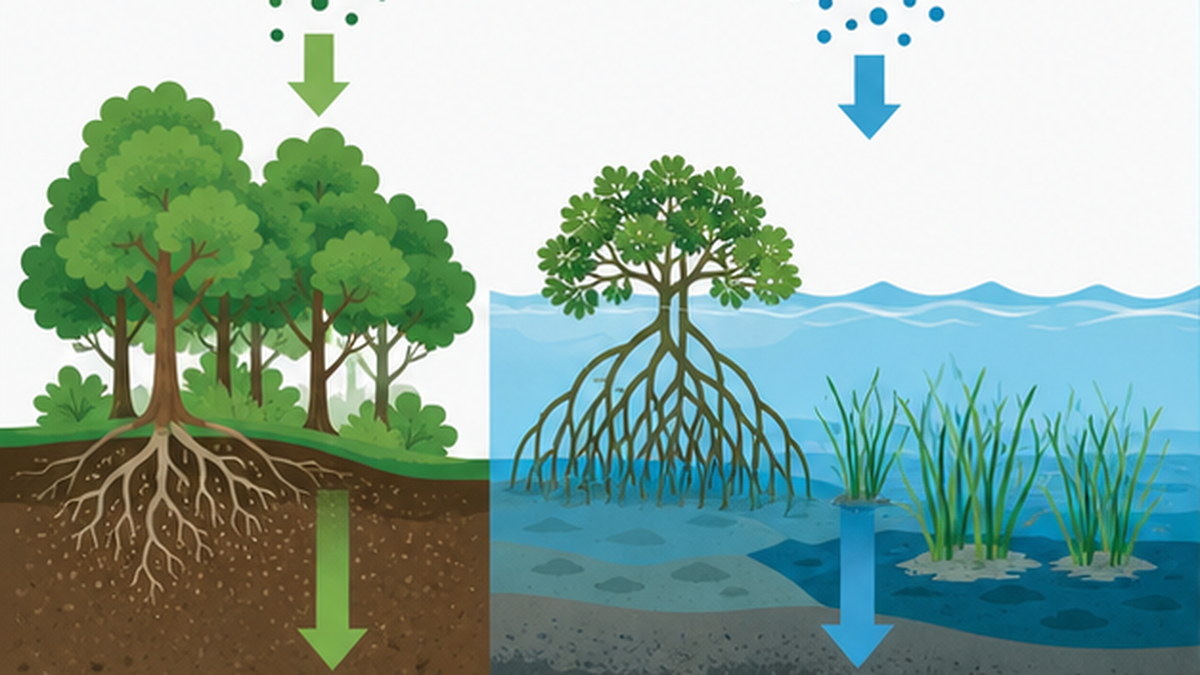
| Perspective | Green carbon (land) | Blue carbon (ocean) |
|---|---|---|
| Main contributors | Forests, grasslands, soil | Mangroves, seagrass meadows, salt marshes |
| Storage location | Plant tissue, surface soil | Plant tissue, seafloor sediment (mud) |
| Speed of decomposition | Relatively fast (aerobic) | Very slow (anaerobic) |
| Duration carbon stays locked away | Mainly on the scale of decades | Sometimes hundreds to thousands of years |
| Area occupied | Wide areas of land | A limited ~0.2% of the ocean |
In short, blue carbon has the distinctive ability to sequester carbon "in a small area," "for a long time," and "efficiently." On a planetary scale, some estimates suggest that marine organisms account for more than half of all the carbon fixed by photosynthesis (from the 2009 UNEP et al. report "Blue Carbon") — a surprisingly large contribution given how small the area involved is. Whereas forests on land store much of their carbon in above-ground biomass (trunks and branches), marine ecosystems store the bulk of their carbon in the seafloor soil, out of sight. Forests on land also carry the risk of losing carbon suddenly through fire or logging, whereas carbon buried in marine mud is far less vulnerable to such disturbances — a stability that shouldn't be overlooked.
The background behind the term "blue carbon"
The concept of blue carbon spread internationally after a 2009 report titled "Blue Carbon," published by the UN Environment Programme (UNEP) and others. Until then, climate action had mostly centered on "protecting and planting forests" (green carbon), but this report shone a light on the hidden CO2 absorption and storage capacity of coastal marine ecosystems, while also warning that they were being lost at a rapid pace. Since then, efforts to incorporate the ocean into climate policy have accelerated worldwide, feeding into initiatives such as Japan's J-Blue Credit system.
Key points
- Blue carbon = carbon absorbed and stored by coastal and marine ecosystems ("blue carbon")
- Its counterpart concept is green carbon (land forests, etc.)
- Because decomposition is slower in the ocean, carbon can be stored for a longer, more stable period
- CO2 is absorbed efficiently within a limited area — about 0.2% of the ocean's surface
Climate change is affecting every corner of the ocean, from rising sea temperatures and shifting currents to ocean acidification. The related mechanisms are covered in detail in our article on rising sea temperatures and shifting currents, but blue carbon is an approach that tries to reduce, using the ocean's own power, the very CO2 that causes these problems — combining both "defense" and "offense."
The three ecosystems that support blue carbon
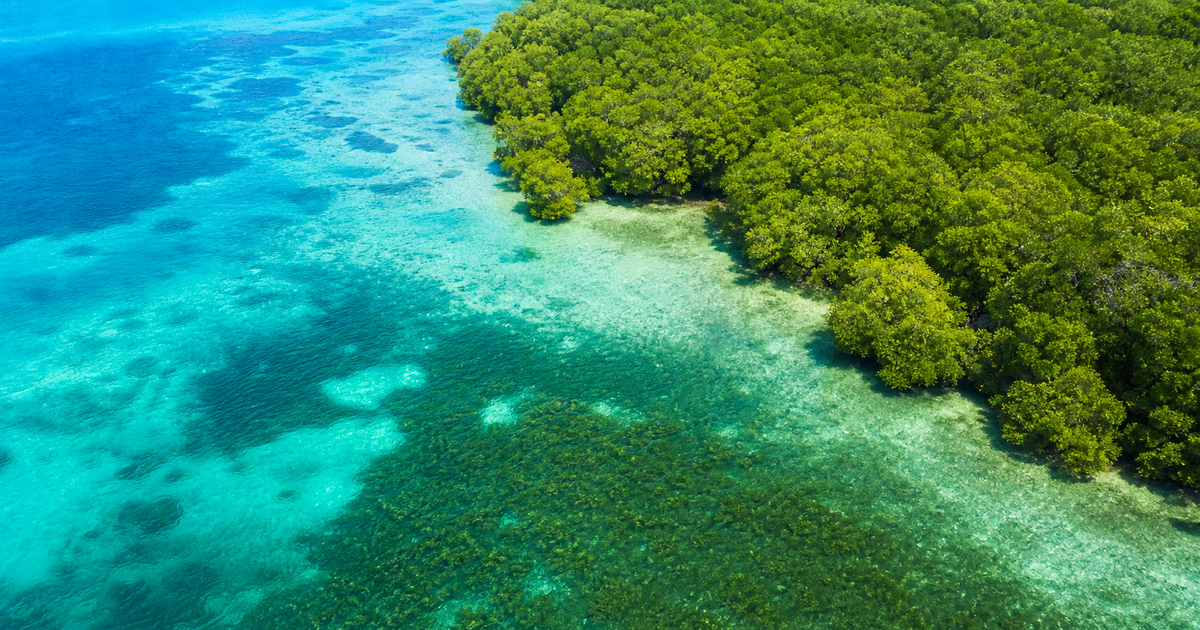
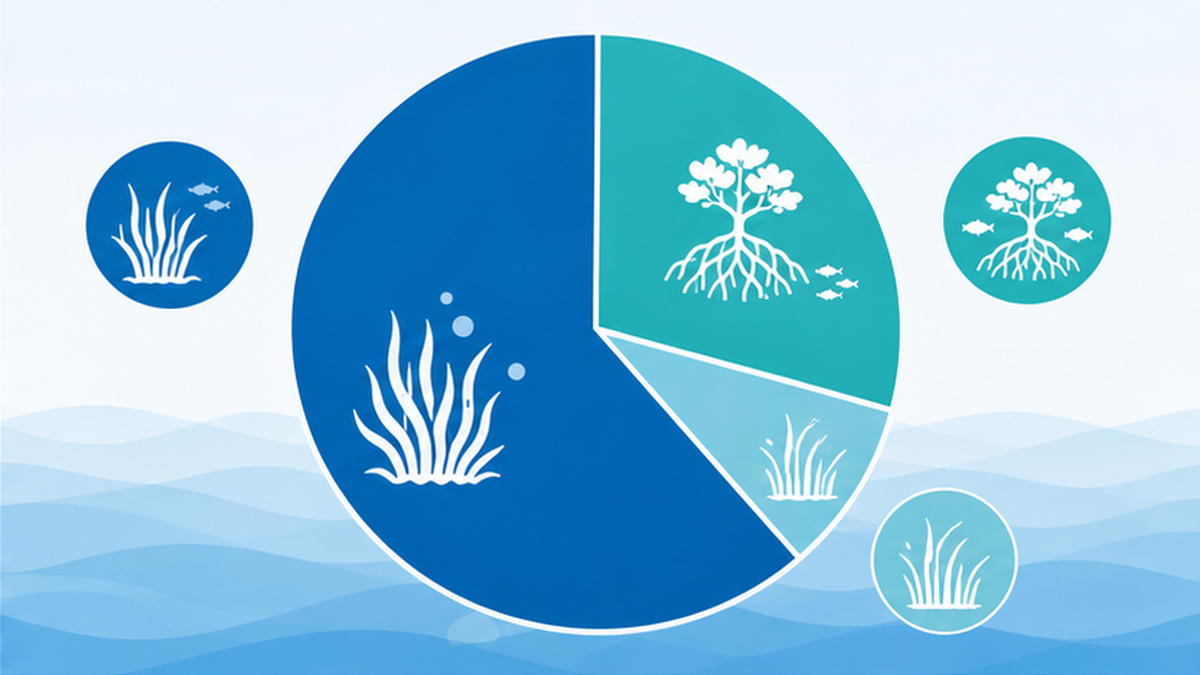
The ecosystems internationally recognized as blue carbon's main contributors are primarily mangrove forests, seagrass meadows, and salt marshes (tidal flats). Worldwide, these ecosystems span about 50 million hectares (more than 1.3 times the land area of Japan), with seagrass meadows estimated to account for about 63%, mangroves about 27%, and salt marshes about 10%. Let's look at the characteristics of each.
Mangrove forests — tropical forests that lock carbon in mud
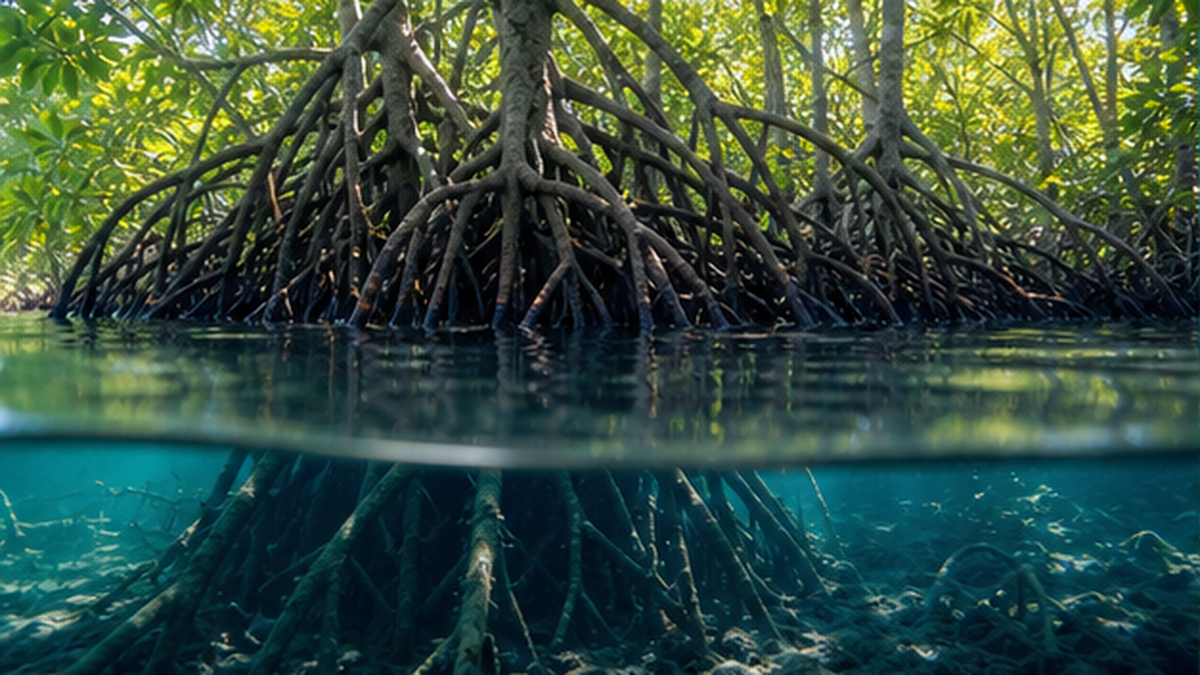
Mangroves are a general term for trees that grow where seawater and freshwater mix, in tropical and subtropical estuaries and coastlines. Their intricately tangled roots soften waves and serve as a nursery for many creatures, while also trapping large amounts of organic matter in the mud around their base. Because this mud is submerged and oxygen-poor, decomposition is slow to proceed, making mangroves one of the largest carbon storehouses among the world's blue carbon ecosystems. One estimate suggests that, of the roughly 11.5 billion tonnes of carbon stored by the world's blue carbon ecosystems, mangroves alone account for about 6.5 billion tonnes.
In Japan, the Nansei Islands, including Okinawa and Kagoshima prefectures, mark the northern limit of mangrove distribution, where species such as Kandelia obovata, Bruguiera gymnorhiza, and Rhizophora stylosa grow naturally. Looking worldwide, mangrove forests are widely distributed along the coasts of Southeast Asia, Africa, and Central and South America, but their area has shrunk dramatically over the past several decades due to shrimp pond development, coastal development, and urbanization. When mangroves are cut down and the mud is disturbed, the enormous amounts of carbon they had stored are released as CO2 all at once, making their conservation extremely important for climate action.
Seagrass meadows — grasslands under the sea
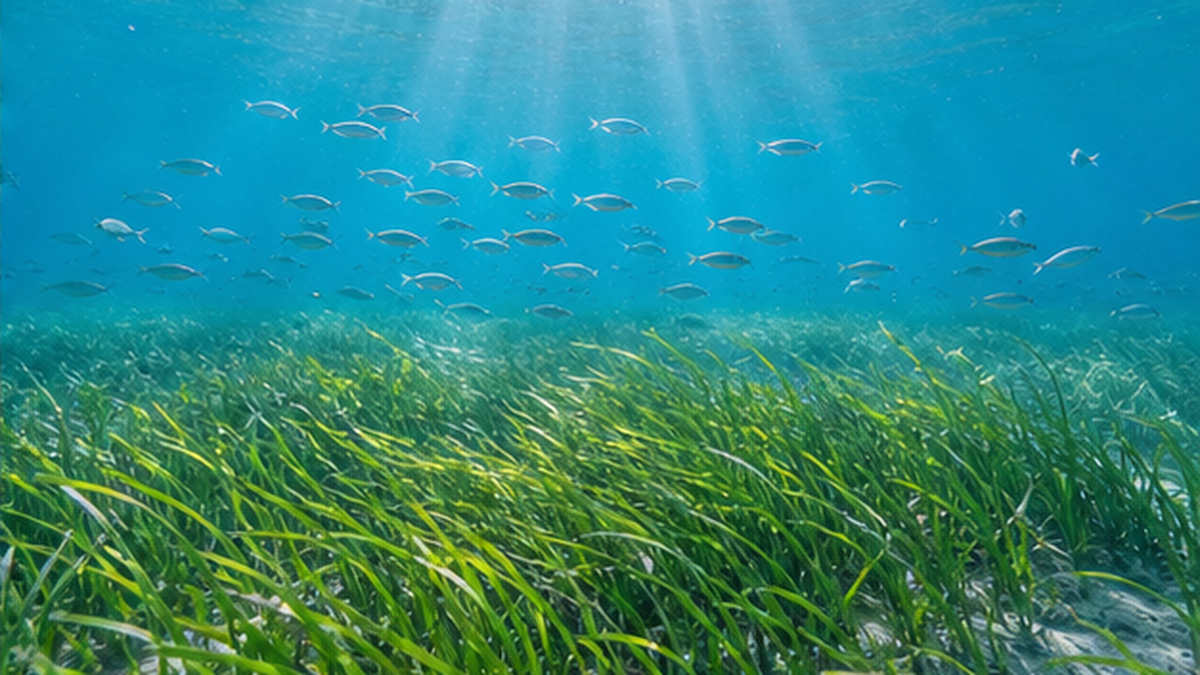
A seagrass meadow is, in effect, an underwater grassland, formed by "seagrasses" — represented by eelgrass — that take root and spread across the seafloor. Whereas "seaweeds" like wakame and kombu are algae that attach to rocks, seagrasses are flowering plants that reproduce by seed and take root in sandy, muddy seafloors. These beds, spreading across shallow coastal waters, absorb CO2 through photosynthesis while accumulating dead leaves and roots on the seafloor, storing carbon. They also serve as a refuge and spawning ground for juvenile fish and small creatures, supporting productive fishing grounds.
Along Japan's coasts, in addition to eelgrass beds, seaweed beds formed by wakame, kombu, and Sargassum are also widely distributed. Because seaweed attaches to rocks, it was long thought to be less able to lock carbon directly into the seafloor, but it has become clear that a nontrivial pathway exists in which seaweed that breaks off and drifts offshore sinks into the deep sea and is sequestered there. This accumulating body of knowledge is one factor supporting Japan's decision, discussed later, to include seaweed's absorption in its national reporting as well. Seagrass meadows account for about 63% of the area of the world's blue carbon ecosystems, making them the most widely distributed type.
Salt marshes and tidal flats — a buffer zone between land and sea
Salt marshes are wetlands, found in estuaries and inner bays affected by the tides, where salt-tolerant plants (halophytes) grow thickly. In Japan, reed beds are a typical example. Together with tidal flats, they catch organic matter flowing in from land and lock carbon away in the mud. While their area worldwide is small, their rate of carbon storage per unit area is high, and they also provide value in water purification, buffering storm surges and tsunamis, and serving as stopover sites for migratory birds.
Japan once had vast tidal flats and wetlands spread across estuaries and inner bays nationwide, but much of this was lost to postwar land reclamation and shoreline development. The tidal flats and wetlands that remain are valuable not only for carbon storage but also as a "natural purification system" that nurtures diverse life and cleans the water. The blue carbon perspective has become a way to put numbers, once again, on the value of these coastal mudflats that had long tended to be overlooked.
What's the difference between "seagrass" and "seaweed"?
Eelgrass and other seagrasses are flowering plants that reproduce by seed and take root on the seafloor. Seaweeds such as wakame and kombu, on the other hand, are algae without distinct roots, stems, or leaves, and attach to rocks and the like. Both form underwater beds that absorb CO2, but they belong to entirely different biological groups. Japan led the world by including the absorption of both in its assessment (discussed later).
All three of these ecosystems are located in places strongly affected by human activity, such as the influx of ocean plastic and coastal development. What happens to trash that flows into the sea is also covered in our article on the breakdown of ocean plastic, but protecting blue carbon is inseparable from protecting the entire coastal environment surrounding it.
Why marine plants can store such large amounts of CO2
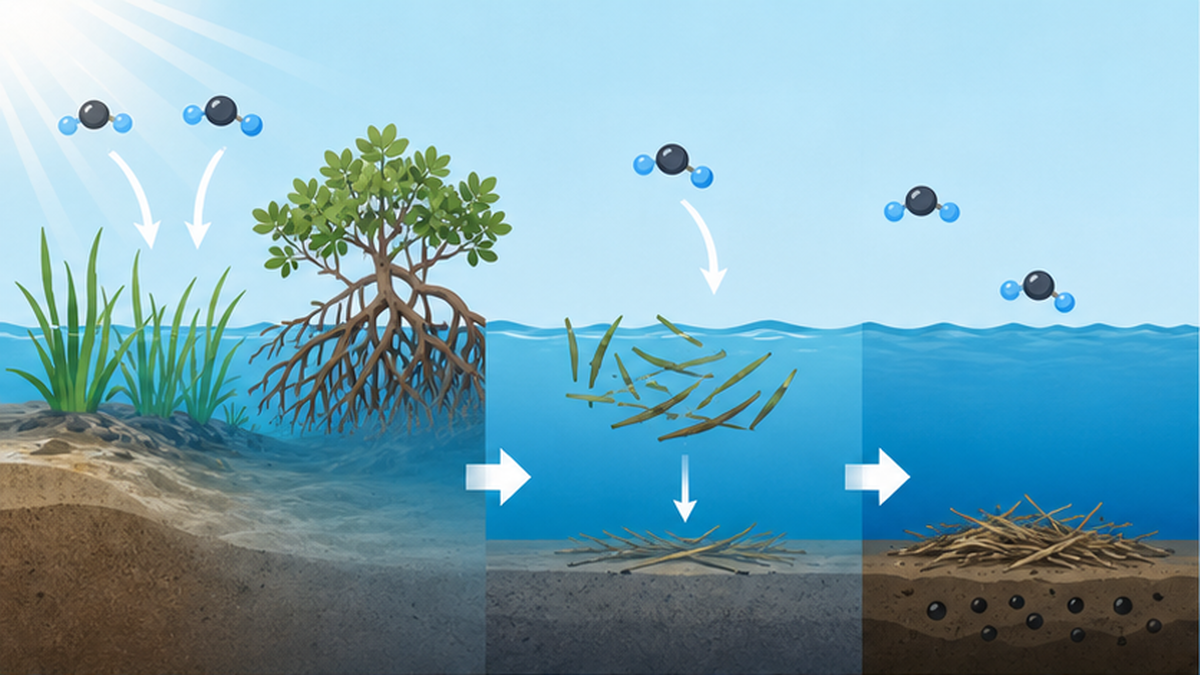
The core of blue carbon lies not so much in the "power to absorb" as in the "power to store and never let go." Here we break down, in three steps, the scientific mechanism that lets coastal marine ecosystems sequester carbon for the long term.
Step 1: Capturing CO2 through photosynthesis
The starting point is the same photosynthesis used by plants on land. Mangroves and seagrasses use sunlight, water, and CO2 dissolved in seawater and the atmosphere to build organic matter (a mass of carbon), growing their bodies as a result. Shallow coastal waters receive plenty of light and are rich in nutrients from land, so photosynthesis is vigorous, and primary production (the rate at which organic matter is created) per unit area is extremely high.
Step 2: Dead plants sink to the seafloor and become buried in mud
When a plant dies, part of its leaves, roots, and stems sink to the seafloor and accumulate along with fine mud. Organic matter of terrestrial origin, carried in by tidal currents, also tends to settle in place as the roots of seagrass beds and mangroves soften the waves. In this way, organic matter containing carbon gradually piles up on the seafloor in an ever-thickening layer. In mangroves and salt marshes, this accumulation builds up a mud layer many meters thick over the years, storing an enormous amount of carbon within it. Whereas forests on land mostly lock carbon into tree trunks, marine ecosystems, in effect, tuck their carbon away in the "invisible vault" of the mud beneath them.
Step 3: Oxygen-poor mud blocks decomposition
This is where the biggest key lies. Because seafloor mud is saturated with water, its interior is in an anaerobic state with almost no oxygen reaching it. Since most microbes that decompose organic matter require oxygen, decomposition slows to a crawl inside oxygen-free mud. Carbon that would decompose within decades in soil on land can remain stably locked away on the seafloor for hundreds to thousands of years — this is exactly why blue carbon excels at "long-term storage."
Furthermore, some of the carbon that flows out from seagrass beds and mangroves is thought to be carried to deeper waters and sequestered there. The ocean is already a massive sink for atmospheric CO2, and the deep-sea environment and material cycles are also touched on in our article on deep-sea creature adaptation, but coastal blue carbon ecosystems can be described as playing a "checkpoint" role, efficiently capturing carbon right at the entrance to that deeper cycle.
The true source of the storage power
- Shallow coastal waters are rich in light and nutrients, so carbon fixation through photosynthesis is high
- Roots soften waves and trap organic matter of terrestrial origin in place as well
- Seafloor mud is anaerobic, so microbial decomposition is extremely slow
- As a result, carbon is sequestered on the order of hundreds to thousands of years
The strengths and limits of blue carbon, in numbers
Let's pin down the scale of blue carbon with as concrete numbers as possible. That said, these figures vary widely depending on the survey method and scope, so it's important to treat them simply as "estimates for grasping the order of magnitude." Accurately measuring the amount of carbon on the seafloor is far from easy, and because studies differ in their assumptions and scope, even figures for the same item can vary considerably. Please understand the values introduced here as "rough guides."
Global absorption and storage volumes
Estimates compiled from research worldwide suggest that blue carbon ecosystems as a whole absorb roughly 0.84 gigatonnes (840 million tonnes) of CO2 a year. The annual rate of carbon fixation by ecosystem is estimated at about 31-34 megatonnes of carbon for mangroves, about 5-87 megatonnes of carbon for salt marshes, and about 48-112 megatonnes of carbon for seagrass meadows (the wide ranges reflect just how difficult these estimates are). The total amount of carbon stored to date is estimated at about 11.5 billion tonnes, of which mangroves account for the largest share, at about 6.5 billion tonnes.
| Ecosystem | Share of global area | Estimated annual carbon fixation rate |
|---|---|---|
| Seagrass meadows | ~63% | ~48-112 Mt-C/year |
| Mangroves | ~27% | ~31-34 Mt-C/year |
| Salt marshes | ~10% | ~5-87 Mt-C/year |
Efficient use of a small area — the greatest strength
What shouldn't be overlooked is "area efficiency." Blue carbon ecosystems occupy only about 0.2% of the ocean's surface area, yet they account for a substantial share of the world's CO2 absorption — meaning their output per unit area vastly exceeds that of terrestrial ecosystems. On a planetary scale, some estimates suggest marine organisms account for more than half of all carbon fixed by photosynthesis (from the 2009 UNEP et al. report), suggesting just how large a role these limited coastal areas play. Note that the ocean is said to absorb roughly 30% of the CO2 emitted by human activity, but this figure includes direct dissolution into seawater itself, and should be considered separately from the carbon fixed by coastal blue carbon ecosystems. It's also been reported that one hectare of mangrove or salt marsh mud can store more carbon than the same area of tropical forest — a good illustration of blue carbon's defining trait of "storing densely in a small area."
The risk of turning into an "emission source" when lost
Blue carbon carries a flip-side risk. When these ecosystems are destroyed, the carbon that had been locked in the mud decomposes and oxidizes, releasing it back into the atmosphere as CO2. One study estimates that the loss and degradation of coastal ecosystems worldwide could release between 0.15 and 1.02 petagrams of CO2 per year (a median of about 0.45 petagrams, or 450 million tonnes). Protect it, and it's a carbon sink; destroy it, and it becomes an emission source — this asymmetry is exactly why conservation is so urgent.
Cautions when reading the numbers
- Blue carbon estimates vary widely depending on method and scope
- Pay attention to units such as "megatonnes," "gigatonnes," and "petagrams" (1 Gt = 1,000 Mt = 1 Pg)
- Consider not only the absorption figures but also the emission risk if the ecosystem is lost
- For the latest figures, it's safest to check primary sources from the Ministry of the Environment or research institutions
Japan's blue carbon strategy — the world's first UN report
For Japan, surrounded by sea on all sides and blessed with a long coastline, blue carbon is a particularly good fit as a countermeasure. And Japan has achieved several "world firsts" in this field. Here we organize the country's efforts.
Reporting seagrass and seaweed absorption to the UN — a world first
In April 2024, Japan included, for the first time, CO2 absorption by seagrass meadows and seaweed beds in its "inventory" of greenhouse gas emissions and absorption, and reported this to the UN. It was the world's first time that a country included the absorption not just of seagrass but of seaweed as well in its national inventory. The reported absorption from beds in fiscal 2022 was about 350,000 tonnes (CO2 equivalent), formally positioning them as a new carbon sink toward Japan's goal of carbon neutrality.
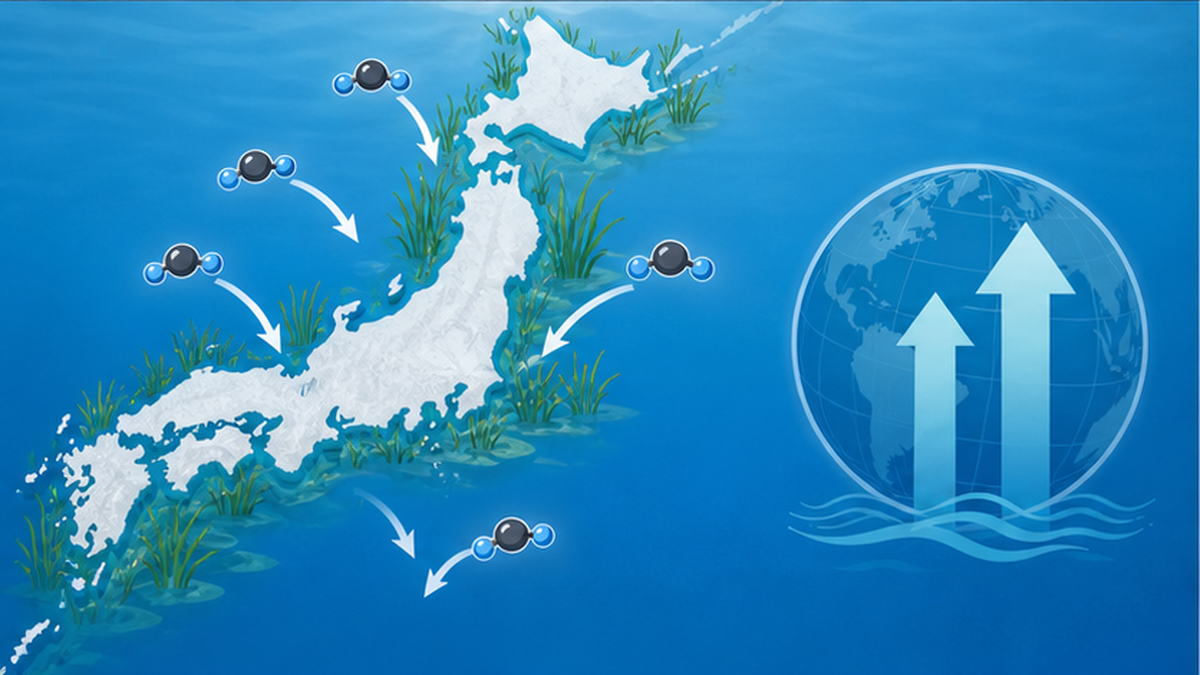
This kind of reporting is supported by scientific infrastructure such as the calculation guidebook developed by the Japan Fisheries Research and Education Agency and others, and a data platform for tracking the distribution and area of these ecosystems — BDAS (Blue Carbon Data Archive System). Only once there is a foundation to objectively measure "where" and "how much" seaweed and seagrass beds exist, and "how much" carbon they store, does internationally credible reporting become possible.
Collaboration among the Ministry of Land, Infrastructure, Transport and Tourism, the Ministry of the Environment, and the Fisheries Agency
Japan's blue carbon policy is advanced through collaboration among the Ministry of Land, Infrastructure, Transport and Tourism (which oversees ports), the Ministry of the Environment (which handles climate measures), and the Fisheries Agency (which handles fisheries and seaweed/seagrass beds), coordinated through a "Blue Carbon Inter-Ministerial Liaison Council." Efforts to make use of the calm waters created by port development for building seaweed and seagrass beds — combining infrastructure with ecosystem restoration — are also spreading across the country. Ideas that treat civil engineering and ecosystem restoration as a single, integrated challenge — such as designing calm waters inside breakwaters or the shoreline of reclaimed land in ways that make it easier for seagrass and seaweed to grow — are a strength particularly suited to Japan, with its many coastal cities.
Why Japan is putting so much effort into blue carbon
Japan is a maritime nation with one of the longest coastlines in the world, one that has long lived alongside the bounty of seaweed beds and tidal flats. While the country's limited land area constrains how much its carbon sink can be expanded through large-scale afforestation, it has a rich asset in its coastal environment. Blue carbon is a promising means of putting that asset to work for climate action and achieving carbon neutrality, and because it is also tied to revitalizing coastal fisheries — an industry facing concerns of decline — there is significant reason for the country to pursue it actively.
Japan's "world first" points
Japan is the first country to include the absorption of both seagrass and seaweed in its national greenhouse gas inventory and report it to the UN. Behind this lies an accumulated national effort to build measurement infrastructure such as calculation guidebooks and data archives. It's a good example of leveraging the strengths of a maritime nation to help shape international rules.
J-Blue Credit — a system linking ocean absorption to the economy
Sustaining "activities that protect" blue carbon requires both money and people to carry it out. J-Blue Credit is the system born in Japan to draw in both.
What is J-Blue Credit?
J-Blue Credit is a uniquely Japanese system in which CO2 absorption generated by conservation and restoration activities for seaweed/seagrass beds and mangroves is certified by a third-party organization, the Japan Blue Economy Association (JBE), and issued as credits (certificates representing the value of emission reductions or absorption). Trading began in fiscal 2020, making it a relatively new type of carbon credit, and it is distinctive in being run under private-sector leadership rather than as a government program.
How the money flows — who buys, and what it's used for
The mechanism is simple. Fishers, local governments, NPOs, and others restore and conserve seaweed/seagrass beds, generating CO2 absorption, which JBE certifies and converts into credits. Companies working toward decarbonization purchase these credits, and the funds raised become capital for the next round of conservation work. For companies, the appeal lies not just in simple offsetting, but in the ability to support activities that protect the local sea. Since the system began, the number of certified projects has kept climbing, and as of early 2026 the cumulative number of projects reaches into the dozens. Port companies, construction companies, local fishing cooperatives, and local governments have all become participants, and initiatives are spreading across the country.
The significance of J-Blue Credit lies in having created a continuous flow of funding for seaweed/seagrass bed conservation, an area that had long relied heavily on "goodwill volunteering." Activities to protect the marine environment had suffered from the weakness that their results were hard to see and funding was hard to sustain. By quantifying absorbed CO2 and putting a price on it that can be traded, the system created a path for conservation activities to become economically self-sustaining as well — that is the essential value of this system.
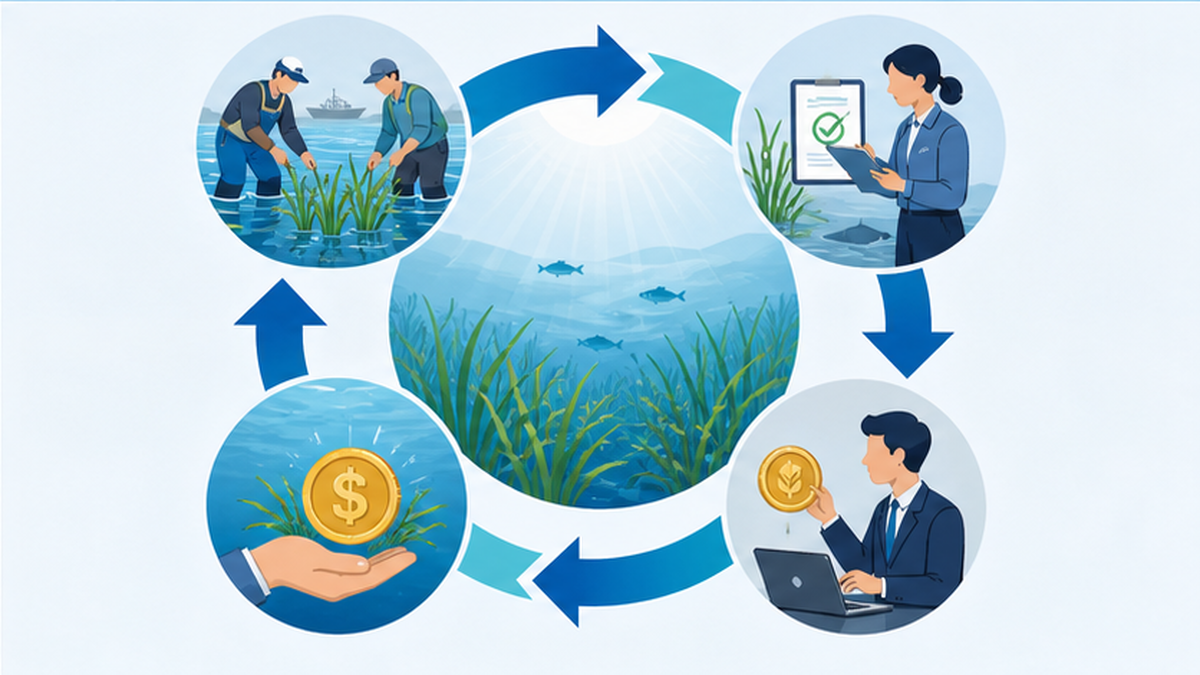
| Participant | Role |
|---|---|
| Practitioners (fishers, local governments, NPOs, etc.) | Conserve and restore seaweed/seagrass beds and mangroves, generating CO2 absorption |
| JBE (certification body) | Scientifically reviews and certifies absorption, and issues credits |
| Buyers (companies, organizations, etc.) | Purchase credits, providing financial support for conservation activities |
"Co-benefits" that connect communities and the sea
The value of J-Blue Credit is not limited to CO2 absorption alone. As seaweed and seagrass beds recover, the fishing grounds where seafood grows become richer, water quality improves, and both marine scenery and biodiversity improve as well. These benefits beyond CO2 reduction are called co-benefits, and being able to advance regional economic and fisheries revitalization alongside climate action at the same time is a major part of what makes this system significant. For fishing communities facing depopulation and aging, bed restoration can also be a way to attract new participants and new connections to the community. Urban companies and rural seas are linked through credits — blue carbon holds the potential to reconnect not just climate outcomes but the future of local communities as well.
Key points of J-Blue Credit
- A uniquely Japanese system for certifying and trading CO2 absorption derived from blue carbon
- Launched in fiscal 2020 and run under private-sector leadership (JBE)
- Funds from corporate purchases create a cycle that supports local bed restoration activities
- Benefits beyond CO2 reduction — such as restoring fishing grounds and purifying water — are also substantial (co-benefits)
Potential as a climate solution — the role it's expected to play
The Paris Agreement sets a goal of keeping the rise in global average temperature below 1.5-2 degrees Celsius compared with pre-industrial levels. Achieving that requires not just cutting emissions but also means of "removing" CO2 from the atmosphere. Blue carbon is positioned as a promising option for achieving this by harnessing the power of nature.
Strengths as a Nature-based Solution (NbS)
Restoring seaweed/seagrass beds and mangroves is a leading example of a Nature-based Solution (NbS), letting the ecosystem itself absorb CO2 without relying on large-scale machinery or enormous amounts of energy. Moreover, because it simultaneously delivers many benefits — disaster prevention, water purification, biodiversity, and fisheries — it is drawing increasing international recognition as a highly cost-effective climate measure. Compared with artificial technologies that capture CO2 from the atmosphere and store it underground (such as CCS), which require large amounts of cost and energy, blue carbon has the advantage of being able to rely on natural processes, making it more sustainable and easier to keep affordable.
A deep connection with marine life
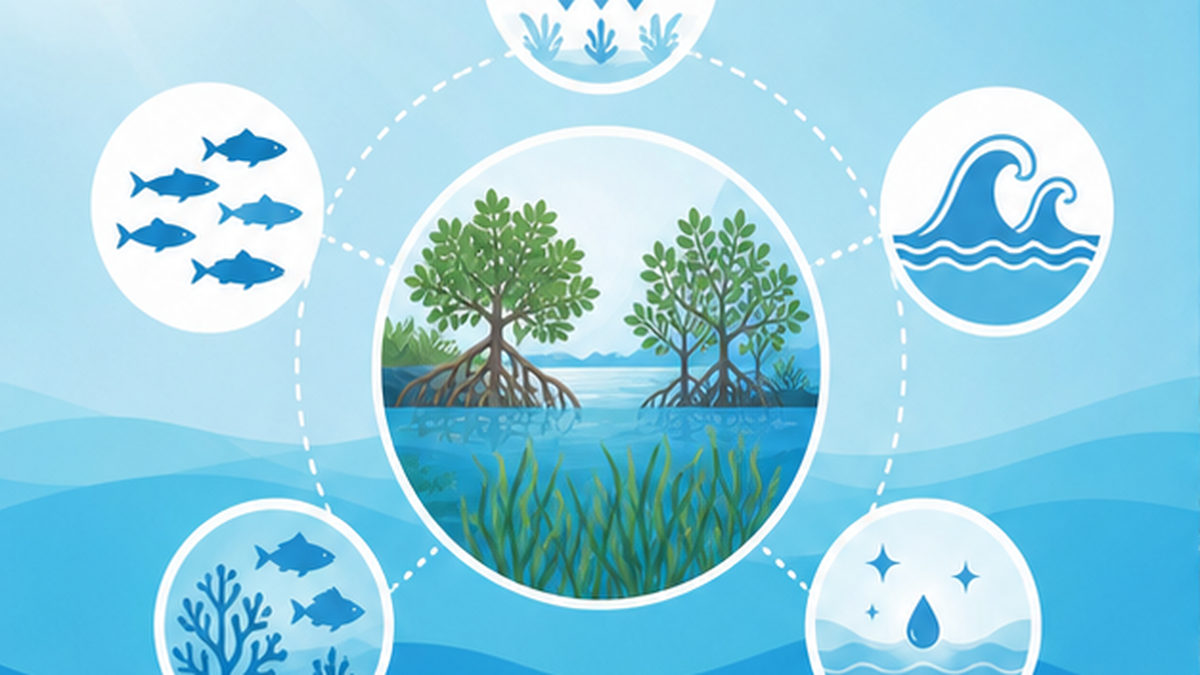
Seaweed/seagrass beds and mangroves serve as a nursery for many marine creatures — juvenile fish, shellfish, crustaceans, and more. Protecting blue carbon ecosystems directly translates into protecting fishery resources and biodiversity as well. Conversely, as rising sea temperatures and acidification progress, these ecosystems themselves weaken, and their capacity to store carbon declines along with them. Blue carbon as a climate solution and the health of marine ecosystems are inseparably linked.
A face as "green infrastructure" protecting the coast
Mangrove forests and salt marshes also act as a natural breakwater, softening the force of waves and lessening the damage from storm surges and tsunamis. Unlike concrete seawalls, they can protect the coast while maintaining habitat for wildlife, which is why their value as "green infrastructure" is also drawing attention. As climate change intensifies storm surges and sea-level rise, this kind of natural defensive power will only become more important.
Blue carbon ecosystems do more than efficiently absorb CO2 within a limited area — they also bring multifaceted benefits in disaster prevention, fisheries, and biodiversity. Protecting them pays off both for climate action and for the lives of local communities.
— Summarized from the substance of various government and research materials
Ocean warming is shaking coastal ecosystems themselves, including through coral bleaching. Recent, severe bleaching events are also covered in our article on ocean acidification and coral reefs, but CO2 absorption through blue carbon works to ease, even slightly, the root cause behind this kind of damage.
The challenges ahead — declining seaweed beds and the difficulty of measurement
While expectations are high, blue carbon also faces a fair number of challenges that need to be overcome. It's important to look at reality clearly, without excessive optimism or excessive pessimism.
Declining seaweed beds and "isoyake" die-off
Along Japan's coasts, seaweed and seagrass beds have declined significantly due to land reclamation and coastal development during the era of rapid economic growth, along with deteriorating water quality. In recent years, moreover, a phenomenon called isoyake ("rocky-shore die-off") has been spreading nationwide. Isoyake refers to a state in which seaweed and seagrass such as eelgrass and wakame disappear from a bed, leaving bare rock exposed. Fisheries Agency guidelines attribute it to factors such as "grazing damage" from sea urchins and fish, seaweed "withering or failing to sprout," or "being washed away" — or some combination of these. The effects of warming, including rising sea temperatures, are cited as a major factor behind it.
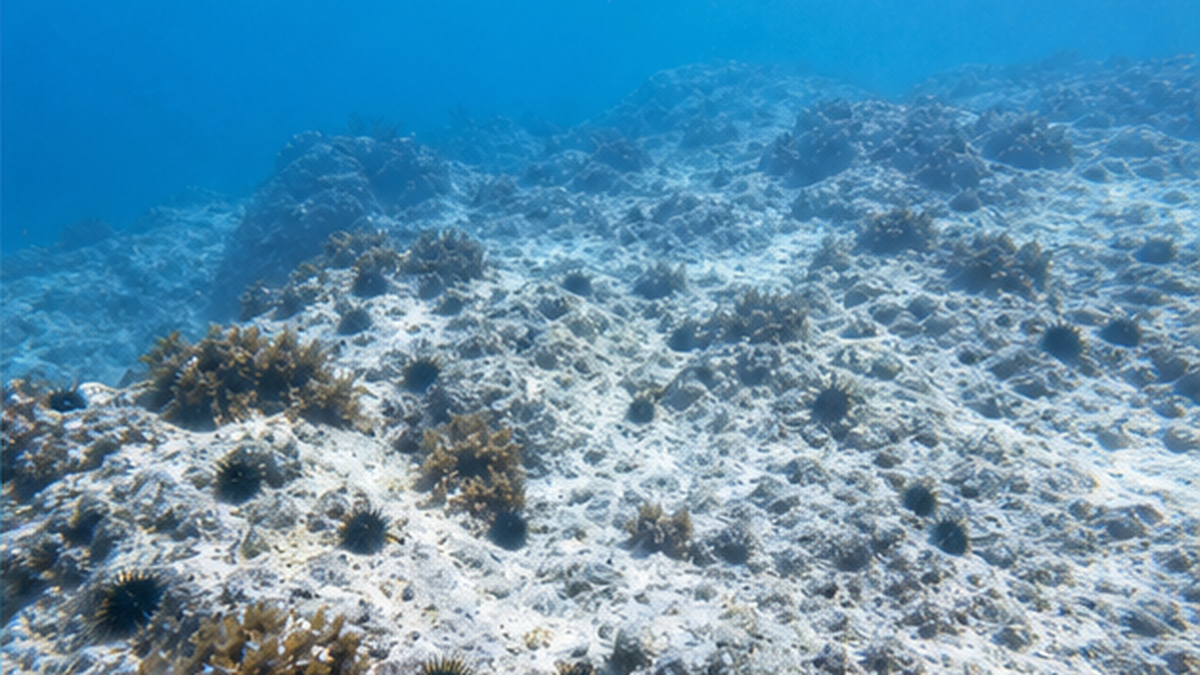
What makes this tricky is that, even after a bed is restored, it often reverts to isoyake once again due to environmental changes or grazing damage. In recent years, the factors preventing recovery have become intertwined in complex ways, and "how to maintain and expand restored beds" has become a major on-the-ground challenge. Reading our article on rising sea temperatures and shifting currents alongside this one, on rising sea temperatures themselves, will give you a fuller picture of the underlying context.
The difficulty of measuring "how much was absorbed"
Using blue carbon for credits or national reporting requires measuring, scientifically and continuously, "how much CO2 was actually absorbed and stored." However, the amount of carbon on the seafloor varies considerably by location and by year, and accurate measurement requires both cost and effort. In Japan, data archives and measurement manuals are being developed, but balancing accuracy with efficiency remains a challenge shared worldwide.
The permanence problem — "can it really be stored for the long term?"
Even carbon that has been carefully stored will return to the atmosphere if the bed is lost to a typhoon, high waves, or environmental degradation. Recognizing the value of carbon sequestration as a credit requires guaranteeing how long that effect will actually last (permanence). How to deal with this kind of uncertainty, inherent in working with nature, is an important point in designing the system. There is also an ironic relationship at play: as climate change itself progresses, rising sea temperatures and sea levels weaken blue carbon ecosystems. The very ecosystems that absorb CO2 are threatened by the warming that CO2 causes — which is exactly why emissions reduction and ecosystem conservation need to be pursued together.
Avoiding both overestimation and underestimation
Blue carbon is promising, but the world's absorption potential is still limited compared with humanity's total emissions, and it alone cannot stop global warming. At the same time, its value in efficiently storing carbon within a limited area, while bringing multifaceted benefits such as disaster prevention and fisheries revitalization, is genuine. Honestly accepting the range and uncertainty in the numbers while steadily building up conservation and restoration efforts — that kind of clear-eyed, forward-looking stance is what's needed now.
Challenges that shouldn't be overlooked
- Japan's seaweed/seagrass beds have declined and degraded due to land reclamation, development, and isoyake
- Even after recovery, beds tend to revert to isoyake, making maintenance and expansion difficult
- Measuring absorption involves large variation by location and year, and ensuring accuracy is costly
- There is a "permanence" risk that stored carbon could be lost through disasters or environmental degradation
Conclusion — blue carbon and how we relate to it
Blue carbon is a natural mechanism by which the ocean's limited coastal ecosystems absorb CO2 with remarkable efficiency and lock it away in seafloor mud for the long term. The three ecosystems — mangroves, seagrass meadows, and salt marshes — store away "blue carbon" through the clever process of photosynthesis and anaerobic accumulation, drawing worldwide attention as a promising step for climate action.
Japan has been the first country in the world to report seagrass and seaweed absorption to the UN, and has connected ocean conservation to the economy through its own J-Blue Credit system. At the same time, real-world challenges remain, including declining seaweed beds, isoyake, measurement accuracy, and permanence. It is appropriate to position blue carbon not as a "cure-all solution," but as one important option that complements the central effort of reducing emissions.
What we can do
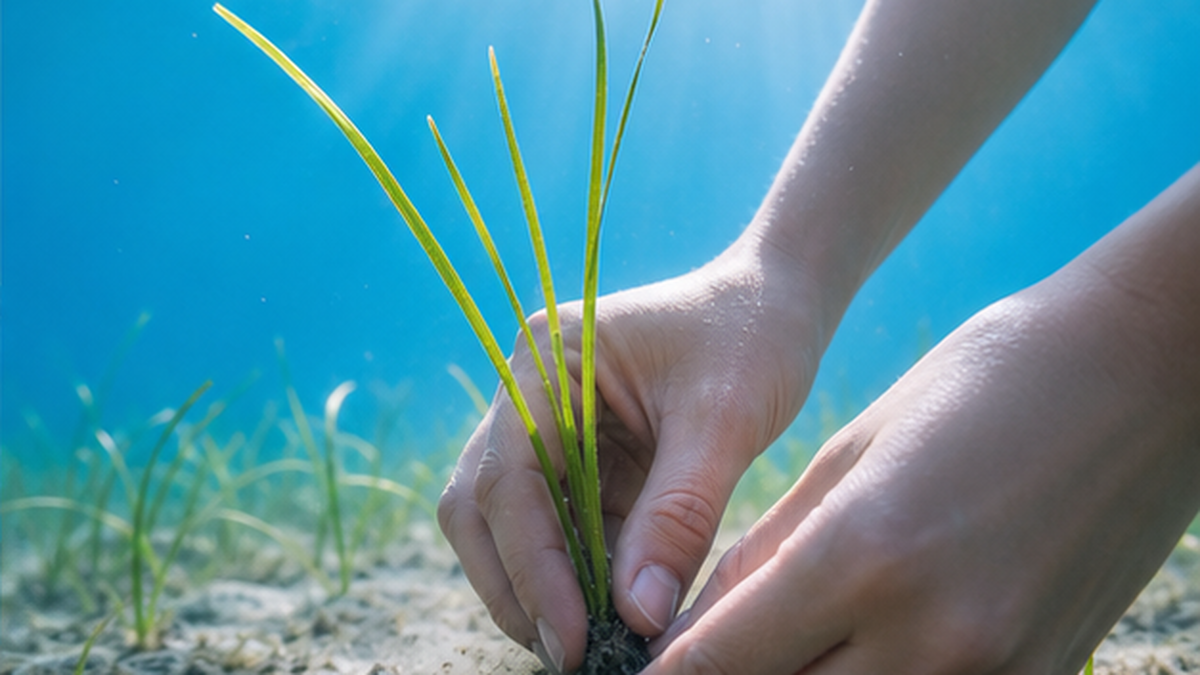
- Participate in or support local beach clean-ups and eelgrass bed restoration activities
- Take an interest in the moves of companies and local governments working on J-Blue Credit
- Learn about the marine environment and climate change, and share accurate information with people around you
- Consciously observe changes in coastal life and seaweed/seagrass beds while traveling or in daily life
What matters is not to over-rely on blue carbon as a magic wand that "will solve global warming on its own." The world's absorption potential is still only a fraction of the enormous CO2 that humanity emits, and blue carbon's contribution only becomes meaningful alongside the central effort of reducing fossil fuel use. Efforts to expand carbon sinks and efforts to reduce emissions themselves need to move forward together, as the two wheels of the same cart.
The ocean is not something distant. It is connected to the land where we live, moderating our climate and supporting our food — a familiar partner. Learning about blue carbon is a first step toward turning our attention back to that power of the ocean, so we can protect and nurture it. Please also take a look at related topics in our articles on the breakdown of ocean plastic and ocean acidification and coral reefs.
Summary of this article
- Blue carbon is the "blue carbon" absorbed and stored by coastal and marine ecosystems, with its strength lying in the ability to store it in seafloor mud for the long term
- The main contributors are mangroves, seagrass meadows, and salt marshes. Worldwide they absorb about 0.84 Gt of CO2 a year, with area efficiency that outperforms land
- Japan was the first country in the world to report seagrass and seaweed absorption to the UN, and connects ocean conservation to the economy through J-Blue Credit
- Challenges remain, including declining beds, isoyake, measurement accuracy, and permanence; it's important to realistically position blue carbon as an option that complements emissions reduction
- There are ways each of us can get involved, such as participating in beach clean-ups or eelgrass bed restoration
References and sources
- Ministry of the Environment, Japan - What is blue carbon / national efforts (Office for Decarbonized Society Transition Promotion)
- Ministry of the Environment, Japan - Case studies of blue carbon initiatives in Japan - CO2 sink measures through the conservation and creation of seaweed/seagrass beds and tidal flats (December 2023)
- Ministry of Land, Infrastructure, Transport and Tourism, Ports and Harbours Bureau - On the inventory reporting of seaweed/seagrass beds (February 2024)
- Japan Fisheries Research and Education Agency - Guidebook for calculating CO2 storage in seagrass/seaweed beds (November 2023)
- Japan Blue Economy Association (JBE) - J-Blue Credit certification/issuance and application guide
- Fisheries Agency, Japan - Isoyake countermeasure guidelines (3rd edition)
- The Blue Carbon Initiative - What is Blue Carbon? (International overview of coastal blue carbon)
- PLOS ONE - Estimating Global Blue Carbon Emissions from Conversion and Degradation of Vegetated Coastal Ecosystems (2012)
- Nikkei - Seaweed and seagrass now counted in CO2 absorption; Ministry of the Environment includes them, a world first (January 2024)
* Listed in order of reliability: government/academic institutions > peer-reviewed papers > specialized organizations > reliable media