⚡ In short
CCS captures CO2 and locks it into rock formations more than 1,000 m below the seabed. Japan's Tomakomai project injected 300,000 tonnes with zero leakage. We explain the mechanism, safety data, costs, the 77 projects operating worldwide, and Japan's plan to store 120–240 million tonnes a year by 2050.
Collecting the CO2 that streams from power-plant and factory stacks and locking it into rock formations more than 1,000 meters below the seabed — it sounds like science fiction, but this is a real technology called CCS (Carbon dioxide Capture and Storage). In Norway, CO2 has actually been stored beneath the seabed for roughly 30 years, since 1996. In Japan, a demonstration project off Tomakomai, Hokkaido began in 2016 and successfully injected a cumulative 300,000 tonnes of CO2.
"Isn't burying it underground dangerous?" "Is that safe in earthquake-prone Japan?" — many people naturally feel this way. In fact, the Tomakomai demonstration produced invaluable real-world data: the 2018 Hokkaido Eastern Iburi Earthquake struck during the injection period, and researchers could observe exactly what happened to the stored CO2. The conclusion: no data indicating any leakage was observed.
This article walks through how CCS confines CO2 geologically, the results of the Tomakomai demonstration, the safety data, the cost hurdles, and Japan's strategy to store 120–240 million tonnes per year by 2050 — all based on primary sources, explained in plain language. Let's take a look at the "final piece" of decarbonization, whose main stage is the ocean.
What you will learn in this article
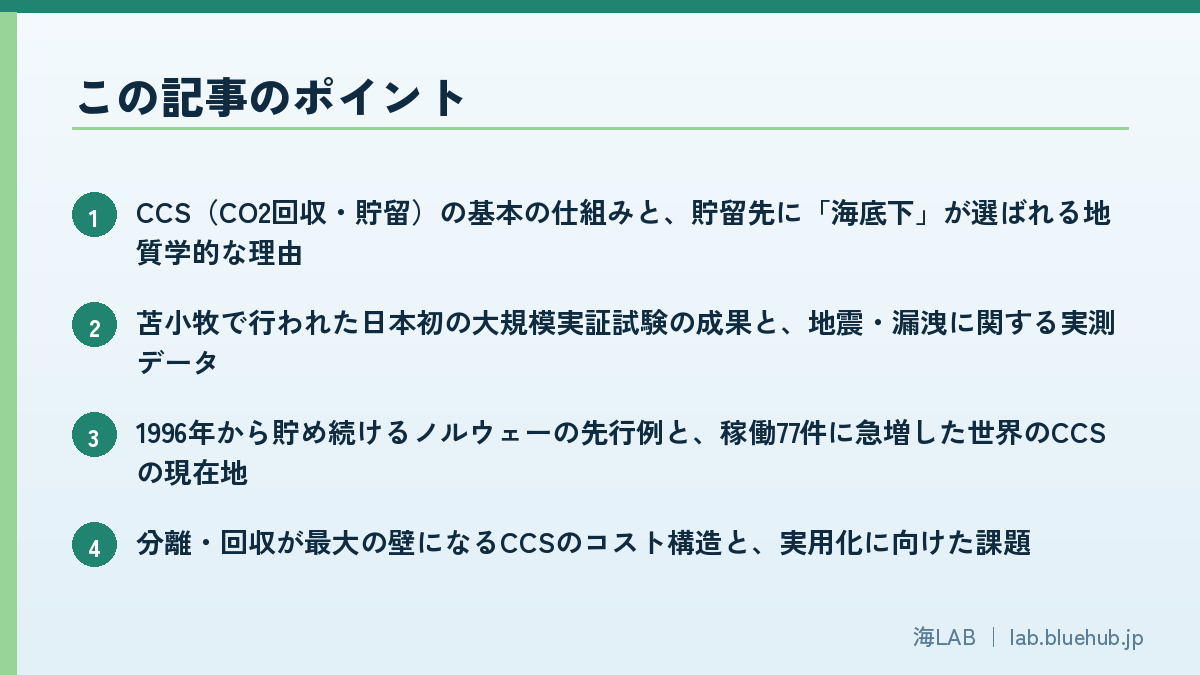
- The basic mechanism of CCS (CO2 capture and storage) and the geological reasons the sub-seabed is chosen as a storage site
- The results of Japan's first large-scale demonstration at Tomakomai, including real measurements on earthquakes and leakage
- Norway's pioneering project storing CO2 since 1996, and the current state of CCS worldwide with 77 projects in operation
- The cost structure of CCS — where capture is the biggest hurdle — and the challenges on the road to deployment
- Japan's policy package, from the CCS Business Act to the Advanced CCS Projects, and the roadmap to 2050
What Is CCS — Capturing and Confining CO2 Rather Than Just Not Emitting It
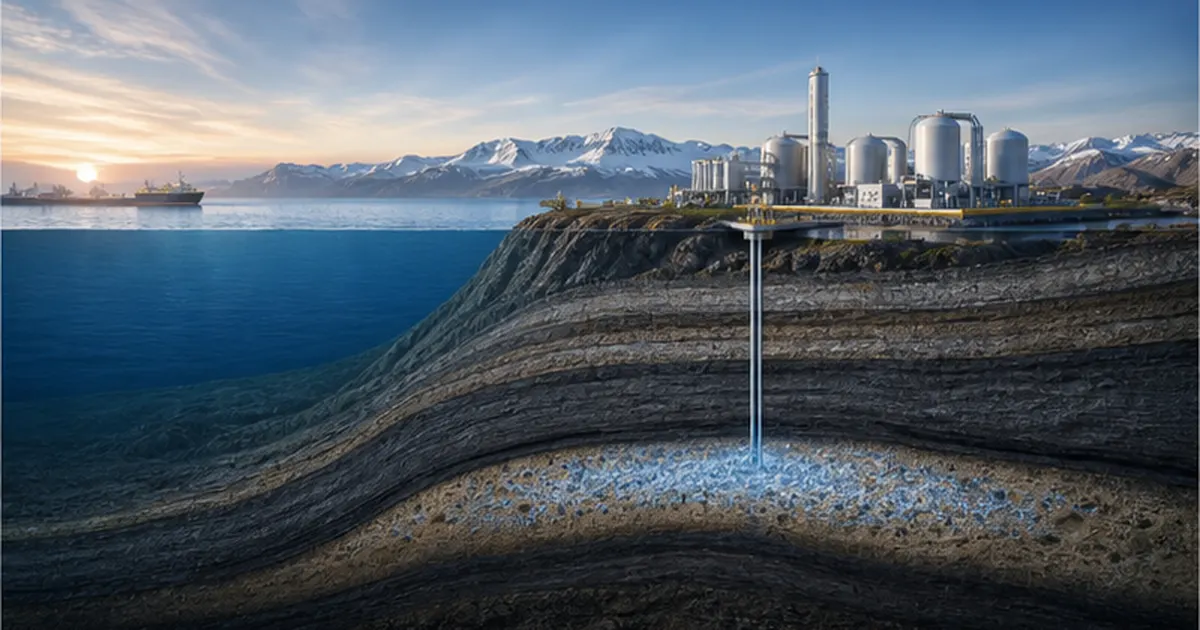
CCS is short for Carbon dioxide Capture and Storage. If energy efficiency and renewables are technologies for "not emitting CO2," CCS is a technology that catches the CO2 that will be emitted anyway before it reaches the atmosphere and permanently confines it deep underground. CO2 is separated and collected from the gas streams of large emission sources — power plants, steelworks, cement plants, hydrogen production units — then transported by pipeline or ship and injected at high pressure into rock formations 800–3,000 meters underground.
The three steps that make up CCS
- 1. Capture: extracting only the CO2 from flue gas. The most common approach is "chemical absorption," in which a liquid amine absorbs the CO2; this method was also used in the Tomakomai demonstration
- 2. Transport: carrying the captured CO2 to the storage site by pipeline or liquefied-CO2 carrier. In Japan, where emission sources and suitable storage sites are far apart, shipping is an important option
- 3. Injection and storage: sending the CO2 through a well into a deep "reservoir" formation, where it is permanently confined within the rock
How CCS differs from CCUS — "use" versus "store"
A similar term is CCUS (Carbon dioxide Capture, Utilization and Storage). As the "U" indicates, it is an umbrella term that also covers using captured CO2 as a feedstock for chemicals, synthetic fuels, or concrete. Globally, however, the amount of CO2 that can be utilized is tiny compared with the amount emitted. For reliably isolating large volumes of CO2 from the atmosphere, geological storage — the "S" — is regarded as the main path.
Why is CCS drawing attention now? Because some emissions simply cannot be eliminated. Cement releases CO2 from the very process of calcining limestone, so switching fuels to renewables cannot bring its emissions to zero. Steel, chemicals, and long-distance shipping and aviation are similarly hard to decarbonize. The IPCC (Intergovernmental Panel on Climate Change) reports incorporate CCS in most scenarios that hold warming to 1.5°C above pre-industrial levels, positioning it as a realistic option for handling the emissions that remain after efficiency and renewables have done their work.
Applications that create "negative emissions" — BECCS and DACCS
CCS also has applications that go beyond reducing emissions to producing "negative emissions" — a net removal of CO2 from the atmosphere. One is BECCS (bioenergy with CCS). Because plants absorb CO2 from the air as they grow, generating power from biomass and then capturing and storing the resulting CO2 yields a net reduction in atmospheric CO2. The other is DACCS (direct air capture with storage), which uses giant fans and sorbents to filter CO2 directly out of the air and store it. Both face high costs, but as two of the few means of "repaying" past excess emissions, they are given important roles in 1.5°C scenarios. They are also technologies that only work because sub-seabed formations exist to receive the CO2.
Key points
- CCS is a technology that captures emitted CO2 and permanently confines it underground
- It consists of three steps: capture → transport → injection and storage
- It is expected to be the trump card for residual emissions from hard-to-abate industries such as cement and steel
Why Beneath the Seabed? — The Geology That Locks CO2 Away
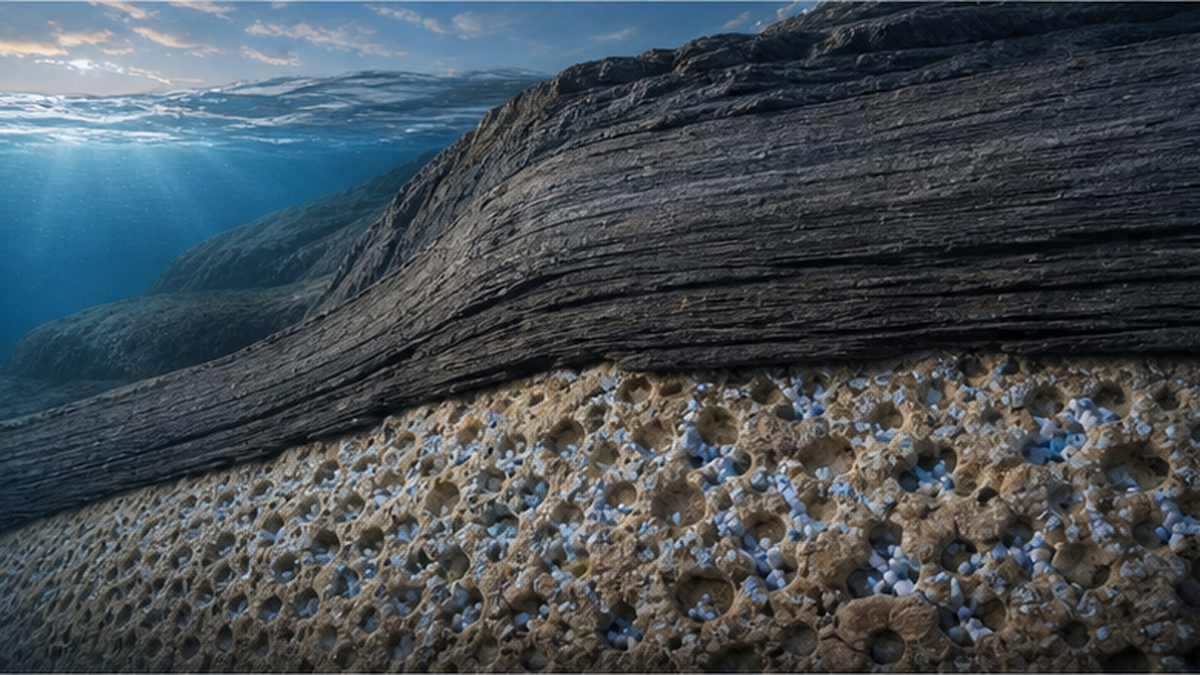
When people hear "CCS," they may picture a huge underground cavern filled with CO2 — but the reality is completely different. The CO2 goes into the microscopic spaces (pores) between the grains of rocks such as sandstone. Imagine high-pressure CO2 gradually soaking into pores that were originally filled with salt water (formation water). Storage sites come in two types: depleted oil and gas fields that are reused, and "saline aquifers" filled with salt water. The largest storage potential worldwide lies in the latter — and both Norway's Sleipner and Tomakomai are aquifer-type sites.
Reservoir and caprock — a "sponge" and a "lid" working as a set
Confining CO2 requires a set of two rock layers. The first is the reservoir — a porous, sponge-like layer of coarse-grained sandstone. The second is the caprock (seal layer) — a fine-grained, dense layer of mudstone that CO2 cannot pass through. Buoyant CO2 tries to rise through the strata, but the caprock acts as a lid and halts its ascent. This is the same structure that has kept natural gas and oil underground for millions of years. CCS, in other words, puts to artificial use a containment mechanism that nature itself has already proven.
Depth matters, too. Below roughly 800 meters, temperature and pressure conditions turn CO2 into a dense, liquid-like "supercritical state," shrinking its volume to a few hundredths of what it occupies at the surface. That is precisely why large amounts of CO2 can be stored efficiently in a limited volume of rock.
Four trapping mechanisms that make storage safer over time
- Structural trapping: the caprock lid physically stops the CO2 from rising (the main mechanism right after storage)
- Residual trapping: capillary forces in the rock pores catch the CO2 as tiny bubbles that can no longer move
- Solubility trapping: the CO2 dissolves into the formation water, becomes heavier, and sinks (the buoyancy itself disappears)
- Mineral trapping: over hundreds to thousands of years, the CO2 reacts with rock constituents and turns to stone as carbonate minerals
What deserves attention is that these traps take effect one after another as time passes. Immediately after storage, containment depends on the caprock, but as the years go by the CO2 dissolves and mineralizes, approaching a state from which it simply cannot leak. Contrary to the intuition that storage might grow unstable over time, geochemically it becomes ever more stable.
So how much "storage space" does Japan have? Surveys by the Research Institute of Innovative Technology for the Earth (RITE) and others estimate that the sub-seabed formations around Japan hold an enormous storage potential of roughly 146 billion tonnes in total — more than 100 years' worth of Japan's annual emissions. For an island nation surrounded by the sea, the sub-seabed is the greatest storage resource of all. This is why CCS is called an "ocean technology."
The Tomakomai Demonstration — Japan's First 300,000-Tonne Injection
No account of CCS in Japan is complete without the Tomakomai CCS Demonstration Project, conducted offshore from the city of Tomakomai, Hokkaido. Japan CCS Co., Ltd. (JCCS), commissioned by the Ministry of Economy, Trade and Industry (METI) and NEDO (New Energy and Industrial Technology Development Organization), began constructing the facilities in fiscal 2012. CO2 injection started in April 2016, and on November 22, 2019 the project reached its target of 300,000 cumulative tonnes (300,110 tonnes). It was Japan's first full-chain demonstration, operating every component of a commercial project — capture, transport, injection, and monitoring.
Where did the CO2 come from?
The CO2 came from the off-gas of the hydrogen production unit at the adjacent Idemitsu Kosan Hokkaido Refinery. This gas contains a high CO2 concentration of about 52%; it was separated and captured by chemical absorption using an amine solution and sent beneath the seabed as high-purity CO2. It was an ideal configuration — an industrial emission source and a storage site standing side by side, with the refinery's gas processed by the neighboring facility and piped straight underground.
Two injection wells, two storage formations
At Tomakomai, two injection wells were drilled diagonally from land out beneath the seabed toward two storage formations with different characteristics. One is the Moebetsu Formation at a depth of about 1,000–1,200 meters — a porous sandstone layer that received almost all of the 300,000 tonnes injected during the demonstration. The other is the Takinoue Formation at about 2,400–3,000 meters, where the feasibility of injecting into volcanic rock was also tested. Mudstone seal layers were confirmed above both formations.
| Item | Details |
|---|---|
| Operator | Japan CCS Co., Ltd. (commissioned by METI and NEDO) |
| CO2 source | Off-gas from the hydrogen production unit at Idemitsu Kosan Hokkaido Refinery (approx. 52% CO2) |
| Capture method | Chemical absorption using an amine solution |
| Injection period | April 2016 – November 22, 2019 |
| Cumulative injection | 300,110 tonnes (achieving the 300,000-tonne target) |
| Main storage formations | Moebetsu Formation (approx. 1,000–1,200 m deep, sandstone) / Takinoue Formation (approx. 2,400–3,000 m, volcanic rock) |
From demonstration site to CO2 shipping hub
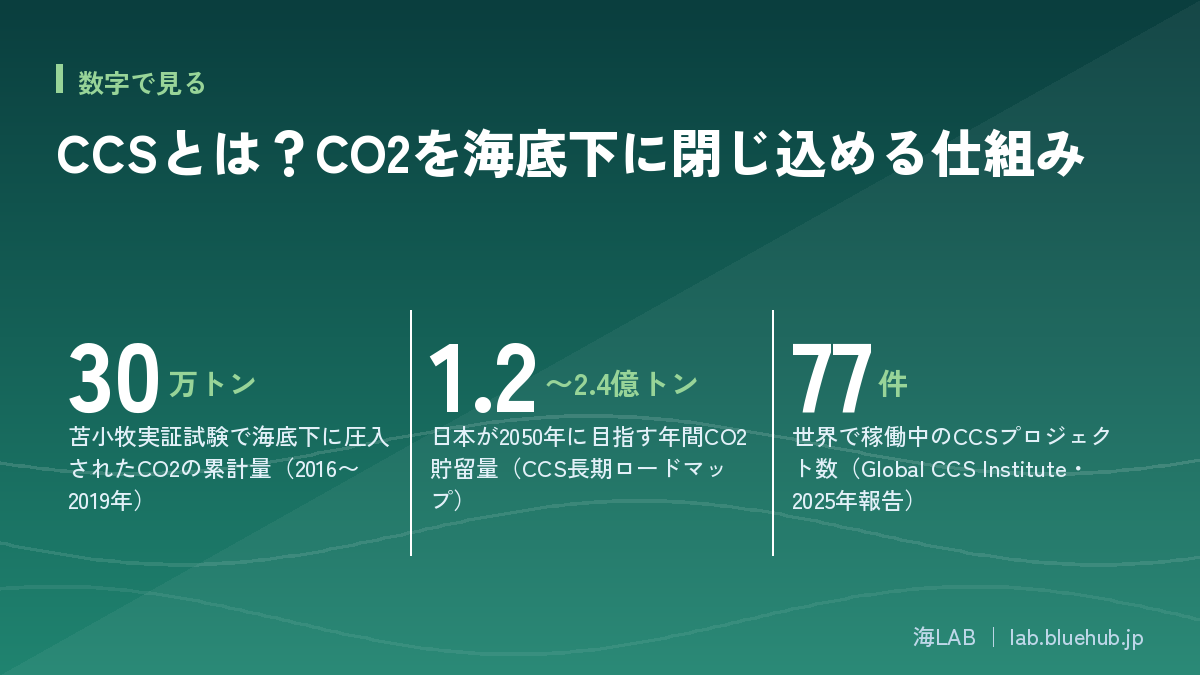
Since injection ended, Tomakomai has become the stage for the next phase of Japanese CCS. In 2023, the world's first demonstration vessel for carrying liquefied CO2 under low-temperature, low-pressure conditions — the EXCOOL — was completed, and trials were conducted shipping CO2 captured at a thermal power plant in Maizuru, Kyoto Prefecture, over the long sea route to Tomakomai. In Japan, where emission sources and storage sites are far apart, "can CO2 be shipped safely in bulk?" is the lifeline question for commercialization — and the answer is being worked out in the waters off Tomakomai. The Tomakomai area has also been positioned as one of the domestic candidate regions for the Advanced CCS Projects, and the geological data, operational know-how, and community trust built up through the demonstration are serving as a runway to commercial deployment.
Three hundred thousand tonnes is a tiny figure against Japan's total annual emissions (on the order of one billion tonnes). But the value of the demonstration lies not in volume: it showed with real data that a full CCS chain can operate safely under Japan's geology, legal system, and social conditions. Now that the ocean's own capacity to absorb CO2 is showing signs of limits (see our article Is the ocean's carbon sink approaching saturation?), having the option to return carbon to the ground by human hands is no small thing.
Is It Safe? — Real Data on Earthquakes, Leakage, and Monitoring
Public concerns about CCS boil down to two questions: "Will the stored CO2 leak out?" and "Will injection trigger earthquakes (or will an earthquake cause a leak)?" The great achievement of the Tomakomai demonstration is that it answered these questions with measured data.
What the Hokkaido Eastern Iburi Earthquake taught us
On September 6, 2018, during the injection period, the Hokkaido Eastern Iburi Earthquake (magnitude 6.7), which registered a maximum seismic intensity of 7, struck east of Tomakomai. Some voices suggested CCS might have induced the quake, but the report published by JCCS after review by experts concluded that the epicenter was about 30 kilometers from the injection site and about 37 kilometers deep — far below the storage formations (about 1,000–3,000 meters) — within the crust, and that there was no connection to the injection. Just as important were the post-earthquake observations: reservoir temperature and pressure data showed no anomalies, and no data indicating leakage of the stored CO2 was observed at all. The fact that the storage system remained sound even after shaking of lower-5 intensity on Japan's scale became precious empirical evidence for pursuing CCS in an earthquake-prone country.
A system that never stops watching — five layers of monitoring
- Continuous temperature and pressure observation: sensors in the injection and observation wells monitor the reservoir 24 hours a day; a leak would appear as a pressure change
- Microseismic monitoring: a seismometer network detects the faintest underground tremors; since injection began, no microseismicity has been detected near the injection site
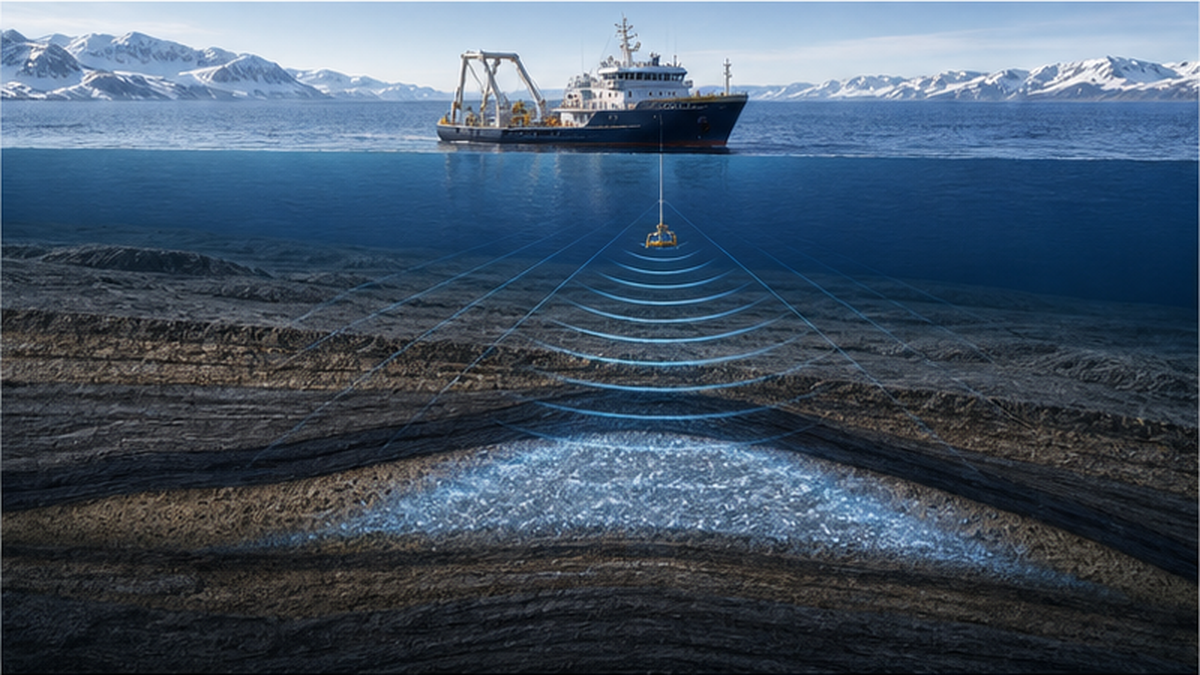
- Seismic surveys: artificial sound waves "X-ray" the subsurface to confirm that the CO2 plume is spreading within the expected area
- Marine environmental surveys: quarterly surveys analyze seawater quality, sediments, plankton, and benthic organisms; video observation of the seafloor checks for bubbles, and no CO2 leakage has been observed
- Continued monitoring after injection: monitoring has continued since injection ended in 2019, verifying the long-term stability of the storage
Sub-seabed storage is governed by international treaties and domestic law
Storing CO2 beneath the seabed is not something anyone may simply do at will. Internationally, the 1996 Protocol to the London Convention, which regulates the dumping of waste at sea, was amended in 2006 to permit the storage of captured CO2 in sub-seabed geological formations under strict conditions. Japan responded by amending its Marine Pollution Prevention Act, making sub-seabed CO2 storage subject to a permit from the Minister of the Environment. The Tomakomai demonstration was conducted under this permit, and the quarterly marine environmental surveys described above were carried out as legal obligations. The line drawn by international rules — not "dumping into the sea" but "sealing into the bedrock beneath the sea, under supervision" — is more clearly established than most people realize.
Not zero risk, but managed risk
The safety of CCS rests not on the promise that "absolutely nothing will happen" but on layered management: site selection (confirming stable geology and seal layers) → designs that create no leakage pathways → multiple layers of monitoring → halting injection if anomalies appear. The CCS Business Act enacted in 2024 likewise obliges operators to monitor their sites, and establishes a system in which a national agency (JOGMEC) takes over long-term management after storage ends.
CCS Around the World — From Norway's 30-Year Record to 77 Operating Projects
To the question "Will CCS really work in practice?", about 30 years of answers already exist. The world's first commercial-scale sub-seabed storage is Norway's Sleipner project. At a North Sea gas field, CO2 contained in the natural gas is separated offshore and has been injected into the Utsira sand formation about 800–1,000 meters beneath the seabed continuously since 1996. Cumulative storage exceeds 23 million tonnes, with no large-scale leakage observed. Norway's carbon tax on CO2 emissions gave companies the incentive that "storing it underground is cheaper than dumping it into the air" — a prime example of policy setting technology in motion.
Sleipner's three decades are also a precious record of long-term observation for science. Repeated seismic surveys (4D seismic) conducted every few years have imaged which direction and how fast the CO2 plume spreads underground, allowing simulations to be checked against reality. Analyzing the gaps between prediction and observation has deepened understanding of storage reservoirs, and those insights have been passed on to the monitoring designs of projects worldwide, including Tomakomai. It is no exaggeration to say that global CCS stands on the data accumulated by this North Sea pioneer.
A rapidly expanding global pipeline
According to the 2025 report by the Global CCS Institute, an international think tank, 77 CCS projects are now operating worldwide — a 54% increase from 50 the year before. Another 47 are under construction, and the full pipeline including planned projects reaches 628 projects with an annual capture capacity of 416 million tonnes. Facilities now operating can capture and store about 51 million tonnes per year, a figure set to double once the facilities under construction come online. Policy support — the US tax credit (45Q), European funds, and more — is pushing the expansion forward.
| Project | Country | Start | Highlights |
|---|---|---|---|
| Sleipner | Norway | 1996 | World's first commercial sub-seabed storage; about 1 million tonnes a year, over 23 million tonnes cumulative |
| Snøhvit | Norway | 2008 | Stores CO2 from an LNG facility on the Barents Sea beneath the seabed |
| Tomakomai | Japan | 2016 | Japan's first full-chain demonstration; injected 300,000 tonnes with zero leakage confirmed |
| Northern Lights | Norway | 2025 | World's first cross-border CCS transport and storage service receiving CO2 from other countries and companies by ship |
Drawing particular attention is Norway's Northern Lights. In 2025 it began receiving liquefied CO2 from other companies' plants — in effect a "CO2 courier plus rental warehouse." A service model in which emitters need not own a storage site but can simply ship their CO2 to be stored beneath the seabed holds promise for Asia, where suitable storage sites are unevenly distributed, and Japanese companies are studying similar cross-border CCS ventures.
Different regions, different faces of CCS
How CCS advances differs by region. The United States, armed with the powerful 45Q tax credit, has become the world's largest cluster in both project count and capture capacity. Europe treats the North Sea sub-seabed as a "shared CO2 warehouse," with a hub-and-cluster model in which countries pool CO2 across borders. Large projects are also starting to move in China and the Middle East. The Asia-Pacific, including Japan, encompasses countries with large emissions but limited domestic storage sites (South Korea, Singapore, and others), so building cross-border networks that carry liquefied CO2 by ship is the focal point. For Japan, with its strengths in shipbuilding and shipping, CO2 carriers and the skills to operate them are also the seeds of a new industry.
The Cost Barrier — How Much Does It Cost to Store One Tonne?
CCS has proven it works technically, but the biggest barrier to deployment is cost. CCS produces nothing sellable like electricity or products; whatever it costs is a pure carbon-mitigation expense. Estimates by RITE submitted to the Agency for Natural Resources and Energy's study group show substantial costs across the value chain from capture through transport and storage, with the capture step accounting for the largest share. Catching dilute CO2 out of flue gas takes a great deal of energy, and making that step cheaper has become a worldwide technology race.
Another issue not to overlook is the "energy penalty." Separating, capturing, compressing, and injecting CO2 itself consumes a lot of energy. A power plant fitted with CCS must therefore burn more fuel to deliver the same electricity, adding cost and resource use. Research to shrink this penalty continues worldwide — improved absorbents, pre-combustion capture instead of flue-gas capture, membrane separation — and lowering capture costs will directly determine how fast CCS spreads.
Three factors that determine the cost
- CO2 concentration: capture from a gas at about 52% concentration, as at Tomakomai, is relatively cheap, while capturing from thermal-power flue gas (around 10%) costs more
- Transport distance and mode: pipelines where source and storage site are close, liquefied-CO2 carriers where they are far apart; Japan is emerging as a leader in shipping technology
- Scale: per-tonne costs fall sharply at millions of tonnes a year compared with hundreds of thousands; consolidating volumes at hubs is key
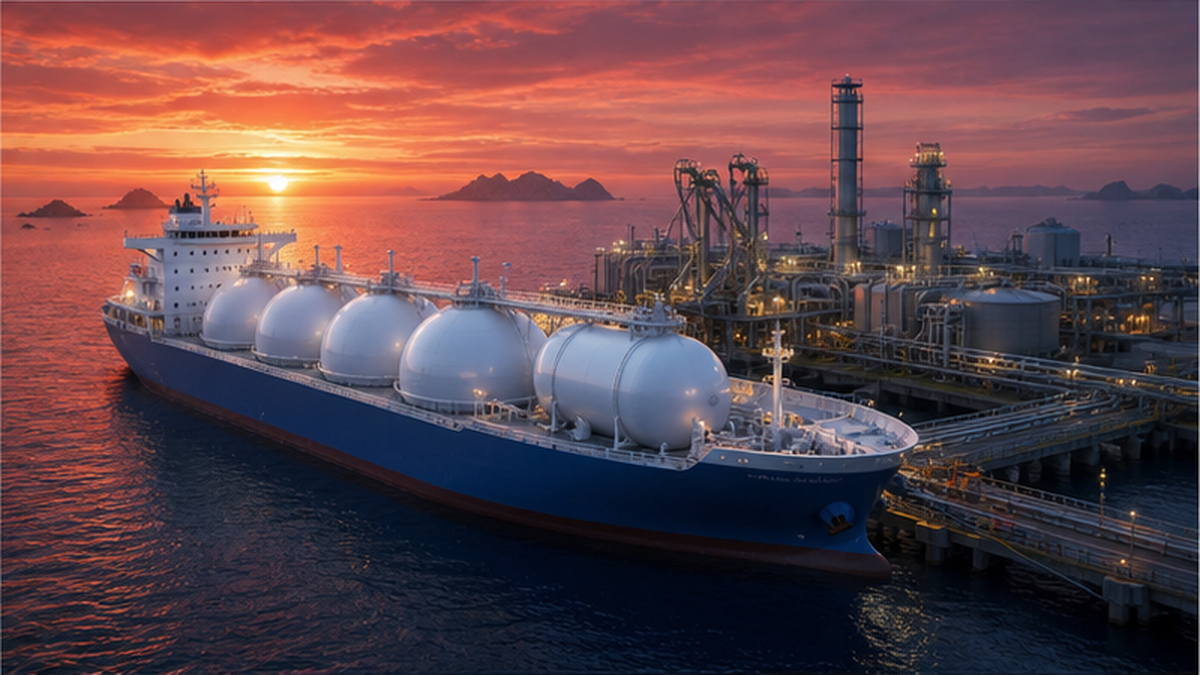
Facing the criticism that CCS "prolongs fossil fuels"
CCS also faces persistent criticism: "It becomes an excuse to keep emitting and prolongs fossil-fuel infrastructure," and "That investment should go to renewables instead." Indeed, much of CCS history has involved injecting captured CO2 into oil fields to boost crude production (EOR), so the criticism has real grounds. What matters is the order of operations: first cut the emissions that efficiency and renewables can cut, then apply CCS to what remains. Holding to that priority is the condition for CCS to be a "final piece" rather than an indulgence.
Challenges for CCS (summary)
- Capture costs are high and the business generates no revenue on its own (policy support is essential)
- Storage sites lie far from emission sources, requiring transport infrastructure
- Accountability in the face of criticism that CCS "postpones emission cuts"
- Institutional design for who bears responsibility for management lasting decades to centuries
Japan's Strategy — From the CCS Business Act to the 2050 Roadmap
Japan, committed to carbon neutrality by 2050, has moved past asking "whether to use CCS" to asking "how to make it ready in time." Behind this is the broad current of GX (Green Transformation), which envisions more than 150 trillion yen in public-private investment. CCS has been clearly positioned as an investment field alongside renewables and hydrogen, and in the past few years three policy pillars have fallen into place: a long-term roadmap, a law, and support for pioneering projects.
1. The CCS Long-Term Roadmap — 120–240 million tonnes a year by 2050
The final report of METI's study group, compiled in March 2023 as the "CCS Long-Term Roadmap," set out the guideline of creating the conditions for CCS businesses to launch by 2030 and enabling annual CO2 storage of roughly 120–240 million tonnes by 2050 — equivalent to 10–20% of Japan's current annual emissions. Working backwards, storage capacity must grow by 6–12 million tonnes every year from 2030 onward. The schedule leaves no room for delay.
2. The CCS Business Act — rules that turn storage into a business
In May 2024, the Act on Carbon Dioxide Storage Businesses (CCS Business Act) was enacted. It is Japan's first full-fledged CCS legislation, defining underground CO2 storage — including beneath the seabed — as a licensed business, establishing storage rights, mandating monitoring, and creating a mechanism for transferring management to JOGMEC (Japan Organization for Metals and Energy Security) after storage ends. With the law settling "who may store, where, and under what responsibility," companies now have the foundation to make investment decisions.
3. Advanced CCS Projects — ventures racing toward a 2030 start
In fiscal 2023, JOGMEC launched the Advanced CCS Projects program to give concentrated support to model ventures. In June 2024 it selected nine projects (five domestic storage, four overseas storage) aiming to begin storage by 2030. Together the nine target about 20 million tonnes of CO2 storage per year, with design work now under way. The sites include domestic sub-seabed formations off Hokkaido and western Kyushu, as well as cross-border concepts shipping liquefied CO2 to Malaysia and Oceania, with the entire value chain from capture through transport and storage supported as a package.
In shipping, too, construction of dedicated CO2 carriers and the transition to new fuels such as ammonia and hydrogen are advancing in parallel (see our article on decarbonizing international shipping). CCS is not a standalone technology — it is coming to life as part of an "ocean decarbonization infrastructure" that pulls in ports, shipping, and the energy industry.
Remaining homework — cost sharing and local consensus
The institutional foundation is in place, but homework remains. First, who pays. How CCS costs will ultimately be reflected in electricity rates and product prices, and how they will combine with carbon pricing, is still under debate. Second, building consensus with local communities. For people living near storage sites — above all the fishers who make their living on the sea — unease about a business that injects something beneath the seabed is only natural. Just as the Tomakomai demonstration advanced through repeated town meetings and open disclosure, opening up the data and answering questions head-on will form the social foundation of this technology. Technology and law alone will not move CCS forward.
CCS in a Carbon-Neutral World — Living with the "Final Piece"
As we have seen, CCS is no magic wand. It is expensive, its storage capacity has limits, and it carries the danger of becoming an excuse to keep emitting. Yet as long as some emissions — from cement, steel, and the like — inevitably remain, net zero by 2050 can only be achieved by combining technologies that cut emissions with technologies that capture and store them. That is the scientific consensus in Japan and abroad.
We should not forget that nature, too, has its own mechanisms for storing carbon. Mangrove forests and seagrass meadows absorb CO2 through photosynthesis and lock carbon into seafloor sediments for centuries — a natural counterpart to CCS known as blue carbon. Engineered CCS handles the large volumes of CO2 from industrial stacks, while blue carbon stores carbon as it enriches coastal ecosystems. Seeing the two not as rivals but as teammates with different roles gives the most balanced picture.
And there is one more side to CCS: it is also a technology that protects the health of the ocean. As atmospheric CO2 rises, the ocean absorbs it and acidifies, making it harder for shellfish and corals to build their shells and skeletons. By reducing the CO2 released to the atmosphere in the first place, CCS ultimately eases the burden on marine life. The bedrock beneath the seabed — the deepest place in the ocean — turns out to stand on the side of protecting the coral reefs and seagrass meadows at the surface. Seen that way, the relationship between this technology and the sea looks a little different.
What we can do
- Learn the facts: judge from both the demonstration data and the challenges — neither "burying it underground is dangerous" nor "with CCS we can relax" is accurate
- Vote with your energy choices: choosing renewable electricity and energy-efficient products signals to society that "reduce first" is the right priority
- Take part in local discussions: near candidate storage sites, briefings and public-comment processes are held; the perspective of residents who know their local waters strengthens both the safety and the credibility of a project
- Act to protect the ocean's carbon cycle: joining seagrass-bed and tidal-flat conservation work or beach cleanups is the most familiar way to defend nature's capacity to absorb carbon
Summary of this article
- CCS captures emitted CO2 and permanently confines it in formations (reservoir plus caprock) on the order of 1,000 m beneath the seabed
- The Tomakomai demonstration injected 300,000 tonnes between 2016 and 2019; no data indicating leakage has been observed, including after the Eastern Iburi Earthquake
- Worldwide, 77 projects now operate; Norway has stored CO2 beneath the seabed for about 30 years, since 1996
- The biggest barrier is capture cost; the priority "reduce first, apply CCS to residual emissions" is the fundamental premise
- With the CCS Business Act (2024) and the Advanced CCS Projects, Japan aims to launch operations by 2030 and store 120–240 million tonnes a year by 2050
References and Sources
- Agency for Natural Resources and Energy – CCS: Capturing and Storing CO2 — Approaching Realization after the Demonstration Test
- Ministry of Economy, Trade and Industry – Tomakomai CCS Demonstration Project: Report at 300,000 Tonnes Injected (Summary Report), Overview
- NEDO – Publication of the Summary Report on the Large-Scale CCS Demonstration Test (press release)
- Japan CCS Co., Ltd. – Report on the Impact of the Hokkaido Eastern Iburi Earthquake on the CO2 Storage Reservoir
- Ministry of Economy, Trade and Industry – CCS Long-Term Roadmap Study Group: Final Report (March 2023)
- Ministry of Economy, Trade and Industry – Advanced Initiatives toward CCS Commercialization: Nine Projects Selected toward Storage Start by 2030 (June 2024)
- JOGMEC – Overview of the Advanced CCS Support Program
- Ministry of the Environment, Japan – Technical Reference on CCS Monitoring Technologies (March 2025)
- Global CCS Institute – Global Status of CCS (annual report on CCS projects worldwide)
* Listed in order of reliability: government and academic institutions > peer-reviewed papers > specialized institutions > trusted media