⚡ In short
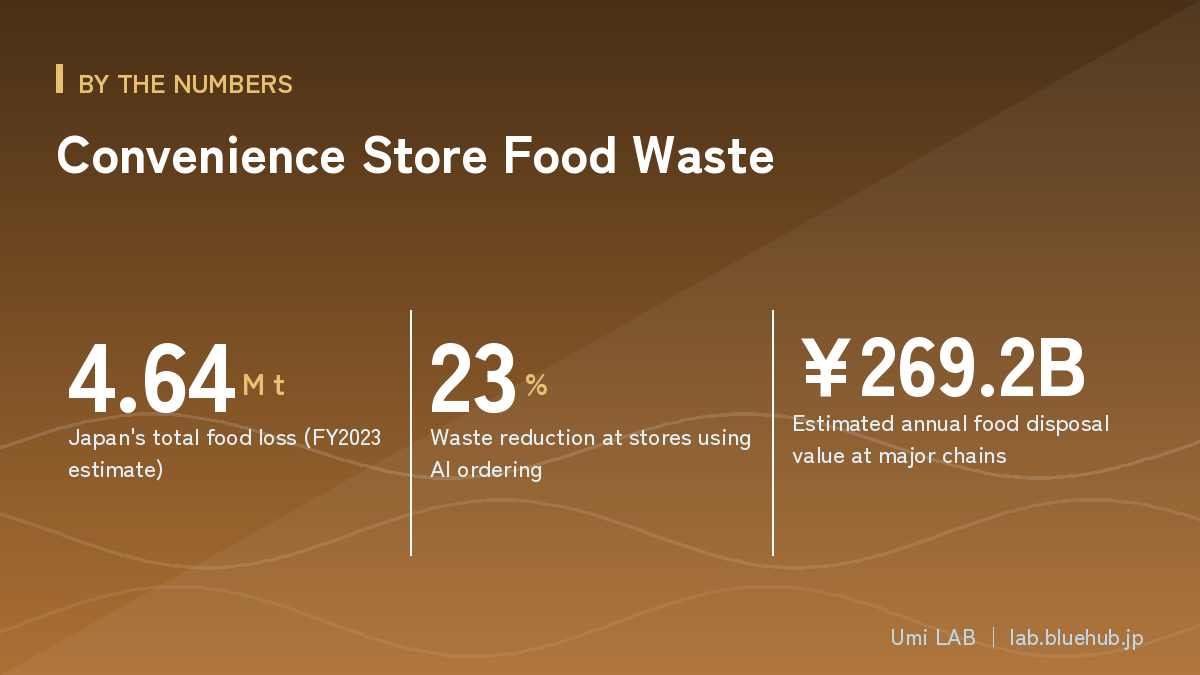
Japan's major convenience store chains discard an estimated 269.2 billion yen worth of food a year. This article covers AI ordering that cuts waste by 23%, reservation sales for seasonal items, food-rescue apps, and the link to seafood loss and the ocean.
Rice balls and bento boxes line convenience store shelves every day. When they go unsold, most are discarded — major chains are estimated to lose around 269.2 billion yen worth of food a year.
The root cause is a structural tendency to over-order in order to avoid running out of stock. In recent years, AI-based demand forecasting, reservation sales for seasonal items like ehomaki (lucky sushi rolls) and Christmas cakes, and food-sharing apps have all built up a track record of reducing waste.
Discarding rice balls and seafood-based side dishes at convenience stores is also indirectly tied to how marine resources are used and to ocean health. This article organizes the latest trends in convenience store food waste measures and their connection to the sea.
With more than 50,000 stores nationwide, convenience stores are one of the retail formats closest to everyday life. That is exactly why small improvements at each individual store add up to something significant for reducing food loss across Japan.
What you'll learn in this article
- Why food waste tends to occur structurally at convenience stores
- How AI ordering systems reduce both waste and stockouts at the same time
- How effective reservation sales are for seasonal items like ehomaki
- How food-sharing apps work and how widely they are used
- How losses of rice balls and seafood dishes at convenience stores relate to the ocean and fishery resources
How much food waste do convenience stores generate?
According to Ministry of the Environment, Japan, estimates, Japan's total food loss in FY2023 was 4.64 million tonnes, split almost evenly between 2.31 million tonnes from businesses and 2.33 million tonnes from households. Among business-sector food loss, convenience stores are considered one of the higher-waste formats because they handle large volumes of perishable bento boxes, rice balls, and prepared side dishes.
Business-sector food loss occurs at every stage — manufacturing, distribution, food service, and retail — but convenience stores stand out for the extremely short time between manufacturing, shelf display, and the end of sale. Most bento boxes and rice balls have only one to two days between production and their expiration date, so even a single day's misjudgment of demand leads directly to disposal. Because stores are expected to keep shelves stocked right up until closing under a 24-hour operating model, the very culture of "zero stockouts" is structurally intertwined with waste.
Disposal cost per store
According to reports, disposal costs per store can reach several million yen a year, straining the finances of franchise operators. Across major chains as a whole, annual food disposal value is estimated at 269.2 billion yen (a figure calculated by multiplying a per-store disposal survey result by the number of stores, not an official corporate disclosure) — comparable to the annual revenue of a mid-sized company. Some companies have headquarters subsidize part of the disposal cost, but that only eases the financial burden; reducing the waste itself remains the essential countermeasure.
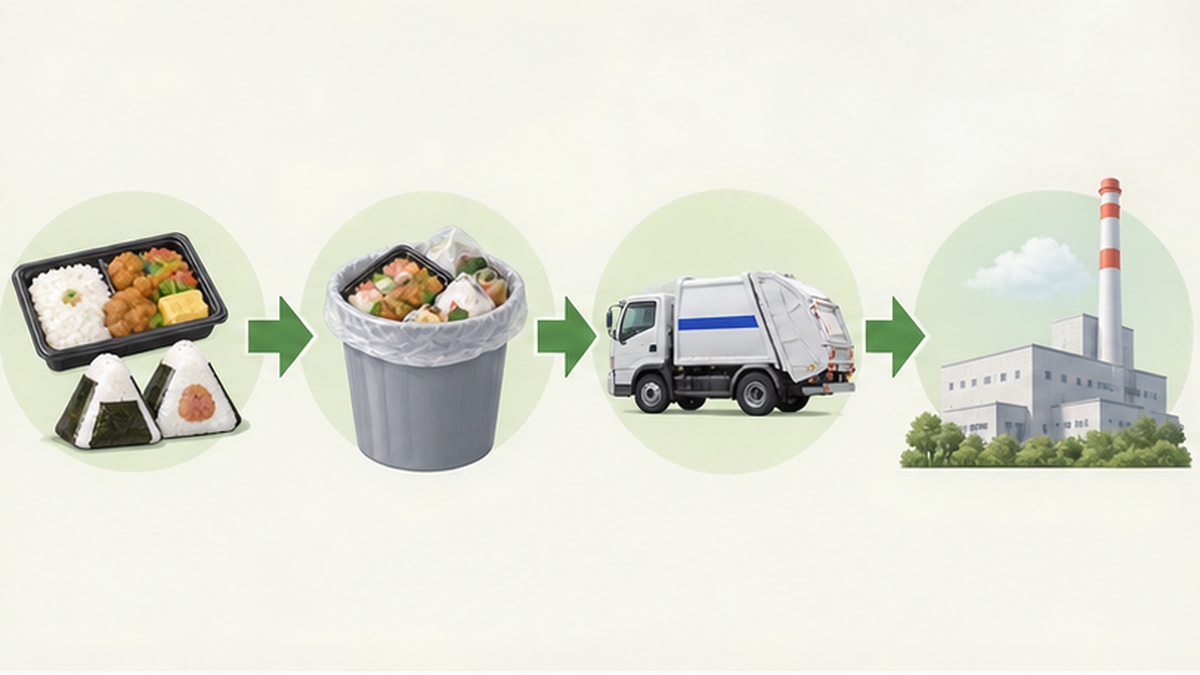
Most discarded bento boxes and rice balls are collected and incinerated by municipalities as "business general waste." Japan's total general waste disposal cost exceeds 2 trillion yen, meaning food loss also burdens society as a whole through waste processing costs. During periods of rice shortages or rising raw material prices, news coverage of discarded rice balls and bento boxes has increased, and there are reports that this has become a source of psychological stress for store staff.
In fact, one report described a single convenience store discarding an estimated 4.68 million yen worth of food a year, with a staff member quoted as saying it was painful to throw the food away. The same reporting noted that 40% of former employees who quit cited the psychological burden of disposal work as one reason for leaving, showing that food loss affects not only management but also the morale of the people working on the front lines.
The connection to rice shortages and price hikes
Japan has seen periods of unstable rice supply in recent years, pushing up the cost of rice used in convenience store rice balls and bento boxes. When large quantities of rice balls are reported as being discarded at a time when rice itself is scarce and valuable, consumer backlash tends to intensify. This heightened social scrutiny is one factor accelerating food waste countermeasures across convenience store chains.
The environmental burden of disposal
- Over 80% of food loss by weight is water, so burning something that doesn't burn easily consumes large amounts of energy
- CO2 is generated during both incineration and transport, contributing to greenhouse gas emissions at both the production and disposal stages
Behind the culture of never running out of stock
The convenience store industry has long treated "never running out of stock" as a key measure of service quality. There is a deep-rooted belief that a customer who can't find what they want late at night may never return, and stores have tended to over-order out of fear of that outcome. The coexistence of this "fear of stockouts" and "tolerance of waste" has been one of the reasons the industry's food loss problem has been so difficult to solve.
Consumer attitudes are gradually changing, too. More consumers now say they value stores with less waste over stores with zero stockouts, or choose stores based on their commitment to the SDGs, and companies increasingly recognize that reducing waste itself can build brand value. This shift in awareness is providing the foundation that supports new approaches like AI ordering and reservation sales.
How AI ordering changes the balance between waste and stockouts
For a long time, ordering at convenience stores depended on the experience and intuition of store staff. Veteran managers factored in weather and even nearby school events when deciding order quantities, but accuracy tends to vary widely for less experienced staff or understaffed stores. Trying to avoid stockouts increases order volumes, which in turn increases waste. The tool spreading to resolve this contradiction is the AI ordering system.
7-Eleven's approach
7-Eleven Japan has introduced an AI ordering system covering about 2,800 items, analyzing past sales data, weather, day of the week, and nearby events to present each store with an optimal recommended order quantity. Stores using the system reportedly saw waste losses drop by 23%, while the burden of ordering work on staff was reduced by up to 40%. Ordering tasks that used to take staff dozens of minutes can now be finalized quickly based on the AI's recommended quantities, achieving both waste reduction and labor savings — a point that has drawn praise.
AI-based demand forecasting isn't a simple average of past data; it combines multiple variables such as recent shifts in sales trends, temperature changes, and nearby events. For example, the AI learns fine-grained patterns — such as demand shifting from rice balls to cold noodles and ice cream during a heat wave, or overall foot traffic dropping during prolonged rain — and reflects them in order-quantity adjustments. This is driving a shift away from the traditional safety strategy of "order extra to avoid running out" toward "order only what's needed to reduce both stockouts and waste."
- Analyzes diverse data including past sales performance, weather, day of the week, and nearby events
- Forecasts demand by time of day and presents recommended order quantities
- Achieves both reduced staff burden and reduced waste at the same time
| Item | Before AI ordering | After AI ordering |
|---|---|---|
| Basis for ordering decisions | Staff experience and intuition | Analysis of sales data, weather, events, etc. |
| Time spent on ordering tasks | Long, highly dependent on individual staff | Burden reduced by up to 40% |
| Waste losses | Prone to over-ordering to avoid stockouts | About 23% reduction at adopting stores |
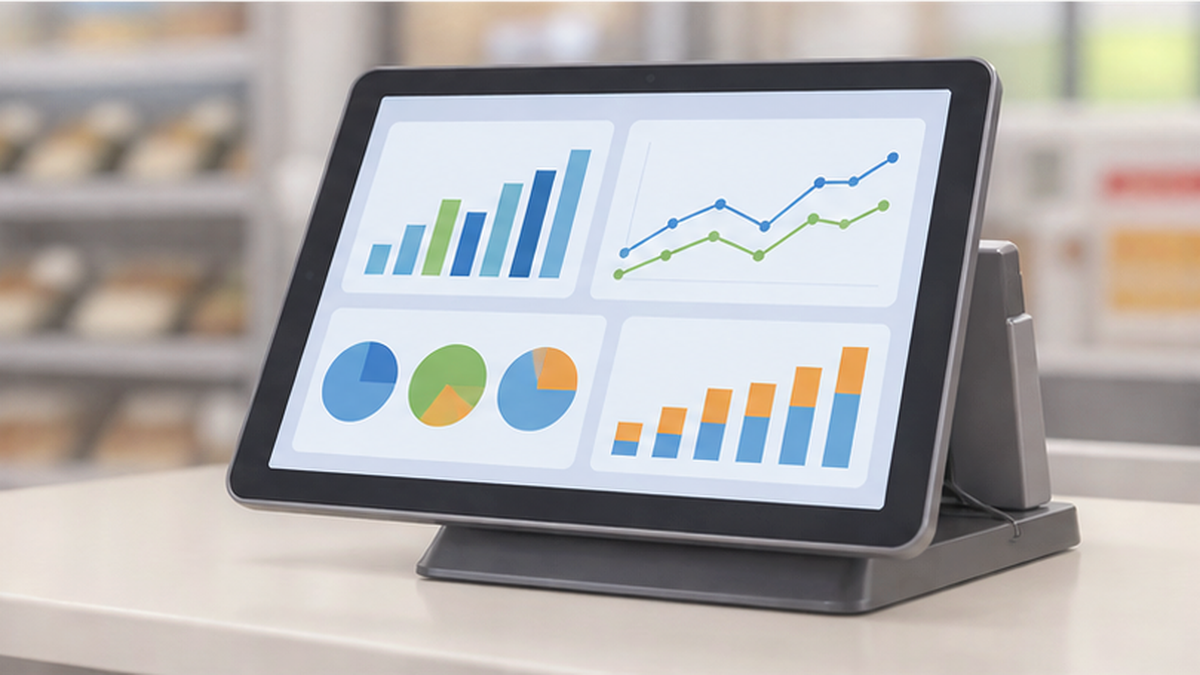
Key point about AI ordering
AI ordering isn't just about "ordering less" — its defining feature is minimizing both the lost sales from stockouts and the losses from waste at the same time. The more accurate the data, the greater the effect.
Cases from Lawson and FamilyMart
Lawson has rolled out a "semi-automatic ordering system" to roughly 14,000 stores nationwide, and reports that precise demand forecasting based on sales data has shortened ordering time by about 44 minutes and cut per-store disposal value by roughly 10% year on year. It has also introduced AI-based purchase quantity forecasting for daily items such as rice balls and sandwiches, aiming to improve the gap with actual demand by about 30%. Lawson is also applying AI to ingredient procurement at its food manufacturing plants, forecasting the quantities needed months ahead based on past order history.
FamilyMart has introduced a humanoid AI assistant to support store manager tasks, analyzing data such as sales and customer traffic to advise on ordering and store layout. While the approaches differ by company, the shared direction — optimizing order quantities based on data — is becoming a standard practice across the convenience store industry.
Cutting losses with reservation sales for seasonal items
Seasonal items such as ehomaki (lucky sushi rolls), Christmas cakes, and eel for the midsummer Doyo-no-Ushi day have long been notorious for large-scale waste, as demand is even harder to predict than for regular products. Because these items sell only once a year, stores accumulate little data on them, and sales can swing widely depending on weather and the day of the week. In recent years, promoting reservation sales — deciding production volumes after gauging demand in advance — has been gaining ground.
The advantage of a reservation system is that stores can shift from "make it, then sell it" to "make only what will sell." Once reservation numbers are confirmed, headquarters and factories can plan production accordingly, narrowing down how much raw material to procure. For ehomaki, that means ingredients like rice, nori seaweed, and dried gourd strips; for Christmas cakes, sponge, cream, and fruit — in both cases, usage becomes directly tied to actual demand, which is expected to reduce loss across the entire supply chain.
Ehomaki fillings often include seafood variations such as shrimp, tuna, and conger eel, in addition to standard ingredients like egg, cucumber, and dried gourd strips. Seasonal items tend to use higher-priced, higher-value ingredients than regular products, so the raw material loss from disposal is relatively larger when it occurs. Narrowing production volume through reservation sales therefore has a significant effect in reducing waste of these higher-value seafood ingredients as well.
Examples of reservation systems in practice
| Company | Initiative | Effect / characteristics |
|---|---|---|
| 7-Eleven Japan | Raised the reservation sales ratio for ehomaki, used PR materials, adjusted planned quantities by store | With a reservation share of 15.7%, disposal costs improved by about 25% year on year |
| Lawson | Shifted seasonal/event products to reservation sales in principle | Moved to a system that gauges demand in advance under a "don't overproduce" premise |
| FamilyMart | Promotes advance reservations via its official "FamiPay" app, with discounts for early reservations | Visualizing demand through the app |
Reservation sales alone do not bring waste down to zero, however. Many stores still keep some walk-in stock, so how to balance reservations against same-day sales remains an ongoing challenge. There are also reports of customers who haven't reserved buying multiple units out of fear they "might not be able to buy any on the day," only to end up throwing away leftovers at home — meaning waste reduction at the store level can simply be shifted to the household level. Getting the balance right between forecast accuracy and same-day stock is essential to avoid this.
Conditions for a reservation system to work well
- Offer reservation incentives (discounts, bonus points) to motivate advance orders
- Have a system flexible enough to adjust production and raw material procurement based on reservation volumes
- Keep same-day stock to the minimum necessary while explaining this to customers in a way that doesn't cause dissatisfaction
Food-sharing apps: a new safety net
Beyond reducing waste itself through ordering and reservation systems, mechanisms that connect surplus food that still ends up unsold with consumers are also spreading. A leading example is the food-loss reduction app "TABETE." A wide range of businesses — bakeries, hotels, restaurants, supermarkets — already use it, and convenience stores have begun participating on a trial basis as well.
Convenience stores have traditionally been cautious about discounting items nearing their expiration date, worried that customers might get used to buying only when discounted rather than at full price. Food-sharing apps largely sidestep this problem: because discount information is shown only within the app, stores can reach consumers on a separate channel with only the soon-to-be-discarded items, without disturbing the regular in-store price level.
TABETE's partnership with convenience stores
TABETE launched in 2018 and, as of January 2025, has partnered with more than 2,900 stores, having reportedly rescued an estimated 2.8 million tonnes or more of food. The mechanism is simple: a store lists items it expects to have left over, and users reserve and pick them up after paying in advance. Stores recover some sales revenue while avoiding disposal costs, and users get products at a discount. Some 7-Eleven stores in Tokyo also piloted a system letting customers pre-pay and reserve discounted items through TABETE, backed by a campaign to encourage adoption.
Mechanisms like this could also feed disposal data straight back into improving demand forecasting. Analyzing which time slots and which products tend to become rescue candidates could feed into improving AI ordering accuracy as well. The ideal future is one where ordering, reservations, and sharing don't operate as isolated measures but reinforce each other.
View TABETETABETEA food-sharing service that lets you rescue still-edible food at a discount🔗 tabete.mePoints to keep in mind when using these apps
When using a food-sharing app, pickup times are usually specified, so it's assumed you will actually go pick up your item after paying. A "no-show" after reserving increases the burden on the store and undermines the sustainability of the service itself. App operators are also introducing cancellation policies and review features so both users and stores can use the service with confidence.
For stores, registering items on a food-sharing app is itself extra work. If staff don't have time to enter product information during busy hours, items may simply end up discarded without ever being listed as rescue candidates. If POS systems could automatically register discounted or rescue-eligible items, this operational hurdle would likely become much smaller.
The spread of food-sharing apps is also drawing attention as a way to make consumers' sense of "it would be a shame to waste this" visible and turn it into action. The act of searching for and buying discounted items itself becomes an ongoing reminder of the food loss issue. A one-off campaign rarely sustains attention for long, but if using the app becomes a daily habit, interest in food loss itself is more likely to take root in society.

What consumers can do
- Check discounted items at nearby stores using food-rescue apps
- Practice "temae-dori" — choosing items with a nearer expiration date from the front of the shelf
- Buy seasonal items by reservation whenever possible
Seafood dish losses and their connection to the ocean
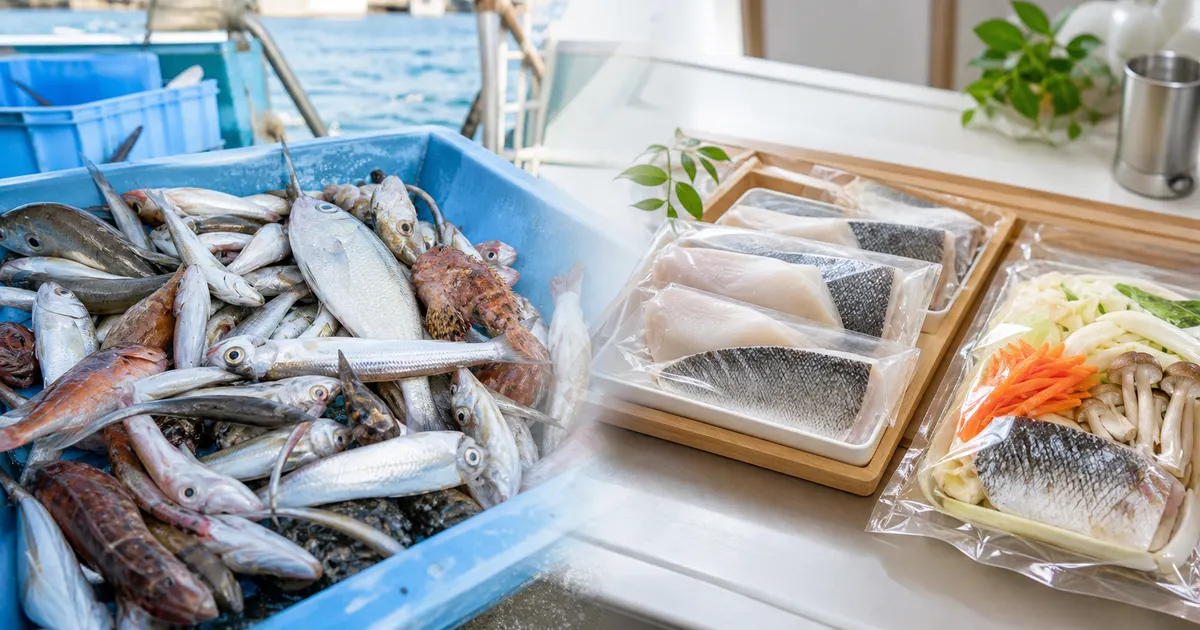
Many convenience store bento boxes and rice balls contain seafood such as salmon, tuna, and shrimp. Staples like tuna mayo rice balls, salmon bento, and shrimp tempura sandwiches sell steadily throughout the year, but any unsold units are naturally discarded. It's easy to overlook that when these are thrown away, the marine resources used as raw ingredients are wasted at the same time.
Seafood carries an environmental footprint at every stage — catching, processing, and transport. Processing that involves repeated freezing and thawing requires energy, and transport depends on a cold chain for refrigeration and freezing. When a single rice ball is discarded at a convenience store, it means the resources and energy used across the entire chain of fishing, processing, and transport behind it have also been wasted.
Eco-feed reduces dependence on wild-caught fish
Some discarded food is reused as "eco-feed," a type of feed used in livestock and aquaculture. Production methods that ferment food waste from food factories and supermarkets with lactic acid bacteria into liquid fermented feed, which can cost less than compound feed, are also spreading. In aquaculture, research is progressing on lowering the proportion of fish meal (feed made from wild small fish) used in feed; one demonstration found that reducing the fish meal ratio for red sea bream from 40–50% to around 30% produced growth results comparable to standard feed. If feeding food waste in this way spreads further, it could help ease the pressure of large-scale fishing of small wild fish for fish meal.
Small fish such as anchovies, the raw material for fish meal, form a foundational part of the marine ecosystem, serving as prey not only for farmed fish but also for seabirds and larger predatory fish. If demand for fish meal keeps growing, fishing pressure on these small fish increases, raising concerns about impacts on the balance of the broader marine ecosystem. While indirect, reducing convenience store food loss and expanding eco-feed use could be one pathway to easing this burden on marine ecosystems.
Aquaculture is expanding globally, as wild catches alone can no longer meet growing demand for seafood. That expansion requires a stable feed supply, but fish meal production is constrained by wild resource limits, making prices prone to rising. If food waste can be used as feed material through eco-feed, it could ease the fish meal supply shortage while also turning waste into a resource as a secondary benefit. If a system spreads in which discarded convenience store food is used as part of such feed material, it could address the challenges of waste disposal and aquaculture at the same time.
CO2 from incineration and climate change
Much of the discarded food is collected and incinerated as business general waste, generating CO2 in the process. Since water makes up more than 80% of food loss by weight, burning it requires extra fuel and lowers incineration efficiency. Greenhouse gas emissions from food loss are one factor contributing to climate change, which in turn affects sea temperature rise and ocean acidification — meaning reducing convenience store waste is not unrelated to protecting the marine environment.
Globally, greenhouse gas emissions from the food system as a whole are often described as being on a scale second only to fossil fuels, positioning food loss reduction as a relatively accessible area within broader climate action. If a format handling enormous volumes of food every day, like convenience stores, reduces waste, the effect extends beyond individual stores to reduce CO2 emissions across the supply chain and society as a whole.
Rising sea temperatures are already shifting where fish are found, with reports from various regions of falling catches in traditional fishing grounds alongside new species being caught in areas that previously didn't yield them. Ocean acidification has been flagged as potentially impairing the growth of organisms with calcium carbonate shells or skeletons, such as shellfish and coral, which could affect fishery resources broadly over the long term. Reducing convenience store food loss is not a direct solution to these ocean changes, but it is one of the few everyday points of engagement available to consumers and businesses in tackling the larger challenge of climate change.
Summary of this section
- Discarding seafood dishes at convenience stores also wastes the marine resources used as raw ingredients
- Turning food loss into eco-feed can help reduce dependence on wild-caught fish
- CO2 from incinerating discarded food affects the ocean through climate change
Common ground with reusing seafood processing byproducts
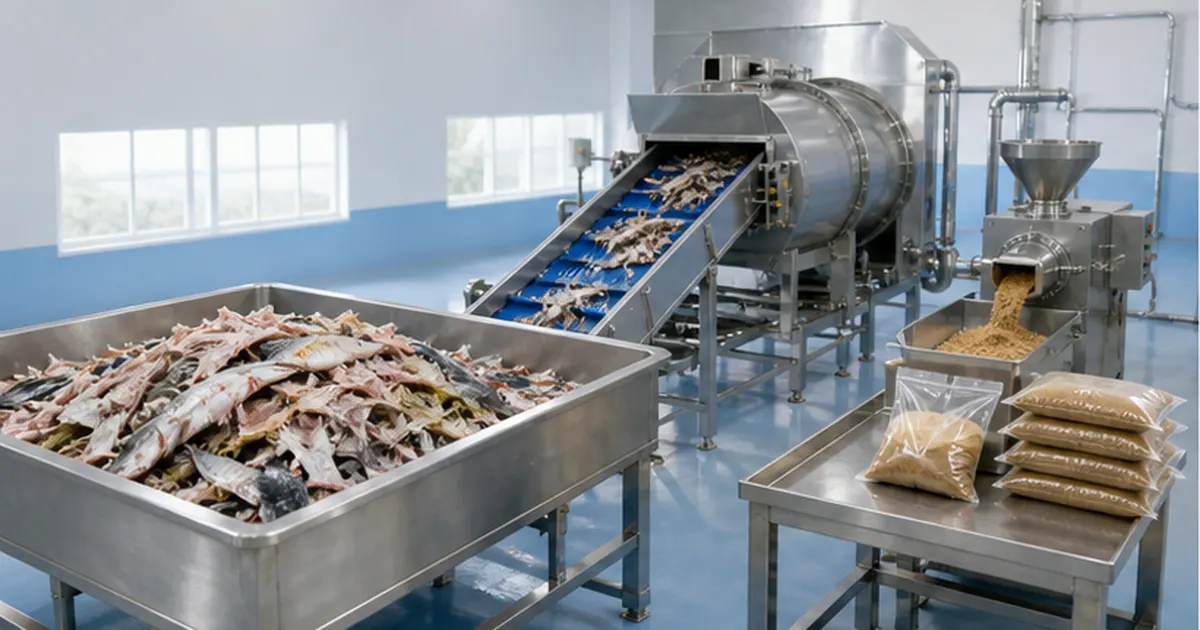
The seafood industry has been advancing technology to make effective use of "ara" — the heads, bones, and internal organs left over from processing fish. Of an estimated 2.32 million tonnes of seafood processing byproducts generated annually, growing efforts turn them into resources for collagen, fish sauce, feed, and fertilizer, creating new value from parts that were once simply discarded. The move to reuse discarded convenience store food as eco-feed shares the same underlying idea as this resourcing of seafood byproducts. The upcycling mindset — putting to use something once judged to have no use — has become an important shared perspective across food loss countermeasures as a whole.
That said, discarded convenience store food often consists of multiple ingredients that have already been cooked or processed, making sorting and reuse harder than for single-material seafood byproducts. Rice balls where rice, nori, and filling are fused together, or bento boxes using many ingredients, often require separation before they can be turned into feed, and keeping the cost and effort of that reuse process down remains a practical challenge.
Advances in equipment that automatically separates packaging and sensor technology that detects contaminants are gradually lowering these sorting costs. Whether efforts to reuse discarded convenience store food as eco-feed or compost expand in earnest going forward will hinge on continued cost reductions in sorting and processing technology, along with readiness on the part of stores and factories to accept the material.
Comparing efforts across other industries
Food loss countermeasures aren't unique to convenience stores. Supermarkets are advancing AI ordering and "temae-dori" awareness campaigns, while the seafood industry is expanding the use of underutilized fish and upcycling of fish byproducts. Related efforts are covered in the following articles as well.
- How supermarkets reduce food waste with AI ordering
- Making the most of fish byproducts: from collagen to fish sauce
- Japan's 2.36 million tonnes of household food loss: the three main causes and what you can do today
As countermeasures accumulate across convenience stores, supermarkets, and households alike, they add up to a reduction in overall food loss. Because supermarkets and convenience stores share the same retail-sector ordering know-how, it's common for the same AI ordering technology developers to serve both formats. This cross-industry sharing of knowledge is one factor speeding up food loss countermeasures overall.
Common ground with the seafood industry's efforts
The seafood industry has been expanding efforts to use out-of-standard or underutilized fish in school lunches, processed products, and hometown tax gift returns. This trend of commercializing "fish that would otherwise be wasted" shares a common goal with convenience stores reducing seafood dish waste: not wasting marine resources that are edible but struggle to reach the market. If convenience store seafood dishes can be sold without waste through AI ordering and reservation sales, that could also make planned production easier further upstream in fishing and processing.
Much of the seafood used in convenience store rice balls and prepared dishes is sourced through processing plants under contract with headquarters. Because those plants determine catch and procurement volumes based on order forecasts from stores, improved ordering accuracy at the convenience store level makes it easier to plan seafood procurement without waste. Conversely, if order volumes keep fluctuating sharply, processing plants are forced to over-procure raw materials to avoid stockouts, which tends to generate excess purchasing and waste further upstream as well. Improving convenience stores' demand forecasting accuracy is thus an effort that extends beyond in-store waste to improving resource efficiency across the entire supply chain.
Future challenges and outlook
The effects of AI ordering and reservation sales are now visible in numbers, but Japan still has a long way to go to substantially reduce business-sector food loss nationwide. The government has set a target of halving food loss by fiscal 2030 compared with fiscal 2000, and the convenience store industry is being asked to deepen its efforts further.
Several years have passed since the Food Loss Reduction Promotion Act took effect, and companies have steadily advanced their countermeasures — but changing consumer awareness is equally necessary. Steady grassroots efforts, such as promoting "temae-dori" and explaining the difference between "best-before" and "use-by" dates, need to combine with system-side measures like AI ordering and reservation sales to maximize the effect of waste reduction. Rather than leaving it entirely to corporate effort, changes in each consumer's purchasing behavior are also a key factor pushing convenience store food loss reduction forward.
Improving AI ordering accuracy also depends on stores continuing to record sales data accurately. If records of discounted sales and waste are incomplete, the quality of the data the AI learns from suffers, and forecasting accuracy plateaus. Going forward, incorporating more diverse data beyond in-store POS data — such as food-sharing app usage, weather data, and social media buzz — into the AI is expected to further improve demand forecasting accuracy, including for seasonal items.
The path forward
- Further expand the range of items and stores covered by AI ordering
- Design incentives that raise the reservation ratio for seasonal items
- Expand the number of stores partnering with food-sharing apps
- Promote turning food waste, including seafood dishes, into eco-feed
To make these efforts truly effective, there is also a need to standardize the differing metrics and aggregation methods each company uses for waste reduction, creating a framework that lets progress be compared and verified across the industry and society as a whole. If individual companies simply publish their own figures, it becomes hard for outsiders to evaluate how much food loss is actually being reduced across the convenience store industry. Establishing common measurement standards, led by the government or industry associations, is likely to be one of the challenges going forward.
Points to keep in mind
- Reservation systems depend on changing consumer behavior, so awareness campaigns and convenience improvements are essential
- Waste reduction figures can vary by how each company aggregates them, so simple comparisons should be made with caution
The relationship with franchise owners
Any discussion of food loss countermeasures in the convenience store industry cannot avoid the franchise contract structure. Under many convenience store chains, franchise owners bear some or all of the disposal cost, so the effectiveness of AI ordering and reservation sales led by headquarters translates directly into franchisee profitability. How far headquarters shares waste-reduction technology and know-how with franchisees, and how the burden is balanced, remains a management challenge that simple technology adoption alone cannot resolve.
Some companies have revised their contracts to increase the headquarters' share of disposal costs when waste occurs, or to eliminate penalties for marking down items before they expire. Creating an environment where franchisees can make waste-reduction efforts without excessive risk is an essential foundation for getting the most out of AI ordering and reservation sales.
For franchise owners, there's also a psychological hurdle in handing over ordering decisions — long based on personal experience and instinct — to a machine. In practice, the final authority to confirm order quantities usually remains with the store, and the AI's recommended numbers are typically presented as a reference figure. Owners with years of experience, in particular, need time to build trust gradually by comparing the AI's suggested numbers against their own judgment.
References and sources
- Ministry of the Environment, Japan – Announcement of estimated food loss volume in Japan (FY2023)
- Ministry of Agriculture, Forestry and Fisheries – Current status of food loss reduction
- Ministry of Agriculture, Forestry and Fisheries – Case studies on reducing ehomaki (lucky roll) waste
- Ministry of Agriculture, Forestry and Fisheries – About eco-feed
- TABETE – A food-sharing service that reduces food loss
- Seven & i Holdings – Food loss and food recycling measures
- FamilyMart – Food loss reduction initiatives
※ Listed in order of reliability: government/academic institutions > peer-reviewed papers > specialized organizations > reputable media