⚡ The answer in 30 seconds
- Coral larval transplanting is a restoration technique based on sexual reproduction that returns larvae or juveniles raised from eggs and sperm to reefs.
- It yields genetically diverse seedlings without harming parent corals, but needs advanced technique, staff, and facilities.
- A Sakieda Bay trial released about 3.5 million larvae for an 8.4% settlement rate. Deaths after settlement are high, so intermediate rearing and environmental measures are key.
As a way to bring back coral reefs, attention is now turning to restoration techniques that start from larvae. Unlike conventional transplanting, which cuts branches and replants them, this approach uses larvae born from eggs and sperm and supports corals from the very beginning of life.
In Japan, work has included settlement-device trials in Sekisei Lagoon, the Fisheries Agency's area-wide coral propagation technology, and larval release tests at Sakieda Bay and Okinotorishima. Large-scale larval reseeding has also been tried overseas.
Drawing on government and university sources, this article sets out how the methods work, what they have achieved, and what challenges remain. Because the figures come from studies with different conditions, it also explains how to read them.
What you will learn
- The difference between sexual and asexual reproduction in corals
- Why larval transplanting draws attention, with its strengths and weaknesses
- Settlement devices in Sekisei Lagoon and the Fisheries Agency's area-wide propagation technology
- Larval releases at Sakieda Bay and Okinotorishima, and overseas examples
- Challenges, and what we can do
What Is Coral Larval Transplanting? From "Planting" to "Letting Them Be Born"
Corals multiply in two ways
Corals increase their numbers in two broad ways. One is asexual reproduction, in which polyps divide or broken branches take root again, producing clones. The other is sexual reproduction, in which eggs and sperm are released into the sea and fertilized, and the resulting larvae settle on the seabed and become new colonies, called sexual reproduction. The Fisheries Agency's coral propagation manual likewise sets out these two modes before building up human-assisted propagation techniques.
When most people hear "coral transplanting," they picture cutting branches from healthy colonies and fixing them to the seabed, which is asexual reproduction. In contrast, the subject of this article, larval transplanting (propagation using larvae), is a way for people to lend a hand from the very moment a coral is "born." Eggs and sperm are collected from parent corals and fertilized, the larvae are raised, and they are settled on the reef, or the juveniles that settle are grown and then moved.
Why sexual reproduction is drawing attention now
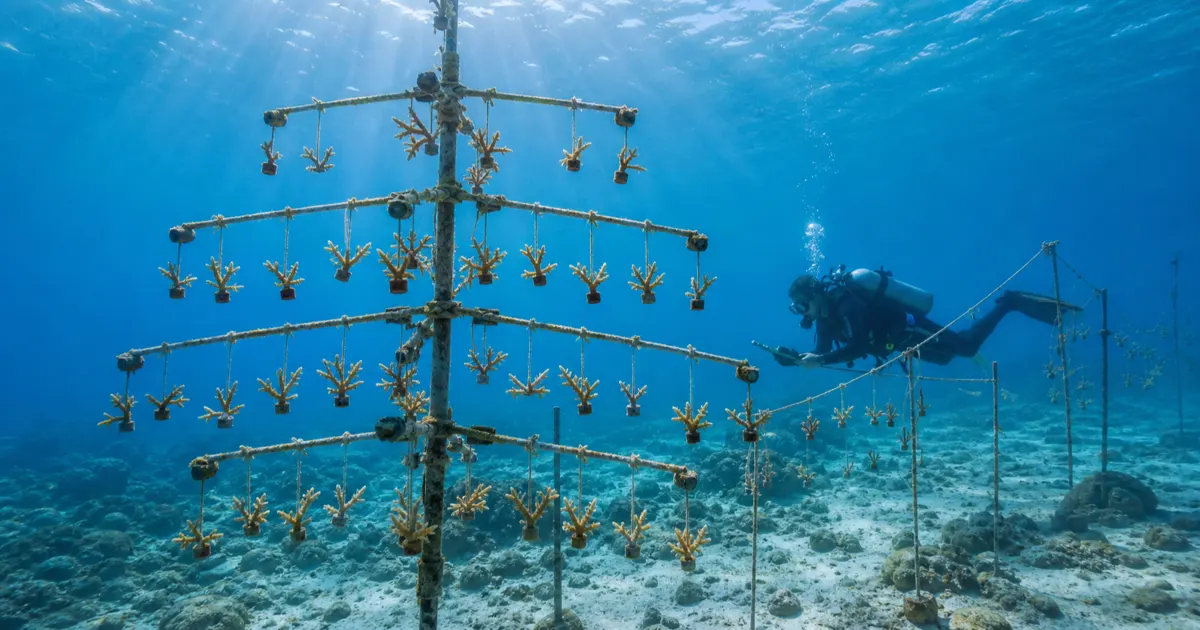
According to Fisheries Agency materials, sexual propagation requires advanced technique and staff, but its strength is that it produces genetically diverse coral seedlings of the same species without harming parent colonies. Transplanting by asexual reproduction has been pointed out to have problems such as the difficulty of obtaining large numbers of parent fragments, and the risk of producing only clones with identical genes that are vulnerable to environmental change.
Recently, repeated large-scale bleaching from high water temperatures has been reported to bring the next heat event before reefs can recover on their own. Reef recovery depends on new individuals being born and joining the population (recruitment). Larval transplanting is positioned as an attempt to boost that recruitment by human hands.
Key points of this chapter
- Corals reproduce in two ways: asexual (clones) and sexual (eggs and sperm)
- Larval transplanting uses sexual reproduction, giving genetically diverse seedlings without harming parent corals
- In return, it requires advanced technique, staff, and facilities
A Coral's Life and Its Bottlenecks: The Long Road Until Larvae Grow Up
From egg to settlement
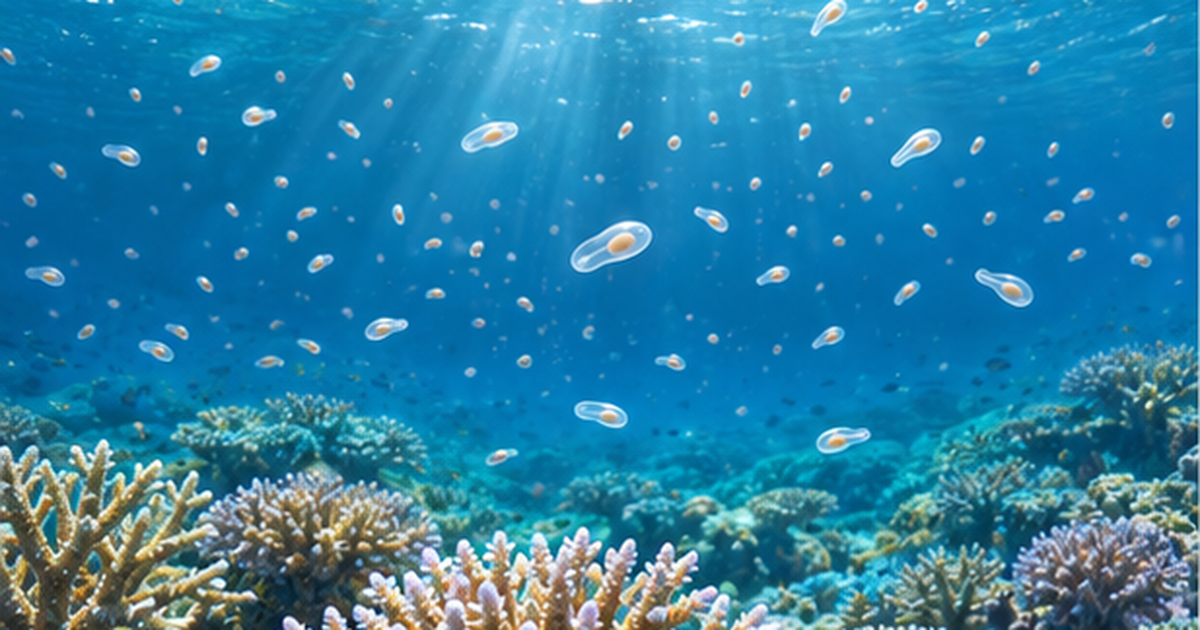
Many reef-building corals spawn all at once, once a year, at a particular time. The released egg-and-sperm packets (bundles) float to the surface, are fertilized at sea, and within days become swimming larvae (planulae). The larvae drift on currents, and when they find a suitable hard surface on the seabed they settle, metamorphose, and become tiny polyps that begin building a limestone skeleton. The mechanism of mass spawning is explained in detail in Why does coral mass spawning happen?.
- Spawning: bundles of eggs and sperm are released at set times, such as around the full moon
- Fertilization: gametes meet those of other colonies near the surface and are fertilized
- Free-swimming larval stage: larvae travel on currents for several days to weeks
- Settlement and metamorphosis: they attach to a hard base and start building a skeleton as polyps
- Growth: over several years they mature into colonies that can spawn themselves
Almost none survive in nature
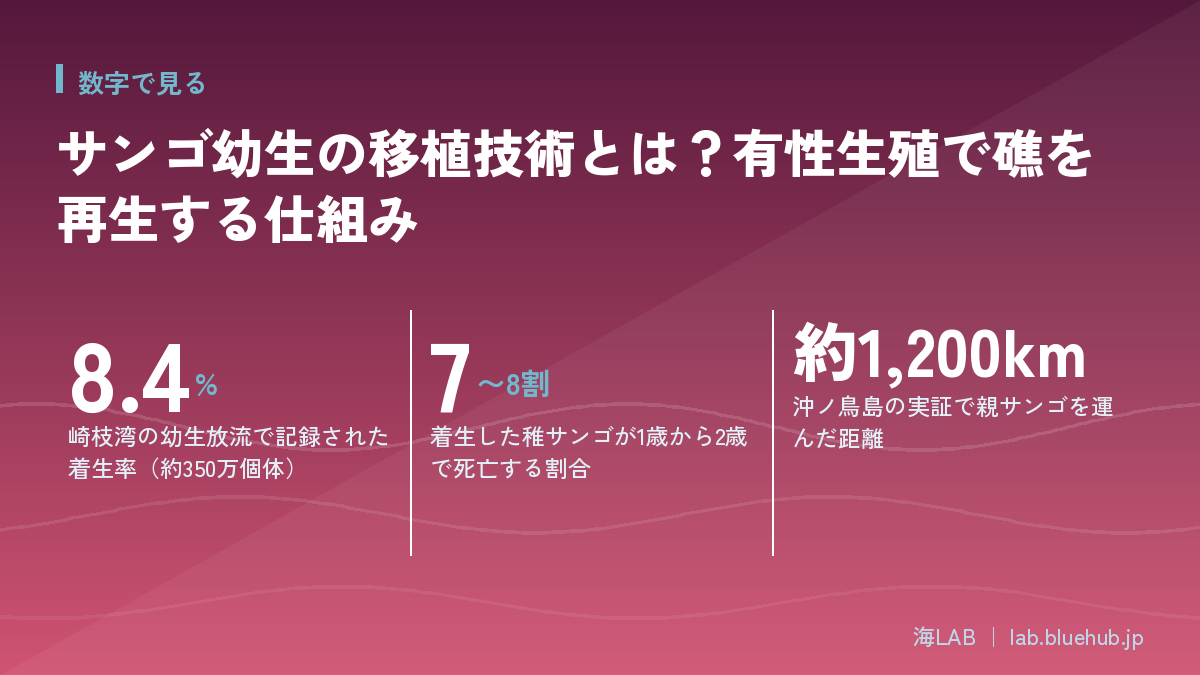
Very few individuals survive this process. A paper summarizing overseas larval restoration studies estimates that less than 0.1–0.001% of fertilized eggs settle and survive to adult size. In Japan, a report from a KAKENHI-funded study that tracked individual corals settled after mass spawning found that 70–80% died between age 1 and age 2.
| Stage | Main cause of loss | Room for human help |
|---|---|---|
| Fertilization | Gametes disperse and fail to meet | Collect eggs and sperm and fertilize them in tanks |
| Free-swimming larval stage | Predation, drift away, poor water quality | Protect in tanks and count and manage them |
| Settlement | Few suitable surfaces, or covered by algae | Provide settlement devices or substrate tiles |
| Post-settlement to year 1 | Fish grazing, sediment, competition with algae | Rear in land-based or protected waters |
Key point
The idea of larval transplanting is to "protect the earliest stage, where losses are largest, before returning corals to the sea." It helps to think of it not as increasing the number born, but as increasing the number that survive.
Japanese Techniques: Settlement Devices, Intermediate Rearing, and Area-Wide Propagation
Settlement devices and sexual-reproduction transplanting in Sekisei Lagoon
A leading example of sexual-reproduction coral transplanting in Japan is Sekisei Lagoon, Japan's largest reef area, between Ishigaki and Iriomote islands. The Ministry of the Environment began surveys for nature restoration in fiscal 2002 and ran a demonstration trial of coral community restoration by sexual reproduction in fiscal 2004. Its materials describe the method's merit as allowing transplanting "without burdening existing corals while securing species and genetic diversity of the transplanted corals."
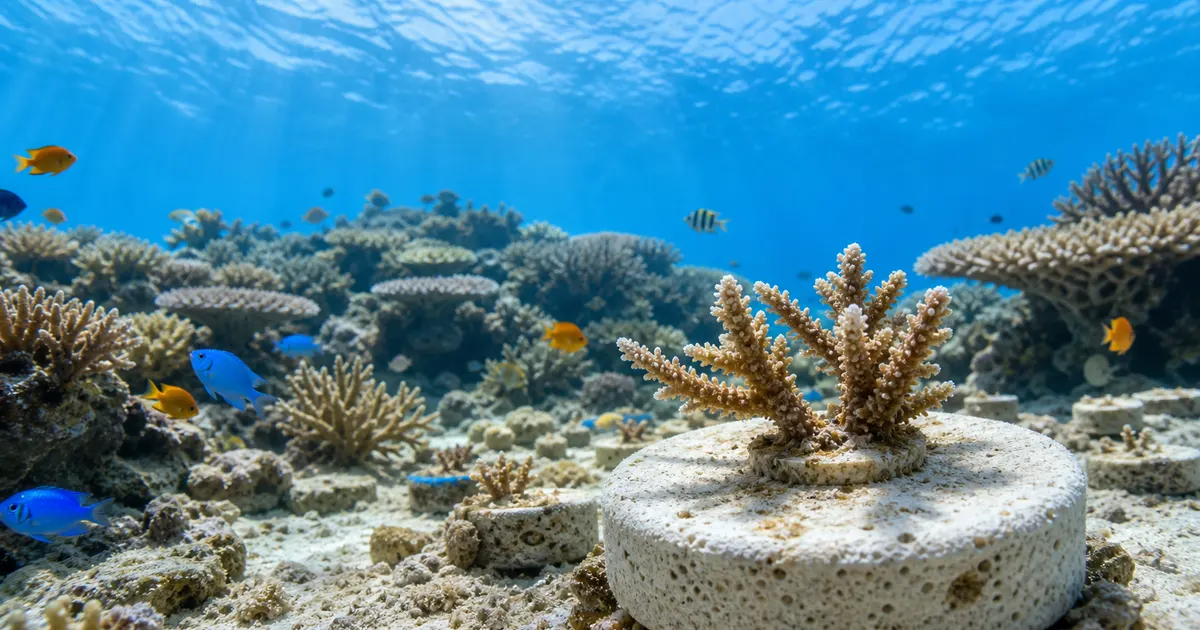
The procedure is to sink artificial substrates shaped like spinning tops, called "settlement devices," into the sea before spawning and wait for drifting larvae to settle on them naturally. After settlement, they are grown at sea, and the materials explain that devices that have reached a transplantable size about a year and a half later are selected and transplanted. The same materials also describe a project from fiscal 2005 in which about 23,000 linked settlement devices were installed.
The Fisheries Agency's "area-wide coral propagation technology"
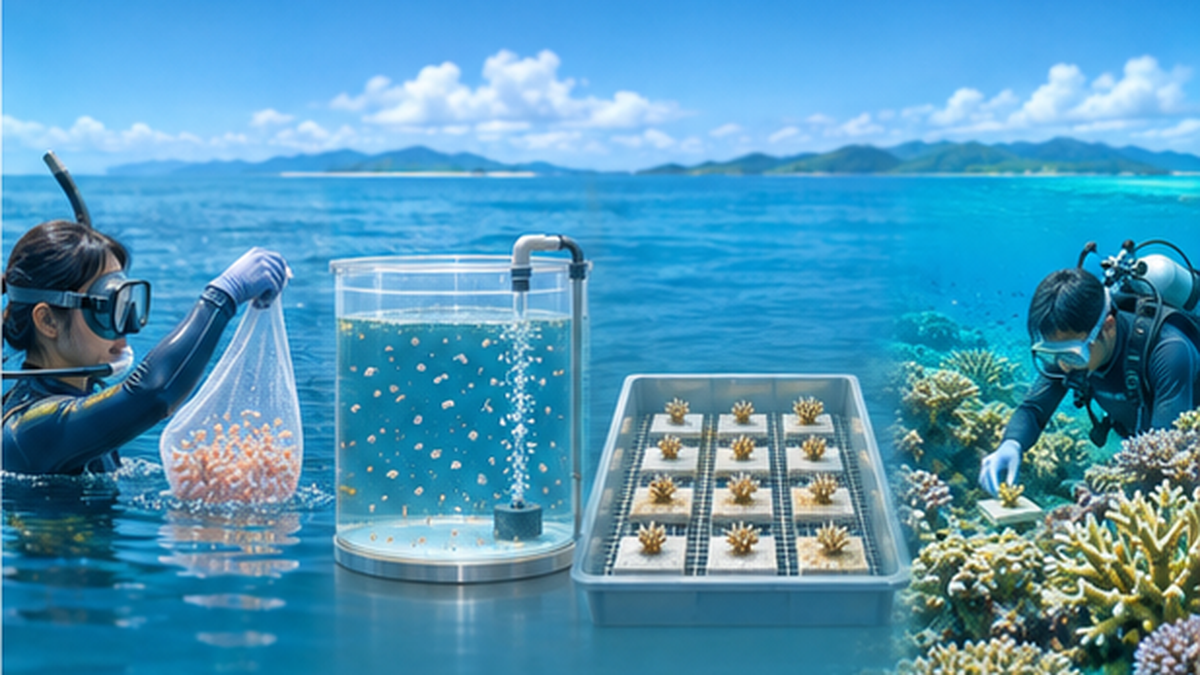
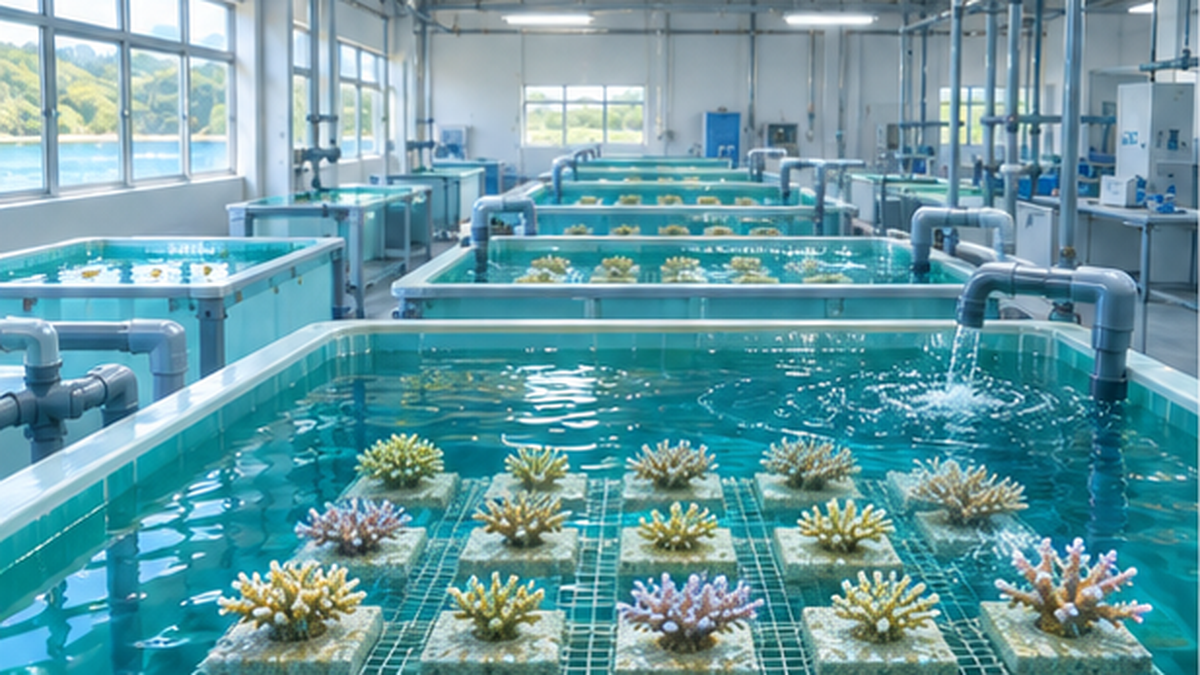
The Fisheries Agency has developed the "area-wide coral propagation technology," which mass-produces seedlings by sexual reproduction, grows them to a certain size through intermediate rearing, and plants them over a wide area. Its manual describes keeping parent corals in land-based facilities to induce spawning, and settling larvae from parent corals on settlement devices and rearing them on artificial or natural substrates to build larval supply bases.
| Method | Outline | Characteristics |
|---|---|---|
| Natural collection | Place settlement devices before spawning and let natural larvae settle | Inexpensive, but recruitment is unstable by year and place |
| Captive parent rearing | Keep parent corals in land-based facilities, induce spawning and obtain larvae | Easier to get many seedlings on schedule, but facilities and staff are needed |
| Bundle use | Collect bundles gathered at the surface and fertilize them | Uses natural spawning, and seedlings from diverse parents are easier to obtain |
In an Okinawa Prefecture report comparing the Zamami and Yomitan waters, using larvae from captive-reared parent corals and bundles was advantageous for producing many seedlings efficiently. The report also notes that natural collection makes stable seedling supply difficult in years when larval recruitment is unstable.
A New Option, Larval Release: Okinotorishima, Sakieda Bay and the Great Barrier Reef
Japan's larval release trial: Sakieda Bay
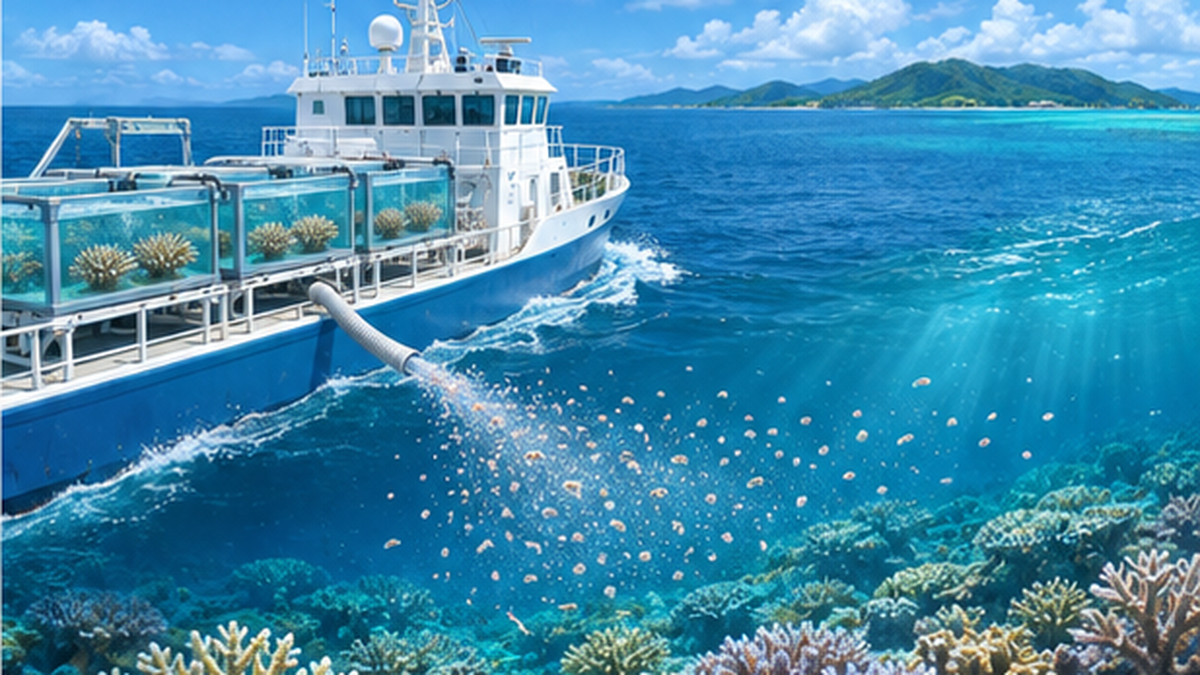
Another approach is to release large numbers of tank-reared larvae directly onto the reef without relying on settlement devices. In a fiscal 2018 Fisheries Agency trial at Sakieda Bay, Ishigaki Island, about 3.5 million coral larvae were released over 0.01 ha (100 square meters) at a release height of 1 m, and the settlement rate was 8.4%. The result shows that, with enough larvae and a suitable place, settlement can occur at a far higher rate than in natural conditions.
A remote challenge: Okinotorishima
The Fisheries Agency is also advancing a larval release trial at Okinotorishima, Japan's southernmost island. Because securing enough parent corals on site is difficult, the procedure was to transport parent corals reared in a land-based facility on Kume Island about 1,200 km, induce spawning, and release the larvae. The larvae were also held for a period (four days, according to the materials) before release. A 2025 record notes a trial in which about 200 parent colonies were carried by ship.
Project materials also point out that the short time available on site and the timing of spawning and sea conditions can make it hard to obtain large numbers of larvae. Larval transplanting does not end with "multiply in tanks and release"; it is strongly affected by field conditions such as spawning forecasts, transport and weather.
Large-scale overseas examples: larval reseeding
Peter Harrison and colleagues at Southern Cross University in Australia have advocated collecting eggs and sperm from mass spawning at sea, rearing larvae in enclosures, and releasing them onto damaged reefs, a method called "larval reseeding." Harrison has studied coral reproduction for more than 30 years and was involved in discovering mass spawning in the late 1980s. According to the university, the method has been tried at scales of up to 2,500 square meters, and small-scale trials were carried out in the southern Great Barrier Reef in 2016–2017.
In the northwestern Philippines, larvae cultured from the April 2013 spawning were released onto a degraded reef, and three years later the grown colonies were confirmed to have matured and to be spawning on their own. This matters because it shows that larvae released by people can become a self-reproducing population. However, these are mainly university and support-organization announcements, and survival figures are measured under different conditions in each source.
Japan vs. overseas
- Japan: mainly settlement devices and land-based facilities, with intermediate rearing before transplanting
- Overseas: large-scale larval reseeding, raising larvae at sea and releasing them
- Both share the aim of keeping genetic diversity through sexual reproduction
Reading the Numbers: Weighing Success and Limits Calmly
Is an 8.4% settlement rate high or low?
An 8.4% settlement rate at Sakieda Bay is a large figure compared with the extremely low natural recruitment. But settlement is a starting point, not a goal. As the tracking result of "70–80% dying between age 1 and 2" shows, many corals die after settling. Success should not be judged by settlement numbers alone; survival and growth after several years must be checked.
Where larvae are reared changes survival greatly
An Australian study reported that larval survival differed greatly, 3.8% when reared at sea versus 66.1% when reared aboard a vessel. Other studies also identify high early mortality after settlement as a challenge. In other words, even for the same larval transplanting, results vary greatly depending on where and how larvae are raised.
| Indicator | Value | Source / conditions |
|---|---|---|
| Share surviving to adult in nature | Less than 0.1–0.001% (estimate) | Overseas review of larval restoration |
| Death between age 1 and 2 | 70–80% | KAKENHI research report (corals settled after mass spawning) |
| Larval release and settlement | about 3.5 million larvae → 8.4% settlement | Fisheries Agency project, Sakieda Bay (FY2018) |
| Difference in larval survival | 3.8% reared at sea / 66.1% reared aboard a vessel | Comparative study in Australia |
Cautions when reading the numbers
The figures in the table come from separate studies with different species, places, years, and measurement methods. Read them not to compare directly "which method is better," but as a guide to which stage is difficult.
Intermediate Rearing and Genetic Diversity: Which Corals Do We Return to the Sea?
Intermediate rearing can make or break the outcome
Juvenile corals just after settlement are a few millimeters or smaller and easily die by being eaten by fish or smothered by algae and sediment. That is why intermediate rearing, which grows them to a certain size in land-based tanks or protected waters before moving them, is important. In the Fisheries Agency's area-wide propagation technology as well, intermediate rearing is a central step between seedling production and transplanting.
Combining this with asexual nursery farming is also an idea. Branch-based methods grow fast but tend to be genetically biased, so using techniques such as those covered in Coral Nursery Farming and Transplanting: Everything You Need to Know alongside seedlings from sexual reproduction is a realistic choice.
Genetic diversity and heat-tolerant individuals
A major strength of sexual reproduction is that it produces offspring that mix genes from different parents. A diverse population may contain individuals that tolerate high temperatures, which can prepare reefs for future bleaching. Selection and breeding of heat-tolerant individuals are introduced in Can We Make Heat-Tolerant Corals?, and the mechanism of bleaching itself is covered in Why Does Coral Bleaching Happen?.
Approaches considered in the field
- Choose parent corals from several colonies, not just one
- Acclimate the rearing environment to conditions close to the transplant site
- Choose transplant sites with little algae where larvae are less likely to flow away
Challenges and Risks: Cost, Labor, and the Problem of "Planting but Failing to Protect"
Barriers of technique, staff, and facilities
As Fisheries Agency materials state, sexual propagation requires advanced technique and staff. Spawning happens once a year and its date shifts, so preparation and work must be completed in a short period. The need for tanks, water-quality control, and transport equipment is also a reason small organizations and communities find it hard to take part.
Transplanting is meaningless if the environment is poor
Another major challenge is the transplant site. Fisheries Agency materials include the observation that for direct transplanting carried out in various places since the 1990s, there are cases in which almost no recovery has been seen. As long as red-soil runoff, poor water quality, crown-of-thorns starfish, and high water temperatures continue, a reef cannot be maintained no matter how many larvae or juveniles are produced. For threats to Okinawa's reefs, see Protecting the Coral Reefs of Okinawa and the Southwest Islands.
- Cost: facilities, labor, and transport are expensive, making it hard to scale over wide areas
- Time: it takes years from settlement to maturity, so evaluating results also takes long
- Environmental factors: causes of post-transplant death such as bleaching, grazing, and sediment cannot be removed
- Ecosystem impact: bringing in individuals from other areas requires care about genetic disturbance
Larval transplanting is not a cure-all
- The root cause, rising sea temperature, cannot be solved by transplanting alone. It must proceed alongside cutting greenhouse gases and reducing pollution from land.
The Future of Larval Transplanting, and What We Can Do
Three directions of ongoing research
- Efficiency: save labor in rearing and settling larvae, and increase the number handled at once
- Securing diversity: produce larvae from many parents and grow populations that include heat-tolerant individuals
- Field verification: track survival and maturity after transplanting over the long term and standardize criteria for success
A University of the Ryukyus research team has reported that coral populations around 20 m depth may serve as a "stepping stone" supplying larvae to shallow reefs. Beyond building reefs by transplanting, protecting the natural flow (network) of larvae will also become important in future conservation.
What we can do
- When visiting coral reefs, be mindful of your choice of sunscreen and avoid touching corals
- Learn about and join local efforts to reduce red-soil runoff and wastewater flowing into the sea
- Support the work of groups and municipalities restoring corals through donations or visits
- Rethink everyday electricity use and connect it to curbing sea-temperature rise
An overview of coral restoration technology as a whole is in What Is Coral Reef Restoration Technology?. Larval transplanting will likely be used together with other methods as a technique that supports corals from the stage of birth.
Summary
- Corals reproduce by asexual and sexual reproduction, and larval transplanting uses the latter
- In nature very few survive to adulthood, so protecting the early stages is key
- In Japan, settlement devices, land-based facilities, and larval release are being tested. At Sakieda Bay about 3.5 million larvae gave an 8.4% settlement rate
- The challenges are technique, cost, and the transplant environment. Efforts must go together with fundamental environmental measures
References and Sources
- Fisheries Agency: Coral Propagation Manual (Sexual Reproduction) – Area-wide coral propagation technology
- Fisheries Agency: Coral Propagation Manual, Chapter 3 – Coral propagation methods
- Ministry of the Environment: Sekisei Lagoon Nature Restoration – Demonstration of sexual reproduction using settlement devices
- Ministry of the Environment: Sekisei Lagoon Coral Community Restoration Project Materials – Sexual-reproduction transplanting with settlement devices
- Ministry of the Environment: Council Materials (Coral Transplanting) – Shift from clone transplanting to juvenile coral transplanting
- Southern Cross University: Restoring coral reefs through mass larval restoration – Larval reseeding
- Frontiers in Marine Science (2021) – Increased recruitment from larval supply and post-settlement mortality
- University of the Ryukyus, Tropical Biosphere Research Center (2022) – Deep-reef corals and larval supply to shallow reefs
* Listed in order of reliability: government agencies and academic institutions > peer-reviewed papers > specialist organizations > reliable media