⚡ In short
Global aquaculture accounts for about 0.49% of greenhouse gas emissions, and 57% of that comes from producing and transporting feed. From insect and algae feeds to AI feeding, energy-saving land-based farms, renewables, and "unfed" bivalves and seaweed, we map the path to sustainable fish farming with data.
The salmon, yellowtail, sea bream, and oysters on supermarket shelves are now mostly "farmed fish" rather than "caught fish." In 2022, global aquaculture production surpassed wild capture for the first time in history. With population growth and the limits of wild stocks, farming is becoming the backbone of seafood supply. Behind it, however, greenhouse gases are emitted through feed manufacturing and transport, the electricity that runs equipment, and fuel for workboats.
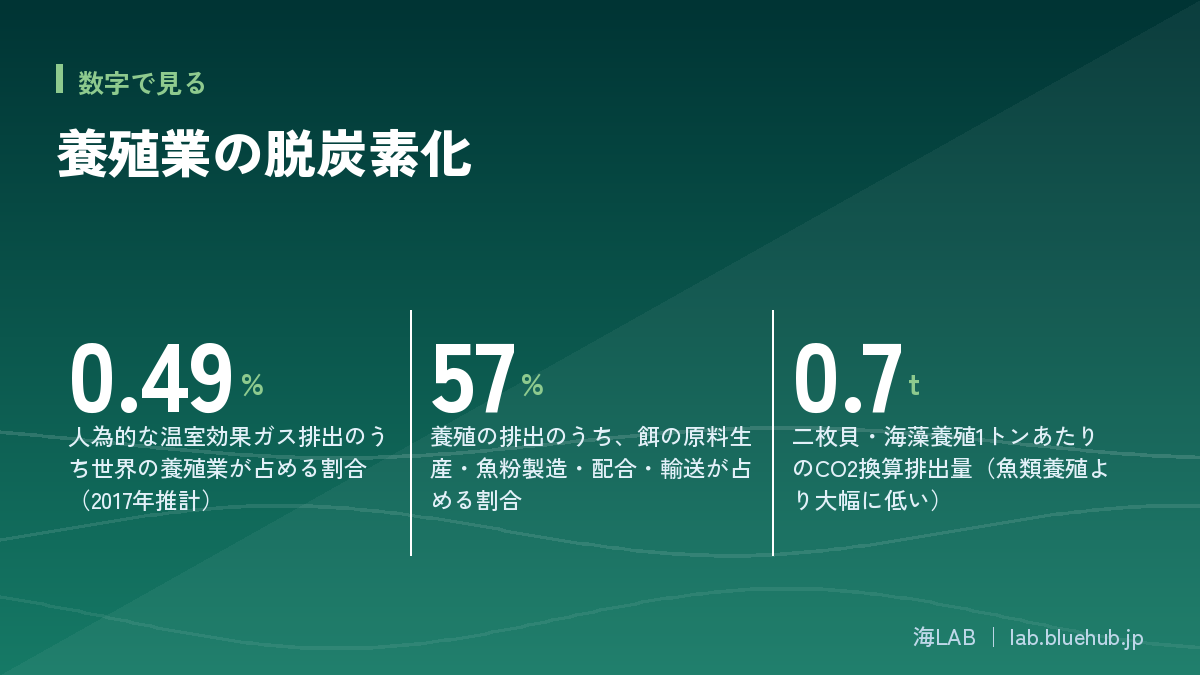
According to an estimate published by a UK research team in 2020, global aquaculture accounts for about 0.49% of human-caused greenhouse gas emissions, and 57% of that comes from feed. That is small compared with cattle or pigs, but aquaculture output is set to keep growing, and "how we farm" now shapes emissions on a planetary scale.
This article checks the numbers on where aquaculture's CO2 comes from, then looks at feed transitions, on-site energy savings at sea-cage farms, electricity strategies for land-based farms, the low-carbon option of bivalves and seaweed, and the national strategies and international certifications driving change. Read it alongside our article on the environmental impacts of aquaculture on the ocean for a full picture of the challenges and possibilities.
What you'll learn in this article
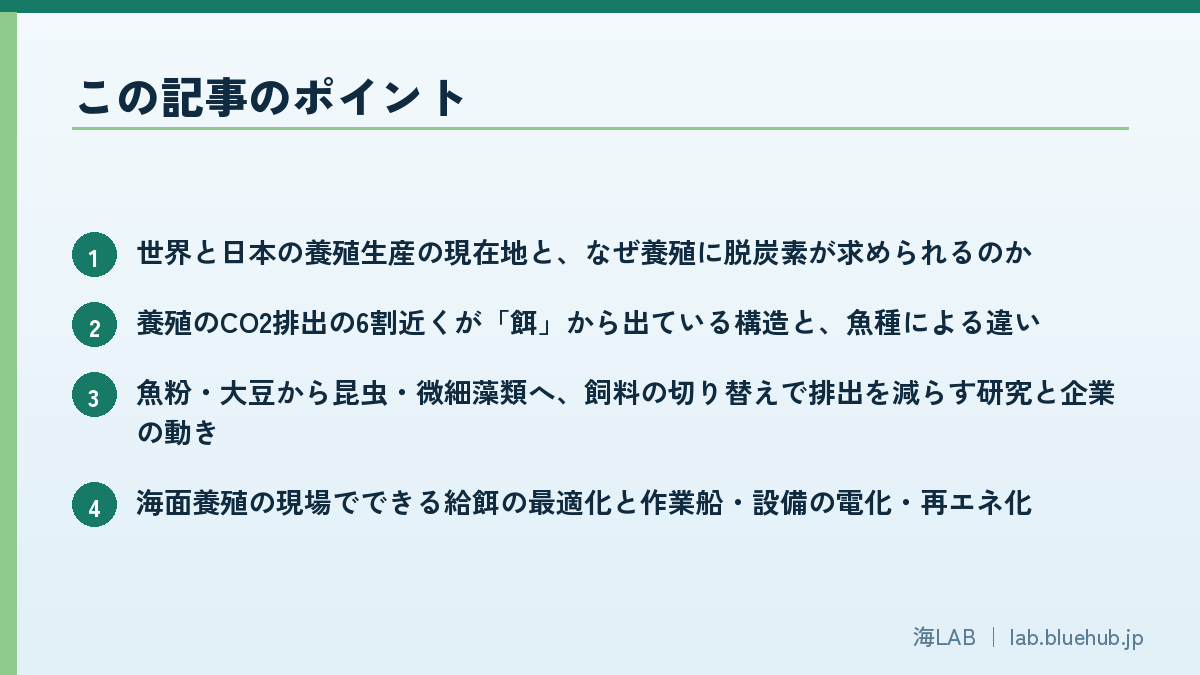
- Where global and Japanese aquaculture stand today, and why fish farming is being asked to decarbonize
- Why nearly 60% of aquaculture's CO2 comes from feed, and how the burden differs by species
- Research and corporate moves to cut emissions by shifting feed from fishmeal and soy to insects and microalgae
- What sea-cage farms can do on site: optimized feeding, electrified workboats, and renewable power
- The electricity wall facing land-based recirculating farms (RAS), and how spring water, waste heat, and on-site generation help
- The strengths of "unfed" farming such as bivalves and seaweed, and the claims that should not be overstated
Aquaculture Is No Longer a Sideshow to Fishing
According to "The State of World Fisheries and Aquaculture 2024," released by the Food and Agriculture Organization of the United Nations (FAO) in June 2024, total global fisheries and aquaculture production reached 223.2 million tonnes in 2022. Aquaculture accounted for 130.9 million tonnes, and even excluding seaweed, farmed aquatic animals reached 94.4 million tonnes. That is 51% of all aquatic animal production, making 2022 the historic year when farming first overtook wild capture (92.3 million tonnes).
Asia Produces 90% of the World's Farmed Seafood
By region, Asia accounts for 91.4% of aquaculture output, followed by Latin America and the Caribbean at 3.3%, Europe at 2.7%, and Africa at 1.9%. This reflects the expansion of carp, shrimp, and tilapia farming led by China, along with India, Indonesia, and Vietnam. Any discussion of decarbonizing global aquaculture must therefore start with Asia's inland fish farms and shrimp ponds.
Why Aquaculture Keeps Growing
Global wild capture has been roughly flat since the late 1980s. Ocean resources are finite, and catches are already close to their ceiling. Meanwhile the world's population keeps growing, and per-capita seafood consumption has more than doubled since the 1960s. Aquaculture has filled that gap. FAO projects further growth in farmed production toward 2032, and whether that growth can be achieved "without increasing environmental burden" sits at the heart of the decarbonization challenge.
Japan's Marine Aquaculture Yields 800,000 Tonnes a Year
Turning to Japan, the Ministry of Agriculture, Forestry and Fisheries' 2024 Fisheries and Aquaculture Production Statistics put marine aquaculture harvest at 801,200 tonnes, down 5.9% from the previous year. Key products include finfish such as yellowtail, red sea bream, and coho salmon, alongside shellfish and seaweed such as oysters, scallops, nori, and wakame. The scale is small by global standards, but as wild catches decline over the long term, aquaculture's share of Japan's seafood supply grows every year.
| Category | Production (2022, world) | Notes |
|---|---|---|
| Aquaculture (aquatic animals) | 94.4 million t | 51% of aquatic animal production; overtook capture for the first time |
| Aquaculture (total incl. seaweed) | 130.9 million t | Seaweed mainly for food and industrial use |
| Wild capture | 92.3 million t | 81 million t marine, 11.3 million t inland |
| Japan's marine aquaculture | 801,200 t (2024) | Down 5.9% year on year (MAFF) |
Why "Decarbonizing Aquaculture" Matters
Aquaculture has been seen as a way to supply protein reliably without depleting wild stocks. But "growing" fish requires a chain of steps: making feed, transporting it, circulating water, supplying oxygen, and shipping the harvest, each of which consumes energy. FAO promotes the sustainable expansion of aquaculture under the banner of "Blue Transformation" while urging countries to shift to lower-impact production. Precisely because farming has become the mainstay of seafood supply, how it cuts its greenhouse gases has come into question.
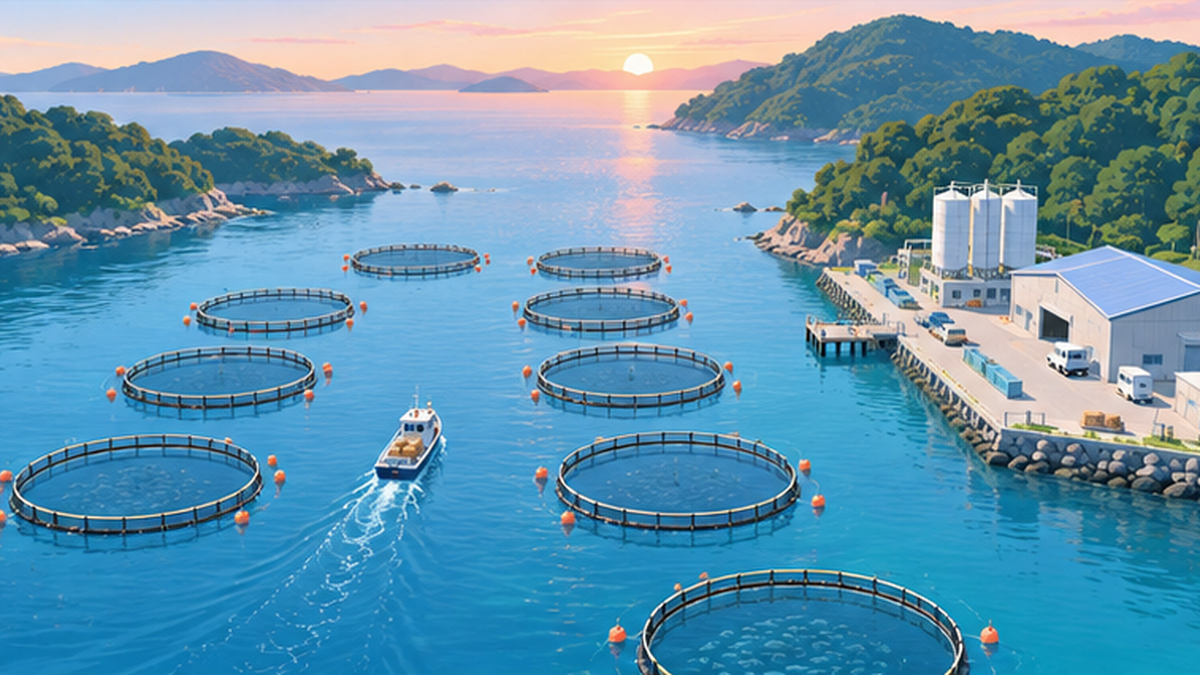
Where Does Aquaculture's CO2 Come From?
The first systematic global estimate of aquaculture's greenhouse gases came from a 2020 study led by MacLeod at Scotland's Rural College (SRUC), published in the journal Scientific Reports. Its distinguishing feature was building up emissions by major species group and region based on the actual composition of commercial compound feeds.
0.49% of Global Human-Caused Emissions
The study estimated that in 2017, global aquaculture (excluding aquatic plants) emitted greenhouse gases equal to roughly 0.49% of all human-caused emissions, a scale comparable to global sheep production. That is an order of magnitude smaller than cattle, which underpins the claim that fish is a more climate-friendly protein than livestock. But farmed output is expected to keep rising, and without action, emissions will rise in step.
57% of Emissions Come from Feed
The most striking finding was the breakdown of sources. Production of feed crops alone (soy, corn, wheat, and so on) accounts for 39% of aquaculture's greenhouse gases. Add fishmeal and fish oil manufacturing, blending at feed mills, and feed transport, and feed-related emissions reach 57%. In other words, nearly 60% of aquaculture's CO2 comes not from the cages where fish swim, but from the fields, factories, trucks, and ships that make and move their feed.
The Emissions Burden Varies Widely by Species
By species, the ratio of production to emissions is far from uniform. Cyprinids (carp family) make up 31% of world aquaculture output and 31% of emissions, a balanced share. Shrimp, by contrast, account for just 10% of production but 21% of emissions, driven by methane and nitrous oxide released from organic matter accumulating on pond bottoms and by the loss of mangrove forests to pond construction. Bivalves show the opposite pattern: 21% of production but only 7% of emissions, because they need no feed and grow by filtering plankton from the water.
| Species group | Share of world aquaculture production | Share of emissions |
|---|---|---|
| Cyprinids (carp) | 31% | 31% |
| Shrimp | 10% | 21% |
| Bivalves | 21% | 7% |
Beyond CO2: Emissions from the Pond Itself
Greenhouse gases from aquaculture are not only CO2. In inland and shrimp ponds, uneaten feed and waste sinking to the bottom decompose in oxygen-poor mud and release methane, while nitrogen-rich effluent releases nitrous oxide. Both are far more potent than CO2, and they are one reason shrimp's emissions share is twice its production share. Research across Asia is now exploring regular removal of bottom sludge and combining fish, shrimp, bivalves, and seaweed in the same pond to cycle nutrients and curb methane.
Three Entry Points for Cutting Aquaculture Emissions
- Feed: rethink the fishmeal and soy ratio, reduce uneaten feed, and shorten ingredient transport distances
- Energy: make pumps, blowers, and heating and cooling more efficient, and switch to renewables
- Species: raise the share of unfed bivalves and seaweed, and of species with high feed efficiency
Changing the Feed: From Fishmeal and Soy to Insects and Algae
How to change feed, which accounts for nearly 60% of emissions, is the central challenge of decarbonizing aquaculture. Feed is also the largest cost in the business. According to the Fisheries Agency's 2024 White Paper on Fisheries, feed makes up more than 60% of costs in finfish farming, and compound feed prices, pushed by a weak yen and reduced anchoveta catches in Peru, rose to about 260,000 yen per tonne in November 2023. Decarbonization and business stability overlap at a single point: rethinking feed.
Low-Fishmeal Feeds to Reduce Dependence
Japan's yellowtail and red sea bream farms have long relied on fishmeal-based compound feeds. Fishmeal is made from small pelagic fish caught off Peru and Chile, so it carries transport emissions from South America and the instability of weather-dependent catches. Research by the Japan Fisheries Research and Education Agency and others has shown that yellowtail feed with fishmeal cut to 30%, supplemented with soybean meal and corn gluten meal, delivers growth performance little different from fishmeal-based feed. For red sea bream, fishmeal-free feeds using concentrated soy protein have produced juvenile growth on par with fishmeal and fish oil diets.
FIFO: How Much Fish It Takes to Grow a Fish
One measure of feed sustainability is FIFO (fish in, fish out): the kilograms of wild forage fish, used as fishmeal and fish oil, needed to produce one kilogram of farmed fish. A value above 1 means more fish is taken from the sea than is grown. Carnivorous species such as yellowtail and tuna have inherently high FIFO, and lowering fishmeal content brings that number down. The more a farm depends on fishmeal, the longer its emissions chain: fuel for the vessels that catch forage fish, the drying process at fishmeal plants, and shipping from South America to Japan. Cutting FIFO helps both resource protection and decarbonization.
Returning Domestic Processing Byproducts to Feed
Another route to reducing imported fishmeal is fishmeal made from fish byproducts generated in Japan. Most of the heads, bones, and viscera from seafood processing plants already go to fishmeal factories for feed and fertilizer. If byproducts generated near a port are turned into fishmeal at a nearby plant and used by nearby farms, transport distances shrink by orders of magnitude compared with shipping from South America. Turning seafood processing residues into fishmeal and fish oil is both a food loss measure and a regional circular system that directly decarbonizes feed.
Soy Has Its Own Pitfall: Deforestation
Replacing fishmeal with soy is not a cure-all. In South America, soybean expansion has a history of converting forests and grasslands, and once land-use change is included, soy protein's climate burden is far from small. Norway's salmon industry has been reducing the share of South American soy protein in feed and substituting crop proteins with lower climate intensity precisely to avoid this land-use problem. The question is not only "what to cut" but "what to replace it with."
Proving Fishmeal-Free, Fish-Oil-Free Feed with Insects and Microalgae
Insects and microalgae are the next-generation ingredients under study. In April 2024, the Japan Fisheries Research and Education Agency announced it had raised red sea bream at growth rates comparable to fishmeal diets using a feed with no fishmeal or fish oil, based on black soldier fly larvae meal and the microalga Aurantiochytrium. Conducted under the Cabinet Office's Moonshot Research and Development Program, the work showed that insects can be multiplied quickly on food waste and that microalgae can synthesize fatty acids such as DHA found in fish oil. It marks a path out of the paradigm of catching fish to grow fish.
Japanese Companies Take On Insect Feed
Companies are moving too. Dai Nippon Printing (DNP) has begun joint development with Ehime University of automated rearing equipment for mealworms as feed for farmed fish, aiming to replace fishmeal with domestically produced insect protein. Booon Inc., a startup from Nagasaki University, is developing "Worm Pod," a low-cost, low-impact system for producing mealworm feed ingredients, and is running trials with a local poultry cooperative using composted chicken manure. Both are still at the demonstration stage, but the idea of "cycling feed ingredients within the region" also makes sense for cutting transport emissions.
Main Feed Ingredient Options and Their Climate Profiles
- Fishmeal and fish oil: high nutritional value, but carry South American shipping and catch-volatility risks
- Soy and corn: stable supply, but large land-use emissions where production involves forest conversion
- Insects (black soldier fly, mealworm): grow on food waste and can be produced locally; mass production is the hurdle
- Microalgae: can synthesize DHA and other fatty acids, promising as a fish oil substitute; lowering culture costs is key
- Fishmeal from processing byproducts: using domestic fish trimmings as feedstock dramatically shortens transport distances
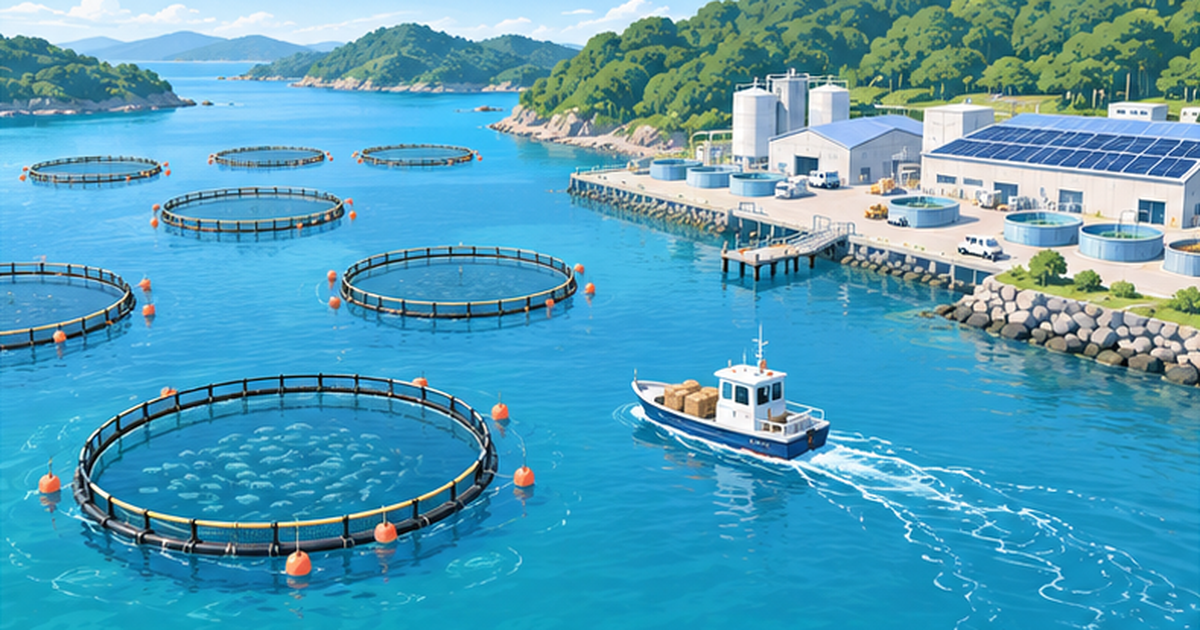
What Sea-Cage Farms Can Do on Site
Just as effective as changing what is in the feed is "not wasting feed." Pellets the fish do not eat sink to the seabed as uneaten feed. The feed produced at the cost of emissions is simply lost, and the organic load on the seabed also degrades water quality.
AI Feeding to Cut Uneaten Feed
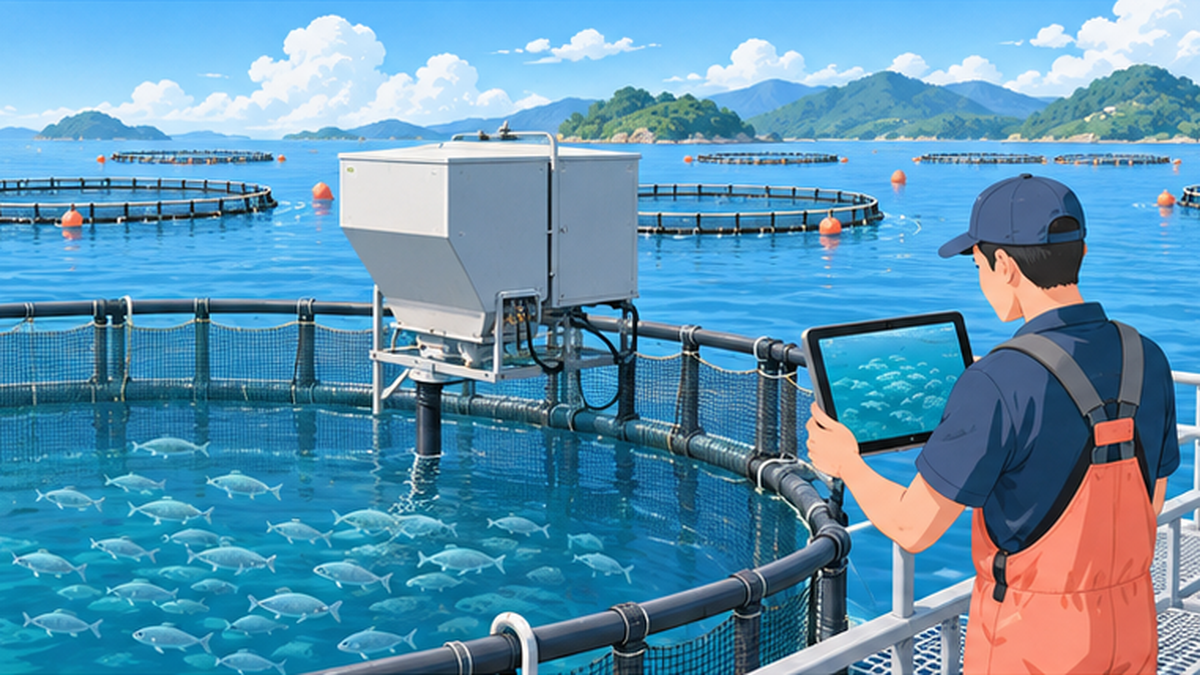
Feeders that use underwater cameras and AI to gauge fish appetite and automatically adjust the amount and timing of feed have begun to spread. AI feeders such as UMITRON's "UMITRON CELL" are in commercial use at yellowtail farms in Nagashima, Kagoshima Prefecture, allowing feeding to be managed remotely from a smartphone. The Fisheries Agency also supports the adoption of ICT-based feeding and husbandry systems under its "smart fisheries" policy. Less uneaten feed means lower feed costs and lower emissions from producing that feed. See our separate article on the state of smart fisheries.
A 10% Gain in Feed Efficiency Cuts Emissions by Nearly 10%
A key farm metric is the feed conversion ratio (FCR): the kilograms of feed needed to add one kilogram of fish weight, with lower being better. Since nearly 60% of emissions come from feed, improving FCR translates directly into emissions cuts. Beyond feeding management that eliminates waste, steady production techniques push feed efficiency up: designing pellet size and composition to match fish digestion, choosing sites with suitable water temperature and current, and husbandry that prevents disease and lowers mortality. It is unglamorous, but one of the most reliable ways to decarbonize aquaculture.
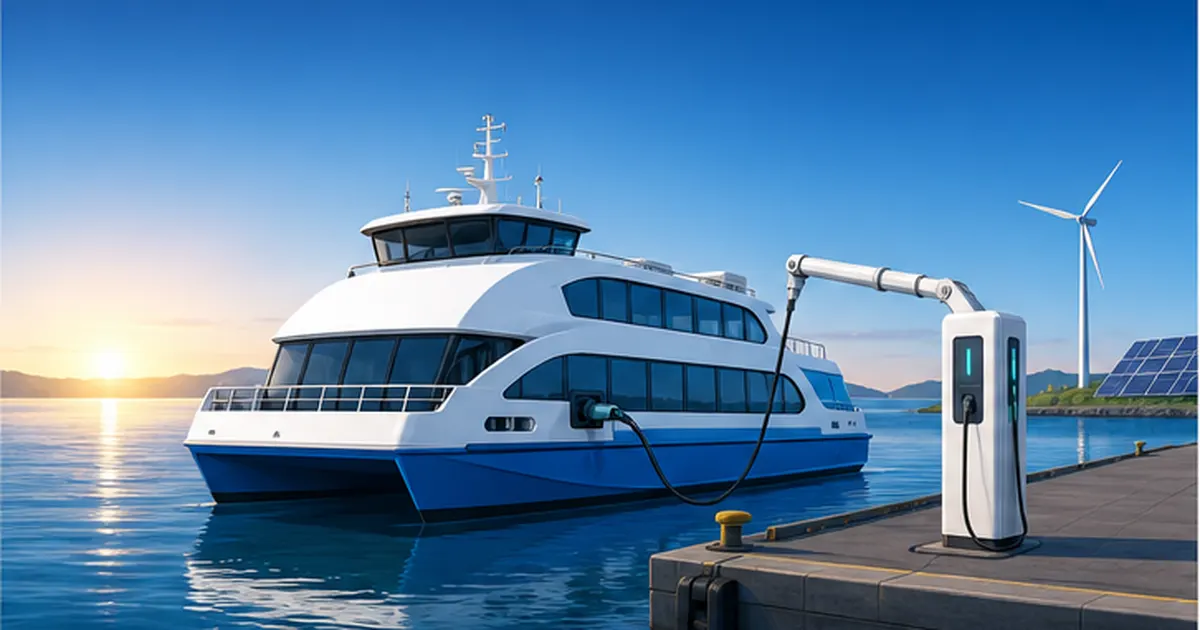
Electrifying Workboats and Equipment
At sea-cage farms, feed boats and workboats shuttle to the cages almost daily. Most run on diesel, and their fuel accounts for part of the emissions. In the Norwegian research institute SINTEF's analysis of salmon farming's climate footprint, electrification of grow-out farms is listed among the main reduction measures alongside changes in feed composition and distribution routes. In Japan, establishing technologies for electric and hydrogen-powered fishing vessels is under study within the Strategy for Sustainable Food Systems (MIDORI), and aquaculture workboats fall within the same trend. The technologies behind low-carbon fishing vessels can be applied to boats at fish farms as well.
Self-Consumed Solar Power
Pairing solar panels with feed warehouses, processing plants, and pump equipment on shore is also spreading. The Ministry of Agriculture, Forestry and Fisheries publishes case studies of renewable energy in farming and fishing communities, and self-consumption of electricity generated at ports and seafood facilities is advancing nationwide. Facilities that draw power around the clock, such as land-based farms, can use a high share of what they generate rather than selling it, so renewables pay off quickly.
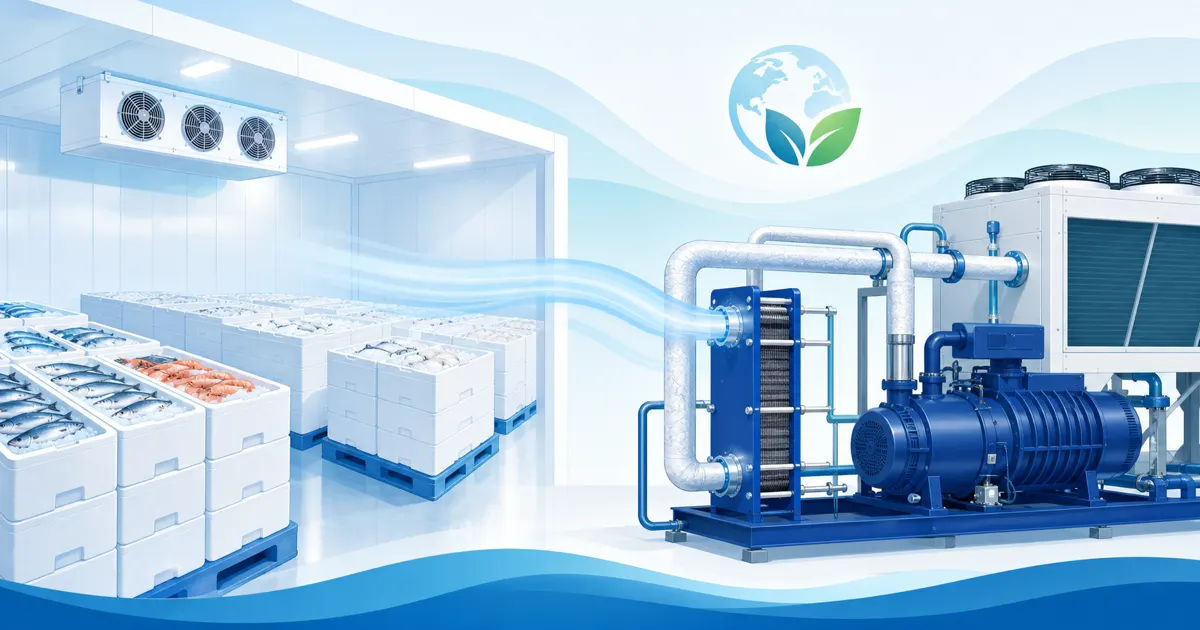
Do Not Overlook Post-Harvest Distribution
In SINTEF's analysis, Norwegian farmed salmon emits 3.8 kg CO2-equivalent per kilogram of live fish at the farm gate, but depending on transport mode and distance to market, that ranges from 4.8 kg to 28 kg per kilogram of edible product. Air freight to Asia sends emissions soaring, while sea freight or delivery to nearby markets keeps them down. Decarbonizing aquaculture cannot be separated from choices about the seafood cold chain and transport beyond the cage.
The same applies to Japan. Shipping farmed yellowtail or sea bream to the domestic market versus exporting it iced by air produces emissions that differ several-fold for the same fish by the time it reaches the consumer. Choosing sea freight or refrigerated container shipping when expanding exports trades some freshness for a large cut in emissions. Seeing the chain from farm to table as a whole is essential to decarbonizing aquaculture.
Land-Based Farming Is a Battle over Electricity
Land-based aquaculture, especially recirculating aquaculture systems (RAS) that filter and reuse water, has drawn attention as a trump card for sustainable farming: no escapes, no eutrophication of the sea, and the ability to build near consumers. According to the Nikkei, registered land-based farms in Japan reached 808 as of January 1, 2026, and shipments in fiscal 2024 totaled 6,907 tonnes.
About 7 kWh per Kilogram, with Pumps Nearly Half the Load
But land-based farming carries a burden sea cages do not: electricity. In RAS, circulation pumps, oxygenation equipment, heating and cooling to hold water temperature, and filter cleaning all run around the clock. Studies of Atlantic salmon RAS put electricity at about 7 kWh per kilogram of fish, with pumps alone taking around 45% of total energy and temperature control about a third. A life cycle assessment of salmon RAS in China found that with fossil-fuel electricity, emissions were 7.01 tonnes CO2-equivalent per tonne of fish, double the 3.39 tonnes of open net-pen farming.
| Farming method | Emissions (per tonne of fish, CO2e) | Main sources |
|---|---|---|
| Open net pen (salmon) | About 3.4 t | Feed, workboat fuel |
| Land-based RAS, fossil power (salmon) | About 7.0 t | Feed, pump and climate-control electricity |
| Land-based RAS, renewable power | Greatly reduced depending on the grid mix | Feed becomes the main source |
Change the Power Source and the Result Flips
These numbers do not mean land-based farming is bad for the environment. Because almost all of the added emissions come from electricity, switching to renewables could bring RAS down to the level of sea cages or below. A life cycle assessment of warmwater fish RAS in Sweden reported that with a grid high in renewables, recirculating farming works without a major energy penalty. Decarbonizing land-based farms therefore runs on two tracks: equipment efficiency and a clean power supply.
Design Essentials for Energy-Efficient Land-Based Farms
- Reduce pump head: minimizing the height difference between tanks and filters cuts the distance water must be lifted, and electricity falls sharply
- Cut pipe resistance: wide, short, straight piping and clog-resistant filter media move the same flow with less power
- Do not "make" temperature: using groundwater, spring water, or warm effluent already near the target temperature limits climate-control electricity
- Recover heat: transfer heat from outgoing water to incoming water with exchangers and improve building insulation
- Inverter control: throttle pumps and blowers to match fish growth stage and time of day instead of running at full power constantly
Modern RAS facilities that stack these design measures have reported electricity per kilogram of fish far below older designs. Land-based farming is not fated to "consume huge amounts of electricity"; it is a technology whose results vary several-fold with design and power choices.
Salmon Farmed with Mount Fuji Spring Water
Japan's flagship example is the large Atlantic salmon land-based farm in Oyama, Shizuoka Prefecture, operated by the Norwegian company Proximar Seafood. Groundwater from the foot of Mount Fuji supplies all its farming water, and salmon raised in its closed recirculating system is sold as "FUJI ATLANTIC SALMON" through Marubeni. First shipments began in September 2024; the farm supplied 1,338 tonnes in 2025, forecasts 3,500 to 4,000 tonnes for 2026, and ultimately targets 5,300 tonnes. Because the fish are raised in Japan and delivered by road, the emissions of air freight from Norway are avoided. The groundwater also holds a stable temperature year-round, reducing electricity for heating and cooling.
Using Idle Power Plant Land and Waste Heat
Electric utilities are entering land-based farming as well. Building on idle land at power plants, with access to low-loss electricity and warm cooling water, can address land-based farming's weak points of power cost and emissions at once. Kyushu Electric Power's salmon farm on idle land at a thermal power plant in Fukuoka Prefecture is one example. The Japan Fisheries Research and Education Agency has also mapped the temperature-management and energy-efficiency challenges through its land-based farming demonstrations. Combining "the heat and water available on site," whether industrial waste heat, hot spring heat, or groundwater, is the practical answer to energy savings in land-based farming.
The Option of "Farming Without Feed"
If nearly 60% of aquaculture emissions come from feed, then farming that needs no feed at all is the most powerful decarbonization tool. Bivalves (oysters, scallops, mussels) and seaweed (nori, wakame, kelp) grow by taking up plankton and nutrients from the water, requiring no fields, factories, or transport to make feed.
Bivalves and Seaweed: 0.7 Tonnes per Tonne
The Blue Food Assessment, a series of studies published in the journal Nature in 2021, standardized environmental impacts across 23 species groups and found that farmed bivalves and seaweed are the lowest-emitting seafood, at roughly 0.7 tonnes CO2-equivalent per tonne of live weight. Even for the same bivalves, wild harvest by vessel burns fuel and emits 3.4 tonnes per tonne, so farming emits less. Given that Japan's marine aquaculture is dominated by oysters, scallops, nori, and wakame, the country's aquaculture already includes many low-carbon products.
Shellfish and Seaweed Dominate Japan's Marine Aquaculture
Within Japan's 800,000 tonnes of marine aquaculture, shellfish and seaweed account for a large share: oysters from Hiroshima and Miyagi, scallops from Hokkaido and Aomori, nori from the Ariake Sea and Seto Inland Sea, and wakame from Sanriku. They receive less attention than finfish, but they need no feed, their facilities are mostly rafts and ropes, and power use is limited mainly to harvesting and processing. By its very production structure, Japanese aquaculture contains many products that are low-carbon by global standards. The recovery of oyster farming after the earthquake and the expansion of seaweed farming combined with measures against barren seabeds are investments that matter for both regional economies and the climate.
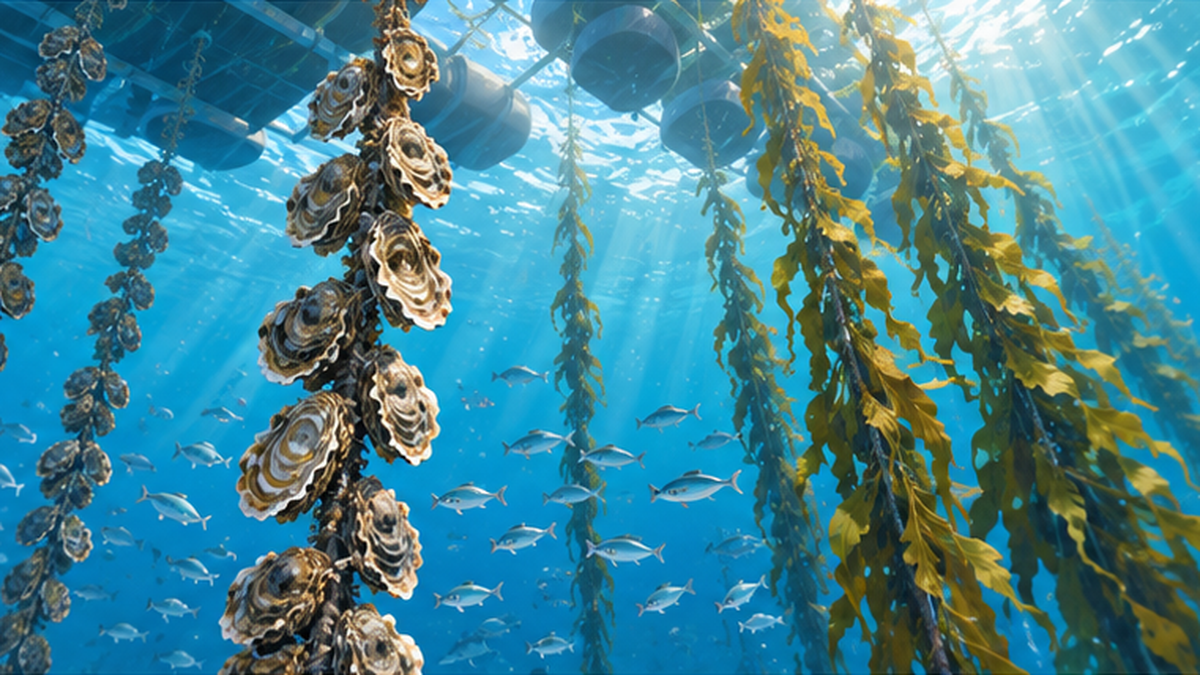
IMTA: Growing Fish with Shellfish and Seaweed
A method under study for directly cutting finfish emissions is integrated multi-trophic aquaculture (IMTA). Bivalves and seaweed are placed around fish cages to absorb nutrients from fish waste and uneaten feed, maintaining water quality while raising output per cage. The 2022 review "Climate-Friendly Seafood" in the journal BioScience positions expanded seaweed and bivalve farming and integrated systems as promising ways to cut emissions and capture carbon in marine aquaculture. See our separate article on the role of seaweed farming in ocean recovery.
Why You Cannot Simply Call It "Carbon-Reducing Farming"
Caution is needed, however, before promoting bivalve or seaweed farming as "a business that absorbs CO2." Seaweed takes up CO2 as it grows, but once harvested and eaten, the carbon returns to the atmosphere. Bivalves fix carbon in the calcium carbonate of their shells, yet shell formation releases CO2 from seawater, and a 2026 analysis in the ICES Journal of Marine Science concluded that, viewed as a whole system, it is hard to call this genuine carbon removal. The strength of bivalve and seaweed farming lies in being "an extremely low-emission source of protein and dietary fiber," a value large enough without leaning on inflated absorption claims.
Checkpoints to Avoid Overstatement
- "Low emissions" and "carbon removal" are different things. The former is solid; the latter is conditional
- Seaweed carbon returns when eaten. Claiming long-term storage requires a separate mechanism such as sinking to the deep sea
- Shell formation in bivalves also releases CO2, so it must be assessed on the whole-system balance
How National Strategy and International Certification Are Moving
Decarbonizing aquaculture is driven not only by producers' efforts but by policy and market mechanisms. In Japan, the Ministry of Agriculture, Forestry and Fisheries' Strategy for Sustainable Food Systems (MIDORI) sets the direction, and internationally, the Feed Standard of the Aquaculture Stewardship Council (ASC), the environmental certification for farmed seafood, does the same.
MIDORI Strategy: Fully Convert Feed by 2050
Formulated in 2021, the MIDORI strategy is the national policy targeting zero CO2 emissions from agriculture, forestry, and fisheries by 2050. For fisheries, it calls for converting all fish feed to compound feeds with low environmental impact by 2050 and achieving 100% hatchery-produced juveniles in farming of Japanese eel, bluefin tuna, and other species. The goal is a farming system that relies neither on wild juveniles nor on unsustainable feed ingredients. It further states that technologies for electric and hydrogen-powered fishing vessels should be established by 2040, and decarbonizing aquaculture workboats lies along that line.
| Target year | Main fisheries targets | Relevance to aquaculture |
|---|---|---|
| 2030 | Restore catch to the 2010 level (4.44 million t) | Stabilize supply through both resource management and farming |
| 2040 | Study establishing electric and hydrogen vessel technologies | Leads to fuel conversion for feed boats and workboats |
| 2050 | Convert all fish feed to low-impact compound feeds | Break from fishmeal dependence; commercialize insect and algae ingredients |
| 2050 | 100% hatchery-produced juveniles for eel, bluefin tuna, and others | A sustainable farming system independent of wild juveniles |
ASC Feed Standard: Zero Deforestation and Emissions Reporting
The international aquaculture certification ASC has introduced an "ASC Feed Standard" covering feed mills as well as farms. From October 31, 2025, farms maintaining ASC certification must use feed that conforms to the standard, and the revised version (V1.2) published in December 2025 became mandatory on February 2, 2026. The standard requires feed mills to source soy, palm oil, and other plant ingredients from supply chains with low risk of deforestation or land conversion (or to publish a time-bound action plan), and prohibits ingredients from land converted from forest after December 31, 2020. It also requires calculating and reporting energy use and greenhouse gas emissions, and the revision requires emissions data under both mass and economic allocation methods. For how ASC certification works, see our separate article.
Making Emissions Visible Moves the Market
As certification and buyer demands spread the practice of calculating and publishing emissions per kilogram of farmed fish, retailers and restaurants can source lower-emission fish. Norway's salmon industry commissioned SINTEF to quantify the effect of 19 reduction measures precisely because export markets ask for climate footprint explanations. For Japanese aquaculture too, calculating and cutting emissions is becoming an unavoidable condition for growing exports.
Support from R&D Programs and Subsidies
The government is backing the transition through both research and capital investment. The Fisheries Agency's Aquaculture Growth Industrialization Technology Development Program is developing high-efficiency feeds for yellowtail and red sea bream as a feed-cost reduction measure, pursuing lower fishmeal content and better feed efficiency together. The Ministry of the Environment publishes an annual list of decarbonization programs that organize subsidy menus for energy-saving equipment and renewables. The Ministry of Agriculture, Forestry and Fisheries also compiles renewable energy case studies from farming and fishing communities, offering precedents for solar installation and self-consumption at aquaculture facilities. Programs change each year, so check that year's application guidelines when planning investment.
What Fish Farmers Can Start Today
- Ask your feed supplier about ingredient composition and origin to understand fishmeal and soy ratios and sourcing policy
- Estimate uneaten feed from feeding records and cut waste with AI feeders or revised feeding methods
- Log monthly electricity and fuel use and roughly calculate emissions per kilogram of fish
- Run the numbers on solar for rooftops or idle land at onshore facilities, assuming a high self-consumption rate
- Review the feed requirements of certifications such as ASC and prepare for emissions disclosure requests from buyers
What Consumers Can Do, and the Challenges Ahead
Decarbonizing aquaculture is not only the producers' job. Consumers can push in the same direction through what they choose to eat.
Put More Shellfish and Seaweed on the Table
The easiest and most effective choice is to eat bivalves and seaweed more often. Oysters, scallops, clams, nori, wakame, and kelp are the lowest-emitting farmed seafood and are already deeply rooted in Japanese food culture. There is no need to eat less fish; simply adding a shellfish or seaweed dish to the menu lowers the table's emissions, slightly but surely.
Look at Origin and Farming Method
For the same salmon, an air-freighted import and one raised in a Japanese land-based or sea-cage farm differ greatly in distribution emissions. The ASC label, or a note that feed uses insects or algae, offers clues to how the fish was raised. Label information is limited, but simply getting into the habit of checking origin widens your choices.
Not Wasting Food Is Decarbonization Too
It is easy to forget that throwing away fish raised at the cost of emissions wastes those emissions entirely. Using fish trimmings for stock or simmered dishes, choosing fillets near their sell-by date, and buying processed products that use skin and bones all dilute aquaculture's emissions "per kilogram eaten." FAO estimates that more than 30% of the world's catch is lost or wasted after harvest; decarbonization on the production side and loss reduction on the consumption side are two faces of the same problem.
Remaining Challenges
Many issues remain unresolved. Insect and microalgae feeds have not yet cleared the barriers of mass-production technology and cost, so full-scale replacement of fishmeal will take time. Land-based farming is low-carbon only with renewable electricity, yet Japan's grid still relies heavily on fossil fuels. Emissions accounting methods are not standardized, and when producers use different assumptions, comparison is difficult. Furthermore, methane from shrimp ponds and mangrove conversion cannot be solved without action in the Asian countries that supply Japan's imported shrimp.
Why Aquaculture Is Still the Answer
Even with these challenges, aquaculture's place at the center of future seafood supply is not in doubt. Wild resources are finite and the world's population keeps growing. Farmed fish, with emissions an order of magnitude below beef, and unfed shellfish and seaweed are among the few options that answer both the climate and food questions. By changing feed, changing power, and broadening what is farmed, aquaculture is turning from "a burden on the sea" into "a solution from the sea." That transition has already quietly begun.
Key Takeaways
- In 2022, global aquaculture production overtook wild capture for the first time. Decarbonizing farming is now a food-system-wide issue
- Global aquaculture emits about 0.49% of human-caused greenhouse gases, and 57% of that comes from feed production, manufacturing, and transport
- Research on insect, microalgae, and low-fishmeal feeds is advancing, including a successful trial raising red sea bream with no fishmeal or fish oil
- AI feeding to cut uneaten feed, electrified workboats, and self-consumed solar are practical tools for sea-cage farms
- Land-based farms use about 7 kWh per kilogram of fish. Clean power and the use of spring water and waste heat are key
- Bivalves and seaweed are the lowest-carbon at 0.7 tonnes per tonne, but avoid calling them "carbon removal"
- The MIDORI strategy targets full feed conversion by 2050; ASC's Feed Standard requires zero deforestation and emissions reporting
References and Sources
- FAO, "The State of World Fisheries and Aquaculture 2024" – Statistics showing global aquaculture production overtook wild capture for the first time in 2022
- MacLeod et al. (2020), "Quantifying greenhouse gas emissions from global aquaculture," Scientific Reports – Estimate that aquaculture accounts for 0.49% of human-caused emissions, 57% of which comes from feed
- Ministry of Agriculture, Forestry and Fisheries, "2024 Fisheries and Aquaculture Production Statistics" – Marine aquaculture harvest of 801,200 tonnes in 2024
- Fisheries Agency, "2024 White Paper on Fisheries" – Feed exceeding 60% of finfish farming costs; trends in compound feed prices
- Fisheries Agency, "The MIDORI Strategy and Fisheries Policy" – 2050 full feed conversion and 100% hatchery juveniles; 2040 study of electric and hydrogen vessel technology
- Japan Fisheries Research and Education Agency, press release on fishmeal-free, fish-oil-free feed for red sea bream using insects and microalgae (April 11, 2024) – Demonstration of feed based on black soldier fly and microalgae
- SINTEF, "Reducing the climate footprint of the salmon farming industry" – Norwegian farmed salmon emissions (3.8 kg CO2e/kg at farm gate) and 19 reduction measures
- ASC, "Feed Standard" – Effective dates of the ASC Feed Standard, zero-deforestation sourcing, and greenhouse gas reporting requirements
- Jones et al. (2022), "Climate-Friendly Seafood," BioScience – Emissions reduction and carbon capture potential in marine aquaculture; the role of bivalve and seaweed farming
- Marubeni, "Launch of Sales of Japan's First Land-Farmed Atlantic Salmon, FUJI ATLANTIC SALMON" – Overview of Proximar Seafood's land-based salmon farm in Oyama, Shizuoka
* Listed in order of reliability: government and academic institutions > peer-reviewed papers > specialist organizations > trusted media