⚡ In short
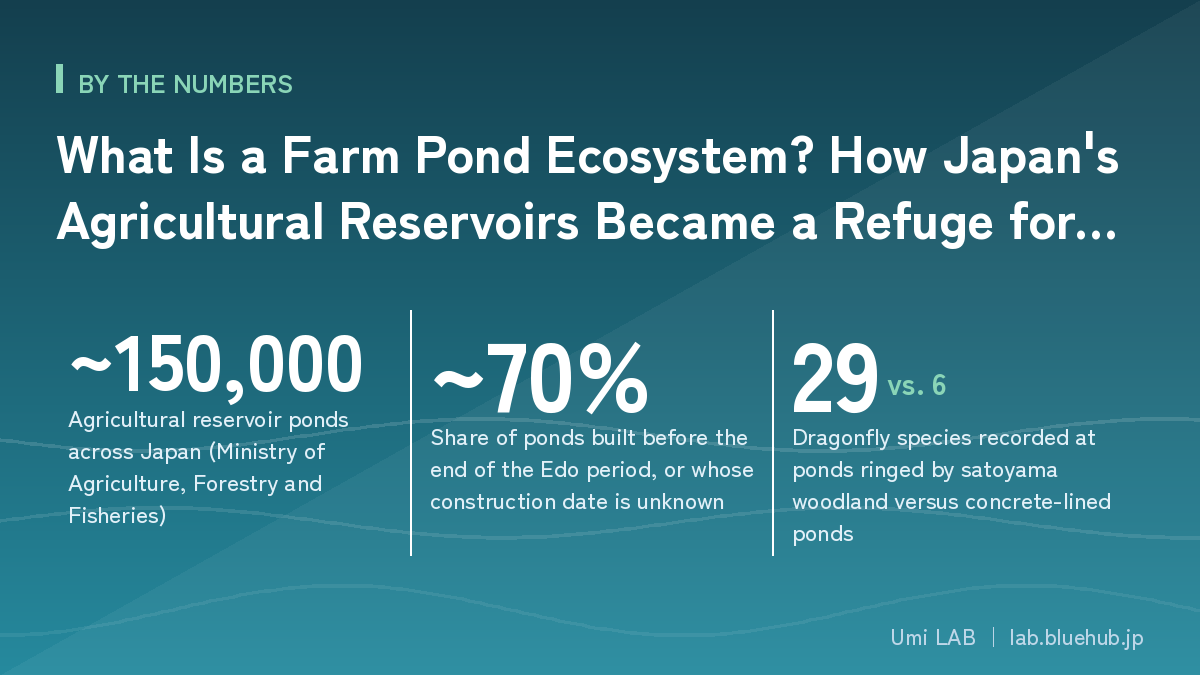
Japan's roughly 150,000 agricultural reservoir ponds were built for rice farming, yet now that about 60% of the country's wetlands have been lost, they have become a last refuge for aquatic plants, dragonflies and bitterlings. This article unpacks how these ecosystems work, the reality of ageing embankments and land reclamation, and the path nutrients take from these ponds all the way to the sea.
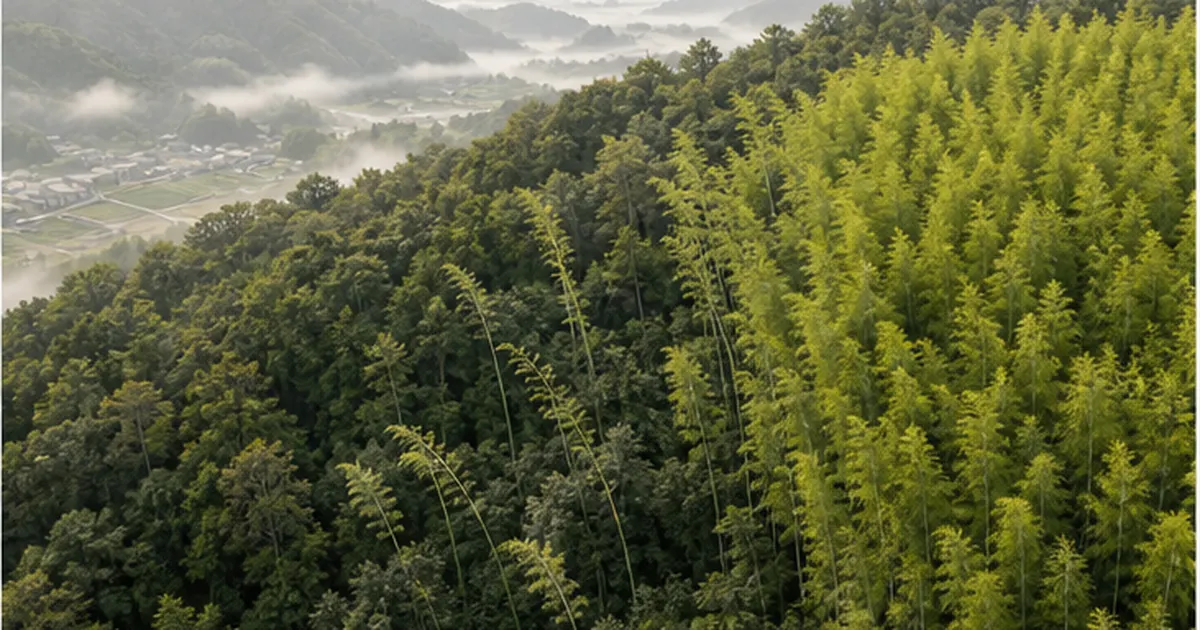
Drive through the farmland of western Japan and small ponds keep appearing at the foot of hills and in narrow valleys, many of them unnamed on any map. Japan has roughly 150,000 agricultural reservoir ponds (Ministry of Agriculture, Forestry and Fisheries). Trace their origins and every one of them turns out to be a piece of equipment built for growing rice. They are neither natural ponds nor lakes: in land without large rivers, people dammed valleys, raised embankments and stored rainwater in what amounted to water tanks.
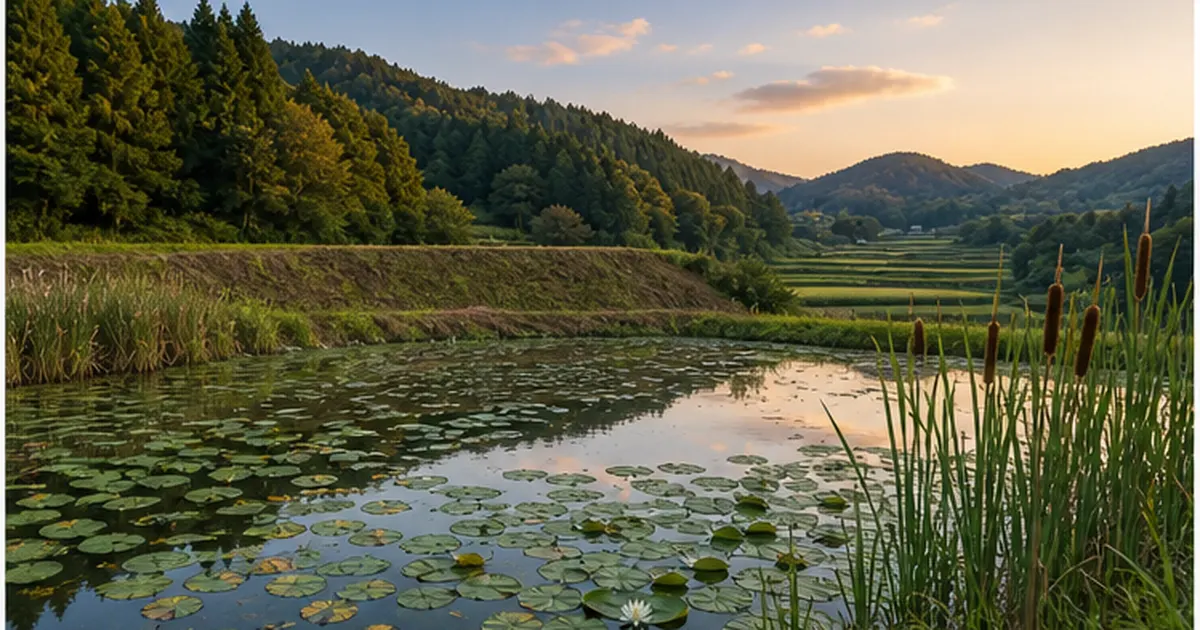
Today those tanks have taken on a second role. Modernisation has cost Japan about 60% of its wetlands, leaving the aquatic plants, dragonflies, freshwater fish and frogs of natural marshes with nowhere to go. Where they fled was the very ponds dug for agriculture. Around 120 aquatic plant species are listed as threatened on Japan's Red List, and many of them now persist in farm ponds. An artificial structure has become a refuge for the natural world — an inversion that defines the state of Japan's freshwater ecosystems.
But the refuge itself is unstable. About 70% of farm ponds were built before the end of the Edo period, or have no record of when they were built at all. The farmers who maintained them are dwindling, embankments are ageing, and in the 2018 western Japan floods 32 ponds failed across six prefectures. Meanwhile urban development fills ponds in, invasive fish move in, and solar panels go up on the water surface. This article first unpacks how a farm pond ecosystem is put together, then looks at the species living there, the technique of draining a pond known as kaibori, and finally the connection to the sea where all that water ends up — all grounded in primary sources.
What you will learn in this article
- Why ponds built purely to secure irrigation water ended up substituting for Japan's lost wetland ecosystems
- The layered structure of a farm pond ecosystem — aquatic plants, dragonflies, fish and amphibians from surface to sediment — and how to gauge its health
- Endangered species such as the Nippon-baratanago bitterling that survive only in farm ponds, and the specific threats of invasive species and hybridisation
- How the traditional practice of kaibori (draining and drying a pond) tackles invasive species and water quality at the same time
- How pond sediment travels down rivers to deliver nutrients to the sea and support nori seaweed farming
- The realities of ageing embankments, unknown owners, land reclamation and breach risk — and how to decide which ponds to keep, retire or repurpose
What Is a Farm Pond? Japan's Oldest Water Infrastructure, Born of Low Rainfall
The Ministry of Agriculture, Forestry and Fisheries defines a farm pond as a pond that stores water and allows it to be drawn off in order to secure irrigation water, in areas with low rainfall and no large river in the catchment. The key phrase is "in order to secure irrigation water". Farm ponds were not created for scenery, and not for wildlife: they are civil engineering works built to grow rice.
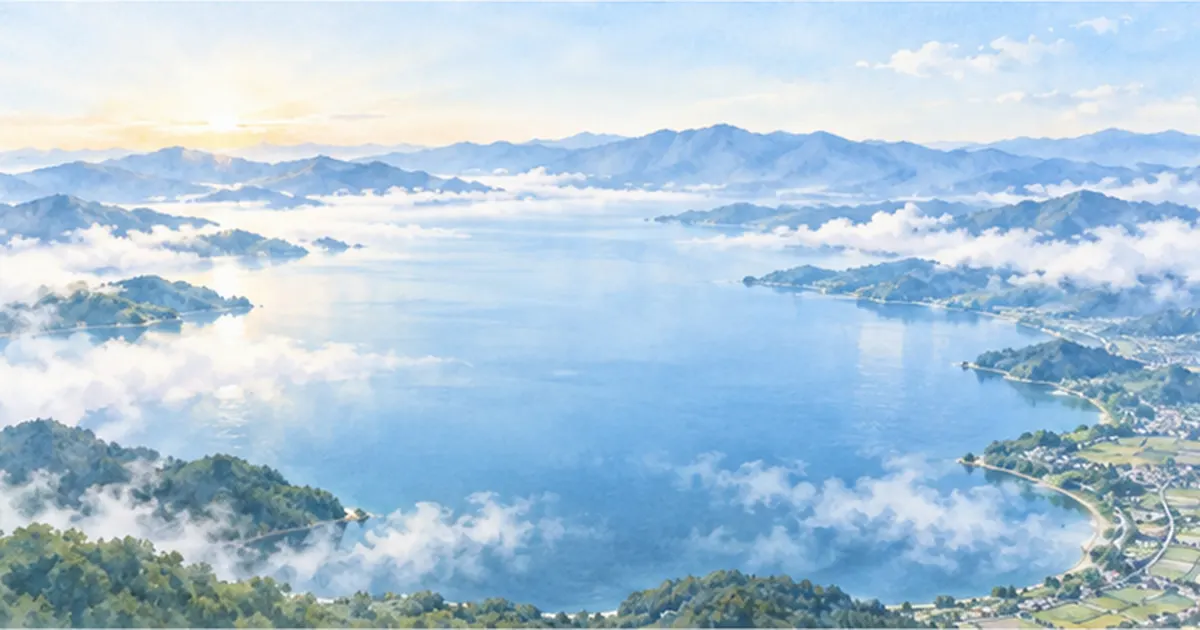
Japan's annual rainfall is far above the global average, but it is concentrated in the rainy season and the typhoon months, and the mountains are so steep that water runs off to the sea within hours. The Seto Inland Sea coast is a particular case: hemmed in by the Chugoku and Shikoku mountain ranges, rain clouds struggle to reach it, and it is known as one of the drier parts of the country. To flood paddy fields reliably, there was no option but to catch the rain when it fell. Farm ponds were the answer.
See the primary sourceMAFF | Overview of Agricultural Reservoir PondsOfficial page covering the national count of farm ponds, their prefectural distribution, construction periods, and multifunctional roles.🔗 maff.go.jpPonds that dam a valley, and ponds dug into flat land
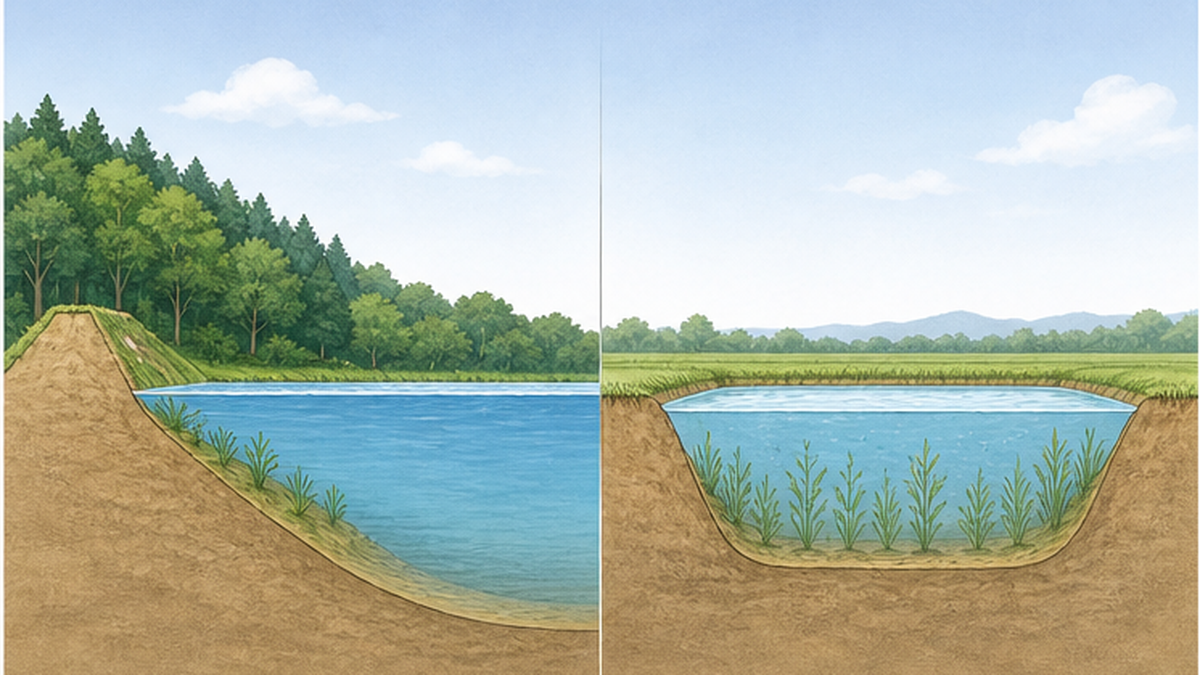
Farm ponds fall into two broad construction types depending on terrain. The first is the tani-ike (valley pond), formed by damming a hillside valley with an earthen embankment; the catchment is large and the water tends to be deep. The second is the sara-ike (dish pond), dug shallowly into flatland with an embankment around it; it is shallow and holds relatively little water for its surface area. For wildlife, this difference is decisive.
- Valley ponds: woodland often remains behind them, feeding in leaf litter and spring water. The gentle depth gradient creates both shallows and deep zones
- Dish ponds: shallow throughout, so light reaches the bottom and submerged plants thrive — but they are vulnerable to drying out and high water temperatures
- Excavated and reservoir-type ponds: common near cities, and often lined with concrete banks
Why did agricultural infrastructure become a habitat?
The reason farm ponds became havens for wildlife is almost ironically simple: they unintentionally recreated conditions very close to those of natural wetlands. There is shallow water, the level rises and falls with the seasons, grassland and woodland surround them, and every few years the water is drawn off in step with the farming cycle. That is precisely the rhythm of disturbance that backswamps on floodplains and natural marshes once provided.
In a natural wetland, every flood resets the vegetation, annual aquatic plants germinate again, and succession starts over. In farm ponds, human maintenance has taken over that role. Kaibori — draining the water and drying the pond bed in the sun — has functioned as a substitute for flooding. This is why farm ponds are described as "secondary nature".
| Natural ponds and lakes | Farm ponds | |
|---|---|---|
| Origin | Natural processes such as landform change and river action | Artificial structures built by raising embankments |
| Water level | Varies naturally with rainfall and inflow | Drops sharply during the irrigation season, recovers outside it |
| Disturbance | Natural events such as floods and droughts | Human management: kaibori, mowing, dredging |
| Biota | Mainly native species specific to that water system | Native species mixed with deliberately introduced ones |
| How they vanish | Slowly, through infilling and natural succession | Abruptly, through abandonment, decommissioning works or land reclamation |
Key points
- A farm pond is not a natural pond but an artificial structure built to secure irrigation water
- Shallows, fluctuating water levels and surrounding grassland and woodland closely resemble the wetlands Japan has lost
- Human maintenance work, kaibori above all, has stood in for natural disturbance
Japan's Farm Ponds in Numbers: ~150,000 Sites, Heavily Concentrated in the West
According to the Ministry of Agriculture, Forestry and Fisheries, Japan has around 150,000 agricultural reservoir ponds. Broken down by prefecture, the leaders cluster around the Seto Inland Sea. Hyogo Prefecture has the most at 21,162, followed by Hiroshima with 16,186 and Kagawa with 12,187. Those three prefectures alone account for close to a third of the national total.
| Rank | Prefecture | Number of ponds |
|---|---|---|
| 1 | Hyogo | 21,162 |
| 2 | Hiroshima | 16,186 |
| 3 | Kagawa | 12,187 |
That skew is a direct reflection of how rainfall and rivers are distributed in Japan. The Seto Inland Sea region receives little rain, and because the distance from the prefectural watershed to the coast is short, no large rivers develop. The Sanuki Plain in Shikoku, eastern Harima in Hyogo and the coastal belt of Hiroshima were, quite simply, land where rivers were in short supply. That is why people there kept digging ponds for more than a thousand years. Pond density is a record of how long a region has been fighting water scarcity.
70% were built "before the Edo period ended" or on an unknown date
MAFF materials note that many agricultural reservoir ponds were built during the Edo period, and that ponds built before the end of the Edo period plus those of unknown construction date together account for around 70%. "Unknown" means no record survives — which is itself a sign of age. Kagawa's Manno-ike is said to have been repaired by the monk Kukai in the Heian period.
That antiquity cuts two ways. One is a plus for the ecosystem: with open water in the same place for centuries, aquatic plant seeds have accumulated in the sediment as a seed bank, and populations of dragonflies and diving beetles have bred generation after generation. The other is a minus for disaster safety. Earthen embankments degrade with time, and no one can declare a pond safe by today's standards when neither records nor design drawings exist.
Farm ponds are quietly disappearing
There was a time when Japan was said to have more than 200,000 farm ponds. The current figure of roughly 150,000 partly reflects more precise counting as databases were built, so the two numbers cannot be compared directly — but there is no doubt that the real number is falling. The main causes are land reclamation for housing, ponds becoming redundant as rice farming stops, and planned "decommissioning works" that deliberately retire ageing ponds for safety.
As discussed later, MAFF materials record that decommissioning works had been started at around 1,500 sites by fiscal 2024. That is the right call from a disaster-safety standpoint, but from an ecological one it means a wetland disappears. What makes the farm pond debate hard is that safety and biodiversity frequently collide head-on.
The Farm Pond Ecosystem: A Small Water World Layered from Surface to Sediment
Look into a farm pond and it seems to be nothing more than standing water. In fact there is a clear layered structure running from the bank out to open water, and from the surface down to the bed. That structure is what allows such a small area to hold a surprising diversity of life.
Aquatic plants form the skeleton of the ecosystem
The single biggest factor shaping a pond's biota is how much aquatic vegetation grows, and in what form. Aquatic plants are producers, spawning substrate, nursery cover for juvenile fish, and a purification system that absorbs nitrogen and phosphorus from the water. They arrange themselves into three zones according to depth.
- Emergent plants (shallow margins, roughly 0–1 m deep): common reed, cattail, wild rice, bur-reed. Rooted underwater with stems and leaves in the air, they provide the "ramp" dragonfly nymphs climb to emerge
- Floating-leaved plants (roughly 1–2 m deep): water chestnut, water lily, fringed water lily, floating heart. Their leaves rest on the surface, and the undersides serve as spawning sites for aquatic insects and snails
- Submerged plants (wherever light reaches): hydrilla, water milfoil, stoneworts. They build three-dimensional thickets underwater that shelter fry and small crustaceans
- Free-floating plants: duckweeds drifting without rooting. Useful, but they darken the water column if they cover too much of it
For this zonation to exist, the bank must slope gently. Where a pond is walled vertically in concrete, the shallows vanish. Without shallows there are no emergent plants; without emergent plants dragonfly nymphs cannot emerge, and the adults stop coming to lay eggs. Bank reinforcement looks like a simple matter of strengthening an edge, yet it strips out the single most important layer of the ecosystem.
Dragonfly counts are a pond's health check
The National Institute for Environmental Studies has run long-term biological surveys of pond clusters in southern Hyogo Prefecture since 2000, mapping the relationship between surrounding land use and dragonfly communities. The results were unambiguous. Ponds set in satoyama woodland held 29–30 dragonfly species; ponds with only fragments of woodland left held 14–19; concrete-lined ponds held just 6.
See the research dataNational Institute for Environmental Studies | Organisms and Environments of Farm PondsLong-term surveys of pond clusters in southern Hyogo Prefecture, linking surrounding land use to dragonfly and aquatic plant communities.🔗 nies.go.jpThe same word "pond" can therefore support almost five times as much life depending on what surrounds it and how its banks are built. Dragonflies spend their larval stage in water and their adult stage on land, so both realms must be healthy for them to survive. That is exactly why species counts work so well as an index of a pond's overall condition. Protecting a farm pond, these numbers argue, means protecting the pond, its margins and the surrounding woodland as a single unit.
What dragonflies tell us
- Nymphs live underwater and adults live on land and in the air, so they reflect the condition of both realms
- They climb emergent plant stems out of the water to emerge, so without emergent vegetation the generations cannot connect
- Different species prefer different depths, plants and water quality, so a high species count directly indicates environmental diversity
- Adults are easy to identify by sight, making them well suited to citizen-led recording
The food web built by fish, amphibians and aquatic insects
Animal layers stack on top of the plant skeleton. Zooplankton and chironomid larvae graze phytoplankton and attached algae; dragonfly nymphs, diving beetles, water scorpions and small fish eat them; and above those come herons, kingfishers, and once catfish and large crucian carp. A farm pond may be small, but it is a complete ecosystem with four or more trophic levels.
The value of farm ponds is especially high for amphibians. Japanese brown frogs, black-spotted pond frogs and Schlegel's green tree frogs use ponds as spawning sites and refuges during periods when paddy fields dry out. In recent years, paddy drainage improvements and the concreting of irrigation channels have cut the routes animals used to travel between fields and ponds. Once a pond becomes an isolated island, the population inside it will eventually blink out. It is an ecological question, but it is equally a question of infrastructure connectivity.
Farm Ponds Have Become the Last Refuge for Endangered Species
The National Institute for Environmental Studies notes that about 60% of Japan's wetlands have already been lost. Floodplains, backswamps, spring-fed mires, shallow natural lakes — the places where freshwater life once lived were erased one after another by river engineering, land reclamation and urbanisation. Japan's Red List (2020) places around 120 aquatic plant species in threatened categories.
The species that lost their homes ended up in ponds dug for farming. Floating heart, fringed water lily, prickly waterlily, water hyacinth-like Monochoria, water clover — plants that were once commonplace in waterways nationwide now survive only in particular pond clusters. The most artificial water bodies harbour the most natural biota: that paradox is where Japan's freshwater ecosystems now stand.
Nippon-baratanago — the fish that raises its young inside a mussel
One species symbolises the crisis: the Nippon-baratanago, a cyprinid bitterling about 5 cm long. It was once widely distributed in Honshu west of Lake Biwa and the Yodo River system, and in northern Kyushu. On Japan's Red List (2020) it is classed as Critically Endangered (CR) — facing an extremely high risk of extinction in the wild in the immediate future. Within Osaka Prefecture, the only confirmed habitat left is a handful of farm ponds in Yao City.
Learn more about this fishOsaka Prefecture Research Institute of Environment, Agriculture and Fisheries | Nippon-baratanagoListed as Critically Endangered (CR) on Japan's Red List. Within Osaka Prefecture it now survives only in a few farm ponds in Yao City.🔗 knsk-osaka.jpThe way this fish breeds illustrates just how intricate a farm pond environment is. From May to June the Nippon-baratanago lays its eggs inside the exhalant siphon of a freshwater mussel such as Sinanodonta. The eggs hatch within the mussel's gills, and the larvae are sheltered inside the animal for about two weeks before swimming out. For the fish to survive, the mussel must be there first.
And the mussel cannot live alone either. Its glochidia larvae attach temporarily to the skin or gills of other fish, such as gobies, in order to develop. Protecting the Nippon-baratanago therefore means maintaining the whole chain: bitterling → freshwater mussel → host fish → sandy-muddy bed the mussel can burrow into. Remove one link and the system collapses quietly but surely.
What is driving the Nippon-baratanago to the edge
- Hybridisation with the rosy bitterling: a closely related species introduced from mainland China has spread nationwide, and hybridisation is erasing pure populations. The two look so similar that it often goes unnoticed
- Decline of freshwater mussels: dredging of pond sediment, deteriorating water quality and predation by invasive species have reduced the mussels that serve as spawning beds
- Predation by invasive fish: largemouth bass and bluegill eat small native fish outright
- Loss of the ponds themselves: terrestrialisation through abandonment, land reclamation, and decommissioning works
In the Takayasu district of Yao City, Osaka, NPOs, local residents and universities have worked together to keep up kaibori and invasive species removal, maintaining the ponds where the Nippon-baratanago survives. What stands out is that the effort is designed as "an activity to keep using the ponds", not "an activity to protect a fish". The ponds are used for farming, drained periodically, and their sediment lifted out. That routine happens to save the fish. Biodiversity conservation is often synonymous with restoring a rhythm of daily life.
The Invasive Species That Changed Japan's Ponds: Bass, Bluegill and Red-Eared Sliders
The most abrupt and visible blow to farm pond ecosystems is invasion by non-native species. The National Institute for Environmental Studies lists invasion by non-native fish alongside surrounding urbanisation, bank hardening and eutrophication as the causes of biodiversity loss in farm ponds.
Fish that eat from the top down
Largemouth bass and bluegill are both North American fish with strongly piscivorous or omnivorous habits, and both are designated Invasive Alien Species under Japanese law. In closed waters like farm ponds, their establishment can wipe out small native fish and shrimp almost entirely. A farm pond food web was assembled on the assumption that no large piscivore was present. Add a powerful predator and rather than a level being added on top, the middle levels disappear.
Bluegill do further damage. Being omnivorous, they eat plant shoots, aquatic insects, other species' eggs and even mussel larvae, severing the bitterling–mussel chain described above at its root. When native fish vanish from a pond, it usually does not mean "one species declined": it means the structure of the ecosystem has been replaced by a different one.
In 2023, red swamp crayfish and red-eared sliders came under regulation
The red swamp crayfish and the red-eared slider (pond slider) are the invasive species most often seen in farm ponds and irrigation channels. Crayfish cut aquatic plants with their claws, physically destroying the plant zonation. Sliders eat large volumes of aquatic plants and animals and compete for habitat with the native Japanese pond turtle.
For these two species, regulation as "conditionally designated invasive alien species" under the Invasive Alien Species Act took effect on 1 June 2023. Keeping them as pets had become so widespread that applying the standard rules outright risked triggering mass abandonment. The design therefore allows household keeping to continue without notification or permission, while banning release into the wild, sale and paid transfer.
Check the regulationsMinistry of the Environment | Conditionally Designated Invasive Alien Species (red-eared slider and red swamp crayfish)Effective 1 June 2023. Release into the wild, sale and paid transfer are banned, while keeping them as household pets remains allowed without notification.🔗 env.go.jp| Action | Crayfish and sliders (conditional designation) | Largemouth bass etc. (standard designation) |
|---|---|---|
| Keeping as a household pet | Permitted (no application, permit or notification needed) | Prohibited in principle (permit required) |
| Releasing into the wild | Prohibited | Prohibited |
| Selling or transferring for payment | Prohibited | Prohibited |
| Giving to a friend free of charge | Permitted | Prohibited in principle |
Three things never to do
- Never release an animal you can no longer keep into a pond or river (however kindly meant, it is an invasion as far as the ecosystem is concerned)
- Never move fish, shellfish or plants taken from one pond into another (even native species can cause genetic disruption)
- Never hand out or sell animals because "they bred too much" (paid transfer of conditionally designated species is prohibited)
Kaibori: Drain a Pond and the Ecosystem Comes Back
Kaibori — literally "scooping out" — means draining a pond, removing mud and debris, and drying the bed in the sun. It began as routine agricultural maintenance: catch the fish, inspect the embankment for damage, and dredge accumulated sediment to restore storage capacity. Today it is being reappraised as a technique for ecological restoration.
Why does drying work?
- Invasive fish can be removed in one sweep: drain the water and the fish have nowhere to escape. It is more reliable than nets or chemicals, and natives can be sorted out and returned
- The sediment oxidises and consolidates: mud dried in the sun is exposed to air, organic matter breaks down, and phosphorus becomes more firmly bound to the sediment, improving water quality
- Clarity rises and light reaches the bed: with less suspended matter and fewer fish stirring it up, conditions are set for submerged plants to return
- The seed bank wakes up: aquatic plant seeds that have lain dormant in the sediment for decades germinate under the stimulus of drying and light
That fourth effect — awakening the seed bank — is the most dramatic. The sediment of a farm pond is a recording device holding the history of the vegetation that pond has known. Even in a pond gone turbid and stripped bare by invasive fish, the seeds may still be waiting, alive, in the mud.
Inokashira Pond and a comeback 60 years in the making
The emblematic case is Inokashira Pond in Tokyo. Kaibori was carried out three times, in fiscal 2013, 2015 and 2017, removing largemouth bass and bluegill. Water clarity improved visibly, and in 2016 the Tokyo Metropolitan Government announced that the endangered aquatic plant Nitella inokasirensis (Inokashira flask stonewort) had reappeared after roughly 60 years. It is an alga first described from Inokashira Pond, and Japan's Red List places it in the Critically Endangered/Endangered category. Something long vanished germinated because the pond bed had been dried.
By removing invasive fish and exposing the pond bed to the sun, water clarity improved and the long-dormant Inokashira flask stonewort germinated.
― Tokyo Metropolitan Government, "Endangered aquatic plant Nitella inokasirensis makes a comeback" (2016)
The story does not end there. A few years after the third kaibori, a new problem emerged: the invasive aquatic plant Canadian waterweed spread ferociously and blanketed the pond bed. The very increase in clarity that let light through was equally favourable to the invader. Kaibori is not a one-shot spell but an ongoing practice that includes what comes afterwards — that is the other lesson Inokashira Pond has to offer.
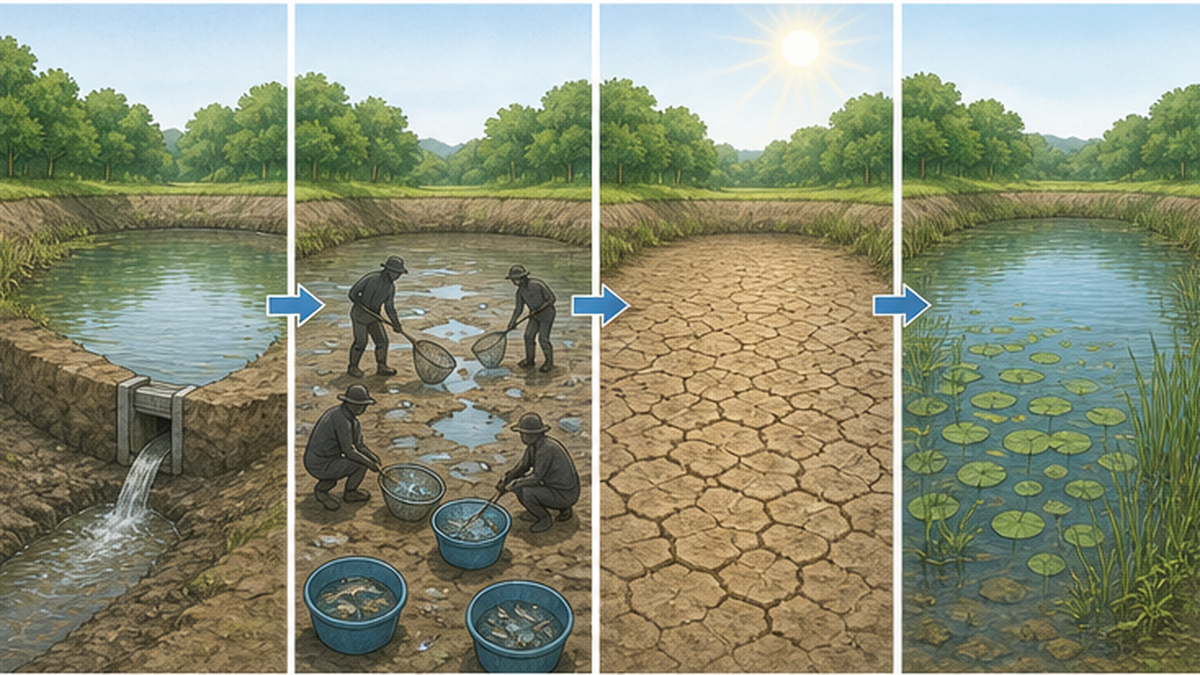
What kaibori achieves all at once
- Maintenance of agricultural infrastructure (embankment inspection, sediment removal, restored storage capacity)
- Removal of invasive species (draining is a decisive method)
- Improved water quality (sediment oxidation and phosphorus binding)
- Regeneration of native aquatic plants (germination from the seed bank)
- Continuity as communal work (the technique and the relationships pass to the next generation)
The Water Reaches the Sea: Farm Ponds, the Seto Inland Sea and Nori Farming
So far the story has stayed inside the pond. But it continues outside it. The water and mud that are drained flow down channels, into rivers, and finally out to sea. That obvious fact has taken on unexpected significance in the Seto Inland Sea.
The problem of a sea that got "too clean"
The Seto Inland Sea was once a body of water plagued by red tides caused by eutrophication from domestic and industrial wastewater. Discharge regulations were tightened step by step, and water quality improved dramatically. Then, from the 2000s, the opposite began to happen. Nitrogen and phosphorus in the seawater fell short, and cultivated nori seaweed started to lose its colour. Nori uses nitrogen to build its pigments, so when nutrients run low the colour fades and both taste and price fall with it.
We have covered the harm of too many nutrients reaching the sea in Where Do Nitrogen and Phosphorus in the Sea Come From? Nutrient Loads from Watersheds and How They Are Cut. What the Seto Inland Sea posed was the inverse question: a sea with too few nutrients is not a rich sea either. "Clean" and "abundant" are not the same thing.
Fishers turned their attention inland, to the ponds
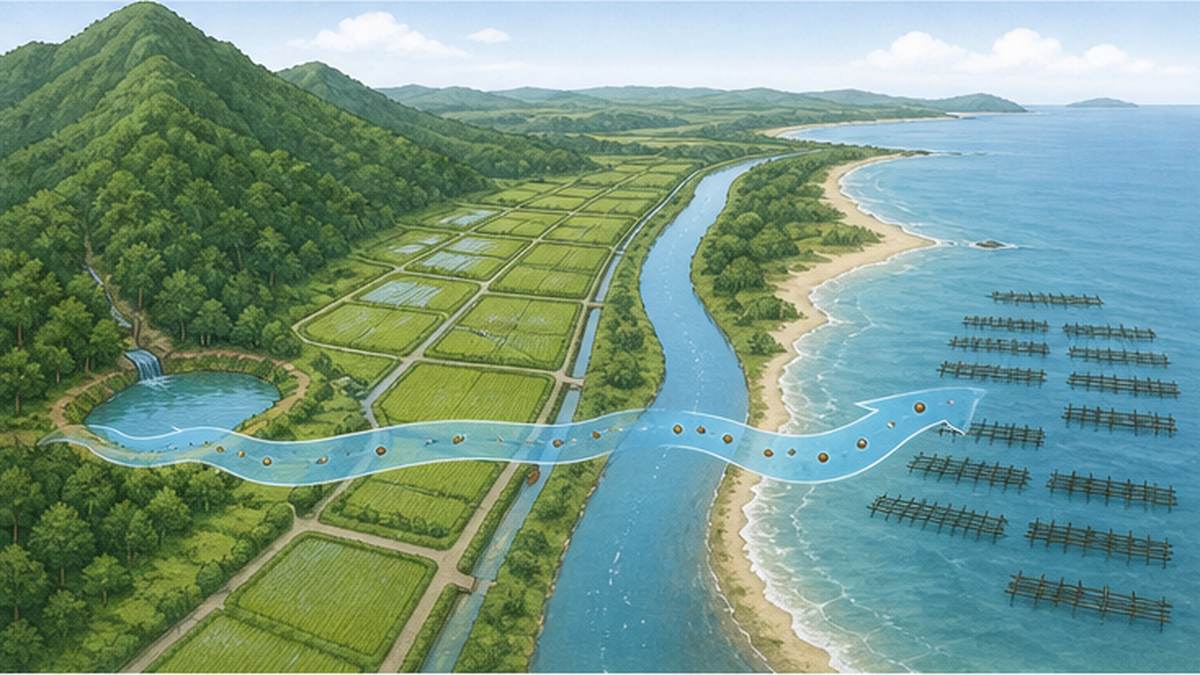
It was fishers in Hyogo Prefecture who acted. If nutrients cannot be added to the sea directly, then restore the flow of nutrients coming from the land. Their focus fell on the more than 20,000 farm ponds within the prefecture. In 2008, the Mori Fisheries Cooperative on Awaji Island approached local farmers and began kaibori at the fishers' initiative — an effort to send the nutrient-rich mud on pond bottoms out to sea via channels and rivers.
See the link to the seaLearn About Hyogo's Fisheries | Kaibori (Pond Draining)Hyogo Prefecture's "rich sea" initiative, sending nutrients down rivers to the coast by draining and drying farm ponds.🔗 hyogo-suigi.jpHyogo Prefecture has positioned this within its "rich sea" policy, with farmers, fishers and residents cooperating to supply nutrients to the sea through rivers by means of kaibori. The Awaji Regional Bureau and the pond conservation support centre have built a framework that backs kaibori technically and financially. For farmers it is pond maintenance; for fishers it is nutrition for the nori — one piece of work solving problems in two entirely different industries at once.
A farm pond sits partway along a single line called a watershed
What this case shows is that a farm pond is not a closed pond. Rain falling on the mountains soaks into forest soil, emerges as spring water into the pond, is distributed to paddy fields in the irrigation season, runs down channels, joins a river, and reaches the sea past the estuary. The pond is a control valve placed partway along that line — and simultaneously a temporary store of nutrients and sediment.
So when a pond is filled in, the flow of nutrients reaching the sea changes; when an embankment fails, sediment surges downstream; and when the aquatic plants disappear, the water leaves for the river more turbid than before. When asking why Japan's seas hold world-class biodiversity, part of the answer is written in small inland ponds. Try to understand the sea and you always end up back on land. Farm ponds show that round trip more clearly than almost anywhere else.
Ageing, Unknown Owners, Land Reclamation: The Reality of Vanishing Ponds
Even with their ecological value this clear, farm ponds keep declining. The reasons are not sentimental but thoroughly structural. A farm pond is infrastructure that only survives while there are people using it — and those people are disappearing.
The people who maintained them are gone
Farm ponds were maintained by associations of the farmers who used the water. With farmers ageing and dwindling, those organisations have weakened. MAFF materials themselves warn that as user-centred pond management organisations weaken, there is concern that day-to-day maintenance will no longer be carried out.
More serious still is the murkiness of legal rights. Ponds built before the end of the Edo period may have no modern registration at all. Owners died generations ago and inheritance was never registered. There are ponds across Japan for which nobody knows the owner, and therefore nobody can take responsibility. The Act on Management and Conservation of Agricultural Reservoir Ponds, in force since 2019, obliges owners and managers to notify their prefecture — which shows that the work has to start from simply establishing where the ponds are, whose they are and what they are like.
What happens to a pond no longer in use
- Abandonment and terrestrialisation: an unmanaged pond gradually fills with sediment and leaf litter, succeeding from reed bed to wet woodland until the open water is gone. Some species remain, but those dependent on open water are lost
- Reclamation and development: near cities, ponds become housing, car parks or storage yards. The ecosystem is lost outright
- Decommissioning works: to remove breach risk, the embankment is deliberately cut down so the pond no longer holds water. Safety is secured, but the water body disappears
- Conversion of the water surface: uses such as floating solar power. The surface remains, but shading affects aquatic plants and the animals that depend on them
That fourth option, floating solar, is a genuinely difficult call. Putting a disused water surface to work generating renewable energy makes sense for decarbonisation, and installations have advanced in Kagawa Prefecture and in Inami Town, Hyogo. On the other hand, covering the surface means cutting off light to submerged and floating-leaved plants, and operators report practical issues such as panels fouled by waterbird droppings. Hyogo Prefecture promulgated an ordinance on harmonising solar power facilities with the local environment in March 2017, requiring prior notification and explanation to neighbours for installations above a certain size. We need a mechanism that first checks whether what looks like "an empty water surface" is in fact somebody's habitat.
Four routes by which a farm pond disappears
- Terrestrialisation through abandonment (slowly, and unnoticed)
- Reclamation for housing or storage yards (all at once, and completely)
- Decommissioning works to remove breach risk (the right choice for disaster safety)
- Conversion of the surface to another use (the water remains, but light and habitat change)
Breaches and the Road Ahead: Ponds to Keep, Ponds to Retire, Ponds to Repurpose
It is not possible to discuss farm ponds through ecology alone. A farm pond is a structure holding water above places where people live downstream.
In 2018, 32 ponds failed
In the western Japan floods of July 2018, 32 farm ponds failed across six prefectures. Damage concentrated in Hiroshima Prefecture, where 23 ponds gave way. According to a damage survey report by NARO, at Shobusako-shimo Pond in Fukuyama City, Hiroshima, a slope above the pond collapsed and sent a mass of sediment into it, causing the embankment to fail; one person died and four were injured downstream.
That disaster was a turning point for farm pond policy. The government re-designated ponds whose failure could cause human casualties as "disaster-prevention priority agricultural reservoir ponds", greatly widening the scope. In 2020 the Act on Special Measures concerning the Promotion of Disaster Prevention Works for Disaster-Prevention Priority Agricultural Reservoir Ponds (Act No. 56 of 2020) was enacted, creating a framework under which prefectures draw up promotion plans and carry out intensive measures.
MAFF materials put the number of disaster-prevention priority ponds at about 52,000 (of which roughly 1,300 are already slated for decommissioning and excluded from assessment), and record that by fiscal 2024, disaster prevention works had begun at around 3,300 sites and decommissioning works at around 1,500. As the figures show, the response still covers only a fraction of the total.
| Measure or event | Year | Content |
|---|---|---|
| Western Japan floods (July 2018 heavy rain) | 2018 | 32 farm ponds failed across six prefectures, 23 of them in Hiroshima |
| Act on Management and Conservation of Agricultural Reservoir Ponds enters force | 2019 | Owners and managers required to notify prefectures, advancing a grasp of the real situation |
| Re-designation of disaster-prevention priority ponds | 2019 onward | Ponds posing a risk of human casualties brought broadly into scope, sharply increasing the number covered |
| Special Measures Act on pond works (Act No. 56 of 2020) | 2020 | Prefectures draw up promotion plans and carry out disaster prevention and decommissioning works intensively |
Neither "keep them all" nor "remove them all"
Seen this way, the question is clearly not a simple choice between conservation and development. Forcing the retention of a pond with housing downstream, an ageing embankment and nobody to manage it serves neither the ecosystem nor the community. Conversely, decommissioning a biologically rich pond with willing custodians for the sake of administrative efficiency is a pure loss. What is needed is sorting, pond by pond.
- Ponds to keep: still used for farming, with a management organisation and high biodiversity. Continue conventional management including kaibori, and carry out ecologically sensitive repairs where needed
- Ponds to retire: no longer farmed, risk downstream, no custodians. Carry out decommissioning works — but where rare species are present, survey first and consider mitigation such as translocation to nearby ponds
- Ponds to repurpose: less used for farming but well located and sized. Give them new roles as flood-control basins, environmental education sites, venues for citizen-led kaibori, or surface uses where conditions have been verified
This sorting only works if we know what lives in each pond. Yet having specialists survey all 150,000 sites is unrealistic. That is precisely why citizen-science approaches, in which residents and children record dragonflies and aquatic plants, matter so much. As noted above, dragonflies are easy to identify by sight and their species count directly reflects environmental quality. People living beside a pond, watching that pond, is itself the best monitoring system available.
What the "100 Best Farm Ponds" list tells us
In March 2010 MAFF selected 100 sites nationwide as the "100 Best Farm Ponds". The criteria were connection to agriculture, historical, cultural and traditional value, landscape, biodiversity, and connection to the local community — with excellence in any one of the five sufficing. The ordering of that list is telling in itself. A farm pond is agricultural infrastructure, a historical asset, a landscape, an ecosystem, and a set of community relationships. Try to describe it through any single one of those values and something always gets left out.
On invasive species, what is happening at sea is instructive too. The spread of marine invasive species through ballast water and the measures against them differs in scale, but shares with farm ponds the same lesson about the irreversibility of establishment in an enclosed water body. Once they are in, it is too late — that much does not change between fresh water and salt.
Summary of this article
- Japan's ~150,000 farm ponds are artificial irrigation ponds, but with about 60% of the country's wetlands lost they now shelter aquatic plants, dragonflies and freshwater fish
- Shallow margins and surrounding woodland are the key. Ponds ringed by satoyama held 29–30 dragonfly species; concrete-lined ponds held just 6
- Species such as the Nippon-baratanago, which needs the whole bitterling → mussel → host fish chain, survive only in farm ponds
- Kaibori is a traditional technique that removes invasive species, improves water quality and germinates the seed bank at once — but it must be continued, not done once
- In Hyogo, water from kaibori runs down rivers to deliver nutrients to the sea and support nori farming. A farm pond sits partway along the watershed line
- Ageing, unknown owners, reclamation and breach risk are all real. What is needed is neither blanket protection nor blanket removal, but sorting pond by pond
References and Sources
- Ministry of Agriculture, Forestry and Fisheries – Overview of agricultural reservoir ponds (national count, prefectural distribution, construction periods, multifunctional roles)
- Ministry of Agriculture, Forestry and Fisheries – Status of disaster prevention and mitigation measures for priority agricultural reservoir ponds (November 2025)
- Ministry of Agriculture, Forestry and Fisheries – Act on Special Measures concerning the Promotion of Disaster Prevention Works for Disaster-Prevention Priority Agricultural Reservoir Ponds (Act No. 56 of 2020)
- National Institute for Environmental Studies – Organisms and environments of farm ponds (long-term surveys in southern Hyogo; dragonfly communities and surrounding land use)
- NARO – Preliminary survey report on farm pond damage in the July 2018 heavy rain disaster: Shobusako-shimo Pond and others, Hiroshima Prefecture
- Ministry of the Environment – Regulation of conditionally designated invasive alien species (red-eared slider and red swamp crayfish)
- Ministry of the Environment – Red List and Red Data Book (threat categories and the latest listing)
- Tokyo Metropolitan Government – Endangered aquatic plant Nitella inokasirensis makes a comeback (2016 press release)
- Hyogo Prefecture – Farm ponds of Hyogo (current status and conservation efforts within the prefecture)
- Osaka Prefecture Research Institute of Environment, Agriculture and Fisheries – Freshwater fish encyclopaedia (native species): Nippon-baratanago
※ Ordered by reliability: government and academic institutions > peer-reviewed papers > specialist organizations > trusted media