⚡ In short
On coral reefs, a grouper shakes its head to call a moray eel out of its den, and the two trap their prey between them. In 406 hours of Red Sea observation, groupers paired with a moray caught about five times as much as they did alone. Research into fish gestures and partner choice shows that cooperation is not the exclusive property of big brains.
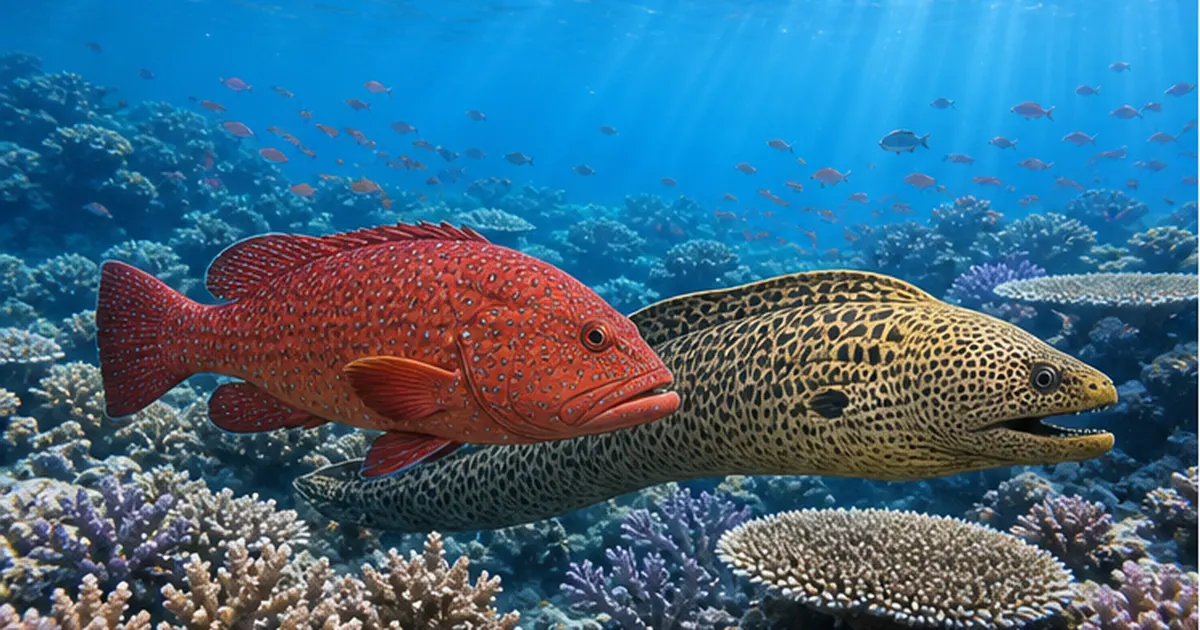
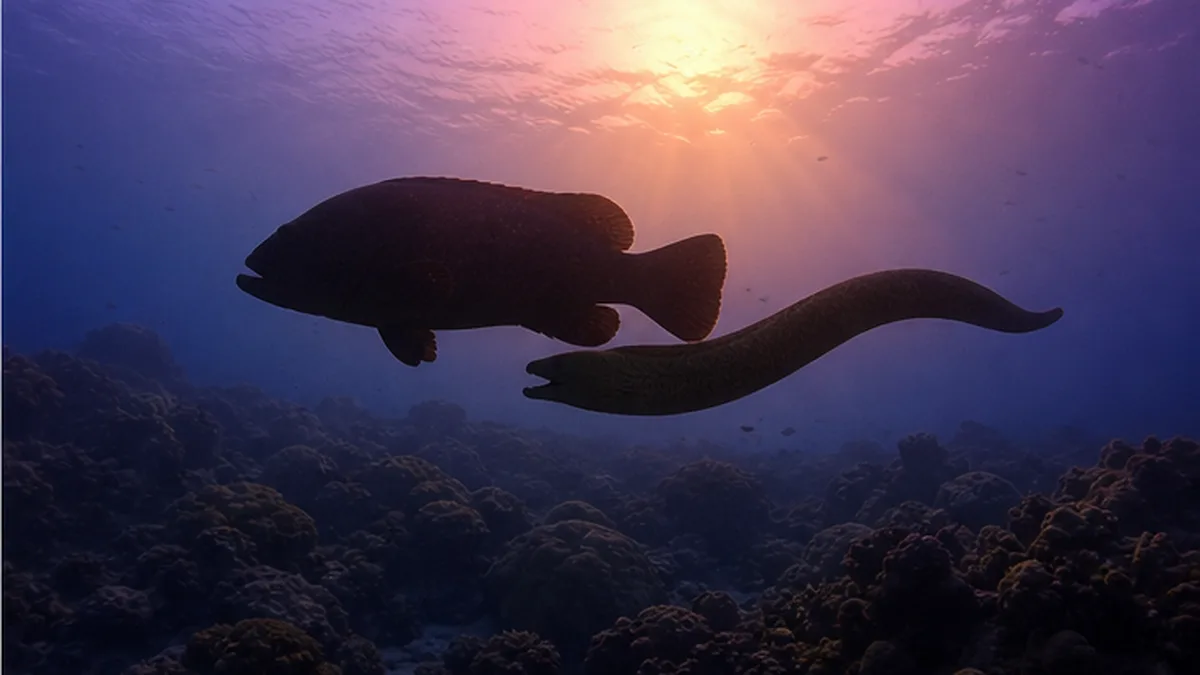
On a coral reef, a grouper about 80 centimetres long stops in front of a crack in the rock and begins shaking its head in rapid, tiny movements. Seconds later, a giant moray eel nearly two metres long slides out of the hole, and the two swim off together. It sounds like a tall tale, but this scene has been recorded for hundreds of hours on reefs in the Red Sea and Australia and reported in peer-reviewed journals.
Groupers are daytime hunters that chase small fish through open water at speed. Morays use their long, flexible bodies to slip into crevices in rock and coral and corner their prey there. Because the two species hunt in completely different arenas, a small fish faces a situation with no way out: flee into a crevice and the moray is there; break for open water and the grouper is waiting. This is a hunt that only works when two different species join forces.
What is even more striking is that the partnership does not begin by chance. It starts with a deliberate invitation from the grouper. What is more, a grouper will not issue that invitation unless it is hungry, and it will not choose a moray that is of no use to it. This article follows the actual data from twenty years of research to unpack what we now know about "gestures in fish" and "partner choice in fish."
What you will learn in this article
- How groupers and morays divide up "open water" and "rock crevices" so that prey has nowhere left to escape
- The difference between the head-shake signal a grouper performs at a moray's den and the headstand signal that points out where prey is hiding
- Real data from the Red Sea and the Great Barrier Reef on how signalling changes the rate of joint hunts and hunting efficiency
- Experiments modelled on chimpanzee studies showing that fish choose when to collaborate and with whom
- Role division in octopus-and-fish hunting groups, and how the octopus keeps order with a "punch"
- The groupers and morays you can meet in Japanese waters, and the distance to keep when watching them
The interspecies hunt taking place on coral reefs
Animals that hunt in groups are nothing unusual. Wolves, orcas, lions, ants — in every case they cooperate with members of their own species. On coral reefs, however, two fish from utterly different lineages corner their prey by covering each other's weaknesses. The relationship between groupers and morays is the classic example.
The daylight hunter and the crevice hunter
Groupers (family Epinephelidae, order Perciformes) are diurnal ambush predators that specialise in lying in wait and short bursts of speed. They engulf small fish whole with their large mouths, but their thick, rigid bodies cannot enter narrow gaps in coral or rock. The moment their prey slips into a crevice, the hunt is over.
Morays (family Muraenidae, order Anguilliformes), by contrast, thread their long, flexible bodies through cracks in the coral. Most are nocturnal, spending the day tucked into rock holes. Inside a crevice they are close to unbeatable, but in open water they swim slowly and cannot run down a fleeing fish.
| Trait | Grouper (Epinephelidae) | Moray (Muraenidae) |
|---|---|---|
| Main activity period | Day | Night (resting in a den by day) |
| Preferred hunting ground | Open water and above the coral | Inside gaps in rock and coral |
| Hunting style | Ambush plus a short charge | Crawling through crevices to corner prey |
| Weakness | Cannot reach prey that escapes into a gap | Pursuit in open water |
| Body form | Thick and rigid, with a large mouth | Long and flexible, with sharp teeth |
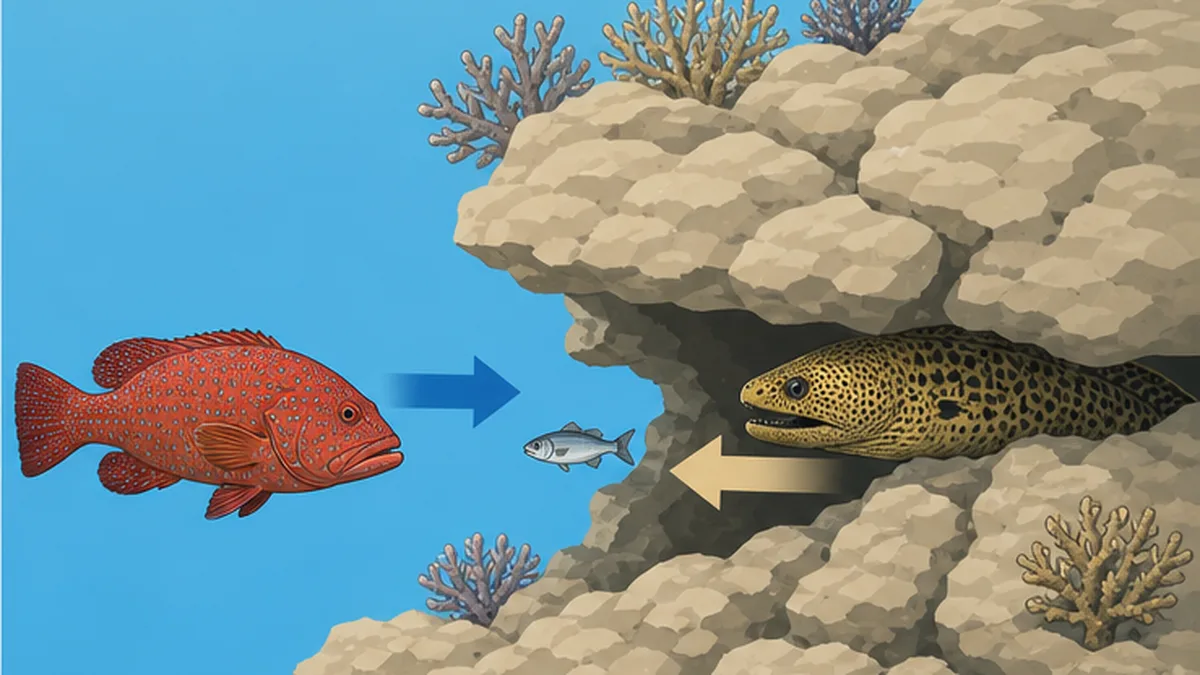
How complementary hunting skills multiply success
Crucially, the two do not share the catch. Whichever one swallows the fish takes all of it. The partnership still works because the expected payoff for each individual is higher together than alone. As long as the other's presence raises your own probability of success, cooperation remains stable without any division of the spoils.
Key terms in this article
- Interspecific cooperative hunting: animals of different species obtaining prey by complementing each other's hunting
- Referential gesture: a movement that points out an object, saying in effect "it is over there." Reported in humans, great apes and corvids — and now in fish
- Mutualism: a relationship in which both parties benefit. Grouper–moray cooperative hunting falls into this category
406 hours in the Red Sea: evidence that groupers "call" morays
The study that put this phenomenon on a scientific footing was published in PLOS Biology in 2006 by Redouan Bshary and colleagues. It was a large-scale survey built on underwater observations made in Ras Mohammed National Park, Egypt, between September 2002 and December 2004.
The scale of the study and its data
- Subjects: 14 groupers, Plectropomus pessuliferus (total length 55–100 cm), and 7 giant morays, Gymnothorax javanicus (total length 130–200 cm)
- Groupers were followed for a total of 406.4 hours
- Within 286 hours of those records, groupers spent about 31.5 hours (roughly 11%) in the company of morays
- 207 interactions in which the two species associated closely were recorded
If these were chance encounters, the time spent together should be very short. The team calculated the expected duration of an accidental association from the swimming speeds and home ranges of both species. The observed associations exceeded that expectation in 56% of the 207 interactions. This is active company-keeping, not random overlap.
A shake of the head means "let's go hunting"
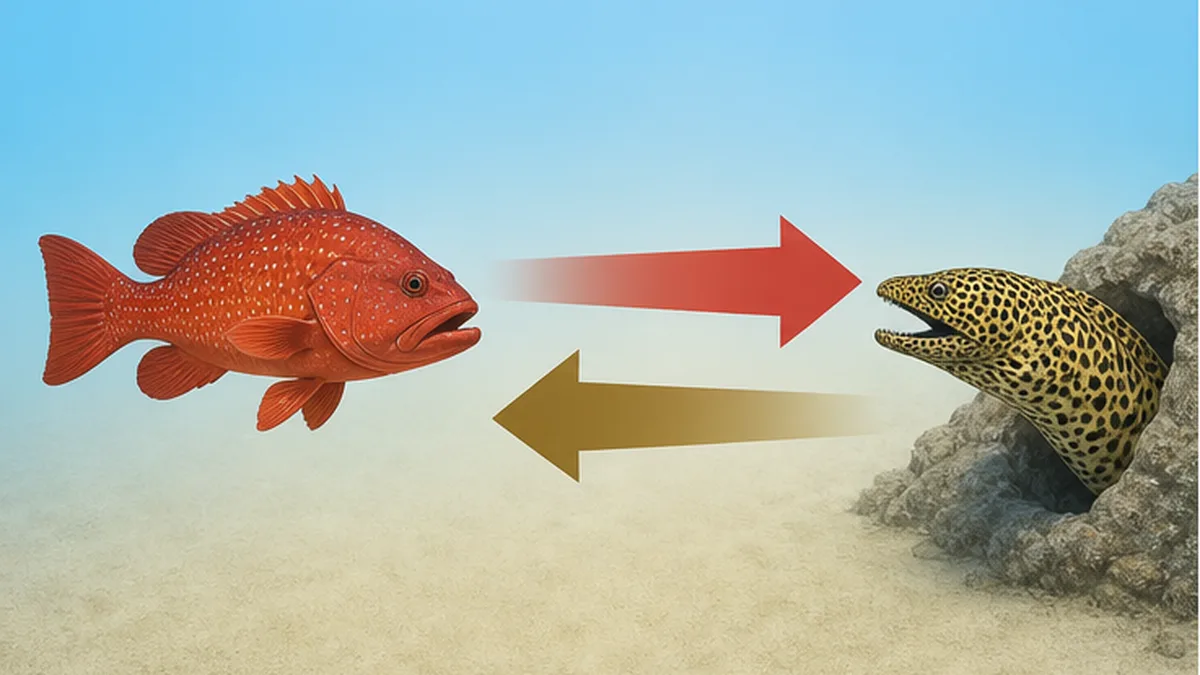
The grouper positions itself right in front of the moray's den and shakes its head violently from side to side while keeping its body axis steady. All 14 observed individuals performed this "head shake," a movement never seen during normal swimming.
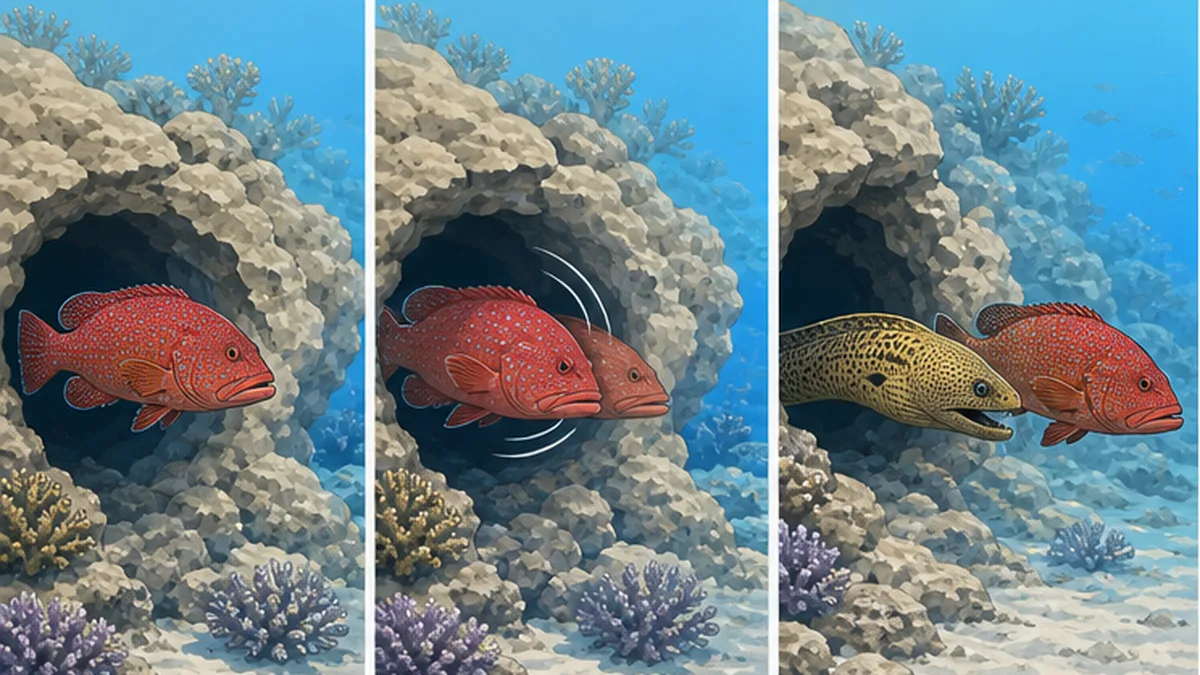
The results were clear. In 70 of the 120 head-shake events (58%), the moray left its den and a joint search or hunt followed. Without a signal, morays moved in only 11 of 38 cases (29%) (chi-squared test, χ²=8.4, p<0.01). In other words, a grouper's signal roughly doubles the chance that a moray sets out.
Roughly five times the catch rate of hunting alone
The payoff has been quantified too. A grouper in the company of a moray caught 0.19 prey per hour, against 0.04 per hour when hunting alone — a difference of about five times. The morays also benefited, taking 5 prey in 829 minutes (0.36 per hour) while with a grouper. A statistical test of the 16 observed successful hunts confirmed a bias that chance cannot explain (binomial test, p=0.007).
| Condition | Grouper catch rate | Proportion leading to a joint hunt |
|---|---|---|
| In the company of a moray | 0.19 prey/hour | With head shake: 70 of 120 (58%) |
| Hunting alone | 0.04 prey/hour | Without head shake: 11 of 38 (29%) |
"A full stomach means no invitation"
The team fed six groupers to satiation and then observed them for 120 minutes. Not a single head-shake signal was produced (Wilcoxon test, T=0, n=6, p=0.032). This is an important experiment: it shows the signal is not a reflexive habit but a behaviour tied to the state of wanting prey.
Pointing out "it's in there": referential gestures in fish
If the head shake is an invitation to go hunting, another gesture — the one performed after prey escapes — carries an even deeper meaning. It is the headstand signal reported in Nature Communications in 2013 by Alexander Vail, Andrea Manica and Redouan Bshary.
A headstand directly above the hiding place
When the small fish it was chasing escapes into a gap in the coral, the grouper swims to a point directly above that hiding place, turns head-down into a vertical posture and shakes its head. In this posture the grouper was positioned above the spot where the prey it had failed to catch was hiding. Nearby morays or Napoleon wrasses then head to that spot and probe the crevice.
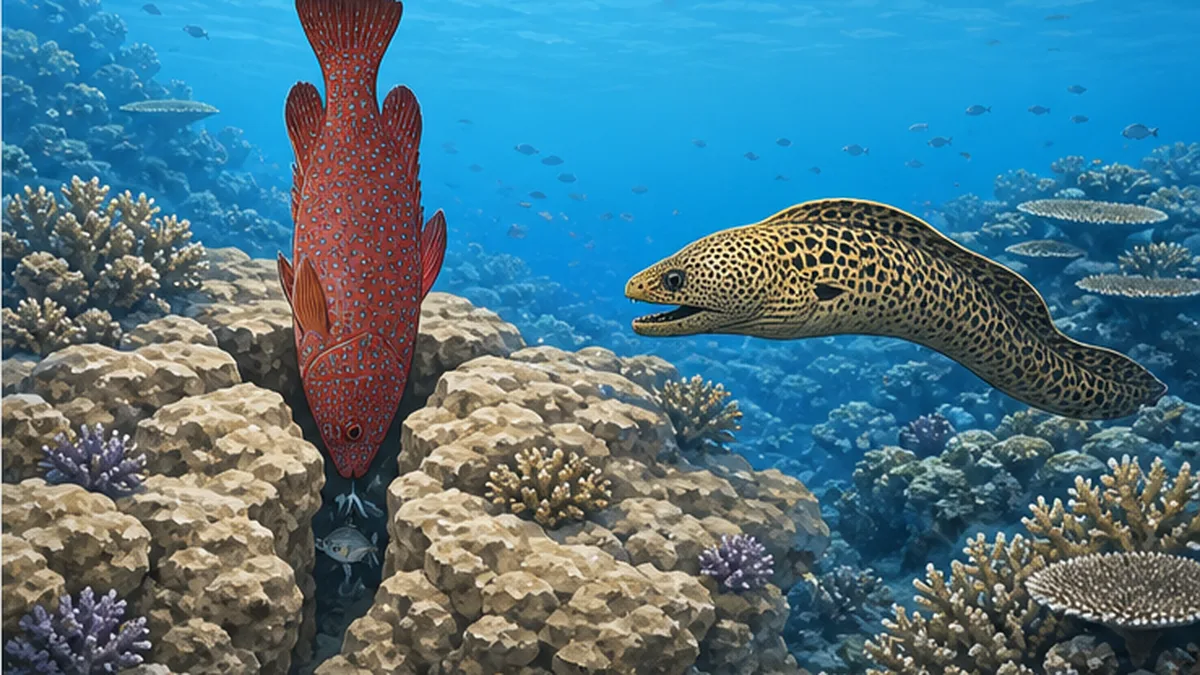
The five criteria for a referential gesture
In animal behaviour research, five criteria have been proposed for recognising a movement as a referential gesture — a gesture that points something out. The team argues that the grouper's headstand satisfies all of them.
- It is directed towards a specific object (the hidden prey)
- It is mechanically ineffective (the grouper is not extracting the prey itself)
- It is directed towards a potential recipient (a moray, for instance)
- It receives a voluntary response from that recipient
- It shows hallmarks of intentionality (persisting until the partner responds, looking at the partner, and so on)
Before this paper, referential gestures had been confirmed only in humans, great apes and ravens — all animals with large brains relative to their bodies. The report in fish shook a core assumption of comparative cognition by showing that "pointing something out" does not require a large brain.
Morays are not the only partners
The study covered the Red Sea grouper Plectropomus pessuliferus marisrubri and the coral trout Plectropomus leopardus of the Great Barrier Reef. Besides giant morays, the recipients of the signal included Napoleon wrasses (Cheilinus undulatus) and day octopuses (Octopus cyanea). The fact that the same signal works across different partner species means the gesture is not locked into a single one-to-one relationship.
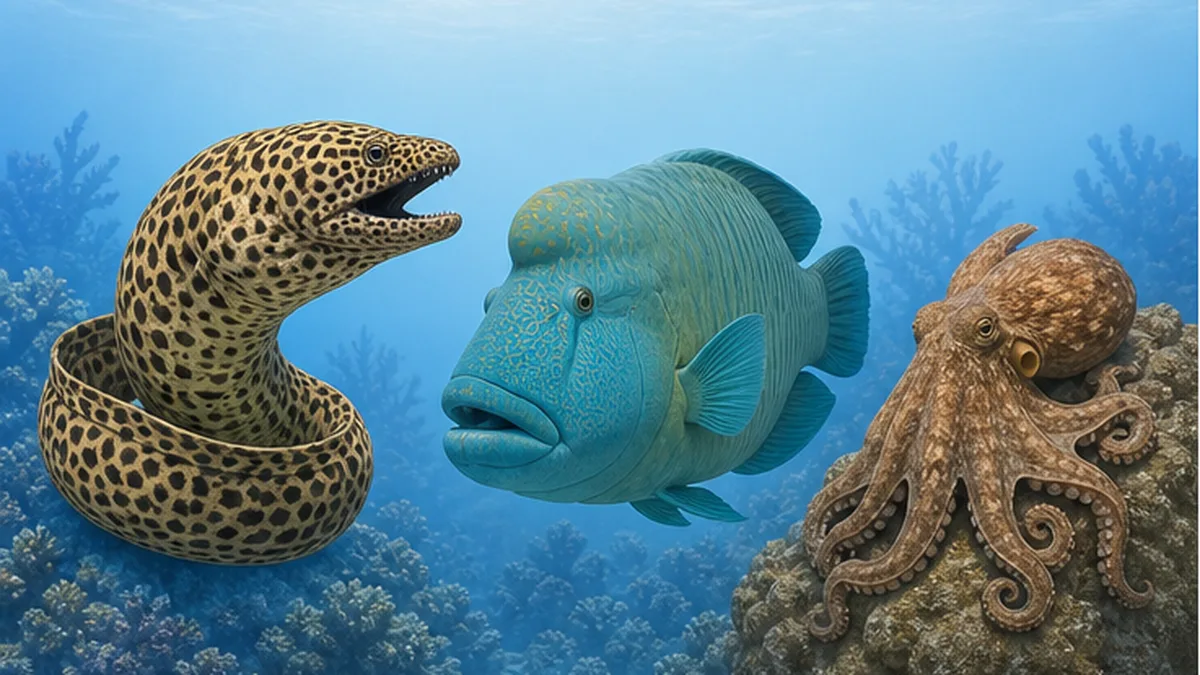
Worth reading alongside octopus intelligence
The octopus, one of these partners, has cognitive abilities that stand out among invertebrates. Its distributed nervous system and camouflage are covered in detail in Why are octopuses and squid so intelligent? Nine brains and a distributed nervous system. Intelligence in the sea has arisen separately in many branches of the tree of life.
When to collaborate and with whom: evidence that fish choose
Being able to issue an invitation is not, on its own, enough to call something cooperation. It is a different matter if an animal calls a partner only when one is needed and can choose a partner who is actually useful. Vail and colleagues answered that question head-on in Current Biology in 2014.
Translating a chimpanzee experiment for fish
The model was the famous "rope-pull task" used with chimpanzees. Using an apparatus in which a food tray only moves if two individuals pull ropes simultaneously, researchers test whether an animal (1) calls a partner only when it cannot succeed alone, and (2) can choose the more capable of several candidates. Apart from humans, only chimpanzees were thought to manage both.
The team translated this into terms relevant to coral trout ecology. The setting was the reef around Lizard Island Research Station, run by the Australian Museum. They prepared a "good" moray model that came to help when signalled and a "useless" model that swam off in the opposite direction, and observed which one the coral trout signalled to.
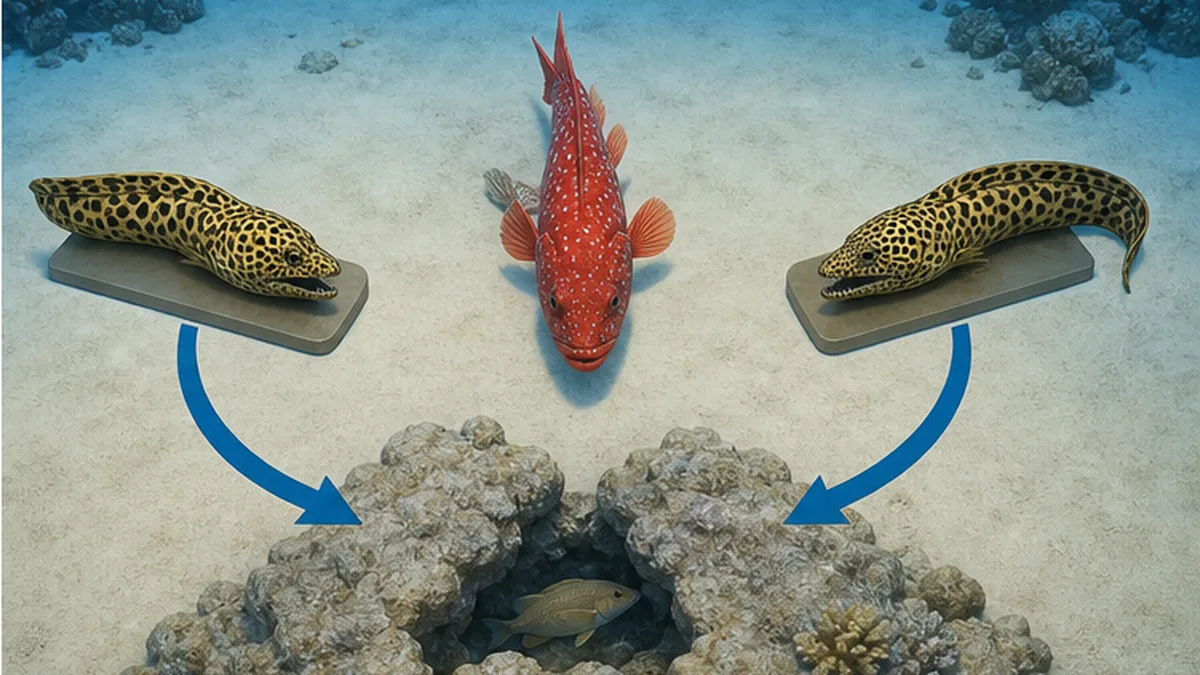
The result: calling when needed, learning who is effective
The coral trout raised the frequency of calling a moray precisely in situations where they could not reach the prey themselves. And over successive trials they came to choose the model that would help. The paper concludes that, in combining these two abilities, the coral trout performs on a par with chimpanzees.
These collaborative abilities are not specific to apes and may be more closely linked to ecological need than brain size or relatedness to humans.
― Summarised from the conclusion of Vail, Manica & Bshary (2014) Current Biology 24(17): R791–R793
| Study | Year and journal | What it established |
|---|---|---|
| Bshary et al. | 2006, PLOS Biology | That groupers call morays with a head-shake signal, that catch efficiency rises about fivefold, and that signals are only given when hungry |
| Vail et al. | 2013, Nature Communications | That the headstand signal indicating hidden prey satisfies all five criteria for a referential gesture |
| Vail et al. | 2014, Current Biology | That fish call a partner only when the situation requires it and learn to choose the effective collaborator |
| Sampaio et al. | 2024, Nature Ecology & Evolution | That in hunting groups of octopus and multiple fish species, searching and movement initiation are led by different members |
It is too early to say "the fish is thinking"
What these studies demonstrate is that the criteria are met at the level of behaviour. Whether a grouper thinks, as a human would, "there is a fish in there, I should tell the moray" is beyond the reach of current methods. The researchers themselves speak carefully of "hallmarks" of intentionality. Excessive anthropomorphism only diminishes what makes this field interesting.
What the moray gets out of it, and why the partnership holds
So far the story has been told from the grouper's side. What about the moray being called out? For a nocturnal animal, being roused in daylight and swimming around costs energy.
There is a payoff for the moray too
In the Red Sea observations, morays accompanying groupers caught 0.36 prey per hour. Because a moray has very few opportunities to hunt alone during the day, the grouper's guidance delivers a meal it would otherwise never have had. And when the grouper marks a hiding place with a headstand, the moray is spared the effort of searching crevices at random.
Nothing is shared, so nothing is fought over
Cooperative relationships tend to collapse over how the rewards are divided. With groupers and morays, however, the catch is swallowed whole by whoever gets it — the step of dividing it does not exist. Which of them wins any given fish is close to luck, and over the long run both do better than they would alone. The structural absence of an opportunity to cheat is what keeps this relationship stable.
Are there familiar faces?
The Red Sea observations did record a tendency for particular pairs of individuals to appear together repeatedly. Whether groupers and morays remember each other as individuals, however, is still unsettled. The finding that coral trout learned which model was effective in the 2014 experiment shows that they can at least update their assessment of a collaborator from experience.
Symbiosis and cooperation are not the same thing
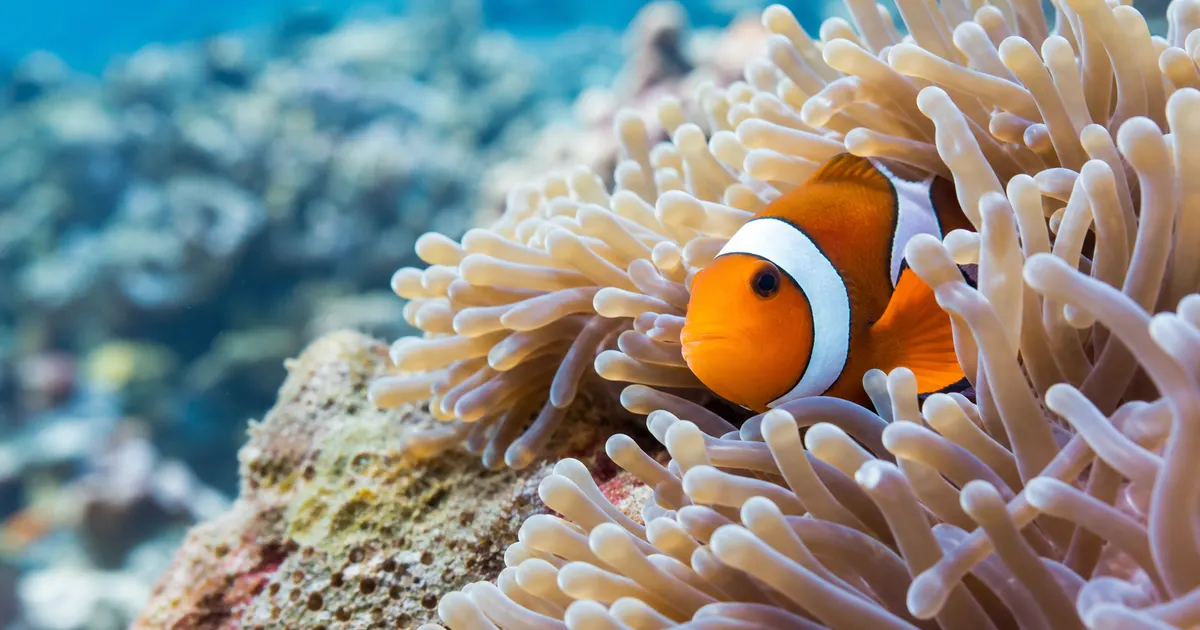
Coral reefs are a treasure house of symbiotic relationships, and they take many forms. The clownfish and the sea anemone live in a permanent shared household that trades shelter for defence — quite different in character from groupers and morays, who choose a partner and team up temporarily. The single word "symbiosis" covers relationships with entirely different conditions.
When does this partnership break down?
Cooperative hunting depends on a surprisingly narrow set of conditions. First, without complex terrain full of crevices, the moray's speciality simply ceases to exist. If bleaching or crown-of-thorns starfish outbreaks collapse the coral skeleton and the reef flattens into rubble, both "prey that escapes into a gap" and "any reason to call a crevice specialist" disappear at the same time.
Second, both species must be present at sufficient density. Groupers are prized by fisheries and are taken selectively from the largest individuals; morays too are fished in some regions. If either declines, the chance of meeting declines with it, and the partnership no longer forms. A behaviour can be lost even while the species survives, if the environment changes — which is why conservation discussions increasingly speak of protecting relationships, not just species.
It also remains unknown whether the two species always cooperate wherever they co-occur, or whether this is a behaviour learned and passed down locally. Recording it before the behaviour itself is lost is the one point on which researchers in this field agree.
Octopus and fish hunting parties: the role division revealed in 2024
Interspecific cooperative hunting is not limited to pairs. A study by Eduardo Sampaio and colleagues, published in Nature Ecology & Evolution in 2024, used three-dimensional tracking to analyse hunting groups formed by an octopus and several fish species, revealing their internal structure.
More than 100 hours of footage analysed in three dimensions
The fieldwork took place in the waters of Israel, Egypt and Australia, gathering more than 100 hours of footage. At the centre is the day octopus (Octopus cyanea), accompanied by goatfish such as the goldsaddle goatfish, the blacktip grouper (Epinephelus fasciatus) and the lyretail grouper (Variola louti) — a cast that can also be seen in the southern seas of Japan.
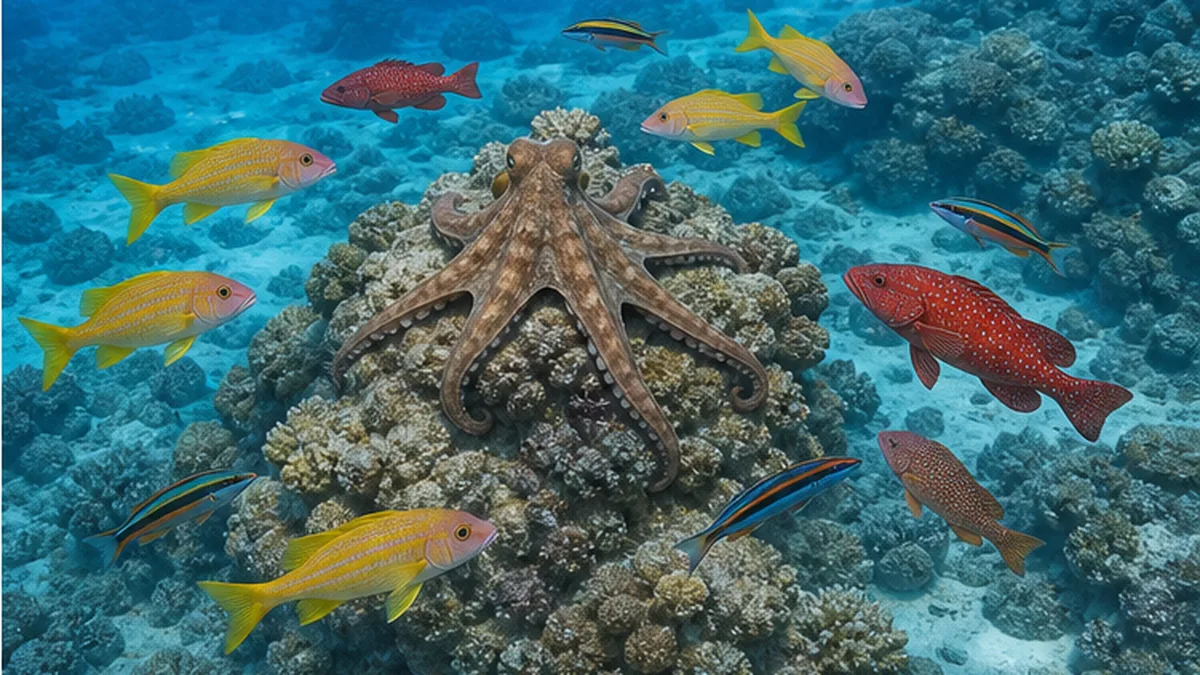
The fish search, the octopus decides
The analysis showed that leadership is not held by one party but divided by role. Ranging widely to locate prey and setting the group's direction falls mainly to the goatfish. Meanwhile, the octopus controls when the group sets off. The octopus pushes an arm into a crevice to flush out prey, and the fish take whatever bolts from it.
The octopus's "punch" keeps order
These groups also contain individuals that do no work and simply skim the rewards. That is where the behaviour reported in Ecology in 2021 comes in: the octopus striking fish with an arm. The 2024 study framed this "punch" as a way of shutting out freeloading fish and protecting the octopus's own share. Behind every cooperative arrangement lies the universal problem of dealing with free riders.
What mixed-species hunting teaches us
- Leadership is not fixed to one individual or species; different members lead the search and the departure
- The composition of the group — which species, how many — changes whether the hunt succeeds
- Punishment of free riders occurs even between species
- Frameworks built in terrestrial primate research can apply to invertebrates and fish in the sea
The same story extends to humans hunting with animals
Groupers and morays are simply the best-studied case of interspecific cooperative hunting, not the only one. Widen the view and it becomes clear that humans, too, are a species that has hunted in partnership with wild animals.
Dolphins and fishers in Laguna, Brazil
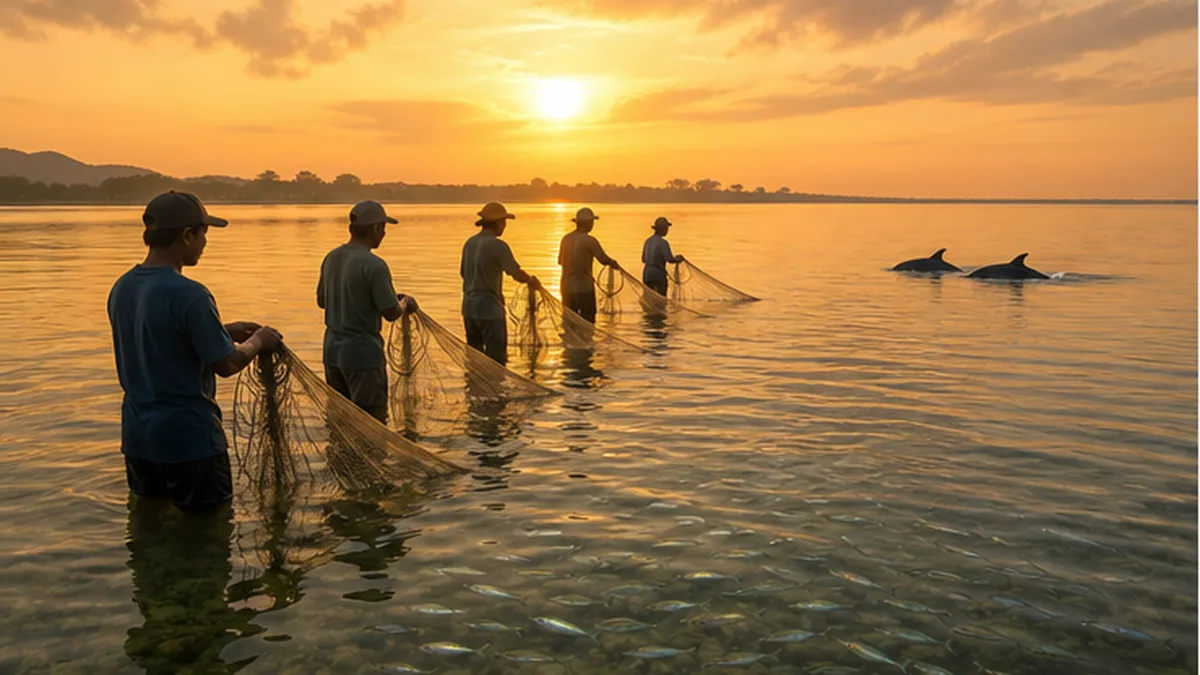
In the southern Brazilian town of Laguna, wild bottlenose dolphins and cast-net fishers have caught mullet together for more than 140 years. The dolphins herd schools of mullet towards the shore and then make a distinctive movement at the surface, such as arching the body. The fishers read that cue and throw their nets. The dolphins take the mullet that scatter as they escape the net.
A study published in PNAS in 2023 quantified the relationship using 15 years of fieldwork. The team tracked mullet schools with sonar cameras, recorded dolphin behaviour with drones and underwater acoustics, and followed the movements of 177 fishers with GPS while weighing their catches. Of roughly 3,000 net casts, about 46% were successful, and the more closely the fishers timed their casts to the dolphins' cues, the larger the catch. On the dolphins' side, individuals that take part in this cooperation have been shown to have higher survival.
Honeyguides and honey hunters in Africa
Another famous case is the relationship between the African bird known as the honeyguide and people. When the bird finds a wild bees' nest, it flies to a person and calls while leading them to it. After the person breaks the nest open and takes the honey, the bird eats the beeswax left behind. A bird that cannot split wood and a person who is poor at finding nests: a textbook complementary pair.
A study published in Science in 2016 focused on the distinctive call — a trill followed by a grunt — used by the Yao people of the Niassa National Reserve in Mozambique. Making this sound raised the probability of being guided by a bird from about 33% to about 66%, and the probability of reaching a bees' nest from about 17% to about 54%. Ordinary noises produce no such effect. A wild bird has learned to understand a specific human signal.
What they share: a signal and complementarity
All three cases come down to just two ingredients. (1) Each party can do something the other cannot (complementarity), and (2) there is a signal that conveys intent (communication). Where those two are present, neither difference in species nor difference in brain size is an obstacle to cooperation.
| Case | Who signals | What is complemented | Report |
|---|---|---|---|
| Grouper × moray | Grouper (head shake, headstand) | Open water and rock crevices | 2006, PLOS Biology and others |
| Fishers × bottlenose dolphins | Dolphins (movements at the surface) | Herding offshore and net-casting at the shore | 2023, PNAS |
| Honey hunters × honeyguides | People (a call) and birds (calls) | Finding the nest and breaking it open | 2016, Science |
Humans are not the only special case
It was once thought that only humans could cooperate while communicating intentions. Yet groupers, dolphins and honeyguides are all solving the same problem as their circumstances require. What may be distinctive about humans is not that we can cooperate, but that we have extended the reach of our partnerships to a planetary scale.
Undoing the assumption that fish are stupid
Many people have heard the folk claim that a fish's memory lasts three seconds. There is no scientific basis for such statements. Recent research on fish cognition has been piling up evidence in the opposite direction.
A fish that recognises itself in a mirror
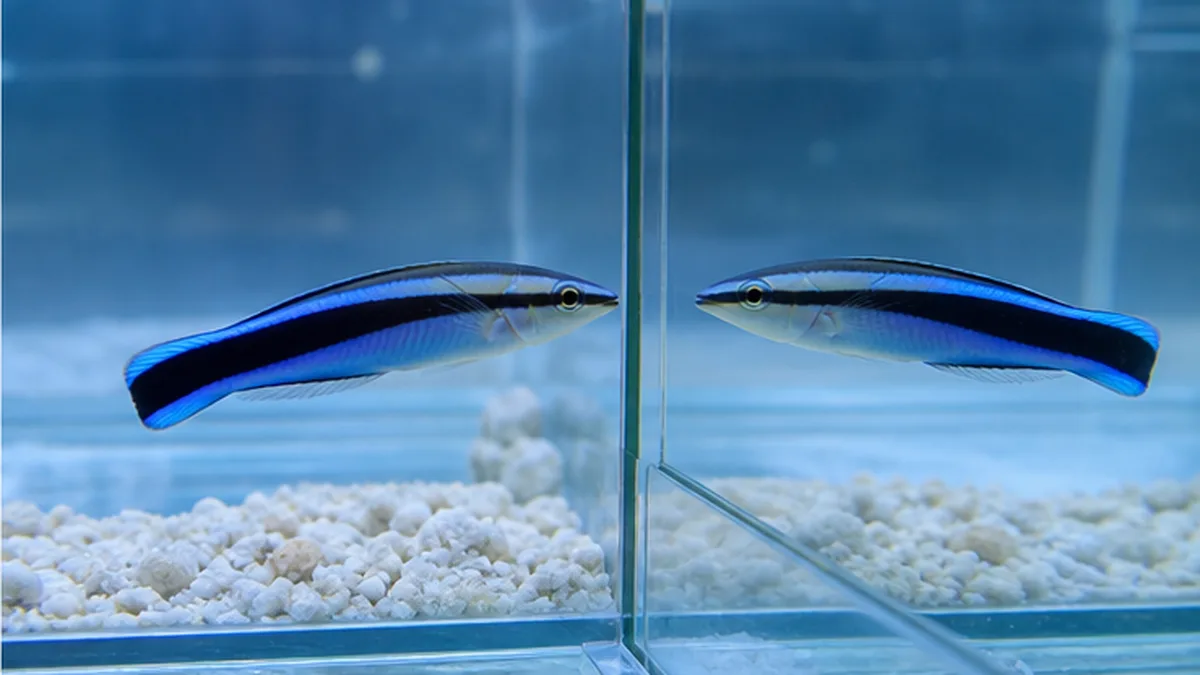
Japanese research has drawn worldwide attention in this field. In 2019, the group of Masanori Kohda at Osaka City University (now Osaka Metropolitan University) reported in PLOS Biology that the cleaner wrasse (Labroides dimidiatus) passed the mark test. When a mark was placed where the fish could not see it without a mirror, such as under the throat, the fish looked in the mirror and then rubbed that spot against the bottom.
The mark test has been passed by only a limited set of animals, including chimpanzees, elephants and magpies. That a fish about 10 centimetres long cleared it forced a rethink of the assumption that self-recognition requires a large brain. The research team themselves argue that the result is not proof that fish have human-like self-awareness, but a reason to re-examine what the test itself means.
Ecological need matters more than brain size
Both the grouper's partner choice and the cleaner wrasse's self-recognition point to the same thing: what matters is whether an animal lives a life that requires the ability. Groupers live where prey escapes into crevices, so calling a crevice specialist is worth doing. Cleaner fish interact with many client fish every day, so distinguishing others from themselves is necessary.
A coral reef is a cognitively demanding environment, crowded with countless crevices and a great diversity of species. How much biodiversity that structural complexity generates is covered in Why are coral reefs called "rainforests of the sea"?, but the same complexity has also been a pressure fostering intelligence in fish.
Advances in method have helped too
Behind this run of discoveries since the 2000s lie improvements in technology: cameras that can record underwater for long periods, individual identification techniques, and automated three-dimensional tracking of movement. Behaviours that were merely invisible are now being made visible one after another.
Groupers and morays you can meet in Japanese waters
This may sound like a story about the Red Sea and the Great Barrier Reef, but relatives of the main characters are common in Japanese waters too. The coral reefs of the Nansei Islands in particular are a very similar stage.
Coral trout (akajin mibai) and the giant moray
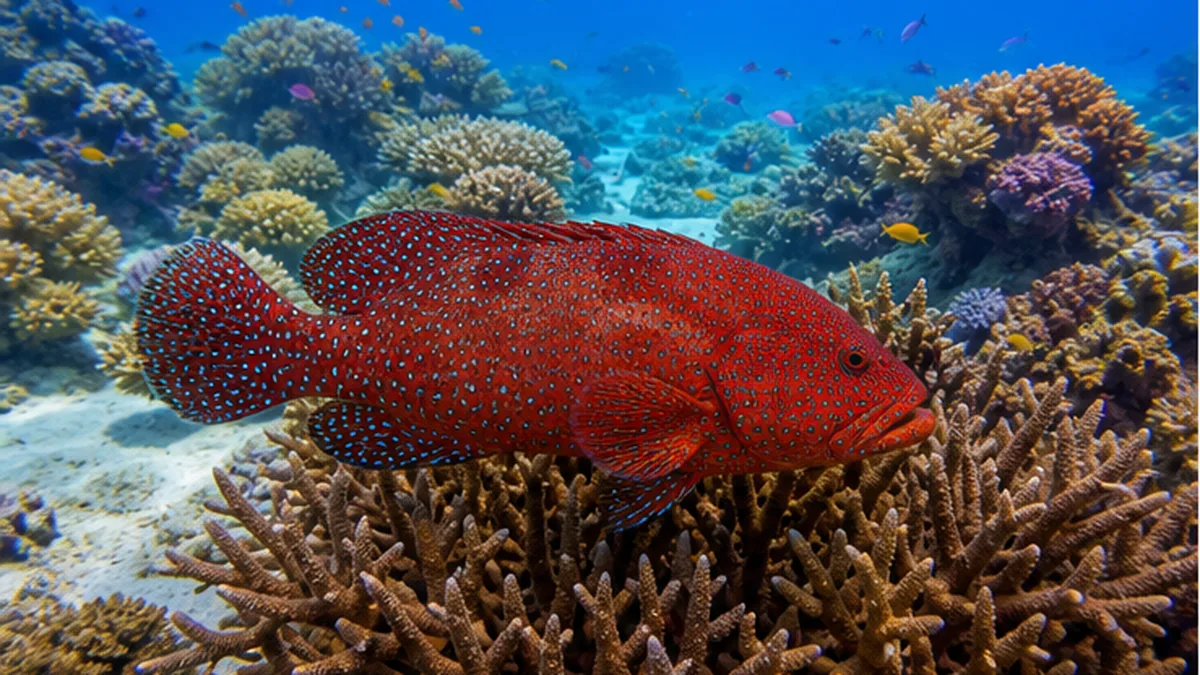
The coral trout (Plectropomus leopardus), the star of the 2013 and 2014 studies, is exactly the prized food fish known in Okinawa as akajin mibai. It ranges from the western Pacific to the Indian Ocean and is landed mainly around the Nansei Islands in Japan. The giant moray (Gymnothorax javanicus) also inhabits the reefs of the Ryukyu Islands and, at up to three metres in total length, is among the largest of all morays.
| Species | Scientific name | Range and features |
|---|---|---|
| Coral trout (akajin mibai) | Plectropomus leopardus | Mainly the Nansei Islands. Red body with small blue spots. A signature premium fish of Okinawa |
| Blacktip grouper | Epinephelus fasciatus | Rocky reefs from central Honshu southwards. Also featured in the 2024 group-hunting study |
| Yellow-edged lyretail | Variola louti | Nansei Islands. Yellow-margined tail fin. Caution: ciguatera toxin |
| Giant moray | Gymnothorax javanicus | Ryukyu Islands and elsewhere. Among the largest morays, reaching 3 m |
| Hong Kong grouper (akou) | Epinephelus akaara | Coastal waters west of central Honshu. Juvenile releases are under way in many areas |
Groupers as a fishery resource, and stock enhancement
Groupers grow slowly, and many species only begin breeding once they are large, which makes them vulnerable to overfishing. In Japan, hatchery production and release of juveniles is being carried out in several prefectures, centred on the Hong Kong grouper (akou). Some local governments, such as Yamaguchi Prefecture, also restrict the size at which the fish may be taken. For the coral trout, technical development of juvenile production has continued at facilities in Yaeyama, Okinawa.
Rules to follow when watching them
Cooperative hunting only happens when the fish are calm enough to behave naturally. If you come across it while diving or snorkelling, do not chase; keep your distance and watch. Morays in particular may bite defensively if a hand comes near their den. Never put your hand into a hole, and never feed the fish — these two rules must be kept.
Feeding destroys the behaviour
Fish that are fed stop hunting as they normally would and start approaching people instead. As the finding that groupers signal only when hungry shows, being hungry is the precondition for this behaviour. Food offered by people destroys that precondition entirely. For an observer, giving nothing is the most considerate choice.
A checklist for watching them in the sea
- If a grouper stops in front of a rock hole and shakes its head, simply watch for a few minutes
- When the moray emerges, pay attention to where the pair heads (the crevices in the rock)
- Do not touch coral or rock, and do not kick them with your fins
- Do not feed, do not chase, and do not fire a flash at close range
- Noting the date, place and species is useful later as a local record
Cooperation is not the exclusive property of big brains
Twenty years of research into grouper–moray cooperative hunting has quietly redrawn the outline of what we call intelligence. Sending a signal, waiting for a response, pointing out a hiding place, remembering and choosing a useful partner — behaviours once considered the privilege of primates have been found in a fish whose brain weighs a few grams.
Ability comes from how you live, not from your lineage
Crucially, these abilities were not inherited from humans. The fish and primate lineages diverged more than 400 million years ago. It is more natural to conclude that similar abilities arose independently, many times over, from similar needs. Biologists call this convergent evolution. The same thing that happened with wings in birds, bats and insects has happened with the capacity to cooperate.
Change how you look, and the sea changes
This perspective feeds back into how we relate to the sea. Reef fish are not merely "resources that happen to be there" but individuals that form relationships, make judgements and learn as they live. If the structure of a coral reef is lost, the crevices go with it — and so do the partnerships built around those crevices. What needs protecting is not only a list of species but the relationships being lived out among them.
Summary of this article
- Groupers take the open water and morays the rock crevices, engaging in interspecific cooperative hunting that leaves prey nowhere to escape
- Groupers invite morays by shaking their heads at the den; in Red Sea observations, 58% of signals led to a joint hunt
- Groupers paired with a moray caught 0.19 prey per hour, about five times the 0.04 per hour they managed alone
- Feeding groupers to satiation eliminated the signal entirely, confirming that the behaviour is tied to the internal state of hunger
- The headstand performed above a hiding place became the first case in fish to satisfy all five criteria for a referential gesture
- Coral trout call a partner only when the situation requires it and learn to choose the effective collaborator — a performance on a par with chimpanzees
- In groups of an octopus and several fish species, the fish lead the search and the octopus decides when to move, while free riders meet the octopus's punch
- From dolphins and fishers in Brazil to honeyguides and people in Africa, cooperation across species spans both sea and land
- The capacity to cooperate has evolved independently many times, driven not by brain size but by the demands of the environment
References and sources
- PLOS Biology – Bshary R, Hohner A, Ait-el-Djoudi K, Fricke H (2006) Interspecific Communicative and Coordinated Hunting between Groupers and Giant Moray Eels in the Red Sea. PLoS Biol 4(12): e431
- Nature Communications (PubMed abstract) – Vail AL, Manica A, Bshary R (2013) Referential gestures in fish collaborative hunting. Nat Commun 4:1765
- Current Biology (PubMed abstract) – Vail AL, Manica A, Bshary R (2014) Fish choose appropriately when and with whom to collaborate. Curr Biol 24(17): R791-R793
- Nature Ecology & Evolution – Sampaio E et al. (2024) Multidimensional social influence drives leadership and composition-dependent success in octopus-fish hunting groups
- Ecology (Wiley) – Sampaio E et al. (2021) Octopuses punch fishes during collaborative interspecific hunting events
- PLOS Biology (mirror self-recognition in fish) – Kohda M et al. (2019) If a fish can pass the mark test, what are the implications for consciousness and self-awareness testing in animals?
- JAMSTEC BISMaL – Marine life database: taxonomy and distribution of Gymnothorax javanicus (giant moray)
- Yamaguchi Prefecture – On catch restrictions for the Hong Kong grouper (an example of size limits for stock management)
- Japan Sea-Farming Association – Records of production, acquisition and release of juveniles for stock enhancement
- PNAS – Cantor M et al. (2023) Foraging synchrony drives resilience in human-dolphin mutualism. PNAS 120(6)
- Science – Spottiswoode CN, Begg KS, Begg CM (2016) Reciprocal signaling in honeyguide-human mutualism. Science 353(6297)
* Ordered by reliability: government and academic institutions > peer-reviewed papers > specialist organisations > trusted media