⚡ In short
Japan has 35 national parks covering about 6.5% of its land, welcoming over 300 million visits a year. Learn about Japan's unique "zoned park" system that designates parks without buying up private land, 90 years of history since 1934, marine park zones that protect the sea, and how tourism and conservation coexist.
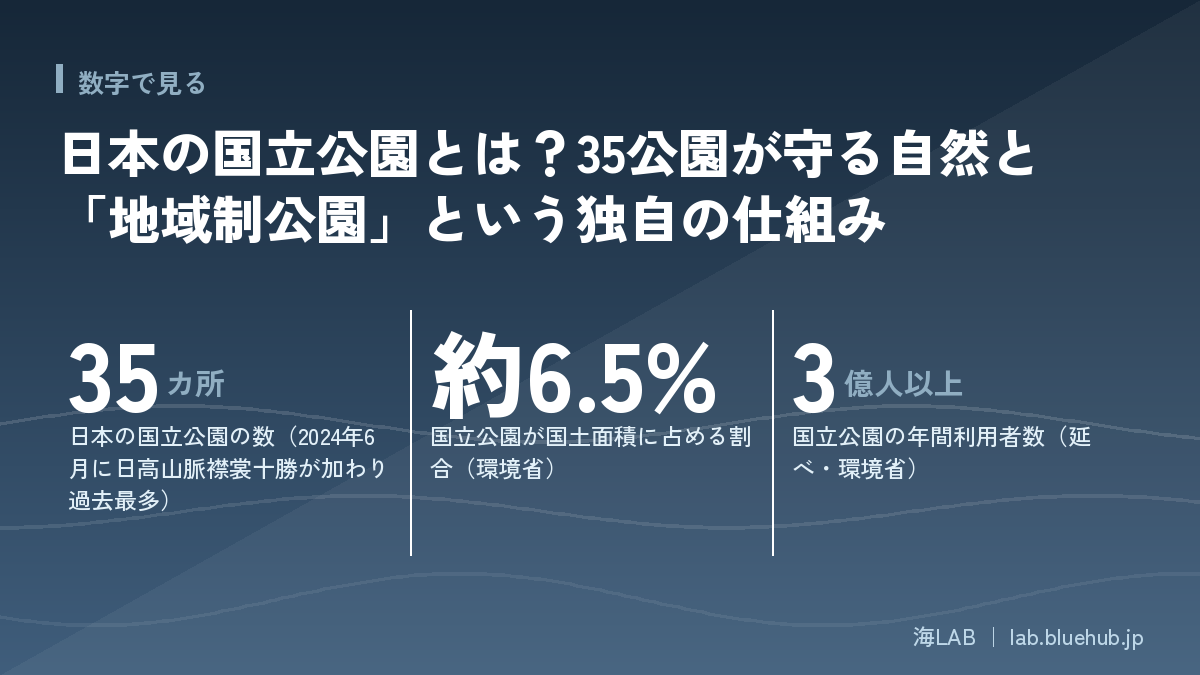
Mt. Fuji, Shiretoko, Yakushima, the seas of Kerama—many of Japan's most iconic landscapes are protected by a single institution: the national park. With the addition of Hidaka-sanmyaku Erimo Tokachi National Park in Hokkaido in June 2024, Japan now has 35 national parks. Together they cover about 6.5% of the national land and receive more than 300 million visits a year—Japan's largest "museum of nature."
Yet Japan's national parks differ fundamentally from places like America's Yellowstone. Instead of the state buying up the land and managing it outright, Japan designates entire areas—including privately owned land—as parks and protects them through rules. This is the "zoned park" (chiiki-sei) system. Inside Japan's national parks there are hot-spring towns, farmland, and everyday life. This uniquely Japanese approach embodies the wisdom of a densely populated country where people and nature have long negotiated their coexistence.
This article explains the basics of the national park system, its 90-year history, the zoned system that protects nature without purchasing land, the marine park zones that guard the sea, and the balancing act between the tourism boom and conservation—all based on primary sources. By the end, the scenery of your next national park trip should look a little different.
What you'll learn in this article
- The definition of a national park and the big picture: 35 parks covering about 6.5% of Japan
- 90 years of history, from the first three parks in 1934 to Hidaka-sanmyaku Erimo Tokachi in 2024
- Japan's unique "zoned park" system that designates parks without buying land, and how it differs from the U.S. model
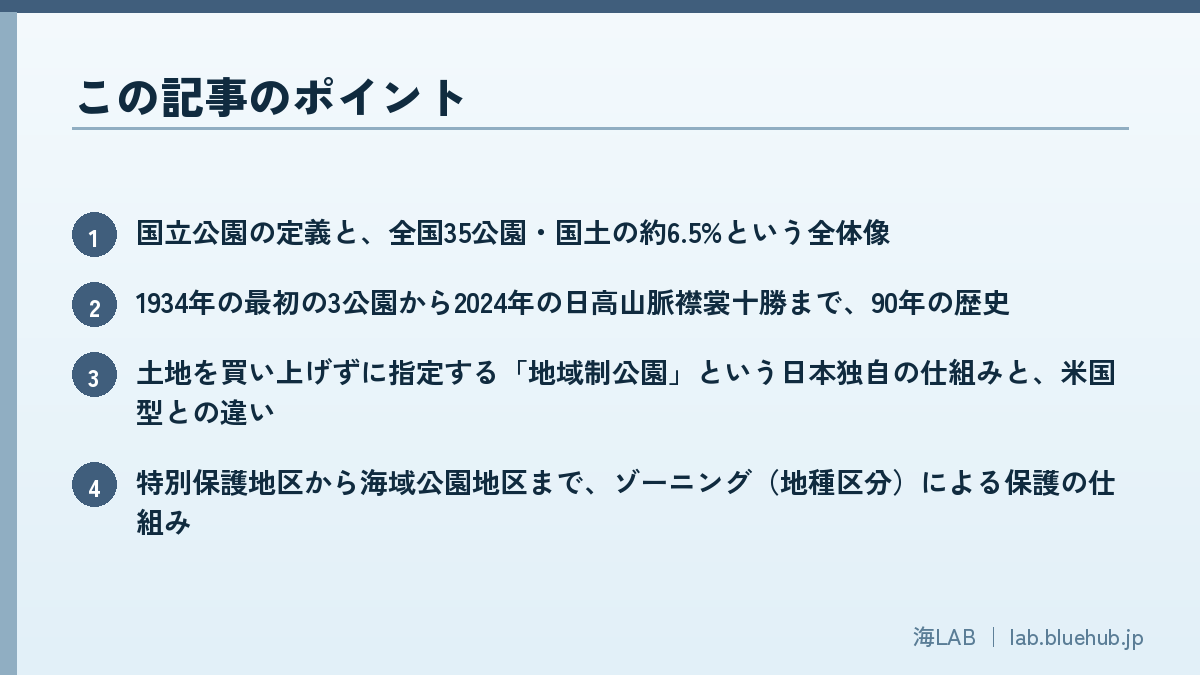
- How zoning works, from special protection zones to marine park zones
- The surge in inbound visitors, the Full Enjoyment Project, and the front lines of balancing tourism and conservation
- Etiquette for visiting national parks and how to take part as a guardian
What Is a National Park? A System for Protecting and Enjoying Japan's Iconic Landscapes
A national park is a park designated by the national government (the Minister of the Environment) under the Natural Parks Act to protect outstanding natural landscapes representative of Japan while promoting their use. Rather than simply fencing off beautiful places, the system explicitly aims at both "protection" and "use"—the premise is that everyone can visit and enjoy nature.
35 parks nationwide, about 6.5% of the country
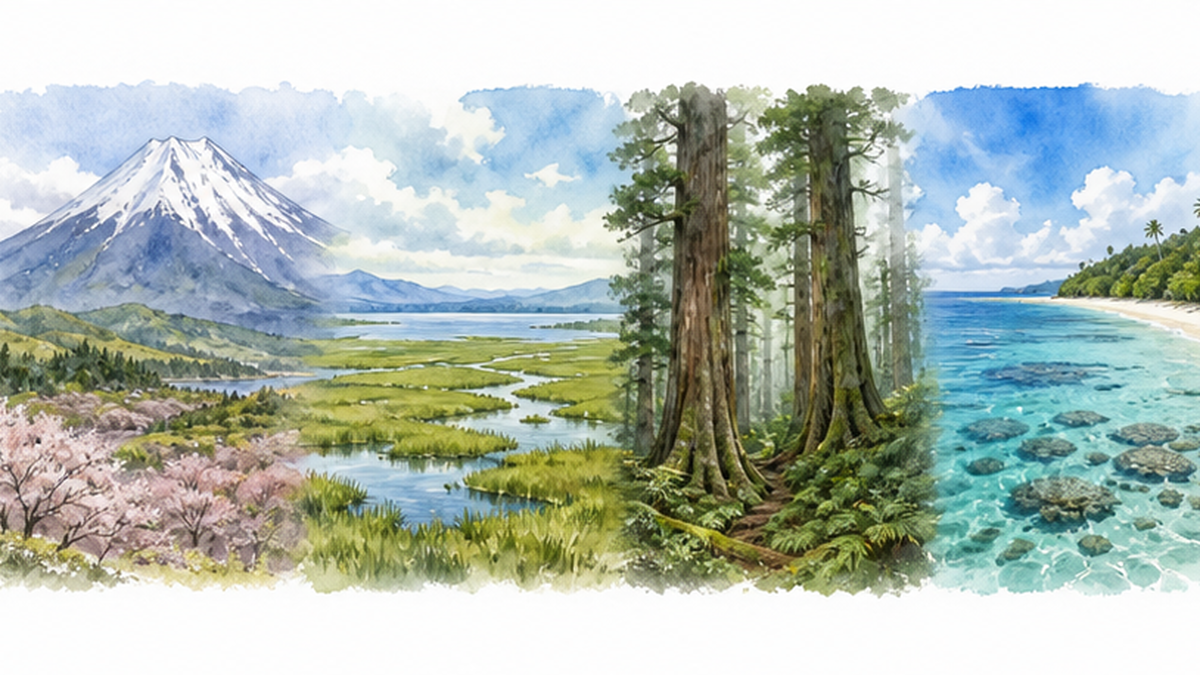
With the designation of Hidaka-sanmyaku Erimo Tokachi National Park in June 2024, Japan now has 35 national parks. Their combined area reaches roughly 2.44 million hectares, about 6.5% of the national land area. From Rishiri-Rebun-Sarobetsu in northern Hokkaido to Iriomote-Ishigaki in Okinawa, they encompass nearly every type of Japanese nature: volcanoes, alpine zones, wetlands, forests, islands, and coral seas.
According to the Ministry of the Environment, national parks receive more than 300 million visits a year—over twice Japan's population. Many people enjoy them not only through climbing and camping but also without realizing it, on hot-spring trips or drives that pass through park boundaries.
7,000 plant species, 100,000 insect species—a treasury of life
National parks protect more than scenery. According to the Ministry of the Environment, Japan is home to about 7,000 plant species, more than 1,000 animal species (mammals, birds, reptiles, amphibians, and others), and an estimated 70,000 to 100,000 insect species, and many of their habitats lie within national parks. Stretching 3,000 km in an arc from subtropical to subarctic climates across more than 6,800 islands, the Japanese archipelago is a biodiversity "hotspot" exceptionally rich for its size. The national parks are, in effect, a microcosm of the archipelago's ecosystems, passing this diversity of life on to the future, landscape and all.
Three tiers: national, quasi-national, and prefectural natural parks
"Natural parks" under the Natural Parks Act come in three ranks: national parks, designated and managed by the state; quasi-national parks, landscapes of nearly national-park quality designated by the state but managed by prefectures; and prefectural natural parks, designated by prefectural ordinance. Together they cover more than a tenth of the national land, making Japan one of the most park-dense countries in the world.
- National parks (35): Outstanding landscapes representative of Japan. Designated and managed by the state (Ministry of the Environment)
- Quasi-national parks: Landscapes of nearly equivalent quality. Designated by the state, managed by prefectures
- Prefectural natural parks: Landscapes representative of a region. Designated and managed by prefectures
Key points
- National parks are natural parks designated by the state to balance protection and use
- They reached 35 in 2024, covering about 6.5% of the national land
- With over 300 million visits a year, they are Japan's largest venue for encountering nature
90 Years of History: From the First Three Parks in 1934 to the 35th in 2024
The world's first national park was Yellowstone, established in the United States in 1872. In Japan, momentum for protecting scenic areas grew with modernization after the Meiji era, and the National Parks Law was enacted in 1931. Then, in March 1934, Setonaikai (Seto Inland Sea), Unzen, and Kirishima became Japan's first national parks. About 60 years after Yellowstone, the history of Japan's national parks began here.
Postwar expansion and the birth of the Natural Parks Act
After the war, as economic growth fueled tourism demand, park designations spread across the country. In 1957 the Natural Parks Act was enacted as the successor to the National Parks Law, establishing today's three-tier system of national, quasi-national, and prefectural natural parks. During the era of rapid growth, conflicts between development and conservation intensified, and the park system matured by strengthening its protective regulations.
The history of the parks is also a history of the conservation movement. The symbol is Oze (today's Oze National Park). After the war, when a dam project for power generation threatened to submerge its marshlands, researchers and mountaineers raised their voices in protest, launching what is often called the origin of Japan's nature conservation movement. Many of the visitor practices now taken for granted nationwide—carry-out-your-trash campaigns, boardwalks to protect vegetation—began at Oze.
New parks of "sea" and "forest" in recent decades
Recent designations show a clear pattern. The Kerama Islands in 2014 (Okinawa; coral seas), Yambaru in 2016 (subtropical forest in northern Okinawa Island), and the Amami Islands in 2017 (Kagoshima; subtropical islands) brought a wave of designations in the biodiversity-rich Nansei Islands. Then, on June 25, 2024, Hidaka-sanmyaku Erimo Tokachi National Park in Hokkaido became the 35th. Encompassing a continuous sweep from a roughly 140-km-long backbone mountain range to the coast at Cape Erimo, it is Japan's largest national park by land area.
How are national parks chosen?
A national park is not created simply because a municipality raises its hand. Under the Natural Parks Act, the Minister of the Environment designates parks after hearing the opinions of the prefectures concerned and the Central Environment Council. What matters is not only the outstanding quality of the scenery but whether the area contains ecosystems representative of Japan's nature, whether it has sufficient coherent extent, and whether a protection-and-use framework can be built together with the region. Designation takes many years of ecological surveys and local coordination—Hidaka-sanmyaku Erimo Tokachi itself was a "promotion" after more than 40 years as a quasi-national park.
| Year | Event |
|---|---|
| 1872 | Yellowstone National Park established in the U.S. (world's first) |
| 1931 | National Parks Law enacted |
| 1934 | Setonaikai, Unzen, and Kirishima designated as Japan's first national parks |
| 1957 | Natural Parks Act enacted, establishing the current natural park system |
| 2014 | Keramashoto (Kerama Islands) National Park designated (31st) |
| 2016–17 | Yambaru (33rd) and Amami Gunto (34th) designated |
| 2024 | Hidaka-sanmyaku Erimo Tokachi National Park designated (35th; Japan's largest) |
The year 2024 marked exactly 90 years since the first designations, and Setonaikai National Park celebrated its 90th anniversary. The history of growing to 35 parks over 90 years is also the history of the Japanese people continually choosing which landscapes to pass on to the next generation.
Trivia: Which national park is Mt. Fuji in?
Japan's highest mountain, Mt. Fuji, is part of Fuji-Hakone-Izu National Park. Designated in 1936, this historic park covers a vast area spanning Mt. Fuji, Hakone, the Izu Peninsula, and the Izu Islands, and ranks among the most visited parks in Japan by international travelers.
The Zoned Park: Japan's Unique Way of Protecting Nature Without Buying Land
The defining feature of Japan's national parks is the "zoned park" (chiiki-sei) system. National parks in the United States and Canada follow the "state-owned park" model, in which the government owns the land (or secures management rights) and manages it as dedicated park land. Japan, by contrast, does not buy up ownership: it draws park boundaries around designated areas—including privately owned land—and protects the scenery through regulation of activities.
People live inside the national parks
According to Ministry of the Environment materials, land within Japan's national parks is about 60% state-owned, about 13% publicly owned, and about 26% privately owned. In other words, more than a quarter belongs to individuals and companies. That is why hot-spring towns, villages, fields, and pastures exist inside the parks: residents live and work as usual under certain rules. The Japanese way is to protect not an "uninhabited reserve" but a landscape where human life and nature overlap.
How zoned parks differ from state-owned parks
| Aspect | Zoned parks (Japan, etc.) | State-owned parks (U.S., etc.) |
|---|---|---|
| Land | Areas designated regardless of ownership (including private land) | State owns and manages the land |
| Protection method | Development and other activities regulated via permits and notifications | Unified management as dedicated park land |
| Human habitation | Villages, hot-spring towns, and farmland exist within parks | Residence and industry limited in principle |
| Examples of adopting countries | Japan, United Kingdom, South Korea, Italy | United States, Canada, Australia |
Strengths and weaknesses of the zoned system
The strength of the zoned system is that even a country with dense land use can designate vast areas, and it can protect not only pristine nature but also "secondary nature" shaped by human activity, such as terraced rice fields, satoyama woodlands, and satoumi coastal areas. On the other hand, coordination with landowners is a constant necessity, and the strong unified management of state-owned parks is not possible. Balancing interests over private-land development remains the biggest theme of national park administration, 90 years after the first designations.
A prime example of "secondary nature" is the grasslands of Aso-Kuju National Park. Aso's sweeping grassland scenery would revert to forest if left alone; it has been maintained by a thousand years of human practices such as controlled burning and grazing. Under the state-owned park mindset, "nature touched by human hands" is hard to treat as worthy of protection, but in Japan's zoned system, such landscapes that are joint works of people and nature can be the very core of a park. Terraced fields, satoyama, and seaside satoumi—the ability to institutionally embrace landscapes the Japanese have cultivated over centuries is the zoned system at its best.
The idea that nature can become richer through human care connects deeply with the "satoumi" philosophy born in the Seto Inland Sea. It says much about Japan's view of nature that one of the very first national parks was the Seto Inland Sea, famed for its many islands and terraced fields.
How Zoning Works: From Special Protection Zones to Marine Park Zones
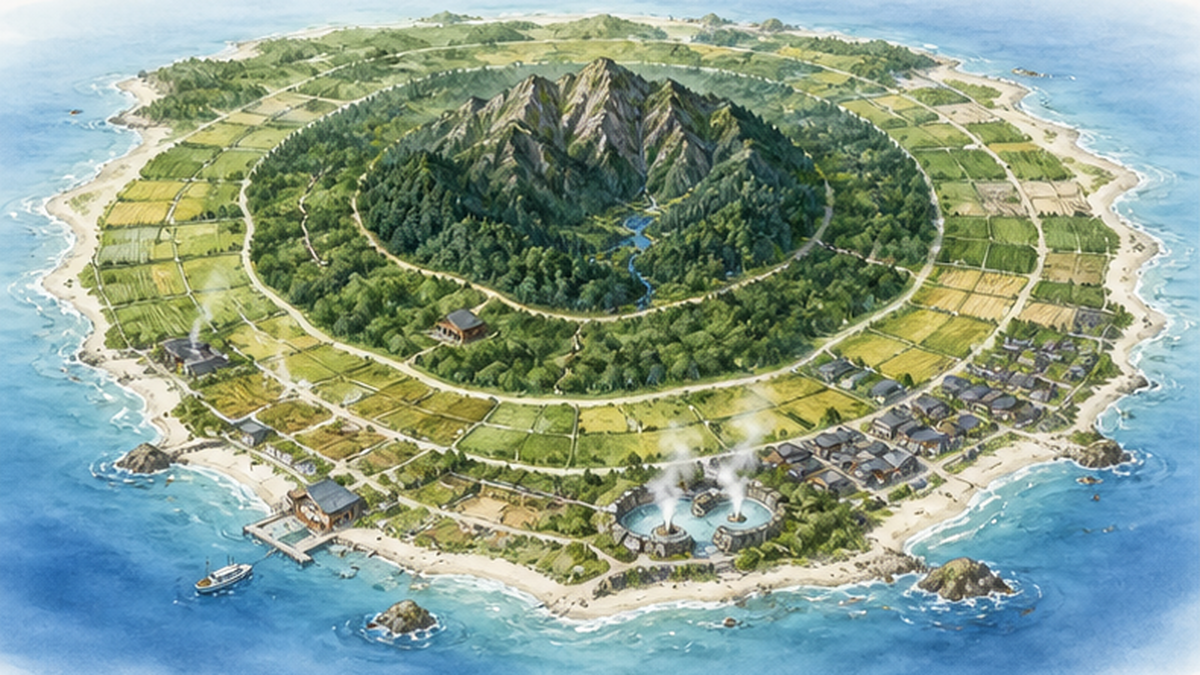
How do you protect nature without buying the land? The answer is zoning. The interior of a national park is divided in stages according to the importance of its nature, and the strictness of regulation changes zone by zone. In the strictest areas, felling even a single tree requires permission; in the mildest, a notification suffices. This gradation is the key to reconciling livelihoods with protection.
Zoning on land: from special protection zones to ordinary zones
- Special protection zones: The core of the park. Most strictly protected to preserve the landscape; collecting plants or animals and erecting structures require permission in principle
- Special zones (Class I–III): Three grades by importance. Construction, land clearing, and logging require permission
- Ordinary zones: Buffer areas outside the special zones. Activities above a certain scale require notification
Zoning at sea: marine park zones
National parks protect more than land. Under the amended Natural Parks Act that took effect in 2010, the former "underwater park zones" were expanded into "marine park zones," enabling protection of not only underwater scenery but also tidal flats, rocky reefs, and other sea-surface landscapes. Exceptional marine areas such as coral reefs and seagrass beds are designated, and activities such as collecting tropical fish or coral and land reclamation are regulated.
Preventing overuse: the use-regulated district system
Zoning also includes a mechanism for adjusting the "volume" of entry. The use-regulated district system, introduced by the 2002 amendment to the Natural Parks Act, allows limits on the number of visitors and periods of entry into areas with outstanding nature. At the Shiretoko Five Lakes in Shiretoko National Park, for example, during the season when brown bears are active, the ground trails can be walked only on tours accompanied by certified guides. Not "keeping people out" but "designing how people come in"—a leading example of use management that delivers high-quality nature experiences while limiting the burden on nature.
Beyond the marine park zones of national parks, mechanisms for protecting marine ecosystems include marine protected areas (MPAs) and Ramsar Convention wetlands, which overlap to form the safety net for Japan's seas.
| Zone | Target | Examples of regulation |
|---|---|---|
| Special protection zone | Park core (pristine nature) | Permission required in principle even for collecting plants, animals, or fallen leaves |
| Class I–III special zones | Important scenic areas | Construction, logging, and land alteration require permission |
| Ordinary zone | Buffer area | Large structures and similar works require notification |
| Marine park zone | Outstanding marine areas such as coral reefs, seagrass beds, and tidal flats | Collection of coral and similar activities and reclamation regulated |
Meanwhile, lodging facilities, campgrounds, visitor centers, and other visitor hubs are concentrated in designated "concentrated facility districts" so they do not sprawl across the park. As at Kamikochi or Oze's Yamanohana, narrowing down the hubs of use minimizes the impact on the vast nature beyond them. Zoning is a mechanism for deciding what to protect—and at the same time, for skillfully designing where to enjoy.
Key points
- The core of the zoned system: protecting scenery through zone-by-zone activity regulation instead of buying land
- In core special protection zones, even collecting plants and animals requires permission
- Since 2010, marine park zones have brought seascapes and marine ecosystems fully under protection
National Parks Connected to the Sea: From the Seto Inland Sea to "Kerama Blue"
The image of "national park = mountains" may be strong, but Japan's national parks have been tied to the sea from the very beginning. Setonaikai National Park, one of the first parks of 1934, was designated precisely for its multi-island seascape dotted with islands large and small. For 90 years it has protected a "landscape of people and sea" that includes island life and terraced fields.
Kerama Islands: the first new park in 27 years was a park of the sea
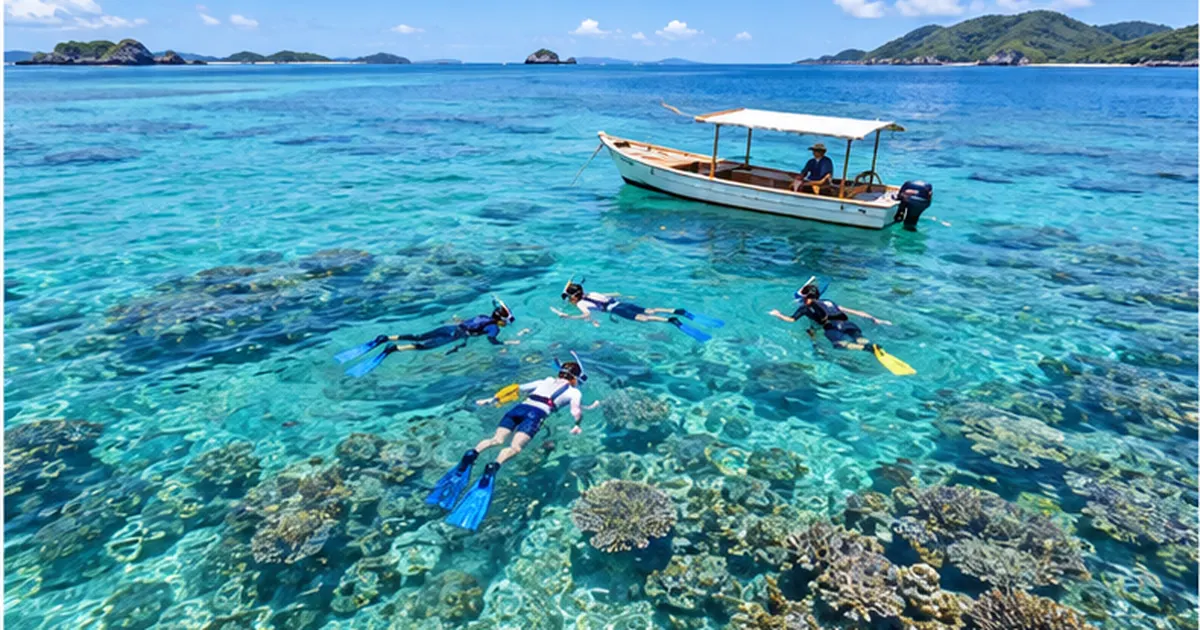
Designated on March 5, 2014, Keramashoto (Kerama Islands) National Park in Okinawa was the first newly created national park in 27 years, since Kushiro-shitsugen in 1987. Against a land area of about 3,520 hectares, its marine area of about 90,475 hectares is Japan's largest. The exceptionally clear waters known as "Kerama Blue" host dense, diverse coral communities, and humpback whales come to breed in winter. About 8,290 hectares of reef waters shallower than 30 m are protected intensively as marine park zones.
To learn how rich the coral seas are—and the crisis they now face—see our article on protecting the coral reefs of Okinawa and the Nansei Islands.
Sanriku Fukko (Reconstruction) National Park: a coastal park supporting recovery from the disaster
Born in 2013, Sanriku Fukko (Reconstruction) National Park (Aomori, Iwate, Miyagi) was created by reorganizing the former Rikuchu Kaigan National Park with the aim of contributing to recovery from the Great East Japan Earthquake—the only national park with "reconstruction" in its name. The Michinoku Coastal Trail, a long-distance path linking spectacular ria coastlines, rich fishing grounds, and earthquake remains that preserve the memory of the tsunami, lets hikers traverse the Pacific coast from Hachinohe in Aomori to Soma in Fukushima along a route totaling more than 1,000 km, generating a circulation of people and economic activity in the affected areas through walking journeys. It embodies a new role for Japan's national parks: facing both the threats and the blessings of nature.
From mountains to sea: the new park model of Hidaka-sanmyaku Erimo Tokachi
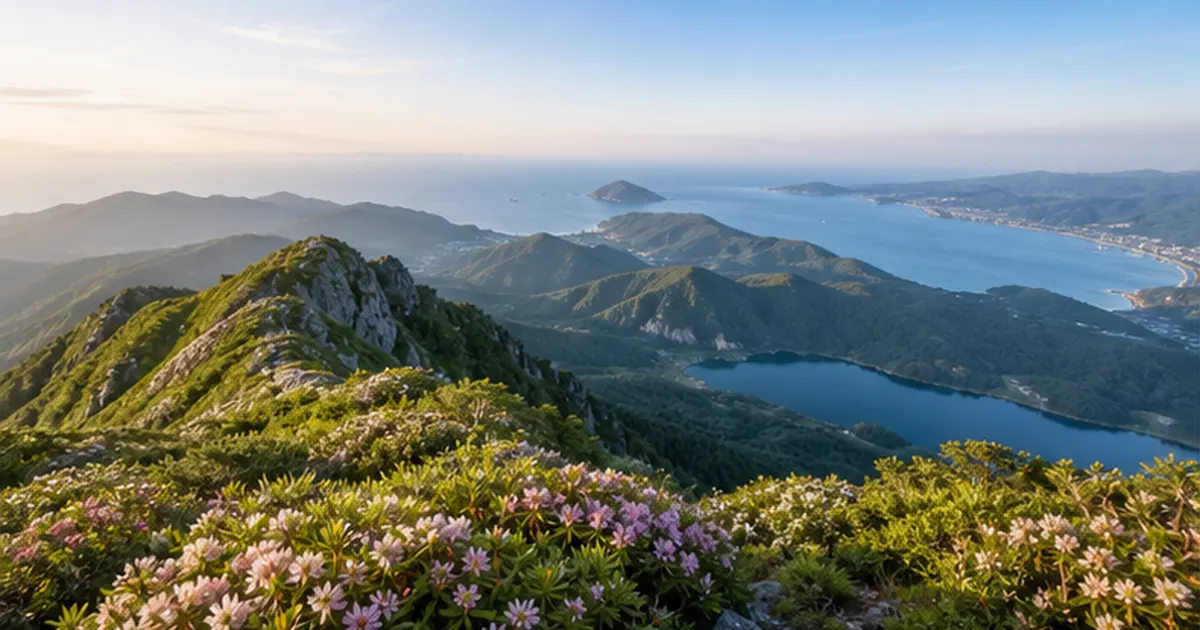
Hidaka-sanmyaku Erimo Tokachi National Park, born in 2024, is groundbreaking in designating a single continuous sweep "from mountains to sea"—from a 2,000-m-class mountain range bearing glacial landforms, through forests, to the sea cliffs of Cape Erimo and the surrounding waters. Mountain forests nurture the sea by way of rivers: the "forest-village-sea connection" that ecology has increasingly revealed is embodied in the very design of the park's boundaries. The area around Cape Erimo is also known as the stage of a "green restoration," where fishers planted trees on land once stripped bare and brought back seas rich in kombu kelp.
Examples of national parks with marine areas
- Setonaikai National Park: One of the world's great multi-island seascapes; among the first parks designated in 1934
- Keramashoto National Park: Marine area of about 90,000 ha, Japan's largest; seas of coral and humpback whales
- Iriomote-Ishigaki National Park: Includes Sekisei Lagoon, one of Japan's largest coral reef areas
- Hidaka-sanmyaku Erimo Tokachi National Park: Designated as one sweep from the mountains to the sea at Cape Erimo
The People on the Ground: Rangers and Local Collaboration
Managing the vast national parks on the ground are the Ministry of the Environment's nature conservation officers (rangers). Ranger deployment in Japan began in 1953 with just 12 officers. Today they are stationed at national parks across the country, handling a wide range of duties: permits for development activities, management of trails and visitor facilities, restoration projects for damaged nature, countermeasures against invasive species, and nature observation programs.
Active rangers and community power behind a small elite corps
Still, government staff alone cannot cover 6.5% of the national land. On the ground, active rangers assist the rangers with patrols and visitor outreach, and citizens registered as park volunteers take part in nature interpretation, cleanups, and vegetation protection. As zoned parks, Japan's national parks cannot function without the cooperation of landowners, farmers, foresters, fishers, tourism operators, and municipalities. Being "parks protected by everyone" is the essence of the Japanese model.
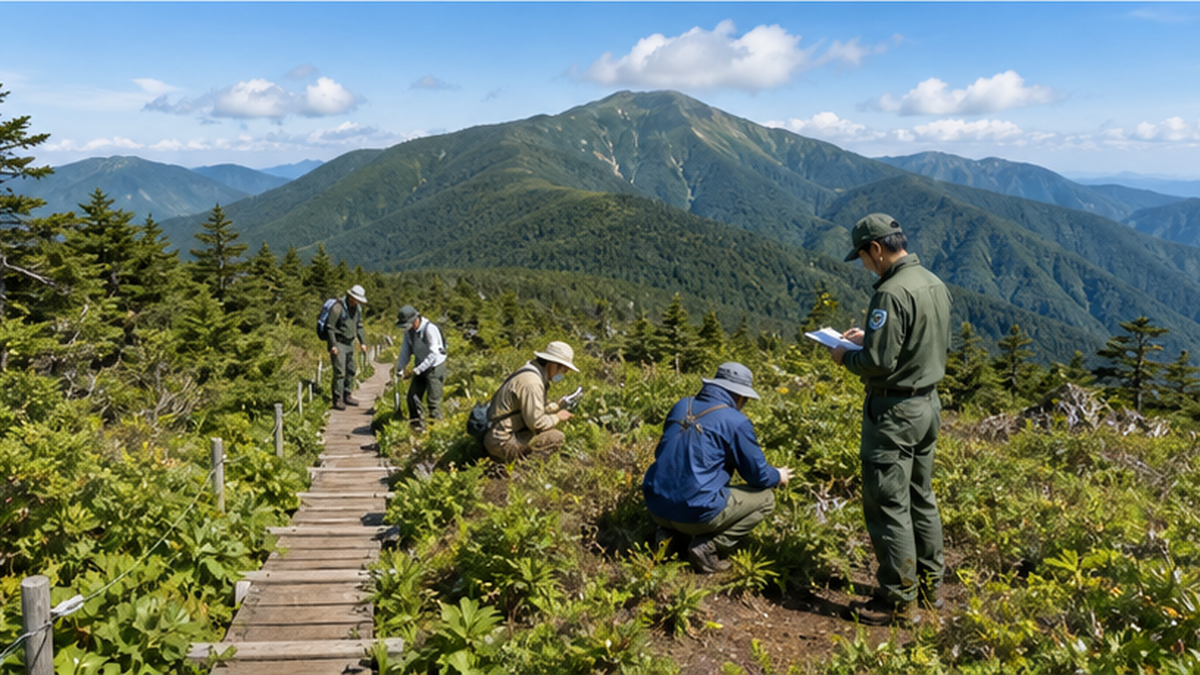
Countering invasive species that threaten ecosystems is another key duty in the field. In Ogasawara National Park, also a World Natural Heritage site, the removal of feral goats that devour island vegetation and the control of green anoles (invasive lizards) that prey on endemic insects have continued for many years, and efforts to restore the endemic ecosystems are bearing fruit. In closed ecosystems like islands and lakes, a single invasive species can drive endemic species to the brink of extinction, making both painstaking control and border measures to prevent introduction indispensable.
The point of contact with visitors is the network of visitor centers. These "gateways to the parks" present each park's origins and wildlife through exhibits and videos, with rangers and interpreters sharing seasonal nature updates; they are popular venues for family nature learning as well. Stopping by before a climb or observation outing—safety information included—lets you enjoy the park far more deeply that day.
Restoring nature through science and collaboration
Modern park management goes beyond "maintaining the status quo." Nature restoration projects that actively reclaim vanishing nature are under way across the country: restoring meandering rivers in Kushiro Marsh, supporting grassland burning in Aso, and more. In the coral seas, restoration of coral communities has continued in Sekisei Lagoon (Iriomote-Ishigaki National Park). Not just protecting but recovering through science—national parks are also the front line of nature restoration in Japan.
Balancing Tourism and Conservation: The Full Enjoyment Project and Overtourism
Japan's national parks are now riding an unprecedented wave of tourism. The "Project to Fully Enjoy National Parks," launched by the government in 2016, seeks to brand the parks as world-class "National Parks" and attract international visitors. It started in response to the government's March 2016 "Tourism Vision to Support the Future of Japan," which set a target of 10 million international visitors to the national parks, with eight parks—including Akan-Mashu, Nikko, and Keramashoto—serving as pilot models for multilingual signage and higher-quality stays. Initiatives learned from Western-style national park management, such as removing derelict buildings to improve scenery and developing nature-based activities, continue across the country under the idea of "funding protection through tourism revenue."
Inbound visitor numbers keep setting records
Partly as a result, international visitors to the national parks hit a record of about 8.44 million in 2024. The Ministry of the Environment estimates the figure reached about 9.88 million in 2025, roughly 1.5 times the pre-pandemic level of 2019. The most popular park is Fuji-Hakone-Izu, home of Mt. Fuji. Japan's mountain and sea landscapes have become a proven tourism asset that draws travelers from around the world.
Facing congestion, etiquette, and pressure on nature
At the same time, concentrated popularity raises concerns about overtourism. Trail congestion and trampling, garbage and sanitation costs, feeding of wild animals—the growth in use translates directly into pressure on nature. Moves to introduce use-management tools such as entrance fees and cooperation payments, reservation systems, and visitor caps are spreading, exemplified by Mt. Fuji's Yoshida Trail, which began collecting a trail fee and capping climber numbers in 2024.
Responding to climate change is another new theme. Since 2021 the Ministry of the Environment has been registering "Zero Carbon Parks," where tourist areas and communities within a park decarbonize together; Norikura Highlands in Chubusangaku National Park became the first. Through electric buses and renewable energy, the aim is a future where "visiting a national park is itself an environmentally friendly journey."
Mechanisms that return money collected from visitors to conservation and facility upkeep attempt to build a circuit in which "enjoying" leads to "protecting." Protection and use need not be opposed—designed well, they can support each other. The philosophy of the Natural Parks Act, which set out "protection and use" side by side 90 years ago, is being put to the test anew.
More use, more pressure
- Trail congestion and erosion, trampling of vegetation
- Garbage brought in or left behind; rising sanitation costs
- Ecosystem impacts from feeding or approaching wild animals
- Countermeasures spreading nationwide: entrance fees, reservation systems, visitor caps
Japan's National Parks and the World: World Heritage and Protected-Area Networks
Japan's national parks are deeply tied to international conservation frameworks. The World Natural Heritage sites of Yakushima; Shiretoko; the Ogasawara Islands; and Amami-Oshima Island, Tokunoshima Island, the northern part of Okinawa Island, and Iriomote Island all have national parks at their core (only Shirakami-Sanchi has a Wilderness Area as its core instead). The strict zoning of the national parks functions as the guarantee of protection required for World Heritage status.
National parks in the 30by30 era
The Kunming-Montreal Global Biodiversity Framework adopted in 2022 set the "30by30" target of conserving at least 30% of land and sea by 2030. Japan, too, is expanding and upgrading its protected areas—led by the national parks—toward this goal. Together with marine protected areas (MPAs), quasi-national parks, and Ramsar wetlands, the national parks are the backbone supporting this international target.
From protecting scenery to protecting ecosystems
The national park system was originally created to protect "outstanding scenery." Today, however, its role in protecting the ecosystems and biodiversity behind the scenery is growing rapidly. The Okinawa rail in the forests of Yambaru, the corals and humpback whales of Kerama, the ice-age relict species of the Hidaka Mountains—the 35 parks are also an "ark" for passing Japan's biodiversity on to the future.
World Natural Heritage sites anchored by national parks
- Yakushima (inscribed 1993): Yakushima National Park
- Shiretoko (inscribed 2005): Shiretoko National Park
- Ogasawara Islands (inscribed 2011): Ogasawara National Park
- Amami-Okinawa (inscribed 2021): Amami Gunto, Yambaru, and Iriomote-Ishigaki National Parks
Enjoying the Parks and Becoming a Guardian: What We Can Do
The greatest charm of the national parks is that anyone can visit and enjoy them. Admission is free in principle, and each of the 35 parks has a completely different character. Start by finding the national park nearest you on a map—many people will discover a park boundary within commuting distance.
35 parks, 35 ways to enjoy them
- Shiretoko (Hokkaido): Drift-ice walks in winter and guided hikes through the primeval forest of the Shiretoko Five Lakes
- Chubusangaku (Nagano, Gifu, and others): From riverside strolls at Kamikochi to traverses of the Northern Alps
- Fuji-Hakone-Izu (Yamanashi, Shizuoka, and others): Views of Mt. Fuji, hot springs of Hakone, and the coastal beauty of Izu
- Setonaikai (11 prefectures): Sunset over the island-studded sea and island-hopping cycling on the Shimanami Kaido
- Keramashoto (Okinawa): Diving in the Kerama Blue and whale watching in winter
Whether you love mountain walks, relaxing in hot springs, or diving in the sea, somewhere among the 35 parks you will surely find "your park." What matters is not separating enjoyment from protection. Using local guided tours and inns turns your travel spending directly into local strength that supports the park.
Basic etiquette for visitors
- Do not collect or harm plants and animals (in special protection zones, even a fallen leaf is subject to collection rules)
- Carry out all your trash; never feed wild animals
- Stay on trails and boardwalks (alpine plants and wetlands can take decades to recover once damaged)
- Cooperate actively where entrance fees or cooperation payments are in place
- Check each park's rules in advance for drone photography and large-group visits
How to get involved on the protecting side
For those who want to go a step further, there are many entry points. Activities in which citizens support the parks—park volunteering, nature observation programs, beach cleanups, and monitoring surveys of coral and vegetation—are expanding year by year. As zoned parks, Japan's national parks are a system in which not just the government but everyone who visits or lives there can be a guardian.
Actions you can take today
- Look up your nearest park and its highlights on the Ministry of the Environment's "National Parks of Japan" website
- Choose a national park as your travel destination and use local inns and guided tours so your money supports the region
- Stop by a visitor center to learn about the park's nature and conservation efforts
- Try joining park volunteer programs, nature observation events, or cleanup activities
Summary of this article
- Japan's 35 national parks cover about 6.5% of the national land and receive over 300 million visits a year
- The history runs 90 years, from Setonaikai, Unzen, and Kirishima in 1934 to Hidaka-sanmyaku Erimo Tokachi in 2024
- Japan's defining feature is the "zoned park" system, designating areas—including private land—without purchase
- Zoning from special protection zones to marine park zones reconciles livelihoods with protection
- International visitors hit a record of about 8.44 million in 2024; entrance fees, caps, and other use design are advancing
- National parks underpin World Heritage and 30by30, and anyone can take part as a guardian
References and Sources
- Ministry of the Environment, "National Parks of Japan" – Official overview of the number of parks, share of national land, annual visits, and history
- Ministry of the Environment press release – "Japan's 35th national park, Hidaka-sanmyaku Erimo Tokachi National Park, is born!" (June 25, 2024)
- Ministry of the Environment, "Overview of the Natural Parks Act" – Explanatory material on the Act's purpose, the zoned park system, and zoning categories
- Ministry of the Environment, "Overview of the National and Quasi-National Park System" – Basic material on the zoned vs. state-owned comparison and land ownership shares
- Ministry of the Environment, "Keramashoto National Park" – Official page (designation overview and marine park zones)
- Ministry of the Environment, "National Park Use Trends in 2025" – Estimates of international visitors to national parks (published March 2026)
- Biodiversity Center of Japan, "National Park Areas" – Basic data on park areas and zoning categories
- Tokyo Metropolitan Government, "What Are Natural Parks?" – Explanation of the natural park system (national, quasi-national, prefectural)
- nippon.com, "A Record 8.44 Million Visitors to National Parks" – Report on 2024 international visitor numbers (based on Ministry of the Environment figures)
* Ordered by reliability: government and academic institutions > peer-reviewed papers > specialized organizations > trusted media