⚡ In short
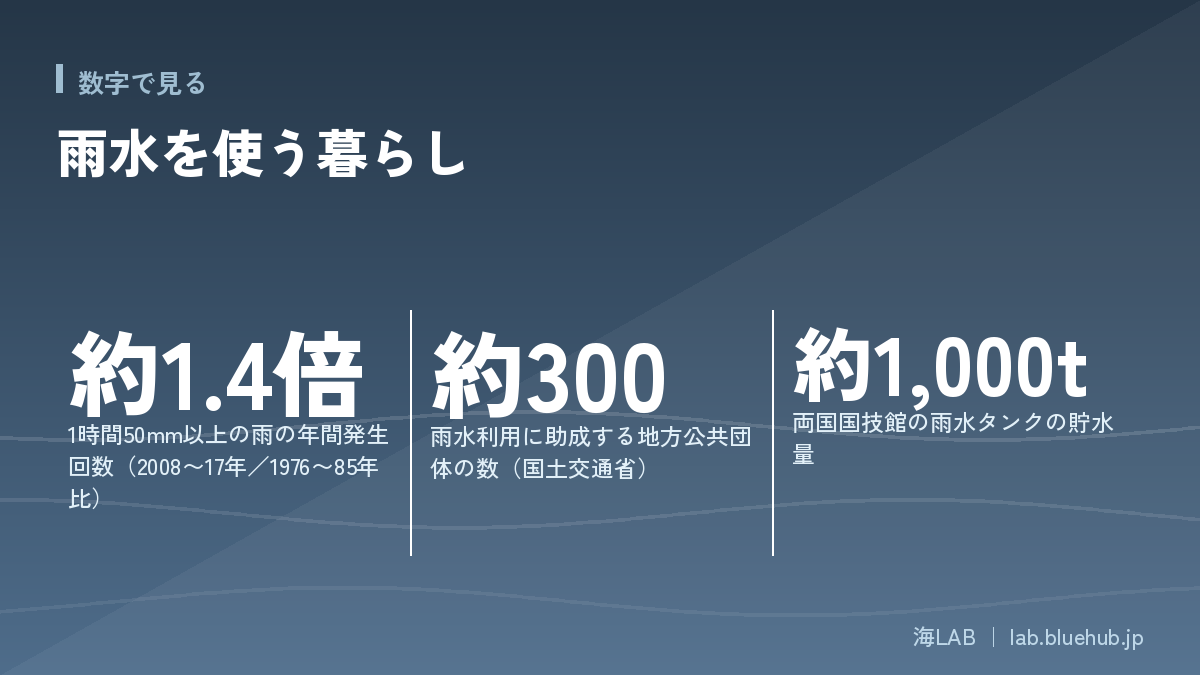
Rainwater tanks and infiltration basins save water and also help cities cope with floods. Hourly rainfall of 50 mm or more has become about 1.4 times more frequent, and roughly 300 local governments offer subsidies. Covers Sumida Ward, the law, and the limits.
Rather than treating rain as 'water to throw away', see it as 'water we can use'. Rainwater use is a familiar approach that saves water and helps against floods at once.
In cities the ground is covered with pavement, so rain cannot soak in and rushes into drains. Short, intense downpours are also increasing, raising the risk of inland flooding.
This article organizes, from public sources, how rainwater tanks work in practice, municipal subsidies, the pioneering case of Sumida Ward, the law and basin-wide flood management, and the limits of rainwater use.
What you will learn in this article
- The basics of rainwater use (storage and infiltration)
- Why urban rain causes floods so easily
- How to use a home rainwater tank and what to watch out for
- Subsidies and the Sumida Ward case
- The rainwater use law and basin-wide flood management
- Limits of rainwater use and realistic ways to live with it
What does it mean to 'use' rainwater?
We use tap water even for toilets and watering
Tap water is purified to drinking quality. Yet part of the water used at home goes to toilet flushing, garden watering and car washing, which do not need drinking-quality water. Rainwater use means collecting rain that falls on the roof and putting it to these uses. Rain has just fallen from the sky and contains few minerals, so with a little treatment it is perfectly usable.
You may picture a small tank in the garden. In reality sizes vary widely, from home tanks of tens to hundreds of liters to underground cisterns of thousands of tons in large facilities. What they share is the idea of not sending rain straight to sewers and rivers, but holding it nearby for a while.
'Using' and 'soaking in' are two sides of the same goal
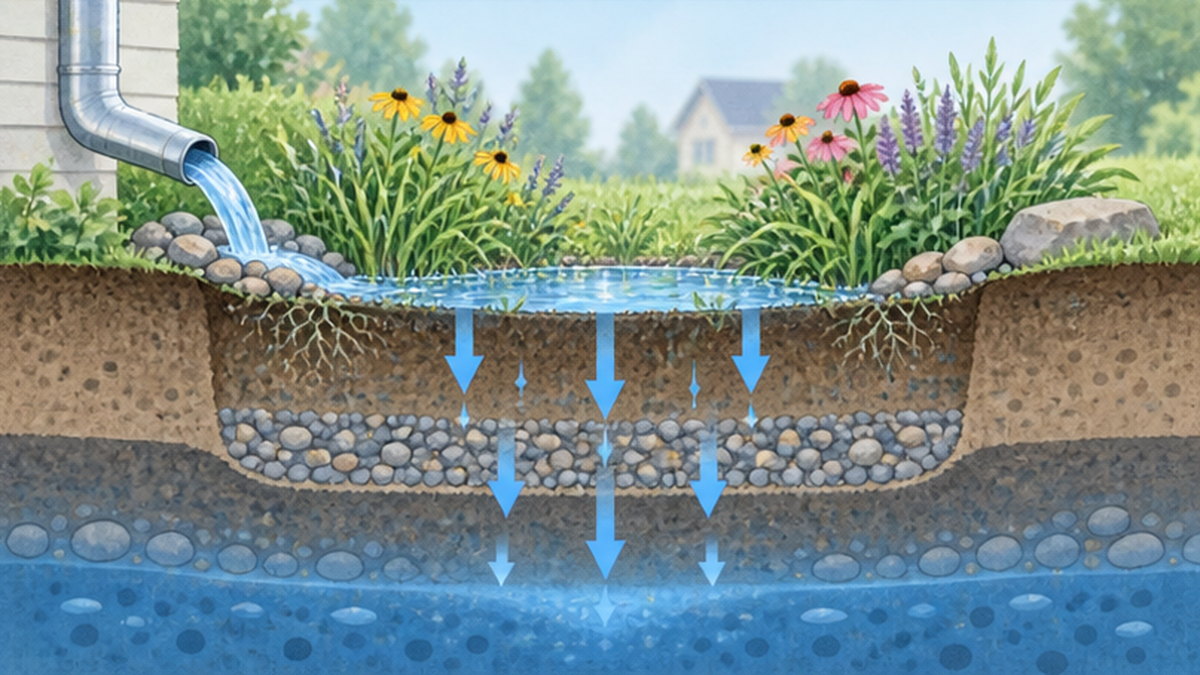
Methods fall into two broad groups. One is storage: rain is kept in tanks or underground chambers to be used later or released slowly. The other is infiltration: rain soaks into the ground through infiltration basins or permeable pavement and joins groundwater. Both soften the sudden flow of rain into rivers and sewers.
- Storage: keep water in tanks or underground chambers; usable for toilets, watering, cooling, etc.
- Infiltration: let water soak into the ground; supports groundwater recharge and springs
- Both reduce the amount of water flowing into drains at the peak of rainfall
Scope of this article
This article first explains why urban rain now causes floods more easily, then looks at home rainwater tanks, municipal subsidies, city-scale efforts typified by Sumida Ward, and the ideas behind the law and basin-wide flood management. Finally, it honestly checks the limits of rainwater use.
Three reasons rainwater use is attracting attention
Three trends explain the renewed attention. First, intense rain is increasing and burdening urban drainage. Second, producing and delivering tap water takes energy and money, so covering non-drinking uses with other water saves resources. Third, rainwater can secure water for daily needs when disasters such as earthquakes or heavy rain cut off the supply.
- Flood control: store rain to lower the peak flowing into drains
- Water saving: reduce tap water for non-drinking uses such as toilets and watering
- Disaster preparedness: usable for toilet flushing and cleaning during outages
These three look separate but can be achieved with the same equipment. A tank holding rainwater eases flood peaks, saves tap water and prepares for disasters. Rainwater use can be called a 'multifunctional small infrastructure' that plays several roles with one facility.
Rainwater wisdom from the past
Using rainwater is not new. Across Japan there were rain barrels under eaves and customs of keeping rainwater for firefighting and sprinkling water on streets. Before tap water spread, rain and well water were vital sources. Modern rainwater use can be seen as an update of this traditional wisdom in materials and design.
Why urban rain causes floods so easily
When the ground is sealed, rain changes from 'water that soaks in' to 'water that flows'
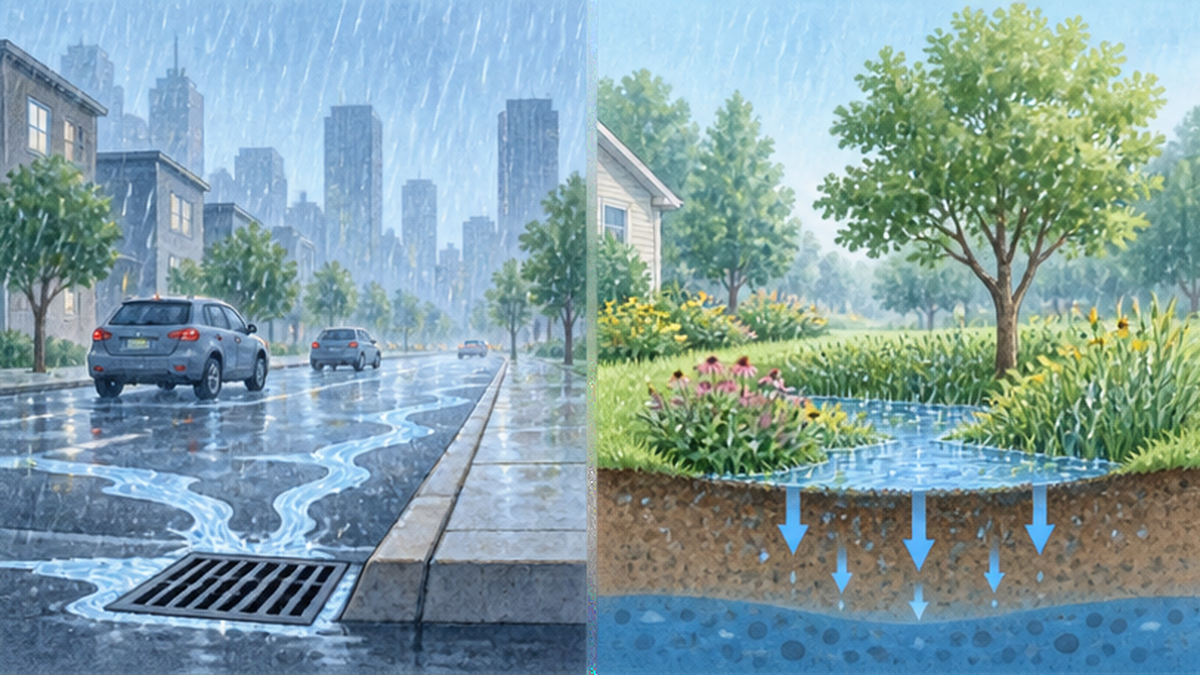
Much of the rain falling on forests, grass and fields soaks into the soil and slowly reaches groundwater and rivers. In cities, roofs, asphalt and concrete cover the ground. With nowhere to soak in, rain gathers in drains and reaches rivers in a short time.
The Ministry of Land, Infrastructure, Transport and Tourism (MLIT) also explains that urbanization reduces the area where rain can infiltrate and increases the amount flowing into rivers and sewers, as a background to inland flooding. Inland flooding here means water overflowing within the city because urban drainage cannot keep up, before rivers overflow.
Intense short rain is really increasing
According to Japan Meteorological Agency (JMA) material based on AMeDAS observations, the annual number of hours with 50 mm or more of rain shows an increasing trend over 1976–2016, statistically significant at the 99% confidence level. In the latest decade (2008–2017) it was about 1.4 times that of the first decade (1976–1985).
Sewers are often designed to carry rain up to a certain level. As short intense rain exceeding the design becomes more common, drainage more often fails to keep up. So beyond enlarging sewers and rivers, the idea of reducing runoff where the rain falls has gained weight.
| Ground surface | Fate of the rain | Effect downstream |
|---|---|---|
| Forest, grass, fields | Soaks in and flows out slowly | River levels rise gently |
| Pavement, roofs | Goes almost directly to drains | Water concentrates in a short time |
| Infiltration basins, permeable pavement | Partly soaks into the ground | Lowers the peak and also contributes to groundwater |
| Rainwater tanks, underground cisterns | Held first, then released or used | Reduces peak runoff |
Key point
- Urban flood control cannot rely only on enlarging rivers and sewers
- Storing rain or letting it soak in where it falls lightens the burden downstream
The idea of the 'runoff coefficient'
River and sewer design uses a number called the runoff coefficient, showing how much of the rain flows out. Generally roofs and pavement are close to 1, and grassland and forest are smaller. The more the ground is paved, the larger the share of rain that runs off. As urbanization advances, the runoff coefficient of the whole basin rises, and the same rain raises river levels more easily.
Rainwater storage and infiltration facilities 'effectively' lower this coefficient. Rain from a roof stored in a tank does not flow downstream. Even if each facility is small, many houses and buildings together can flatten runoff across the basin.
Inland flooding versus river flooding
| Type | What happens | Main cause |
|---|---|---|
| River flooding | River water overflows or breaks the levee | Rising water from heavy rain across the basin, including upstream |
| Inland flooding | Water overflows in the city because drainage cannot keep up | Short intense rain, rainfall beyond drainage capacity, high river levels preventing drainage |
Inland flooding can occur in residential areas, underground malls and underpasses even when rivers do not overflow. Low-lying land and underground spaces suffer easily, and it is watched as an urban-specific flood. Reducing water where the rain falls is effective preparation against exactly this.
How home rainwater tanks work in practice
From roof to barrel via the downspout
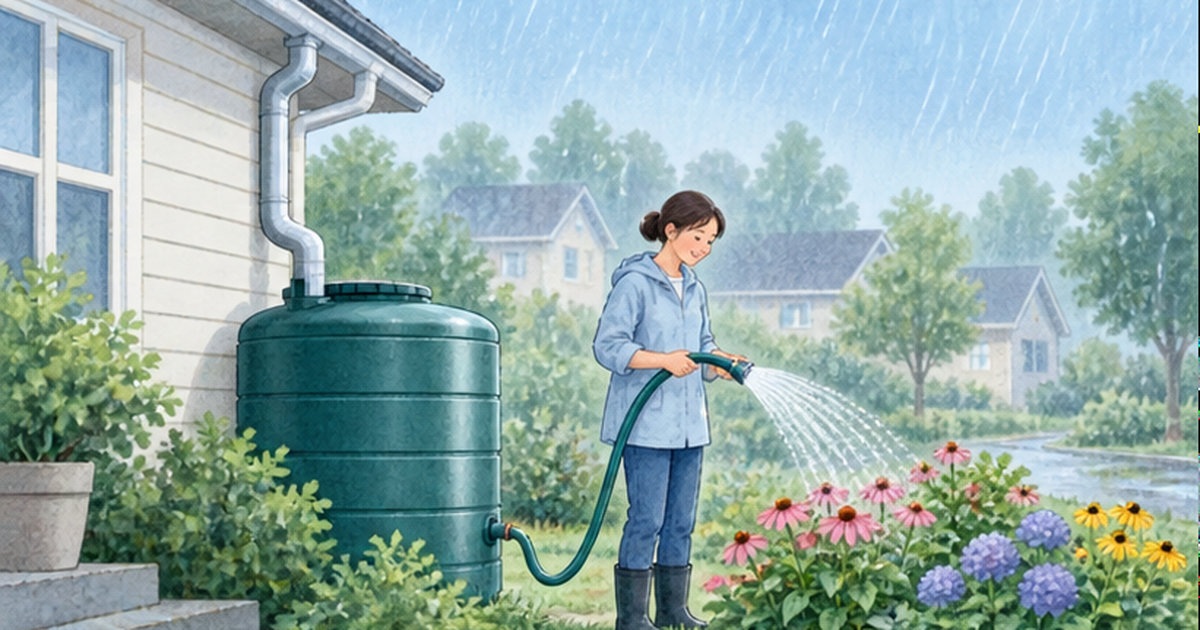
A home rainwater tank collects rain falling on the roof through the downspout and stores it. The water can be used for garden and flower bed watering, sprinkling, car washing and cleaning the balcony. Besides cutting the water bill, it gives peace of mind as a water source during disasters.
You can store more than you think
Rainwater volume can be roughly estimated as roof area (m²) × rainfall (mm) = liters. For example, for a house with 50 m² of roof (horizontal projection) and 10 mm of rain, the simple calculation gives 50 × 10 = 500 liters. In practice it is less because of the roof material and the initial dirty water discarded, but one rain can easily fill a tank of a few hundred liters.
This calculation is a guide for getting a feel for the volume. Actual collection varies with roof material, slope, discarding of first flush, evaporation and tank capacity.
Points to note when using it
- Do not drink it: because of dirt on roofs and gutters and the effects of birds and insects, do not use it for drinking or cooking
- Prevent mosquitoes: cover with a lid or mesh so larvae do not breed
- Clean regularly: leaves and mud accumulate, so make cleaning the filter net and the bottom a habit
- Winter freezing and overflow drainage: secure a drainage route so overflow does not pool around the house
Trivia
- Rainwater is used as soft water (close to soft water) suited to watering plants and laundry. However, for laundry and similar uses, follow the guidance of your municipality or manufacturer with hygiene in mind
First steps
- Check your roof area and where the downspouts are
- Find out whether your municipality has a rainwater tank subsidy
- Start with a small tank of 50–100 liters
Types of tanks and how to choose
Home tanks include freestanding types placed in the garden, slim types connected to the downspout against a wall, and underground types. When choosing, check the location, desired volume, appearance, ease of cleaning and capacity conditions for municipal subsidies together.
| Type | Features | Suited to |
|---|---|---|
| Freestanding | Easy to install and move; many products hold about 100–300 liters | Detached houses with a garden or balcony |
| Slim | Fits against a wall and takes little space | Small lots and apartments |
| Underground | Large capacity, does not spoil the view; requires construction | New builds or homes with exterior work |
Ways to improve collection efficiency
- Fit a filter net (collector) on the downspout to remove leaves and debris
- Rain at the start of a shower carries roof dirt, so use a valve or device to discard the first flush
- Set the tank tap at a height where a watering can fits
- Send overflow to garden plantings or an infiltration basin
The first rain tends to contain dust and bird droppings from the roof, lowering water quality. Discarding the first flush takes a little effort but is important for using the stored water comfortably.
Role as water in disasters
When water supply stops, securing water for flushing toilets as well as drinking water becomes a major problem. Having water for flushing helps maintain hygiene in evacuation life. Tank water cannot be drunk as is, but can go to flushing, cleaning and rinsing. By using it daily for garden watering, you also prepare a water source for emergencies.
Municipal subsidies: nearly 300 offer them nationwide
Many municipalities subsidize installing tanks and infiltration basins
According to MLIT's water resources page, about 300 local governments nationwide have subsidies for installing rainwater tanks and infiltration basins. Another MLIT document says 266 municipalities had subsidies for facilities that store or infiltrate rainwater as of March 2021. Numbers vary by year and scope, but many municipalities clearly support it.
Subsidy details differ by municipality. Tank capacity, location, application timing and budget caps are set, so always check the conditions with your city office or its official page before buying or building. Setagaya Ward, Ota Ward, Yokohama and others explain their programs on official pages.
Typical flow to receive a subsidy (general example)
- Check eligibility, upper limit and application period on the municipality's official page
- Apply before installation (applications after purchase are often not eligible)
- Buy and install after receiving the grant decision
- After installation, submit a completion report with receipts and photos
Caution
- Some municipalities stop accepting applications mid-year when the budget is reached
- Buying or building before applying may make you ineligible
- Amounts and conditions may change each fiscal year

How to find subsidies
A simple way is to search 'your municipality + rainwater tank + subsidy' or 'rainwater infiltration basin + subsidy'. MLIT's water resources pages also introduce rainwater use efforts and municipal subsidies. Some municipalities subsidize part of the tank purchase, others cover infiltration basin installation, and some cover both.
Eligible capacity and whether apartments and businesses are included are decided by each municipality. Even similar programs differ in detail, so do not apply another municipality's information as is.
National moves supporting rainwater use
MLIT has published guidelines on promoting rainwater use and issued a revised edition in March 2025 (Reiwa 7). The guidelines summarize the thinking on planning, design and maintenance of rainwater facilities for municipalities and businesses to reference. This national support underpins municipal subsidies and adoption in large facilities.
Learning from Sumida Ward: town-wide rainwater use
Ryogoku Kokugikan: Japan's first full-scale rainwater tank facility
Sumida Ward, Tokyo, is known as a pioneer of rainwater use. According to the ward's official page, around 1981 the ward asked the Japan Sumo Association to introduce rainwater use at Ryogoku Kokugikan for flood prevention and effective use of water resources. The Kokugikan rainwater tank completed in 1984 is regarded as Japan's first full-scale example, storing about 1,000 tons. The water is used for toilet flushing, cooling and watering.
Large buildings become 'mini dams'
Sumida Ward has since spread rainwater use to facilities across the ward. Ward materials and reports introduce Tokyo Skytree (2,635 tons), the Edo-Tokyo Museum (2,500 tons), Sumida Ward Office (1,000 tons), Sumida Small and Medium Enterprise Center (770 tons) and Sumida General Gymnasium (696 tons). The Tokyo Shimbun described Sumida's rainwater storage as a 'mini dam' and reported that over 23,000 tons are used across the ward.
If a large amount of rainwater is stored under a building, less water rushes into sewers during heavy rain. On fine days, the stored water can go to toilets and watering. The strength of rainwater use is that it serves both disaster prevention and water resources.
Rojison: neighborhood disaster wells
In the densely built wooden-house area of Mukojima in Sumida Ward there are small facilities called rojison that store rainwater and draw it with a hand pump. They are a local ingenuity used for initial firefighting and as water for daily needs during disasters.
Key points of the Sumida model
- Use the basements of large buildings as cisterns and use the water for toilets, cooling and watering
- Reduce the water flowing into sewers during heavy rain
- Keep small facilities residents can use, like rojison
Why did rainwater use spread in Sumida?
Sumida Ward lies on low ground between the Arakawa and Sumida rivers and is highly alert to floods. The ward's request to the Kokugikan aimed to combine flood control with effective use of water resources. Starting in the 1980s, the effort spread to private buildings, schools and public facilities, and led to ward subsidies and a local movement to 'make use of rainwater'.
Sumida's efforts show that rainwater use is not just water saving but can be part of town planning. Large facilities take the lead in storing rain while residents encounter rainwater firsthand at rojison. Such layered efforts can be said to nurture local disaster awareness.
Applying it in your own town
- Find out whether public facilities, schools and large stores use rainwater
- Propose rainwater cisterns when building or renovating
- Hold events where people can experience rainwater tanks and sprinkling
The law and basin-wide flood management: handling rain as a society
Act on the Promotion of Rainwater Use (in force 2014)
The Act on the Promotion of Rainwater Use (Act No. 17 of 2014), in force on May 1, 2014, aims to promote rainwater use given that appropriate water cycle management has become an issue with climate change. It is positioned as contributing to effective use of water resources and also to curbing the concentrated runoff of rainwater into sewers and rivers.
- The national government and independent administrative agencies set targets for installing rainwater facilities in buildings they construct (Article 10)
- Local governments and others endeavor to set and publish similar targets (Article 11)
- The national government formulates a basic policy on promoting rainwater use
Based on this law, the target for national buildings was approved by the Cabinet in March 2015. MLIT has also published guidelines on rainwater use and issued a revised edition in March 2025.
Basin-wide flood management: catching water across the whole basin, not only in rivers
MLIT's basin-wide flood management (ryuiki chisui) is an effort where residents, companies and municipalities in the basin reduce flood damage together, in addition to levees and dams built by river administrators. It includes rainwater storage and infiltration facilities, land use regulation and guidance, and pre-release from dams. Home rainwater tanks and infiltration basins are a small part of this large framework.
The related laws on basin-wide flood management also made it easier to promote rainwater storage and infiltration facilities through designation of specified urban rivers. Even if each home tank is small, the idea is that many together can lighten the burden on the whole basin.
Tokyo's rainwater infiltration efforts
Tokyo Metropolis summarizes the thinking on infiltration basins and pipes in its rainwater infiltration guidelines and the Bureau of Sewerage's 'Rainwater Infiltration Handbook' (March 2024). The technical guidelines show methods that use coefficients considering the effects of groundwater level and clogging when estimating infiltration capacity. Infiltration facilities must be maintained to avoid clogging, not just installed.
| System / effort | Main content |
|---|---|
| Act on the Promotion of Rainwater Use (2014) | Targets for rainwater use in national and municipal buildings; basic policy |
| Basin-wide flood management | Flood measures integrating rivers, sewers and the basin |
| Designation of specified urban rivers | Framework promoting rainwater storage and infiltration facilities |
| Municipal subsidies | Support for the cost of installing tanks and infiltration basins |
How we use rain changes how we see water in daily life
Laws and basin-wide flood management may feel far from daily life. But small actions, like putting a tank under the downspout or installing an infiltration basin in a corner of the garden, connect directly to water management for society as a whole. Basin-wide flood management is distinctive in that each resident can carry out fine-grained runoff control that government alone cannot.
Seeing rain not as a 'nuisance' but as a 'usable resource' is the first step toward towns that are resilient to floods and value water.
Infiltrating rainwater: links to groundwater, springs and the sea
Rain that soaks in becomes a water source over years to decades
Rain falling on pavement reaches rivers in tens of minutes if it flows away. Rain that soaks in from gardens or infiltration basins moves slowly through the soil and becomes groundwater. Groundwater is a hidden urban water source supporting well water, springs and normal river flow. Increasing infiltration not only eases floods but also recharges groundwater.
This groundwater mechanism is covered in detail in our article Where Does Groundwater Come From? The Science of Recharge and Land Subsidence. Rainwater use and infiltration are the entrance to it.
Infiltration basins and permeable pavement
A rainwater infiltration basin is a small facility with holes in its bottom and sides that lets collected rain soak from a gravel layer into the surrounding soil. Many products are for homes, installed under roof downspouts, and are eligible for municipal subsidies. Permeable pavement lets rain on the road pass through gaps in the pavement to the layer below, and is used in parking lots and walkways.
However, infiltration basins may be less effective or need care where groundwater is high, the soil is clayey, or near slopes and cliffs. That is why Tokyo's technical guidelines instruct choosing facilities after checking the infiltration capacity of each site.
| Method | Suited places | Cautions |
|---|---|---|
| Infiltration basin | Under downspouts of detached houses | Little effect in clayey soil or high groundwater; clogging measures needed |
| Permeable pavement | Parking lots, walkways, parks | Surface clogging; handling in freezing regions |
| Rainwater tank | Houses, apartments, facilities | Managing mosquitoes, water quality and capacity |
| Underground cistern | Large and public facilities | High installation cost |
Rain in the city finally reaches the sea
Rain falling on the city ultimately flows into the sea through drains and rivers. In heavy rain, litter, mud and oil on the road are flushed into rivers all at once and reach estuaries and coasts. Slowing and reducing the flow of rain also helps soften the concentrated inflow of pollutants to the sea.
The problem of litter carried from rivers to the sea is explained in Plastic Waste Flowing from Rivers to the Ocean. Efforts to lower the rain peak are thought to help weaken the force of such outflows. However, it cannot be said that rainwater use itself directly improves the marine environment; it is only part of measures across the whole basin.
Combined sewers and overflow in wet weather
Sewers in older urban areas include combined systems that carry sewage and rainwater in the same pipe. In heavy rain, water beyond treatment capacity may be discharged untreated into rivers or the sea, called combined sewer overflow. Storing rainwater in tanks or cisterns to reduce runoff can help reduce the frequency and volume of such overflows.
The relationship between sea and rainwater in one line
- Keeping rain in the city works to lighten the burden on rivers, estuaries and the sea. However, the size of the effect differs with the region and the scale of the facility
Limits and challenges of rainwater use
Not a cure-all: far too little for heavy rain volumes
Honestly, home rainwater tanks alone cannot prevent floods. A tank of a few hundred liters is tiny compared with the water of a downpour. And if the tank is full when the next rain comes, it gives no storage effect. To work for flood control, it needs operation such as emptying before rain or releasing slowly through a narrowed outlet.
Water quality and maintenance
Rainwater is not sterile. It contains roof material and airborne dust, and should not be drunk or used for purposes touching the body. Large facilities need filtration and disinfection equipment. Neglected tanks can become mosquito breeding sites.
Cost-effectiveness and how widespread it is
It can be hard to recover installation costs from water bill savings alone. Municipal subsidies play a role in easing this initial burden. It is realistic to consider not only the economics of saving water but also the value for disaster prevention and environmental education.
- Effects are 'small but cumulative': small for one house, but community-wide efforts contribute to reducing runoff
- Decide where and when to use it: limit to watering, sprinkling and toilets where water quality can be relaxed
- Assume maintenance: plan for the effort of cleaning and inspection
- A supplementary measure under climate change: combine with levees, sewers and basin-wide flood management
Caution
- Do not expect too much 'flood control effect' from rainwater tanks. The effect depends on storage volume, operation and local conditions, and does not replace other flood control measures
Rainwater use and the future under climate change
Warmer air holds more water vapor, and heavy rain is thought to become more likely. With short intense rain likely to keep increasing, measures that store rain and curb runoff look set to grow in importance. On the other hand, some years have long dry spells, and storing rain helps save water. Rainwater use is one of the few means that address both the 'too much' and 'too little' rain problems.
However, how much flood damage rainwater use can reduce depends on local conditions. Without overestimating individual effects, it is essential to combine it with other measures such as levees, sewers and evacuation plans.
Living with rainwater starting today
Five things you can do in daily life
- Put a bucket or small tank under the downspout and use it for watering and sprinkling
- Check municipal subsidies and consider installing a rainwater tank or infiltration basin
- Consider replacing concrete in parking areas or gardens with gravel or more permeable materials
- On a rainy day, observe the flow of water around your home and find where puddles form
- Ask the manager of your apartment building or workplace about rainwater use and drainage measures
Working together in the community
As the Sumida rojison case shows, rainwater use gains strength when shared by a community, not just individuals. You can start by placing a small tank with your neighborhood association, school or park manager. It also becomes teaching material for children to learn where rain goes, and a chance to feel the water cycle linked to the sea.
To see the water cycle from a wider view, also read Technologies to Protect Limited Water (Saving, Gray Water, Rainwater Use).
Summary of this article
- Rainwater use keeps rain nearby through storage and infiltration
- Short intense rain is increasing, and in cities rain easily rushes into drains all at once
- About 300 municipalities nationwide offer subsidies for rainwater tanks and more
- Some places, like Sumida Ward, use large buildings as 'mini dams'
- The effect is limited, but worth accumulating as part of basin-wide flood management
References and Sources
- MLIT, Water Resources: Efforts to Promote Rainwater Use – Rainwater use efforts and status of municipal subsidies
- MLIT, Water Resources: Act on the Promotion of Rainwater Use – Outline of Act No. 17 of 2014
- MLIT Guidelines on Promoting Rainwater Use (revised March 2025) – Thinking on planning, design and maintenance
- MLIT, Promotion of Basin-wide Flood Management – Framework of basin-wide flood management
- MLIT, Support Measures for Rainwater Storage and Infiltration Facilities – Support for storage and infiltration facilities
- JMA, Long-term Changes in Short-duration Heavy Rain Observed by AMeDAS – Long-term change in rain of 50 mm+/hour
- Sumida Ward, History of Rainwater Use – Request for rainwater use at Kokugikan, etc.
- Sumida Ward, Rainwater – Sumida Ward's rainwater use efforts
- Tokyo Bureau of Sewerage, Rainwater Infiltration Handbook (March 2024) – Rainwater infiltration basins and pipes
- Tokyo Shimbun: Using rain, over 23,000 tons — Sumida Ward as a mini dam – Report on Sumida Ward's rainwater storage
* Listed in order of reliability: government and academic institutions > peer-reviewed papers > specialist organizations > trusted media