⚡ In short
Nature journaling is a notebook habit of recording nature in pictures, words and numbers. Learn the research showing drawing can double recall, how to start by the sea, tools, tips for sticking with it, and how to use the Ikimono Log for citizen science.
Nature journaling is a habit of recording the nature in front of you in a notebook with pictures, words and numbers, building observation skills and curiosity. Skill at drawing does not matter. What matters is gathering the things you only notice once you try to draw them.
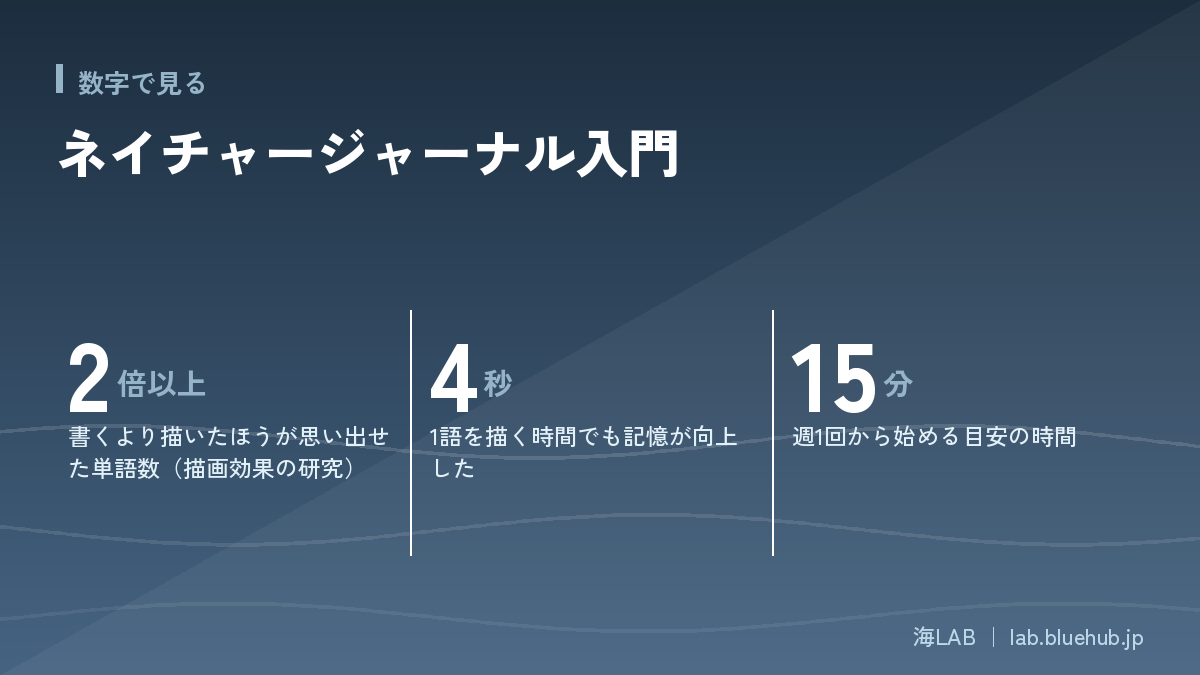
In research at the University of Waterloo in Canada, people recalled more than twice as many words when they drew them rather than just wrote them, a result called the "drawing effect." Using pictures in observation records therefore has an experimental basis.
This article walks through the sea as a setting: tools, the basic format, what to observe, linking notes to citizen science, and tips for continuing.
What you'll learn in this article
- What nature journaling is and how it differs from diaries and sketching
- Why drawing deepens memory and observation (the drawing effect)
- Preparation with just a notebook and pencil, plus basic seaside safety
- The three prompts: notice, wonder, be reminded
- How to connect your records to citizen science and ocean conservation
- How to keep going and avoid giving up after a few days
What Is Nature Journaling? A Notebook That Turns "Looking" into "Observing"
Definition and origin of the term
Nature journaling is the habit of recording nature you have seen outdoors with your own eyes in a single notebook using three things: pictures, words and numbers. You do not need to draw as neatly as a field guide. What matters is leaving the "observer's viewpoint": what you saw, felt and wondered about on that day in that place.
The person known for popularizing the term is Clare Walker Leslie, an American wildlife artist and educator. For more than 40 years she has taught ways to connect with nature by combining drawing, writing and observation, and has written more than ten books. Naturalist John Muir Laws (known as Jack), influenced by her book Nature Drawing: A Tool for Learning, published The Laws Guide to Nature Drawing and Journaling in 2016; it was translated in Japan by Tsukiji Shokan.
How it differs from diaries, sketches and field notes
Many similar habits exist, but nature journaling differs a little in purpose and rules. Sorting out the differences makes starting feel lighter.
| Type | Main purpose | Role of drawing | Best for |
|---|---|---|---|
| Diary | Recording events and feelings | Rarely used | People who want a daily reflection |
| Sketchbook / picture diary | Making art and self-expression | The star (drawing beautifully) | People who want to improve drawing |
| Field notes | Recording research data | Supporting (accuracy first) | People doing surveys or research |
| Nature journal | Building observation and curiosity | A means (skill does not matter) | Anyone who wants to know nature deeply |
Why start by the sea
The habit works in mountains and forests too, but the seaside suits beginners. The tides change the scenery every day, so just returning to the same place reveals differences. Shells on the sand, crabs on rocks, washed-up seaweed, the colors of sky and sea: there is no end of subjects at your feet. Umi Lab focuses on how to record by starting from seaside observation.
Key points of this chapter
- Nature journaling records observations in pictures, words and numbers
- You do not need to draw well; the aim is to keep your viewpoint
- The seaside, which changes daily with the tides, is an ideal first stage
Why Does Drawing Deepen Memory and Understanding? The "Drawing Effect" in Research
The University of Waterloo drawing-effect studies
The rule of thumb that "drawing helps you remember" has experimental support. Myra Fernandes, Jeffrey Wammes and colleagues at the University of Waterloo in Canada compared how many words people could recall later after writing them versus drawing them. Drawn words were repeatedly remembered better than written ones, and participants often recalled more than twice as many. The researchers named this the "drawing effect."
Notably, drawing skill did not affect the results. Even when drawing a word took only 4 seconds, memory was reported to be better than for writing alone. In other words, practicing to draw well is not required to gain the memory benefit.
Why it works: three kinds of encoding at once
Researchers explain that drawing makes you encode a word verbally, as an image, and through hand movement at the same time. You check the object in detail, translate it into lines, and record it with your hand. Information is thus imprinted in several ways, which likely gives you more cues when recalling it later.
- Verbal encoding: organizing names and features in words
- Pictorial encoding: holding shape, color and layout as an image
- Motor encoding: hand movement becomes a memory cue
How observation changes: fewer "I thought I saw it" moments
Another big practical benefit is losing the illusion of having seen. When you try to draw a shell, you realize you did not know whether the spiral turned right or left, or whether the rim was jagged or smooth, until just before drawing. The moment you try to draw, you see what you had not seen. This is the core effect of nature journaling for building observation skills.
A note on reading the research
- The main drawing-effect experiments were laboratory studies using words and textbook definitions
- They did not directly measure the effect of field observation itself
- Treat them as evidence for the general tendency that drawing helps memory
A Lineage from Darwin: Why Have Scientists Kept Notebooks?
Beagle voyage notes that prepared the theory of evolution
The habit of observing and recording nature is almost the history of science itself. Charles Darwin traveled the world from 1831 to 1836 on the Royal Navy survey ship HMS Beagle, leaving huge numbers of observation notes and specimens. His observations of places such as the Galapagos Islands later led to the theory of natural selection. His notes worked less as a tool for reaching conclusions than as material for thinking again later.
Naturalists in Japan
In Japan too, Edo-period honzogaku (herbal studies), natural-history illustration and modern naturalists recorded nature by combining sketches and explanatory text. Minakata Kumagusu is known for carefully recording slime molds and fungi with illustrations. Nature journaling can be seen as turning this tradition of observing, recording and thinking into something ordinary people can enjoy.
In today's conservation work
The Nature Conservation Society of Japan (NACS-J) has also featured efforts to record familiar nature in drawings in its magazine Shizen Hogo. Having citizens who notice changes in nature, not only experts, is regarded as a starting point of conservation.
Key points of this chapter
- Observation notebooks are "material for thinking" that scientists such as Darwin used
- Today they also draw attention as a way for citizens to notice change in nature
Preparing to Start: A Pencil and a Notebook Are Enough
The minimum kit and useful extras
The most common failure is getting stuck choosing tools and never starting. The minimum kit is just one notebook and a pencil (or pen). For the seaside, add useful extras as in the table below.
| Category | Item | Seaside note |
|---|---|---|
| Essential | Notebook (about A5 to B6), pencil or ballpoint pen | Water-resistant paper or pens give peace of mind |
| Useful | Colored pencils, watercolor pencils, eraser | Sea breeze curls paper, so a clipboard with a clip helps |
| For observing | Magnifier, small binoculars, ruler | Use the ruler to record size; photographing it next to a shell also works |
| Safety / environment | Hat, drink, trash bag, comfortable shoes | Non-slip shoes are a must on rough rocky shores |
Choosing a notebook: blank or grid
A plain or lightly gridded notebook is recommended. Thick ruled lines make drawing hard, while a very large notebook is a nuisance to carry. Choose a first notebook that is inexpensive and fine to ruin. A beautiful notebook creates the tension of "I must not spoil it" and records do not last.
Safety preparation: always check tide and weather
If you observe by the sea, it is important to check the tide table before you go. The Japan Meteorological Agency publishes tide predictions nationwide, and knowing the low-tide window lets you pick a good time for rocky-shore observation. Also check wave and weather forecasts, and do not push yourself on rough days. The Japan Coast Guard also publishes information on preventing accidents at sea.
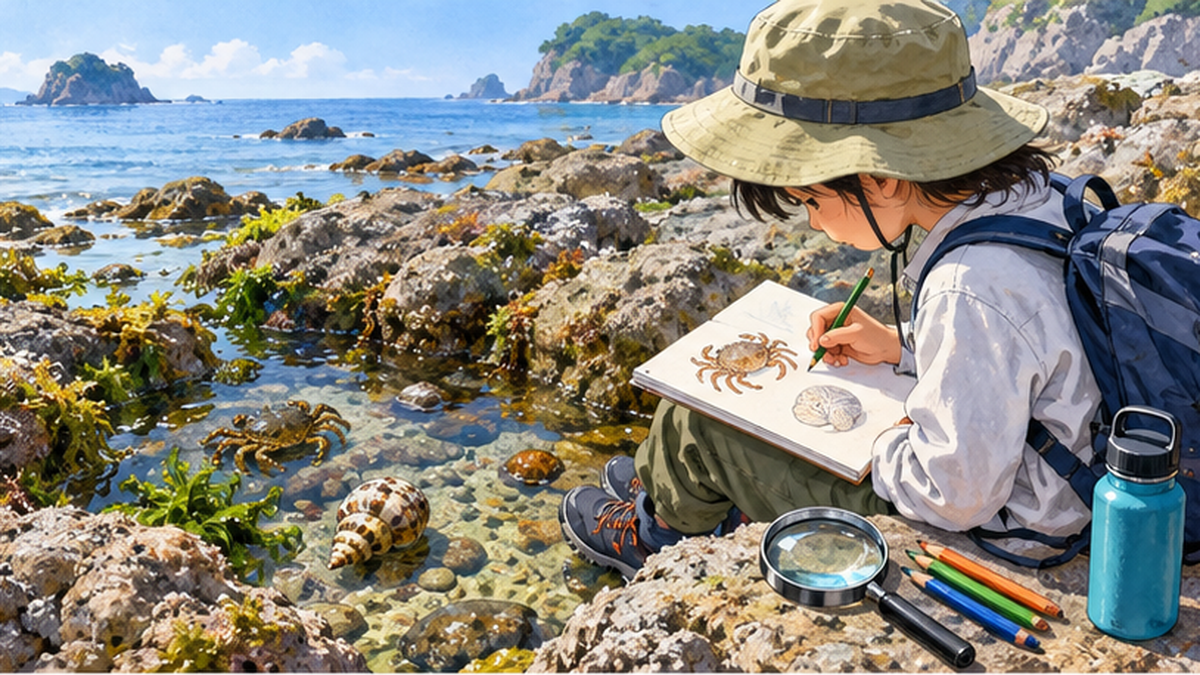
Safety rules for seaside observation
- Always check low-tide hours and leave before the tide turns
- Do not go alone to the edge of rocks or places hit by waves
- Check weather and wave information on your phone and cancel on rough days
- Do not take creatures home; return them to where they were after observing
The Basic Format: Build One Page with "Notice, Wonder, Be Reminded"
Three prompts proposed by Laws
When you do not know what to write, three openers introduced by Laws help: "I notice," "I wonder," and "It reminds me of." Just asking yourself these three in order deepens observation naturally.
| Opener | Meaning | Seaside example |
|---|---|---|
| I notice | Write the facts as seen | The snail shell spirals to the right, with about ten fine ridges on the surface |
| I wonder | Put a question into words | Why are the shells gathered only in the crack of the rock? |
| It reminds me of | Link to experience or knowledge | The place is like the barnacle colony I saw last year |
Five elements on one page
A page becomes a record you can reread later when it has the following five elements. They need not all be perfect; three is enough.
- Date, time, place and weather (the heading of the record)
- Tide state (low or high tide, tide level, etc.)
- Drawing (the shape of the subject, whole and details)
- Words (observations, questions, impressions)
- Numbers (size, count, air and water temperature, etc.)
Draw from "whole to detail"
First draw the outline of the subject large, then add only the conspicuous features. Details can come last. Rather than overdrawing, adding labels with arrows increases the information in your observation. A short note such as "shell about 3 cm tall" or "five legs on each side" becomes a clue later when you compare with a field guide.
What to do when you cannot draw well
- Break the subject into simple shapes such as circles, squares and triangles
- Make a "contour-only drawing" by connecting lines in the order you see them
- If you cannot draw, words alone are fine (partly supplemented by photos)
- Limit yourself to five minutes per subject, then move on
How to make your first page
- Write the date, place and weather
- Choose one subject in front of you (a shell, stone, seaweed, etc.)
- Write one line each for notice, wonder and reminded
- Draw a simple picture and measure and write down one size
What to Observe by the Sea and Recording Tips
Tide-pool creatures: record how fast things change
Rocky-shore tide pools are places where the environment changes greatly between high and low tide. When the water recedes, temperature and salinity fluctuate, and crabs, hermit crabs, sea anemones and sea urchins have ways of coping. Drawing a simple map of where you found each creature helps you see the characteristics of its habitat when you look back. See also our article on tide-pool creatures and observation manners.
Sandy beaches: read the sea's movement from washed-up items
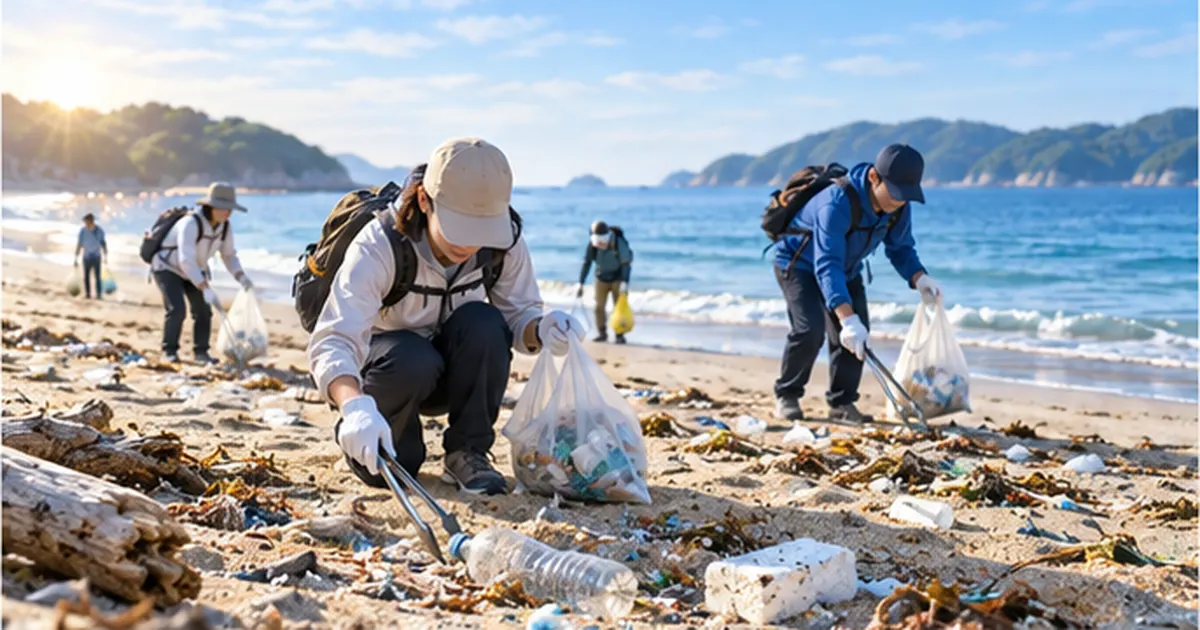
Shells, seaweed, driftwood, pumice and litter are washed up on sandy beaches. Drift items reflect the currents, seasonal winds and recent weather in that sea area. If you observe and record the same beach from the same spot once a month, seasonal change becomes visible. When you find litter, counting and recording its type and number can also help citizen surveys.
Colors of sky and sea, clouds, waves: keep them as numbers
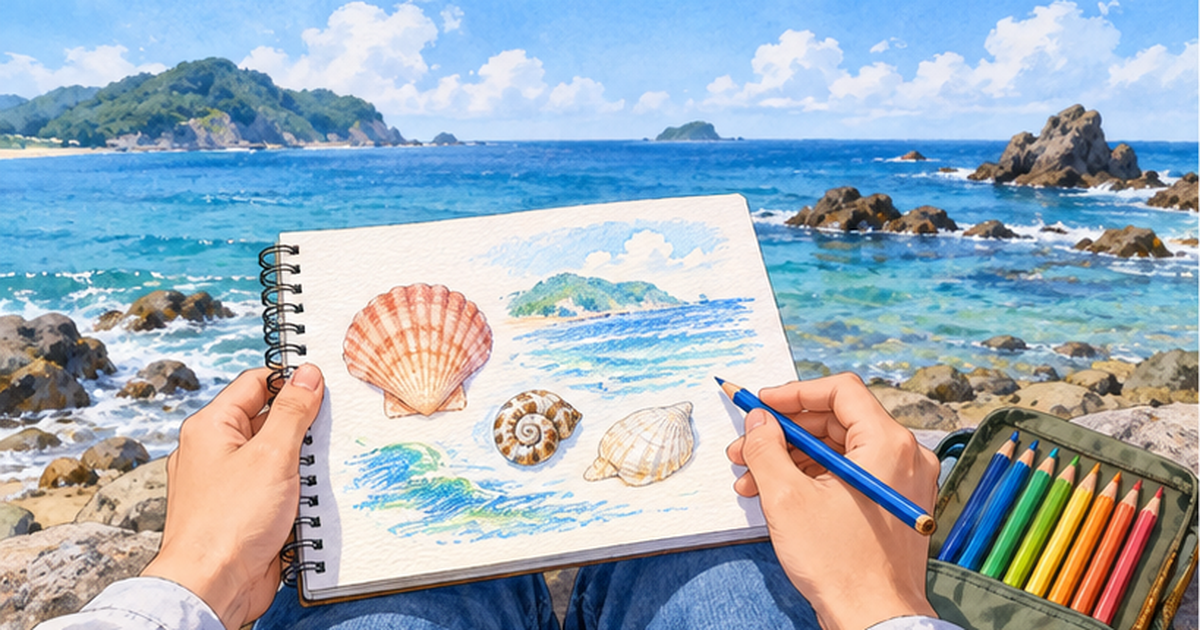
Not only creatures but also the color of sky and sea, cloud shapes, wave height and wind direction are fine subjects. Paint changes in sea color with colored pencils, and write down air and water temperature as numbers if you can measure them. After a year, the passing seasons pile up in one notebook.
| Subject | Items worth recording | What becomes visible |
|---|---|---|
| Tide-pool creatures | Species, number, position, size, behavior | Relation between tides and habitat |
| Shells and drift items | Shape, size, color, where found | Currents, seasonal winds, original habitat |
| Seaweed | Color, shape, where attached | Seasonal changes in species |
| Sky, sea, waves | Color, cloud shape, wave height, wind direction | Weather change and sea condition |
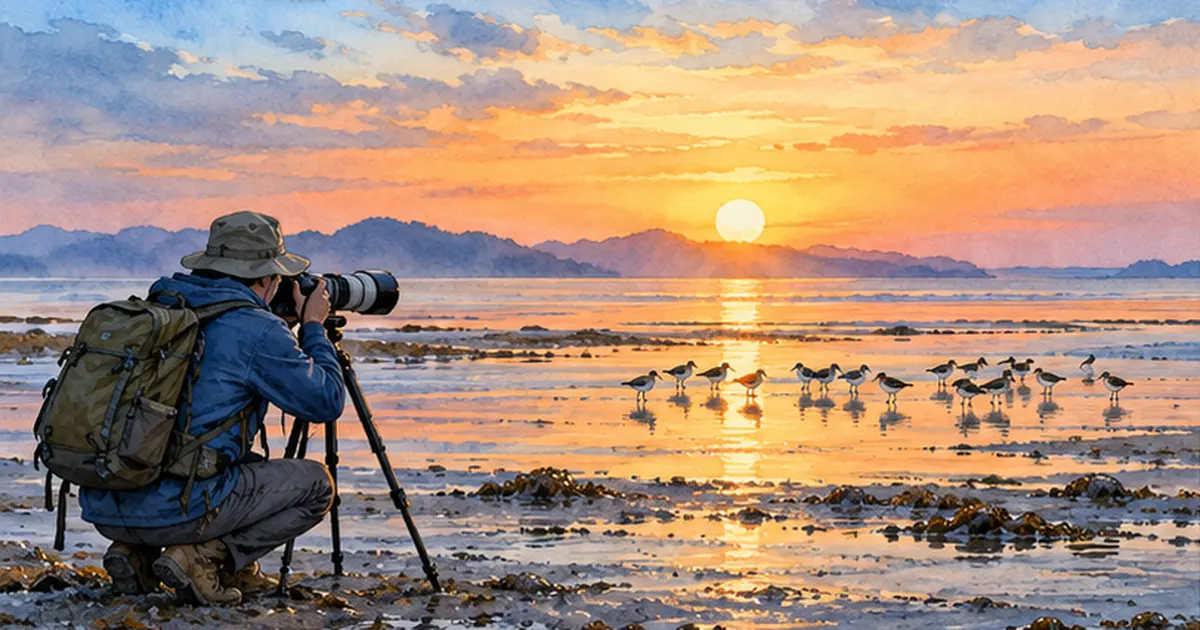
| Birds | Species, behavior, flock size | Migration timing, the shore as a feeding ground |
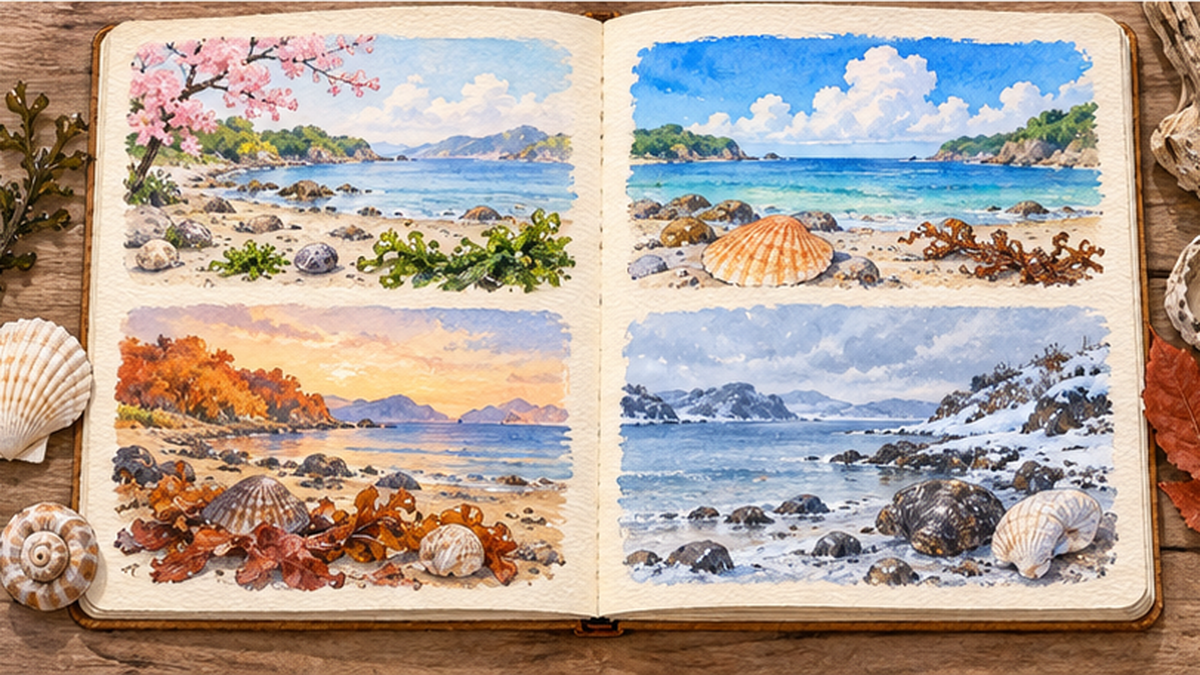
The case for fixed-point observation at one place
The most effective approach is to visit the same place repeatedly. Going to one spot lets you notice small changes better than visiting a different place each time. Discoveries such as "there is seaweed that was not here last month" or "the shells on this rock have decreased" become reliable records because you have a notebook.
Key points of this chapter
- The seaside offers many subjects: tide pools, sand, sky and sea, birds
- Record not only the species but also position, size and behavior
- Fixed-point observation at one place helps you notice seasonal change
Linking Records to Ocean Conservation: Nature Journaling as Citizen Science
When a notebook becomes "data"
Depending on how it is used, a personal observation notebook can become scientific data. The Ikimono Log, run by the Biodiversity Center of Japan under the Ministry of the Environment, is a system where citizens, groups and experts can register and share information on living things. From the smartphone app you can also record the location of an observation through GPS photos. If you photograph creatures you observed in your notebook and register them with date and place, they become valuable material for understanding changes in local nature.
It is fine if you do not know the name
Many people hesitate to record because they do not know a creature's name, but in nature journaling you can look up the name later. In some years the Ikimono Log has offered a "species identification support" service in which experts help identify species, and recording first and checking afterward is the recommended flow. Writing the features carefully in your notebook speeds up identification.
Combine with recording marine litter
When observing by the sea you will often notice drifted litter. Citizen activities that count and record the type, number and place of litter take place in many areas. See our article on citizen science and marine litter for details. If you add a "litter I found today" column to your notebook, you can keep both enjoyment and conservation in one volume.
| Type of record | Main use | Related effort |
|---|---|---|
| Photos of creatures with location | Understanding local species distribution | Ikimono Log |
| Number and type of drifted litter | Understanding the reality of marine litter | Citizen beach-clean surveys |
| Records of seasonal change | Noticing climate and environmental change | Your own fixed-point notebook |
Manners for observing without harming nature
- Do not take creatures home; return them to where they were after observing
- If you turn over a stone, always put it back
- Some places and species are protected from collecting, so check beforehand
- Do not disturb other people or fishers at work
- If you find litter, take it home to the extent that is safe
Summary: the notebook connects nature and society
- A personal observation notebook can lead to citizen-science data
- Even if you do not know the name, recording features lets you look it up later
- Keeping to manners is the premise for continuing to observe
Building a System to Keep Going: Avoiding the Three-Day Slump
Start with "once a week," not "every day"
The biggest obstacle to forming a habit is how high the bar is. It is more realistic to start with 15 minutes once a week than to try every day. On days you cannot get to the sea, draw the sky from your window or a nearby park. Nature is not only the sea but also right at your feet.
Allow yourself not to "finish"
If you try to complete a page, you will not keep going. It is enough to stop partway and add to it next time. Imperfect pages are often the most charming when you look back.
Make time to look back
If you set aside time about once a month to look through your notebook, you can feel seasonal change and the growth of your own observation. Comparing with "a drawing of the same place half a year ago" shows that your eye has developed.
| Common stumbling point | Remedy |
|---|---|
| No time | 15 minutes, focused on a single subject |
| Embarrassed about poor drawing | Draw as if no one will see it; text-only days are fine |
| Do not know what to write | Write only the three: noticed, wondered, reminded |
| Bad weather keeps you indoors | Draw the sky from your window or a shell you picked up |
| Getting bored | Change the theme (shells, clouds, birds, tides) |
Using it with family and at school
When doing it with children, the key is not to judge their drawings. Adults only need to ask for impressions and ask, "Why did you think so?" It is also easy to use in school integrated-study time and local nature walks, and sharing what you observed deepens learning.
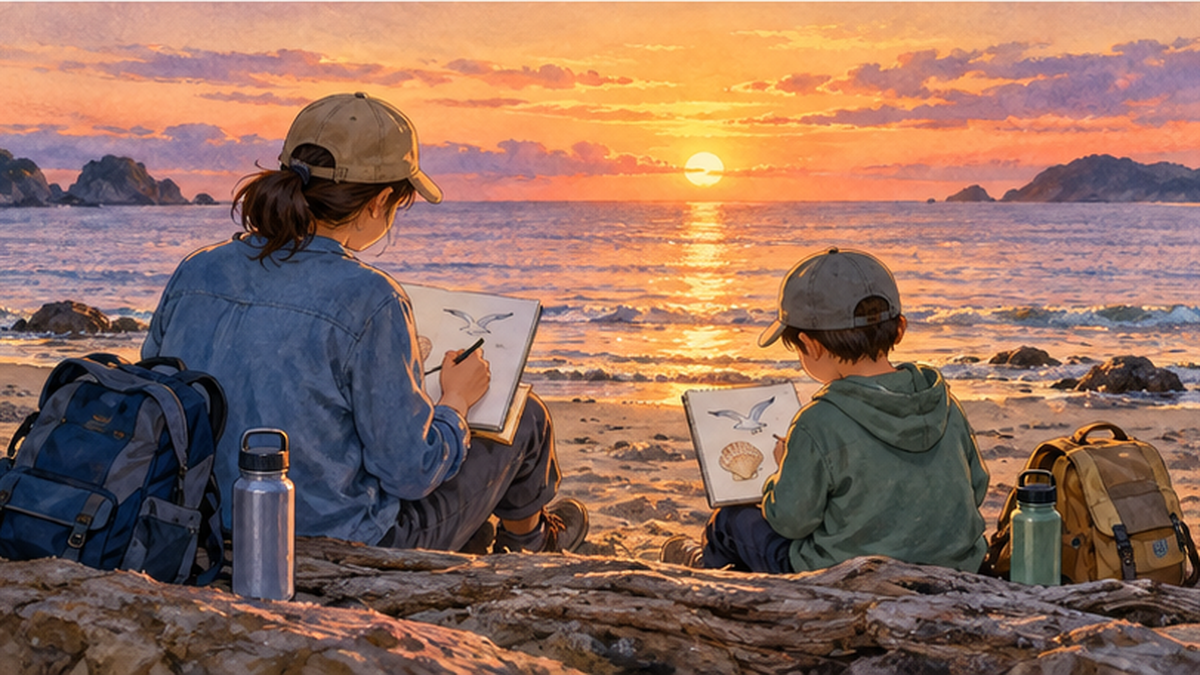
Three actions you can take this week
- Put a notebook and pencil in your bag and check the tide table
- Observe and draw one subject for five minutes at a nearby shore, riverside or park
- At the end of the month, look back through the pages and write one comment on what you noticed
References
- Fernandes, Wammes & Meade (2018) The Surprisingly Powerful Influence of Drawing on Memory – Current Directions in Psychological Science (review of the drawing effect)
- ERIC: Creating a Recollection-Based Memory through Drawing – Journal of Experimental Psychology: Learning, Memory, and Cognition, 2018
- University of Waterloo: Need to remember something? Draw it. – Introduction to research on the drawing effect
- John Muir Laws: An introduction to Nature Journaling – Introduction to nature journaling
- Tsukiji Shokan: Laws' Guide to Nature Drawing and Journaling (Japanese edition) – Japanese edition of Laws' book
- Hachette: Keeping a Nature Journal, 3rd Edition – By Clare Walker Leslie
- Ministry of the Environment: Ikimono Log – Biodiversity information collection and provision system
- Japan Meteorological Agency: Tide tables – Nationwide tide and tide-level predictions
* Listed in order of reliability: government and academic institutions > peer-reviewed papers > specialized organizations > reputable media