⚡ In short
What are ocean education and ocean literacy? This article explores NOAA's Seven Essential Principles, Japan's Basic Act on Ocean Policy, community practice in Kesennuma and Karatsu, and Nippon Foundation survey data, examining how learning can raise a generation that protects the sea even as fewer children ever visit it.
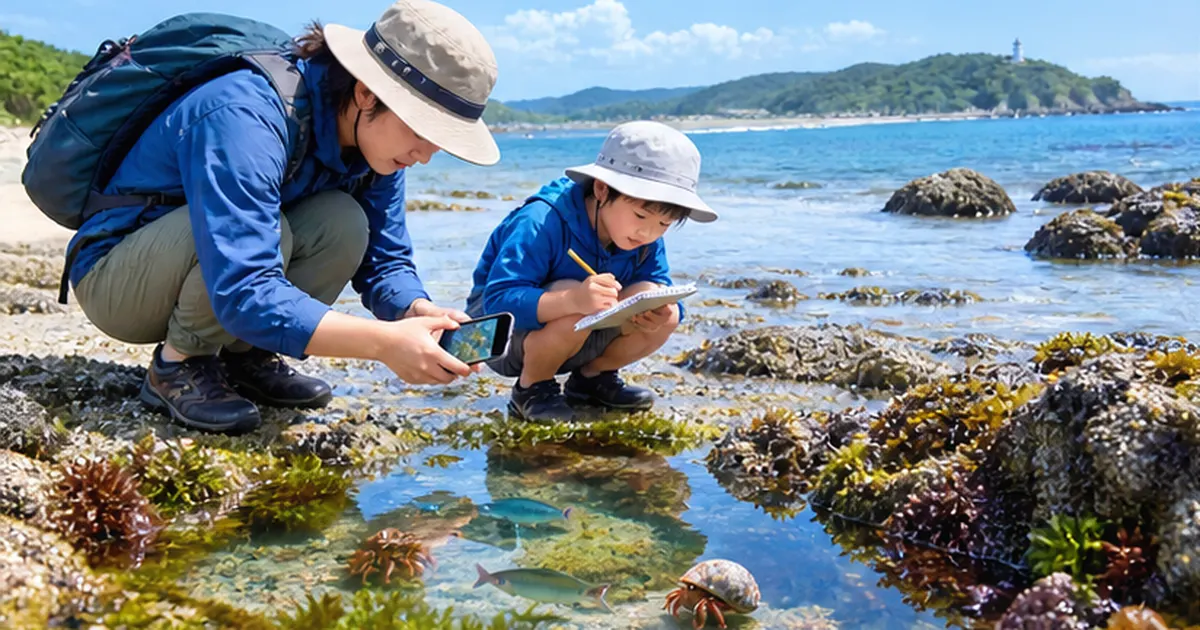
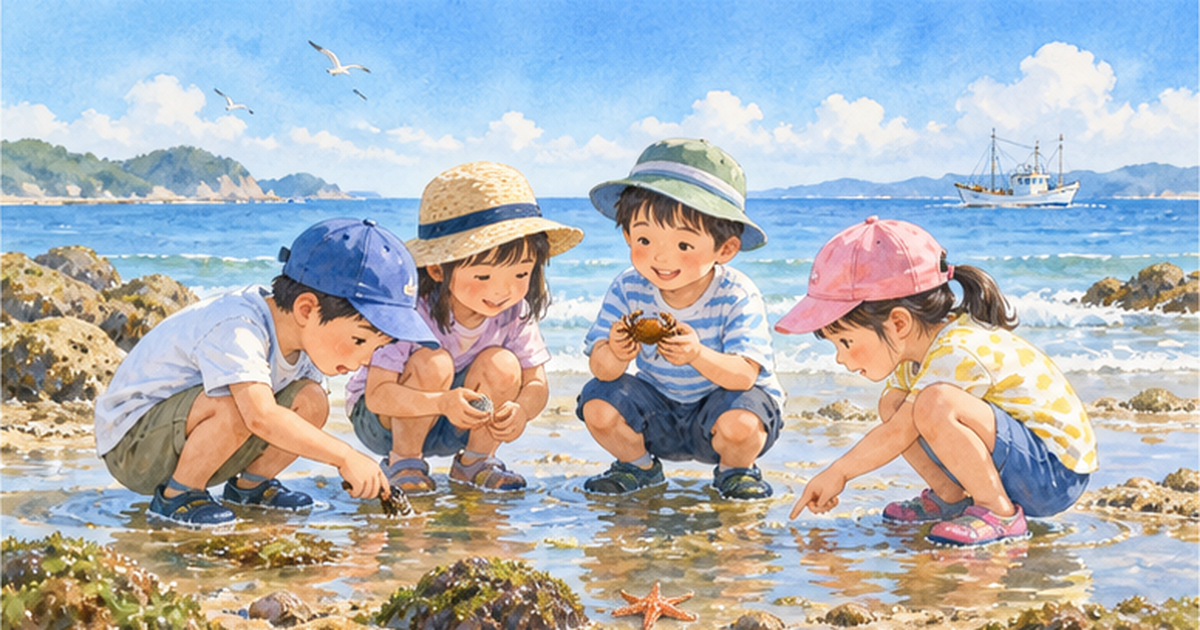
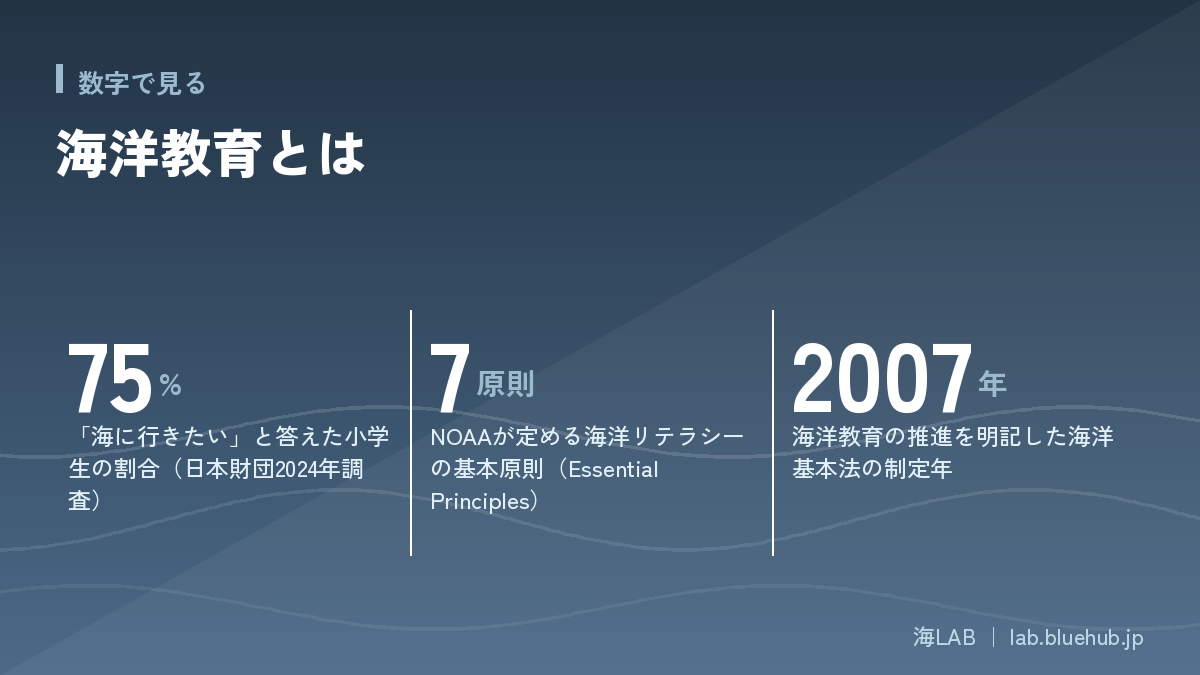
Will a child who has never been to the sea grow up wanting to protect it? A Nippon Foundation survey found that 68% of respondents had childhood ocean experiences of "less than one day a year," while 63% of adults who still say they want to go to the sea had experienced it "two to four days a year or more" as children. The data quietly shows that interest in the ocean grows through experience, not just knowledge.
The term "ocean education" gained a clear place in Japanese national policy through the Basic Act on Ocean Policy, enacted in 2007. Article 28 of the Act obliges the state to deepen public understanding of the ocean through school and social education. Since then, the Ministry of Land, Infrastructure, Transport and Tourism (MLIT), the Ministry of the Environment, and the Ministry of Education, Culture, Sports, Science and Technology (MEXT) have each advanced teaching materials and links to the national curriculum, and municipalities such as Kesennuma and Karatsu have emerged as communities that put this into region-wide practice.
Looking abroad, the "Seven Essential Principles of Ocean Literacy," organized by the United States' National Oceanic and Atmospheric Administration (NOAA), has become a shared language for ocean education worldwide. UNESCO's Intergovernmental Oceanographic Commission (IOC-UNESCO) has also called on policymakers to weave more ocean content into national curricula as climate change and biodiversity loss deepen. This article organizes the current state of ocean education in Japan and the world through data and real-world practice.
What you'll learn in this article
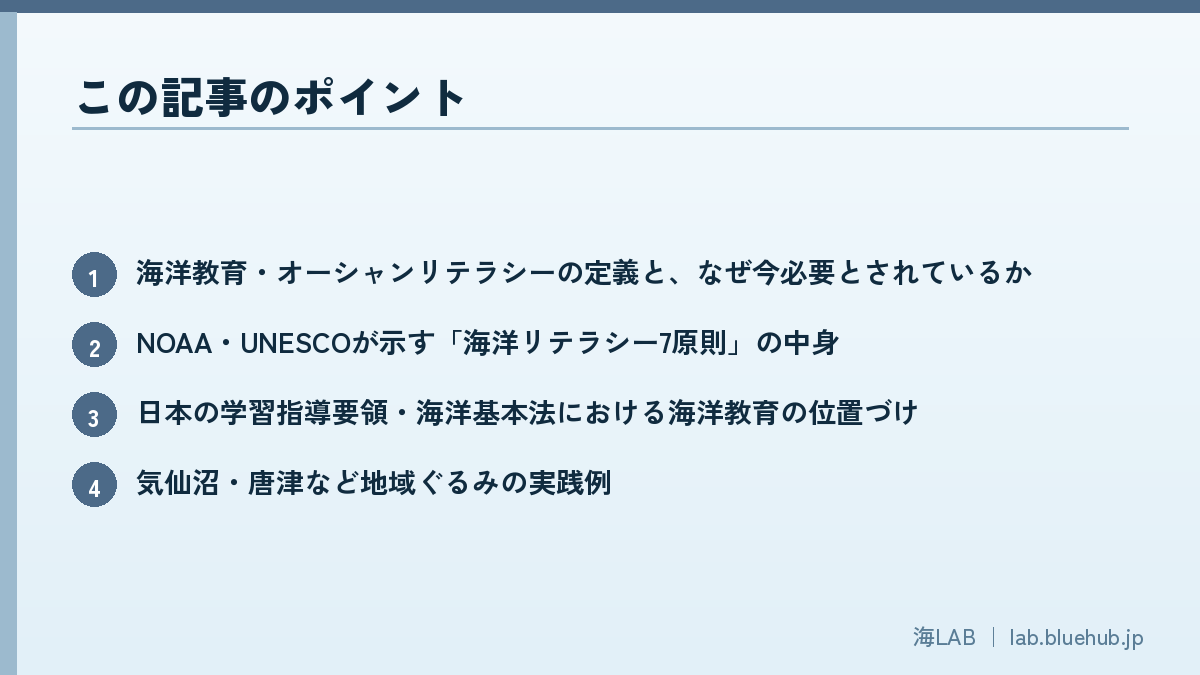
- The definition of ocean education and ocean literacy, and why it matters now
- What the "Seven Essential Principles of Ocean Literacy" from NOAA and UNESCO actually say
- How ocean education is positioned within Japan's national curriculum and Basic Act on Ocean Policy
- Community-driven practice in places like Kesennuma and Karatsu
- How childhood ocean experiences shape future attitudes and behavior
- Ocean-education actions you can start today at home or in your community
What Are Ocean Education and Ocean Literacy?
"Ocean education" refers to educational activities, carried out through schools and communities, that deepen understanding of the ocean's nature, culture, industries, and environmental issues, and that cultivate people who can think about and act on their relationship with the sea. In Japan, the Basic Act on Ocean Policy, enacted in 2007, was the first law to formally articulate this idea as national policy.
The definition of ocean education and the Basic Act on Ocean Policy
Article 28 of the Basic Act on Ocean Policy requires the state to promote ocean-related education in schools and community settings, to raise awareness of international frameworks such as the UN Convention on the Law of the Sea, and to popularize recreational activities that bring people closer to the ocean. It also obliges the state to promote interdisciplinary education and research at universities to develop human resources capable of addressing ocean policy challenges. The article reflects the fact that, despite being surrounded by the sea on all sides, Japan previously had no law systematically positioning ocean education.
Based on this Act, the government adopts a "Basic Plan on Ocean Policy" by cabinet decision roughly every five years to accumulate concrete measures. The Fourth Basic Plan, decided in April 2023, set "comprehensive maritime security" and "building a sustainable ocean" as its two pillars, and positioned the development of ocean-related human resources and the promotion of ocean education as one of its key measures. On top of the legal foundation, concrete five-year plans are layered one after another.
Four perspectives that make up ocean education
- Experience the ocean — engage with the sea through the five senses
- Know the ocean — study it as natural and social science
- Protect the ocean — become a stakeholder in environmental issues and conservation
- Use the ocean — sustainably draw on its blessings through fishing, shipping, and tourism
Japan's land area ranks only 61st in the world, yet its territorial waters and exclusive economic zone (EEZ) combined cover about 4.47 million square kilometers — roughly 12 times its land area — making it the world's sixth largest by this measure. Tiny, remote islands scattered across the Pacific, such as Minamitori-shima and Okinotori-shima, support this vast maritime territory. Hidden behind its small land area, Japan is unmistakably a maritime nation, and whether its citizens have an understanding of the ocean to match that status is the question at the starting point of ocean education.
The term "ocean literacy"
In English-speaking countries, the term "ocean literacy" has become established. It refers not merely to a quantity of knowledge about the sea, but to "an understanding of the ocean's influence on you and your influence on the ocean." The U.S. National Oceanic and Atmospheric Administration (NOAA) systematized this definition, building the framework in collaboration with educators and researchers from around 2005 onward; the latest version, 3.2, was published in January 2024.
This concept matters because it prevents the topic of the ocean from being reduced to mere "facts about fish and ships." The ocean shapes the climate, supplies a substantial share of the oxygen we breathe, and underpins economic activity. Ocean literacy is distinctive in that it is designed to understand these cross-cutting roles of the ocean across subject boundaries — science, social studies, home economics, and integrated studies alike. The aim of the concept is to connect a one-off school trip to the beach with systematic knowledge, rather than letting the experience end there.
It is worth noting that Japan's ocean education developed from the starting point of a law — the Basic Act on Ocean Policy — while NOAA's ocean literacy emerged from bottom-up collaboration among researchers and educators, a different origin. It is striking that these two flows, one top-down institution-building and the other a bottom-up framework born in the field, arrive at the same conclusion: the need to combine knowledge with experience.
Why Ocean Education Matters Now
Children drifting away from the sea
The Nippon Foundation's biennial "Survey on Attitudes Toward the Sea Among Japanese People," conducted since 2017, reached its fourth round in 2024 and, for the first time, surveyed elementary school children and their parents. The results are telling: 75% of elementary schoolers said they "want to go to the sea," while the child-rearing generation's own interest in the sea was relatively low, revealing a reality in which people are not making it to the sea as often as children wish.

Climate change, biodiversity loss, and the role of education
The challenges facing the ocean — coral bleaching from rising sea temperatures, and ecosystem stress from overfishing and marine plastic — grow more complex every year. Internationally, policy responses are advancing, such as the 30by30 target to expand marine protected areas (MPAs), but building institutions alone is not enough. As the world confronts climate change, biodiversity loss, and economic sustainability, UNESCO's Intergovernmental Oceanographic Commission (IOC-UNESCO) has called on policymakers worldwide to position ocean literacy as a foundational element of education systems. If the task of solving these crises is to be handed to future generations, an educational foundation that lets them understand the ocean as their own concern is indispensable.
Social benefits beyond the classroom
The significance of ocean education is not limited to raising environmental awareness. Shipbuilding, shipping, fisheries, and marine energy make up an important part of Japan's economy, and whether these industries can secure a workforce for the future is also an industrial policy concern. At the same time, learning from childhood how to prepare for ocean-related natural disasters such as tsunamis and storm surges is important from a disaster-prevention education perspective. That a region like Kesennuma has integrated the experience of the earthquake into its ocean education shows that these two dimensions cannot truly be separated.
Challenges facing ocean education on the ground
While the concept draws broad agreement, several barriers stand in the way of classroom practice. First, because the theme spans multiple subjects — science, social studies, integrated studies — it can be unclear which class time should be used to teach it. Second, few teachers have specialized training in ocean education, and some lack confidence teaching it even with materials in hand. Third, schools not located near the coast face physically limited opportunities for hands-on learning. Teaching-material development by MLIT and the Ministry of the Environment, along with teacher training run by university research centers, are efforts to remove these barriers one by one.
These challenges are not unique to ocean education; they are shared across environmental education broadly. Conversely, the know-how developed in ocean education could well be applied to education on other environmental themes, such as forests, rivers, and biodiversity. Perhaps Principle 6 — that the ocean is connected to every ecosystem on Earth — applies just as much to educational methods themselves.
The "Seven Essential Principles of Ocean Literacy" from NOAA and UNESCO
The ocean literacy framework organized by NOAA consists of seven "Essential Principles" and a total of 45 "Fundamental Concepts" that support them. It serves as a reference point for designing educational programs worldwide, presenting a body of ocean knowledge that everyone, regardless of age, should know.
What the seven principles say
| Principle | Summary |
|---|---|
| Principle 1 | The Earth has one big ocean with many features |
| Principle 2 | The ocean and life in the ocean shape the features of Earth |
| Principle 3 | The ocean is a major influence on weather and climate |
| Principle 4 | The ocean made the Earth habitable |
| Principle 5 | The ocean supports a great diversity of life and ecosystems |
| Principle 6 | The ocean and humans are inextricably interconnected |
| Principle 7 | The ocean is largely unexplored |
What is interesting about these seven principles is that Principle 6 — "the ocean and humans are inextricably interconnected" — is not merely an emotional message that "the ocean matters," but is presented as a set of concrete facts: a substantial share of the oxygen we breathe comes from ocean phytoplankton, the ocean absorbs most of the excess carbon dioxide and heat on Earth, and much of the world's trade and food supply passes through the sea.
The evidence behind Principle 7: "The ocean is largely unexplored"
NOAA explains that more than 80% of the world's oceans remain unmapped, unobserved, and unexplored. As of 2026, only about 28.7% of the seafloor has been mapped at high resolution using the latest multibeam sonar technology, and the area of deep seafloor actually "explored" by human eyes or instruments is estimated at less than 0.001% — an area roughly the size of Rhode Island. The international "Seabed 2030" project, aiming to completely map the ocean floor by 2030, is underway. The ocean is at once familiar and one of the least-known places on Earth.
The 45 fundamental concepts
Each of the seven principles is linked to several more specific "fundamental concepts," totaling 45 items. Principle 3 (influence on climate), for example, includes the concrete fact that the ocean stores most of the heat at Earth's surface and exchanges heat and moisture with the atmosphere. Teachers and curriculum developers break down these 45 items by grade level and theme, incorporating them into science, social studies, and integrated-studies classes. UNESCO has also worked to spread this framework across educational settings worldwide through its "Ocean Literacy for All" toolkit, published in 2017.
What makes NOAA's framework so effective is that it functions simultaneously as a list of knowledge and as a "common language" for designing educational curricula. Regardless of country or language, referring to the same coordinates of seven principles and 45 concepts lets educators check where their own national curriculum falls short on ocean perspectives. Research mapping these onto Japan's national curriculum is also underway, forming a foundation that connects domestic ocean education programs to this international framework.
In practice, these 45 concepts also serve as a checklist for lesson design. When building a unit on "marine life," for instance, checking whether it incorporates not only Principle 5 (biodiversity) but also Principle 2 (ocean life shapes landforms) and Principle 6 (connection to humans) helps create a three-dimensional lesson rather than a mere catalog of facts. The framework also functions as a yardstick for evaluating and improving ocean education materials.
Ocean Education in Japan's School System
The national curriculum and ocean education programs
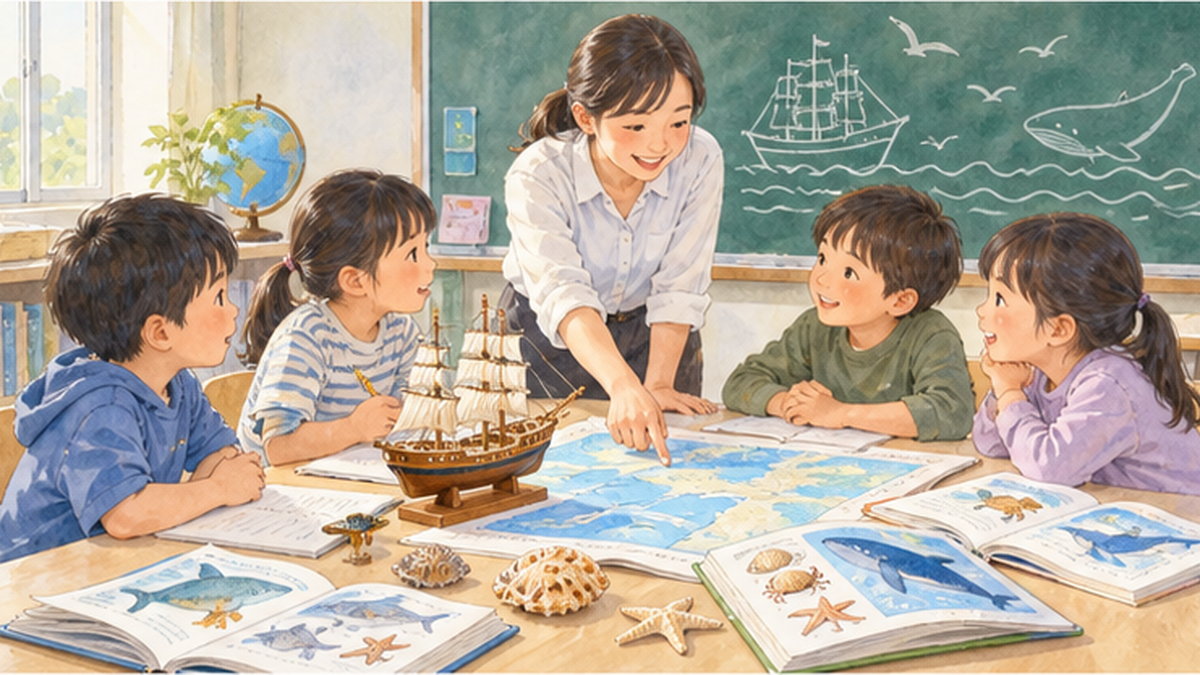
MLIT has created and published an "Ocean Education Program" for elementary and junior high school teachers, aligned with the revised national curriculum. Designed to fit naturally into elementary school social studies and junior high geography classes, it has enriched teaching materials on maritime industries such as shipping, shipbuilding, and ports. This addresses the fact that, despite Japan being surrounded by the sea on all sides, maritime content had previously been limited in textbooks.
Cooperation between the Ministry of the Environment and MEXT (ESD)
The Ministry of the Environment has published a web resource called "Manabi no Chizu" (Map of Learning) for practicing Education for Sustainable Development (ESD), providing educational programs — including ocean-related content — that link to units across subjects in the national curriculum. MEXT also positions ocean topics within its broader environmental education framework. In effect, MLIT, the Ministry of the Environment, and MEXT share the work of building materials and opportunities, each from its own institutional role.
Toward learning that crosses subject boundaries
Japan's recent national curriculum encourages cross-subject themes through "integrated studies" (periods of inquiry-based learning). Ocean education fits this framework well: ocean currents and ecosystems can be approached from a science perspective, fisheries and trade from a social studies perspective, and seafood and diet from a home economics perspective — all connecting to the same theme of "the ocean" from different angles. In some regions, inquiry-based learning is structured so that students visit a local fishing port to observe the catch being landed, then return to the classroom to study the distribution system — moving back and forth between hands-on experience and classroom study. This kind of design is one concrete way Japan's education system realizes the cross-subject understanding of the ocean that the seven principles aim for.
| School level / subject | Example connection to ocean education |
|---|---|
| Elementary science | Tides, marine life, the water cycle |
| Elementary social studies | Regions with thriving fisheries, trade and the role of ports |
| Junior high social studies (geography) | Exclusive economic zones, maritime transport, fishery resources |
| Junior high science | Ocean currents and weather, plate tectonics and trenches |
| High school integrated geography / earth science | Marine environmental issues, climate change and ocean circulation |
| Integrated studies (inquiry) | Project-based learning on local seas, ports, and fisheries |
Ocean Education Rooted in Communities: Kesennuma and Karatsu
ESD and ocean education in Kesennuma
Kesennuma City in Miyagi Prefecture is one of the municipalities that has pursued ESD for more than 20 years. Since the Great East Japan Earthquake, it has integrated a disaster-prevention perspective into its ESD work and, in partnership with local NPOs, developed educational activities that support recovery. Because Kesennuma holds both an industry that lives with the sea and the memory of a sea that once turned violent, ocean education there has taken root not just as a way to "know the ocean" but as learning that fosters "the resolve to live alongside the sea." For local children who lost schools and fishing ports to the tsunami, the sea is learned not as something to blindly fear or unconditionally celebrate, but as a partner to engage with after properly understanding both its blessings and its dangers.
Karatsu and the University of Tokyo's Center for Ocean Literacy and Education
The University of Tokyo's Center for Ocean Literacy and Education, within its Graduate School of Education, traces its roots to the "Center for the Promotion of Ocean Education," established in 2010 with support from the Nippon Foundation, and took its current form in 2019. It is Japan's first hub dedicated to research and practice in ocean education for elementary, junior high, and high school students. The Center has held the "Ocean Education Children's Summit" in Kesennuma and built up other community-linked practices. In Karatsu, Saga Prefecture, and in school settings across the country, similar efforts linking universities and research institutions to ocean education are spreading.
A network reaching beyond individual regions
Beyond practice at the level of individual municipalities like Kesennuma and Karatsu, Japan has a network of "UNESCO Associated Schools" that promote education for sustainable development, and many member schools in coastal areas have reported ESD practice built around their local sea or rivers. Rather than letting the success of a single school or municipality stand alone, sharing know-how through this nationwide network — and translating it into forms usable by inland schools less familiar with the sea — is recognized as the next challenge.
From a coral reef island: Taketomi, Okinawa
At Taketomi Elementary and Junior High School in Taketomi Town, Okinawa Prefecture, students go out into the waters around Taketomi Island themselves to observe the current state of the coral, witness bleaching where it occurs, gather and organize information about its causes, and present what they themselves can do — a full cycle of inquiry-based learning. Local ocean education supporters assist with lectures on coral ecology and snorkeling experience programs, and Okinawa Prefecture itself has compiled a collection of environmental education and outreach programs for coral reef conservation that schools and community groups across the prefecture can use. The sequence of confirming an anomaly with one's own eyes in the sea before thinking it through, rather than simply hearing an explanation of the crisis, is key to building a sense of personal stake.
The Data Showing Childhood Ocean Experience Shapes the Future
What the Nippon Foundation survey reveals
The Nippon Foundation's 2024 "Survey on Attitudes Toward the Sea Among Japanese People" surveyed roughly 10,000 people nationwide and has been conducted continuously, including tracking attitude shifts before and after the pandemic. While the share of people who say "I love the sea" has trended downward year by year, 75% of elementary schoolers say they "want to go to the sea," showing that interest in the ocean itself has not disappeared. The problem lies in the gap between that interest and actual opportunities for experience.

How early experience changes a lifelong relationship with the sea
The same survey found that 68% of respondents reported childhood ocean experiences of "less than one day a year," while 63% of those who still want to go to the sea as adults reported having experienced it "two to four days a year or more" as children. While causation cannot be firmly established, the data suggests that the frequency of early experience is one factor shaping a person's lifelong relationship with the sea. This underscores the importance of designing ocean education around actual contact with the sea, not confining it to classroom knowledge alone.
This tendency — that the frequency of early experience shapes attitudes — is not a new finding from the 2024 survey. The Nippon Foundation also featured, in its 2019 survey, the connection between childhood ocean experiences and attitudes and behavior toward the sea in adulthood. The fact that the same tendency has been confirmed repeatedly across multiple years of surveys suggests a reasonably stable structural relationship, rather than a one-off correlation.
A perspective for children growing up without the sea nearby
In discussions of ocean education, it is often pointed out that a structural gap tends to emerge between coastal regions and inland areas far from the sea in the amount of early experience children can gain. Building opportunities to visit the coast into school trips and nature-experience learning, teaching the connection to the sea through rivers and tap water, and making use of aquariums and science museums are all ways to cultivate ocean literacy regardless of where a child lives. Whether ocean education can expand beyond a handful of coastal municipalities into learning accessible no matter where one lives will shape the quality of practice going forward.
The UN Decade of Ocean Science and the Global Movement
What is the Ocean Decade (2021–2030)?
The United Nations designated 2021 through 2030 as the "UN Decade of Ocean Science for Sustainable Development" (the Ocean Decade), with IOC-UNESCO leading efforts to advance ocean science and its application in society worldwide. Under the banner "The Science We Need for the Ocean We Want," it aims to connect ocean-related knowledge with action by engaging not only researchers but policymakers, industry, and civil society.
| Societal outcome | Description |
|---|---|
| A clean ocean | Sources of ocean pollution are identified and reduced or removed |
| A healthy and resilient ocean | Marine ecosystems are understood, protected, restored, and managed |
| A productive ocean | Supports food supply and a sustainable ocean economy |
| A predicted ocean | Society has the capacity to understand current and future ocean conditions |
| A safe ocean | Protects lives and livelihoods from ocean-related hazards |
| An accessible ocean | Open access to ocean data, information, and technology |
| An inspiring and engaging ocean | Society understands and changes its relationship with the ocean's benefits and sustainable development |
Among these seven, "an inspiring and engaging ocean" is the outcome most directly tied to education and outreach. No matter how much ocean science research accumulates, the Decade's goals cannot be met unless society understands what it means and changes its behavior. Ocean education, including school education, is positioned as the foundation for achieving this "inspiring and engaging ocean."
In Japan, a "National Decade Committee for Ocean Science" has been organized, bringing together universities, research institutions, companies, and NPOs to advance Ocean Decade activities. Community-level ocean education practices, like those in Kesennuma or Taketomi, may look like small individual efforts on their own, but through this national committee they can connect to the context of the global ten-year plan — showing that local activity and the global framework are continuous with one another.
Global trends in ocean education policy
As climate change, biodiversity loss, and economic sustainability challenges deepen, IOC-UNESCO has issued a policy brief calling on policymakers in every country to weave ocean-related content more systematically into national curricula. A movement to position ocean literacy across subject boundaries is spreading, particularly in Europe, and Japan's efforts under the Basic Act on Ocean Policy are part of this same international trend.
One concrete example is the "Network of European Blue Schools," a pillar of the "EU4Ocean Coalition" launched in 2020 by the European Commission's Directorate-General for Maritime Affairs and Fisheries. Member schools commit to embedding ocean literacy and sustainability into everyday lessons, and the network has grown into the world's largest ocean-education network, with more than 600 member schools from EU member states and associated countries. Participating schools take part through a mechanism called the "Find the Blue Challenge," identifying an ocean-related theme close to home and pursuing it as project-based learning. This differs from the approach seen in Japan's community practices in Kesennuma, Karatsu, and Taketomi — building a network of schools across borders — but the goal it aims for is the same.
Ocean Education Actions for Home and Community
The protagonist of ocean education is neither a national program nor a university research center, but ultimately the family and community that interact with a child every day. The Basic Act on Ocean Policy, the seven principles of ocean literacy, and the UN Decade of Ocean Science examined so far are all "institutions" or "frameworks" — none of them, by itself, changes a child's awareness. It is the adults close to a child who turn the opportunities these institutions create into actual experience.
As the Nippon Foundation data introduced in this article shows, interest in the ocean already exists in many children. What is lacking is not interest, but the opportunity to convert that interest into real experience. The institution of the Basic Act on Ocean Policy, the body of knowledge in the seven principles, and the accumulated practice in Kesennuma and Taketomi are not separate, isolated points — they take on meaning only when connected in the setting of the family.
Starting with everyday experiences
- Take a walk along a nearby coastline, or join a family beach cleanup
- Combine a visit to an aquarium or science museum's ocean exhibits with picture books or videos afterward
- Join local programs run by fishing cooperatives or municipalities, such as beach seine-net experiences or tide-pool observation walks. Places such as seagrass meadows, which nurture fish, can also be observed up close in many areas
- Talk at the dinner table about where fish comes from and how it was caught, connecting it to the growing shortage of fishing successors and other challenges behind seafood
- Look up shells or creatures picked up during shell-gathering or a day at the beach
- Supplement curiosity about the sea with ocean documentaries or field-guide apps, which are accessible even inland
- Choose a nearby sea, river, or waterside creature as the topic for a summer research project
Passing the learning on to the next generation
Keys to sustaining ocean education
- Design it around "experience," not knowledge alone
- Value not only the ocean's crises but also the joy and appreciation of the sea
- Have schools, families, communities, and research institutions share roles and cooperate
- Turn it into a small, continuing habit rather than a one-off event
The smallest step you can take today
There is no need to overthink it. The next time you eat fish, or the next time you drink tap water, simply ask a child, "Which sea does this connect to?" It's fine if there's no answer. That question itself is the first step in the long process of building ocean literacy.
Ocean education does not require special equipment or a trip to a distant sea to begin. Realizing that a nearby river connects to the sea, or wondering where the fish on the dinner table came from — an accumulation of such small realizations becomes the entry point to the larger framework of ocean literacy. The step toward the next generation not only "knowing" the ocean but becoming its protector is already within everyday reach.
References
- MLIT (Japan) – On ocean and maritime education in elementary and junior high schools
- MLIT (Japan) – Press release on the publication of an ocean education program aligned with the revised curriculum
- MEXT (Japan) – MEXT's approach to environmental issues
- Kesennuma City Government – On ESD and ocean education in Kesennuma
- The University of Tokyo – Center for Ocean Literacy and Education
- Nippon Foundation, Umi to Nihon Project – 2024 Survey on Attitudes Toward the Sea Among Japanese People
- NOAA – Ocean Literacy: The Essential Principles and Fundamental Concepts (version 3.2)
- UNESCO – UNESCO Ocean Literacy
- IOC-UNESCO – UNESCO-IOC Launches New Policy Brief Highlighting the Urgent Need to Strengthen Ocean Literacy in Education
- House of Representatives, Japan – Text of the Basic Act on Ocean Policy
※ Listed in order of reliability: government and academic institutions > peer-reviewed papers > specialized organizations > trusted media