⚡ In short
The oval disc on a remora's head is a modified dorsal fin and a remarkably precise attachment device. Friction from lamellae and spinules, prime spots on a blue whale that cut drag by up to 84%, and the long-standing question of whether remoras are parasites or partners. Here is the full story of a hitchhiker that first appeared 38 million years ago.
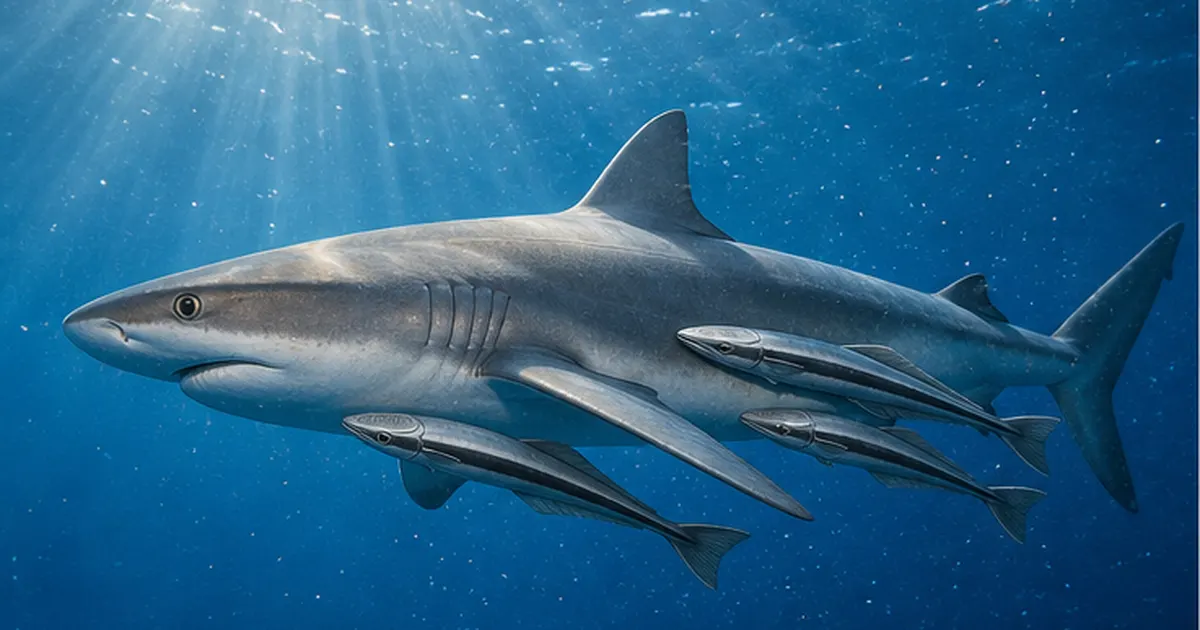
Have you ever seen a long, slender fish riding flat against the body of a large shark or sea turtle? That is a remora. Despite the Japanese name that calls it a "shark," it belongs to a completely different group from the cartilaginous sharks: it is a bony fish, a relative of perch. What sits on top of its head is an oval disc resembling a koban, the oval gold coin of the Edo period. Thanks to that single organ, remoras can travel thousands of kilometres across the ocean while barely swimming at all.
For a long time remoras have been described as freeloaders that simply cadge a ride from their hosts. In Japanese, someone who curries favour with the powerful for personal gain is said to be "like a remora." Yet the closer you look at these fish, the clearer it becomes that this judgement is far too simple. The disc is a hydrodynamically sophisticated device, remoras know where on a host's body it is easiest to hold on, and they sometimes clean their hosts by eating the parasites attached to them.
This article works through the physics of how the disc functions, the surprising behaviour recorded by cameras mounted on the backs of blue whales, the diet revealed by stomach-content analysis, and the long-standing ecological question of whether this is parasitism or symbiosis, drawing on peer-reviewed papers and material from public institutions. By the end, the fish clustered beneath the whale shark in an aquarium's main tank should look entirely different to you.
What you will learn
- That remoras are not sharks but bony fishes of the order Perciformes, and that the disc on the head is a modified first dorsal fin
- How the disc combines lamellae (plate-like ridges) with spinules to deliver both suction and friction
- The 2020 observational study showing that remoras choose low-drag "prime seats" on the body surface of blue whales
- What stomach-content analysis reveals about their diet: scraps, plankton and the parasitic copepods that infest their hosts
- Parasite or partner? Why a relationship long presented as the textbook example of commensalism is now being reconsidered
- Applications in human technology, from underwater robots to marine tracking tags inspired by the remora disc
What exactly is a remora? The ocean hitchhiker that is not a shark
Let us clear up the confusion about the name first. Remoras are not sharks. Sharks and rays are cartilaginous fishes with skeletons made of cartilage, whereas remoras are bony fishes with fully ossified skeletons and belong to the order Perciformes. Phylogenetically their closest relatives include jacks, dolphinfish and cobia, a food fish in its own right. The Japanese name, which literally means "small-coin shark," simply reflects the look of a coin-shaped fish stuck to a shark; there is no taxonomic relationship at all.
Four genera and eight species worldwide, seven in Japanese waters
The family Echeneidae comprises four genera and eight species in the world's oceans. The genera are organised chiefly around Echeneis, Remora and Phtheirichthys, and the species include Echeneis naucrates (the live sharksucker), Remora remora (the common remora) and Remora australis (the whalesucker). Seven of these have been recorded from Japanese waters; although they are warm-water fishes, they ride the Kuroshio Current and turn up along the coast of Honshu as well.
The most common species, and the one most often seen in aquariums, is the live sharksucker (Echeneis naucrates). According to FishBase it reaches a maximum total length of 110 centimetres and is distributed throughout tropical and subtropical waters between 45°N and 45°S. Its depth range is shallow, roughly 1 to 85 metres, and it appears everywhere from the open-ocean surface layer to coastal coral reefs.
A slender body with a black stripe along the flank
A remora's body is extremely elongated, with a somewhat flattened cross-section. The colour ranges from silvery grey to brown, and in most species a dark blackish-brown longitudinal stripe runs from the tip of the snout to the tail. This shape is convenient for shedding water flow while attached to a host, and it also reduces resistance when the fish leaves the host and swims under its own power.
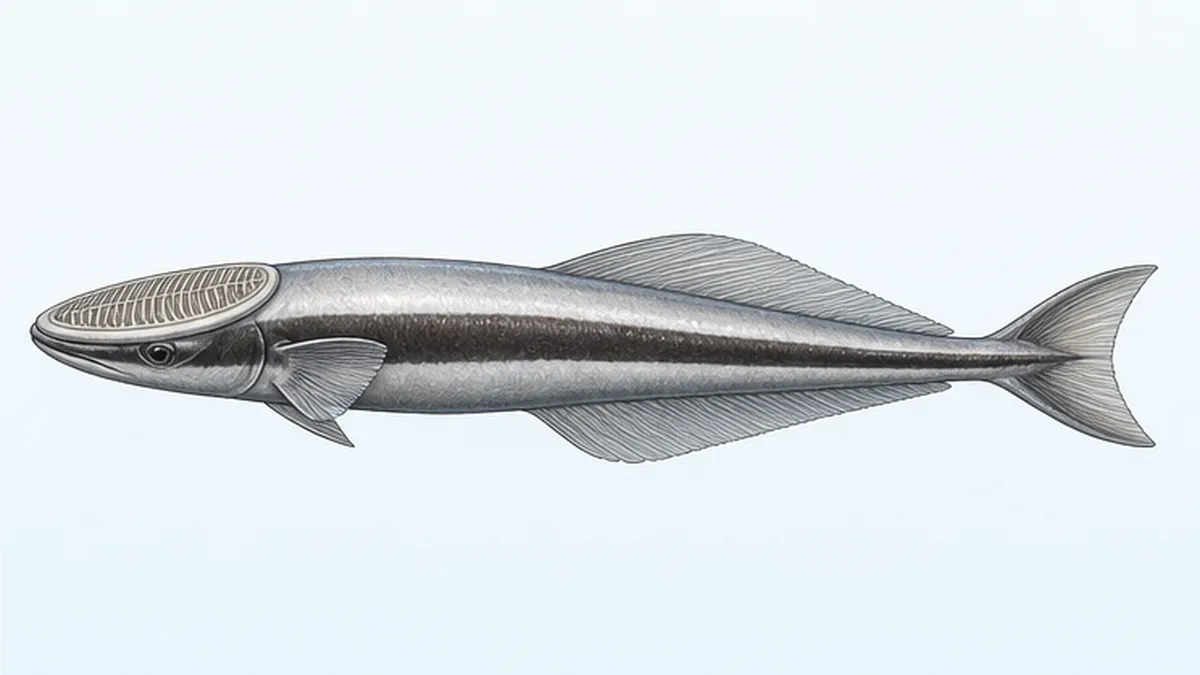
The name comes from an Edo-period coin
The Japanese name kobanzame comes from the resemblance between the disc on the head and the koban, an oval gold coin of the Edo period. In English the fish is called a sharksucker or a remora. Remora is Latin for "delay," and the ancient Romans believed that a remora attached to a ship's hull could halt its progress. Pliny's Natural History even records the fish stopping a warship. In reality it has no such power, but the accounts show that fish clinging to hulls had caught human attention from very early on.
Whose back do they ride on?
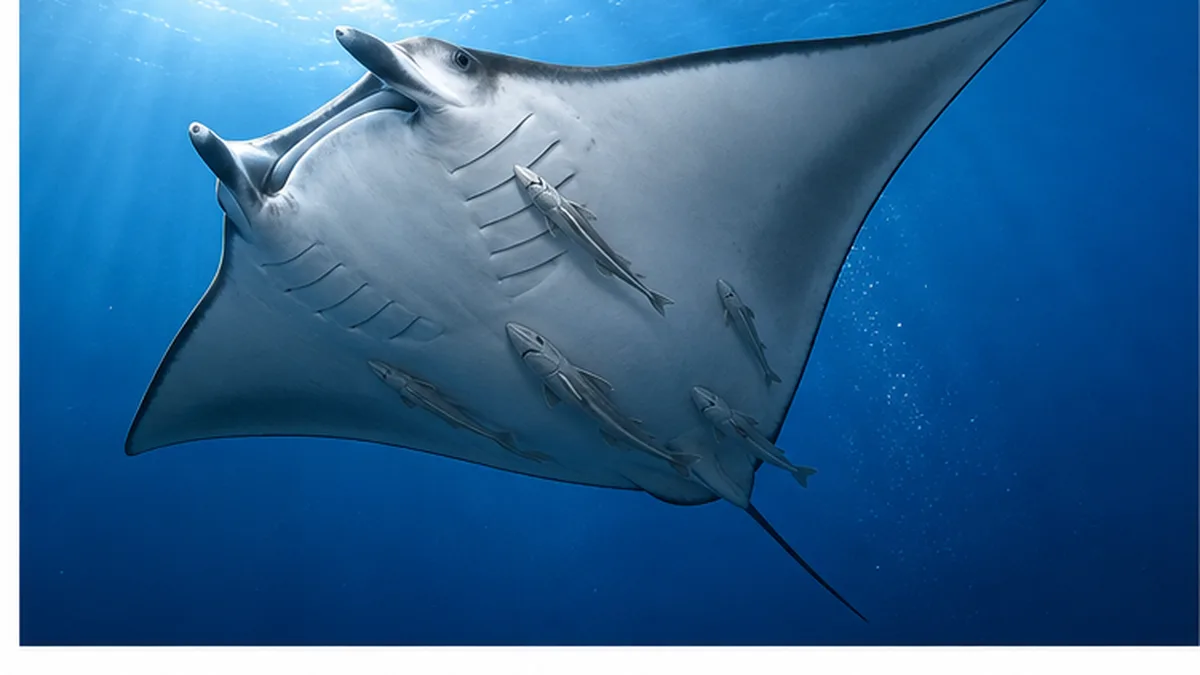
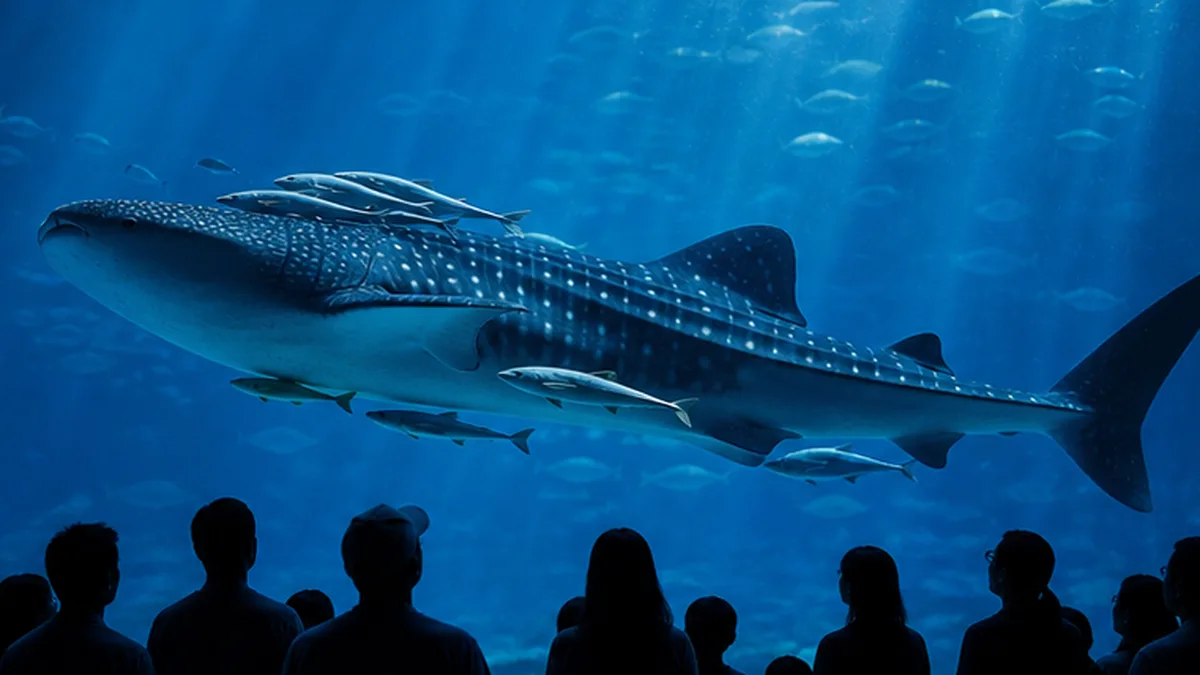
Remoras attach to a wide range of hosts: sharks, rays, sea turtles, large bony fishes, whales and dolphins, and even ships' hulls and divers. At the Okinawa Churaumi Aquarium, several remoras are displayed attached to the aquarium's whale shark in the Kuroshio Sea tank, where visitors can observe the relationship at close range.
Points that are easily misunderstood
- A remora is not a shark (a cartilaginous fish) but a bony fish of the order Perciformes
- The disc is not a mouth, and it sits on top of the head (the fish attaches with its dorsal side facing the host)
- Hosts are not limited to a single species: sharks, rays, sea turtles, whales, ships' hulls and more
What the disc really is: a precision device made from a dorsal fin
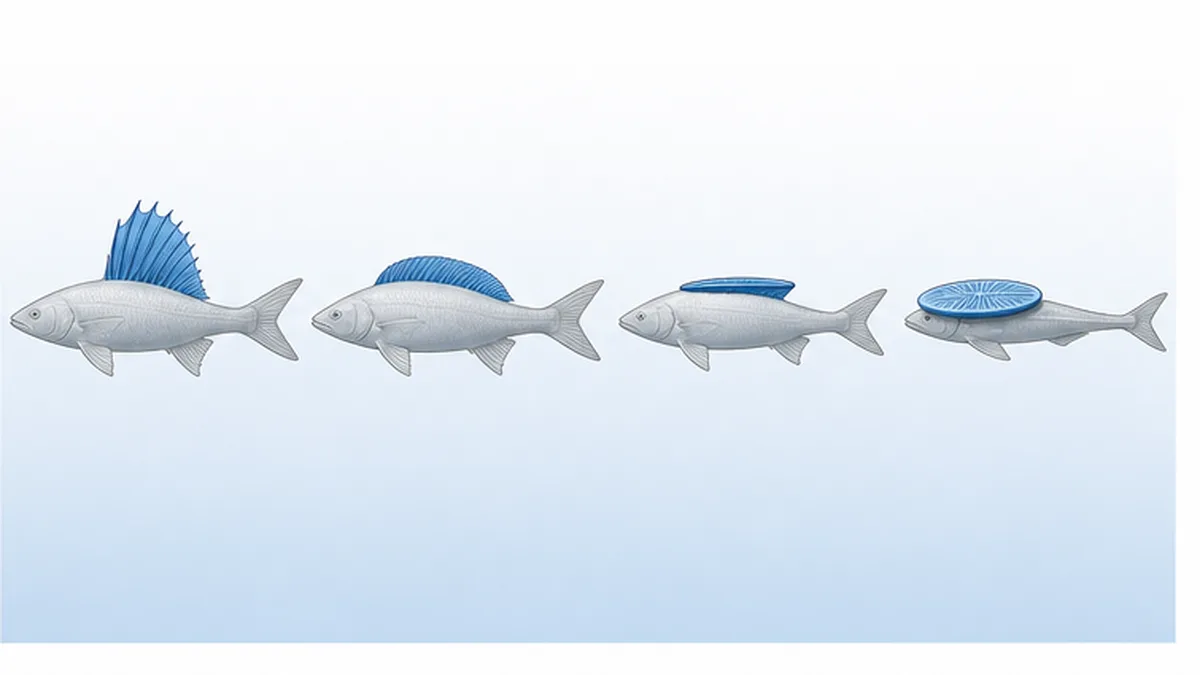
No account of remoras can avoid the disc on top of the head. Where did this organ come from? The answer is surprising: the first dorsal fin. The spiny dorsal fin that ordinary fishes hold upright on the back migrated forward over evolutionary time, folded down horizontally, and its elements separated left and right into a series of plates. That is the oval disc.
Lamellae: the bones of a flattened fin, lined up in rows
Seen from above, the disc reveals many slender plates arranged in neat rows on either side of a central ridge. These are the lamellae. Each lamella was originally a fin ray, one of the bones that supports a fin. They normally lie flat and point backwards, but when pressed against a host's body they rise up and divide the interior of the disc into a series of small chambers.
The outer rim of the disc is edged with a soft fleshy lip. This lip deforms flexibly to follow the contours of the host's body surface and seals water inside. It is thanks to this pliable edge that remoras can attach to surfaces as different as rough shark skin, the hard smooth shell of a sea turtle and the painted hull of a ship.
Spinules: microscopic teeth that stop slipping
Along the edges of the lamellae sit even smaller tooth-like projections called spinules. These structures, too fine to see with the naked eye, are what make a remora's attachment truly secure. When the disc is pressed down the lamellae rise, and the spinules along their edges bite into the host's skin, preventing lateral movement.
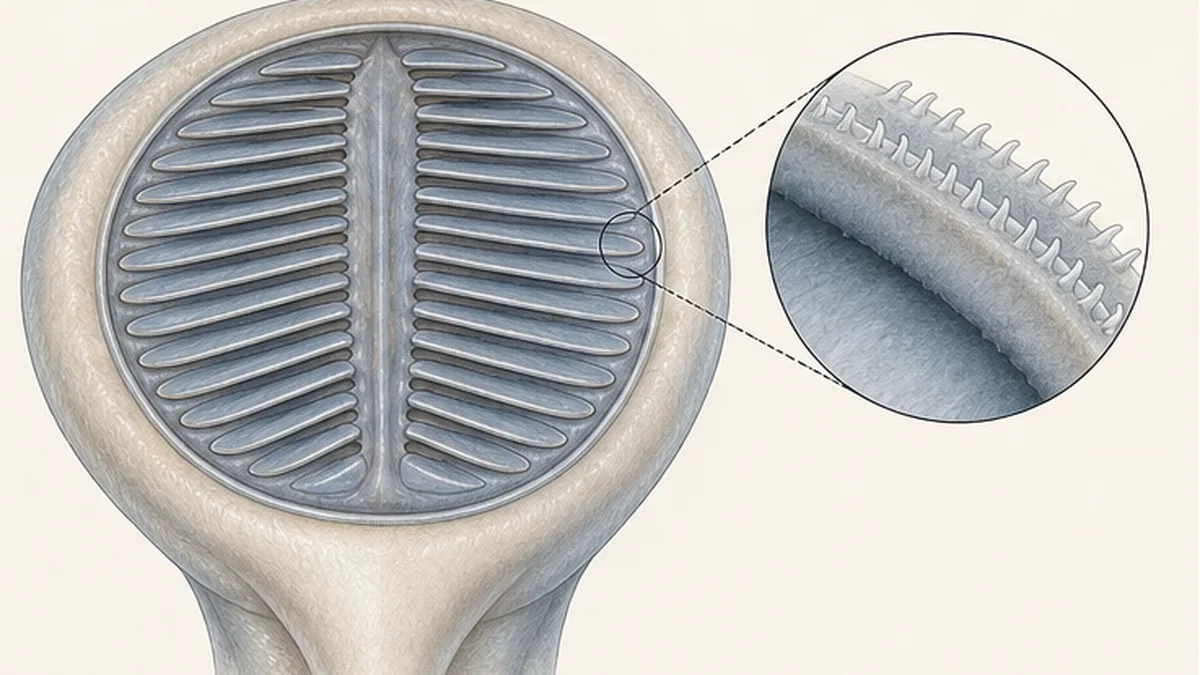
Spinules raise friction dramatically
Michael Beckert, Brooke E. Flammang and Jason H. Nadler quantified just how much difference the spinules make in a 2015 paper in the Journal of Experimental Biology (volume 218, issue 22, pages 3551–3558). Natural spinules pressed against smooth glass gave a coefficient of friction of only 0.081, but against rough glass the value jumped to 0.24. Between a remora disc and shark skin the measured coefficient was 0.22 ± 0.07. The team concluded that the geometry of the spinule tips plays an essential role in enhancing friction, and that the effect is greatest on finely textured surfaces such as shark skin.
| Combination | Contact surface | Coefficient of friction |
|---|---|---|
| Artificially reproduced spinules | Smooth glass | 0.122 ± 0.006 |
| Artificially reproduced spinules | Rough glass | 0.35 ± 0.04 |
| Natural spinules | Smooth glass | 0.081 ± 0.002 |
| Natural spinules | Rough glass | 0.24 ± 0.01 |
| Remora disc | Shark skin | 0.22 ± 0.07 |
In other words, a remora's disc does not hold on by suction (negative pressure) alone. The sealing function that creates a pressure difference is combined with a non-slip function delivered by microscopic projections. It is this two-stage design that allows a remora to stay attached in a place as demanding as the body surface of a shark swimming at tens of kilometres per hour.
The disc has touch sensors built into it
The disc's performance is not only a matter of structure. In 2020, Karly E. Cohen, Brooke E. Flammang, Callie H. Crawford and L. Patricia Hernandez reported in Royal Society Open Science (volume 7, issue 1) that the remora disc contains push-rod-like mechanoreceptor complexes, in other words touch sensors. Until then, structures of this kind had been known only from monotremes such as the platypus and the echidna.
The sensors are distributed on the dorsal surface of the soft lip around the rim, with a clear bias in density: 9 to 12 per square centimetre at the front and 2 to 4 at the rear, a significantly higher density anteriorly (p < 0.001). The researchers suggest that remoras may use these sensors to detect the instant they touch a host and to initiate attachment rapidly. They may also help the fish sense the shear forces acting during attachment and maintain a hold over long periods.
The remora disc, then, is not a passive adhesive pad but an active organ that senses contact and attaches of its own accord.
Why they do not come off: the physics of suction and friction
Now that the structure is clear, let us look at the forces actually at work. A remora attached to a host experiences forces in two broad directions: a vertical force trying to peel the disc away, and a horizontal force trying to sweep the body backwards.
Vertical forces: a pressure difference holds it down
When the rim of the disc seals against the host's body surface, the space inside is cut off from the outside. If the remora lifts the central part of the disc slightly, the internal volume increases and the pressure falls. The surrounding water pressure then presses the whole disc against the host, and that is the holding force. Because ambient pressure rises with depth, in principle the deeper the pair dives, the harder the disc is pressed down.
Horizontal forces: without friction it would simply slide off
The horizontal direction is easy to overlook but more important. When a host swims fast, strong drag pulls the remora's body backwards. A pressure difference alone cannot stop that sliding. This is where spinule friction comes in. Whether the fish is pushed forward or dragged backward, the raised lamellae and their spinules catch and hold its position.
Three elements that make the disc work
- Fleshy lip: conforms to uneven surfaces and seals the interior
- Lamellae: partition the disc and maintain local pressure differences
- Spinules: bite finely into the host's skin and prevent lateral slipping
To let go, they swim forward
If the hold is that strong, how does a remora detach when it wants to? The answer is simple: it swims forward. The disc resists backward pull strongly, but when the fish slides forward the spinules fold down and resistance drops sharply. Thanks to this asymmetry, the design is conveniently hard to dislodge while the fish is clinging on, yet easy to slip out of when the fish decides to move.
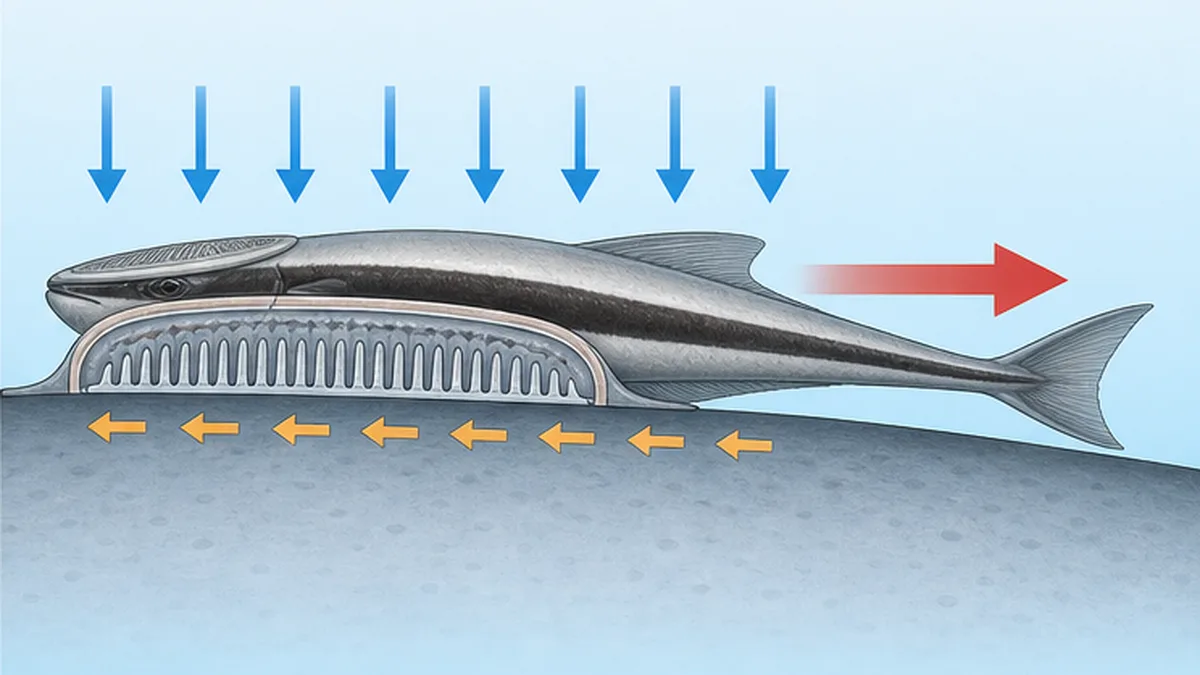
Shark skin as a moving foothold
When the host is a shark, the foothold is anything but flat. Shark skin is covered with dermal denticles, microscopic scales built like teeth: stroked backwards the surface feels smooth, stroked forwards it feels like sandpaper. This directional roughness offers ideal purchase for a remora's spinules. The friction measurements above, in which rough surfaces produced coefficients nearly three times higher, confirm exactly this compatibility.
The area around a host's gills and inside its mouth is also a space into which water flows gently. Remoras sometimes work their way into the gill chambers of sharks and manta rays because those places are low-flow refuges and, at the same time, a rich larder of parasites.
Intriguingly, the spinning leaps that dolphins perform in the air have also been examined mechanically as a possible way of shaking off attached remoras. Even a hold that looks unbreakable may, from the host's point of view, be something it would rather be rid of. That perspective leads directly to the next question: parasite or partner?
Where do they attach? What the back of a blue whale revealed
Remoras do not attach just anywhere on a host. The first study to record this continuously in the wild was published by Brooke E. Flammang and colleagues in 2020 in the Journal of Experimental Biology (volume 223, issue 20).
211 minutes filmed by a camera on a whale
The team attached a multi-sensor biologging tag to blue whales (Balaenoptera musculus), the largest animals on Earth, using four suction cups. The tag carried two cameras, allowing it to film what was happening on the whale's body surface underwater. The footage obtained ran to 211.5 minutes, and it captured a total of 27 individual remoras at 61 attachment positions. These are the first data to follow the behaviour of individual remoras riding a host continuously over long periods.
Three prime seats
Analysis showed that the places where remoras gathered and moved about were concentrated in three hydrodynamically advantageous areas of the whale's body: directly behind the blowhole, beside and behind the dorsal fin, and the flank region above and behind the pectoral fin. In each case, projections and contours of the body cause the flow to separate, generating a low-speed wake downstream.
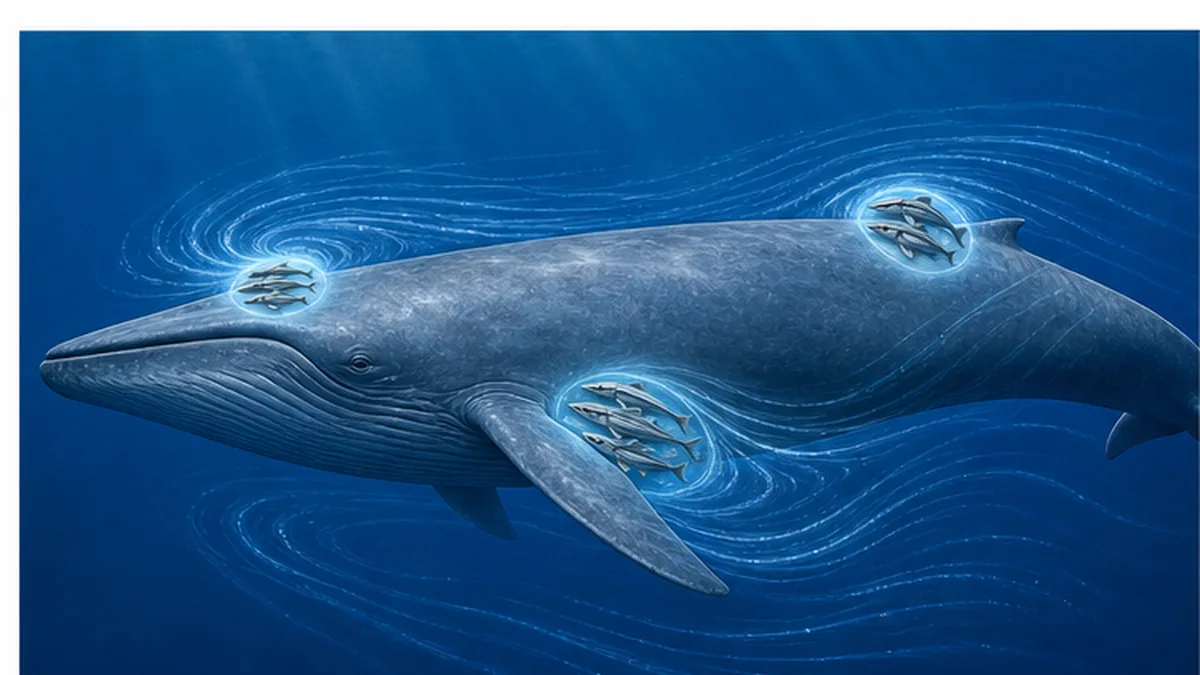
Up to 84% less drag
The team analysed the flow in these regions using computational fluid dynamics. They estimated that a remora whose body height is about 0.2 times the boundary-layer thickness experiences 40–50% drag reduction in separation regions and 59–84% in wake regions. At the maximum, 84%: compared with attaching thoughtlessly to a flat area, the water resistance acting on the fish is cut dramatically.
This is not merely a way of taking it easy. Less drag also means less load on the disc and less risk of being torn away. The data can be read as showing that remoras treat the vast body of a whale as terrain, choosing the sheltered valleys in which to settle.
Surfing without sticking
The footage held one more surprise. Rather than staying fixed by the disc at all times, remoras were repeatedly observed gliding just above the whale's body surface without attaching, inside the boundary layer. Because the relative speed of the water is reduced close to the body, swimming there allows them to change position with little energy. They were, in effect, surfing the whale's body surface to search for food or move to a better spot.
Key points of the blue whale study
- 27 individuals at 61 attachment positions recorded in 211.5 minutes of footage (Flammang et al. 2020)
- Attachment concentrated in three regions: behind the blowhole, around the dorsal fin and behind the pectoral fin
- Wake regions offer an estimated drag reduction of up to 84%
- Remoras were also seen gliding near the body surface rather than remaining permanently attached
What do they eat? Leftovers versus parasites
"They eat their host's leftovers." For a long time, that single sentence was the whole account of the remora diet. Scraps of flesh do indeed drift away when a shark tears into prey, and remoras waiting below have been seen picking them up. But when researchers actually examined stomach contents, the story turned out to be more complicated.
What the stomachs of 401 individuals showed
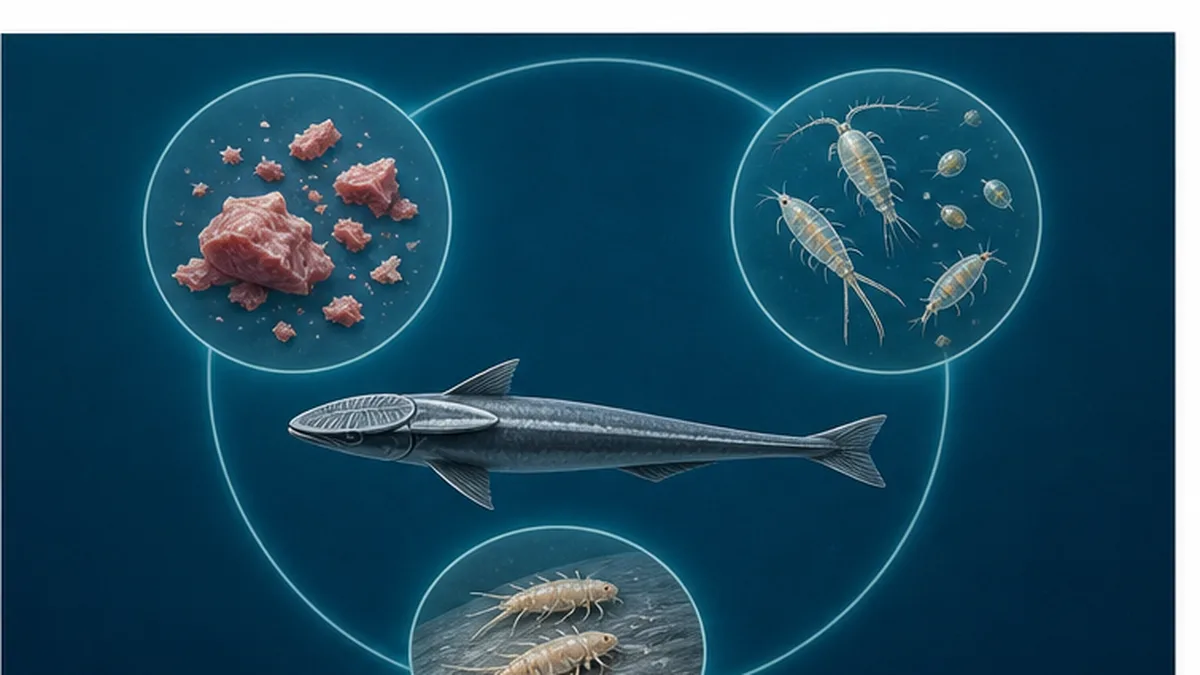
The study on remora diet still cited today is a 1970 paper in Copeia by Roger F. Cressey and Ernest A. Lachner, "The Parasitic Copepod Diet and Life History of Diskfishes (Echeneidae)." The pair examined the stomach contents of 401 individuals across six echeneid species. In the common remora (Remora remora), 70% of the stomachs containing food held parasitic copepods, chiefly of the family Caligidae. They were also detected to a significant, if lesser, extent in four other species.
Parasitic copepods are small crustaceans that attach to the skin, gills and mouths of sharks, rays and large fishes and feed on their body fluids. The fact that they filled remora stomachs means that remoras eat the parasites attached to their hosts. Far from being mere freeloaders, they also act as cleaners.
Diet shifts as they grow
The same study showed that parasite eating is not a lifelong diet. Among 95 sharksuckers examined across a standard length range of 57 to 630 millimetres, the largest individual found to have eaten parasitic copepods measured only 311 millimetres standard length. In other words, there is a developmental shift: young fish eat parasites off their hosts and switch to larger prey as they grow.
This shift also implies that the meaning of the relationship changes with age. Young individuals contribute as cleaners, while larger ones move towards using the host mainly as transport. Within a single species, in other words, the nature of the relationship is not uniform, which shows how difficult it is to describe ecological relationships as fixed properties of a pair of species.
They can hunt for themselves too
Remoras are by no means incapable of finding food on their own. They leave their hosts to chase small fish and crustaceans, and they also take zooplankton. Feeding on host faeces has been reported as well. Hitchhiking is best understood as a strategy for making travel and foraging efficient, not as a precondition for survival.
That is the decisive difference between remoras and true parasites, which cannot live without a host. Even among strategies that all involve "using another organism's body," the degree of dependence varies enormously. For a different angle on the diversity of relationships among marine organisms, see Why coral reefs are called the rainforests of the sea.
Parasite or partner? The textbook answer is shifting
Relationships between organisms are classified by who gains and who loses. If both gain, it is mutualism; if only one gains and the other is unaffected, commensalism; if one gains at the other's expense, parasitism. The remora-host relationship has long appeared in textbooks as the standard example of commensalism. In recent years, however, that placement has begun to wobble.
Evidence for mutualism: the cleaner role
The stomach-content research described above is a strong argument for the mutualism side. If remoras remove parasitic copepods from their hosts, the hosts benefit too. In animals with very large bodies, such as whale sharks, parasites on the skin and gills can affect health, so a lodger that cleans them may well be welcome.
The costs the host pays
Other research points to costs. First, increased drag: every remora attached adds to the resistance the host must overcome to push through the water. Second, skin damage, since spinules biting in can injure the epidermis and potentially open a route for infection. And behaviour such as entering the gills or body cavities places a clear burden on the host.
| View of the relationship | Effect on the host | Supporting observations |
|---|---|---|
| Commensalism | Essentially none | The remora gains transport and food; the host neither gains nor loses (the traditional view) |
| Mutualism | Beneficial | Remoras eat and remove parasitic copepods from the host (Cressey & Lachner 1970) |
| Close to parasitism | Harmful | Increased drag, skin damage from spinules, intrusion into gills and body cavities |
A 2026 report: diving inside manta rays
The debate was shaken considerably by a 2026 paper in Ecology and Evolution (volume 16, issue 5) from Emily A. Yeager and colleagues at the University of Miami's Shark Research and Conservation Program, titled "Hiding in Plain Sight: Evidence of Echeneidae Cloacal and Gill Diving Behavior in Manta Ray Hosts." The team compiled seven observations collected between 2010 and 2025 in Florida, Mozambique and the Maldives, providing photographic evidence that remoras dive into the cloacas and gill chambers of manta rays.
The behaviour was confirmed in all three known manta species and across multiple ocean basins. The researchers list predator avoidance, feeding and drag reduction while swimming as possible purposes, but which is the main driver remains unknown. What is certain is that once a fish is inside a host's body, the effect on that host is no longer a matter of indifference.
Hosts show a degree of tolerance
The host's own response is easily overlooked. If remoras were purely harmful, hosts would presumably try hard to shake them off. In practice, whale sharks and manta rays are frequently seen carrying anywhere from a few to more than a dozen remoras for long periods. Attempts to dislodge them tend to appear only in clearly unpleasant situations, such as intrusion into the gills or body cavity. The very fact that hosts tolerate a degree of company suggests that this is not simple parasitism.
Think of the relationship as a gradient
In the end, the remora-host relationship cannot be captured in a single word. Depending on the remora species, its life stage, the host species and the circumstances, the relationship shifts continuously from commensalism through mutualism to something approaching parasitism. Symbiosis in ecology is a matter of shading rather than black and white, and remoras are an excellent teaching example of exactly that.
Beware the "freeloader" label
In Japanese, kobanzame is a metaphor for someone who rides on another's power, but real remoras also clean parasites off their hosts and can forage for themselves. Describing relationships between organisms purely in terms of one-sided gain and loss means missing their complexity.
An evolutionary story: a hitchhiker born 38 million years ago
A dorsal fin becoming a suction disc is one of the boldest remodellings in fish evolution. When and how did it happen?
The middle-to-late Eocene, about 38 million years ago
According to the phylogenomic analysis published in 2019 in Integrative Organismal Biology by C. P. Kenaley, A. Stote, W. B. Ludt and P. Chakrabarty, the family Echeneidae originated in the middle to late Eocene, roughly 38 million years ago. In the seas of that era, the ancestors of modern whales were adapting fully to marine life and large sharks were flourishing. The growing number of large, long-ranging animals in the ocean is thought to have laid the groundwork for a hitchhiking way of life.
The disc did not appear overnight. It probably began with nothing more than a habit of pressing the body into hollows or sheltered flow on a host's surface; the dorsal fin then flattened to increase contact area, the fin rays became lamellae, and scales became spinules in stages. Some research suggests that early remoras began by attaching to rough surfaces such as shark skin.
Juvenile growth retraces evolution
The idea that the disc derives from the dorsal fin had been proposed as far back as the eighteenth century, but it was a study by researchers at the Smithsonian Institution and the Natural History Museum in London, published in the Journal of Morphology in 2013, that confirmed it developmentally. By observing juvenile skeletons stage by stage, the team showed that the three components of a dorsal fin — distal radials, proximal-middle radials and fin spines — can be identified directly in the early stages of disc formation. Comparison with a fish that has an ordinary dorsal fin, Morone americana, made the correspondence clear.
Development proceeds strikingly fast. A juvenile of 26.7 millimetres is still forming the structure, but by about 30 millimetres a complete disc of just 2 millimetres sits on top of the head. A tiny fish, barely three centimetres long, is already equipped to hitch a ride: a vivid case in which individual development appears to retrace the evolutionary path.
Host choice differs between species
The same study also revised the accepted view of host choice in the family. Previously the assumption was a dichotomy between reef generalists that attach to a wide range of hosts and pelagic specialists that attach to particular ones. The analysis showed a different pattern: the pelagic group was more variable in host choice, while the group treated as reef generalists was less variable. In particular, Echeneis naucrates, long regarded as a reef species, turned out to show marked host specialisation.
The closely related cobia has no disc
One of the closest relatives of the Echeneidae is the cobia (Rachycentron canadum). Cobia have no disc, but as juveniles they have an elongated body and a dark flank stripe strikingly like a remora's, and they are known to swim in attendance on large sharks and rays. The way of life that preceded the acquisition of a disc, in other words, survives in a close relative today: an intriguing comparison.
There are many other cases of marine animals repurposing body parts for unexpected uses as they adapt to their environment. For the organs sharks use to sense the faint bioelectric fields of their prey, see A guide to shark electroreception; for creatures that have rebuilt their bodies for extreme conditions, see The astonishing adaptations of deep-sea life.
Into human technology: remora-inspired robots and how we treat the sea
Attaching and detaching repeatedly, underwater, on a wet surface, to a moving partner: to an engineer, the performance of a remora disc is exactly the capability you would most like to have. Remoras have accordingly become a focus of biomimetics.
A robotic disc that holds roughly 340 times its own weight
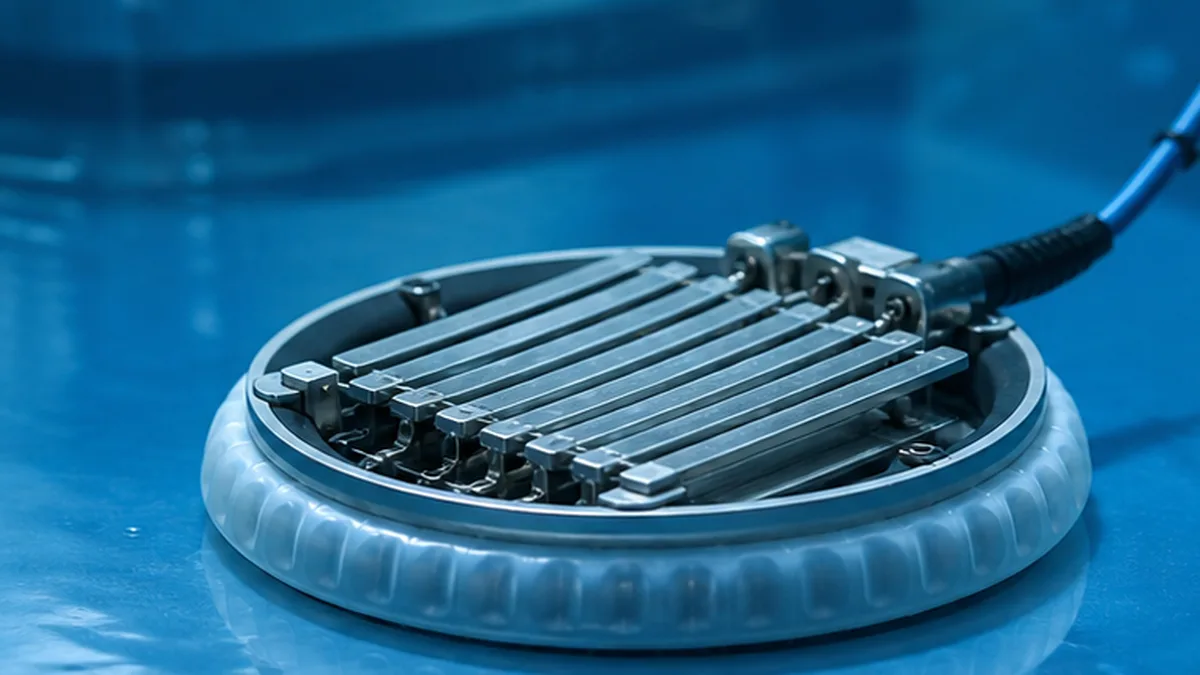
In 2017, Science Robotics published a paper titled "A biorobotic adhesive disc for underwater hitchhiking inspired by the remora suckerfish." The team built a disc-shaped device modelled on the remora disc, combining a soft outer lip, movable lamellae and fine spinules. On smooth surfaces the prototype resisted pull-off forces of up to 436.6 ± 16.0 newtons. Since the device itself weighs 0.129 kilograms, that is roughly 340 times its own weight.
Later work has reported biomimetic discs that outperform the holding forces measured for live remoras attached to shark skin. We have reached the point where a design nature spent 38 million years refining can be understood and reproduced by people.
A tool for studying marine animals without harming them
The application with the greatest promise is tagging marine animals. Learning about the lives of whales and sharks requires attaching sensors and tracking them, but methods that pierce the body injure the animal. A remora-style attachment device can stay in place for as long as needed and then come off naturally, allowing observation with far less burden on the animal. Indeed, the tag attached to the blue whales in the study described earlier was itself held on by four suction cups.
The scope goes well beyond ocean observation. Underwater hull inspection, robots for inspecting submerged infrastructure, and even medical devices designed to stay in place inside the body all create demand for technology that adheres reliably to wet surfaces.
You can meet them at an aquarium, and eat them
Remoras are also easy to observe up close in Japanese aquariums. At the Okinawa Churaumi Aquarium's Kuroshio Sea tank, remoras are displayed attached to the whale shark, so visitors can see for themselves the size difference and exactly where the fish attach. Divers, too, frequently see them accompanying large sharks and rays.
They are eaten as well. Remoras are handled as sashimi grade at markets such as Toyosu and have long been eaten in Okinawa. The flesh is white, with a characteristic gelatinous layer beneath the skin. Catches are small, however; rather than a targeted fishery, remoras are landed incidentally alongside other species. Making full use of fish like these, which are never the star of the catch but are certainly landed, is also part of reducing seafood waste.
Protecting the hosts means protecting the remoras
A remora's life is impossible without the large animals that serve as its hosts. Whale sharks, manta rays, many shark species and sea turtles are declining under overfishing, bycatch and habitat degradation. As hosts disappear, the places available to the fish that ride them are quietly lost as well. Marine life does not exist species by species in isolation; it is connected through a web of relationships that are easy to overlook.
A fish carrying a gold coin on its head, living on the back of the largest animal on Earth while reading the flow of water around it. Simply knowing that changes how you look at the sea. Noticing the connections between living things is the first step towards wanting to protect them.
What we can do
- At aquariums and in field guides, pay attention to who is with whom, and take an interest in the relationships between organisms
- Learn about the work of organisations conserving large marine animals such as sharks, sea turtles and manta rays
- Reduce marine litter: drifting nets and fishing line injure large animals and take away the homes of the fish that ride them
- Choose seafood from sustainable fisheries (MSC certified, for example) to support reductions in bycatch
References and sources
- Journal of Experimental Biology – Flammang B. E. et al. (2020) Remoras pick where they stick on blue whales, 223(20): jeb226654. Analysis of attachment positions and drag reduction on the blue whale body surface
- Journal of Experimental Biology – Beckert M., Flammang B. E. & Nadler J. H. (2015) Remora fish suction pad attachment is enhanced by spinule friction, 218(22): 3551–3558. Quantitative measurement of friction enhancement by spinules
- Integrative Organismal Biology – Kenaley C. P., Stote A., Ludt W. B. & Chakrabarty P. (2019) Comparative Functional and Phylogenomic Analyses of Host Association in the Remoras (Echeneidae). Origin date and host specificity from phylogenomic analysis
- Ecology and Evolution – Yeager E. A. et al. (2026) Hiding in Plain Sight: Evidence of Echeneidae Cloacal and Gill Diving Behavior in Manta Ray Hosts, 16(5). Cloacal and gill-chamber diving in manta rays
- Science Robotics – Wang Y. et al. (2017) A biorobotic adhesive disc for underwater hitchhiking inspired by the remora suckerfish, 2(10): eaan8072. Performance evaluation of a biomimetic disc modelled on the remora
- Royal Society Open Science – Cohen K. E., Flammang B. E., Crawford C. H. & Hernandez L. P. (2020) Knowing when to stick: touch receptors found in the remora adhesive disc, 7(1): 190990. Discovery of mechanoreceptors in the disc lip
- Phys.org (coverage of a Journal of Morphology study) – Developmental confirmation of the dorsal-fin origin of the disc by the Smithsonian Institution and the Natural History Museum, London (2013). Disc formation between 26.7 mm and about 30 mm body length
- Copeia (via Semantic Scholar) – Cressey R. F. & Lachner E. A. (1970) The Parasitic Copepod Diet and Life History of Diskfishes (Echeneidae). Stomach-content analysis of 401 individuals across six species
- FishBase – Species summary for Echeneis naucrates (live sharksucker): maximum total length 110 cm, circumtropical distribution, depth range 1–85 m. The family's genera and species are also listed in the site's Family Summary
- Okinawa Churaumi Aquarium – Churaumi creature guide, "Remora." Attachment to the whale shark and display in the Kuroshio Sea tank
※ Ordered by reliability: government and academic institutions > peer-reviewed papers > specialist organisations > trusted media