⚡ In short
Scallop and oyster shells, produced at the scale of hundreds of thousands of tonnes a year, are finding uses in fertilizer, fishing-ground restoration, chalk and building materials. We explain cases from Hiroshima and Hokkaido and the challenges of resource recovery.
Scallop and oyster shells are not just waste: they are a valuable resource with the same composition as limestone. How to put hundreds of thousands of tonnes of shells a year to use has become a challenge in many regions.
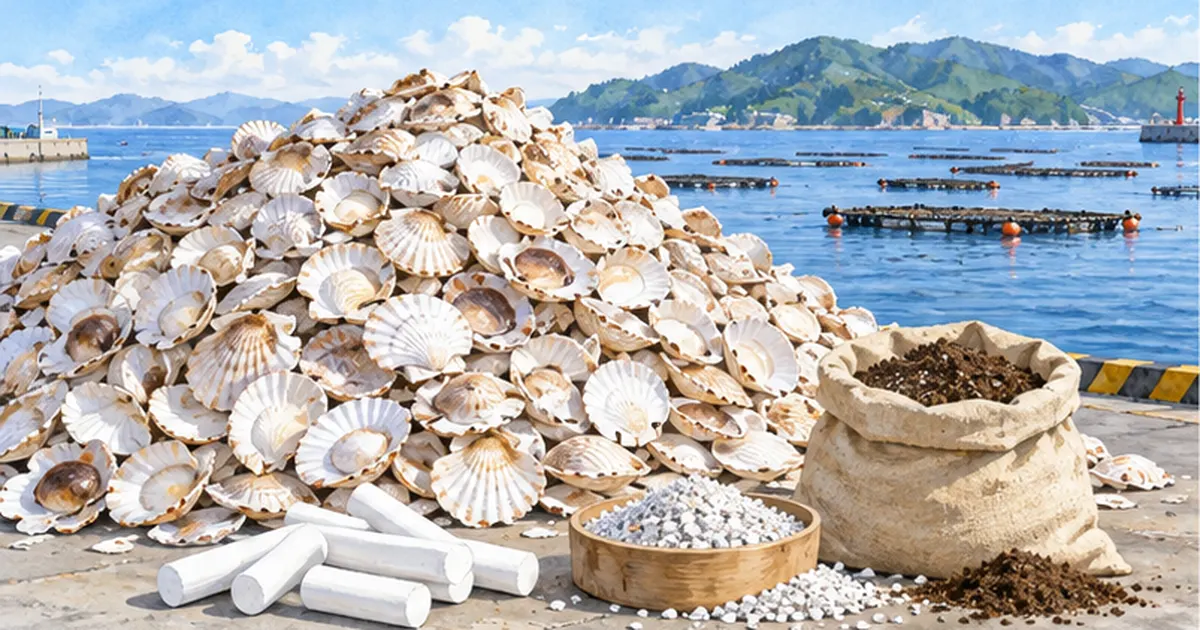
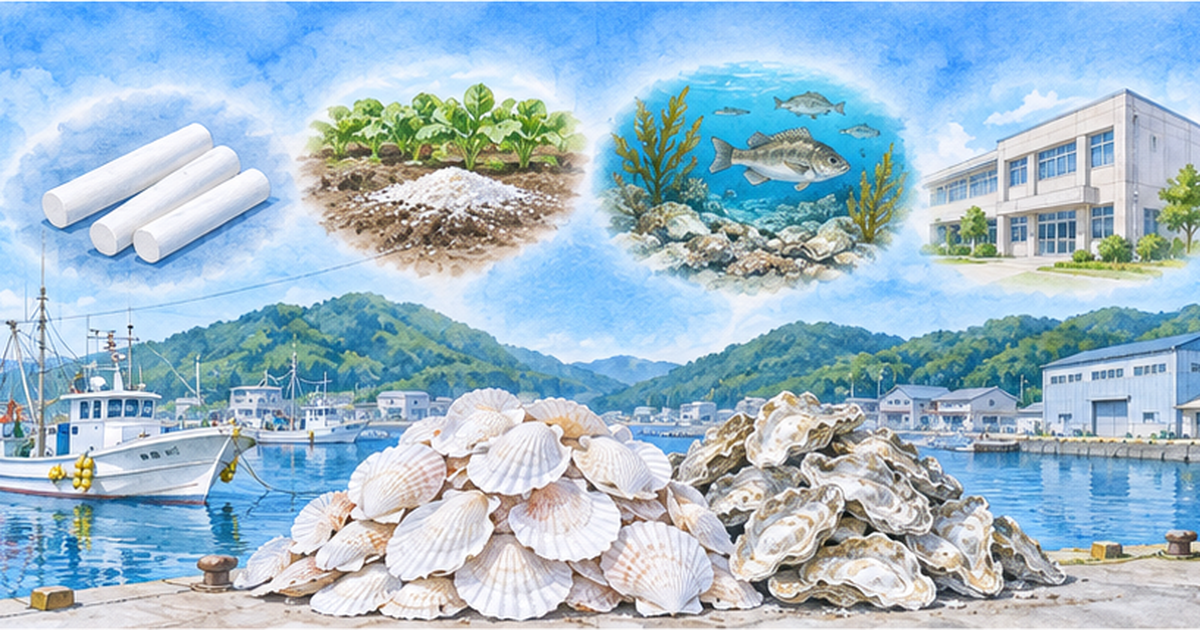
The meat goes to the dinner table, while the shells stay behind in the producing area. To change this familiar picture, a variety of uses are advancing, including fertilizer, feed, fishing-ground restoration, chalk and building materials.
Drawing on public documents and trial results from Hiroshima, Hokkaido, Aomori, Okayama and elsewhere, this article summarizes the current state and challenges of turning shells and fishery residues into resources.
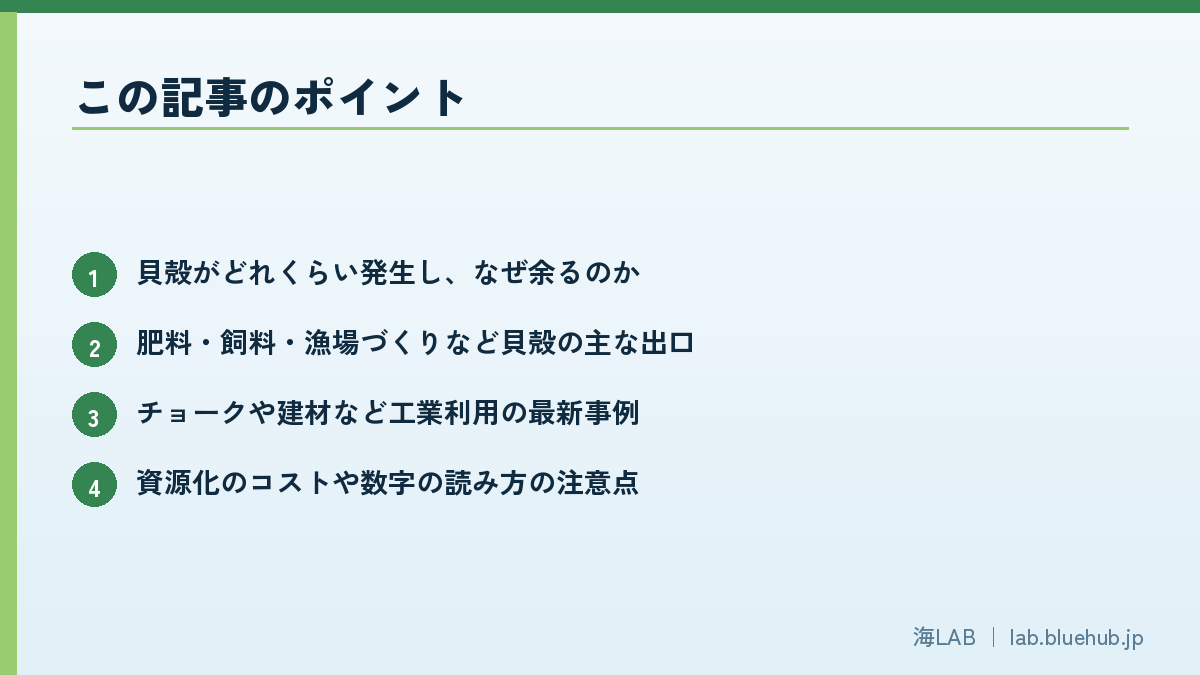
What you will learn in this article
- How many shells are produced, and why they pile up
- The main outlets for shells: fertilizer, feed, fishing-ground restoration
- Latest industrial uses such as chalk and building materials
- Cautions about costs and how to read the numbers
- Easy ways each of us can get involved
Shells are not 'trash' but a resource that can stand in for limestone
How many shells are actually produced?
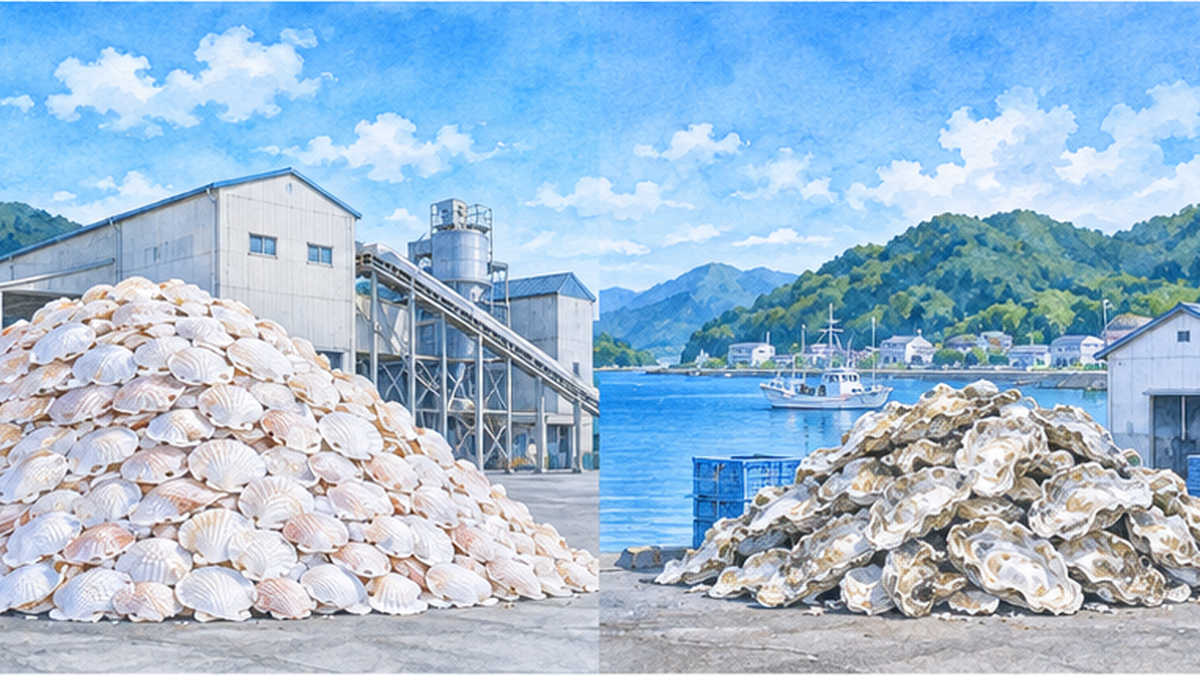
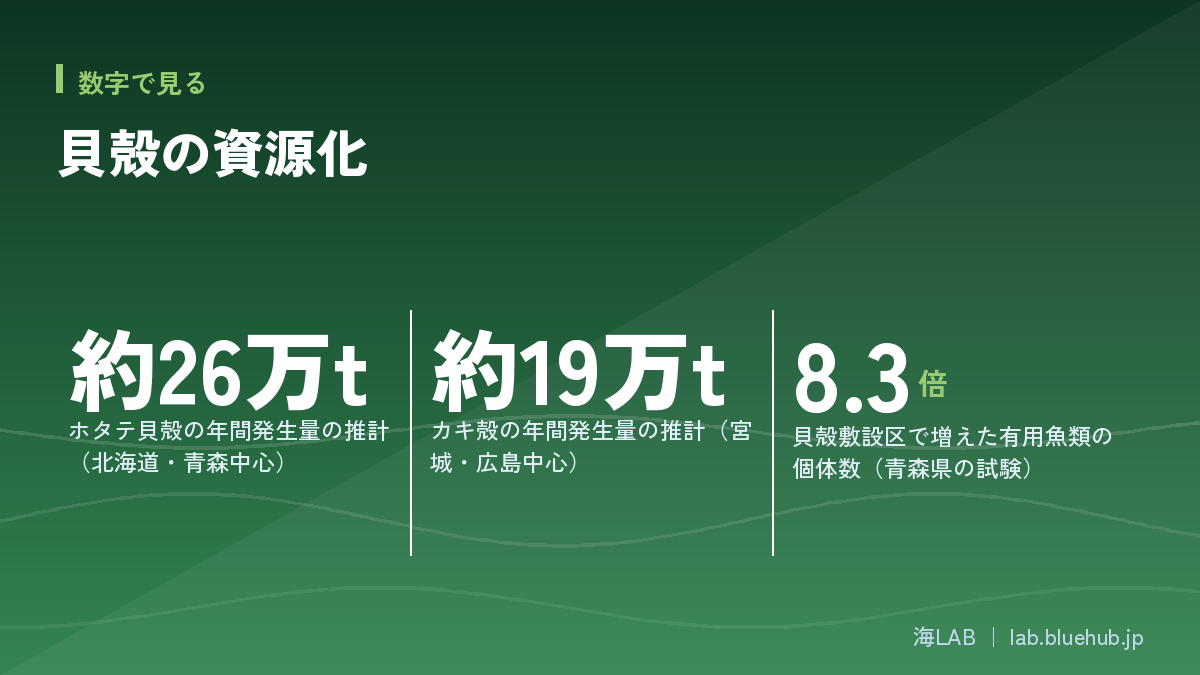
Scallops and oysters are representative seafood that support Japan's coastal fisheries and aquaculture. The meat reaches the table, but the shells cannot be eaten. Once the meat is shucked and shipped, the shells remain at processing plants in the producing areas. According to technical materials from the construction sector, scallop shells are estimated at about 260,000 tonnes a year, mainly in Hokkaido and Aomori, and oyster shells at about 190,000 tonnes a year, mainly in Miyagi and Hiroshima. However, the figures vary depending on the scope of counting (for example, whether shucked meat for export or shell-on shipments are included). Another source estimates scallop shell output at 360,000 tonnes, so it is realistic to understand it as a range from the 200,000s to the 300,000s of tonnes.
Weight is hard to picture, so consider Hiroshima Prefecture. It manages oyster shells by volume in cubic meters, and the amount left over each year because it cannot be used up (the annual surplus) is expected to be about 60,000 cubic meters for the 2024 season (Reiwa 6) and about 50,000 cubic meters for the 2025 season (Reiwa 7). This is an estimate of the surplus beyond existing uses, not the total output, yet it means shells of this scale look for a destination every year.
Shells are nearly the same as limestone
The main component of shells is calcium carbonate. Hiroshima Prefecture also points out that oyster shells are mainly calcium carbonate, the same as limestone, and expects new uses in construction and manufacturing. Technical materials from a construction company likewise state that shells have properties close to limestone aggregate. In other words, shells can be a circular resource from the sea that substitutes for limestone dug out of mountains.
- The main component is calcium carbonate, with the same properties as limestone
- Scallops take in carbon from seawater as they grow and build their shells
- Producing areas are concentrated around fishing ports, so large quantities are easy to collect
The idea of fishery 'by-products'
The edible share of seafood can be smaller than you might expect. Shells make up a large part of the weight of shellfish, and fish processing yields heads, bones, viscera and skin. Whether these are called 'waste' or 'by-products' greatly changes how they are handled. Treated as by-products, they become something to analyze, find uses for and add value to. Shells are a prime example.
Using the resources we receive from the sea as fully as possible not only improves the economics of the fishing industry but also reduces the burden of disposal and the impact on the environment. This article looks at concrete efforts, centering on shells.
Scallops and oysters are different
Even among shells, scallops and oysters differ in both origin and shape. Scallops come mainly from Hokkaido and Aomori and have large, flat shells. Oysters come mainly from Miyagi and Hiroshima and have thick, rugged shells. Different shapes change how suitable each is for crushing and for various uses. For example, uneven oyster shells are considered well suited to being laid on the seabed as shelter, while the particle characteristics of scallop shells are put to use as a raw material for chalk and powders.
Key points of this section
- Shells are produced at the scale of hundreds of thousands of tonnes a year
- The main component is calcium carbonate, the same as limestone
- Because the figures vary with counting methods, view them as a range
Why have shells become a 'disposal headache'?
Treatment as industrial waste and storage problems
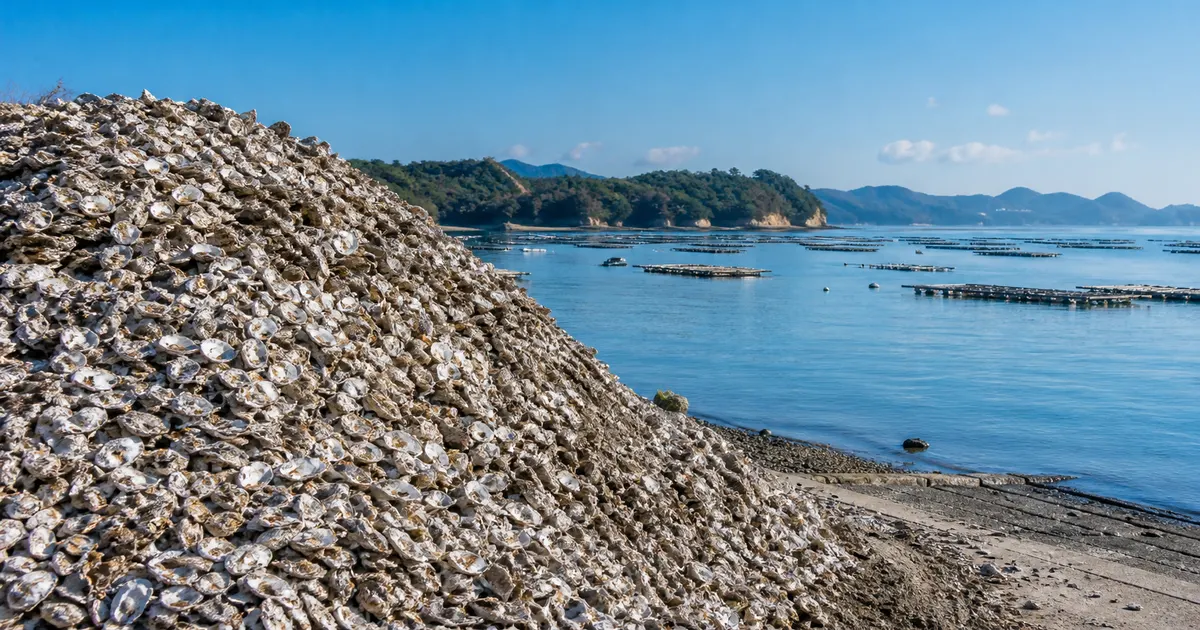
When shells arise from business activities, they are in principle treated as industrial waste. Transport and disposal cost money, and the burden grows with volume. For this reason, producing areas have long been a sight of shells piled up on processing plant grounds or in dedicated storage sites. Open piles can cause odors from sea breezes and rain, and raise concerns about the landscape and surrounding environment.
Hiroshima Prefecture has a temporary storage site for oyster shells in the Eba district (capacity of about 63,000 cubic meters). According to the prefecture, about 29,000 cubic meters were stored there as of the end of May 2026 (Reiwa 8). Because storage space is limited, it will eventually approach capacity unless uses increase.
Uses can also shrink
Oyster shells have long been widely used as agricultural fertilizer and poultry feed. According to the prefecture, however, use has tended to decline in recent years because of avian influenza outbreaks and rising prices of agricultural materials. When demand is concentrated in one industry, outlets can narrow suddenly due to that industry's circumstances.
| Challenge | Details |
|---|---|
| Storage | Temporary storage sites have limited capacity |
| Cost | Transport and disposal cost money |
| Concentrated demand | Mainly fertilizer and feed, so vulnerable to external factors |
| Processing | Shells are hard, and crushing or calcining requires energy |
Related fishery residue problems
Besides shells, fish processing also generates residues. Research materials from Hokkaido report that scallop processing yields about 30,000 tonnes of viscera, mainly the digestive gland (known as 'uro'). Cadmium tends to accumulate in uro at relatively high concentrations, and it has been pointed out that removal technology is needed before using it for fertilizer or feed. This is a different difficulty from shells, and circulating fishery residues as a whole requires careful assessment of each component.
Circumstances differ by region
The shell problem is not uniform nationwide. In Hokkaido and Aomori, the scallop-producing areas, more shells come out in years with stable catches. In Hiroshima and Miyagi, the oyster-producing areas, both the volume and how it is used vary with the scale of farming, the harvest and processing methods. Solutions must therefore be designed around each region's industrial structure and nearby demand.
For example, regions with many farms and poultry houses nearby can expect demand for fertilizer and feed. Where there is demand for fishing-ground restoration in sea areas close to ports, returning shells to the sea becomes realistic. Where factories or construction sites are close, use as aggregate or filler is also a candidate. Building up 'where, for what, and how much' at the regional level is the starting point of shell circulation.
The flow from sea to land and back to the sea
Shells are part of the body of shellfish raised in the sea. They can be brought ashore, processed and used on farmland or in building materials, or returned to the sea to build fishing grounds. Whether to use them on land or return them to the sea is decided by comparing quantity, quality and cost. What cannot be used either way becomes the 'surplus' that piles up in storage.
A caution
Shells and viscera are handled differently. Shells are mainly calcium carbonate and have wide uses, whereas viscera such as uro require management of heavy metals and the like. It is important not to lump everything together as 'fishery waste' but to consider each part separately.
Agriculture and livestock: the oldest outlet
Shells as soil conditioner
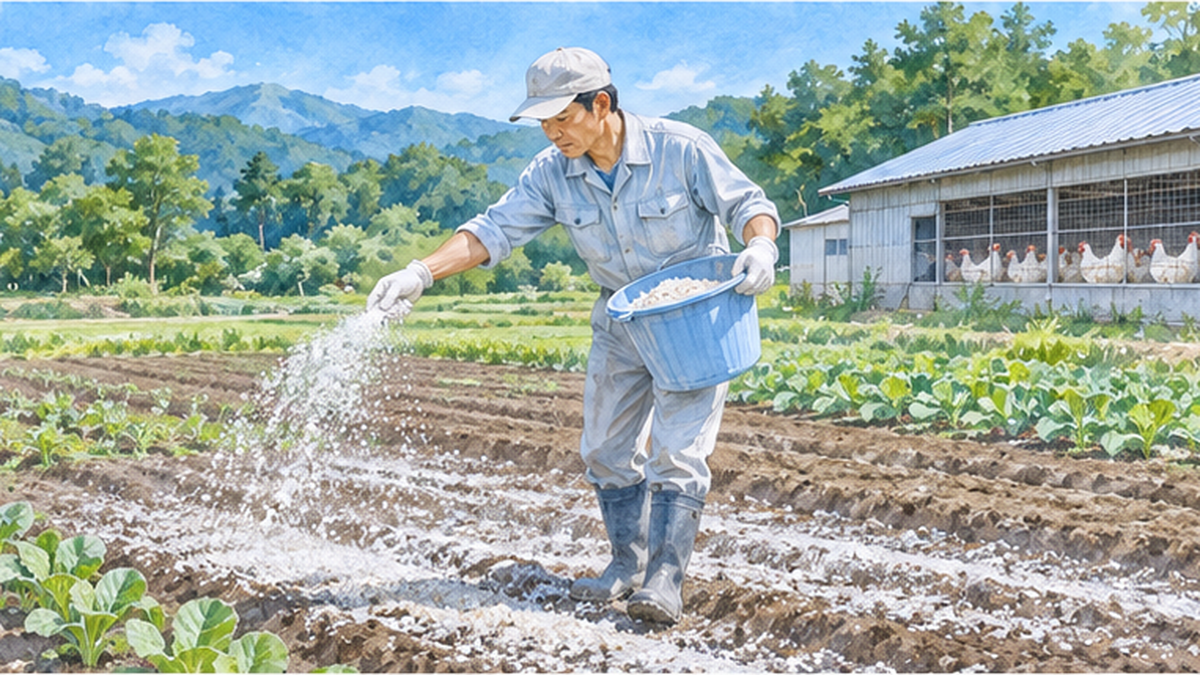
Because Japan has a lot of rain, its soils tend to become acidic, and adding lime to adjust acidity is indispensable on farmland. Since shells are mainly calcium carbonate, they can replace lime materials. Besides spreading crushed shells as they are, they can also be burned and powdered. Research reports from Hokkaido also note that use as a soil conditioner and as a drainage material for subsurface drains is already in practice.
Shells dissolve slowly and so are said to work gently, with soil changing little even when a large amount is spread at once. On the other hand, effects vary with particle size and whether the shells are calcined, so they must be chosen to suit the crop and soil condition.
Use as livestock feed
Laying hens need a lot of calcium to form eggshells. Finely crushed oyster and scallop shells have therefore been used as a calcium supplement in poultry farming. Hiroshima's oyster shells also have a history of effective use as poultry feed. However, as noted in the previous chapter, avian influenza changes the poultry industry itself, so this demand is easily affected by outside circumstances.
- Adjusting acidity of farmland (substitute for lime materials)
- Drainage material for improving drainage
- Calcium supplement for laying hens and others (feed additive)
The perspective of regional circulation
Shells are used as fertilizer on fields, and the vegetables and grain grown there are consumed locally. Oyster shells used in poultry feed become eggshells that reach the table. Such flows are a picture of 'regional circulation', in which resources go around within the producing area. The less they must be carried far, the less transport energy is needed.
From the viewpoint of agriculture and poultry farming, on the other hand, shells are just one of many lime materials, compared with others on price, stable quality and ease of handling. To be chosen, shells need consideration for users, such as uniform particle size, less dust and packaging that is easy to carry. The facilities that processors in Hiroshima built to strengthen production are exactly an investment to 'prepare shells in a form easy for users to use'.
Commercialization with added value
In some regions, products made from shells are also produced, such as bath agents, deodorizers, vegetable washing agents and calcium materials for food. Such products have high value per weight, so the burden of transport cost is relatively light. However, uses related to food and hygiene must meet safety and quality standards, so the barrier to entry is also high.
Note
When shells are used on fields or as feed, removal of salt and impurities and hygiene management are necessary. In practice, use follows the standards and procedures set by each local government or business.
Repairing fishing grounds: the idea of returning shells to the sea
Laying shells on the seabed as habitat
Shells were originally made in the sea. There are attempts to lay them on the seabed to serve as breeding and spawning grounds for aquatic life. In a trial in Mutsu Bay, Aomori Prefecture, it was reported that the laid shells kept their shape without wearing away for a long time and showed no spreading due to waves. In the sections with shells, the number of useful fish was 8.3 times higher than in the control section, and the eggs of Hexagrammos otakii (ainame) were also confirmed to have been laid.
The gaps between shells become hiding places for small fish and crustaceans. Algae and tiny organisms attach to the surface, and a chain of creatures that feed on them can be expected to gather.
Improving seabeds where mud has built up
In Bisan Seto, Okayama Prefecture, a trial laid oyster shells in 2009 on a sea area where the seabed had turned to silt (fine mud). The report says no silt accumulation was seen even about two years after laying, and suggests that the mineralization of organic matter by benthic organisms in the laid area may be involved. Meanwhile, in a scattering trial off Kawauchi, Aomori Prefecture, there was almost no effect on water or sediment quality, but an effect of preventing attachment of polydora (a harmful worm-like organism) to scallops was seen. Note that effects differ with sea conditions and the way shells are used.
| Trial site | Content | Reported result |
|---|---|---|
| Aomori, Mutsu Bay | Laying scallop shells on the seabed | Shells kept their shape; useful fish up 8.3 times |
| Okayama, Bisan Seto | Laying oyster shells (2009) | No silt accumulation after about two years |
| Aomori, off Kawauchi | Scattering scallop shells | Effective in preventing polydora attachment |
Hiroshima Prefecture's guidelines
Hiroshima Prefecture has compiled guidelines on fishing-ground creation and sediment improvement using oyster shells. The prefecture positions improvement of the fishing-ground environment as a use expected to expand, and also developed facilities to increase production by processors. As a result, processors' use in fiscal 2025 is said to have risen by about 17,000 cubic meters from the previous year.
What to check before returning shells to the sea
Laying shells on the seabed seems like a natural idea, but prior checks are essential in practice. In some sea areas, scattering shells itself is subject to coordination of fishing-ground use and environmental impact assessment. This is because both effects and risks change with water depth, currents, sediment, and the relationship with nearby aquaculture facilities and fishing gear.
- Whether the depth, currents and sediment of the site are suitable
- Whether the shells carry too much attached material or organic matter (whether washing or drying is needed)
- Whether coordination with nearby fishers and related agencies is complete
- Whether there is a survey plan to measure effects after laying
Hiroshima Prefecture compiled guidelines in order to organize these checks and procedures so that they can be reproduced on site. Sharing not only successes but also cases where effects were limited is the key to realistically expanding use at sea.
Shells as a 'structure' that attracts life
Laying shells increases the unevenness of the seabed. Compared with a flat seabed of only sand or mud, more gaps create places to hide and lay eggs. That ainame eggs were confirmed in the Aomori trial shows that the structure made by the shells suited spawning. The idea of supplementing habitat by human hands to support resource recovery applies to other fishing-ground work as well.
Summary of this chapter
- Returning shells to the sea can make them habitat and spawning grounds
- Effects vary by sea area and method
- Local governments are writing guidelines, and processing capacity is being strengthened
Industry and construction: chalk, sterilization, aggregate and sealants
Chalk containing scallop shells
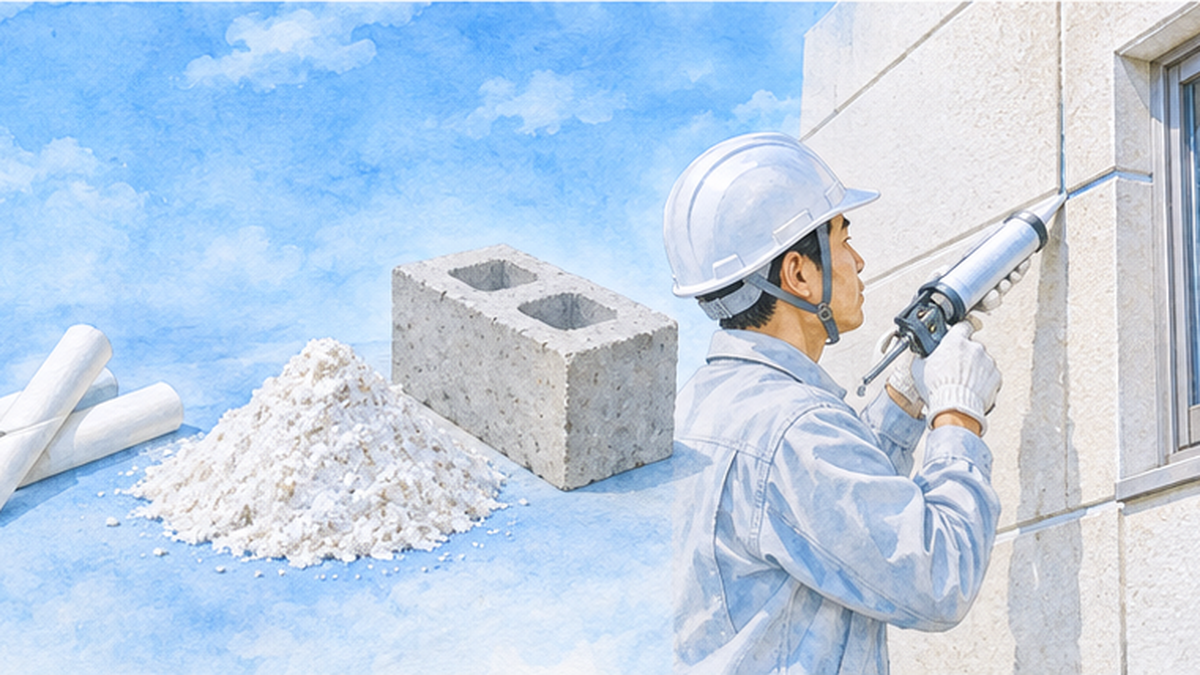
In Hokkaido, the Hokkaido Industrial Research Institute and the Bibai plant of Nihon Rikagaku Kogyo jointly developed chalk containing scallop shells. It focused on the fact that particles of calcium carbonate powder made from scallop shells are rod-shaped; it received an encouragement prize at the Hokkaido New Technology and New Product Development Awards and was also certified as a Hokkaido Recycling Brand. A familiar stationery item thus becomes a destination for shells from the producing area.
Sterilization and antibacterial use of calcined shells
When shells are burned at high temperature, calcium carbonate turns into calcium oxide (quicklime), which shows strong alkalinity on contact with water. Making use of this property, powder of calcined shells is used for sterilization and antibacterial purposes. According to materials, scallop shells show antibacterial properties when calcined at 900°C or higher, or 1,000°C or higher, and the technique for suppressing microorganisms in the food field has been compiled. Hokkaido University research also developed a sheet in which the powder is mixed into biomass plastic.
However, calcination requires high temperatures and uses energy. From an environmental viewpoint, it is also essential to weigh the value of sterilization uses against the energy and cost of burning.
As aggregate for concrete
Crushing shells and using them in place of sand (fine aggregate) is considered technically sound. However, because shells are flat, the packing density (solid volume ratio) tends to be low, and crushing also costs money. In Hokkaido, a demonstration test was carried out in fiscal 2023 to 2025 in which concrete blocks using scallop shells as part of the aggregate were placed at aquaculture facilities to fix the carbon dioxide absorbed by the shells.
As filler in sealants
In a sealant developed by Obayashi Corporation and Cemedine, about 30% of the calcium carbonate is replaced with a biomass filler made from scallop shells. Because scallops take in CO2 as they grow, this is said to lead to lower carbon emissions than using raw materials derived from limestone.
| Use | How it works | Notes |
|---|---|---|
| Chalk | Blends in rod-shaped calcium carbonate particles | Quality control as a product |
| Sterilization and antibacterial | Turned into quicklime by high-temperature calcination | Calcination energy needed |
| Concrete aggregate | Replaces part of the sand with shells | Issues with shape and crushing cost |
| Sealants | Replaces about 30% of the calcium carbonate | Formulation design needed |
Looking at it from a CO2 viewpoint
The calcium carbonate in scallop shells contains carbon taken in during growth. If these shells are kept for a long time inside products or structures, the carbon can be seen as not returning to the atmosphere during that period. The demonstration of concrete blocks containing shells in Hokkaido is an effort to verify this point.
However, the effect of such 'fixation' is determined by the amount of shells, the period of use, and the balance against CO2 emitted by calcination and transport. When speaking in numbers, it is necessary to check what has been included in the calculation. It is worth keeping in mind that using shells does not automatically mean decarbonization.
The appeal of shells as a material
Shells are a rich material, from those with a beautiful luster like mother-of-pearl to those that become fine white powder. Calcium carbonate has high whiteness and is said to work well as a pigment or filler. A Mie Prefecture document reports that calcium carbonate refined from pearl oyster shells reached a purity that nearly meets the specification for pharmaceutical raw materials. Raising the degree of refinement may lead to higher-value uses.
Challenges and cost: why 'recycle everything' is not easy
The effort of collecting, washing and crushing
Shells as they are still carry attached organic matter and salt. To use them in fertilizer or building materials, pretreatment such as washing, drying and crushing is needed. Producing areas are scattered along wide coastal regions, so the cost of collection and transport cannot be ignored. Even when a use is found, the reality is that it does not spread unless it is profitable.
It matters that demand is not concentrated in one place
As in Hiroshima, when demand for fertilizer and feed falls for outside reasons, shells soon pile up. Spreading uses across agriculture, fishing-ground creation, construction and manufacturing leads to stable circulation. The prefecture's expectations for use in construction and manufacturing aim at this very diversification.
Pitfalls when touting 'resource recovery'
- Recycling rate figures change depending on the scope and definition of counting
- 'Use' can include simple uses that serve as an alternative to storage or landfill
- If high-temperature calcination or long-distance transport uses energy, the environmental benefit weakens
Rules and institutions
To use shells as products or materials, it is also necessary to understand the rules on waste handling. Whether something counts as waste or can be treated as a valuable (sellable) resource is judged on the actual trading situation and the certainty of use. For local governments and businesses, clarifying the use routes for shells and sorting out from which stage they are treated as resources is an important foundation for expanding use.
Hokkaido has a system such as the Hokkaido Recycling Brand, which certifies recycled products, and chalk using shells has been certified under it. Certification systems are expected to raise trust in quality and make products easier for buyers to choose.
Technology development and cooperation are the key
Development of uses for shells is progressing through cooperation among not only fishery businesses but also research institutes, materials manufacturers, construction companies and local governments. For example, a technology developed by an industrial research institute is commercialized by a manufacturer, and local governments back certification and wider use. A flow is emerging in which a problem producing areas have long held alone is solved across regions.
Cautions when reading the numbers
The amount of shells produced and the utilization rates differ in estimation method by source. The figures in this article are also estimates from the cited materials, and may change with the year and counting method.
Related articles
For the basics of turning shells into resources, see shells as calcium material; for oyster shell cases, see oyster shell recycling.
What we can do: learn about regional efforts and choose
Pick up shell-derived products
Products that use shells, such as chalk, building materials and fertilizer, are actually all around us. When buying, look for labels such as 'contains scallop shell' or 'derived from oyster shell'. Just knowing that shells from producing areas are circulating can change how you see seafood.
Learn from the experience of eating shell-on seafood
When enjoying shell-on seafood, such as at oyster huts or grilled scallops on the beach, take an interest in where the shells go after eating. In some regions, collected shells are channeled into fertilizer or fishing-ground creation.
Links to marine litter and the blue economy
Turning shells into resources is part of a sustainable ocean economy (the blue economy) in the sense of using fishery by-products within the region. Reading the overview of the blue economy as well makes the position easier to understand. For the viewpoint of recovery in regions where shellfish farming is active, the article on oyster farming recovery is also useful.
Learning with children
Using shells as a subject in school classes and hands-on learning is also a good approach. Pouring vinegar on scallop or oyster shells and watching the bubbles lets you feel the properties of calcium carbonate. Some regions run activities in which shells are crushed into powder and made into chalk. Shells from food are in fact a learning material.
Visit and support producing areas
Visiting areas working on shell circulation is also a form of support. Buy seafood at harbor shops and ask what efforts are under way in that region. Exchanges through tourism and food support both the local fishing industry and the use of shells. BlueHub, a platform for ocean learning, will continue to introduce such regional efforts.
What you can do starting today
- Look for and choose shell-derived products
- Read the shell utilization information published by local governments in producing areas
- After eating shell-on seafood, find out where the shells go
- Share this story with family and friends
Summary: shells come from the sea and return to life and the sea
Scallop and oyster shells are produced at the scale of hundreds of thousands of tonnes a year, and many producing areas struggle with storage and disposal, yet depending on how they are used they are a resource with a wide range of outlets, including fertilizer, feed, fishing-ground creation, chalk, sterilizing agents and building materials. Having calcium carbonate, the same component as limestone, supports this breadth of uses.
Challenges remain, however, such as instability when demand is concentrated in one place and the cost and energy needed for pretreatment and calcination. Efforts like Hiroshima's to diversify uses, strengthen processing capacity and prepare guidelines are advancing in various places.
Key points of this article
- Shells are mainly calcium carbonate and can substitute for limestone
- Output is at the scale of hundreds of thousands of tonnes a year; figures vary by counting method
- Outlets are wide: agriculture, livestock, fishing grounds, industry and construction
- The challenges are pretreatment cost and concentrated demand; diversifying uses is the key
参考文献・出典
- Hiroshima Prefecture: Utilization of oyster shells – Annual surplus, temporary storage, guidelines
- Hokkaido Industrial Research Institute: Dustless chalk with scallop shells – Technical information on shell-blended chalk
- 国土交通省 北海道開発局 資料 – Demonstration of concrete blocks containing scallop shells
- 大林組 技術紹介 – Sealant using scallop shells
- Aomori Industrial Technology Center report – Seabed laying and scattering trials of scallop shells
- 岡山県 資料 – Oyster shell laying trial in Bisan Seto
- 北海道立工業試験場 報告 – Use of crushed scallop shells
- 三重県 資料 – Calcium carbonate from pearl oyster shells
- Fisheries Agency – 水産政策・統計
* Listed in order of reliability: government and academic bodies > peer-reviewed papers > specialist organizations > reliable media