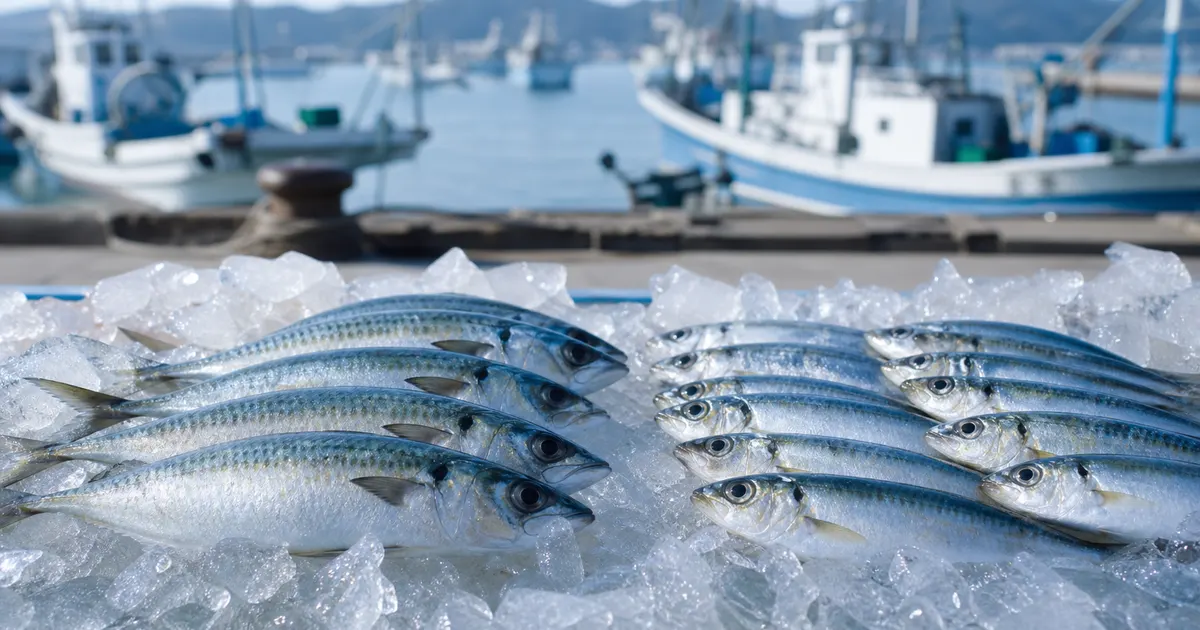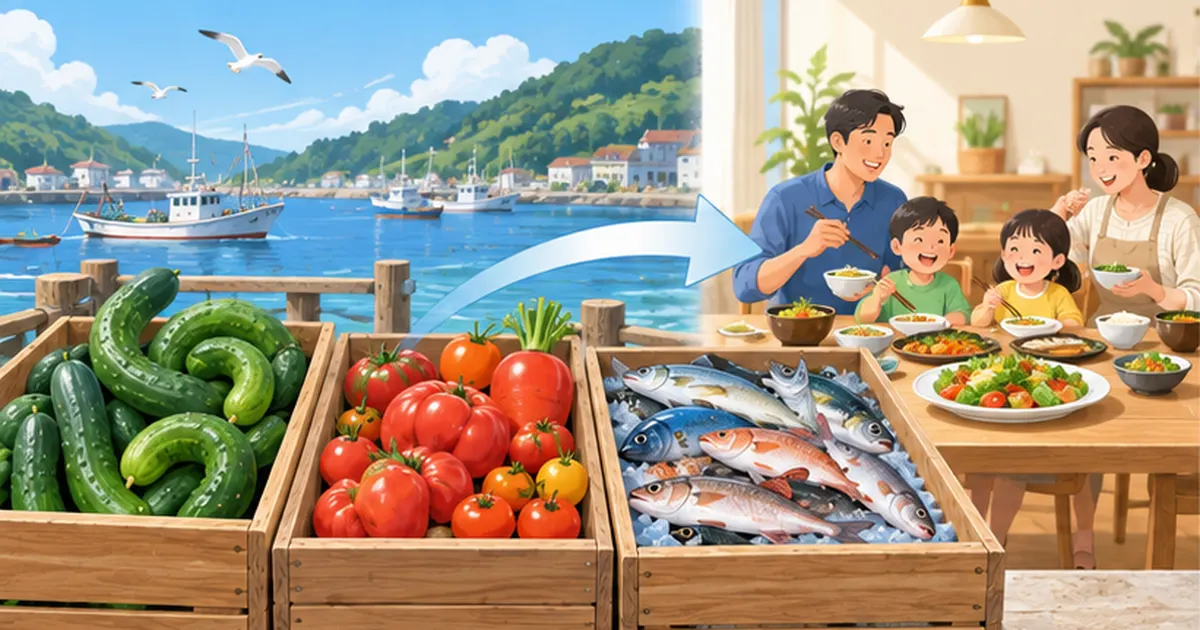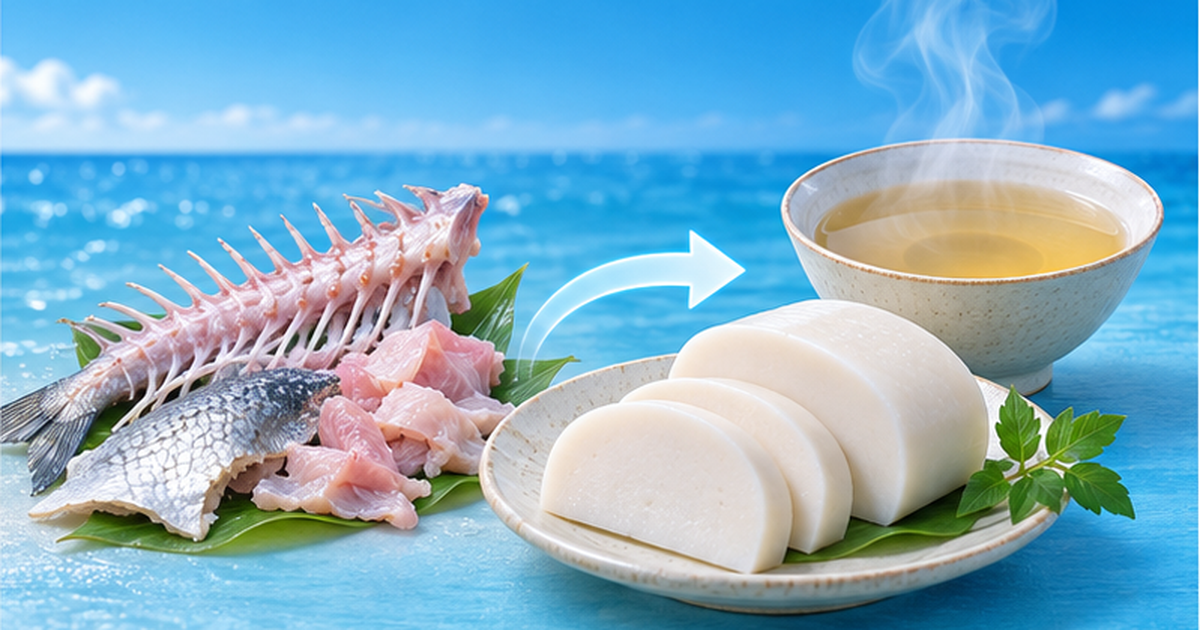
⚡ The answer in 30 seconds
- Seafood processing trimmings have many edible parts and can become food material as surimi or dashi.
- Frozen surimi was developed in Hokkaido in 1959, and fish paste products exceed 30% of processed seafood.
- About 70% of domestic supply is imported surimi, and surimi from domestic trimmings is hoped for.
- Commercialization requires freshness control, stable supply and consumer understanding.
At seafood processing sites, every fillet or can produced also yields backbones, skin and offcuts: trimmings. Most become fishmeal or fertilizer, but because they contain edible parts, efforts to bring them back to the table as surimi and dashi are spreading across Japan.
This article reviews the history of frozen surimi, the spread of fish paste products and fish sausage, and cases from Miyagi, Iwate, Ehime and elsewhere, based on materials from public and research institutions.
How can trimmings be turned into value? We look at the technology, the hurdles to commercialization, and how we can choose wisely as consumers.
What you will learn
- How processing "trimmings" differ from offal and food loss
- How surimi is made and how frozen surimi came about
- The scale of fish paste products and the import-dependent surimi industry
- Examples of trimming use in Miyagi, Iwate, Ehime and other regions
- How to extract umami through dashi and fermented seasonings
- Commercialization challenges and how we can choose better
What Are Seafood Processing Trimmings? What Remains After the Flesh Is Taken
What is produced behind fillets and cuts
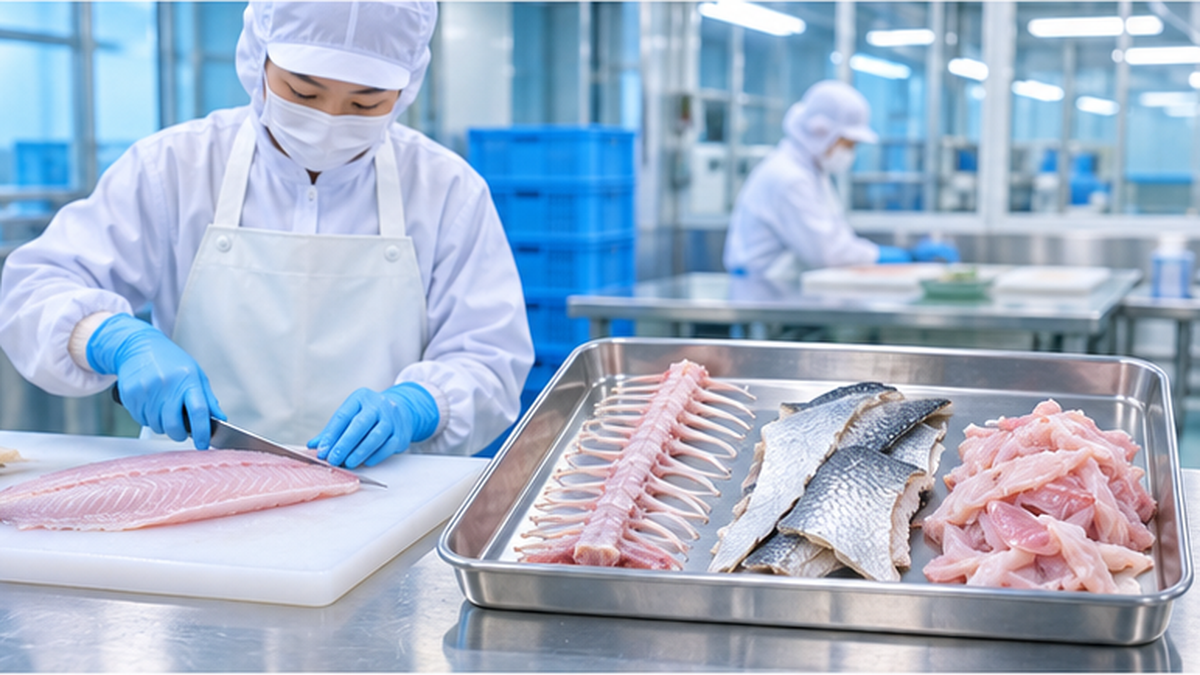
At the stores you see fillets, frozen fillets, dried fish, canned fish and kamaboko. The factories that make them cannot turn all of the raw fish into products. Heads, backbones, skin, dark meat, thin flesh around the rib bones, and misshapen flesh cut off during trimming are all produced as "trimmings" in daily work. Trimmings are not bad fish; the word mostly means parts that do not fit product specifications.
Many trimmings contain parts that people would find perfectly tasty. For example, flesh left on the backbone (garami) is rich in umami, and dark meat contains iron and taurine. But uneven shapes, inconsistent moisture and fat, or dark color make them hard to sell as they are.
How "offal" differs from "food loss"
In earlier articles, Umi Lab covered effective use of seafood processing residue (fish offal). According to an estimate by Toko Yamashita (Regional Fisheries Studies, Vol. 64 No. 2, 2024), Japan's fish offal amounts to 2.32 million tonnes a year, while "food loss"—edible food that is discarded—is estimated at about 4% of edible fish and shellfish. The trimmings discussed here sit in between: "by-products mixed with edible parts".
Terminology in this article
- Offal: parts normally not eaten, such as heads, bones, viscera and skin
- Trimmings: nonstandard flesh and cut pieces from processing (many parts are edible)
- Food loss: food that could be eaten but is thrown away
Why trimming use is a challenge for fisheries
Most trimmings go to fishmeal, fertilizer and feed, and outright disposal is kept to a minimum. However, prices for feed and fertilizer are lower than for food, and some see the raw material's value as not fully drawn out. If trimmings can be returned to food, income from the same material rises and less is wasted. Surimi and dashi are the leading players.
Where trimmings come from
Where trimmings arise differs by type of processing. Filleting leaves backbones, heads and skin after the fish is cut into three pieces. Cutting blocks for sashimi produces flesh and dark meat trimmed away when shaping. In dried-fish and canning plants, small fish rejected in size sorting and broken pieces also become trimmings. In katsuobushi plants, there are offcuts from shaping before shaving.
Thus trimmings occur "almost daily and in almost constant amounts" in each process. This suggests they could be used reliably as processing material. On the other hand, quality varies when species and parts are mixed, so how to separate and collect them is the starting point of use.
How far trimmings are returned to food depends on plant facilities, hygiene control, sales channels and profitability. Parts that cannot go to food go to other uses such as fishmeal, fish oil, fertilizer and biogas, reducing waste overall. Surimi and dashi are the "food outlets" among them.
What Is Surimi? Technology That Returns Trimmings to Food
Basic surimi production
Surimi is a paste made by separating fish flesh from bones and skin and grinding it finely. It is the raw material for fish paste products such as kamaboko, chikuwa, hanpen and satsuma-age. The general frozen surimi process is: (1) remove bones and skin and collect the flesh (meat separation), (2) wash with water to remove fat, odor and water-soluble proteins (washing), (3) squeeze out water (dewatering), (4) add sugar and phosphates, and (5) freeze rapidly.
Washing concentrates myofibrillar proteins, the source of elasticity, among fish muscle proteins. When kneaded with salt they form a network, and heating produces a springy texture (called "ashi"). Thanks to this property, even poorly shaped flesh, once made into surimi, can be used as a food material of uniform quality.
| Step | Purpose | Key point |
|---|---|---|
| Meat separation | Separate flesh from bones and skin | Machines can recover flesh even from small fish and trimmings |
| Washing | Remove fat, odor and water-soluble components | Proteins responsible for elasticity are concentrated |
| Dewatering | Squeeze out excess water | Stabilizes quality and improves shelf life |
| Adding sugar and phosphates | Prevent denaturation during freezing | Enables long storage and transport |
| Rapid freezing | Lock in freshness and quality | Formed into blocks and distributed nationwide |
The 1959 breakthrough: birth of frozen surimi
Frozen surimi is reported to have been developed in 1959 (Showa 34) by a research team including Kyosuke Nishitani at the Hokkaido Central Fisheries Experiment Station (now Hokkaido Research Organization Central Fisheries Research Institute) (according to HRO materials; other sources say "developed in the 1960s," so accounts vary). Adding sugar and phosphates made proteins less prone to denaturation during freezing and allowed long-term storage.
Before this, fish paste products required processing fish on the day of landing. With frozen surimi, fish could be processed near the fishing grounds, frozen, and shipped to factories nationwide when needed. The technology's great significance is that it separated where and when fish are caught from where and when products are made.
Trimmings suit the surimi approach
What determines surimi's "ashi" (elasticity)
The elasticity of kamaboko varies with species, freshness, number of washings, amount of salt and heating temperature. In general, fresher white fish gives stronger elasticity, which weakens as freshness drops. Red-fleshed fish with much dark meat has a dark color and weak elasticity as is, so careful washing is used to remove color and odor components.
When making surimi from trimmings, the proportion of dark meat and skin greatly affects quality. Much dark meat darkens the color, and much skin changes the texture. Rather than mixing trimmings as they are, ideas include sorting by part to decide uses and blending with other surimi to adjust.
Wastewater from washing also needs attention. Washing dissolves water-soluble proteins and the like into the water. These are hard to use as food yet burden wastewater treatment. Research on recovering and using these components has appeared in recent years, but how far it is practical varies by region and company.
Fish that suit surimi and fish that don't
Fish suited to surimi have white, firm flesh that gains elasticity when washed. Besides Alaska pollock, threadfin bream, croaker, lizardfish and cod are known as raw materials for fish paste products. Fatty, dark-fleshed fish such as sardine and mackerel tend to show color and odor as they are, and are used with adjusted washing. Shark meat tends to have an ammonia-derived odor, so, as noted earlier, treatment with baking soda water is being studied.
Knowing which fish suits which use is the first step in deciding where trimmings go. If they can be sorted and collected as "trimmings of this fish suit surimi" and "bones of this fish suit dashi," nothing is wasted. In plants, merely separating containers by species and part greatly changes later steps.
The K value is often used to judge freshness. It shows the proportion of ATP (the cell's energy substance) that, after the fish dies, breaks down through inosinic acid into inosine and hypoxanthine; the smaller the number, the fresher the fish. For surimi too, fresher raw material gives better elasticity, so it is important to chill and process trimmings quickly. For details see The science of fish freshness, the K value and the cold chain.
Surimi making is originally a process that "does not care about the shape or size of the flesh." Small fish, bony fish and unattractive fish can all be used with a meat separator (a machine that mechanically separates flesh from bone). Surimi production is a sensible way to return trimmings to food.
Japan's Fish Paste Products and Surimi Industry in Numbers
Fish paste products exceed 30% of processed seafood
Based on the FY2021 Fishery Processing Statistics Survey, MAFF's "Nippon Traditional Foods" introduction reports that total processed seafood output is about 1.43 million tonnes, of which fish paste products are about 495,000 tonnes, over 30% of the total. Kamaboko has a long history; the oldest surviving record is a banquet menu from Eikyu 3 (1115) (Ruijuzatsuyosho).
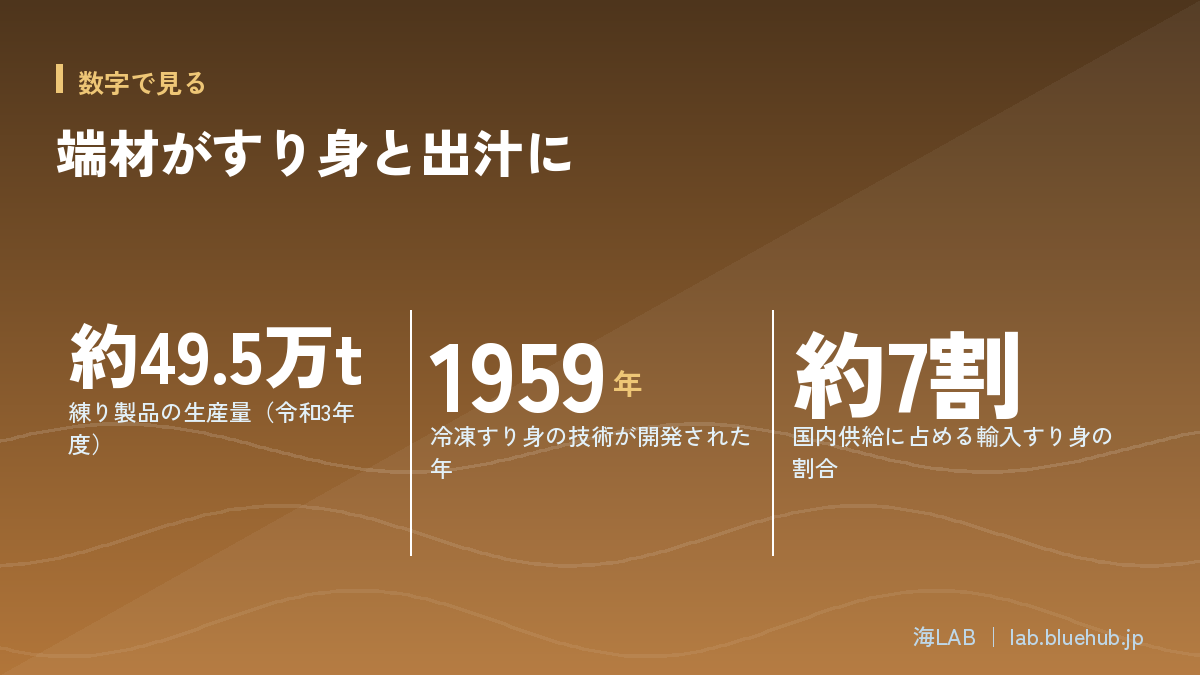
Domestic surimi production has fallen sharply from its peak
According to HRO and other materials, domestic frozen surimi production peaked in 1976, mainly in Hokkaido, at about 420,000 tonnes. In 1977 the establishment of the 200-nautical-mile exclusive economic zone ended free pollock fishing on distant waters, and domestic production fell sharply. Today about 70% of domestic supply is said to be imported surimi from the United States, Thailand, China and others. World surimi production is estimated at 600,000 to 700,000 tonnes a year.
| Year | Event | Background |
|---|---|---|
| 1959 | Frozen surimi technology is developed | Research team at Hokkaido Central Fisheries Experiment Station |
| 1960s | Frozen white fish surimi widely used in fish paste products | Storage and transport become possible, mass production advances |
| 1976 | Domestic frozen surimi production peaks (about 420,000 t) | Mainly Hokkaido, using Alaska pollock |
| 1977 | 200-nautical-mile zone established | Distant-water fishing restricted, domestic production declines |
| Present | About 70% of domestic supply is imported surimi | Imports from the US, Thailand, China and others |
Import dependence raises the value of trimming surimi
How fish paste products support Japan's fish eating
Fish paste products are an easy-to-eat form of protein with bones and skin removed. They keep well, need little cooking effort, and are widely used in oden, hot pots and lunch boxes. As fewer households fillet raw fish, fish paste products also help keep fish eating familiar.
On the other hand, when the price of raw surimi rises, product prices and plant management are affected. Raw materials being exposed to overseas catches and exchange rates is a major issue for small and medium regional makers. Efforts to make surimi from domestic trimmings and unused fish are drawing attention as a way to widen raw-material options.
When about 70% of raw material depends on overseas surimi, being able to make surimi from domestic trimmings and unused fish can supplement part of it with domestic supply. There is hope of being less affected by international prices and exchange rates, and research institutes in various places are working on it. Hurdles to commercialization remain, however, such as meat-separation yield and stable supply.
Fish Sausage Shows How Surimi Is Put to Use
From tuna to surimi as raw material
Fish sausage is an easy-to-understand example in the history of trimming use. According to a news article (Gendai Business), full-scale production and sales began in 1953, with tuna and whale as the main raw materials at first. When frozen white fish surimi came into use in the 1960s, production expanded at once and is said to have peaked around 1973 for the industry as a whole.
Because it keeps at room temperature and has a mild, easy taste, it is said to have spread from cities to farming villages. Production fell in the 1980s with rising frozen surimi prices and other factors, but in recent years it has been re-evaluated for health consciousness and as a convenient protein source, and is said to be flat to recovering.
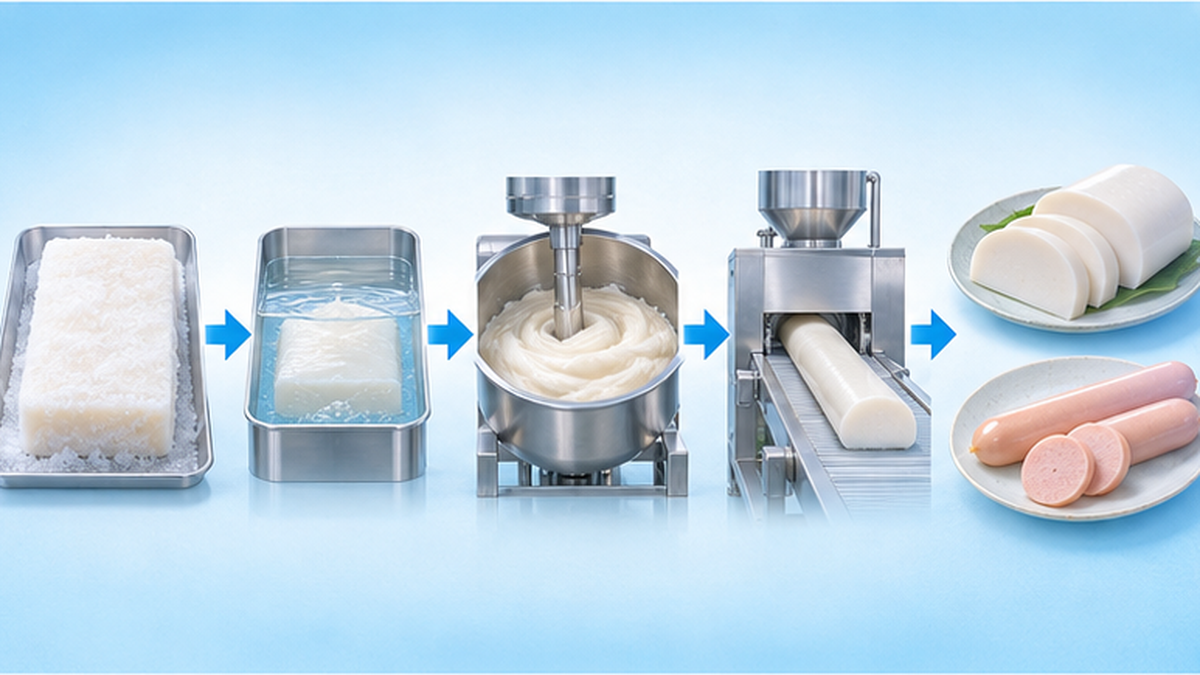
Blending surimi for stable quality
According to the same article, surimi arrives at factories in 10 kg slabs, and several fish species are blended to keep quality constant. Because fish properties change with season and origin, technology to adjust raw-material variation is essential. The same idea of adjustment is key when using trimmings.
Lessons from a "success model" of trimming use
The history of fish sausage shows that even as raw materials changed, it was made viable as food through processing ingenuity. Raw material shifted from tuna and whale to surimi, using resources available at the time to combine shelf life and ease of eating. For trimming use too, the question is not "what to use" but "how to make it work as food."
Selling a product for a long time also requires responding to the demand of the times. The same fish sausage has been accepted for different value: as a precious protein source when nutrition was scarce, and now as an easy, healthy food. Products from trimmings also need to be designed to be chosen for taste and convenience, not only because of "mottainai."
Key point
- Surimi uses the "properties of protein," not "shape"
- Blending can absorb variation in raw material
- The spread of white fish surimi brought fish paste products to tables nationwide
Local Efforts to Turn Unused Fish and Trimmings into Surimi
Miyagi: turning blue shark meat into surimi
A Miyagi Prefecture document (results of a MAFF-commissioned project) introduces an example in which the meat of blue shark, previously underused, was washed in baking soda water and made into surimi. Treating it with baking soda water suppresses the shark's characteristic odor so it can be used in fish paste products. Products made with this surimi were reported to be softer than conventional ones.
The same set of materials covers demonstration research aimed at cutting costs and adding value in seafood processing by developing products from low- and unused fish and processing residue. Miyagi Prefecture also provides technical support to companies that want to turn unused parts, including processing residue, into processing material.
Iwate: trimmings as minced products, seasonings and fillings
A report from Iwate Prefecture's fisheries technology center lists examples of using resources that are hard to distribute because landings are small, they are hard to process, or the price does not fit. Examples include commercializing unused fish and processing trimmings as minced products, extracting extracts with functional components from cannery residue, and making seasonings from salmon and saury trimmings. A Chinese-style seafood steamed bun filled with trimmings is also introduced.
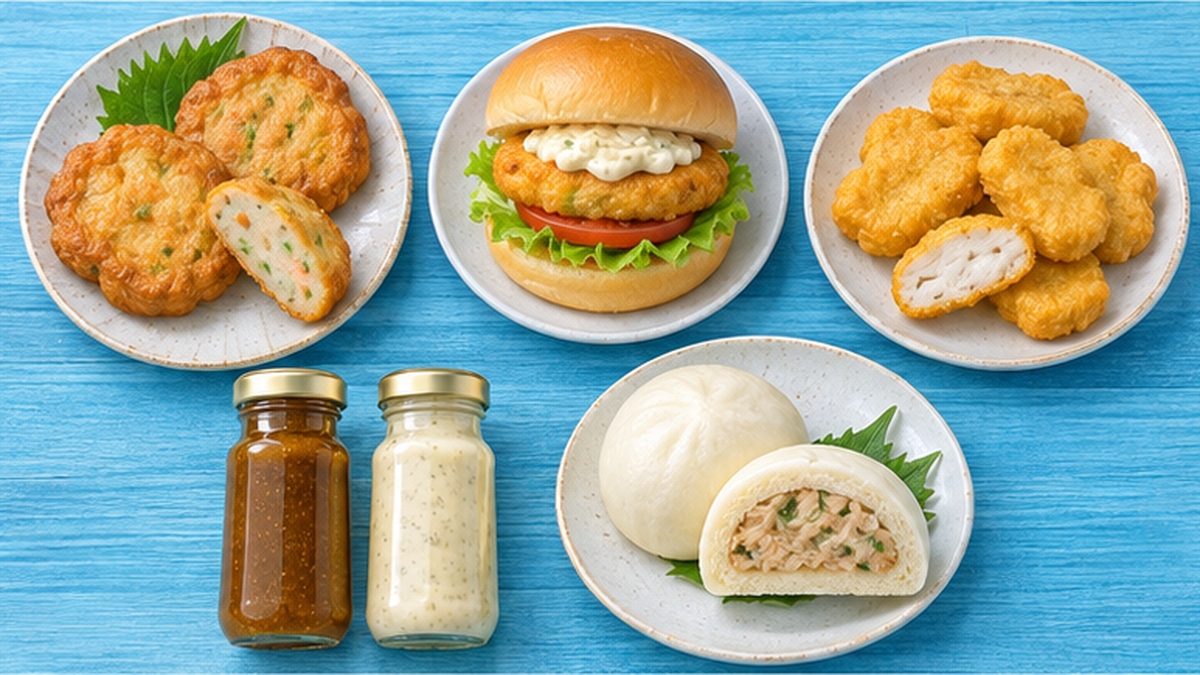
Taste surveys guide commercialization
Conditions for success seen in common
What the efforts have in common is a step-by-step approach: (1) investigate the characteristics of trimmings and unused fish (odor, color, flesh quality), (2) choose a processing method that suits them, and (3) confirm taste and price with prototypes. In the blue shark case, odor was handled with baking soda water; in Iwate, hard-to-process resources were turned into minced products and fillings.
Another common point is that government and research institutes provide technical support. Developing alone makes trial and analysis costly. By using public technical support and joint research, even small processors can take on new product development more easily.
Making use of regional character is also important. Linking products to fish caught locally or to processing methods eaten there for a long time gives a product a story that reaches consumers. Trimming use can also be a chance to reconsider the value of a region's fisheries.
In another study, prototypes such as hamburgers and nuggets were made from unused fish surimi and taste surveys were conducted. Collecting data on pricing and preferences is said to have provided information for moving from "can make" to "can sell." Beyond technology, confirming taste and price that consumers accept is important.
Local processing complexes and shared use
In areas such as Yaizu City in Shizuoka and Makurazaki City in Kagoshima, where bonito and tuna processing is concentrated, trimmings of the same species come out in large amounts and at constant quality. Such areas have conditions that make it easy to send trimmings to food. With shared cold storage and processing equipment, even small factories can sell trimmings as food more easily.
By contrast, in areas with small-volume, many-variety processing, trimmings tend to be varied. In that case, processing methods that easily absorb differences in raw material, such as mince, extracts and seasonings, suit better than surimi. The suitable outlet changes with the character of the region's fisheries.
The challenge of trimming use lies not only in technology but in regional cooperation. When fishery cooperatives, processors, government, research institutes and sellers each bring their roles, efforts hard for a single factory become possible. Reviewing the flow of trimmings at the regional level will become more important.
Related efforts are also introduced in the articles on using unused fish and technologies for using fish offal. Reading them together makes the place of surimi clearer.
Dashi as an Outlet: Extracting Umami from Trimmings
The nature of fish umami: inosinic acid and amino acids
Fish umami comes mainly from inosinic acid (a nucleotide umami compound) and amino acids such as glutamic acid. Katsuobushi and niboshi dashi have deep flavor because they contain much inosinic acid. Combined with kelp's glutamic acid, the "synergy effect" that makes umami taste stronger is well known. Trimmings also contain these umami components.
According to a report from Shimane Prefecture's fisheries office, inosinic acid peaks around full rigor after the fish dies. Heating to 80°C or higher at that point stops the action of degrading enzymes and keeps the umami. Making use of this finding, dashi packs and canned goods have been prototyped.
Ehime: sea bream backbones into a fermented seasoning
In an Ehime Prefecture study, backbones from filleting farmed sea bream were fermented with soy sauce koji and salt to prototype a seasoning. A prototype also replaced part of the salt in jakoten, an Ehime specialty, with this seasoning. Another report says fermenting various seafood with dried koji and salt water produced seafood extracts of differing taste and aroma through protein breakdown. These are results expected to be used in seasonings.
Bone-and-head dashi you can make at home
Learning from katsuobushi and niboshi: how to extract umami
Japan has traditional foods that draw umami from fish. Katsuobushi is a preserved food in which bonito is boiled, deboned, smoked, dried and aged through repeated mold-inoculation. Niboshi are small fish boiled and dried, used for dashi in miso soup and simmered dishes. Both are wisdom that concentrates umami by reducing water and allows long storage.
The thinking behind these traditional foods can be applied to trimming use: boiling trimmings to extract umami as an extract, drying them into powder, or fermenting them to increase amino acids. Untidy shape does not affect the amount of umami. Dashi and extracts can be said to be one outlet suited to trimmings.
However, the quality of umami and its off-notes differ by species and part. Fatty fish oxidize easily and may smell. Including viscera can cause bitterness. Selecting raw material, preparation and designing heating conditions are therefore keys to tasty dashi.
Trimming use is not only a factory matter. At home, blanch fish bones and heads (ara) in boiling water to remove surface dirt and slime ("shimofuri") before simmering, and you get dashi with little fishy smell. Grilling before simmering adds a roasted aroma. After making dashi, check local rules before putting the bones out with burnable waste.
Powders and extracts widen the uses
Umami from trimmings can be used not only as dashi packs but also as powder or extract for processed-food ingredients, such as soup bases, furikake, seasonings and pet food. Liquid extracts can be concentrated and stored, and used stably to flavor products.
Extracts and fermented seasonings have the advantage of being easy for consumers to accept, because no form of trimmings remains in the product. There is less resistance to words like "gara" or "ara," making them a handy outlet. On the other hand, food design is needed for taste balance, salt content and allergen control.
Using umami from trimmings can reduce reliance on chemical seasonings and allow products that highlight domestic ingredients. Stable quality and safety are essential, though. Using analytical support from public institutions and joint testing raises development speed and reliability.
What you can do at home
- Buy whole fish and use the bones and heads for dashi and miso soup
- Blanch to reduce fishy smell
- Freeze and thaw only what you need
The Reality of Trimming-Use Business: Cost, Freshness, Stable Supply
Freshness and hygiene are the first wall
To return trimmings to food, they must be handled as food under hygiene control from the moment they arise. Trimmings for feed and fertilizer may be kept with other waste, but for food they require dedicated containers, chilling and quick processing. It is hard to realize if factory flow and staffing cannot keep up.
Stable supply of quantity and quality
Trimmings from a processing plant vary by day in species, part and amount. For food manufacturers to buy stably, a system to secure constant quality and quantity is essential. In regions such as processing complexes where several factories gather, collecting and processing trimmings jointly is also conceivable.
| Challenge | Details | Direction of response |
|---|---|---|
| Freshness and hygiene | Chilling and dedicated containers from the moment trimmings arise | Dedicated lines, quick processing |
| Profitability | Can they sell at a price that justifies investment and effort? | Product design with high added value |
| Stable supply | Species and amounts change daily | Joint collection across factories, blending |
| Consumer understanding | Image of "trimmings" | Ingenuity in naming and presentation, confirmation through tasting |
Naming and presentation
Laws and labeling rules must be checked
Selling trimmings as food requires a business license under the Food Sanitation Act and labeling of ingredient names, allergens and so on under the Food Labeling Act. When using seafood-derived raw material, attention is also needed for species and origin labeling. When developing a new product, consulting public health centers, local government help desks and public research institutes early reduces rework.
Expressions such as "unused fish," "nonstandard" and "trimmings" can mislead people about product quality depending on how they are used. Conveying ingredients and methods accurately so the actual content is clear protects consumer trust.
Words such as "trimmings" and "offal" tend to give a negative impression. In recent years, terms such as "unused parts" and "upcycling" are used to convey appeal. Still, carefully conveying that real quality, safety and price are worth the value builds trust.
What We Can Do: Choices That Support the Value of Trimmings
What to look for when choosing fish paste products
The ingredient list of kamaboko, chikuwa and fish sausage sometimes says "fish meat (Alaska pollock, threadfin bream, croaker, etc.)." Paying attention to the names of the raw fish lets you imagine what fish the surimi is made from. If you see products using domestic ingredients or local unused fish, picking one up is one way to help.
Getting to know regional seafood products
Sasa-kamaboko (Miyagi), steamed board kamaboko (Odawara, Kanagawa), noyaki chikuwa (Shimane), jakoten (Ehime), tsukeage (Kagoshima) and others show that fish paste products vary by region. They are also the fruit of wisdom that uses local fish completely. Comparing them when you travel should make the culture of trimming use feel close.
Summary: from trimmings to something we eat and savor
Three points to keep in mind when shopping
You do not need to do anything special to support trimming use. Just keep three things in mind: (1) check fish species and origin on the ingredient list, (2) choose regional seafood products and fish paste products, and (3) when you buy a whole fish, use the bones and head for dashi. These lead to using seafood resources fully.
Reducing leftovers also matters. Even if trimmings are used, the point is weakened if food is finally left uneaten at the table. Buying amounts you can finish and using frozen and processed goods wisely reduces loss across seafood.The overall picture of seafood food loss is also a useful reference.
Seafood processing trimmings become raw material for fish paste products as surimi, and umami material as dashi or fermented seasoning. More than 60 years have passed since frozen surimi was developed in 1959, and efforts to use unused fish and trimmings as domestic food materials are advancing in many places. Freshness control, stable supply and consumer understanding matter as much as technology.
For related reading, see Using fish offal (bones, skin, viscera) and Seafood food loss as well.
Summary of this article
- Trimmings have many edible parts and can become raw material for surimi and dashi
- Frozen surimi was developed in 1959 and supports fish paste products and fish sausage
- About 70% of domestic supply is imported surimi; surimi from domestic trimmings is hoped for
- In dashi and fermented seasonings, prototypes using umami components are advancing in many places
- Commercialization requires freshness control, stable supply and consumer understanding
References and sources
- MAFF | Nippon Traditional Foods: Fish Paste Products – Output, history and types of fish paste products
- HRO | Materials on frozen surimi – Development of frozen surimi and trends in domestic production
- Hokkaido University Graduate School of Agriculture | Master's thesis abstract – Rise and decline of the frozen surimi industry
- Miyagi Prefecture | Research on using low- and unused fish and processing residue – Cases such as turning blue shark into surimi
- Iwate Prefecture Fisheries Technology Center | Results report – Cases of commercializing processing trimmings
- Ehime Prefecture | Report on prototype seafood extracts and seasonings – Fermented seasoning from sea bream backbones
- Shimane Prefecture | Fisheries technology information (Tobics) – Inosinic acid and umami retention through heating
- Gendai Business | History of fish sausage – Changes in raw materials and production trends
* Arranged in order of reliability: government agencies > academic institutions > peer-reviewed papers > specialist organizations > reliable media