⚡ The answer in 30 seconds
- Mycorrhizal fungi live on plant roots and deliver nitrogen, phosphorus and water in exchange for sugar. About 72% of vascular plants form arbuscular types and about 2% form ectomycorrhizal types.
- A 1997 experiment showed carbon moving between trees through fungal hyphae. The idea that "mother trees deliberately help their offspring," however, was judged poorly supported by a 2023 review.
- In Japanese research, seedlings grown under trees with a different mycorrhizal type grew about 50-90% more slowly, suggesting fungi help shape which tree species make up a forest.
- In coastal black pine forests, mycorrhizal fungi such as Rhizopogon (shoro) are studied for helping seedlings establish, and forest-making that includes underground fungi is gaining attention.
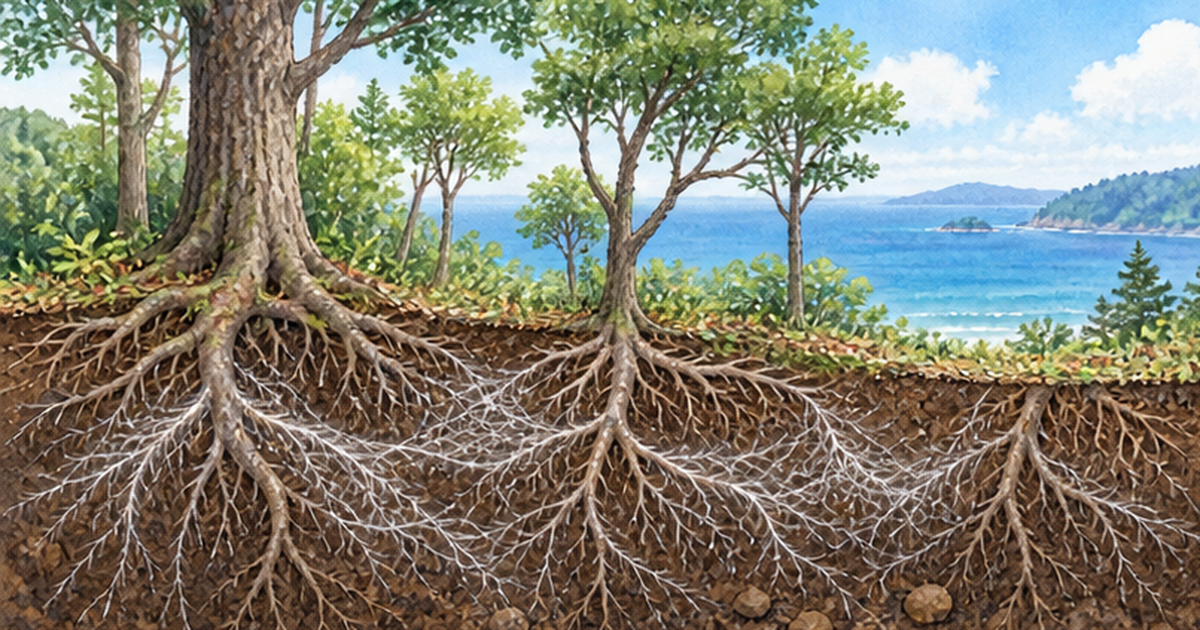
Under the trees of a forest, invisible threads of fungi spread through the soil, merge with the roots, and exchange water and nutrients. This partnership is called a mycorrhiza, and the fungi that form it are mycorrhizal fungi.
The story that "trees are connected underground and parent trees help their young," known as the "wood wide web," is widely told, but scientists disagree about how well it holds up. This article separates established facts from open questions.
We also look at research in Japan's Ashiu Research Forest and the use of mycorrhizal fungi in coastal black pine forests, offering a view that connects forest and sea.
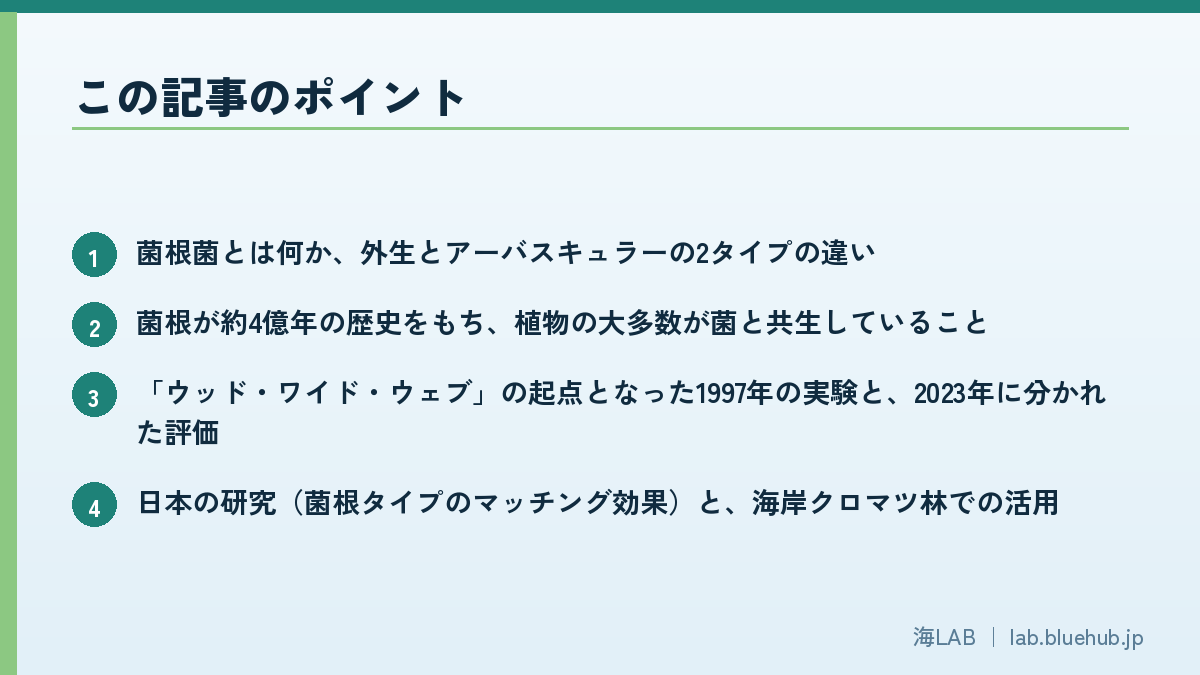
What you'll learn in this article
- What mycorrhizal fungi are, and the two main types: ectomycorrhizal and arbuscular
- Mycorrhizas have a history of about 400 million years, and most plants live in symbiosis with fungi
- The 1997 experiment that started the "wood wide web" story, and how its evaluation split in 2023
- Research in Japan (the mycorrhizal type matching effect) and the use of mycorrhizal fungi in coastal black pine forests
- What each of us can do to protect fungi underground
What Are Mycorrhizal Fungi? Underground Partners Living in Plant Roots
Mycorrhiza: roots and fungi as one organ
When walking in a forest, we rarely imagine what is happening in the soil underfoot. Yet the tips of most trees' roots are entered by fungi (relatives of molds and mushrooms), forming a shared organ called a "mycorrhiza." The fungi that form it are mycorrhizal fungi.
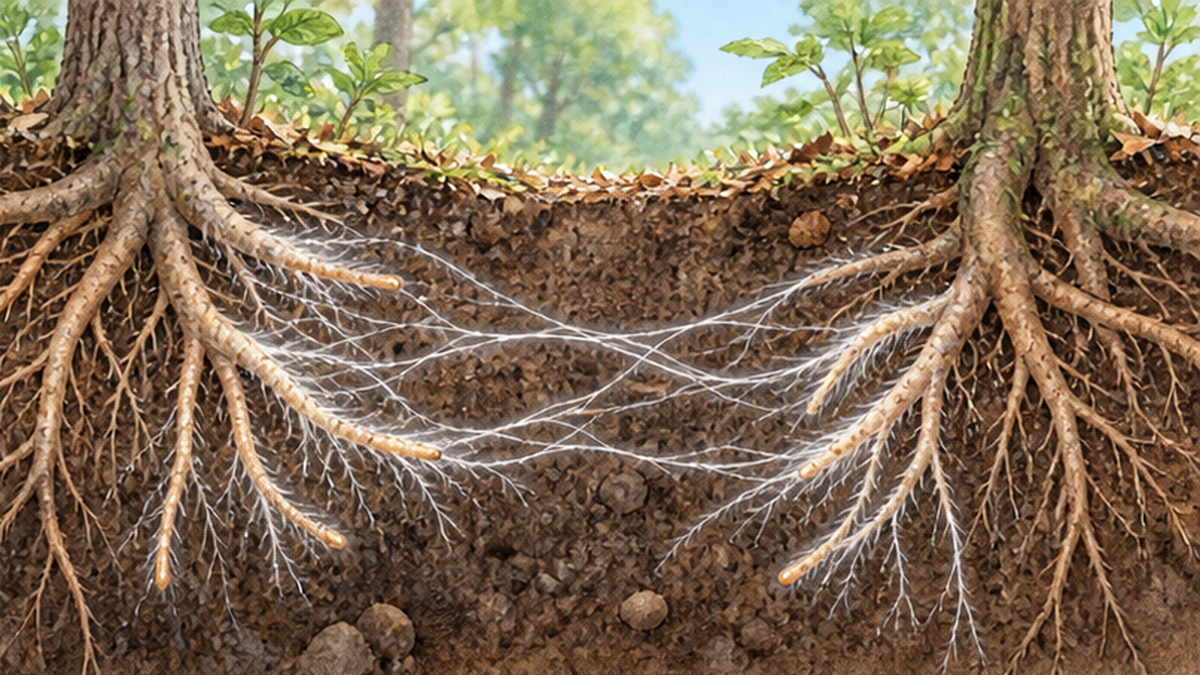
Mycorrhizal fungi spread thin thread-like "hyphae" through the soil. Hyphae are even finer than root hairs and can slip between soil particles, gathering water and nutrients that roots alone cannot reach. In return, the plant gives the fungus sugars made by photosynthesis. A mycorrhiza is therefore a symbiosis in which a "nutrient-carrying fungus" and a "sugar-making plant" both benefit.
Kyoto University's Hiroaki Kadowaki, introduced by Science Portal (Japan Science and Technology Agency), likewise explains that mycorrhizal fungi receive sugars made by photosynthesis from trees and supply necessary nutrients such as nitrogen and phosphorus in return.
Two main types: ectomycorrhizal and arbuscular mycorrhizal fungi
There are several types of mycorrhizas, but two matter most for understanding forests.
| Type | How the fungus lives | Mushrooms above ground | Main host trees (examples) |
|---|---|---|---|
| Ectomycorrhizal fungi | Hyphae cover the root surface and extend between root cells | Some form mushrooms | Pine, oak, Castanopsis, hornbeam, etc. |
| Arbuscular mycorrhizal fungi | Hyphae enter inside root cells | Do not appear as mushrooms | Cherry, camellia, maple, camphor tree, etc. |
Many edible mushrooms such as matsutake and shoro belong to the ectomycorrhizal group and are the visible "fruit" of the fungus. The body lies in the soil as a mass of hyphae, and the mushroom is only a part. Arbuscular mycorrhizal fungi, by contrast, grow inside roots and produce no mushrooms above ground, so they are easy to overlook.
Key point
A mycorrhiza is neither a relationship in which the fungus dominates the plant nor one in which the plant discards the fungus; it is a trading relationship in which sugars and nutrients are exchanged. This exchange is the starting point of a forest's material cycle.
Most plants have mycorrhizas
How many plants have mycorrhizas? A 2018 review in New Phytologist by Brundrett and Tedersoo organizes vascular plants as follows: about 72% form arbuscular mycorrhizas, about 2% form ectomycorrhizas, about 1.5% (such as the heath family) form ericoid types, about 10% (orchids) form orchid mycorrhizas, and about 8% form no mycorrhiza at all.
In other words, the image of plants living alone is the exception; most land plants live by borrowing a network of hyphae, a second "root" outside their own roots.
400 Million Years of Partnership: Mycorrhizas Have Supported Land Plants
The oldest fossils: the 400-million-year-old Rhynie chert
The history of mycorrhizas is surprisingly long. In the Rhynie chert of Scotland (a siliceous rock about 400 million years old, from the Early Devonian), structures that look like arbuscular mycorrhizas are preserved. Reports such as Taylor et al. (1995) identified "arbuscules," very similar to those of modern arbuscular mycorrhizal fungi, inside cells of fossilized plant roots.
When plants first moved from sea to land, their roots were still undeveloped. Fungi are thought to have taken over the job of drawing water and phosphorus from the soil. The view that the move onto land was itself supported by fungal symbiosis is one of the widely accepted hypotheses in plant science today.
Ectomycorrhizas arose in the Cretaceous
Brundrett and Tedersoo describe "three waves" in mycorrhizal evolution: first the establishment of the arbuscular type; second, the Cretaceous, when ectomycorrhizal, ericoid and orchid mycorrhizas newly arose; and third, the ongoing diversification and increasing complexity of roots in biodiversity-rich regions.
Ectomycorrhizas are tied to the leading trees of today's temperate and subarctic forests, such as the pine and beech families. The pine, oak and Castanopsis woods familiar from Japan's satoyama cannot be discussed without their ectomycorrhizal fungi.
| Period | Event | Meaning |
|---|---|---|
| About 400 million years ago | Fossil arbuscular mycorrhizas appear (Rhynie chert) | Plants' move onto land and fungal symbiosis occurred at the same time |
| Cretaceous | Ectomycorrhizal, ericoid and orchid mycorrhizas newly appear | Linked with conifers, the beech family and other forest dominants |
| Present | Most vascular plants have mycorrhizas (about 8% have none) | Most land plants depend on fungi |
Trivia: a mycorrhiza is a shared "home"
The word "mycorrhiza" combines the Greek-derived roots for fungus and root. Because the structure cannot exist with only the plant or only the fungus, researchers treat it biologically as a "symbiotic organ."
The Birth of the "Wood Wide Web": The 1997 Experiment
Carbon moved back and forth between birch and fir
The idea that mycorrhizal fungi connect trees was spread widely by a field experiment by Suzanne Simard and colleagues, published in Nature in 1997. In a Canadian forest, seedlings of paper birch and Douglas-fir were planted side by side, one was given carbon dioxide containing carbon isotopes (13C and 14C), and researchers traced where the carbon moved.
The labeled carbon was reported to move in both directions between the two species, with a net movement toward the Douglas-fir in the second year. A third species with a different fungal type (western red cedar) served as a control to tell whether transport ran through hyphae.
The phrase "wood-wide web" on the cover of the same issue was a play on the "World Wide Web" and spread worldwide through popular books and documentaries.
Note: the nickname did not come from the researchers
- The term "wood wide web" is said to have been used by the journal when introducing the paper. That a striking name spread first may have contributed to later over-interpretation.
Discovering the hub "mother trees"
In 2010, Beiler and colleagues in New Phytologist used genetic markers (microsatellite DNA) to identify individual fungi on Douglas-fir roots in a 30 m x 30 m plot of a British Columbia forest, Canada, and drew a "blueprint" of the fungal network. The Rhizopogon species R. vesiculosus and R. vinicolor each formed 13-14 genetic individuals (genets), and a single genet colonized up to 19 trees.
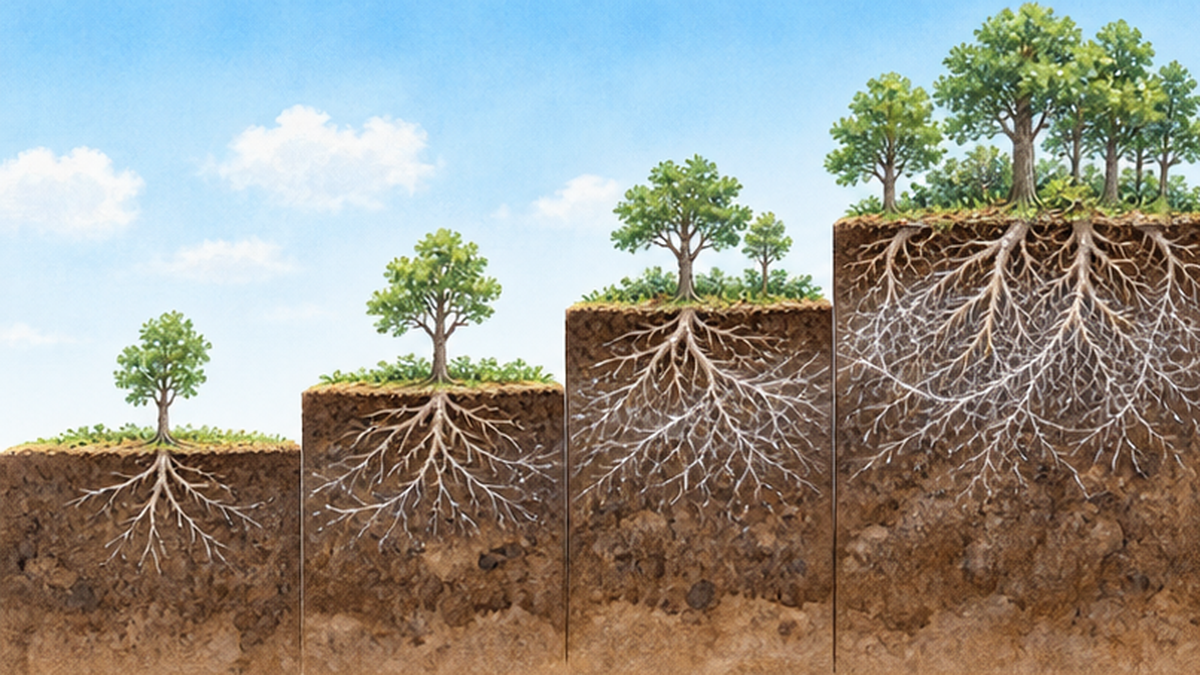
Tree size also had a strong positive relationship with the number of connections, giving a "scale-free" network in which larger old trees are linked to more trees. Young seedlings were growing within the fungal network formed by the old trees.
- The existence of "hubs": a few old trees with many connections
- Young trees were seen to "join" an existing fungal network as they grew
- However, this is evidence that trees are "connected," not that trees "deliberately help" one another
What Moves Through the Fungal Network?
Four flows: sugar, nitrogen, phosphorus and water
By tracking substances marked with isotopes, research on mycorrhizal networks has confirmed the flows below. How much moves, under what conditions, and how much it matters in a real forest differ from study to study.
| What is carried | Main direction | Role |
|---|---|---|
| Sugar (photosynthate) | Plant -> fungus | Energy source for the fungus |
| Nitrogen | Fungus -> plant | Material for leaves and proteins; fungi gather it from soil organic matter |
| Phosphorus | Fungus -> plant | Phosphorus hardly moves in soil, so the reach of hyphae makes a big difference |
| Water | Fungus -> plant | In dry periods, water may be carried from tiny soil pores |
Do parent trees really share with their young?
The most popular image in the wood wide web story is that "a large parent tree helps a shaded seedling by sharing sugars." This cannot, however, be said to be sufficiently demonstrated scientifically at present.
A 2023 paper by Karst and colleagues in Nature Ecology & Evolution examined three popular claims about fungal networks: (1) common mycorrhizal networks are widespread in forests, (2) seedlings grow better thanks to resources moving through the network, and (3) mature trees selectively send resources and defense signals to their offspring. They concluded that (1) and (2) have insufficient evidence because field results vary widely and have other possible explanations, and that no peer-reviewed support was found for (3). They also reported that poorly supported claims have increased over the past 25 years.
In response, in 2025 Simard and colleagues argued in Frontiers in Forests and Global Change that there were problems in how the literature was searched and papers were selected. Researchers are divided, and the scientific debate is ongoing.
Separate how certain each claim is
(1) Mycorrhizal fungi help trees take up nutrients: well established. (2) Hyphae can connect multiple trees: confirmed by genetic analysis and other methods. (3) Resources move through the network: confirmed in experiments, but the amount and importance in forests are debated. (4) Parent trees deliberately help their young: little evidence.
Research in Japan's Forests: Ashiu Research Forest and the "Mycorrhizal Type Matching Effect"
Why do pine forests form naturally but cherry forests do not?
Research on mycorrhizal networks is advancing in Japan as well. Hiroaki Kadowaki of Kyoto University and colleagues measured seedling growth in large experiments that imitate forests and read DNA in the soil to show which microbes form the networks.
Earlier studies had shown that around parent trees with ectomycorrhizas (pine, oak, etc.), seedlings of the same species grow well (positive feedback), while around parent trees with arbuscular mycorrhizas (cherry, maple, etc.), seedlings of the same species grow poorly (negative feedback). DNA analysis also gave evidence that fungi are passed from parent trees to seedlings and shared.
This matches a familiar observation: pine forests form naturally with ease, whereas pure cherry stands rarely do.
Seedlings grow poorly when the mycorrhizal type differs
More interesting still, seedling growth drops sharply under trees with a different mycorrhizal type. Red pine seedlings planted under mountain cherry grew at a rate about 50% lower than those planted under red pine. Conversely, mountain cherry seedlings planted under red pine grew about 90% more slowly than those planted under mountain cherry.
The research team calls this the "mycorrhizal type matching effect." The idea is that seedlings thrive in soil rich in fungi of their own type and are at a disadvantage in soil of another type. Similar trends were seen in combinations such as red pine and Japanese maple, and Japanese hornbeam and mountain cherry.
| Combination | Change in seedling growth rate | Possible background |
|---|---|---|
| Red pine seedling under mountain cherry | About 50% lower | An ectomycorrhizal seedling does not suit arbuscular mycorrhizal soil |
| Mountain cherry seedling under red pine | About 90% lower | An arbuscular mycorrhizal seedling does not suit ectomycorrhizal soil |
Real forests are not so simple
However, when similar relationships were examined from tree density in census data (a survey of all trees above a certain size) from the Ashiu Research Forest in northern Kyoto Prefecture, they did not always match the matching effect seen in experiments. This is thought to be because many factors, such as light, water, seed dispersal by animals, pathogens and other microbes, interact in a real forest.
Kyoto University also announced in 2018 results suggesting that underground fungal networks may shape the stability and change of forests. The implication is that mycorrhizal fungi can drive not only the coexistence of many tree species but also succession, in which tree species replace one another.

What the research shows
- Trends seen in experiments and trends seen in real forests do not always agree. That is why long-term surveys that accumulate field data are indispensable.
Variations on Mycorrhizas: Orchids, Heaths and Pyrola
Orchid and heath mycorrhizas
Mycorrhizas are not only for forest trees. In Brundrett and Tedersoo's summary, orchids (about 10%) form orchid mycorrhizas, and the heath family and relatives (about 1.5%) form ericoid mycorrhizas. Orchid seeds are tiny and store almost no nutrients, so orchids are well known to depend on fungi from the germination stage.
Plants of the heath family are often found on poor, acidic soils and in wetlands, and ericoid mycorrhizas help them obtain nitrogen and other nutrients in such harsh environments. The type of mycorrhiza is deeply tied to the environment in which a plant lives.
Plants that do not "overdo" photosynthesis
In Pyrola (Ichiyakuso), widespread on Japanese forest floors, a study using stable carbon isotope analysis estimated that about 50% of its carbon comes from mycorrhizal fungi. Plants normally give sugars to fungi, but in this species living on the dim forest floor, it was suggested that part of its carbon is supplemented from the fungus.
The relationship between plants and fungi does not fit a one-way picture of "plant gives, fungus receives." It is thought to be a flexible trade in which the balance between giving and receiving can shift with conditions.
| Mycorrhizal type | Share (vascular plants) | Typical plants | Characteristics |
|---|---|---|---|
| Arbuscular | About 72% | Cherry, maple, camphor tree, many herbs | Hyphae enter root cells. The oldest type |
| Ectomycorrhizal | About 2% | Pine, oak, Castanopsis, beech family | Covers the root surface. Many of the fungi form mushrooms |
| Ericoid | About 1.5% | Heath family plants | Advantageous for obtaining nitrogen in poor, acidic soils |
| Orchid | About 10% | Orchids | Depend on fungi from seed germination |
| No mycorrhiza | About 8% | Some herbs, etc. | Obtain nutrients by other means without relying on fungi |
How to read the numbers
These shares are based on numbers of species, not forest area or numbers of individuals. Ectomycorrhizal trees are only about 2% by species, but because they are dominant in temperate to subarctic forests, their influence on forest landscapes is large.
Mycorrhizal Fungi on a Global Scale: Carbon Cycling and Climate Change
Some of the carbon fixed by plants flows to fungi
Plants take in carbon dioxide through photosynthesis and hand part of it to fungi underground. A 2023 study by Hawkins and colleagues in Current Biology estimated how much carbon the world's mycorrhizal fungi receive for their underground mycelium. It suggests that about 13.1 billion tonnes of CO2 equivalent per year of the carbon fixed by land plants flows, at least temporarily, to mycorrhizal mycelium, equal to about 36% of annual CO2 emissions from fossil fuels.
A "flow per year," not a "stock"
- This figure is an estimate of the "flow" of carbon fungi receive each year. Reading it as "fungi are storing 13.1 billion tonnes" would be wrong. The authors themselves say the estimate rests on the best evidence currently available but is imperfect and should be interpreted with caution.
Protecting carbon in the soil
Hyphae can leave carbon in the soil after they die, where it may remain for a long time as soil organic matter. Logging and conversion to farmland can cut fungal networks and cause soil carbon to be lost. As Kyoto University researchers point out, several studies show that even after trees are cut and replanted, underground microbes do not quickly return to their former state.
For climate action, attention is turning not only to the "number" of trees planted but to protecting the whole underground ecosystem, including fungi suited to that soil.
- Protecting forests means protecting the underground fungal network
- In reforestation, compatibility between the planted species and the soil's mycorrhizal type may affect success
- Development and farming that turn over soil sever underground networks
On a related note, for soil life as a whole, see also "Life in the Soil: Earthworms and Springtails Underground" to grasp how widely the underground ecosystem extends.
From Forest to Sea: Mycorrhizas Support Coastal Forests and Coastal Environments
Coastal black pine and "shoro"
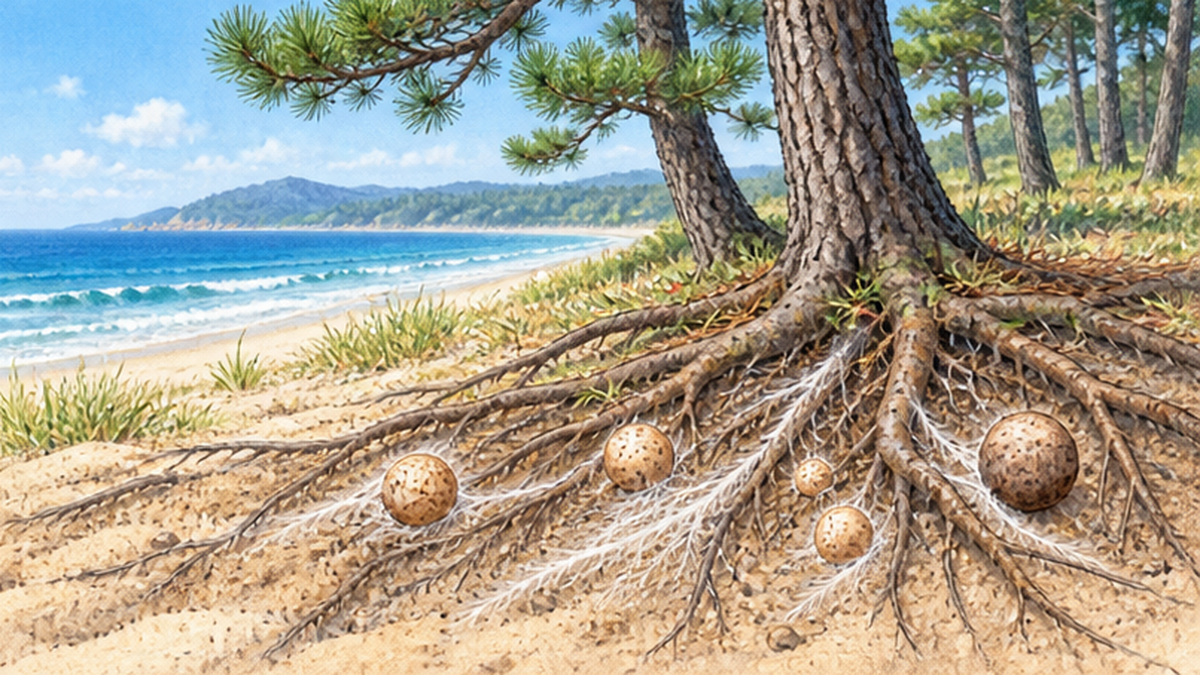
Where land meets sea, coastal forests are where mycorrhizal fungi are most visibly at work. Sand is poor in water and nutrients, and exposed to sea wind and salt, yet black pine, the leading tree of Japan's coastal forests, survives by living in symbiosis with ectomycorrhizal fungi.
Research reports from Aichi and Shimane prefectures have tested seedlings inoculated with mycorrhizal fungi such as shoro (Rhizopogon) to address the low survival of black pine seedlings on coasts. Because mycorrhizal fungi are also explained to supplement water in the soil, research is advancing on them as a way to improve establishment in nutrient-poor, quickly drying sand. In a long-term survey on the Shimabara Peninsula in Nagasaki Prefecture, Scleroderma-type puffballs (kotsubutake) and Rhizopogon were inferred to be the dominant native mycorrhizal fungi, helping keep black pine healthy.
In experiments by Matsuda and colleagues at Mie University, higher sodium chloride concentrations tended to increase kotsubutake and shoro and decrease Suillus bovinus-type slippery jacks and Cenococcum geophilum. Choosing salt-tolerant fungi is thought to help coastal forest restoration.
Coastal forests are also connected to the marine environment
Coastal forests protect lives from tsunami, blowing sand and sea wind, and are also an entrance for water and nutrients flowing from land to sea. When the soil of forests and coastal forests is healthy, rainwater soaks in slowly, softening the sudden outflow of excess sediment and nutrients to the sea. For more, see "What Headwater Conservation Forests Do" and "Coastal Forest Restoration."
Differences from marine life
Many plants that live in water, such as seagrasses (eelgrass and others), do not rely on mycorrhizas as a main means of gathering nutrients, as land plants do. Land and sea use very different strategies for collecting nutrients. For links between land and sea, see also "How Rivers and the Sea Connect."
Tips for Reading the News: How to Take "Trees Talk"
The distance between headlines and papers
Expressions like "trees chatter underground" and "mother trees raise their young" captivate people but tend to be stronger than the actual research results. This is exactly what Karst and colleagues' 2023 paper pointed out: with each citation the story can grow a little, spreading as a stronger claim than the original study, a "citation bias."
Yet it is not accurate to take this as "the wood wide web was a lie." Results showing fungal connections and carbon movement, such as the 1997 experiment and the 2010 network analysis, have accumulated. The dispute is over how much the connections matter in a forest and whether trees can be said to "intentionally" send resources.
Three questions for judging how certain research is
- Lab or field? Results from greenhouse seedlings do not necessarily apply to real forests.
- "Moved" or "helped"? That a substance moved and that the receiver grew better are separate matters.
- Are there other explanations? Check whether other routes, such as direct uptake from soil or roots, have been ruled out.
These three questions are useful when reading news about marine life or climate change, too. Simply remembering that "interesting" and "certain" are different things changes how you deal with information.
Summary of this section
Mycorrhizal networks certainly exist, and movement of substances has been confirmed. The ecological meaning and any "intent of parent trees" remain under scientific debate. Take the established parts and the debated parts separately.
What We Can Do: Ways of Living That Protect the Underground Forest
An everyday action checklist
- Do not compact the soil of forests and parks: staying on designated paths protects the soil around roots where hyphae gather.
- Do not over-harvest mushrooms: a mushroom is the fungus's "fruit," but follow local rules so the mycelium in the soil is not damaged.
- At tree-planting events, think about "where" as well as "what" to plant: choosing species that have long grown on the site is a shortcut to keeping compatibility with underground fungi.
- Reconsider heavy use of chemical fertilizers and pesticides: excess phosphorus is said to reduce plants' need for fungi and weaken mycorrhizal function.
- Join local coastal forest and satoyama conservation activities: they protect not only what is above ground but also the ecosystem below it.
Even without special skills, simply knowing that "there is a network of living things under the ground" changes a little how you step and how you relate to green spaces.
Observations to try at school or home
- Look for white thread-like hyphae under fallen leaves in a park or around a fallen log
- In a pine forest, gently dig the soil at the base of a mushroom and observe its position relative to pine roots (check with the site manager whether collecting is allowed)
- Compare how the plants at your feet differ under different tree species, such as pine, cherry and maple, in the same park
Summary: knowing the underground forest changes how you see the forest above
- Mycorrhizal fungi, one with plant roots, carry water and nutrients and have supported land ecosystems for 400 million years. The discovery that "trees are connected underground" is appealing, but it is important to take what is known and what is still debated separately.
References & Sources
- Science Portal (Japan Science and Technology Agency): Mycorrhizal networks, Hiroaki Kadowaki (Kyoto University) – Mycorrhizal types, matching effect, analysis of the Ashiu Research Forest
- Kyoto University research result (20 Nov 2018): Underground fungal networks found to drive forest stability and change – Mycorrhizal fungi, coexistence of tree species and succession
- Simard et al. (1997) Net transfer of carbon between ectomycorrhizal tree species in the field. Nature – Carbon movement between birch and Douglas-fir
- Beiler et al. (2010) Architecture of the wood-wide web. New Phytologist 185:543-553 – Linking multiple cohorts through Rhizopogon genets
- Brundrett & Tedersoo (2018) Evolutionary history of mycorrhizal symbioses and global host plant diversity. New Phytologist – Share of plants by mycorrhizal type and evolution
- Taylor et al. (1995) Fossil arbuscular mycorrhizae from the Early Devonian. Mycologia – Arbuscular mycorrhizal fossils of the Rhynie chert
- Karst, Jones & Hoeksema (2023) Positive citation bias and overinterpreted results lead to misinformation on common mycorrhizal networks in forests. Nature Ecology & Evolution – Examination of claims about common mycorrhizal networks
- Frontiers in Forests and Global Change (2024): rebuttal paper by Simard and colleagues – Rebuttal of Karst et al.'s review methods
- ScienceDaily (2023) Mycorrhizal fungi crucial to storing carbon (Hawkins et al., Current Biology) – Estimate of carbon allocation to mycorrhizal mycelium
- Aichi Prefecture: Development of coastal forest restoration technology using black pine seedlings (FY2015-2017) – Research on black pine seedlings inoculated with shoro
※ Listed in order of reliability: government/academic institutions > peer-reviewed papers > specialist organizations > reputable media