⚡ In short
Japan's food retail sector wasted 480,000 tonnes of food in FY2024. Learn how supermarkets like Yaoko and Ito-Yokado use AI demand-forecast ordering, markdowns, and the food-sharing app TABETE to cut waste.
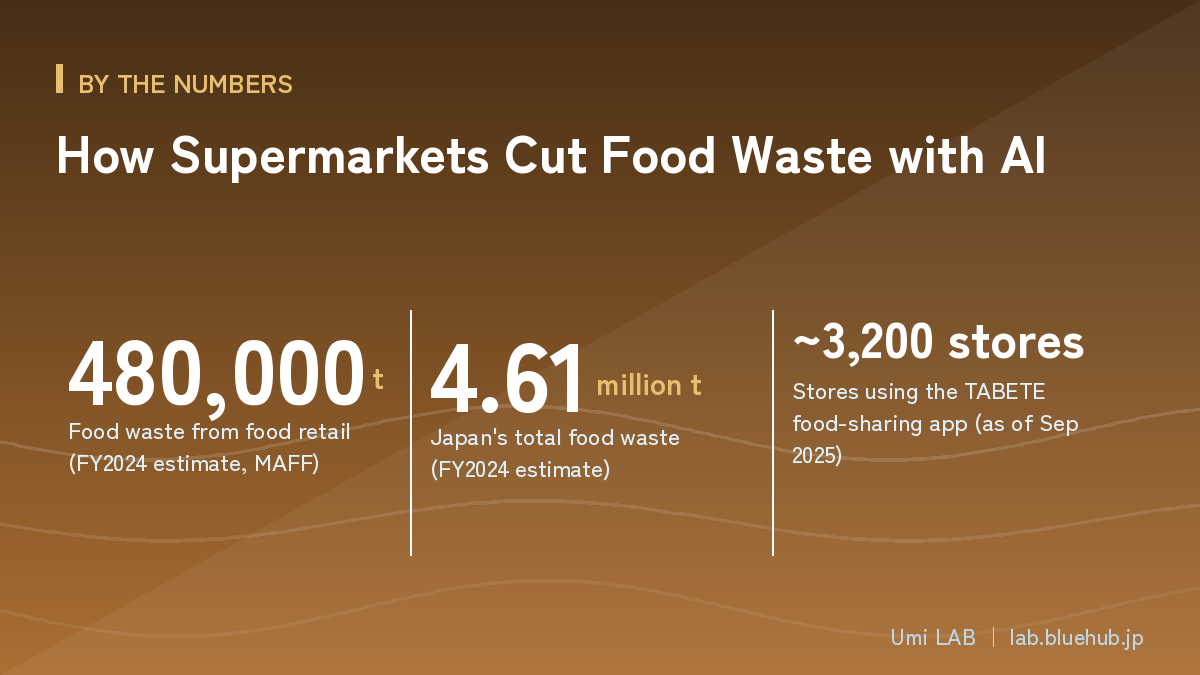
Have you ever wondered how much food is thrown away behind the shelves at your local supermarket? According to FY2024 estimates released by Japan's Ministry of Agriculture, Forestry and Fisheries (MAFF) and the Ministry of the Environment in June 2026, the food retail sector alone generated about 480,000 tonnes of food waste in a single year — roughly equal to the annual throughput of several thousand mid-sized supermarkets.
In recent years, supermarket chains have combined multiple measures to cut waste, including AI-based demand-forecast ordering, dynamic markdowns, and partnerships with food-sharing apps. Case studies from major chains such as Yaoko, Ito-Yokado, and Lawson report both shorter ordering times and reduced waste at the same time.
Meanwhile, seasonal items like ehomaki (lucky direction sushi rolls) and Christmas cakes remain notoriously hard to forecast, and their disposal makes headlines every year. This article draws on the latest statistics and concrete company initiatives to lay out the full picture of supermarket food waste reduction — and what we as consumers can do about it.
What you'll learn in this article
- The latest food waste statistics from MAFF, broken down by business and household sectors
- How AI demand-forecast ordering works at supermarkets and how much waste it cuts
- How far markdowns and clearance sales can go in reducing waste
- How food-sharing apps like TABETE work and what they've achieved
- The structural waste problems behind seasonal foods like ehomaki and Christmas cakes
- Concrete actions consumers can take to help supermarkets cut food waste
How much food waste do supermarkets generate?
On June 30, 2026, Japan's Ministry of Agriculture, Forestry and Fisheries (MAFF), the Consumer Affairs Agency, and the Ministry of the Environment released their FY2024 food waste estimates. Japan's total food waste came to 4.61 million tonnes, a slight decrease from the previous year. Published annually, this figure — tracked against data going back to FY2000 — serves as a key indicator of how far Japanese society has come in reducing food waste.
| Category | FY2024 estimate | Change from prior year |
|---|---|---|
| Total food waste | 4.61 million t | ▼30,000 t |
| Business-sector food loss | 2.37 million t | ▲60,000 t |
| of which food manufacturing | 1.10 million t | – |
| of which food service | 700,000 t | – |
| of which food retail | 480,000 t | – |
| of which food wholesale | 90,000 t | – |
| Household food loss | 2.24 million t | ▼90,000 t |
Of the business-sector food loss, food retail (supermarkets, convenience stores, etc.) accounts for 480,000 tonnes — less than food service (700,000 tonnes) or food manufacturing (1.10 million tonnes), but it draws particular attention because it occurs closest to consumers. Overordering to avoid stockouts, and removal of items past internal sell-by deadlines, are the main causes.
How much has it dropped compared to FY2000?
Per the published data, business-sector food loss has fallen 57% compared to FY2000, while household food loss has fallen 48%. The steeper decline on the business side likely reflects earlier, more organized efforts by major retail and food-service chains — more sophisticated ordering systems, revised best-before labeling, and so on. Household-sector reductions have progressed more slowly, suggesting there's still room to build stronger "eat it all, use it all" habits at home.
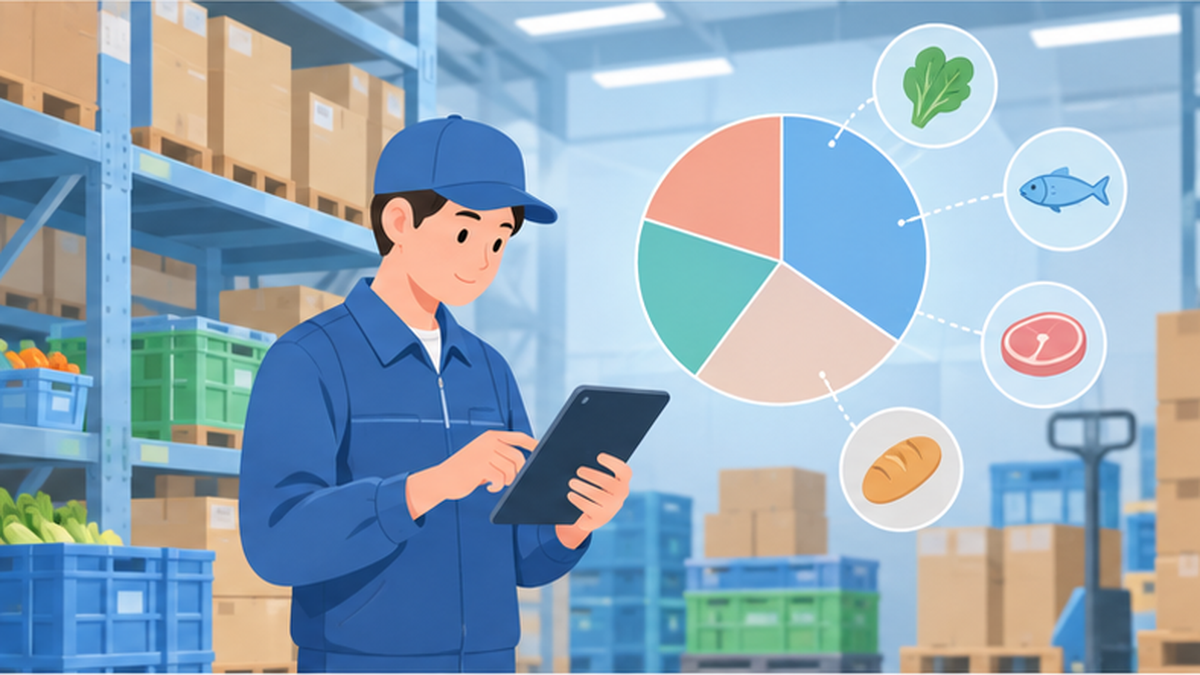
Breakdown of business-sector food loss (FY2024 estimate)
- Food manufacturing: 1.10 million t
- Food service: 700,000 t
- Food retail: 480,000 t
- Food wholesale: 90,000 t
Where food waste occurs in retail
- Removal of items whose best-before or use-by dates are approaching, past the store's internal sell-by deadline
- Unsold fresh food and prepared meals due to bad weather or lower-than-expected foot traffic
- "Extra" ordering driven by staff wanting to avoid the lost sales from running out of stock
- Removal for reasons unrelated to actual quality, such as damaged packaging or mislabeled dates
Prepared foods, bread, and boxed lunches in particular have a short window between production and sale, making demand especially hard to forecast. Foot traffic swings sharply with weather, nearby events, and the day of the week, so orders based on experience alone tend to run short or long — which is exactly where AI demand-forecast ordering delivers the most value.
The Food Loss Reduction Act and supermarkets' role
Japan enacted the Food Loss Reduction Promotion Act in 2019, establishing that national and local governments, businesses, and consumers each have a role to play in reducing food waste. Under this law, MAFF and the Consumer Affairs Agency publish annual estimates for both the business and household sectors, and collect and publicize initiatives by industry. As the point of direct contact with consumers, supermarkets play a key role in putting the law's goals into practice — through in-store awareness campaigns, markdown policies, and smarter ordering.
How AI demand forecasting is transforming ordering
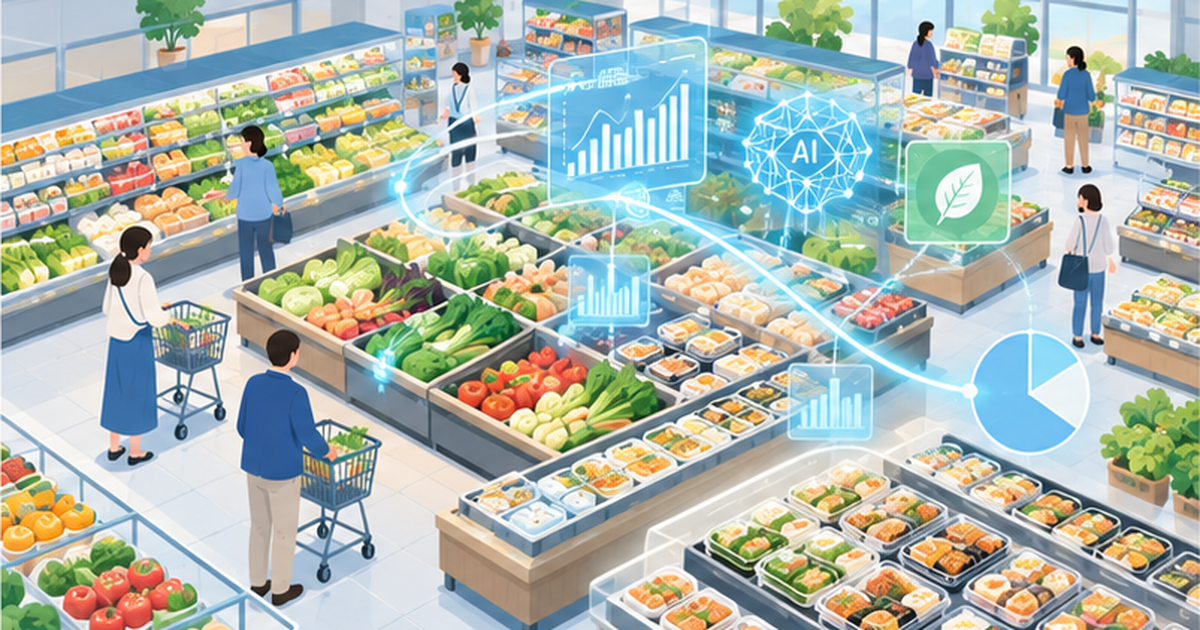
The measure delivering the biggest results in supermarket food waste reduction is AI-based demand-forecast ordering. By learning from past sales alongside weather, day-of-week, and local event data, AI automatically suggests the right order quantity for each store — turning what was once a veteran staffer's intuition into a quantified, streamlined process.
Challenges with traditional ordering
Before AI, ordering was typically done manually by store staff based on past sales ledgers and personal experience. While a veteran could order with high accuracy, judgment varied widely between staff, and know-how was often lost when someone was transferred or retired. On top of that, with supermarkets carrying anywhere from thousands to tens of thousands of SKUs, judging demand item by item took an enormous amount of time.
What kind of data AI learns from
- Several years of POS sales data (by item, time of day, day of week)
- Weather data (temperature, precipitation probability, typhoon information, etc.)
- Calendars of nearby events and school activities
- Promotional schedules such as sales and flyer distribution
- Inventory data and delivery lead times
By combining these data sources, AI can make judgment calls close to human intuition — for example, "fewer bento customers tomorrow because of rain" or "more demand for rice balls because of a nearby sports day."
Concrete results from adopting companies
| Company | Initiative | Result |
|---|---|---|
| Yaoko | Adopted Hitachi's demand-forecast-based automatic ordering system | Cut ordering time from 3 hours to 25 minutes, reduced food waste 5–15% |
| Ito-Yokado | Rolled out AI demand-forecast ordering to all stores from September 2020 | Cut ordering work time by about 30%, also reduced sales losses |
| Lawson | Deployed semi-automatic ordering across roughly 14,000 stores nationwide | Cut ordering time by 44 minutes, reduced per-store waste value by about 10% year over year |
| 7-Eleven | AI ordering that learns from weather, day of week, and local events | Cut roughly 35 minutes of ordering time per day |
These figures are all drawn from each company's own published case studies, and they share a common pattern: shorter ordering time and reduced food waste achieved together. By forecasting demand variability in advance, AI cuts down on both "sold out, lost sales" and "overproduced, thrown away."
Key points of AI demand-forecast ordering
- Uses external data such as weather, day of week, and nearby events as learning material
- Fine-tunes order volumes at the store and item level
- Standardizes work that used to depend on staff experience and intuition
- Frees up staff time for customer service and shelf-stocking thanks to shorter ordering time
What shorter ordering time really means
The benefits of AI demand-forecast ordering go beyond waste reduction alone. When ordering time drops from 3 hours to 25 minutes, as in Yaoko's case, staff can redirect that time toward customer service, shelf-stocking, and store cleanliness. For a retail industry grappling with labor shortages, automating ordering is seen as a way to tackle food waste and improve working conditions at the same time.
Hurdles to adopting AI ordering
Despite the clear benefits reported, adopting AI demand-forecast ordering comes with real hurdles: integrating it with existing core systems, preparing historical data for each store, and the transition period needed for staff to trust and rely on AI's suggestions. Newly opened stores or those that have just been renovated, in particular, have little historical data to draw on, so it can take time before forecast accuracy stabilizes.
Spreading to small and midsize supermarkets
AI demand-forecast ordering initially spread mainly among major chains, but the rise of cloud-based services has made it more accessible to smaller supermarkets that lack the resources to build their own systems in-house. Subscription-based services with lower upfront costs have also emerged, and the technology is expected to become a standard ordering tool regardless of store size.
The role and limits of markdowns and clearance sales
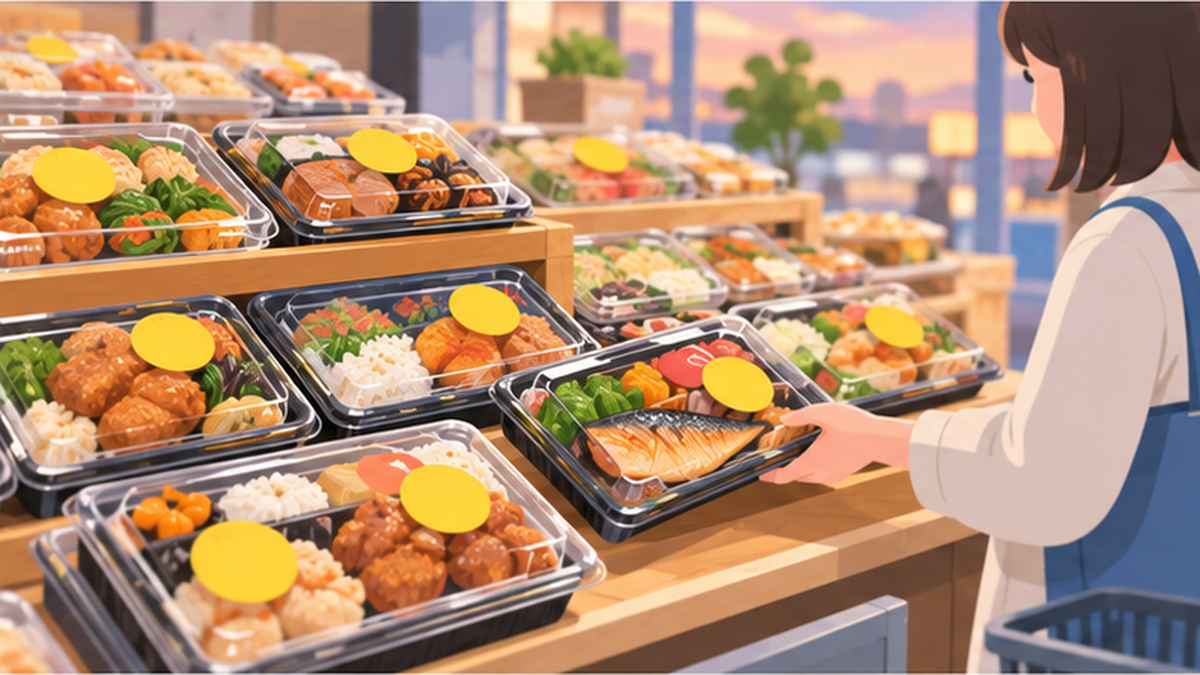
Marking down items as their best-before or sell-by date approaches — known as "mikiri hanbai" (clearance selling) — has long been a standard food waste countermeasure. In recent years, more supermarkets have adopted "dynamic pricing," using AI and sensors to automatically adjust discount levels based on time of day and inventory levels.
How dynamic pricing works
- Electronic shelf labels (e-paper) allow remote, bulk price updates, enabling fine-grained control over discount timing
- Discount rates are raised in stages as the sell-by deadline approaches
- Discounts are linked to inventory data, prioritizing items likely to be thrown away
That said, markdowns alone have limits. Applying discount stickers takes manual labor, and if shoppers start waiting for discounts before buying, it can actually reduce opportunities to sell at full price. That's why many supermarkets combine AI ordering — to avoid overproducing in the first place — with markdowns to sell off whatever is left over.
The link with "front-shelf picking" campaigns
Alongside markdowns, Japan's Ministry of the Environment and MAFF encourage consumers to practice "temae-dori" — picking items from the front of the shelf, which are closer to their sell-by date, when the food will be consumed soon anyway. This reduces in-store waste without waiting for a discount. Markdown policies on the retailer's side and this kind of purchasing behavior on the consumer's side work together to maximize the effect of clearance selling.
Adjusting how much prepared food is made
Another approach that doesn't rely on markdowns is scaling back production of prepared foods and boxed lunches based on AI forecasts in the first place. While large last-minute discounts near closing time can generate buzz, pricing plans built around discounting can also erode profit margins. Many chains are therefore investing in better demand forecasting with the ultimate goal of "selling out without relying on markdowns."
How electronic shelf labels improve efficiency
Traditionally, applying markdown stickers meant staff picking up each item by hand and attaching a sticker one by one. With electronic shelf labels, prices can be updated in bulk from a headquarters or backroom terminal, allowing fine control over discount timing while cutting the labor needed for sticker application. In an industry facing severe labor shortages, electronic shelf labels are gaining attention as an investment that tackles food waste and staffing efficiency at once.
Markdowns and understanding freshness labels
For clearance selling to work smoothly, consumers also need to correctly understand what "safe to eat by" really means. A best-before date indicates when food is "at its best," not a hard safety cutoff like a use-by date. Without this distinction being well understood, shoppers may avoid items simply because the best-before date is approaching, undermining the effectiveness of markdowns. In-store signage and municipal awareness campaigns play a role in communicating this basic knowledge alongside markdown policies.
Delivering surplus food through food-sharing apps
Beyond in-store markdowns, another growing approach is "food sharing" — delivering surplus food to consumers via smartphone apps. A leading example is TABETE, operated by CoCooking Inc., where restaurants, bakeries, and supermarket deli counters list items they want to sell before closing, and consumers pick them up at a discounted price.
TABETE at a glance
- Operator: CoCooking Inc.
- Stores using the service: approximately 3,200 nationwide (as of September 2025)
- Items covered: bread, prepared foods, boxed lunches, sweets, and other items nearing their sell-by date
- How it works: check listings in the app, pay in advance, and pick up at the store
The advantage for supermarkets is that they can cut disposal costs while gaining a touchpoint with new customers, all at once. Consumers benefit from buying food at a lower price, and this mutual benefit is why municipalities also encourage residents to use these services.
Municipalities promoting adoption
Several municipalities — including Tokyo's Adachi Ward, Utsunomiya City, and Sakai City — encourage residents on their official websites to use food-sharing services. For local governments aiming to reduce waste and food loss, partnering with private services offers awareness benefits without additional cost, and this kind of collaboration is likely to keep expanding.
Benefits and caveats for users
For users, the appeal of food-sharing apps lies not only in getting food at a lower price, but also in discovering bakeries and delis they wouldn't otherwise visit. On the other hand, listings appear irregularly and pickup windows are limited, so there's no guarantee you'll find exactly what you want. It's best used as a way to "take advantage of whatever good deal happens to show up that day," rather than as a guaranteed shopping channel.
How well food sharing fits supermarkets
Food-sharing apps were initially used mainly by independently run bakeries and restaurants, but in recent years supermarkets' deli and bakery counters have increasingly adopted them too. Rather than a bulk discount right before closing, announcing surplus items in the app ahead of time and spreading out pickup slots also has operational benefits — avoiding checkout congestion while selling through inventory in a planned way.
The structural challenge of ehomaki and Christmas cakes
Large-scale disposal of seasonal products has long been one of the most closely watched aspects of supermarket food waste. In January 2019, MAFF issued a notice to food retail industry associations ahead of ehomaki season, calling for sales matched to actual demand and encouraging a shift toward reservation-based or fully made-to-order sales.
Why reservations alone don't eliminate waste
- Demand from same-day, non-reserved customers is hard to forecast due to weather and foot traffic
- Stores, fearing stockouts, tend to produce extra on top of confirmed reservations
- Long production and preparation lead times make it difficult to respond to last-minute demand shifts
7-Eleven continues to encourage advance reservations through in-store reservation boards and awareness materials featuring MAFF's mascot "Rossnon." Even so, recent surveys have found a certain amount of unsold stock even at stores using reservation systems, leaving improved forecast accuracy and a higher reservation ratio as ongoing challenges.

The structural difficulty of seasonal food waste
Seasonal products are sold only once a year, meaning prior-year data is less reliable and lead times for preparation are long — making it hard for even AI forecasting to fully eliminate waste. A combination of thorough reservation systems and demand forecasting is the most realistic countermeasure.
The same issue applies to Christmas cakes and osechi
The same structure seen with ehomaki also applies to Christmas cakes and osechi New Year dishes. Both are items that "won't sell if you miss the day or season," yet require days to weeks of preparation lead time. Many supermarkets and department stores work to raise reservation ratios so that production and procurement volumes move closer to confirmed reservation numbers, but eliminating the portion produced speculatively for walk-in customers remains difficult, leaving a structural pattern of annual waste.
Combining forecasting with reservation systems is key
A realistic approach to reducing seasonal product waste doesn't rely on any single measure. Reservation systems secure confirmed demand in advance, while AI demand forecasting — accounting for weather and local events — keeps same-day supplementary production to a minimum. This two-pronged approach is currently considered the best available solution for seasonal products like ehomaki and Christmas cakes.
What happens to unsold seasonal items
For surplus that occurs even with thorough reservations and forecasting, retailers take a multi-step approach: same-day markdowns, switching to frozen sale for items that can be frozen, donation to food banks, and recycling into animal feed or compost. The basic philosophy of seasonal food waste countermeasures rests on two pillars: preventing waste from occurring in the first place, and making the best possible use of whatever surplus does occur.
What consumers can do to help reduce food waste
Even as supermarkets advance their own initiatives, household food loss (an estimated 2.24 million tonnes in FY2024) still accounts for nearly half of the total. Depending on how you shop, consumers can directly contribute to reducing supermarket food waste too.
- Front-shelf picking: choose items from the front of the shelf that are closer to their sell-by date
- Make active use of clearance and "imperfect" product sections
- Buy surplus items through food-sharing apps
- Check your fridge before shopping to avoid buying more than you need
- Only pre-order the quantity of seasonal items you actually need
For more specific ways to reduce food waste at home, see our related article "Japan's Household Food Waste: 2.36 Million Tonnes a Year — The Three Main Causes and What to Do Today."
Supermarket measures and consumer behavior are two sides of the same coin
No matter how accurate AI demand-forecast ordering becomes, if consumers keep reaching for items at the back of the shelf, the ones at the front will go unsold and ultimately be thrown away. Conversely, if consumers actively choose front-shelf items or clearance products, supermarkets can sell through inventory with smaller markdowns, which in turn improves order optimization. Food waste reduction only reaches its full potential when businesses' technology investments and consumers' everyday choices work in sync.
The three main causes of household food waste
Household food loss is generally attributed to three main causes: direct disposal (throwing away unopened food after it expires), leftovers, and excessive trimming (such as peeling away too much of a vegetable). Rethinking how you shop at the supermarket is also a first step toward preventing these forms of waste at home. Buying only what you need and using ingredients according to a plan helps reduce food waste across both the business and household sectors.
Parallels with food loss in seafood
Supermarket food waste countermeasures apply not only to produce and prepared foods, but also to the seafood counter. Fish and shellfish, which spoil quickly, are often discarded before ever reaching the sales floor due to being off-spec or misshapen. For more, see "Reducing Seafood Food Loss: Spoilage, Off-Spec Waste, and Frozen Food Utilization."
The overall picture of measures supermarkets are advancing
- AI demand-forecast ordering to prevent "overproducing"
- Markdowns and dynamic pricing to "sell through" inventory
- Food-sharing apps to "deliver through a different channel"
- Reservation systems and awareness campaigns to "smooth out demand" for seasonal products
Growing use of underutilized fish and off-spec produce
Alongside more sophisticated demand forecasting, some supermarkets are actively turning previously discarded underutilized fish and off-spec vegetables into products. Using misshapen vegetables as ingredients for prepared foods, or packaging abundant but little-known fish species for sale, offers a dual benefit: less waste and a broader product lineup. Related efforts are also covered in "The Distribution Systems Rescuing Off-Spec Produce and Underutilized Fish."
Conclusion: cutting waste through both AI and consumer behavior
As the FY2024 statistics show, food waste from the retail sector remains substantial at 480,000 tonnes. As cases from Yaoko, Ito-Yokado, and Lawson demonstrate, AI demand-forecast ordering is a powerful tool that can improve ordering efficiency and cut waste at the same time. On top of that, markdown sales and food-sharing apps like TABETE serve as a safety net for surplus that AI alone can't prevent.
As seasonal products like ehomaki show, technology alone can't bring waste to zero. Food waste reduction moves forward steadily when supermarkets' systemic efforts combine with small everyday actions from consumers — like front-shelf picking and reserving seasonal items in advance.
Going forward, we can expect AI demand-forecast ordering to spread further among small and midsize supermarkets, more stores to adopt food-sharing apps, and reservation ratios for seasonal products to keep rising. Beyond just tracking the statistics, each individual choice we make in daily shopping — which item to pick today — adds up to support the retail sector's broader push to cut food waste.
Key takeaways from this article
- Food retail generated 480,000 tonnes of food waste in FY2024, out of 4.61 million tonnes nationwide
- AI demand-forecast ordering cuts both ordering time and food waste at once
- Markdowns and food sharing act as a safety net that makes up for overproduction
- Combining reservation systems with demand forecasting is the realistic answer for seasonal products
- Consumer habits like front-shelf picking and advance reservations reinforce supermarkets' efforts
References
- Ministry of Agriculture, Forestry and Fisheries (MAFF) – FY2024 business-sector food loss estimates released
- Consumer Affairs Agency – Release of FY2024 food waste estimates
- MAFF – Food loss and food recycling
- MAFF – Reducing seasonal food waste (ehomaki initiatives)
- MAFF – Case studies on reducing ehomaki waste (PDF)
- TABETE (CoCooking) – Official food-sharing service website
- Ryutsuu News – MAFF calls on retail associations to reduce ehomaki waste
※ Listed by reliability: government/academic institutions > peer-reviewed papers > specialist organizations > reputable media