⚡ In short
Coral reefs generate $3.6 billion a year in tourism value, yet 14% has been lost in a decade. From Okinawa, Kerama, Palau, and the Galapagos to Green Fins and JSTS-D certification, here's how travelers can help protect the ocean today.
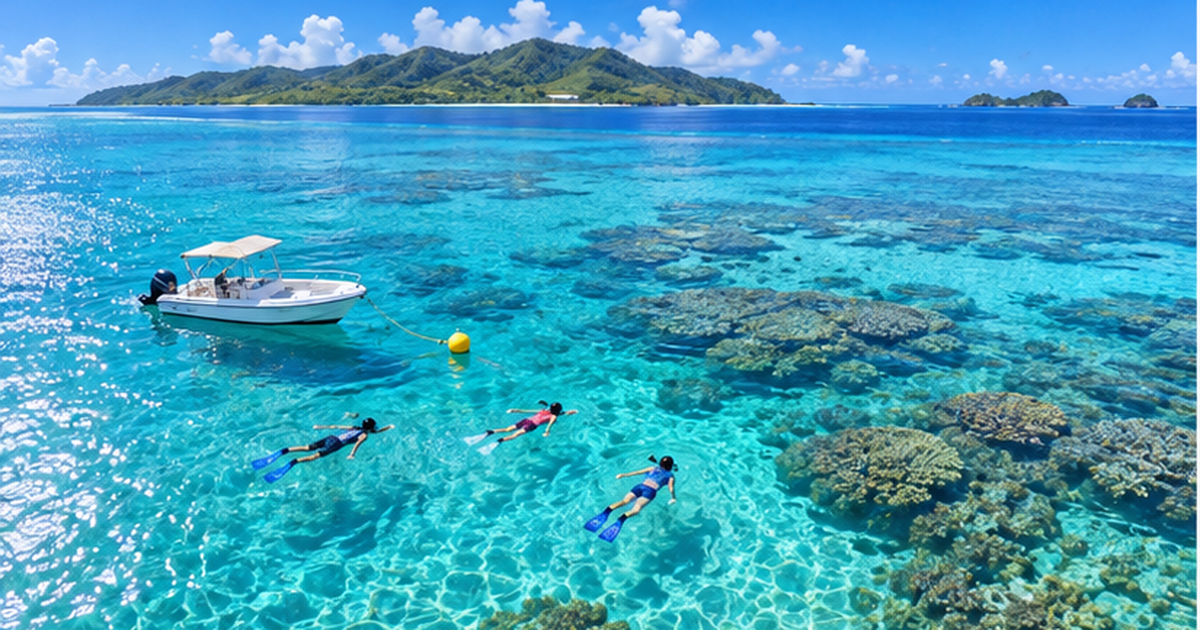
Snorkeling in clear blue water, watching fish dart among coral reefs — what if that very trip were quietly damaging the ocean itself? Sustainable ocean tourism is the idea of balancing the economic benefits of tourism with protecting marine ecosystems.
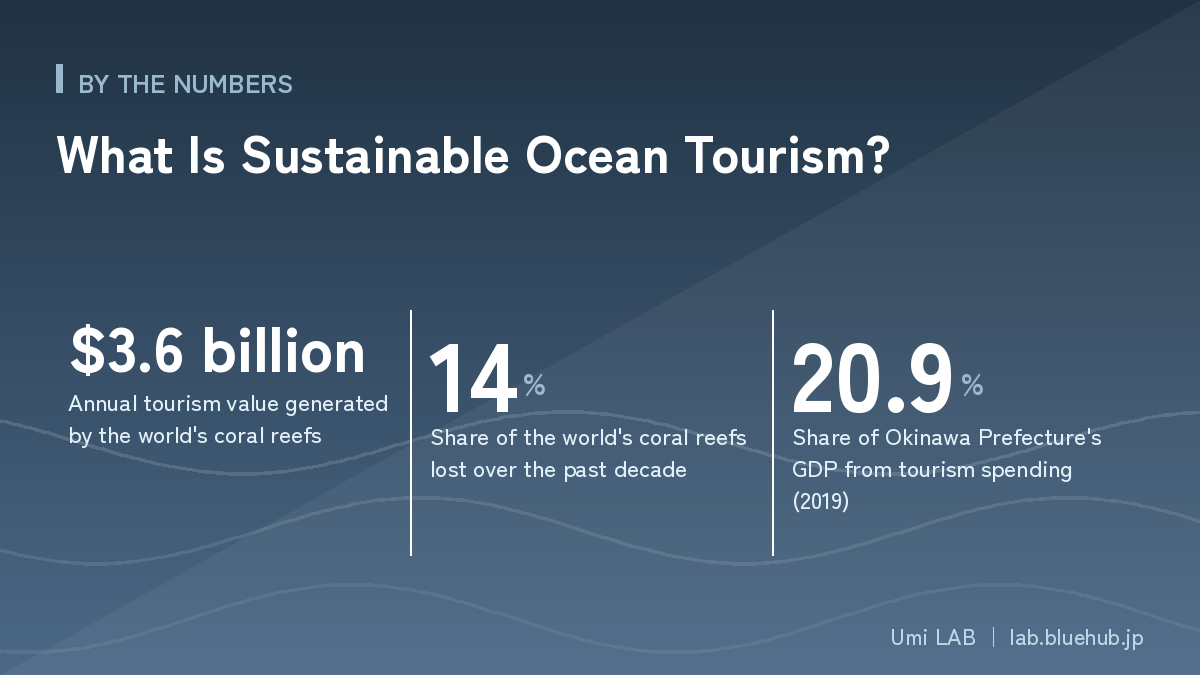
The world's coral reefs generate $3.6 billion a year in tourism value, yet 14% has been lost over the past decade. In Okinawa, the number of visitors in fiscal 2025 topped 10.93 million — an all-time high — and tourism spending has grown to account for 20.9% of the prefecture's GDP. At the same time, reports of environmental damage from overtourism, from coral trampling to illegal parking, keep coming in from across the islands.
This article draws on primary sources to lay out the definition of sustainable tourism, domestic case studies from Okinawa, Kerama, Yakushima, and Ogasawara, overseas entry-fee and pledge systems from Palau, the Galapagos, and the Maldives, and concrete actions travelers can take starting today.
What you'll learn in this article
- The definition of sustainable tourism and how it differs from ecotourism
- The concrete impact of overtourism on coral reefs and sea turtles
- How international and domestic certification schemes like Green Fins and JSTS-D work
- Why regulations on reef-harming sunscreen ingredients are spreading
- Global examples of entry fees and pledges used to manage visitor numbers, such as in Palau and the Galapagos
- Actions travelers can start taking today
What Is Sustainable Ocean Tourism?
The UN World Tourism Organization (UNWTO) defines "sustainable tourism" as tourism that takes full account of its current and future economic, social, and environmental impacts, addressing the needs of visitors, the industry, the environment, and host communities. The key point is that this isn't the name of a particular hotel or tour — it's a way of thinking about how to manage an entire destination.
How It Differs from Ecotourism
Japan's Ministry of the Environment defines ecotourism as "a form of tourism in which visitors experience and learn about the natural environment, history, and culture of a region while taking responsibility for conserving them." While ecotourism is a travel style focused on experiencing and conserving nature and culture, sustainable tourism is a broader destination-management concept that also encompasses the local economy, society, and residents' lives. In other words, ecotourism can be seen as one concrete method for achieving sustainable tourism.
Why the Ocean Is Especially Important
On land, destinations can be managed relatively easily — putting up ropes to block access, or building boardwalks. In the ocean, however, it's hard for travelers themselves to see what's happening beneath the surface, so it's easy to end up "trampling something without realizing it" or "letting a chemical wash off without realizing it." How to compensate for this lack of visibility is a challenge unique to ocean tourism. That's exactly why third-party certifications like Green Fins and JSTS-D, discussed later, or pre-trip briefings from guides, play an even more important role than they do on land.
Unlike land-based sightseeing, which is mostly about viewing scenery, ocean tourism centers on experiences — diving, snorkeling, whale watching, sea turtle observation — that involve direct contact with the ecosystem itself. Stepping on coral, disturbing a nesting sea turtle, letting sunscreen chemicals wash into the water: a traveler's actions translate directly into pressure on the ecosystem in a way that's different from land-based destinations.
Marine ecosystems also take a long time to recover. Coral reefs grow over decades, sometimes centuries, so a landscape that has once been lost rarely returns within just a few years. That's precisely why, to keep enjoying the benefits of tourism, we need to build systems that "protect while using" the resource, ahead of its growth rather than after the fact.
The Three Pillars Behind Sustainable Tourism
UNWTO's definition rests on three pillars: environmental, socio-cultural, and economic. Applied to ocean tourism, the environmental pillar means reducing pressure on coral reefs and marine life; the socio-cultural pillar means respecting the livelihoods and culture of local fishers and residents; and the economic pillar means ensuring tourism revenue benefits the community, not just a handful of large operators. Meeting only one of these isn't enough — UNWTO's view is that a destination can only be called "sustainable" once all three are in balance.
The Gap Between Traveler Awareness and Action
According to a 2025 survey by the booking platform Booking.com, 84% of travelers worldwide (69% of Japanese travelers) said "traveling more sustainably is important," and 93% (85% in Japan) said they want to make more sustainable choices when they travel. Yet a 2024 survey found that only 53% of Japanese travelers actually said they wanted to "travel more sustainably over the next 12 months," showing there is still a gap between awareness and action. Meanwhile, 59% (69% globally) said they want to leave a destination in better condition than they found it — a sign that traveler awareness is steadily rising.
Four perspectives this article covers
- ① The concrete impact of tourism on coral reefs, sea turtles, and other marine life
- ② International and domestic certification and rule-making, such as Green Fins and JSTS-D
- ③ Overseas examples of managing visitor numbers through entry fees and pledges, such as Palau, the Galapagos, and the Maldives
- ④ Concrete actions each traveler can choose to take
Ocean Tourism by the Numbers: Scale and Challenges
The relationship between the ocean and tourism is significant even in purely economic terms. Let's start with the big picture, in numbers.
The Economic Value of Coral Reefs
According to analysis by the UN Environment Programme (UNEP) and the research group Mapping Ocean Wealth, the world's coral reefs generate $3.6 billion a year in tourism value — $1.9 billion from "on-reef" tourism such as diving and snorkeling, and $1.6 billion from "reef-adjacent" tourism such as beaches and local seafood. Trips to coral reefs are estimated at around 70 million a year worldwide.
Reefs Keep Disappearing as Tourism Demand Grows
At the same time, the world's coral reefs have lost 14% of their extent over the past decade. Rising sea temperatures and bleaching driven by climate change, combined with pressure from human activity including tourism, are compounding the damage. Even so, coastal and marine tourism is projected to become the largest value-adding segment of the ocean economy by 2030, at 26% of the total, highlighting a dilemma in which both the economic benefits and the environmental burden keep growing.
| Item | Figure | Source |
|---|---|---|
| Annual economic value of coral reef tourism | $3.6 billion | UNEP / Mapping Ocean Wealth |
| Annual trips to coral reefs worldwide | Approx. 70 million | Mapping Ocean Wealth |
| Share of coral reefs lost in the past decade | 14% | UNEP |
| Tourism spending as a share of Okinawa's GDP (2019) | 20.9% | Okinawa Prefecture data / media reports |
| Visitors to Okinawa (FY2025, all-time high) | 10.935 million | Okinawa Prefecture / Nikkei |
| Annual visitors to the Galapagos Islands (2022) | Approx. 268,000 | Media reports (Time Out, etc.) |
How Overtourism Burdens the Ocean
"Overtourism" refers to a situation where growth in visitor numbers exceeds a destination's capacity, harming the environment and residents' daily lives. Okinawa has drawn attention at home and abroad as a leading example.
According to Okinawa Prefecture, the number of visitors in fiscal 2025 rose 9.9% year on year to an all-time high of 10.935 million, surpassing the roughly 10 million recorded in fiscal 2018. Tourism revenue topped ¥1 trillion for the first time, and the economic benefits keep growing year after year. At the same time, the question of how to accommodate an ever-growing number of visitors has become more urgent than ever.
Coral Trampling and Sunscreen
Tourism spending's share of Okinawa's GDP reached 20.9% in 2019, before the pandemic — a strikingly high level for Japan. As visitor numbers have surged, cases of divers and snorkelers accidentally touching and damaging coral, and people entering the water without rinsing off environmentally harmful sunscreen ingredients, have become a growing concern. In shallow areas where people can stand, inexperienced swimmers accidentally standing on coral is far from rare.
Illegal Parking, Traffic Congestion, and Water Accidents
Traffic congestion and accidents caused by an increase in rental cars, illegal parking around beaches, and a rise in water accidents among inexperienced travelers have all been reported, showing that the burden extends beyond the ecosystem to residents' daily lives. In outlying islands such as Miyako, road infrastructure has struggled to keep pace with visitor growth, and traffic and noise are cited as impacts on the local living environment. There are even warnings that chronic congestion on access roads to popular beaches during peak season could hamper emergency vehicles, underscoring that environmental strain and strain on daily infrastructure cannot be separated.
Onna Village's Response: The "Coral Village Declaration"
In 2018, Onna Village issued its "Coral Village Declaration — the World's Most Coral-Friendly Village," and has since pursued land-use regulation through an environmental conservation ordinance, measures to prevent red-soil runoff, wastewater regulations for large facilities, the removal of crown-of-thorns starfish, and coral farming and transplanting, among other efforts to balance tourism with conservation. A key feature is that this isn't the effort of a single local government alone — accommodation operators, dive operators, and government share the responsibility.
As visitor numbers themselves keep climbing, however, there are cases where the efforts of individual municipalities alone can't keep pace with the growing burden. A perspective on managing the overall volume on the receiving side — such as spreading visitors across popular areas, or tightening the cap on the number of visitors per guide during peak season — is becoming more important the larger the economic scale grows.
Behaviors travelers often engage in that cause harm
- Touching or standing on coral with fins or hands
- Entering the water without rinsing off sunscreen containing harmful ingredients
- Using flashlights or camera flashes at sea turtle nesting sites
- Boarding boats that drop anchor where there are no mooring buoys
Regulations on Reef-Harming Sunscreen Ingredients Are Spreading
One factor that travelers rarely think about, yet which has an outsized impact, is the chemical ingredients in sunscreen.
The Spread of Oxybenzone Regulations
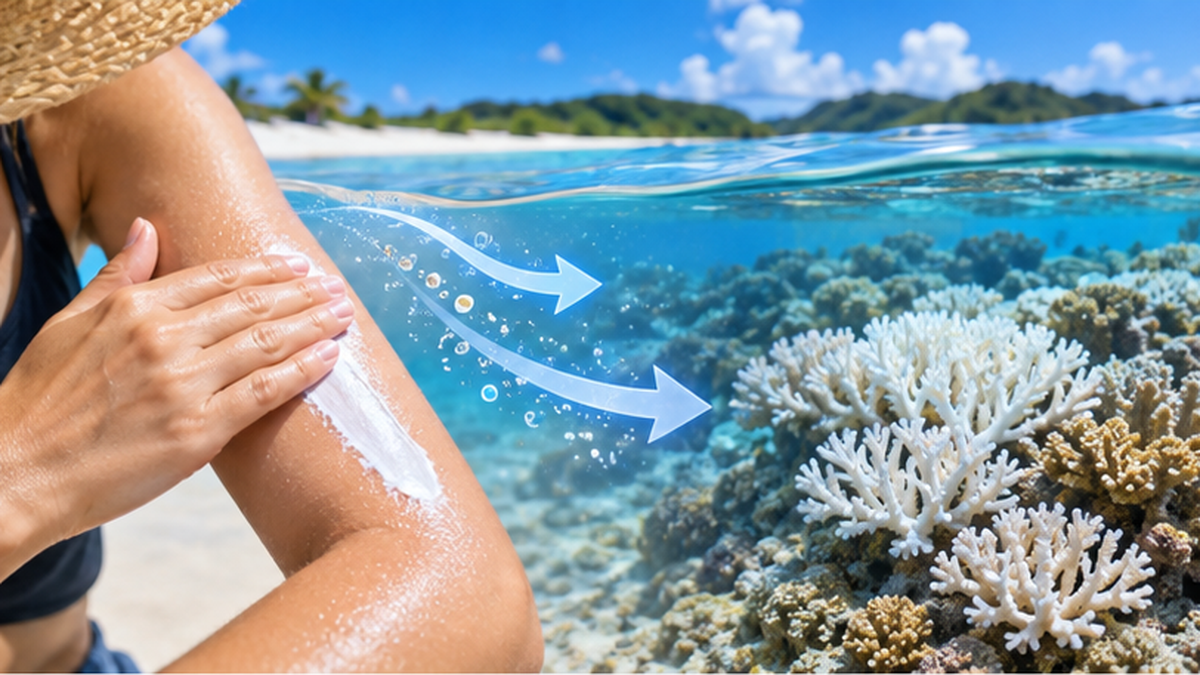
In 2018, the Pacific island nation of Palau became the first country in the world to announce a national ban on sunscreens containing chemicals harmful to coral reefs. Under its 2018 Responsible Tourism Education Act, Palau has banned the import, sale, and possession of sunscreen products containing oxybenzone and other such ingredients since January 2020. The U.S. state of Hawaii passed similar legislation in 2018, banning the sale of sunscreens containing oxybenzone and octinoxate from January 2021.
According to Japan's embassy in Palau, an estimated 14,000 tonnes of sunscreen wash into the ocean worldwide every year via beaches and wastewater, and similar regulations are spreading to other ocean tourism destinations such as Thailand, following Hawaii and Palau. Oxybenzone has been shown to trigger bleaching even in cooler waters, and there are concerns that combined with rising water temperatures from climate change, the pressure on coral reefs will only grow.
| Country/Region | Regulation | Effective |
|---|---|---|
| Palau | Ban on import, sale, and possession of sunscreens containing oxybenzone and similar ingredients | From January 2020 |
| Hawaii, USA | Ban on sale of sunscreens containing oxybenzone and octinoxate | From January 2021 |
| Thailand | Restrictions on reef-harmful sunscreen use within national parks | From 2021 |
Mineral ("non-chemical") sunscreens that use UV-scattering agents such as titanium dioxide or zinc oxide, rather than chemical UV absorbers, and products labeled "non-nano" (with particles not ground down too finely), are believed to have comparatively less impact on coral. If it's hard to judge from labeling alone, the surest approach is to check the ingredient list for oxybenzone and octinoxate.
- Check for "oxybenzone-free" or "octinoxate-free" labeling when buying sunscreen
- Consider mineral, "non-nano" UV-scattering sunscreens as an option
- Prioritize rash guards, hats, and other protection over relying on sunscreen alone
- Apply sunscreen while getting changed, rather than right before entering the water, so it has time to absorb
Rules to Protect Sea Turtle Nesting Sites
Sea turtle nesting sites are another setting heavily affected by visitor behavior. According to the Yakushima World Heritage Conservation Center (Ministry of the Environment), loggerhead turtle landings at Nagata Beach on Yakushima account for 30–40% of all landings in Japan, making it the largest nesting site in the North Pacific. Because a single beach carries such a large share, the rules for observing it are directly tied to the conservation of the species.
Nesting Behavior Sensitive to Light and Footsteps
According to the Yakushima World Heritage Conservation Center (Ministry of the Environment), sea turtles are extremely sensitive to light and human presence — if people walk around the beach at night or use flashlights, a turtle may abandon its landing and return to the sea without laying eggs. Nesting begins in late April, and during hatching, which starts in early July, human footsteps can compact the sand so hatchlings can't dig their way out, and streetlights or car headlights can trigger "phototaxis," drawing hatchlings in the wrong direction.
Observation Rules at Nagata Beach, Yakushima
At Nagata Beach on Yakushima, one of the world's foremost sea turtle nesting sites, a local organization formed by the Nagata district runs sea turtle observation tours, with rules developed by a dedicated Sea Turtle Conservation and Use Subcommittee. Since sea turtles react not only to camera flashes but also to the light from camera and smartphone screens, visitors are asked to thoroughly control light — for example, covering screens with cloth or using infrared cameras — while observing. Participation requires joining a reservation-only guided tour, and access to the beach and length of stay are also set by zone.
Things to keep in mind when observing sea turtles
- Don't use flashlights, camera flashes, or smartphone light
- Follow the instructions of designated tours and guides
- Don't approach an individual too closely while it's nesting or just after
- Follow the rules on which areas of the beach you may enter, and at what times
Marine Park Rules in the Kerama and Ogasawara Islands
Beyond individual etiquette, there's also a move to build rules into the framework of national parks. Located about 40km west of Okinawa's main island, the Kerama Islands are known for their multi-island seascape of over 30 large and small islands and some of the world's clearest water, and were designated Japan's 31st national park on March 5, 2014 (Coral Day).
Coral Damage from Crown-of-Thorns Starfish and Diving
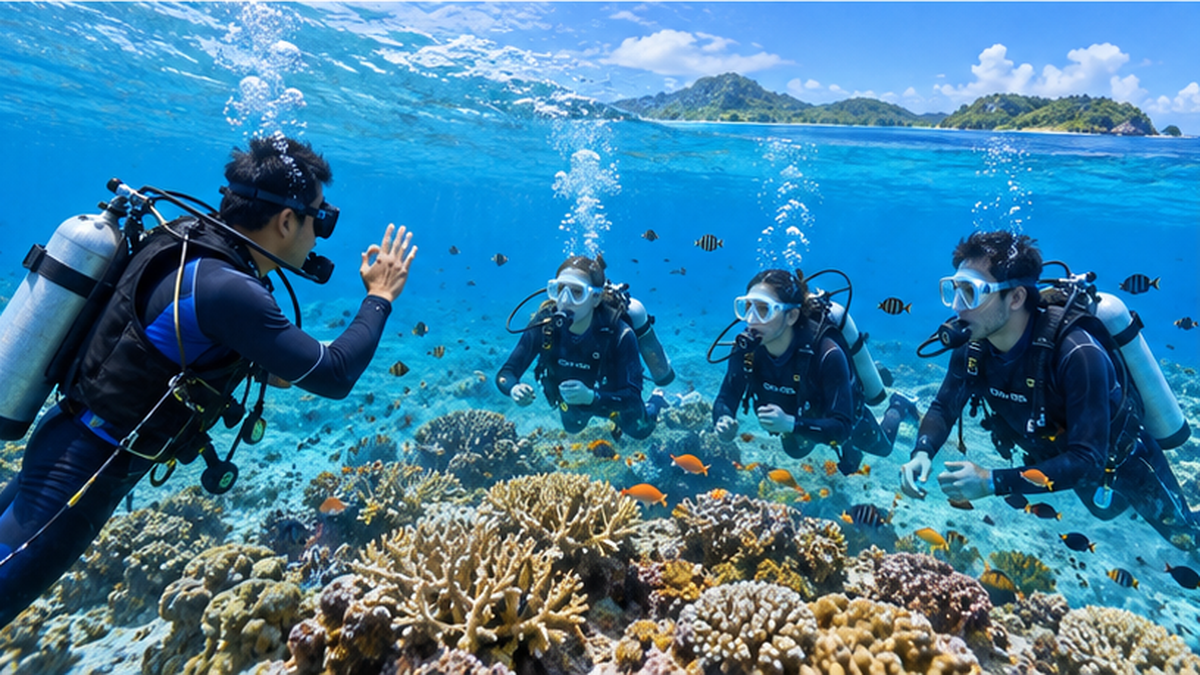
When the Kerama Islands National Park was designated, coral damage from crown-of-thorns starfish outbreaks and from activities such as scuba diving was already recognized as a challenge. In response, the Tokashiki Village and Zamami Village ecotourism promotion councils drafted a comprehensive plan under Japan's Ecotourism Promotion Act, which received certification from relevant ministries in June 2012.
Guidelines the Region Sets for Itself
The two village councils established the "Kerama Regional Ecotourism Guidelines," calling on dive shops and visitors to use the area appropriately. Rather than the national government imposing regulations unilaterally, having local tourism operators themselves participate in creating the guidelines makes it more likely the rules will match conditions on the ground. Combining the perspective of locals for whom the sea is part of daily life with specialist conservation knowledge is a model that can be applied to other ocean tourism destinations as well.
Designating a national park is also an opportunity for a region to publicly declare how it intends to use and preserve its sea, beyond mere legal regulation. In the case of the Kerama Islands National Park, the designation itself was pursued as a direct response to concrete problems — the crown-of-thorns starfish outbreaks and coral damage — a case where the institution and the on-the-ground challenge are directly linked.
Ogasawara's Voluntary Whale-Watching Rules
In the Ogasawara Islands, a UNESCO World Natural Heritage site, Japan's first whale-watching-based ecotourism began in 1988. In 1992, the Ogasawara Whale Watching Association established voluntary rules, which have since been revised twice and remain in effect today. Boats under 20 tonnes must maintain a reduced-speed zone within 300m of a whale and a no-entry zone within 100m; for drone photography, operators must not approach within 30m of a whale, must not fly over a pod that another boat is already watching, and must not approach from the whale's direction of travel. Japan's Ministry of the Environment has also compiled rules visitors should follow as the "Ogasawara Country Code." Rather than waiting for national regulation, the fact that an industry association itself quantified and enforces standards for distance and speed is an approach that can be applied to ocean tourism beyond coral reef diving.
Where coral reef rules are built around divers and snorkelers making a "quiet approach," whale watching centers on controlling the physical distance and speed between a boat and a whale. Tailoring the shape of the rules themselves to the ecology and type of risk posed by the target species is another point other regions can learn from when designing their own systems.
International Diving Standards and Japan's JSTS-D
Alongside individual traveler awareness, standard-setting on the part of operators and destinations is also advancing.
"Green Fins," an Environmental Standard from UNEP and the UK
Green Fins is an international environmental standard for dive and snorkel operators launched in 2004 by the UN Environment Programme (UNEP) and the UK-based environmental charity Reef-World Foundation. Member operators are assessed annually against a 15-point code of conduct and ranked Gold, Silver, or Bronze based on how little impact they have on coral reefs; the standard is now implemented in over 14 countries. In Japan, Onna Village in Okinawa became the first local government to fully adopt Green Fins in 2019, and around 20 shops now operate under the standard. The initiative has drawn in accommodation and tourism operators more broadly — for example, a resort hotel within Onna Village has earned Gold certification.
"JSTS-D," Which Evaluates an Entire Destination
Beyond the efforts of individual operators, Japan has also built a domestic system for managing entire destinations. In June 2020, Japan Tourism Agency established the "Japan Sustainable Tourism Standard for Destinations (JSTS-D)," aligned with international criteria developed by the Global Sustainable Tourism Council (GSTC). It's an index that lets local governments and DMOs (destination management organizations) measure their consideration for both visitors and residents using multifaceted, objective data, as a basis for medium- to long-term destination management plans.
Local governments and DMOs that pass JSTS-D review can obtain and use the "JSTS-D logo mark." Regions across Japan, from coastal areas to mountain towns — such as Tonosho in Kagawa Prefecture and Hakuba Village in Nagano Prefecture — have been adopting the logo mark, and it is becoming a shared language for destination-building that is "good to live in, good to visit."
A Two-Layer Structure: Operator Level and Destination Level
Green Fins and JSTS-D operate at different levels. Green Fins is a scheme that assesses the code of conduct of individual operators such as dive shops, while JSTS-D evaluates the management system of an entire destination run by a local government or DMO. From a traveler's perspective, checking both indicators — Green Fins when choosing an operator, and the JSTS-D logo mark when choosing a destination — makes it easier to make sustainable choices on multiple levels at once.
What you can do when choosing a tour
- Check for Green Fins certification (Gold, Silver, or Bronze) before booking
- Choose boats and shops that use mooring buoys
- Choose tours that limit the number of people per group
- Choose operators that explain in advance not to touch or stand on coral
Entry Fees and Pledges: A Global Trend in Managing Visitor Numbers
Looking abroad, alongside certification schemes, there's also a growing movement to directly manage visitor numbers through "entry fees" and "pledges."

The Palau Pledge: The World's First Environmental Immigration Policy
In December 2017, Palau introduced the "Palau Pledge," requiring every visitor to sign a pledge stamped directly into their passport upon arrival — considered the world's first immigration policy built around environmental responsibility. The pledge text includes a commitment to "tread lightly, act kindly, and explore mindfully," and it was notably co-created with local schoolchildren. It explicitly bans acts such as collecting marine souvenirs, feeding fish or sharks, touching coral, and littering, with fines of up to $1 million for violations.
What's distinctive about the Palau Pledge's balance is that while signing it is mandatory to enter the country, the content itself is framed less around punishment and more around language that encourages voluntary behavior change. Using the airport — a place every visitor must pass through — is also a deliberate design choice, ensuring the message reaches even travelers who never read a guidebook.
The Galapagos Islands Raise Their Entry Fee
The Galapagos Islands (Ecuador), which have had an entry-fee system since 1998, doubled their fee for foreign visitors from $100 to $200 per person in August 2024 — the first revision since the system was introduced. Home to over 9,000 species, many of them endemic, the Galapagos have seen visitor numbers recover to near pre-pandemic levels, at around 268,000 a year, raising concerns about pressure on water and food resources and disruption to the ecosystem. Revenue from the higher fee goes directly toward conservation work that mitigates the ecological impact of tourism, infrastructure, and support for local communities.
The Maldives' "Green Tax"
The Maldives, made up of over 1,000 islands, has introduced a "Green Tax" aimed at environmental protection and improvement. Visitors staying at resorts, hotels, or safari boats pay $6 per night regardless of age, while guesthouse guests pay $3 per night; from January 2025, the accommodation tax at large resorts with 50 or more rooms doubled to $12. The aim is to channel tax revenue from tourism — the country's core industry — into environmental measures such as conserving the surrounding coral reefs and managing waste.
Insuring Coral Reefs: Cancun, Mexico's Experiment
There are also examples of securing funding from an angle other than managing visitor numbers. Off Cancun, Mexico, an insurance product for coral reefs developed by the major reinsurer Swiss Re has been introduced. Covering about 60km of beach and coral reef, tourism-related operators such as hotels pay premiums of $1 million to $7.5 million, while a payout of $25 million to $70 million is made if the reef suffers major damage from a hurricane. The payout funds work such as installing artificial reef structures and restoration efforts — relocating damaged coral to safety, growing it, and later returning it to its original reef. With Caribbean hurricanes growing more intense in recent years, this is drawing attention as an approach that uses a financial mechanism to protect a resource that is also economically vital to the tourism industry.
From "Cheap and Plentiful" to "Fair Contribution for Protection"
Palau's pledge system, the Galapagos' entry fee, and the Maldives' Green Tax share a common aim. Rather than simply reducing visitor numbers, the idea is to get each visitor to take personal responsibility for the environment, or to have part of the burden returned as conservation funding, sustaining both tourism and nature over the long term. A growing number of destinations within Japan are also introducing entry fees or cooperation fees, and these overseas examples offer useful reference points for designing future systems.
A Checklist for Choosing a Destination, and What You Can Do Today
Based on the institutions and case studies covered so far, here's a summary of what travelers should look for when choosing. Neither certification schemes nor entry fees can protect the ocean on their own. What ultimately makes them work is the behavior of each traveler — following the rules on the ground, and choosing wisely.
| What to check | Signs to look for |
|---|---|
| Diving/snorkeling operator | Whether it holds Green Fins certification (Gold, Silver, or Bronze) |
| Accommodation / the destination overall | Whether it has obtained the JSTS-D logo mark |
| How the tour is run | Use of mooring buoys, limits on group size |
| Your own belongings | Sunscreen free of oxybenzone and octinoxate |
| Wildlife-watching tours | Whether rules set by local organizations or subcommittees exist |
| Visiting national parks / protected areas | Whether the host side has an entry fee, cooperation fee, or pledge system |
Tourism that takes full account of its current and future economic, social, and environmental impacts, addressing the needs of visitors, the industry, the environment, and host communities
― UNWTO's definition of sustainable tourism
The Roles of Government, Operators, and Travelers
Bringing together the examples covered here, sustainable ocean tourism is sustained by three parties each playing their role: government (building institutions such as national park designations and entry fees), operators (complying with standards such as Green Fins and guiding on the ground), and travelers (following the rules and choosing wisely). No single party can do it alone — a good policy from government means little if operators don't comply, and operators' efforts lose effect if travelers unknowingly break the rules. Conversely, travelers consciously choosing based on certifications and institutions is itself a force that reinforces the efforts of government and operators.
What You Can Do Before, During, and After Your Trip
- Check for certifications such as Green Fins or JSTS-D before booking
- Check the ingredient label on your sunscreen before entering the water
- Don't touch or get too close to coral or wildlife without your guide's instruction
- Don't use light-emitting devices on tours involving light-sensitive creatures, such as sea turtle observation
- Where an entry fee or cooperation fee applies, pay it willingly, and take an interest in how it's used
- Share the rules that need to be followed, along with your impressions, when posting about your trip on social media
For more on protecting Okinawa's coral reefs, see How to Enjoy Okinawa Tourism While Protecting Its Coral Reefs; for the relationship between tourism and disaster recovery, see What Is Ocean-Based Recovery Tourism?. For more on sea turtle biology itself, see The Life and Conservation of Sea Turtles.
Summary
- Sustainable tourism is an approach to travel that balances environmental, economic, and social considerations
- Coral reefs generate $3.6 billion a year in value, yet 14% has been lost in a decade
- Domestic and international schemes such as Green Fins, JSTS-D, and the Kerama ecotourism guidelines are spreading
- Palau's pledge-based immigration policy and the Galapagos' entry fee are early examples of "fair contribution for protection"
- Individual actions — from sunscreen ingredient regulations to sea turtle observation rules — also have a significant impact
- Being mindful from the moment you choose a destination or operator helps ensure the ocean can be enjoyed for a long time to come
References and Sources
- Japan Tourism Agency – Japan Sustainable Tourism Standard for Destinations (JSTS-D)
- Ministry of the Environment, Japan – Ecotourism initiatives
- Yakushima World Heritage Conservation Center, Ministry of the Environment – Sea turtle observation rules
- Ministry of the Environment, Japan – Kerama Islands National Park overview and plan
- Embassy of Japan in Palau – On the ban on sunscreens containing ingredients harmful to coral reefs
- Green Fins – Certified Membership (international environmental certification scheme)
- Onna Village, Okinawa – Coral Village Declaration: the World's Most Coral-Friendly Village
- UNEP – Protecting million dollar reefs is key to sustaining global tourism
- Mapping Ocean Wealth – Coral Reef Tourism: Data Highlights Conservation Opportunity for Industry
- Toyo Keizai Online – (Japanese) Okinawa overtaking Hawaii: the alarming decline in tourist etiquette
- Booking.com – 2025 Sustainable Travel Report
- Ogasawara Whale Watching Association – Watching rules
- Ryukyu Shimpo – (Japanese) Okinawa visitor numbers hit an all-time high of 10.93 million in FY2025
※ Ordered by reliability: government and academic institutions > peer-reviewed research > specialist organizations > trusted media