⚡ The answer in 30 seconds
- RE.UNIQLO is UNIQLO's clothing collection, reuse and recycling initiative, developed from the all-product recycling program started in 2006.
- From 620,000 down items collected in Japan in 2019, the first Recycled Down Jacket was made in Autumn/Winter 2020.
- The jacket reuses 100% of the down and feathers and uses recycled polyester for the shell, a true clothes-to-clothes approach.
- Mass clothing disposal and microfibers shed in the wash affect the sea, so circulating clothes is also about protecting the ocean.
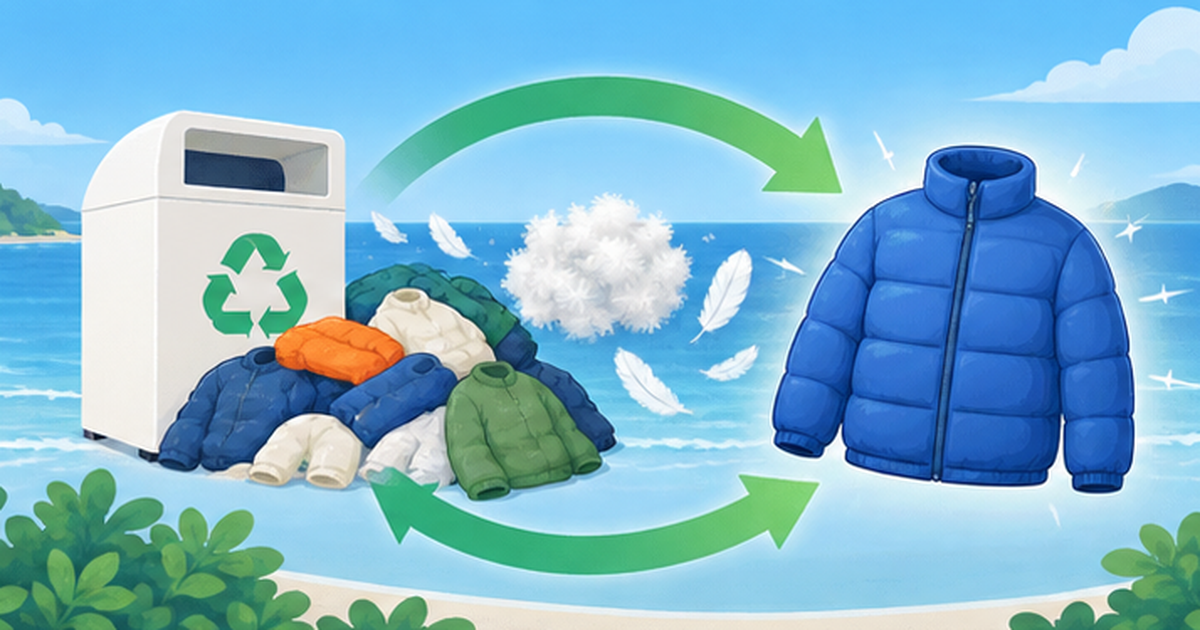
UNIQLO's "RE.UNIQLO" is an initiative that collects clothes people no longer wear at its stores and channels them into reuse and recycling.It aims for a "clothes-to-clothes" cycle, such as making new down jackets from collected down.
Clothing is familiar to everyone, yet it carries major environmental problems. According to the Ministry of the Environment's estimates, about 70% of the clothing discarded by households and businesses in Japan ends up as waste, and synthetic-fiber garments shed tiny fibers with every wash, some of which flow into the sea. The circulation of clothing is therefore both a land-waste issue and an ocean issue.
This article organizes how RE.UNIQLO works and what it has achieved based on public information, then explains its relationship to the marine environment and how to read corporate initiatives, step by step.
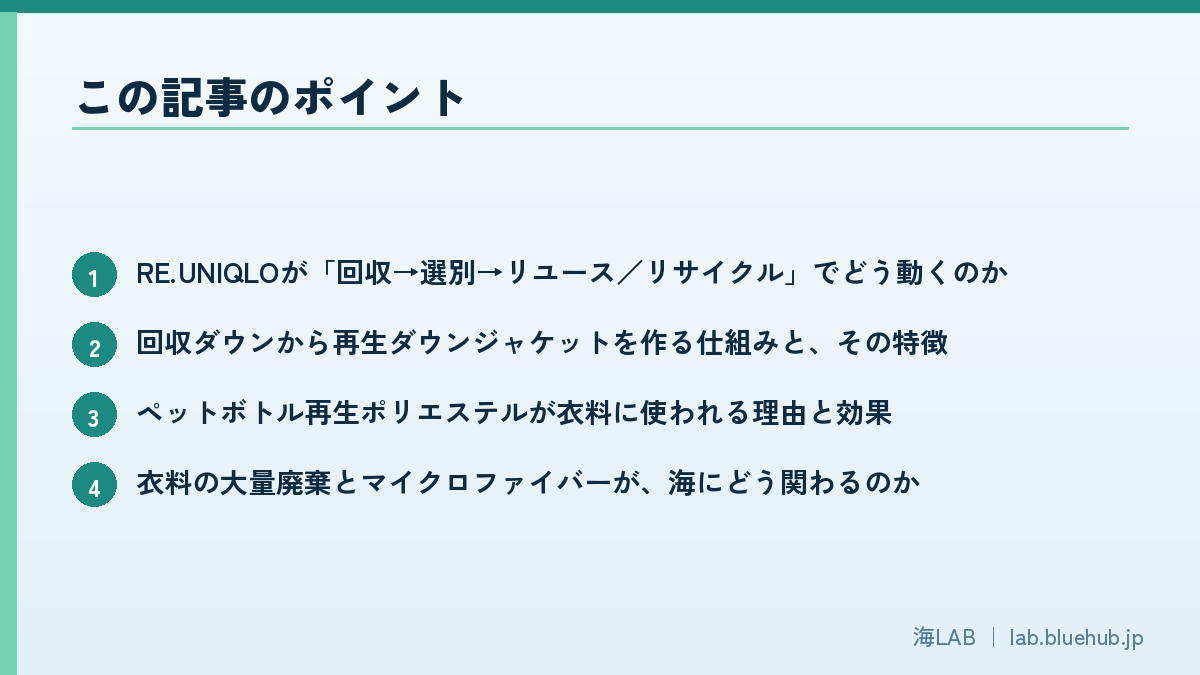
What you will learn in this article
- How RE.UNIQLO works: collection → sorting → reuse / recycling
- How recycled down jackets are made from collected down, and their features
- Why recycled PET polyester is used in clothing, and its effects
- How mass clothing disposal and microfibers affect the ocean
- What to look for when reading corporate initiatives, and what we can do
What is RE.UNIQLO? The big picture
From the 2006 all-product recycling program to RE.UNIQLO in 2020
Fast Retailing, which operates UNIQLO, started its "All-Product Recycling Program" in 2006. Customers bring UNIQLO clothes they no longer wear to stores, and the clothes are delivered to people in need or reused as resources.
In 2020 the program evolved into "RE.UNIQLO." The "RE" carries meanings such as Reuse, Recycle and Reduce, showing a commitment not to waste collected clothes.
What happens to collected clothes
Clothes collected at stores are sorted and, depending on condition and material, follow one of two broad paths. Items that can still be worn go toreuse, while those that can no longer be worn go torecycling.
| Category | Main destination | Purpose |
|---|---|---|
| Reuse | Clothing support for refugees and disaster victims (in cooperation with UNHCR and others) | Deliver wearable clothes to people who need them |
| Recycling (back into clothes) | Raw material for new clothing such as recycled down | Circulate resources within clothing |
| Recycling (non-clothing) | Automotive sound-insulation material, fuel, etc. | Put materials to other uses instead of discarding them |
Collection starts at the store register
Collection has been accepted at the registers of all UNIQLO stores in Japan. In 2020, a measure giving a 500-yen digital coupon for returned down products was also introduced, a device to encourage participation.
How collected down becomes "recycled down"
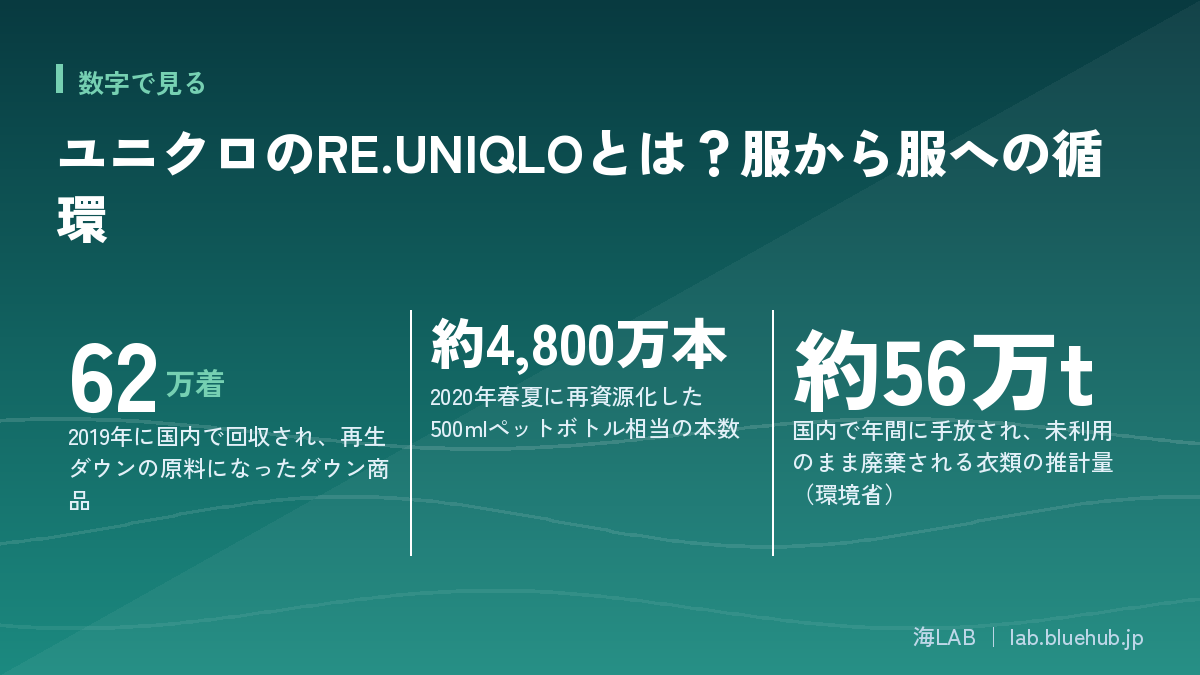
620,000 items collected in Japan in 2019
Recycled down is perhaps the symbol of RE.UNIQLO. According to UNIQLO, the down products collected in Japan in 2019 totaled620,000 items, and from this raw material the first "Recycled Down Jacket" was launched in Autumn/Winter 2020 (released on November 2, 2020, priced at 7,990 yen excluding tax).
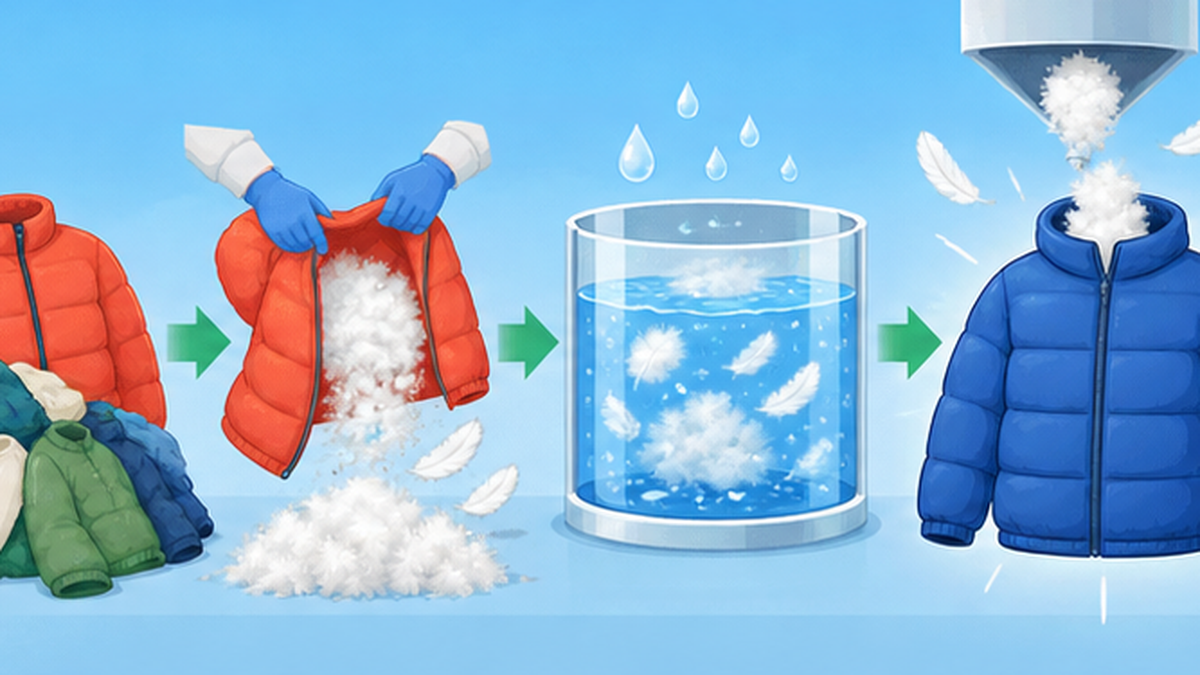
100% reused down and a recycled polyester shell
This jacketreuses 100% of the down and feathersand uses recycled polyester for the outer fabric. The Paris R&D Center team handled the design, aiming to go beyond the impression that "recycled means plain."
Key point
- The main feature is that it goes beyond "collecting clothes and using them as resources" and returns the material to the same kind of garment. Keeping material quality while circulating it is, in fact, technically difficult.
How does it differ from new down?
The advantage of recycled down is that less new down needs to be procured. On the other hand, because collected items vary in condition, sorting, washing and quality control are essential. Some details, such as specific CO2 reductions, are not given numerically in the published materials, so always check primary sources when quoting figures.
From PET bottles to clothes: using recycled polyester
About 48 million 500 ml PET bottles' worth recycled
UNIQLO uses polyester recycled from collected PET bottles in its clothing. According to the company, in the Spring/Summer 2020 season it recycledabout 48 million 500 ml PET bottles' worth of material. Compared with making it from crude oil, CO2 emissions from producing recycled polyester chips are said to be about one third.
For PET bottle recycling itself, the article onHow PET bottle horizontal recycling works is also a useful reference. "Horizontal" recycling returns bottles to bottles, while "fiberization" turns bottles into clothing; the material is the same but the purpose differs.
Share of recycled materials and the target
UNIQLO has set a goal of raising the share of recycled and similar materials among all materials used toabout 50% by FY2030. According to the company, progress in FY2024 was 18.2%. That the gap to the target is openly shown is important information when evaluating the effort.
Where PET bottles go is also a gateway for marine litter
Disposable PET bottles can become marine litter if not properly collected. The stronger the flow that turns collected bottles into resources such as fibers, the less leaks into the sea. As a familiar example, readingCoca-Cola's recycled PET initiatives as well helps you understand both the beverage side and the clothing side.
Why clothing must circulate: waste volumes in Japan
Ministry of the Environment estimate: about 560,000 tonnes discarded each year
According to the Ministry of the Environment's estimates, new clothing supply in Japan is about 822,000 tonnes, of which about 70%, or about 558,000 tonnes, is released by businesses and households and discarded unused. Households alone account for about 510,000 tonnes processed by incineration and other means.
| Item | Estimate | Note |
|---|---|---|
| New domestic supply | About 822,000 t | All clothing |
| Released and discarded unused | About 558,000 t | About 70% |
| Of which, from households | About 510,000 t | Incinerated, etc. |
The government's target and where we stand
The government aims to cut the amount of clothing released by households that ends up discarded by 25% by FY2030 compared with FY2020. Progress as of 2024 is said to be only about 1.7%, so collection, reuse and recycling systems must expand greatly to reach the target.
Note
- In March 2026 the Ministry of the Environment formulated an "Action Plan for Promoting Sustainable Fashion." It emphasizes not only corporate collection but also consumer behavior change: "choose quality items and wear them with care."
Clothing and the sea: the microfiber problem
Fibers shed in the wash reach the sea
Garments made of synthetic fibers such as polyester and nylon shed invisibly fine fiber fragments (microfibers) with every wash. These are not completely removed even by sewage treatment plants, and some flow into rivers and the sea.
According to a 2017 report by the International Union for Conservation of Nature (IUCN), 15–31% of the plastic entering the ocean is estimated to be primary microplastics, and roughly two thirds of that comes from washing synthetic textiles and tyre abrasion. For synthetic textile washing alone, an estimate of about 35% of primary microplastics is widely cited.
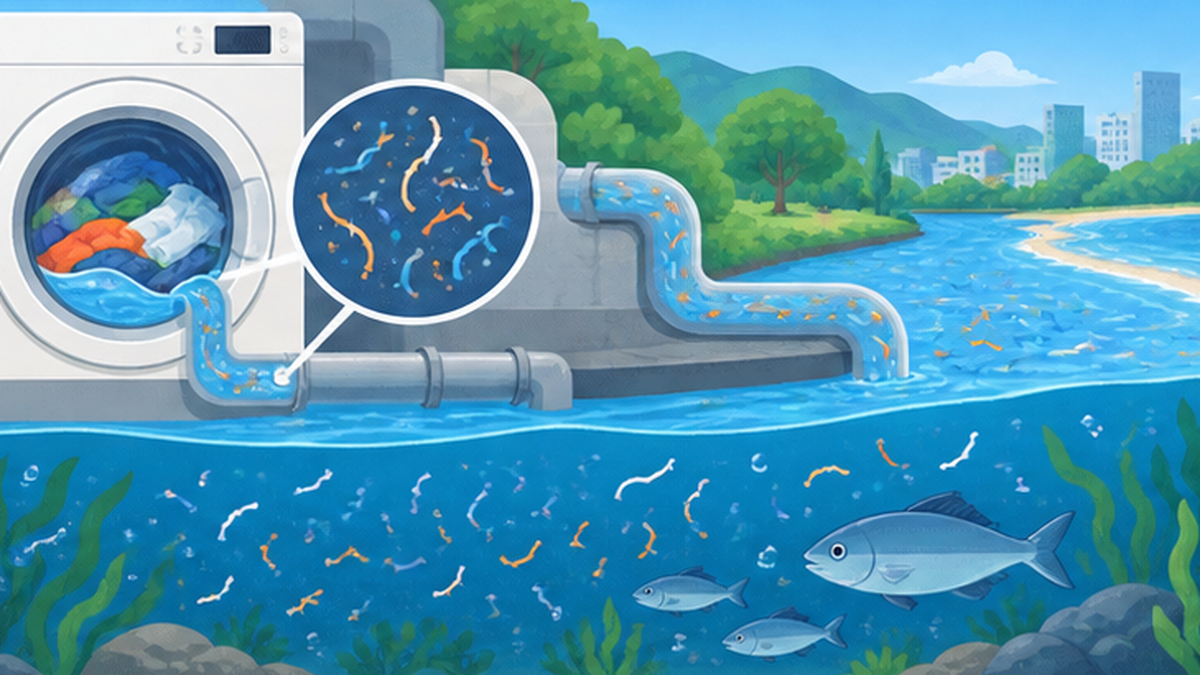
Effects on marine life
It has been pointed out that tiny plastics in the sea are taken up by plankton and small fish and may spread through the food chain. The extent of the impact is still being researched, but "not releasing" and "reducing" them are precautionary measures.
How to view the link between RE.UNIQLO and the ocean
RE.UNIQLO itself is not a program that directly reduces microfibers. However, using clothes longer, reducing disposal and circulating materials can curb the production and disposal of new synthetic fibers, which can be expected to indirectly reduce the burden on the ocean.
Caution
- Recycled materials do not mean "no microfibers." Recycled polyester also sheds fibers when washed. Material circulation and measures against release during washing need to be considered separately.
Reuse and social contribution: clothing support for refugees and disaster victims
Sorting collected clothes into 18 categories for delivery
In UNIQLO's collection program, clothes that can still be worn are sorted, taking into account differences in season, gender, size, climate, culture and religion, into18 categories and delivered to refugees, disaster victims and others. Rather than simply "sending used clothes," it is characterized by matching the circumstances of the recipients.
Shortage of children's and baby clothes
In the collection campaign held from October 15 to November 30, 2021, discount coupons were offered for returning HEATTECH innerwear (200 yen per item, up to 1,000 yen) and down wear (1,000 yen per item), and the public was told thatabout 1 million items were lacking of the children's and baby clothes needed for refugee support.
In addition, from September 2022 a project began, in cooperation with the UN High Commissioner for Refugees (UNHCR), to support Rohingya refugee women in Bangladesh.
Priority of reuse versus recycling
In the thinking of resource circulation, the basic order is Reduce first, Reuse next, and Recycle last. Reuse, which uses clothes as they are, takes less processing energy than recycling and is a lower-impact option.
How to read corporate initiatives
Three checkpoints when reading figures
- What is the reduction measured against?: Is the comparison basis stated, such as "compared with making it from crude oil"?
- What is the scope?: Japan only or worldwide? Specific products only or all products?
- The gap between target and result: How should we view the gap between the target of about 50% by FY2030 and progress of 18.2% in FY2024?
Look at both strengths and challenges
RE.UNIQLO is advanced in practicing clothing circulation at scale. At the same time, challenges remain across the industry, such as how to reduce mass production and mass consumption of clothing itself, and how much of the collected clothing can be returned to clothing.
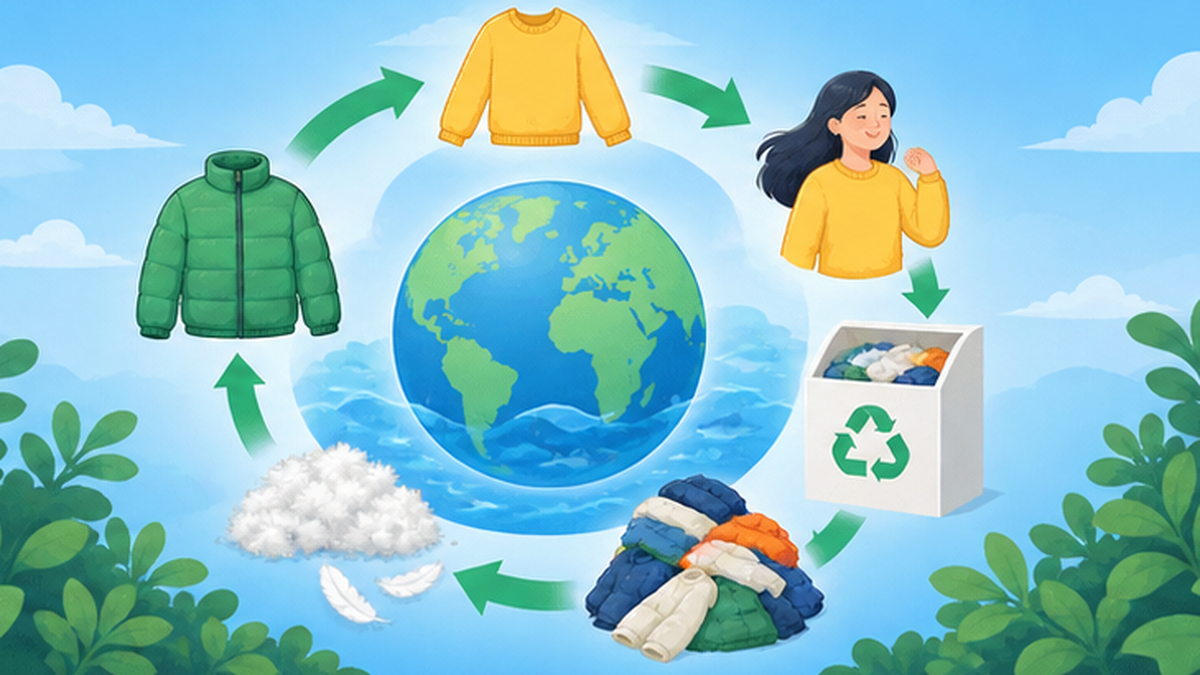
For readers interested in the marine environment, what matters is not deciding "which company is good," buthow the whole life cycle of clothing connects to the oceanand applying that to your own choices. Related to this, it also helps to look at examples ofproducts made from reused ocean plastic.
What we can do: how we live with clothes
Three stages: before buying, while wearing, when letting go
- Before buying: Consider whether you really need it, whether the quality lasts, and whether it goes with what you own
- While wearing: Reduce fiber release by using laundry bags and reviewing wash frequency, and care for clothes to wear them longer
- When letting go: First give away or sell, then use reuse/recycling channels such as in-store collection, and throw away as trash only as a last resort
Notes on using in-store collection
Each brand has its own eligible products and conditions for collection. The degree of stains or tears, excluded items and whether coupons are offered change over time, so check the latest information on the official website before using it.
What you can do from today
- 1. Check clothes in your closet you haven't worn for over a year.2. Give away, sell or take wearable clothes to collection.3. Use a laundry bag for synthetic-fiber clothes.
Summary: circulating clothes is a choice that protects the ocean
RE.UNIQLO connects collected clothes to reuse and recycling and puts a "clothes-to-clothes" cycle into practice. Recycled down made from 620,000 down items in Japan and the use of recycled PET polyester are concrete examples of using resources carefully.
At the same time, the share of recycled materials is still progressing toward its target, and the national goal of reducing clothing waste is only halfway there. Learning about corporate initiatives, checking figures and scope, and reviewing our own relationship with clothes lead to both resource circulation on land and conservation of the marine environment.
Summary of this article
- RE.UNIQLO is a clothing collection and circulation initiative that developed from the 2006 program.
- From 620,000 collected down items came a recycled down jacket reusing 100% of the down and feathers.
- About 560,000 tonnes of clothing are released and discarded in Japan each year, which is not unrelated to the ocean microfiber problem.
- Read figures by checking "reduction compared with what" and "how far the scope extends."
References and sources
- UNIQLO press release (September 2020): Recycled Down Jacket – 620,000 items collected, recycled down, price, collection sites
- UNIQLO press release (October 2021): collection campaign – HEATTECH and down collection, and refugee support
- UNIQLO Sustainability (Roundtable) – Recycled-material target and progress
- Business Insider Japan: explainer on UNIQLO's recycling – Background of RE.UNIQLO and recycled polyester
- Ministry of the Environment: Sustainable Fashion – Estimates of clothing supply and disposal, and government target
- IUCN Primary microplastics in the oceans (2017) – Sources of primary microplastics
- UNHCR Japan – Official information on refugee support
- UNIQLO official site (Sustainability) – Check the latest initiatives and collection conditions
* Listed in order of reliability: government and academic institutions > peer-reviewed papers > specialist organizations > reliable media