⚡ In short
In 2019 Japan withdrew from the IWC and resumed commercial whaling after 31 years. This article organizes the moratorium's history, the resource management method, differences with Norway and Iceland, and the economics of whale meat versus whale watching.
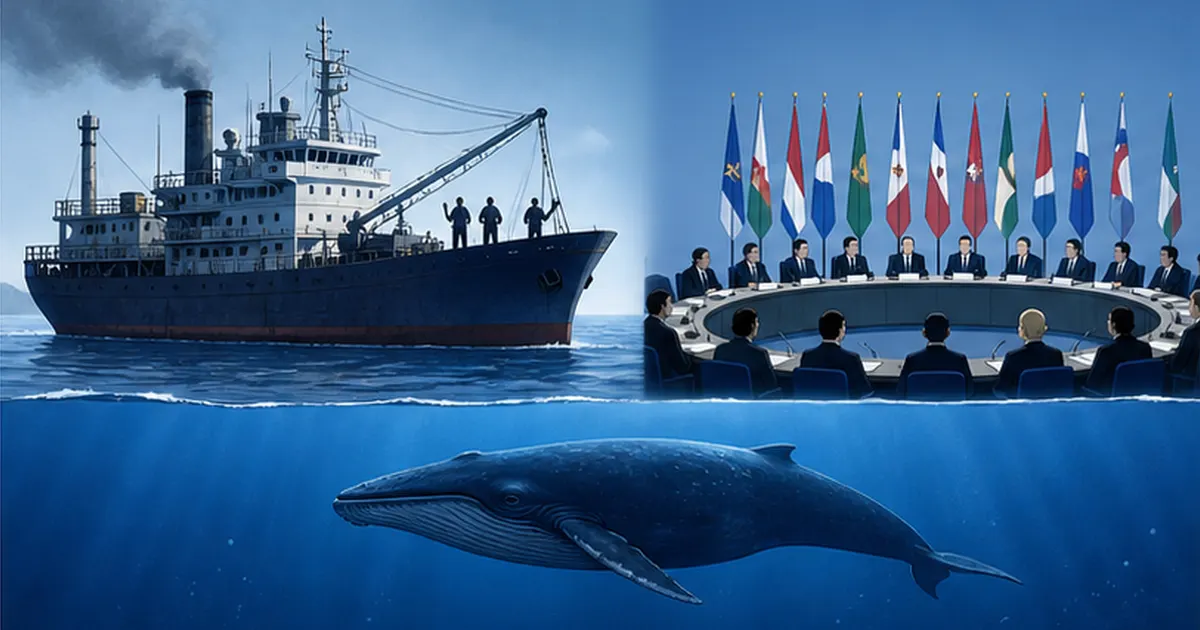
On July 1, 2019, Japan resumed commercial whaling for the first time in 31 years. The move came together with a decision to withdraw from the International Whaling Commission (IWC). The story is often framed as "Japan versus the world," but in reality it is a tangle of resource-management science, international political power balances, and differing cultural and ethical views on how whales should be regarded.
The conflict over whaling did not begin recently. The IWC, established in 1946 to balance resource protection with the orderly development of the whaling industry, changed character sharply from the 1970s onward as anti-whaling countries joined one after another, and in 1982 it adopted a moratorium suspending commercial whaling altogether. Japan kept pressing for science-based resource management within this framework, but after its reform proposal was rejected in 2018, it chose to withdraw.
Norway, meanwhile, has continued commercial whaling, while Iceland, long a whaling nation, decided to halt it from 2024 onward. Worldwide, whale watching — a "use by viewing" — has grown into an industry worth more than $2 billion a year, while whale meat consumption within Japan has fallen to under 1% of its peak. This article organizes the history, institutions, and figures behind the whaling debate based on primary sources, aiming for as neutral a view as possible of the structure of the conflict.
What you'll learn in this article
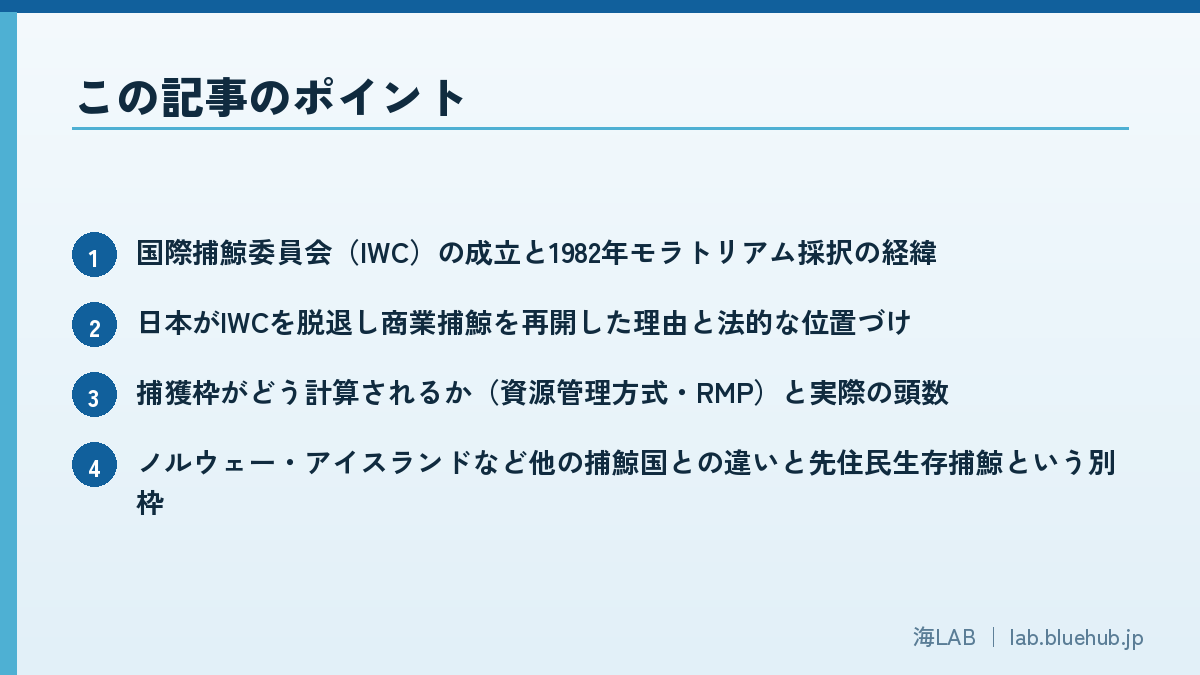
- How the International Whaling Commission (IWC) was formed and how the 1982 moratorium was adopted
- Why Japan withdrew from the IWC and resumed commercial whaling, and its legal basis
- How catch limits are calculated (the Revised Management Procedure, or RMP) and the actual numbers caught
- How Japan differs from other whaling nations like Norway and Iceland, and the separate category of aboriginal subsistence whaling
- The sharp decline in whale meat consumption and the economic scale of the whale-watching industry, a "use by viewing"
- Why the conflict over resource management, animal welfare, and culture remains unresolved
The History of Whaling and the Founding of the IWC
Whaling itself has been practiced around the world since ancient times, but once whaling cannons and factory ships appeared in the 20th century, catch numbers rose sharply. The overhunting of large whales such as blue whales in the Southern Ocean was especially severe, reducing several stocks to the point where they could no longer sustain themselves.
Modern whaling and the collapse of whale stocks
In the 1930s, tens of thousands of whales a year were caught in the Southern Ocean alone, with overhunting proceeding in the absence of any resource-management framework. A "first come, first served" dynamic, in which countries competed to increase their catches, threatened the sustainability of whale stocks. Because multiple whaling nations operated in the same waters at the time, even if one country exercised restraint, stocks would keep declining as long as others increased their catches — a structure resembling a "tragedy of the commons," and one reason an international management framework later became necessary.
Blue whales in the Southern Ocean in particular saw their numbers collapse rapidly in the first half of the 20th century as whaling cannons and factory-ship whaling (in which whales are processed at sea aboard a mothership) spread, and some stocks are said to have effectively collapsed as a resource. This led the whaling industry to shift its targets to fin whales and then to the smaller minke whale, and these differences in stock status by species continue to shape today's debate.
For the Western nations that were the main whaling powers at the time, whales were primarily a source of whale oil — used for lamp fuel, margarine, and soap — and whale meat was not necessarily the main objective. As petroleum-based chemical products and vegetable oils spread, demand for whale oil fell and large-scale Western whaling operations shrank rapidly. In Japan, by contrast, whale meat became a valued source of animal protein amid severe postwar food shortages — a difference in how whales were used from country to country and region to region that carries through to the differing positions seen today.
The purpose of founding the IWC in 1946
Against this backdrop, the International Convention for the Regulation of Whaling was adopted in 1946, and the International Whaling Commission (IWC) was established the following year under it. The convention's preamble sets out the goal of "providing for the proper conservation of whale stocks and thus making possible the orderly development of the whaling industry," and the organization was originally intended to balance resource protection with the survival of the whaling industry. Its founding members were mainly countries that whaled, and it initially functioned largely as a fisheries-management body deciding catch quotas by species.
Today more than 90 countries and territories belong to the IWC, including not only whaling nations but also landlocked countries and small island states that do not whale. While this broader membership has value for building international consensus on resource management, whaling nations have repeatedly questioned a structure in which the votes of countries with no direct stake in whaling can determine the outcome.
How the character of the IWC has changed
- At its founding, the membership was centered on whaling nations
- From the 1970s onward, anti-whaling countries joined one after another
- Because decisions are made by majority vote based on membership, changes in the composition of members heavily sway outcomes
- The IWC now has more than 90 member countries and territories, many with no direct stake in whaling
Why Was the 1982 Commercial Whaling Moratorium Adopted?
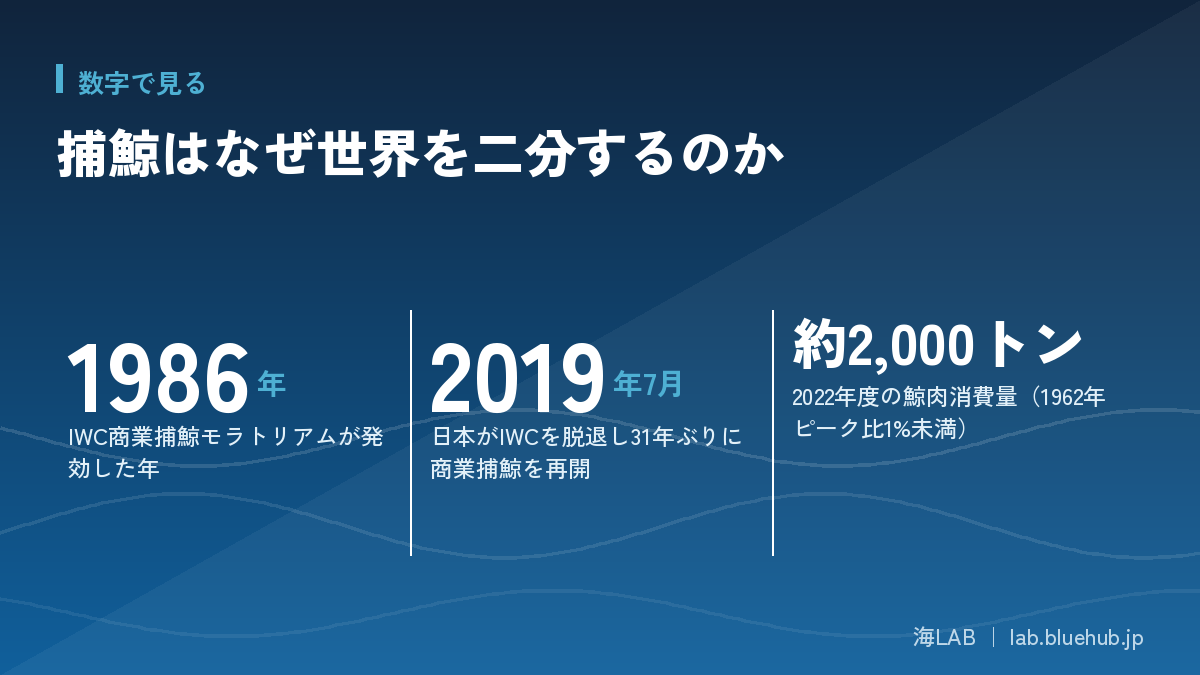
At the IWC's 34th Annual Meeting in 1982, a proposal to reduce commercial whaling catch limits for all whale species to zero in stages was put to a vote and passed 25 in favor, 7 against, and 5 abstentions. It took effect from the 1986 whaling season, and Japan, Norway, Peru, and the Soviet Union (as it then was) all filed formal objections.

The dynamics behind the rise of anti-whaling nations
Behind the adoption of the moratorium lay the international spread of the environmental movement from the 1970s onward, and the entry of new IWC members opposed to whaling. Because IWC business is decided by majority vote among member countries, the growing number of non-whaling and anti-whaling nations was directly reflected in voting outcomes.
The "condition" of scientific stock assessment
The moratorium came with a condition: a comprehensive assessment of whale stocks would be carried out by 1990, and the moratorium would be reviewed based on its results. Japan repeatedly invoked this condition to call for resuming commercial whaling of species whose stocks had recovered, but no agreement was ever reached at the IWC's annual meetings.
Part of the reason lies in the fact that the IWC has two layers of decision-making: the Scientific Committee and the plenary meeting. The Scientific Committee is a body of experts that assesses the state of whale stocks and has developed tools such as the Revised Management Procedure (RMP), but whether its recommendations are reflected in actual catch limits ultimately rests with the plenary meeting, where the decision is made through a political vote among member states. Japan has consistently argued that "scientific assessment and political decision-making have become disconnected," while anti-whaling countries have held firm to a precautionary stance.
In fact, the IWC Scientific Committee itself completed the RMP in the 1990s and, for some species and stocks, indicated that sustainable catches would be possible. However, the plenary meeting never reached agreement on the detailed rules needed to apply the RMP to actual catch limits — the so-called Revised Management Scheme (RMS) — leaving a long-running, effectively "suspended" situation in which a scientifically completed management method could not keep pace with political consensus-building. This impasse is the direct backdrop to Japan's eventual decision to withdraw.
The moratorium was not only about endangered species
The moratorium was a blanket suspension applied to all whale species regardless of their stock status, and it also covered species such as the minke whale, whose stocks are considered relatively abundant. This "one-size-fits-all suspension regardless of species" has been a central point of rebuttal from whaling nations including Japan.
Japan's Withdrawal from the IWC and Resumption of Commercial Whaling (2019)
At the IWC's 67th Annual Meeting in September 2018, Japan put forward a reform proposal centered on science-based resource management and a limited resumption of commercial whaling, but it was rejected 27 in favor, 41 against, and 2 abstentions. Following this result, the Japanese government formally decided at a Cabinet meeting on December 25 of that year to withdraw from the IWC, and notified the IWC of its withdrawal on December 26.
From the rejection of the reform proposal to the decision to withdraw
| Timing | Event |
|---|---|
| September 2018 | Japan's reform proposal rejected at the IWC meeting (27 in favor, 41 against, 2 abstentions) |
| December 25, 2018 | Cabinet formally decides to withdraw from the IWC |
| December 26, 2018 | Formal notification of withdrawal sent to the IWC |
| June 30, 2019 | Withdrawal from the IWC takes effect |
| July 1, 2019 | Commercial whaling resumes within Japan's territorial waters and exclusive economic zone (EEZ) |
Domestic reaction and public opinion
The decision to withdraw from the IWC and resume commercial whaling was met with a relatively muted response at home. Some opinion surveys found not only voices actively supporting the resumption but also a fair number of responses along the lines of "I don't know much about it" or "I'm not very interested" — reflecting the fact that whale meat consumption had already faded from daily life. For the government and the fisheries industry, securing a sovereign right to manage resources appears to have carried more policy weight than the intensity of public opinion.
The rule of resuming whaling only within the 200-nautical-mile zone
Crucially, the commercial whaling Japan resumed is limited to its own territorial waters and EEZ. The "research whaling" (such as JARPA and JARPN) that had previously been conducted in the Southern Ocean and the high seas of the northwest Pacific ended with the IWC withdrawal. In other words, post-withdrawal Japanese whaling amounts to a trade-off: giving up operations on the high seas in exchange for switching to commercial whaling within its own waters.
"Research whaling" and "commercial whaling" are not the same thing
Before withdrawing from the IWC, Japan had conducted whaling for scientific research purposes (research whaling) in the Southern Ocean and elsewhere, using an exception clause in the moratorium. This included a case in which the International Court of Justice (ICJ) ruled part of the program unlawful in 2014. After withdrawal, this framework itself ended, and Japan now conducts only commercial whaling within its own waters.
The impact of the International Court of Justice ruling
In 2010, Australia brought a case to the ICJ arguing that Japan's Southern Ocean research whaling program (JARPA II) was effectively commercial whaling and violated the International Convention for the Regulation of Whaling. In its March 2014 ruling, the ICJ found that the grounds for justifying the Southern Ocean research whaling program as being for scientific purposes were insufficient, and ordered Japan to revoke existing permits and refrain from issuing new ones. Japan accepted the ruling, suspended Southern Ocean research whaling, and then carried out a redesigned research whaling program (NEWREP-A), but ended this framework altogether upon withdrawing from the IWC.
The decision to withdraw drew criticism from Australia, New Zealand, and environmental NGOs, among others, while Japan's Fisheries Agency has explained its position as one of "completely withdrawing from whaling in the Southern Ocean and on the high seas, and by limiting operations to its own 200-nautical-mile zone, actually choosing a path that reduces international friction." Indeed, diplomatic tension over Southern Ocean whaling receded substantially after the withdrawal.
Key points of the ICJ ruling (March 2014)
- Found the grounds for justifying the lethal research methods used in the Southern Ocean research whaling program (JARPA II) as scientific were insufficient
- Ordered Japan to revoke existing permits and refrain from issuing new ones
- Did not rule the treaty itself or whaling in general unlawful — the judgment concerned the propriety of how that particular program was operated
How Are Catch Limits Set? The Revised Management Procedure (RMP)
Since resuming commercial whaling, Japan calculates a total allowable catch (TAC) for each whale species based on stock surveys, guided by the concept of the Revised Management Procedure (RMP) developed by the IWC. A key feature of the RMP is that it builds in the margin of error in stock estimates and sets large safety margins so as not to reduce populations.
How the RMP works and its safety margins
- Sighting surveys and other methods are used to estimate the stock size (population) of each whale species
- A formula that accounts for estimation error and future uncertainty is used to calculate the allowable catch
- If a stock is judged to be declining, the catch limit is pushed toward zero
- Each year's actual catch is factored in when reviewing the following year's limit
Actual catch numbers, 2023-2025
According to Fisheries Agency and Institute of Cetacean Research data, the 2023 catch totaled 187 Bryde's whales, 142 minke whales, and 24 sei whales. In 2024, a TAC of 25 sei whales was set, and 25 were caught. The catch is limited to three species considered to have relatively abundant stocks — minke, Bryde's, and sei whales — while species such as humpback and blue whales, whose stocks are still considered to be recovering, are excluded.
In managing catch limits, mothership whaling (operations off Hokkaido and the Tohoku coast conducted by the Kangei Maru) and coastal small-type whaling (operations based at ports around the country such as Abashiri, Ayukawa, Wada, and Taiji) are managed separately by target species, season, and fishing ground. Mothership whaling focuses mainly on sei and Bryde's whales, while coastal small-type whaling centers on minke whales, and each region's landing record also factors into how catch limits are allocated.
This framework does more than simply set "how many may be caught" — it also clarifies where responsibility lies for each vessel, fishing method, and sea area. A system of individual identification and tracking through DNA registration and similar measures has been established for landed whales to prevent illegal or unreported catches, forming a management regime designed to prevent improper mixing at the distribution stage.
Only three whale species may be caught
- Minke whale (Okhotsk Sea / northwest Pacific stock)
- Bryde's whale (northwest Pacific)
- Sei whale (northwest Pacific)
| Year | Catch (approximate total for the three species) | Key events |
|---|---|---|
| 2019 | Around 200 | First year after resuming commercial whaling; catch limit ceiling set at 227 |
| 2023 | Bryde's 187, minke 142, sei 24 | Both coastal and mothership operations become established |
| 2024 | 25 sei whales caught against a TAC of 25 | New mothership Kangei Maru enters service and begins operating |
How to view the relationship between catch limits and stock size
Supporters of continued whaling argue that because the RMP is an internationally developed, conservative management method, catch limits calculated according to it will not harm stocks. Others point out that stock estimates from sighting surveys inherently carry a degree of error, and that factors such as shifts in the distribution of prey species due to climate change may not be fully captured by the model. Rather than looking only at the catch limit figures themselves, understanding the calculation method and underlying assumptions is essential to evaluating this issue.
Whaling Nations Worldwide: Norway, Iceland, and Aboriginal Subsistence Whaling
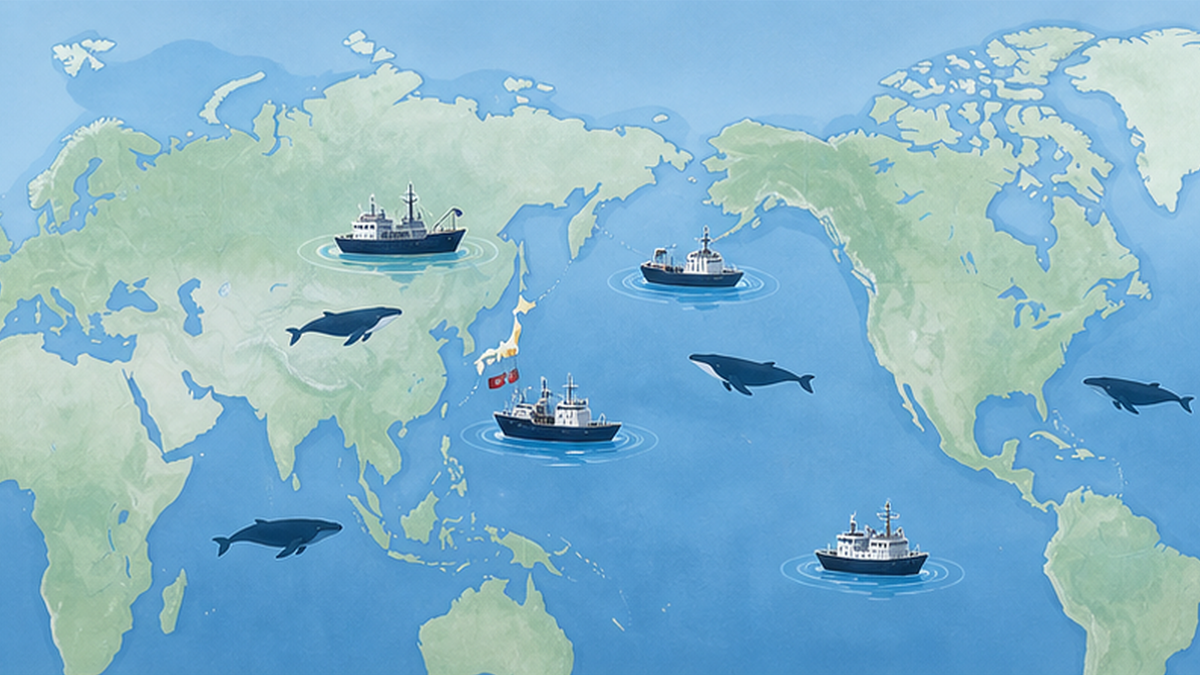
Japan is not the only country still conducting commercial whaling. Norway continues commercial whaling targeting minke whales in the North Atlantic, while Iceland, long a whaling nation, has changed course. The IWC framework also includes a separate system distinct from commercial whaling: "aboriginal subsistence whaling."
Norway: continuing at a shrinking scale
Norway's whaling fleet has shrunk from 350 vessels in 1949 to around 18 today, but the country has maintained its formal objection to the moratorium and continues commercial minke whaling based on its own stock assessments. Whaling is small relative to Norway's fishing industry as a whole, with cod fishing serving as its main source of income.
Iceland: halting whaling from 2024
Iceland saw effectively no fin whale catches between 2019 and 2021, and only one minke whale caught, leaving whaling in a largely dormant state. The government explained that there was "little evidence" that continuing whaling from 2024 onward would bring any economic benefit, and shifted course, citing falling demand, including a shrinking export market to Japan.
Aboriginal subsistence whaling, a separate category
Separately from commercial whaling, the IWC grants certain catch quotas for "aboriginal subsistence whaling" carried out by indigenous peoples in Alaska (United States) and Chukotka (Russia) as part of their traditional way of life. This is intended not for commercial purposes but for personal consumption and cultural continuity, and is treated as exempt from the moratorium. Inupiat communities in Alaska hunt bowhead whales, while indigenous people on the Chukotka Peninsula hunt gray whales, each under catch quotas of several dozen animals. Within Japan, too, coastal small-type whaling in places such as Taiji has long been positioned as a local livelihood and culture dating back to the Edo period.
South Korea: the controversy over "bycatch"
South Korea accepts the IWC moratorium, and whaling for commercial purposes is prohibited. However, the sale of whales caught incidentally as "bycatch" in fishing nets is permitted, and a certain number of minke whales in particular are distributed as meat this way. Conservation groups both in South Korea and abroad have raised suspicions that catches described as bycatch may in fact be substantive hunting, and have criticized the exception as functioning as a loophole in an otherwise banned commercial whaling regime.
The Faroe Islands' pilot whale drive hunt, a different issue
In the Danish territory of the Faroe Islands, a traditional drive hunt known as the "grind" continues, in which pilot whales — not the baleen and sperm whales that fall under IWC management — are herded into shallow coastal water and killed. Because pilot whales are taxonomically closer to dolphins, the hunt falls outside IWC regulation, but images of shallows turning red with blood have repeatedly drawn international criticism, illustrating how the whaling debate can take different shapes depending on species classification and local culture.
The Case Against Whaling: Animal Welfare, Ecosystems, and Protest Movements
The arguments made against whaling are not limited to a single line of reasoning. Alongside concerns about resource management, they include animal-welfare concerns over killing an animal considered highly intelligent, a view that emphasizes the ecological role of whales, and differences in cultural and ethical values.
Criticism from an animal welfare perspective
Anti-whaling groups make it a central criticism that killing methods may cause whales significant suffering. Whaling nations counter that improvements in slaughter technique have raised the rate of instant death, and this remains a point on which the two sides' arguments tend to run in parallel without converging.
A history of obstruction and protest
Since the 1970s, international environmental NGOs such as Greenpeace and Sea Shepherd have carried out protest activities against whaling vessels. Sea Shepherd in particular repeatedly obstructed Japan's Southern Ocean research whaling fleet through the 2000s and into the 2010s, with acts such as throwing smoke bombs and chemical-filled bottles, and approaching or pursuing vessels, drawing extensive international media coverage. Some of these actions escalated into physical confrontation with vessels, prompting intervention by law enforcement agencies in various countries. While such direct action has drawn public attention, it has also been noted as a factor that can sharpen confrontation rather than resolve it.
In response to escalating obstruction in the Southern Ocean, Japan strengthened security from fiscal year 2014 onward, including placing Japan Coast Guard personnel aboard its research whaling fleet. Sea Shepherd, for its part, announced in 2017 that it would withdraw from direct obstruction activities in the Southern Ocean, citing financial constraints among other reasons, and has since shifted its focus toward information campaigns and lobbying governments.
It is also worth noting that whaling is not the only human activity that kills whales. Whales accidentally caught in fishing gear as bycatch, and the effects of underwater noise from ships on their lives, have also been highlighted — factors worth keeping in view alongside intentional hunting when weighing the whaling debate.
The ecological role of whales as a point of debate
Whales are thought to play a role known as the "whale pump," circulating nutrients such as iron to the ocean surface through their waste and thereby supporting phytoplankton growth. This ecosystem service is one basis for the argument, put forward by some anti-whaling advocates, that whales should be treated as "assets to be kept alive" rather than "resources to be harvested." The way whales support ocean nutrient cycling through migrations spanning thousands of kilometers is closely related to this debate as well.
The question of cultural relativism
Another factor that makes the whaling debate difficult is that values themselves — over how far, and in what ways, animals may be treated — differ across cultures. Some societies take the raising and slaughter of cattle and pigs for granted, while others believe that animals considered highly intelligent, such as whales and dolphins, deserve special consideration. Whaling nations often push back against having such differing values imposed on them unilaterally as a "universal ethic," while anti-whaling nations argue that animal welfare should not be dismissed as merely a matter of cultural difference. This clash of values is a point that, unlike resource-management debates, is difficult to settle with numbers.
Measuring the Economics: Falling Whale Meat Demand and Whale Watching
Viewed through an economic lens, the whaling debate reveals two contrasting figures: the steep decline in domestic whale meat consumption in Japan, and the scale of the globally growing whale-watching industry.
From a 230,000-ton peak to about 2,000 tons
Domestic demand for whale meat in Japan peaked at roughly 230,000 tons in fiscal 1962, when dishes such as deep-fried whale (ryukyu-age style tatsuta-age) were also a familiar staple on school lunch menus. From the 1970s onward, however, consumption declined as pork and poultry became more widespread, and after the 1988 suspension of commercial whaling it settled at roughly 2,000 to 5,000 tons a year. Consumption in fiscal 2022 stood at around 2,000 tons — below 1% of its peak.
The global whale-watching market
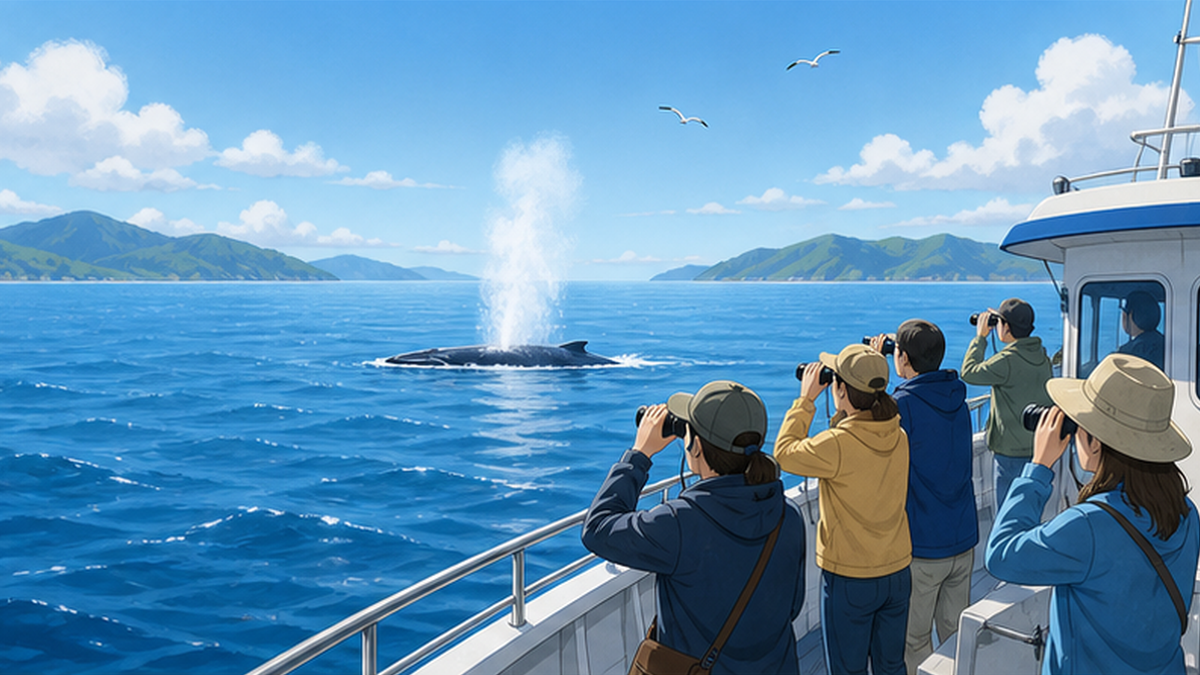
Whale watching — a form of tourism built around "seeing" whales rather than catching them — has continued to grow around the world; a survey by the International Fund for Animal Welfare (IFAW) found roughly 13 million participants a year and revenue exceeding $2 billion (equivalent to hundreds of billions of yen). In some countries and regions that have given up whaling, this tourism demand has become a new pillar of the local economy.
Within Japan, too, whale-watching tours are held in places such as the Ogasawara Islands, Shiretoko, and Okinawa, and have become an established part of the local tourism economy in some areas. Notably, in places like Taiji, both coastal small-type whaling and whale watching take place in the same community — a reminder that "viewing" and "harvesting" are not necessarily an either-or choice, and that some areas are exploring ways to make the two coexist.
The current state of whale meat pricing and distribution
As domestic demand has shrunk, whale meat today is distributed mainly through specialty shops, some supermarkets, hometown tax donation gifts, and online retailers. Once an everyday food, whale meat has seen its price rise relative to its shrinking supply, taking on more the character of a delicacy or regional specialty than a staple food. Kyodo Senpaku and other companies in the industry are working on branding and new product development in response to this situation, but have not managed to significantly widen the underlying demand base.
Comparing two forms of "use"
- Whale meat consumption: shrunk to under 1% of its peak (a structural decline in domestic demand)
- Whale watching: has grown into a global industry with roughly 13 million participants and revenue exceeding $2 billion a year
- Whether to continue whaling is shaped not only by stock status but also by shifting demand trends
The New Mothership Kangei Maru and the Future of Japanese Whaling
Five years after the resumption of commercial whaling, in May 2024 the newly built whaling mothership Kangei Maru — the first new-built mothership in 73 years — entered service. Built as the successor to the aging former mothership Nisshin Maru, it measures roughly 112.6 meters in length with a gross tonnage of about 9,299 tons, and cost an estimated 7.5 billion yen to build. It is operated by Kyodo Senpaku Co., Ltd., Japan's sole mothership whaling company.
The aims behind the first new-built mothership in 73 years
The Kangei Maru uses electric propulsion and has a cruising range of about 7,000 nautical miles (roughly 13,000 km). Through this investment in a new mothership, Kyodo Senpaku aims to improve production efficiency and expand whale meat branding and sales channels, but as noted above, given that domestic demand itself is shrinking, some observers point out that recouping the investment will not be easy. An aging workforce and a shortage of successors are also seen as challenges, meaning the new mothership's entry into service is not merely an equipment upgrade but a crossroads for the whole industry over whether whaling can be passed on to the next generation.
Kyodo Senpaku is a company backed by investment from fisheries firms and fishing-industry organizations, and it operates mothership whaling — the only large-scale form of whaling operation remaining in Japan. Whereas coastal small-type whaling is carried out by small operators around the country, mothership whaling is concentrated in the single vessel Kangei Maru, meaning that this one ship's operating status has an outsized effect on Japan's total whaling output.
Communities like Taiji that carry on whaling culture
In coastal small-type whaling communities such as Taiji in Wakayama Prefecture, whaling has been passed down as a livelihood tied to local history, food culture, and belief systems. When discussing the merits of commercial whaling, the cultural significance it holds for such local communities is an important consideration alongside the resource-management debate, one that cannot be dismissed. Taiji is also home to a museum introducing the history and culture of whaling, part of an ongoing effort to present whaling as part of the town's local identity.
Shimonoseki Port (Yamaguchi Prefecture), the base for mothership whaling, and the coastal small-type whaling ports of Abashiri (Hokkaido), Ayukawa (Miyagi Prefecture), and Wada (Chiba Prefecture) also each have local economies closely tied to whaling. Alongside the Kangei Maru's entry into service, the city of Shimonoseki has stepped up tourism and promotional activities branding itself as a "whaling town," another example of efforts to connect the history of whaling bases to local revitalization.
Between Resource Management and Culture and Ethics
Sorting through the whaling debate shows that the lines of conflict are not singular. There is (1) the scientific question of whether stock levels for each species can tolerate hunting, (2) the animal-welfare and ethical question of how whales should be treated, and (3) the cultural question of tradition and local economies tied to fishing and food culture — issues so tightly intertwined that they cannot be fully captured by a simple "for or against."
Mapping the structure of the conflict
| Issue | Case for continuing whaling | Case against whaling |
|---|---|---|
| Resource management | The three target species have abundant stocks and can be managed via the RMP | Population estimates carry uncertainty, requiring precautionary measures |
| Animal welfare | Improved slaughter technique has minimized suffering | Killing an animal considered highly intelligent is itself problematic |
| Culture and economy | Should be respected as a traditional local livelihood and food culture | Demand has shrunk, leaving little economic rationale |
A perspective on international opinion and diplomatic cost
The whaling issue has affected not only technical resource-management discussions but also international opinion and diplomatic relations. While Japan's IWC withdrawal drew criticism from some countries, others view it as having greatly reduced friction over Southern Ocean operations and diminished its role as a source of diplomatic tension compared with before the resumption. How a country positions whaling is at once a fisheries-resource policy question and a diplomatic judgment that shapes its standing in the international community.
What we can do, and perspectives worth keeping in mind
For anyone interested in the ocean approaching the whaling issue, what matters is not just an emotional for-or-against stance but a willingness to check primary data — stock levels, catch limits, and consumption trends. Understanding how science, politics, and culture intersect around a single animal, the whale, offers a way to think more broadly about ocean ecosystems and how we relate to food. Whether one supports or opposes whaling, starting from primary sources and separating out the distinct issues at stake is a first step toward engaging with this long-running debate.
References and Sources
- Japan Fisheries Agency, "Whaling" – Official information on catch limits and the resource management method
- Japan Fisheries Agency, "The Overall Situation Surrounding Whaling" – Background on the IWC withdrawal and resumption of commercial whaling
- Ministry of Foreign Affairs of Japan, "The Situation Surrounding Whaling" – Diplomatic background to the IWC withdrawal
- Japan Fisheries Research and Education Agency, "FY2024 State of International Fishery Resources: Sei Whale" – Primary data on catch records and stock assessment
- International Fund for Animal Welfare (IFAW), whale-watching information – Scale of the global whale-watching market
- Sasakawa Peace Foundation, Ocean Policy Research Institute, "The IWC Withdrawal and Japan's Whaling" – Background and analysis of the withdrawal
- Nikkei, "Iceland to Halt Whaling" – Reporting on Iceland's policy shift
- International Whaling Commission (IWC) official website – Primary information on the moratorium, membership, and proceedings
* Listed in order of reliability: government and academic institutions > peer-reviewed papers > specialist organizations > reputable media