⚡ In short
Okinawa's dugongs are listed under Japan's most severe endangered category. This article explores the 2024 DNA evidence of survival, the Henoko base dispute, and the decline of seagrass meadows.
A marine mammal still lives in Okinawa's waters that has long been cited as the model for "mermaid" legends. Growing up to 3 meters long, the dugong is one of the world's few fully marine herbivores that feeds exclusively on seagrass, and it is listed in Japan's Ministry of the Environment Red List under the most severe category, "Critically Endangered (IA)."
In April 2024, a joint research team from Ryukoku University and the Okinawa Prefectural Institute of Health and Environment announced that environmental DNA analysis of feces had confirmed dugongs living around Irabu Island in the Miyako Islands for the first time in roughly half a century. It was a discovery that offered a glimmer of hope for a Nansei Islands population long feared to have gone locally extinct.
At the same time, the waters off Henoko in Nago City — an area where dugong feeding trails had once been regularly observed — have become the site of a new US military base landfill project, fueling ongoing debate over the protection of the species' habitat. This article draws on primary sources to explain the dugong's biology, its status as an endangered species, the latest survey results, and the challenges facing its conservation.
What you'll learn in this article
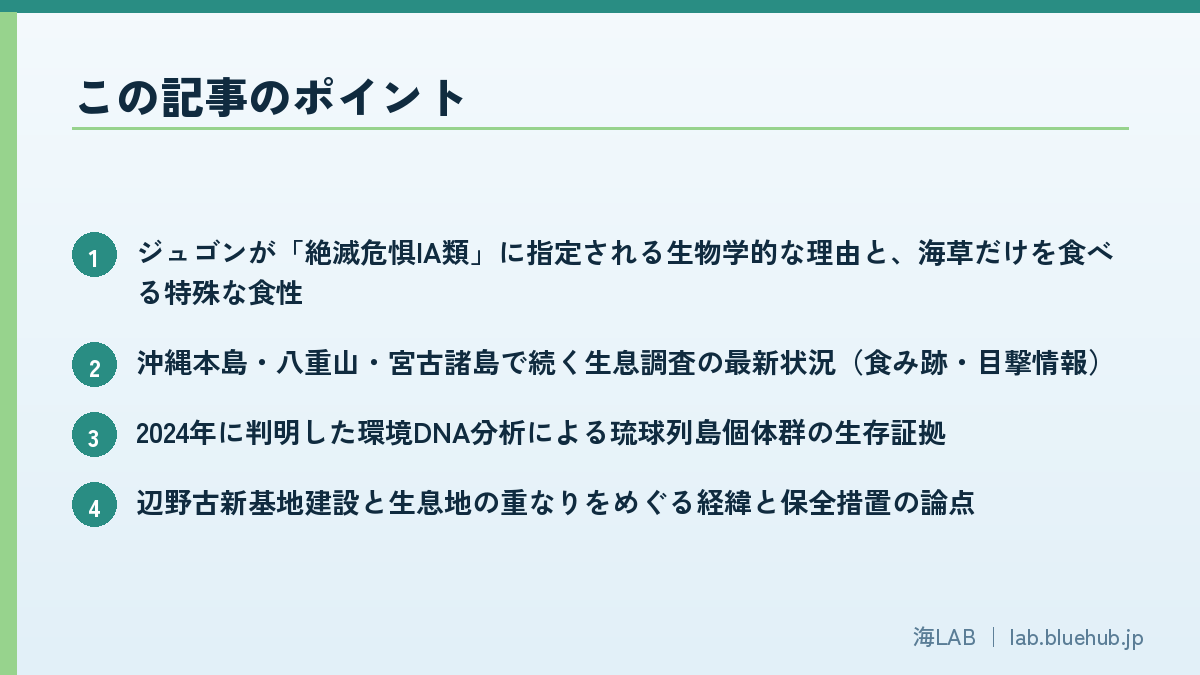
- The biological reasons dugongs are listed as "Critically Endangered (IA)," and their unique diet of seagrass alone
- The latest survey findings (feeding trails and sightings) from Okinawa's main island, Yaeyama, and Miyako Islands
- The 2024 environmental DNA evidence confirming the survival of the Ryukyu Islands population
- The background and debate over conservation measures at the overlapping dugong habitat and the Henoko base construction site
- How the decline of seagrass meadows affects dugongs, and the connection to blue carbon
- What each of us can do, from reporting sightings to supporting conservation
What kind of animal is the dugong?
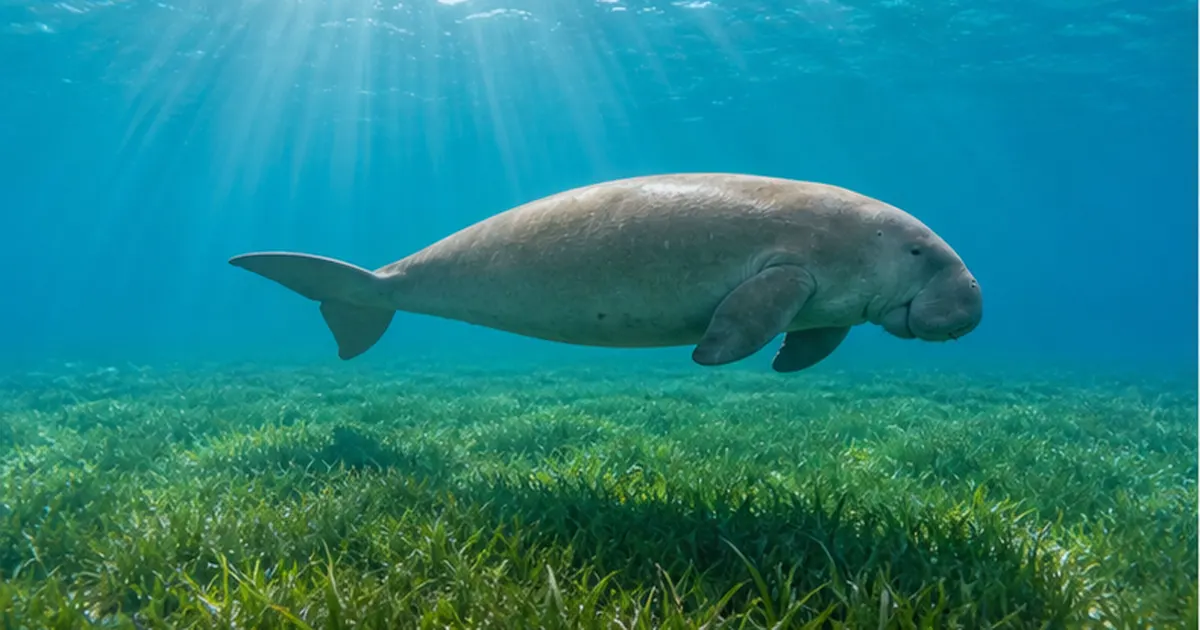
The dugong (Dugong dugon) is the only living species in the family Dugongidae, part of the order Sirenia, which it shares with the three species of manatee. Dugongs measure 2.4–3 meters long and weigh roughly 300–400 kg, with a rounded, spindle-shaped body and a crescent-shaped tail fluke reminiscent of a whale's.
Classification and the Sirenia family
Sirenians are thought to be distantly related to elephants and are divided into the family Dugongidae (one species, the dugong) and the family Trichechidae (three species of manatee: the American, Amazonian, and West African manatees). While manatees also inhabit rivers and brackish water and eat a wide range of plants, dugongs spend their entire lives at sea and feed almost exclusively on seagrass — a major ecological difference between the two groups.
A "marine herbivore" that eats only seagrass
Dugongs feed by uprooting seagrasses such as tape seagrass and spoon seagrass that grow in seagrass meadows. This feeding behavior leaves grooves on the seabed roughly 10–30 cm wide and 1–3 meters long, known as "feeding trails" or "dugong trenches." Because sighting a dugong directly is extremely rare, these trails are the single most important clue for confirming their presence.
Lifespan and reproductive cycle
Dugongs are long-lived, with lifespans around 70 years, but their reproduction is remarkably slow. Sexual maturity takes about a decade, gestation lasts roughly 13–14 months, and calves nurse and stay with their mothers for 2–3 years afterward, so a female typically gives birth only once every 3–7 years. This slow reproductive rate is a major reason why, once numbers decline, recovery takes a very long time.
Why it inspired "mermaid" legends
Dugongs and manatees are widely believed to have inspired mermaid legends because of the way they surface briefly to breathe and cradle their calves with their forelimbs while nursing — behaviors that, glimpsed from a distance, could resemble a human figure. In reality, a dugong's eyesight is not especially well developed; instead, it relies on sensitive whiskers around its mouth and on hearing to locate seagrass beds even in murky coastal waters. This reliance on non-visual senses is an adaptation shared with other marine mammals that navigate dark or turbid waters.
A lesson from the extinction of its relative, Steller's sea cow
Sirenia once included another species: Steller's sea cow, a large animal that lived in the Bering Sea. First recorded by Western science in 1741, it was hunted to extinction within just 27 years, by 1768. The rapid loss of this relative — which reached 7–8 meters in length — is frequently cited today as a historical lesson in how vulnerable slow-breeding sirenians are to human pressure, and it continues to inform dugong conservation policy.
Body structure and adaptation to the sea
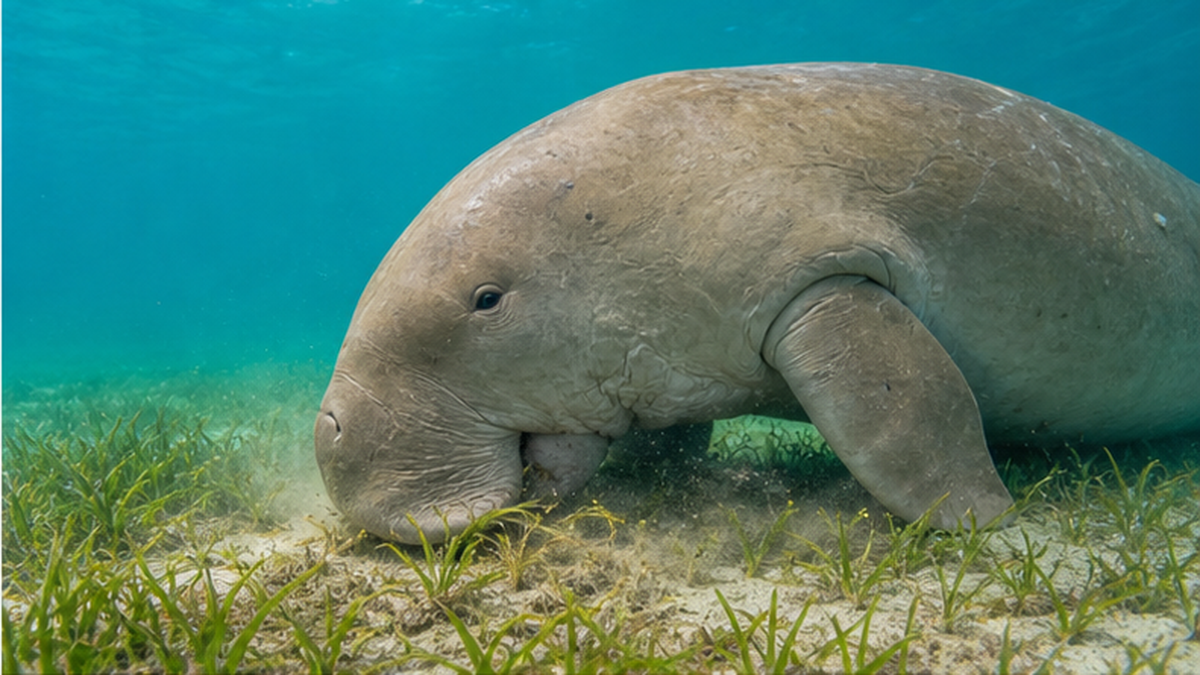
A dugong's nostrils sit on top of its head, allowing it to breathe by barely breaking the surface. Its forelimbs, reduced to flipper-like appendages, are still dexterous enough to sweep seagrass toward its mouth or support a nursing calf. Thick blubber helps it retain heat in cooler waters, but dugongs generally prefer warm coastal waters above about 20°C, which confines their range almost entirely to shallow tropical and subtropical seas. This strong dependence on water temperature is itself one of the factors limiting where dugongs can live.
Dugongs in Okinawan culture
In Okinawa, the dugong has long been called "zan" and cherished as a symbol of the sea's abundance and good fortune in fishing. The Yaeyama region even has a place name, "Zan no Hama" (Dugong Beach), along with folktales and traditions centered on the animal. Rather than being seen purely as a rare wild species, the dugong has historically been woven into local culture and belief — a connection that helps today's conservation efforts find local understanding and support.
Why is it listed as Critically Endangered (IA)?
The dugong's risk of extinction varies greatly by region. Globally, the IUCN (International Union for Conservation of Nature) Red List classifies the species as "Vulnerable" (2015 assessment), and relatively stable populations remain in places such as northern Australia and the Persian Gulf. However, some regional populations — including those in East Africa and parts of East Asia — have been locally assessed as "Critically Endangered" or even "extinct," and the population inhabiting Japan's Nansei (southwestern) Islands, including the Ryukyu Islands, falls into this most severe category.
The IUCN Red List assessment
The IUCN reassesses dugongs by regional population, and the Nansei Islands population is considered to have extremely few individuals, placing it on the brink of viability as a population. There is no comprehensive global population estimate, but regional populations range enormously, from a few dozen to tens of thousands of individuals, with declines being most severe in areas where coastal development has advanced furthest.
Its designation within Japan
Within Japan, the dugong is listed under the most severe category — "Critically Endangered (IA): species facing an extremely high risk of extinction in the wild in the very near future" — in both the Ministry of the Environment's Red List and Okinawa Prefecture's "Red Data Okinawa." It is also listed on Appendix I of the Convention on International Trade in Endangered Species (CITES), which effectively bans international trade. In October 2021, it was further designated a "Designated Rare Wild Species" under Okinawa Prefecture's Rare Wildlife Protection Ordinance, making capture, killing, and transfer subject to regulation.
| Assessment | Scope | Status |
|---|---|---|
| IUCN Red List (global) | Dugong dugon, entire species | Vulnerable (2015 assessment) |
| IUCN Red List (regional population) | Nansei Islands (Japan) population | Equivalent to Critically Endangered |
| Ministry of the Environment Red List / Red Data Okinawa | Domestic population | Critically Endangered (IA) |
| CITES | International trade | Appendix I (trade effectively banned) |
How it differs from populations elsewhere in the world
While populations in Australia and the Persian Gulf remain in the thousands to tens of thousands, the population around Okinawa has, for many years, been estimated at only a handful to a few dozen individuals based on sightings. The smaller and more scattered a population is, the greater the relative impact any single threat — such as bycatch or habitat loss — has on the population as a whole.
The dugong's past status in the Ryukyu Islands
Records from shortly after World War II suggest that extensive seagrass meadows once lined the coasts of Okinawa's main island and the Yaeyama Islands, and dugong sightings were more frequent than they are today. However, as coastal landfill and port development accelerated during Japan's postwar economic boom, and as red-soil runoff increased, the areas where dugongs could be confirmed gradually narrowed. The fact that today's confirmed habitats are concentrated in the northern part of Okinawa's main island and parts of Yaeyama and Miyako reflects more than half a century of change in the coastal environment.
What the Red List assessment criteria show
The IUCN criterion applied here, "A2bcd+4bcd," combines the rate of population decline — past or projected — with its underlying causes, such as habitat degradation, overharvesting, and pollution. The resulting classification reflects overall trends for the species as a whole; for regional populations like the Nansei Islands group, where numbers are in the single or low double digits, the assessment is understandably placed in a more severe category than the global one. Japan's "Critically Endangered (IA)" designation accurately reflects just how dire the situation facing dugongs in the country has become.
The latest population surveys in Okinawa (fiscal 2020–2025)
Okinawa Prefecture launched its dugong conservation project in fiscal 2016 and has continued population surveys jointly with the Ministry of the Environment ever since. Surveys combine visual observation with searches for feeding trails on the seabed, automatic cameras, drones, and interviews with local fishers.
Seven priority sea areas surveyed jointly by Okinawa Prefecture and the Ministry of the Environment
The surveys have designated seven priority sea areas for confirming dugong presence, including the waters around Kouri and Yagaji islands off Nago City, around Izena Island, Iriomote and Kuroshima in the Yaeyama Islands, and Irabu, Kurima, and Ikema islands in the Miyako Islands. Feeding trails were confirmed across several of these areas during fiscal 2020–2022. In its fiscal 2025 survey, the Ministry of the Environment reported feeding trails found across six sea areas — Yagaji in Nago City, Ishigaki, Iriomote, and Irabu — and an automatic camera in Nagura Bay in northern Ishigaki Island recorded the tail fin of a large animal believed to be a dugong.
What feeding trails ("dugong trenches") reveal
Because direct sightings of dugongs are exceedingly rare, most surveys rely on the presence or absence of feeding trails. A fresh trail has clean, white-cut edges on the surrounding seagrass, which become less distinct over time as the grass regrows around it. This condition allows researchers to roughly estimate when — and how frequently — a dugong has used a given area.
| Fiscal year | Key findings | Sea areas |
|---|---|---|
| FY2020 | Feeding trails confirmed in multiple areas | Izena Island, Iriomote Island, and others |
| FY2021 | Feeding trails confirmed at Izena, Iriomote, Kuroshima, Irabu, Kurima, and Ikema islands | Miyako and Yaeyama islands |
| FY2022 | Feeding trails confirmed in multiple areas through continued surveys | Around Nago City, Miyako and Yaeyama islands |
| FY2025 | Feeding trails found in six sea areas; a large animal's tail fin recorded by automatic camera in Nagura Bay, Ishigaki | Yagaji (Nago City), Ishigaki, Iriomote, Irabu |
What matters most is that feeding trails have been confirmed intermittently in the same sea areas across multiple fiscal years. Rather than reflecting a one-off passage, this pattern suggests a small number of individuals are repeatedly using specific meadows — evidence used to designate these areas as priority "core habitats" for protection.

Collecting sighting reports through the Dugong Portal Okinawa
Okinawa Prefecture and the Ministry of the Environment jointly operate the "Dugong Portal Okinawa" website, which publishes sighting reports and feeding-trail survey results dating back to 2010 while continuously accepting new sighting reports from divers, fishers, and other ocean users. The accumulation of these fragmentary reports from the public has proven valuable for identifying key habitats and considering protected areas.
Visit this siteDugong Portal OkinawaThe official site for reporting sightings and viewing survey results from Okinawa Prefecture and the Ministry of the Environment.🔗 biodiversity.okinawaCooperation with local fishers
Fishers working Okinawa's coastal waters interact with the sea on a daily basis, and their observations have contributed significantly to sighting and feeding-trail discoveries that periodic government surveys alone would likely miss. Okinawa Prefecture has built information-sharing relationships with fishing cooperatives and local diving operators, and institutionalizing this "on-the-ground" knowledge has helped improve the accuracy of population assessments.
The 2024 breakthrough: environmental DNA evidence of survival
In April 2024, a joint research team led by Professor Atsushi Maruyama of Ryukoku University's Faculty of Advanced Science and Technology and Director Hiroyuki Ozawa of the Okinawa Prefectural Institute of Health and Environment published findings in the Springer Nature journal Scientific Reports demonstrating that dugongs continue to inhabit the Nansei Islands.
The joint study by Ryukoku University and the Okinawa Prefectural Institute of Health and Environment
The research team combined DNA analysis of feces collected in the field (using PCR testing and sequence analysis) with a review of sighting reports of swimming individuals, drone imagery, dive surveys, and interviews with fishers. As a result, DNA carrying dugong-specific genetic sequences was detected in feces collected along the Kushi coast in eastern Okinawa's main island and around Irabu Island in the Miyako Islands.
Confirmed near Irabu Island for the first time in about half a century
The finding around the Miyako Islands drew particular attention. Records of dugongs in this area had long been absent, making this detection a significant discovery — the first confirmation in roughly half a century. With some observers having suggested since 2019 that the population around Okinawa's main island may have gone locally extinct, this result offered valuable evidence that the Nansei Islands population still persists.
What the possibility of breeding implies
Because DNA was detected across multiple sea areas and at multiple points in time, the research team suggests the animals may not simply be passing through the Nansei Islands but could be breeding in the region. This moves the science beyond simply confirming "traces" of presence and into exploring whether the population itself remains viable.

How environmental DNA is transforming survey methods
Traditional dugong surveys relied heavily on "indirect evidence" — feeding trails and sighting reports — making it difficult to confirm individual animals directly. Environmental DNA analysis detects trace genetic material that organisms leave behind in water or feces, allowing researchers to confirm a species' presence with high accuracy without ever seeing it. The PCR primer set used in this study, which specifically amplifies dugong-specific DNA sequences, was developed through ongoing work by the Ryukoku University research group and holds promise for broader use in monitoring other rare species. Looking ahead, it could help efficiently screen wide sea areas and narrow down where limited budgets and personnel should be focused.
Estimating a very small population
The exact number of dugongs in the Nansei Islands remains unknown, but based on accumulated sighting and feeding-trail surveys, researchers have generally estimated the population at somewhere in the single digits to, at most, the low teens. In a population this small, there is concern about reduced fertility from declining genetic diversity (inbreeding depression), and recovery is thought to require long-term monitoring alongside habitat conservation.
The Henoko base construction and the dugong habitat issue
The waters off Henoko in Nago City, in northern Okinawa's main island, are the site chosen by the Japanese and US governments for a replacement facility for the US Marine Corps' Futenma Air Station — and, at the same time, a sea area where dugongs have long been confirmed to live. This overlap in land and sea use has become one of the central points of contention in dugong conservation.
The habitat before the landfill began
Before boring surveys were conducted in 2004, feeding trails were regularly found in the waters south of Henoko Point. Surveys from that period recorded more than 110 new feeding trails in just two months, underscoring how important this area was as a foraging ground for the animals.
Over 200 detected calls in 2020
After landfill soil deposition began in December 2018, sightings and traces of dugongs in the surrounding waters largely disappeared for a long stretch. However, in 2020, recording equipment placed near the base construction site detected calls believed to be from a dugong roughly 200 times, raising the possibility that an individual was still using the area even amid ongoing construction.
The governor's opinion on conservation measures versus the government's position
Citing concerns over environmental impact from the ongoing landfill work, Okinawa Prefecture has repeatedly called for construction to be halted and the situation reassessed. In the governor's formal opinion on the environmental impact assessment, it was stated that the conservation measures proposed by the project operator (the Okinawa Defense Bureau) would be insufficient to protect the natural and living environment. The national government, meanwhile, maintains that it is "appropriately implementing environmental conservation measures" and has continued construction. This dispute remains unresolved.
Concerns from researchers and conservation groups
Several conservation organizations, including the Nature Conservation Society of Japan (NACS-J) and WWF Japan, have repeatedly submitted requests to the government arguing that construction at Henoko is proceeding without adequately verifying its impact on dugong habitat. Beyond the landfill area itself, experts have called for long-term monitoring of how turbid water, noise, and vibration from construction affect the behavior of dugongs moving through the surrounding waters.
The history of the issue (since the 1990s)
The proposal to relocate Futenma Air Station to the Henoko coast dates back to a Japan–US agreement reached in 1996. In the years since, disputes between the prefecture and the national government over environmental assessment procedures and landfill approval — including litigation — have persisted for a long time. The dugong's habitat remains one of the central environmental flashpoints in this broader base relocation dispute, one that has now continued for more than a quarter century.
The decline of seagrass meadows and its impact on dugongs
The dugong's survival is directly tied to the health of the seagrass meadows it depends on for food. Because of its highly specialized diet of seagrass alone, if a meadow shrinks or disappears, it is only a matter of time before dugongs vanish from that area as well.
The role seagrass meadows play
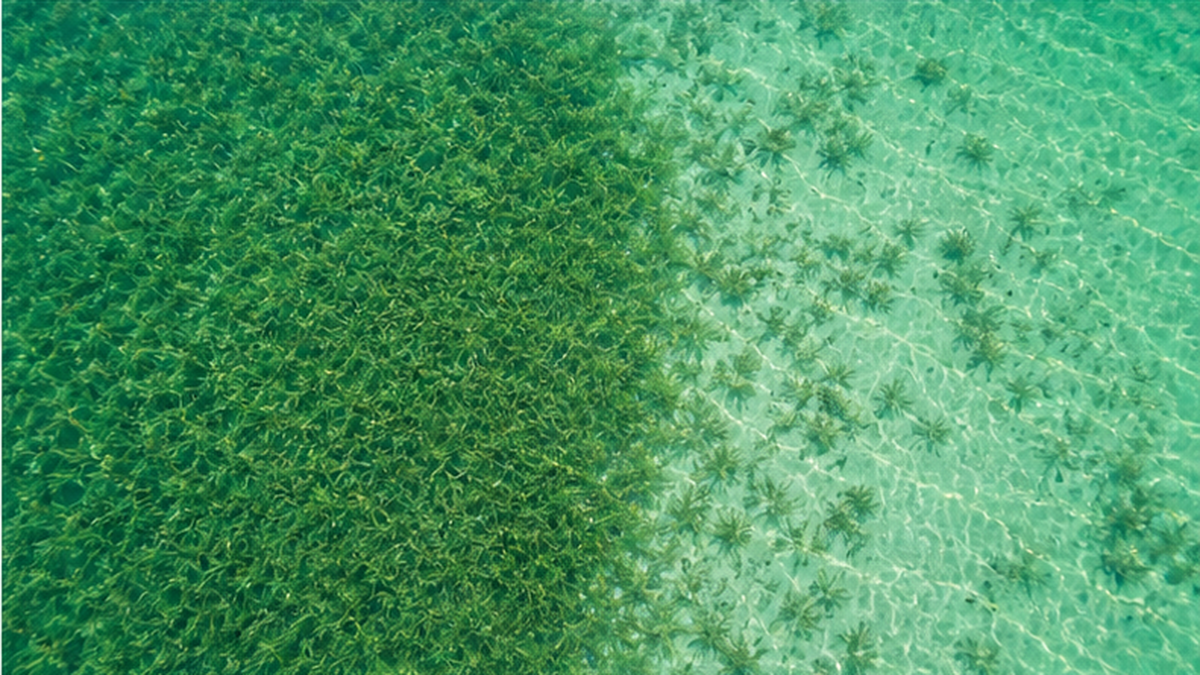
Seagrass meadows are a cornerstone of coastal ecosystems, providing habitat not only for dugongs but also for green sea turtles and many species of fish and crustaceans. Their root systems stabilize seabed sediment, help purify water, and dampen wave energy. For dugongs, meadows serve as both a food source and the very foundation that determines the range in which they can live.
The main causes of decline
Seagrass meadow decline stems from multiple, compounding causes: direct loss from coastal landfill and port development; degraded water quality and clarity from domestic wastewater and red-soil runoff; large-scale disturbance from typhoons; and, more recently, shifts in distribution linked to rising water temperatures. Around Okinawa's main island, the cumulative effect of these factors is believed to have caused localized shrinkage of meadows that once extended much further.
Their value as blue carbon and efforts at restoration
Seagrass meadows have also drawn recent attention as "blue carbon ecosystems," which absorb atmospheric carbon dioxide and store it in seabed sediment over long periods. Restoring and protecting these meadows carries significant value from the standpoint of both dugong conservation and climate action. Related mechanisms are explained in more detail in What Is Blue Carbon? How Mangroves and Seagrass Meadows Store Carbon in the Sea, and Japan's Efforts. The ecological value of seagrass meadows themselves is also covered in The Cradle of the Sea: Biodiversity in Eelgrass Meadows.
Meadow restoration initiatives
Across Okinawa, fishers, NPOs, and research institutions are collaborating on restoration efforts, transplanting seedlings and dispersing seeds into areas where seagrass meadows have been lost. However, transplanting seagrass is even more sensitive to growing conditions — substrate, depth, and wave exposure — than coral transplantation, and achieving a stable success rate remains a challenge. Because dugong conservation and meadow restoration are two sides of the same coin, they cannot be pursued separately from one another.
Differences between Okinawa's main island and outlying islands
The coast of Okinawa's main island is more exposed to urbanization and tourism development, which tends to accelerate meadow decline, while the less densely populated outlying islands of Yaeyama and Miyako still retain relatively extensive meadows in some areas. This difference in how much meadow remains likely explains why recent feeding-trail confirmations have been more common on the outlying islands.
Connections with neighboring ecosystems
Seagrass meadows are often found adjacent to mangrove forests and coral reefs, supporting an "ecological connectivity" through which fish move from juvenile nursery grounds to adult habitats. Conserving dugongs, then, is directly tied to the health of the entire coastal ecosystem — not just the meadows themselves, but the mangroves and coral reefs connected to them. Mangrove forests likewise play a vital supporting role in Okinawa's coastal ecosystems, and taking an integrated approach to protecting seagrass meadows, mangroves, and coral reefs together will only grow more important going forward.
Other threats: bycatch and vessel strikes
Beyond shrinking habitat, dugongs also face direct threats from the overlap between their range and human fishing activity and maritime traffic.
Bycatch in set nets and gillnets
Because dugongs must surface periodically to breathe, they face the risk of becoming entangled and drowning in coastal set nets and gillnets — a threat known as bycatch. For a Nansei Islands population with so few individuals remaining, even a single accidental death can have an outsized effect on the population as a whole. Bycatch is a serious challenge shared globally by marine mammals in general, including whales and sea turtles, and is discussed in more detail in What Is Bycatch? The Scale and Solutions as Whales, Sea Turtles, and Seabirds Get Caught in Nets.
Collisions with vessels
Because dugongs move slowly and favor shallow coastal waters, they also face the risk of collisions with small vessels such as fishing and tourist boats. As coastal development advances and vessel traffic increases, the likelihood of such accidental collisions rises as well.
Water pollution
Domestic wastewater and sediment or fertilizer runoff from farmland degrade the clarity and quality of coastal water, indirectly squeezing the seagrass resources dugongs depend on for food. Addressing this requires action on both coastal development and agricultural land management.
Indirect effects of climate change
Rising sea temperatures also affect the species composition and distribution of seagrass itself. As species less tolerant of warm water decline and are replaced by more heat-tolerant ones — a process of "species turnover" — the quality of meadows dugongs have traditionally relied on may change, potentially reducing foraging efficiency. Intensifying typhoons, which physically disturb meadows, are cited as another indirect risk linked to climate change.
Major threats facing dugongs in Okinawa
- Shrinking or disappearing seagrass meadows (landfill, water quality degradation, red-soil runoff)
- Bycatch in set nets and gillnets
- Risk of vessel collisions
- Water pollution from domestic wastewater and farmland runoff
- Rising water temperatures and intensifying typhoons from climate change
- Reduced genetic diversity due to the population's small size
Conservation measures and what we can do
Okinawa Prefecture and the national government are pursuing dugong conservation through three pillars: surveys, regulation, and public outreach. With so few individuals remaining, even a small reduction in threats can be decisive for the population's continued survival.
Okinawa Prefecture's dugong conservation project (since fiscal 2016)
Okinawa Prefecture has continuously run its dugong conservation project since fiscal 2016, conducting population surveys, collecting and publishing sighting reports, and carrying out public outreach activities. Working in coordination with the Ministry of the Environment, survey results are published annually.
Regulation as a "Designated Rare Wild Species" (October 2021)
In October 2021, the dugong was designated a "Designated Rare Wild Species" under Okinawa Prefecture's Rare Wildlife Protection Ordinance. This makes capture, killing, and transfer subject to regulation, with penalties for violations. At the national level, its listing as "Critically Endangered (IA)" in the Ministry of the Environment's Red List and inclusion in CITES Appendix I similarly place restrictions on international trade.
Challenges in research and monitoring capacity
Surveying a species with as few individuals as the dugong requires specialized researchers and sustained funding. While new technologies like environmental DNA analysis improve survey efficiency, only a limited number of research institutions are equipped to carry it out, leaving the question of how to sustain collaboration among universities, government, and private organizations over the long term as an ongoing challenge.
How ordinary citizens can get involved
What you can do
- Report sightings through the Dugong Portal Okinawa or to Okinawa Prefecture's Nature Conservation Division
- Join coastal cleanups and environmental education events that help protect seagrass meadows
- Share what you learn about dugongs and seagrass meadows with others
- Stay informed about organizations working on conservation, such as WWF Japan, and keep your interest alive
Summary
Because of its highly specialized diet of seagrass alone and its slow reproductive cycle, the dugong struggles to recover once its numbers decline. The 2024 DNA analysis showed that the Nansei Islands population still persists, but challenges remain — from shrinking habitat and bycatch to reconciling conservation with development projects. How we protect the small number of dugongs scattered from Okinawa's main island to the Yaeyama and Miyako islands, and the seagrass meadows that sustain them, will depend on continued surveys and regulation — and on each of us staying engaged.
The role of education and outreach
Schools, museums, and aquariums throughout Okinawa run environmental education programs that convey the importance of dugongs and their seagrass habitat. Precisely because so few individuals remain and direct encounters are exceedingly rare, this kind of education — presenting the sea as a place where a dugong "might still be" — helps sustain the public interest that underpins long-term conservation.
References and sources
- Ministry of the Environment, Japan: "Broad-area survey of dugongs and seagrass meadows" – Published survey results
- Okinawa Prefecture: "Dugong conservation and sighting information" – Okinawa Prefecture Nature Conservation Division
- Dugong Portal Okinawa – Okinawa Prefecture / Ministry of the Environment, Japan
- IUCN Red List: Dugong dugon – International Union for Conservation of Nature
- Ryukoku University: "Dugongs still inhabit the Ryukyu Islands" – Press release distributed via Kyodo News PR Wire (April 8, 2024)
- WWF Japan: "About Dugongs" – Overview of biology and conservation activities
- Okinawa Prefecture: "The Story of the Dugong: Okinawa's Dugongs" (2nd edition) – Okinawa Prefecture Department of Culture, Environment and Affairs, Nature Conservation Division
- Tokyo Shimbun: "Has the dugong returned to the waters off Henoko?" – Reporting on detected calls near the base construction site
※ Ordered by reliability: government and academic institutions > peer-reviewed research > specialist organizations > trusted media