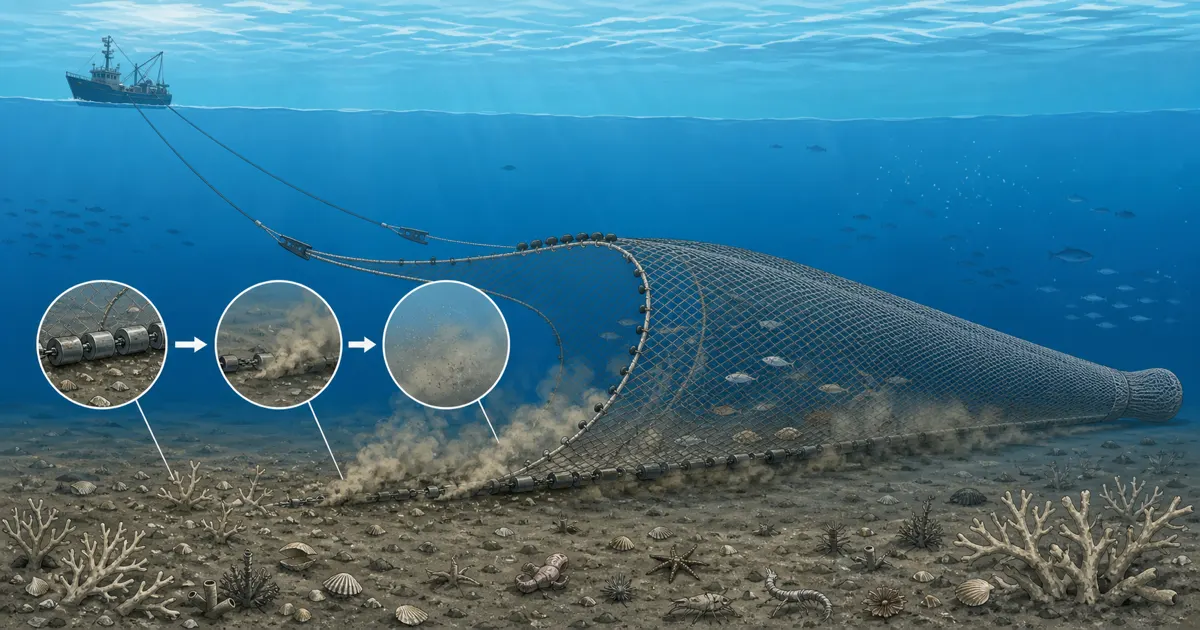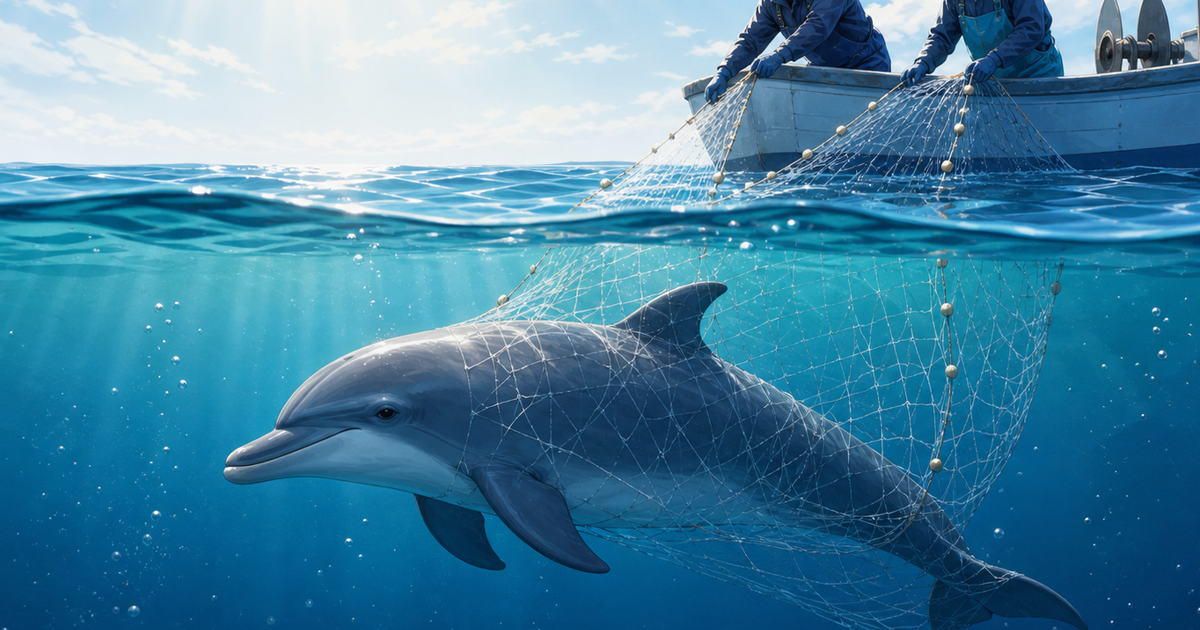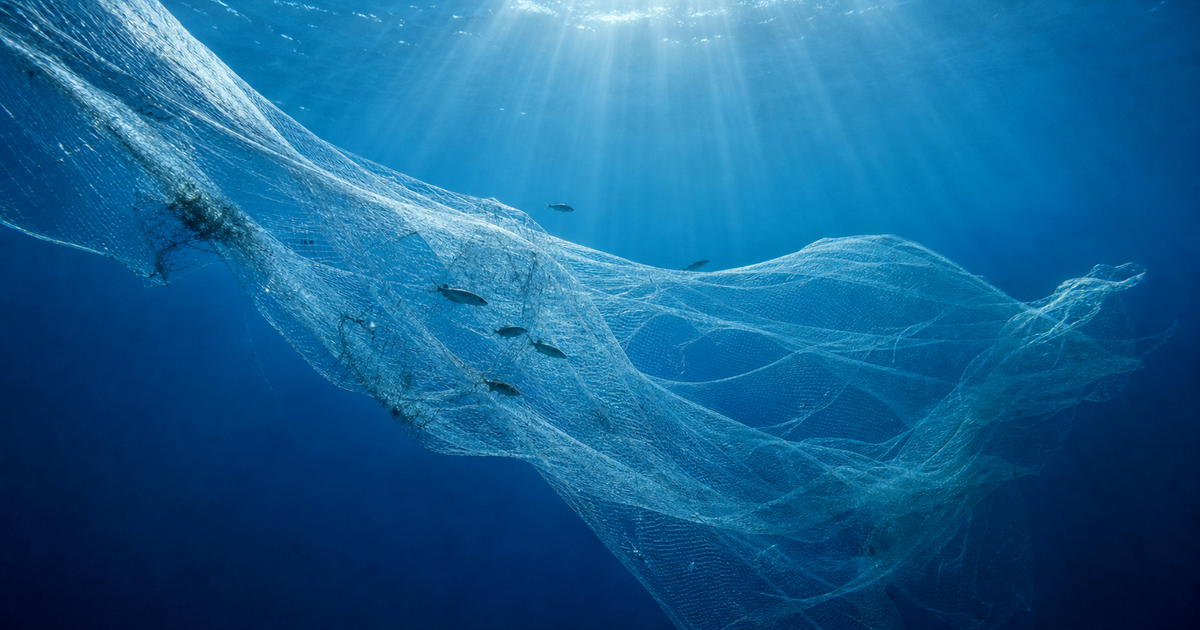
When fishers stop using a net or rope and it's left behind in the sea, it doesn't quietly rest. Carried by the currents, tangled around rocks and sunken wrecks, it keeps catching fish, crabs, and sometimes even sea turtles and dolphins, all without anyone's help. Prey can't escape and dies, its carcass draws in the next victim, and the trap gathers still more prey. We call this fishing gear that keeps "fishing" long after losing its owner ghost gear.
Ghost gear isn't a problem confined to some distant sea. It's estimated to make up at least 10% of the world's ocean plastic waste, with an estimated 500,000 to 1 million tons of new gear flowing into the ocean every year. Worse, plastic fishing gear takes decades to centuries to break down, harming marine life the entire time. When WWF called it an "immortal menace," that was no exaggeration.
Drawing on primary sources such as Japan's Ministry of the Environment, the Fisheries Agency, the FAO (UN Food and Agriculture Organization), WWF, and peer-reviewed papers, this article works step by step through what ghost gear is, how much of it is being lost at sea, what damage it causes, and how the world and Japan are trying to confront it. By the time you finish reading, ocean news should look a little different to you.
What you'll learn in this article
- What ghost gear is, why it's called "ghost," and why it keeps catching creatures almost indefinitely
- What share of all ocean plastic waste ghost gear accounts for, and the specific figures and studies behind that
- The real damage being inflicted on marine life and habitats, including sea turtles, whales, seabirds, and coral
- The main reasons fishing gear ends up lost at sea, and the structural difficulty of eliminating it entirely
- Frontline countermeasures — recovery efforts, gear marking, international rules (FAO, GGGI), and biodegradable gear
- Concrete actions we can take as consumers and citizens
What is ghost gear?
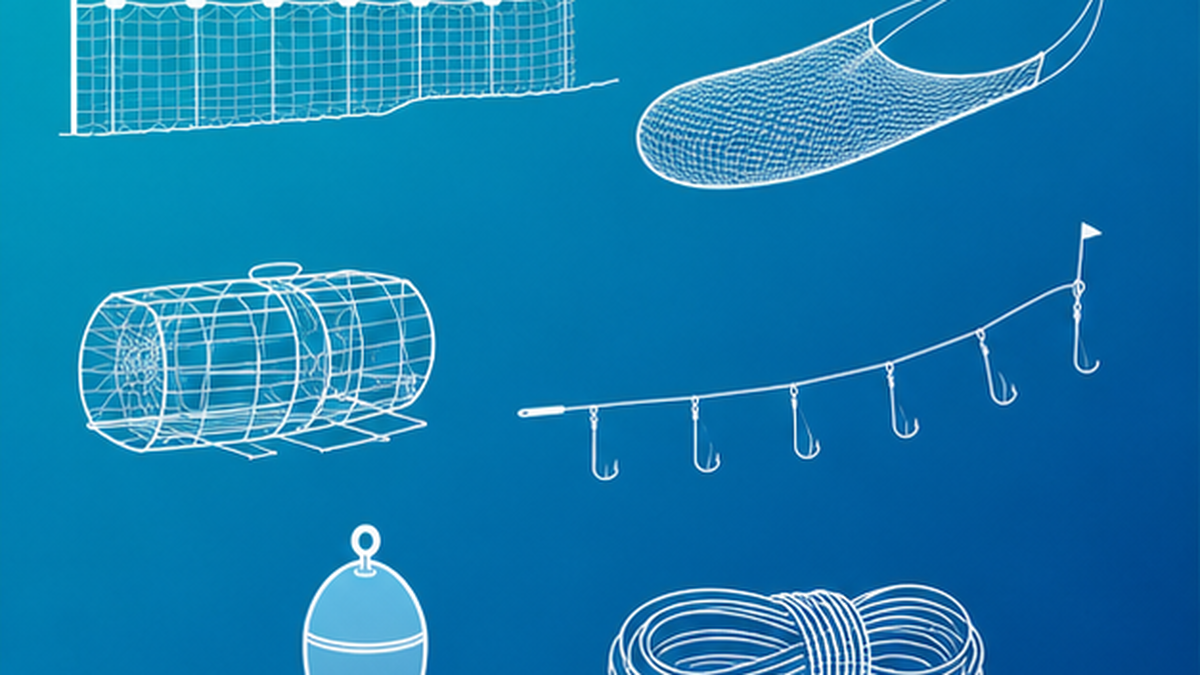
Ghost gear is a general term for fishing nets, ropes, fishing lines, traps, buoys, and other equipment that has been abandoned, lost, or discarded at sea. Internationally, the term ALDFG (Abandoned, Lost or otherwise Discarded Fishing Gear) is used, and this is the standard terminology in reports from the FAO (UN Food and Agriculture Organization) and UNEP (UN Environment Programme).
As the term "ghost gear" suggests, the heart of the problem is that it keeps fishing even after its owner is gone. When a fisher is managing their gear, fish caught in a net are landed, and bycatch is released. But once a net is left behind at sea, whatever it catches is never collected by anyone, never released, and simply dies. This phenomenon is called ghost fishing, which we'll explain next. What matters here is that fishing gear itself is by no means "evil." It's an indispensable tool for bringing fish to our tables. The problem arises not from the tool itself, but from the moment it slips out of anyone's control and is left behind in the sea. In other words, ghost gear is a useful tool transformed the instant it "loses control" — a negative byproduct of fishing itself.
The negative cycle of "ghost fishing"
Ghost fishing refers to the phenomenon in which abandoned fishing gear keeps catching marine life without ever losing its ability to catch. What makes it so frightening is that it creates a self-perpetuating vicious cycle. First, small fish or crustaceans get caught in a net or trap. Unable to escape, they die, and their carcasses attract predators such as crabs or larger fish. Those predators then get caught in the same net and die too — and so a single piece of gear keeps gathering victims for years on end.
Particularly serious is the ghost fishing caused by trap gear sunk to the seafloor. Traps used to catch crabs, shrimp, and shellfish stay on the seafloor even after being lost, and their entry mechanisms keep functioning. Once prey enters, it can't get out, and the casualties keep piling up one after another. One study reported a case in which a single lost crab trap kept catching dozens of crabs every year for several years. Unlike nets, traps are less likely to drift or tear from the currents, so they quietly but steadily keep killing. A tool meant to catch "valuable resources" in a fisher's hands turns, on the seafloor, into a "device that simply wastes lives" — this is the essential tragedy of ghost fishing.
Three reasons ghost gear is "especially troublesome"
- With no owner, any creature caught is never collected or released — it always dies
- Made of plastic that takes decades to centuries to break down, it keeps fishing the entire time
- A self-perpetuating vicious cycle occurs, where carcasses become bait that attracts the next victim
Not all of it comes from deliberate dumping
Hearing "ghost gear," you might imagine "gear a fisher deliberately threw into the sea." But in reality, deliberate dumping is actually the minority. Most of it is lost in ways closer to unavoidable circumstances: swept away by bad weather, snagged on reefs or shipwrecks, severed by the passage of other vessels, or tangled with other fishing gear. In other words, ghost gear isn't a problem caused by a few careless individuals — it's a structural challenge that comes with the practice of fishing itself. Precisely because of this, penalties alone won't solve it; a range of measures is needed, including the recovery, marking, and material-switching approaches discussed later.
To see where ghost gear fits within the broader ocean plastic problem, reading it alongside our articles on the breakdown of ocean plastic and the problem of deep-sea trash gives a fuller, more three-dimensional picture. Ghost gear is one of the "entry points for plastic entering the ocean," and also the beginning of a long story of subsequent breakdown, spread, and sinking to the deep sea.
Ghost gear's share of ocean plastic waste
When people hear "ocean plastic waste," many picture plastic shopping bags, PET bottles, or straws. But in fact, a considerable portion of the large plastic debris drifting in the ocean comes from fisheries. Let's look at the representative data showing this share. The numbers vary depending on the source and measurement method, but what they consistently show is that "fishing gear is a major player in the ocean plastic problem."
Why is there such a gap between our everyday impression and the data? The reason lies in "where you observe." The trash we see on beaches or in cities is mainly disposable packaging thrown away by consumers. But out on the open ocean — especially in the empty offshore waters and beneath the surface — the scenery changes completely. What drifts there is fishing nets and ropes, far larger and heavier than household waste. Because fishing gear is used out on the water, it naturally enters the ocean directly and in large quantities, without passing through land-based trash streams at all. This characteristic — that its point of origin is the ocean itself — is the fundamental reason fishing gear stands out so prominently in the ocean plastic problem.
"At least 10%" overall, up to "70%" among large plastics
According to WWF's 2020 report "Stop Ghost Gear," at least 10% of all ocean plastic waste comes from fishing gear. Even more notable is the estimate that, limited to large plastic (over 20cm) floating on the sea surface, up to about 70% by weight is fishing gear. While finely broken-down microplastics are overwhelmingly more numerous, when it comes to "weight" and "the power to directly entangle living creatures," fishing gear stands out prominently.

Fishing nets made up "46%" of the Great Pacific Garbage Patch
Understanding these differences in percentage helps you avoid being swayed by numbers you see in the news or on social media. What matters isn't arguing over which figure is "correct," but grasping that "the picture changes depending on how you observe it," and that "no matter how you look at it, fishing gear is an entity that can't be ignored." With that in mind, let's take a concrete look at the symbolic site where this was demonstrated.
This fact is symbolized by a study of the enormous accumulation of debris spanning the waters between Hawaii and California known as the Great Pacific Garbage Patch. In research published by Lebreton and colleagues in the journal Scientific Reports in 2018, a large-scale collection survey by a fleet of 18 vessels revealed that at least 46% of the garbage patch's mass consisted of fishing nets, with much of the remainder also being fishery-derived plastic such as rope, traps, and net spacers. Rather than the "island of household trash" we might imagine, the reality was a "sea of fishing gear."
The same study also highlighted the gap between the "count" and "weight" of the debris. Of the estimated 1.8 trillion pieces of plastic drifting in this region, 94% were microplastics smaller than 5mm. Yet by weight, microplastics accounted for only 8% of the total. Conversely, large debris over 5cm made up more than three-quarters of the total weight. In other words: "count them and microplastics overwhelmingly dominate; weigh them and macro debris (like fishing nets) overwhelmingly dominates." It's mainly this latter, large debris that entangles marine life and physically destroys habitats — which is precisely why tackling fishing gear is such a high priority within the broader ocean plastic problem.
At least 46% of the Great Pacific Garbage Patch's mass consisted of fishing nets, and much of the rest was also fishery-derived gear such as rope and traps.
— Lebreton et al. (2018), Scientific Reports
| Data point | Figure | Source |
|---|---|---|
| Fishing gear's share of all ocean plastic waste | At least 10% | WWF (2020) |
| Fishing gear's share of large surface plastic (by weight) | Up to about 70% | WWF (2020) |
| Fishing nets' share of the Great Pacific Garbage Patch's mass | At least 46% | Lebreton et al. (2018) |
| Estimated amount of fishing gear entering the ocean each year | 500,000-1 million tons | WWF (2020) |
Watch how you read the numbers
"10%," "46%," and "70%" are all correct figures, but they refer to different scopes. 10% is the share of ocean plastic waste as a "whole"; 46% is for a "specific sea area," the Great Pacific Garbage Patch; and 70% is limited to "large plastic" floating on the surface. When you see a percentage in the news, always checking "a percentage of what?" is the key to reading the data correctly.
How much fishing gear is lost to the ocean each year?
So how much fishing gear is actually disappearing into the ocean every year? For a long time, there was no reliable global estimate, but a major breakthrough came in 2022. A research team from the University of Tasmania and Australia's CSIRO (Commonwealth Scientific and Industrial Research Organisation) combined interviews with 451 fishers worldwide with global fishing-effort data to produce a global estimate, published in the peer-reviewed journal Science Advances. Since there are few witnesses to events happening out at sea, counting lost gear piece by piece is essentially impossible. So the researchers carefully interviewed the very people using the gear — the fishers themselves — about "how much they lose each year," and multiplied that rate by the scale of fishing activity worldwide, producing for the first time a credible overall picture.
"About 2% of all fishing gear" every year
According to Richardson and colleagues' 2022 study, an estimated roughly 2% of the fishing gear used worldwide is lost to the ocean every year. Don't underestimate that "mere 2%." The total volume of fishing gear used worldwide is enormous, and translating 2% into actual numbers produces a scale beyond imagination. Looking at the specific breakdown should take your breath away.
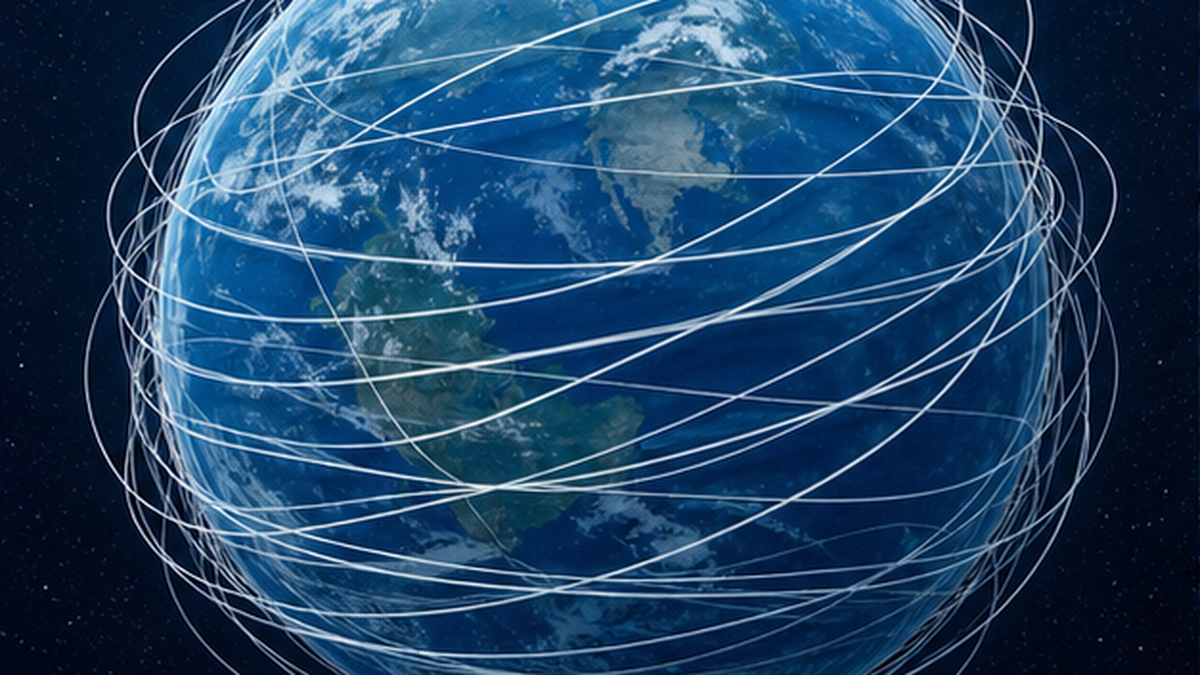
- Longline mainlines: roughly 740,000 km per year (enough to circle the Earth more than 18 times)
- Fishing hooks: roughly 14 billion per year
- Traps: over 25 million per year
- Purse seine nets: roughly the equivalent of 75,000 km² per year
- Gillnets: roughly the equivalent of 3,000 km² per year
Different gear types are lost at different rates
Even among fishing gear, the share lost to the ocean varies greatly by type. According to data compiled by WWF, 5.7% of fishing nets, 8.6% of traps, and a striking 29% of fishing lines used worldwide are lost or abandoned every year. The high loss rate for fishing lines especially stands out. That's because they're thin and easily severed, easily lost when snagged, and difficult to recover since they're transparent. The higher a gear type's loss rate, the higher the priority for countermeasures such as the marking and material-switching efforts discussed below. Put another way, having solid data on which gear types are lost, and how much, makes it possible to concentrate limited budget and effort where it will have the greatest effect. Measuring the numbers is, in itself, the first step toward a solution.
| Gear type | Annual loss/abandonment rate | Characteristics |
|---|---|---|
| Fishing nets (gillnets, trawl nets, etc.) | About 5.7% | Large surface area makes it easy to entangle creatures |
| Traps | About 8.6% | Sinks to the seafloor and keeps fishing for a long time |
| Fishing lines (including longlines) | About 29% | Thin, easily severed, and difficult to recover |
The frightening thing about "2%" accumulating
Even if only 2% of the total is lost each year, plastic fishing gear doesn't break down for decades to centuries. That means whatever is lost each year essentially "accumulates" in the ocean almost unchanged. Over 10 years that adds up to 20%, and over several decades, many times that amount remains in the sea — meaning if recovery can't keep pace, the damage only keeps growing year after year.
The serious harm inflicted on marine life and habitats
Ghost gear is called "the deadliest form of ocean plastic debris" because it isn't just waste — it's a "tool" that directly kills living creatures. The harm broadly falls into two categories: entanglement and ingestion. Here, we'll look at the data illustrating its scale and the concrete harm it causes. While PET bottles and plastic bags mostly harm creatures through "ingestion," fishing gear has a distinct cruelty in that it takes lives directly through the physical restraint of "entanglement."
66% of marine mammals, 50% of seabirds, and every species of sea turtle affected
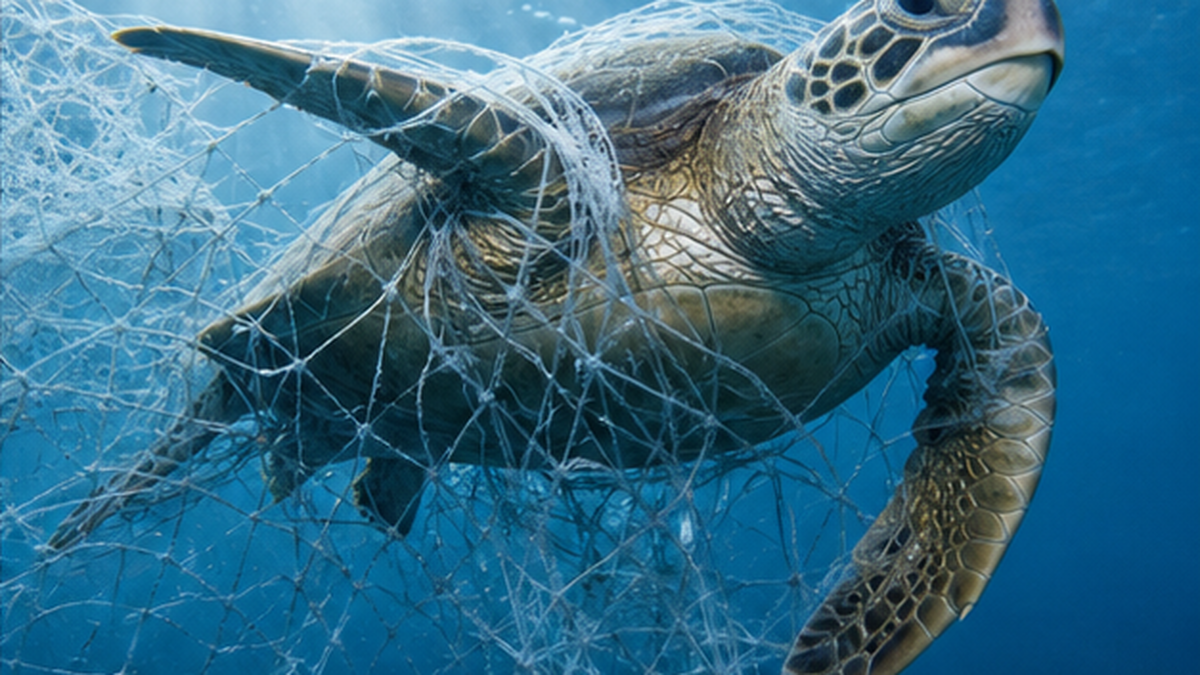
According to WWF's report, entanglement harm from ghost gear affects an estimated 66% of marine mammal species, 50% of seabird species, and all seven species of sea turtles. Creatures caught in a net drown after losing the ability to swim, weaken from being unable to catch food, or develop infections from wounds where the net cuts into their bodies — dying slowly and painfully. There are documented cases of whales living for years while dragging tens of kilograms of fishing net, and their suffering is immeasurable. In young, still-growing individuals, rope wrapped around the body can cut ever deeper into the flesh as they grow, sometimes reaching the bone. Only a small fraction are discovered and rescued by humans; the vast majority meet their end unknown to anyone, on the ocean floor. WWF's designation of ghost gear as "the deadliest form of ocean plastic debris" reflects this cruelty and the fact that the damage is both wide-ranging and long-lasting.
The range of affected creatures is also expanding year by year. The number of marine species affected by entanglement or ingestion has been reported to have nearly doubled over roughly 20 years, from 267 species in 1997 to 557 species. Some of this reflects improved research, but it also reflects the fact that plastic and fishing gear accumulating in the ocean keep increasing. And the harm isn't limited to the large animals we know by name, like sea turtles or whales. Seabirds mistake fragments of plastic for food, swallow them, and die of malnutrition with a stomach full of plastic. Creatures like deep-sea life, whose ecology is still poorly understood, may also be affected by fishing gear that has sunk to the deep sea. Ghost gear's harm reaches every layer of the ocean, from the surface all the way to the deep sea.
It also destroys habitats themselves, like coral reefs and mangroves
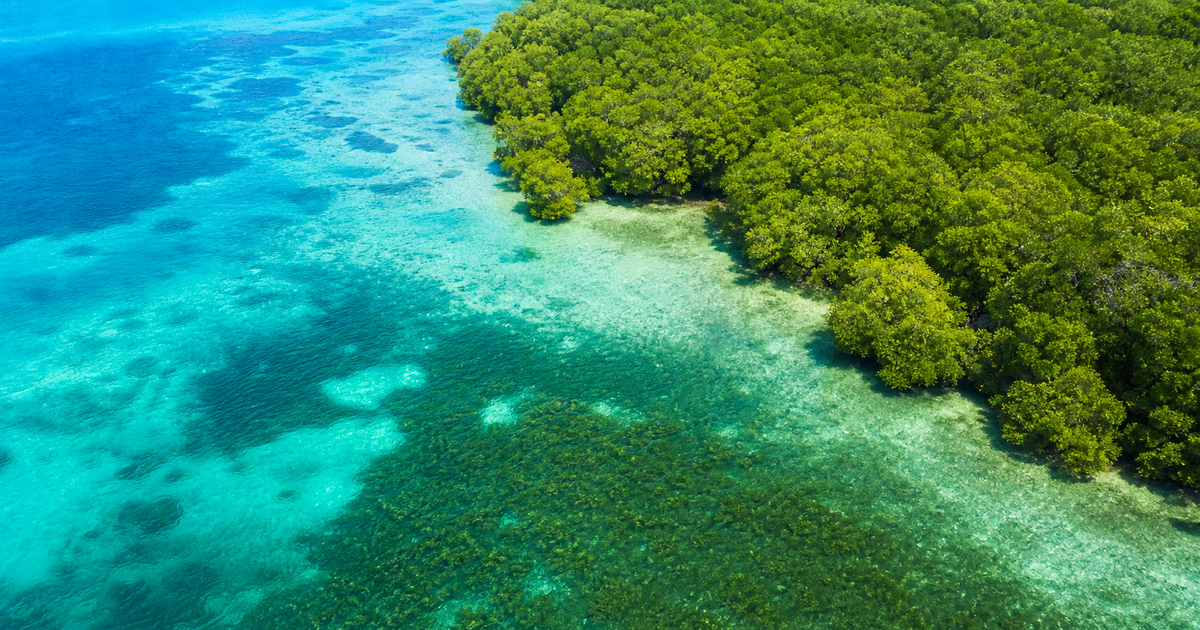
The harm isn't limited to individual creatures. Heavy fishing nets carried by the currents drape over coral reefs, suffocating, snapping, and grinding away at the coral. For coral already weakened by bleaching from ocean acidification and high water temperatures, ghost gear can be the final blow. Coastal habitats that serve as a cradle for many species, such as mangroves and seagrass beds, are damaged in the same way.
It also breaks down into microplastics
As a further long-term problem, fishing nets and ropes gradually break apart under UV light and wave action, turning into countless microplastics. These fine fibers are taken up by fish and shellfish, work their way through the food chain, and may eventually make their way back to our own dinner tables. This pathway is explained in detail in our article on microplastics and health. Ghost gear poses a double threat: the visible harm of "large nets killing creatures," and the invisible harm of "breaking apart and spreading."
Four pathways of harm caused by ghost gear
- Entanglement: creatures get tangled in nets or ropes, drowning, weakening, or being injured
- Ingestion: fragments are mistaken for food and eaten, damaging or blocking the digestive tract
- Habitat destruction: covering, snapping, and grinding away at coral reefs and mangroves
- Fragmentation: breaking down into microplastics that enter the food chain
Why does ghost gear keep being created?
Once you understand how serious the harm is, the question naturally arises: "why hasn't this been eliminated?" As mentioned earlier, most ghost gear isn't the result of deliberate dumping — it arises from reasons structurally tied to fishing itself. Understanding the causes is the starting point for thinking about effective countermeasures. For some problems, finding and punishing the culprit is the path to a solution, but that's not the case here. What matters more is designing systems around "how can gear be made less likely to be lost?" and "if it is lost, how can the harm be minimized?" Here, we organize the factors behind this.
No fisher wants to lose their gear
First, as a basic premise: fishing gear is expensive equipment for a fisher's livelihood. A complete net setup costing hundreds of thousands to millions of yen is not unusual. Fishers have no economic incentive to lose their gear — quite the opposite, losing it means a major financial hit. Misunderstanding this point and simply concluding "it's the fishers' fault" leads to a misdirected response. They, too, are in many ways "victims," losing gear against their will. And yet it still gets lost, because of unavoidable factors like the following.
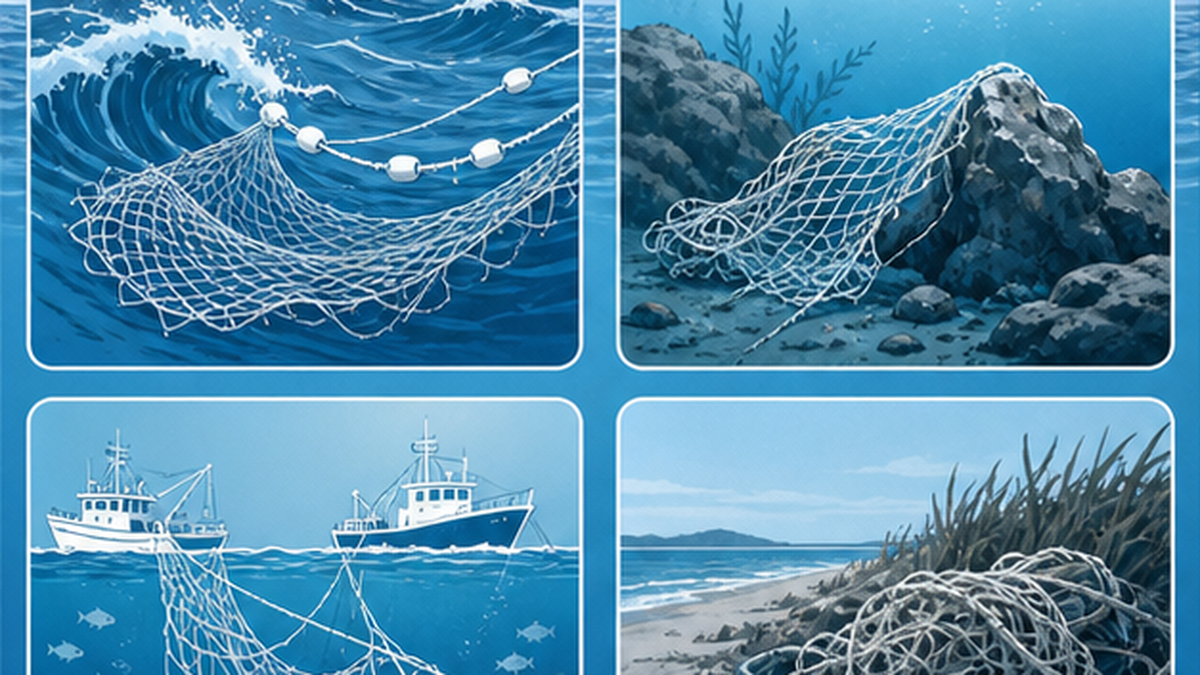
- Bad weather and rough seas: strong winds and high waves carry nets and buoys away, making recovery impossible
- Snagging: gear gets caught on rocky reefs, shipwrecks, or other obstacles on the seafloor and is severed
- Collisions between gear: in crowded fishing grounds, gear gets tangled with other vessels' equipment or cut by ship propellers
- Lack of tags or markers: no one can tell whose gear it is, so even if it's lost, no one can be identified as responsible for recovering it
- Difficulty of disposal on land: a lack of facilities and funding for properly disposing of used gear makes it more likely to be left behind
The ocean as a "tragedy of the commons"
Another deep-rooted factor is that the ocean is a "commons" belonging to no one in particular. Even if each individual fisher loses only a small amount of gear, it adds up to enormous damage when accumulated across the whole world. But from any one individual's perspective, it's "just my one piece," and there's little strong incentive to bear the cost of recovering it. This structure is precisely the "tragedy of the commons" itself. That's exactly why relying on individual goodwill alone isn't enough — building society-wide rules, such as mandatory marking, deposit systems, and formalized recovery mechanisms discussed below, becomes essential.
Climate change is also a contributing factor
In recent years, the intensification of extreme weather driven by rising sea temperatures and shifting ocean currents has also been pointed to as a factor increasing gear loss. As typhoons and high waves grow stronger and more frequent, the risk of losing fishing gear rises accordingly. The ghost gear problem is directly connected to the larger challenge of climate change.
Recovery and prevention — the frontline of a world now in motion
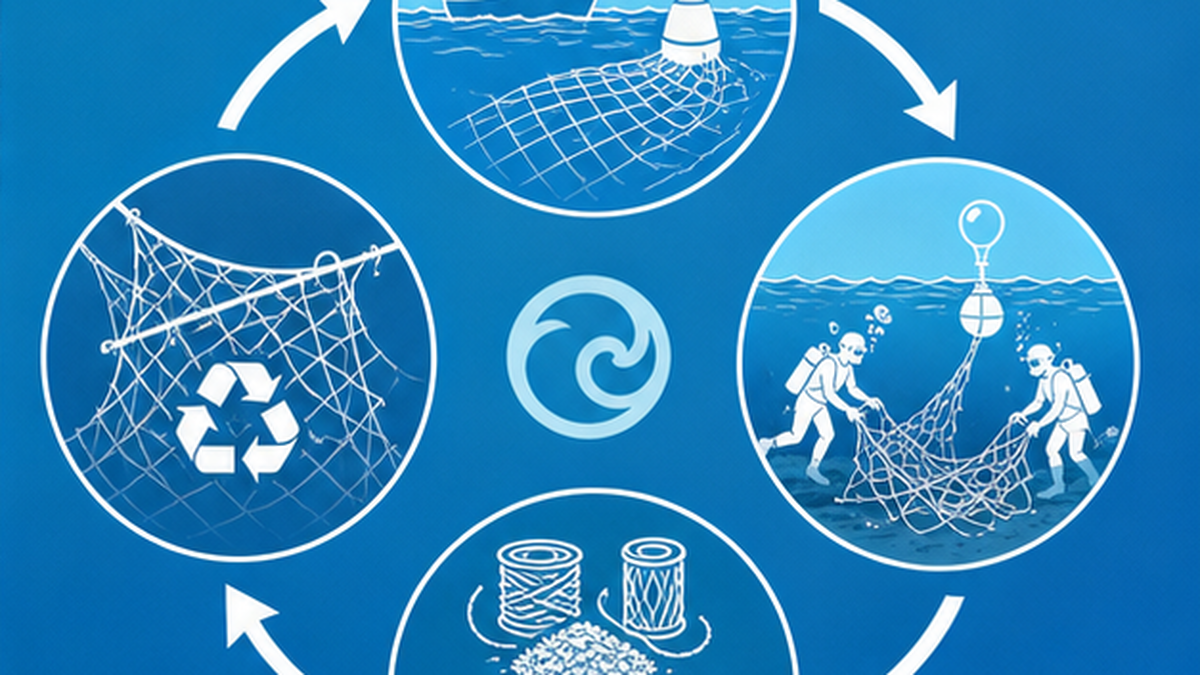
Reading this far might leave you feeling discouraged, but countermeasures are steadily advancing. Efforts against ghost gear proceed along two main pillars: "prevention" (not letting it enter the sea) and "recovery" (removing it). Let's look at each in turn. These two work like the two wheels of a cart. No matter how much gear is recovered, if the amount newly lost exceeds it, the total in the ocean won't decrease; and prevention alone won't eliminate the enormous volume of ghost gear already in the sea. That's exactly why both "prevention" — turning off the tap — and "recovery" — mopping up the water already spilled on the floor — need to be pursued simultaneously. In recent years, international frameworks have also been taking shape to keep these two wheels turning across borders.
The international lead: the "GGGI" and FAO's rulemaking
Leading this field on a global scale is the Global Ghost Gear Initiative (GGGI), launched in 2015. As of 2021, GGGI includes governments from 17 countries along with more than 100 companies, NGOs, research institutions, and international bodies (with participating countries and organizations continuing to grow since), sharing best practices for gear management. In response to this momentum, the FAO adopted its Voluntary Guidelines on the Marking of Fishing Gear (VGMFG) in 2018. If a mark identifying the owner is attached to a piece of gear, recovery and accountability become clearer when it's lost, which also helps deter abandonment. It's the same idea as putting a license plate on a car — giving fishing gear an "identity" too. In 2019, the FAO further partnered with GGGI to hold workshops across regions including the Southwest Pacific, Southeast Asia, West Africa, and South America/the Caribbean, spreading marking methods and gear-management best practices to the field.
Growing interest from the G7 and the international community
Ghost gear has also become a policy issue for major countries. In 2021, the OECD published a policy paper titled "Towards G7 Action to Combat Ghost Fishing Gear," urging countries to improve gear design, strengthen recovery, and develop better data. Fishing gear is also treated as an important topic in discussions on the UN's international treaty on plastic pollution. Ghost gear is now recognized as a global challenge that no single country can solve alone.
Recovered ghost gear becomes a "resource"
There's hope on the recovery side too. Recovery efforts by divers and fishers are underway around the world, and initiatives to regenerate recovered fishing nets as nylon material are spreading. Companies have emerged that recover used fishing nets and turn them into products like carpets, clothing, swimwear, and sunglasses. "Thrown away, it's trash; collected, it's a resource" — the circular-economy idea of turning ghost gear from a liability into value is gradually becoming reality. When recovered fishing nets can be sold for a price, recovery becomes "income" rather than "a burden" for fishers and communities, creating a real incentive to voluntarily collect abandoned gear. Rather than binding people with penalties, this approach of moving people with economic incentives has drawn attention as a practical remedy for overcoming the "tragedy of the commons" mentioned earlier.
The use of technology is also advancing. If the location of fishing gear can be tracked in real time using GPS-equipped buoys or electronic tags, recovery efforts can head out immediately even if it's lost. Countries are experimenting with a variety of "find it even if it's lost" mechanisms — detecting drifting debris via satellite or drone, and apps for sharing the location of lost gear among fishers. Ghost gear countermeasures now look like an all-out effort combining everything from steady, on-the-ground cleanup activities to cutting-edge digital technology.
Prevention and recovery — the two pillars of countermeasures
- Prevention: introducing gear marking, designing sturdy gear that's less likely to be lost, properly disposing of used gear
- Recovery: recovery activities by divers and fishers, using trackable electronic tags and buoys
- Circulation: recycling recovered fishing nets into nylon products and reusing them as a "resource"
- Rules: building an international framework through GGGI, FAO guidelines, and a UN treaty
The hope of biodegradable fishing gear, and its challenges
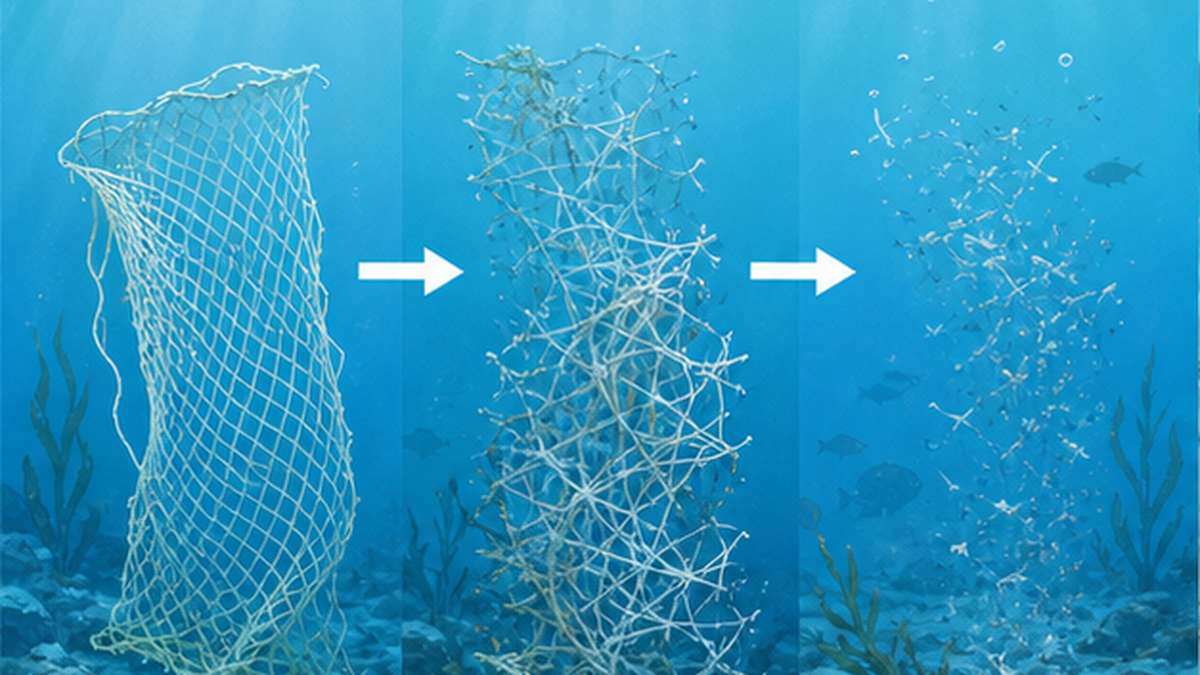
Alongside prevention and recovery, another promising approach is the idea of "making fishing gear from materials that return to nature in the first place." If fishing gear biodegrades in the ocean after a certain period, then even if it's lost, ghost fishing won't continue forever. This is the concept behind biodegradable fishing gear.
Research from Japan is moving the world
Research in this field from Japan is drawing global attention. In 2025, a research group from the University of Tokyo, Kyushu University, Ehime University, and others discovered that some commercially available nylon fishing lines, previously thought not to break down at all, actually biodegrade in the ocean. Made from a copolymer of nylon 6 and nylon 6,6, this fishing line is already mass-produced and commercially available at a practical cost, raising hopes that it could become a "decisive solution" to the ghost gear problem. A group led by Professor Kenichi Kasuya of Gunma University is also advancing the development of new biodegradable materials that can be applied to fishing gear.
Field verification is also progressing. In Ainan, Ehime Prefecture, a large-scale field trial has been conducted to verify the effectiveness of biodegradable fishing line in curbing marine pollution. This is a good example of the science of ocean plastic breakdown being applied to fisheries in the field. Japan is one of the world's leading fishing nations, which means it bears significant responsibility for gear-derived waste — but it also holds the potential to become a "country that exports solutions," leveraging its strengths in materials science and precision manufacturing. The ghost gear problem is, for Japan, both a challenge and an opportunity to contribute to the world through technology.

Not a "magic material" — the challenges that remain
Another significance of biodegradable fishing gear is that it turns the duration of harm after loss from "infinite" to "finite." Conventional nylon gear keeps fishing for decades to centuries, but if made from a material that breaks down within a few years, the duration of ghost fishing would shrink dramatically. Not being lost at all is the ideal, but being able to guarantee that "even if it's lost, the harm won't continue forever" is itself major progress. It could be described as a kind of "third breakwater," alongside prevention and recovery.
That said, biodegradable fishing gear isn't a cure-all. There are no shortage of challenges still to overcome. First is strength and durability. Gear needs to be sturdy while in use, yet conveniently decompose only after it's lost — a set of conflicting requirements. Second is controlling the decomposition rate. If it decomposes too quickly, it will break during use; if too slowly, it won't prevent ghost fishing. Third is cost. If it's more expensive than conventional plastic gear, it will be harder to get fishers to adopt it.
| Challenges for biodegradable fishing gear | What's required |
|---|---|
| Strength and durability | Being as sturdy as conventional gear while in use |
| Controlling the decomposition rate | Not decomposing during use, then decomposing within an appropriate timeframe once lost |
| Cost | Getting closer to a price fishers can actually adopt |
| Reliability of decomposition | Reliably decomposing even in the cold, dark, deep parts of the ocean |
The pitfall of "biodegradable"
Even when labeled "biodegradable," many materials only break down in high-temperature industrial composting facilities, and in the cold, dark ocean they can remain intact just like conventional plastic. That's exactly why it's important to determine whether a material's "marine biodegradability" (breaking down in the actual ocean environment) has been confirmed. Consumers, too, need to avoid being reassured by the label alone.
Japan's efforts, and what we can do
Finally, let's organize the moves happening within Japan, along with what we, as citizens, can do. Ghost gear is a large-scale problem, but there are actions to take at the policy, industry, and individual levels alike. For Japan, surrounded by ocean on all sides and one of the world's leading consumers of seafood, this issue is by no means someone else's problem. Precisely because we've benefited from the bounty of rich fishing grounds, the responsibility to hand that ocean on to the next generation is also ours to bear.
Moves by the Fisheries Agency and the Ministry of the Environment
Countermeasures are also progressing within Japan. In 2019, the Fisheries Agency compiled "Future Efforts to Address the Plastic Resource Circulation Problem in Fisheries," laying out support for developing and testing environmentally friendly gear, including biodegradable materials; promoting the recovery of marine debris; ensuring proper and prompt disposal of used gear; and properly managing gear currently in use. The Ministry of the Environment also positions fishery-derived waste as a key issue within its broader ocean plastic countermeasures. The Ocean Policy Research Institute of the Sasakawa Peace Foundation and others continue to publish policy research on abandoned and discarded fishing gear.
In Japan, a system is also taking root in which fishers themselves become the ones cleaning up the sea. A representative example is the "marine debris collection and disposal" initiative, in which trash caught on the seafloor while fishing is brought back and properly disposed of. The people who catch fish becoming, at the same time, the people who protect the ocean — this cycle led by those directly involved, rather than relying solely on outside goodwill, has been highly regarded internationally as a sustainable countermeasure. A shift in thinking is quietly underway, one that positions fishing not merely as "the source of the problem" but as "the lead player in the solution."
What we can do as consumers and citizens
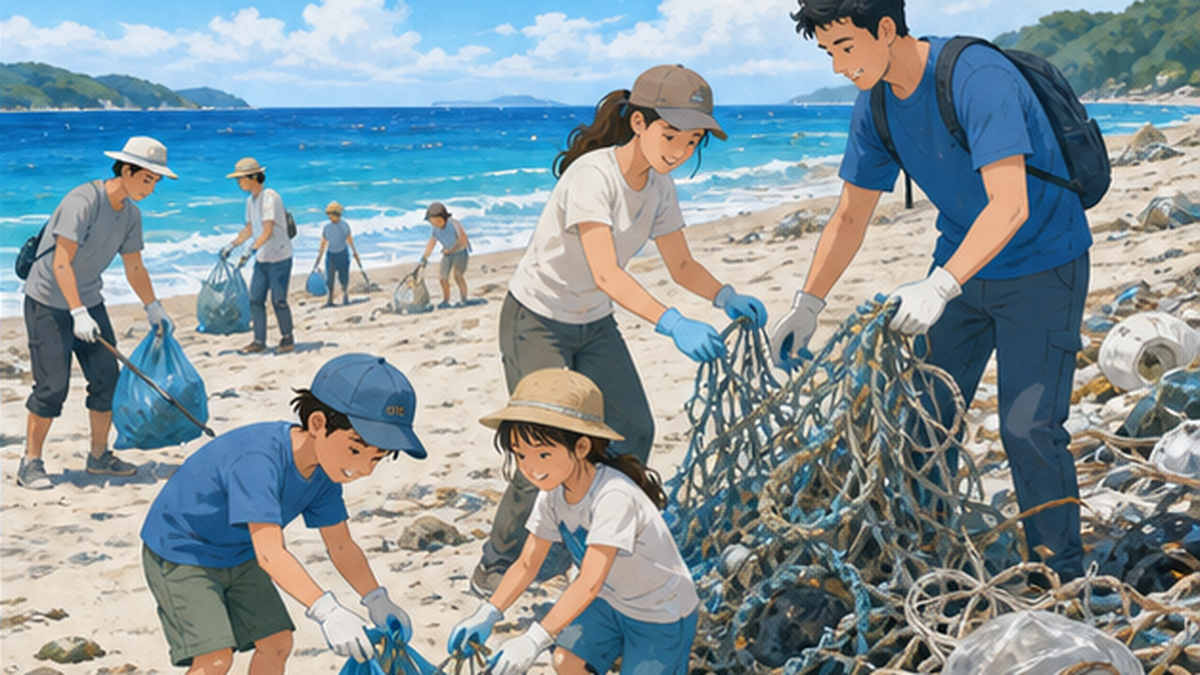
You might think "this is a fishing industry issue, it has nothing to do with me," but that's not true. Our choices and actions genuinely contribute to solving the problem. The fish we eat were caught by someone using fishing gear. Some of that gear remains in the sea, taking the next life — and consumers, too, are part of this chain. There's no need to do anything difficult; you can start with small steps in everyday life.
- Join a beach cleanup: a direct contribution toward recovering fishing nets and ropes that have washed ashore
- If you go fishing, take your tackle home with you: recreational fishing line and tackle are also a real cause of ghost gear
- Choose products made from recycled fishing nets: buying recycled nylon products helps drive the circular economy forward
- Choose sustainable seafood: choose seafood from environmentally responsible fisheries, such as MSC-certified products
- Learn about the issue, and share it: spread awareness of ghost gear through social media and conversation, widening the circle of concern
A step you can take starting today
- Look up a beach or riverside cleanup event happening near you
- Always take home any line or plastic left over from fishing or leisure activities
- Pay attention to labels like "marine biodegradable" or "recycled nylon" when shopping
Ghost gear is a problem that quietly progresses in places we can't see, in the ocean. Precisely because of that, simply "knowing about it" is itself the first step toward addressing it. Please share the knowledge you've gained from this article with the people around you. More people taking an interest is the single greatest force for moving policy and industry forward.
Conclusion — driving the "ghosts" out of the ocean
Ghost gear is an "immortal" kind of fishing equipment that keeps fishing even after losing its owner, making up at least a tenth of ocean plastic waste and as much as seventy percent among large plastics — a major player in ocean environmental issues. Every year, 500,000 to 1 million tons enter the sea, tormenting hundreds of species of creatures from sea turtles and whales to seabirds, and destroying habitats such as coral reefs.
But there is hope. International rulemaking by GGGI and the FAO, gear marking and recovery/recycling systems, and biodegradable fishing gear research originating in Japan — the world has clearly begun to move. What's encouraging about this problem is that its causes are clear, and the steps that need to be taken are visible. All that remains is how big a movement we can build from the interest and action of each individual person supporting it. Whether the "ghosts" of the ocean can finally be laid to rest depends not on someone far away, but on choices made by all of us — including you, reading this article.
Summary of this article
- Ghost gear refers to fishing nets, ropes, fishing lines, traps, and other gear (ALDFG) abandoned, lost, or discarded at sea, which keeps catching marine life even after its owner is gone
- Fishing gear accounts for at least 10% of all ocean plastic waste, up to 70% of large plastic on the sea surface, and 46% of the Great Pacific Garbage Patch
- An estimated 500,000 to 1 million tons — about 2% of all fishing gear — is lost to the ocean every year, accumulating without breaking down
- 66% of marine mammal species, 50% of seabird species, and all seven species of sea turtles are harmed, and habitats such as coral reefs are also destroyed
- Most is lost not through deliberate dumping but through structural causes such as bad weather, snagging, and collisions
- Countermeasures center on GGGI/FAO international rules, gear marking, recovery and recycling, and the development of biodegradable fishing gear
- Citizens can also help through cleanup participation, taking tackle home, choosing recycled products, and sharing information
References and sources
- Fisheries Agency of Japan – Future Efforts to Address the Plastic Resource Circulation Problem in Fisheries (ocean plastic waste countermeasures)
- Ministry of the Environment, Japan – On the Ministry of the Environment's Efforts Toward Solving the Ocean Plastic Problem
- FAO (UN Food and Agriculture Organization) – Voluntary Guidelines on the Marking of Fishing Gear
- WWF – Stop Ghost Gear: The most deadly form of marine plastic debris (2020 report)
- Science Advances – Richardson et al. (2022), Global estimates of fishing gear lost to the ocean each year
- Scientific Reports (Nature) – Lebreton et al. (2018), Evidence that the Great Pacific Garbage Patch is rapidly accumulating plastic
- OECD – Towards G7 Action to Combat Ghost Fishing Gear (2021 policy paper)
- University of Tokyo, Graduate School of Frontier Sciences – Discovery that commercially available fishing line, previously thought not to decompose, biodegrades in the ocean (press release)
- Ocean Policy Research Institute, Sasakawa Peace Foundation – "Ocean Newsletter" essay on marine pollution from abandoned and discarded fishing gear (Junko Toyoshima, 2021)
- The Global Ghost Gear Initiative (GGGI) – Official site and resources
※ Listed in order of reliability: government and academic institutions > peer-reviewed papers > specialist organizations > trusted media