Drifting weightlessly through the dim tanks of an aquarium, wrapped in light — that is the jellyfish most of us picture. Yet it's hard to imagine from that image that the bell shape is just one brief scene in a jellyfish's whole life. Between birth and death, a jellyfish changes its form again and again, almost as if it were a completely different creature each time. There is a stage when it clings to the seafloor and lives like a sea anemone, and a stage when it takes on the strange shape of a stack of plates.
This article traces, step by step and with illustrations, the complex life cycle that runs from egg to planula larva, polyp, strobila, and ephyra, and finally to the adult jellyfish. It also gently explains, based on primary sources from public and research institutions, the mystery of the "immortal jellyfish" that reverts to a younger form as it ages, and how the jellyfish blooms that have become a problem worldwide in recent years are affecting fisheries and power plants.
Learning about the jellyfish life cycle is more than mere trivia about a creature. Why, where, and how much jellyfish multiply is also a mirror reflecting the balance of the whole sea — water temperature, nutrient conditions, and the number of fish. Let's peek behind that small, transparent body at the grand mechanisms of the sea.
What you will learn from this article
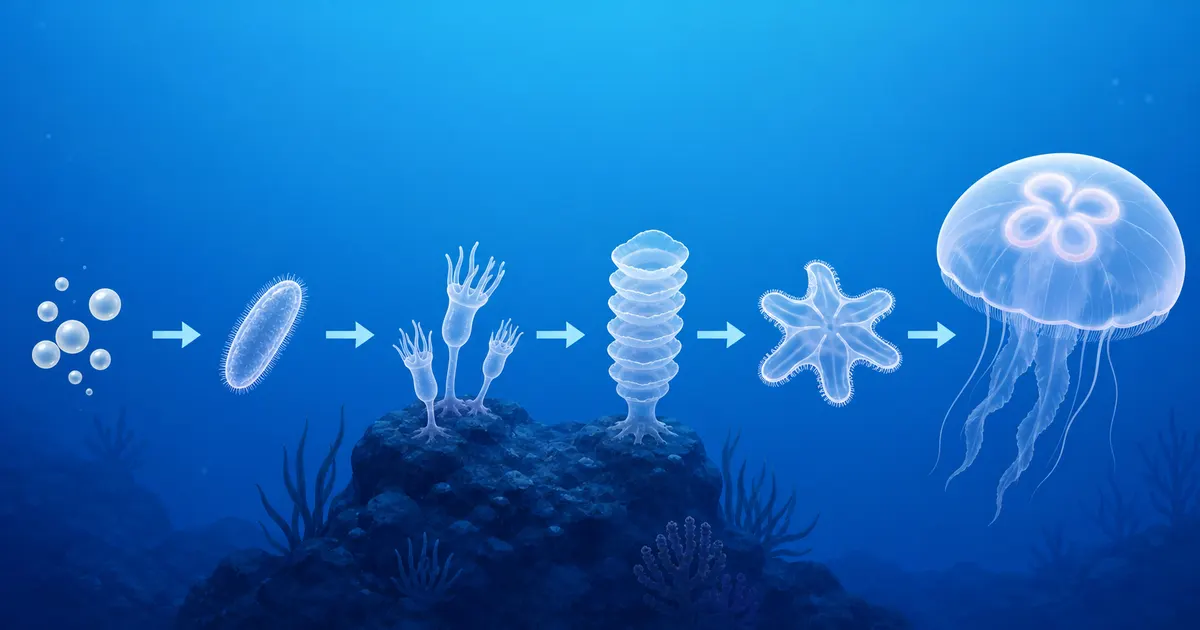
- Jellyfish have a complex life cycle that changes form: egg → planula → polyp → strobila → ephyra → adult
- How a polyp on the seafloor becomes a stacked-plate strobila and releases tiny ephyrae one after another (strobilation)
- The "transdifferentiation" by which the immortal jellyfish remakes its cells to revert to a younger form, and the scientific meaning of this rejuvenation
- Why warming, eutrophication, overfishing, and coastal modification are driving jellyfish blooms
- The concrete damage Nomura's jellyfish blooms cause to fixed shore nets and power plant water intakes
- A perspective for reading an increase in jellyfish as an indicator of the balance of the marine ecosystem
What Exactly Is a Jellyfish, Anyway?
Before tracing the jellyfish life cycle, let's first sort out where jellyfish sit within the animal kingdom. Jellyfish belong to a group called cnidarians. Cnidarians are characterized by having "cnidocytes" — capsules loaded with venomous stingers used to catch prey — and sea anemones, corals, and hydras belong to the same group. This is a group with a fairly ancient presence among sea creatures, with a primitive body structure.
What we usually picture when we say "jellyfish" is the shape that swims by opening and closing its bell, but in fact this is only one of two basic body forms cnidarians can take. Cnidarians can take the form of a "polyp," attached to the seafloor with its mouth facing up, or a "jellyfish (medusa) form," drifting through the water with its mouth facing down, and many jellyfish experience both of these over their lifetime.
More than 90% of the body is water
Most of a jellyfish's body is water. Depending on the species, roughly 95–98% of its body weight is water, and inside the bell spreads a jelly-like layer called "mesoglea." There are no bones or shells, and no center that could be called a brain. Even so, jellyfish can use a network of nerves and sense organs scattered around the rim of the bell to sense light, gravity, and water movement, and can swim by pulsing.
They also have no dedicated organs like a heart, blood vessels, or respiratory organs. Oxygen and nutrients are exchanged directly through the thin body wall. It is precisely because of this simple body that jellyfish can keep drifting without using much energy, and can survive readily even as the environment changes. Many species are also bioluminescent, and the light emitted by deep-sea jellyfish is touched on in the article on bioluminescence in deep-sea creatures.
"Jellyfish" is not a single species
What's worth noting is that the word "jellyfish" does not refer to one particular species, but is a common name that lumps together many creatures with a similar appearance. Among cnidarians, several groups are called "jellyfish," including the Scyphozoa, to which the moon jellyfish and Nomura's jellyfish familiar from aquariums belong, the Hydrozoa, to which the immortal jellyfish discussed later belongs, and the box jellyfish, known for their potent venom.
- Scyphozoa: moon jellyfish, Nomura's jellyfish, and others. Many have large bells and a polyp stage in their life cycle
- Hydrozoa: the immortal jellyfish and others. Small in size, and includes species capable of rejuvenation
- Box jellyfish (Cubozoa): have a nearly cube-shaped bell, and some species have potent venom
- Ctenophores (comb jellies): similar in appearance but lack cnidocytes, technically a separate group from cnidarians
The pattern of the life cycle differs slightly from group to group. This article first traces the basics of the life cycle using the most typical and easy-to-understand example, the moon jellyfish (Scyphozoa), and then broadens the discussion to the special rejuvenation of the immortal jellyfish and the blooms of Nomura's jellyfish.
The cnidocyte, a jellyfish's venomous stinger, has an intricate mechanism: when it touches prey, an internal thread instantly fires out, pierces the target, and injects venom. This mechanism is shared with how corals and sea anemones capture small plankton and defend themselves. Reading the article on the symbiosis of clownfish and sea anemones, which deals with the relationship between sea anemones and clownfish, makes clear just how diverse the lifestyles of cnidarians can be, even among relatives. Transparent and gentle-looking as they are, jellyfish are in fact hunters equipped with these sharp weapons.

Key terms in this article
- Planula: a small larva born from a fertilized egg that swims through the sea
- Polyp: the stage where the animal attaches to the seafloor and lives like a sea anemone
- Strobila: the stage where the polyp takes on a shape like a stack of plates
- Ephyra: the small, star-shaped baby jellyfish released from the strobila
Act One: Born From an Egg, the Planula Wanders the Sea
The complex life of a jellyfish begins with sexual reproduction. Adult moon jellyfish have males and females; the male releases sperm into the water, and fertilization occurs when the female takes it in. The female moon jellyfish broods the fertilized eggs for a while in fluttering structures inside the bell called oral arms, and from there sends the larvae out into the sea.
What is born this way is called the planula larva. The planula is a larva only about 0.2 millimeters long, shaped somewhat like an elongated rugby ball, and it swims slowly through the water by moving fine cilia on its body surface. At this point it has neither the bell nor the tentacles typical of a jellyfish. It is simply a small clump of cells drifting through the seawater.
The planula's journey is about "finding a place to live"
The planula does not swim in order to feed. Its greatest purpose is to find a foothold on which to attach and live from now on. The planula drifts through the water for a few hours to a few days, and when it touches a rock, a shell, seaweed, or sometimes an artificial surface such as a harbor seawall, a ship's hull, or an aquaculture raft, it tries to settle there.
Interestingly, planulae tend to favor spots as a settling site that are shielded from light, or the underside of something. It is thought that by choosing an environment that helps avoid strong light and predators, they make it easier to survive the next stage. The fact that the more artificial structures a coastline has, the more footholds are available for planulae, is an important point that connects to the discussion of blooms later in this article.

Settling: a major decision
A planula that finds a suitable spot attaches the front end of its body to the surface and fixes itself there. This is called settlement. Once settled, the planula loses the cilia it used for swimming and greatly remodels the shape of its body. Small tentacles begin to grow around its upward-facing mouth, and it gradually transforms into the next form, the polyp, which lives attached to the seafloor.
This shift from a "swimming life" to a "sessile life" is the first major transformation in a jellyfish's life. One individual, with the same genetic information, switches to an entirely different way of life depending on the environment. This very flexibility is key to understanding the jellyfish life cycle.
Whether or not it can settle is a critical, life-or-death gateway for the planula. If it exhausts its energy without finding a suitable foothold, it simply dies. Conversely, if it reaches a surface with good conditions, a long sessile life begins from there. There are places in the sea more and less favorable for planula settlement, and this distribution shapes where jellyfish later tend to appear in large numbers. The question of what kind of environment sea creatures choose to live in is connected to the broader material cycle of the ocean involving food and oxygen; the mechanism by which phytoplankton produce oxygen and form the base of the food chain is also explained in the article on phytoplankton and ocean oxygen.
Switching between sexual and asexual reproduction
A major feature of the jellyfish life cycle is that it combines "sexual reproduction," in which adults reproduce via eggs and sperm, with "asexual reproduction," in which polyps multiply through division and similar means. Sexual reproduction generates diverse combinations of genes, while asexual reproduction is well suited to rapidly increasing numbers when conditions are favorable. This two-pronged approach supports jellyfish's high reproductive capacity.
Act Two: The Season of the Polyp, Rooted on the Seafloor
The form a settled planula transforms into is the polyp. The moon jellyfish's polyp, also called a "scyphistoma," is only a few millimeters in size. It has a mouth at the top of a body shaped like a slender tube, surrounded by tentacles. Attached to the seafloor, it spreads its tentacles to catch and eat small drifting zooplankton, looking much like a tiny sea anemone.
Hard as it is to imagine from the bell-shaped jellyfish we see in the sea, moon jellyfish can spend months, or under certain conditions even years, in this polyp form. Although a jellyfish's life is strongly associated with drifting through the water, in fact a considerable portion of its life is spent quietly attached to the seafloor.
The polyp keeps multiplying its own copies
The greatest feature of the polyp stage is that it can keep multiplying its own copies through asexual reproduction. Polyps increase their numbers in various ways: producing new polyps that bud from part of the body (budding), extending a thin stalk and forming a new polyp at its tip, or separating off part of the body to move elsewhere. Even a single settled planula can give rise to a group of dozens or hundreds of polyps.
This property is very important. That's because once a group of polyps has established itself somewhere, even if jellyfish do not appear much in a given year, it means, in effect, that a stock of "jellyfish eggs" is being stored on the seafloor. The polyp is, in a sense, a standby unit on the seafloor — enduring quietly when conditions are poor, and giving rise to jellyfish all at once when conditions align.

The mechanism of "dormancy" to wait out harsh seasons
Some polyp species, when the environment turns harsh, shrink their bodies and cover themselves in something like a hard shell, entering a dormant state. They wait out periods of scarce food or unsuitable water temperature in this dormancy. Then, once conditions recover, they spread their tentacles again and resume activity. This tenacity underpins jellyfish's resilience to environmental change.
How much polyps multiply, and when they give rise to jellyfish, is strongly influenced by environmental conditions such as water temperature, food supply, and oxygen levels. In particular, a sea low in oxygen is thought to favor jellyfish, and this point is deeply connected to the problem of ocean deoxygenation and dead zones. Even in environments where fish struggle to live, jellyfish polyps tend to survive easily.
Key points of the polyp stage
- Attaches to the seafloor and lives in a form resembling a sea anemone
- Can keep multiplying copies (clones) of itself through asexual reproduction
- May spend months to years — a large part of its life — in this form
- Endures harsh environments through dormancy, and becomes active all at once when conditions align
Act Three: The Strange Stacked-Plate Form — Transformation Into a Strobila
A polyp that has been multiplying and standing by on the seafloor, once certain conditions align, finally begins preparing to give rise to jellyfish. What occurs at this point is the most dramatic transformation in the jellyfish life cycle: the change into a strobila.
The polyp's body, which had until then been a slender tube shape, begins to develop a series of horizontal constrictions starting from the top. As the constrictions deepen, the body gradually changes into a shape like a stack of many plates. The stage at which it takes on this stacked-plate appearance is called the strobila. A single polyp temporarily becomes a tower of many stacked plates.
Strobilation: plates that each become a jellyfish
The phenomenon in which a polyp changes into a strobila and separates its constricted plates off one by one as baby jellyfish is called strobilation. Each and every one of the stacked plates becomes the basis of an independent small jellyfish. Starting from the plates near the top of the tower, they begin to move as if arching their bodies, and eventually detach from the parent body and swim off.
In other words, a single polyp can give birth to many baby jellyfish all at once. Moreover, dozens or hundreds of polyps, multiplied through asexual reproduction, exist on the seafloor. Each becomes a strobila, and each releases multiple jellyfish. This multiplication effect means that an enormous number of jellyfish can appear in the sea within a short period. The groundwork for a bloom is already laid at this stage.
Worth recalling here is the property that allows polyps to wait on the seafloor for years. Even if jellyfish are barely seen in a given year, that does not mean the polyps have disappeared — they may simply be waiting for conditions to align. In a year when water temperature and food conditions come together, if countless waiting polyps undergo strobilation all at once, an incomparably larger number of jellyfish than the previous year can suddenly appear. The fact that jellyfish occurrence varies greatly from year to year, and is often hard to predict, is rooted in this mechanism of "waiting and then transforming all at once."

The trigger for transformation is "falling water temperature"
So when does a polyp transform into a strobila? In the case of the moon jellyfish, one major trigger is thought to be a drop in water temperature. In many regions, strobilation occurs during the period from autumn to winter when water temperature falls, and young jellyfish increase in the sea heading into early spring. In other words, many of the jellyfish we see at the sea or on the beach from spring to summer were born from polyps that transformed during the preceding winter.
Besides water temperature, it has become clear that factors such as food supply, day length, and water quality also affect the timing of strobilation. Conversely, this means that if the sea's temperature environment changes, the timing and quantity of jellyfish born can also change. The problem of recent rises in seawater temperature disrupting the seasonality of living creatures is also discussed in the article on ocean warming and fisheries, and the jellyfish life cycle is not immune to this influence either.
| Stage | Appearance / features | Main role |
|---|---|---|
| Planula | A roughly 0.2mm larva that swims using cilia | Searches for a foothold on which to settle |
| Polyp | Shaped like a sea anemone, attached to the seafloor | Multiplies copies through asexual reproduction and waits |
| Strobila | Shaped like a stack of plates | Turns each constricted plate into a baby jellyfish |
| Ephyra | A star-shaped baby jellyfish a few mm across | Swims off and heads toward adulthood |
| Adult jellyfish | The familiar bell shape | Releases eggs and sperm through sexual reproduction |
Strobilation and "jellyfish budding"
Besides strobilation, in which plates stack and separate, there is another way to produce jellyfish from a polyp: "jellyfish budding," in which a jellyfish is born directly from the side of the body like a bud. Which method is used differs by group; among the Hydrozoa, to which the immortal jellyfish belongs, jellyfish budding is common. Even among creatures all called "jellyfish," the way they are born varies considerably.
Act Four: From the Star-Shaped Baby Ephyra to the Adult Jellyfish
The baby jellyfish that separates from the strobila and swims off is called the ephyra. The ephyra is still a very small being, only a few millimeters across. Rather than the round, smooth bell of an adult jellyfish, it is characterized by a star or starfish shape with eight notches cut into it. It begins swimming clumsily, flapping its arms.
This star shape is a hallmark by which a newly born ephyra can be identified. If you see a small, transparent star drifting weightlessly in an aquarium's life-cycle display, that is a baby jellyfish, an ephyra. It is here that the jellyfish finally begins its full-fledged return to a "swimming life."
The bell rounds out through the metephyra stage
The ephyra grows by eating zooplankton, and the gaps between its star-shaped notches gradually fill in. The intermediate stage, in which a membrane spreads between the arms and the rim of the bell gradually becomes smoothly connected, is sometimes called the metephyra. Eventually, once the notches have completely filled in and it becomes a smooth, disc-shaped bell, the familiar adult jellyfish form is complete.
In an adult moon jellyfish, a four-leaf-clover-like pattern can be seen through the inside of the bell. These are the gonads, where eggs or sperm are produced. In other words, the completion of the bell means the jellyfish has become an adult capable of sexual reproduction. It reaches this stage a few months after birth and enters the breeding season.
An adult jellyfish does not simply drift passively. It opens and closes its bell rhythmically to push water out and move forward little by little. This pulsing also serves to draw water containing food toward the center of the body, so swimming and eating are one and the same act. Its food mainly consists of small zooplankton, fish eggs, and juvenile fish, which it captures using the cnidocytes on the rim of its bell and its oral arms. Transparent and seemingly docile in appearance, the jellyfish in fact occupies a solid position as a predator within the ocean's food web.

The life cycle comes full circle
The adult jellyfish eventually releases eggs and sperm through sexual reproduction, and a new planula is born from the fertilized egg. The planula settles on the seafloor and becomes a polyp, the polyp passes through the strobila stage and releases ephyrae, and the ephyrae grow into adults — and so the jellyfish life cycle draws a great circle and comes fully around.
Within this circle, two phases of quite different character — "swimming versus attaching" and "one individual multiplying into many versus combining diverse genes" — are skillfully woven together. Enduring tenaciously through the sessile polyp stage, multiplying rapidly through asexual reproduction once conditions align, and securing genetic diversity through sexual reproduction — this design is precisely the secret of the strength that has let jellyfish survive in the sea for hundreds of millions of years.
The life of a jellyfish is almost like the stitched-together story of two separate creatures. The one that waits on the seafloor and the one that drifts through the sea are merely different seasons of the same life.
— The Umi LAB Editorial Team
Summary of the life cycle so far
- The form changes through egg → planula (swimming larva) → polyp (sessile) → strobila → ephyra (baby) → adult
- The polyp stage's asexual reproduction is combined with the adult's sexual reproduction
- Triggered by factors such as falling water temperature, a single polyp gives rise to numerous jellyfish
- This complexity and tenacity underpins jellyfish's high reproductive capacity
A Jellyfish That Doesn't Die? The Mystery of the Immortal Jellyfish's "Rejuvenation"
The life cycle we've traced so far has been a one-way flow: born, grow, reproduce, and eventually die. Yet there is a jellyfish with a remarkable ability that defies this flow: the immortal jellyfish, found in the Mediterranean, the seas around Japan, and elsewhere. When the immortal jellyfish ages or is injured, it can "rejuvenate" — reverting from its adult form back to a younger form. For this reason it is often called the "immortal jellyfish."
The immortal jellyfish is a small hydrozoan jellyfish, with a bell diameter of just a few millimeters to about a centimeter. In an ordinary jellyfish, once the adult has finished reproducing, it ages and dies. But when the immortal jellyfish faces a "life-threatening crisis" such as environmental deterioration, starvation, or injury, rather than remaining in its bell shape and waiting to die, it shrinks its body into a small mass and then reverts back into a young polyp. And from that polyp, a new jellyfish is born once again.
"Transdifferentiation," the remaking of cells
What underpins the immortal jellyfish's rejuvenation is a mechanism called transdifferentiation. Normally, once a cell has taken on a specific role — such as a muscle cell or a nerve cell — it cannot change into a different type of cell. But in the immortal jellyfish, cells that made up the adult body can reset that role and remake themselves into a different type of cell. This phenomenon is connected to the kind of cellular reprogramming drawing attention in regenerative medicine, such as with iPS cells, and it is said that jellyfish in the immortal jellyfish family are nearly the only multicellular animals capable of repeating rejuvenation this freely.
Shin Kubota, who has studied the immortal jellyfish at Kyoto University's Field Science Education and Research Center, has reported succeeding in causing the same individual immortal jellyfish to rejuvenate 14 times in a row by giving it artificial stimuli under laboratory conditions. In theory, since it can repeat rejuvenation every time it faces a crisis, there is no clear limit to its lifespan — this is the reason it is called "immortal." In practice, however, in the actual ocean, individuals are often eaten by other creatures or fail to rejuvenate, so not every individual can go on living forever.

The possibilities rejuvenation research opens up for medicine
What matters here is that the immortal jellyfish, like other jellyfish, normally lives an ordinary life cycle — reproducing sexually via eggs, growing from planula to polyp and then to adult. Rejuvenation does not happen automatically at all times; it is triggered only as an "emergency measure" when facing a life-threatening crisis. It moves forward while things go well, and turns back to start over when necessary. This two-pronged way of living underpins the immortal jellyfish's remarkable tenacity.
Unraveling the mechanism behind the immortal jellyfish's rejuvenation goes beyond a mere curiosity about creatures. If we can understand how cells reset their roles and revert to a younger state, it is hoped this could aid our understanding of aging and regenerative medicine. In Japan, institutions such as the Kazusa DNA Research Institute have worked on genetic analysis of the immortal jellyfish, advancing the search for genes involved in rejuvenation. This small, transparent jellyfish may offer hints toward the big question of our own aging.
Examples of creatures flexibly remaking their bodily mechanisms are found widely in the sea beyond jellyfish. For instance, the advanced abilities displayed by cephalopods are introduced in the article on octopus and squid intelligence. Sea creatures possess a diversity of survival strategies that cannot be measured by the common sense of life on land.
"Immortal" is not a precise description
The immortal jellyfish is often introduced as "immortal," but strictly speaking, the accurate understanding is that it "can potentially avoid death from aging." It still dies if eaten by a predator, if it contracts a disease, or if the rejuvenation process itself fails. It is closer to reality to view it as a special creature for which aging does not necessarily lead directly to death.
Why Do Jellyfish Increase: The Human Shadow Behind Blooms
In recent years, jellyfish blooms have become a problem in seas around the world. What was once a rare phenomenon occurring perhaps once every few decades now happens in various places almost every year. In the seas around Japan too, large Nomura's jellyfish have repeatedly bloomed in massive numbers, dealing significant blows to fisheries. Why are jellyfish increasing this much?
Many researchers point to human activity as the underlying cause. Journals on global environmental issues have also argued that multiple factors — warming, eutrophication, coastal modification, overfishing, and the spread of introduced species — combine to trigger jellyfish blooms that exceed the natural range of variation. Let's look at each in turn.
1. Rising seawater temperatures
Rising seawater temperature is thought to work in favor of jellyfish reproduction. Sea temperatures around Japan have continued to rise over the past century or so, and a warmer sea promotes polyp growth and strobilation, lengthening the period during which jellyfish can be active. Warming also changes ocean current patterns, which is one factor making it easier for jellyfish to be carried over long distances. The chain of effects brought about by ocean warming is discussed in detail in the article on ocean warming and fisheries.
2. Eutrophication and oxygen depletion
When nutrients flowing in from cities and farmland cause the sea to become eutrophic, phytoplankton bloom in large numbers, and the small zooplankton that feed on them also increase. Since zooplankton are food for jellyfish, this creates an "all-you-can-eat" environment for jellyfish. Furthermore, as excess plankton decompose, oxygen in the water is consumed, and once the sea becomes hypoxic, fish flee while jellyfish, which tolerate low-oxygen environments well, gain a relative advantage. The mechanism of eutrophication is covered in red tides and eutrophication, and oxygen-depleted seas are covered in ocean deoxygenation and dead zones.
3. Overfishing
In the sea, jellyfish and small fish are often competitors for the same zooplankton. Many fish are also predators that eat jellyfish eggs, larvae, and small jellyfish. But when overfishing reduces fish numbers, both food competitors and predators decrease, creating a doubly advantageous situation for jellyfish. A sea that has been overfished tends to tip toward one dominated by jellyfish.
4. Coastal modification and ballast water
Hard artificial surfaces — harbor seawalls, breakwaters, aquaculture rafts, power plant structures — make ideal footholds for planulae to settle and polyps to attach. Even in areas with little natural rocky terrain, an increase in artificial structures means an increase in habitat for polyps. In addition, planulae and polyps have been reported to get caught up in the ballast water ships take on for stability, being carried to distant seas and establishing themselves in new territory. In this way, jellyfish blooms are spreading on a global scale.

Jellyfish as a mirror reflecting "changes in the sea"
Seas where jellyfish are increasing are often seas with fewer fish, scarce oxygen, and skewed nutrients. A jellyfish bloom is a problem in itself, and at the same time it is a sign that the marine ecosystem's balance has broken down. An increase in jellyfish needs to be received as a warning from the sea as a whole.
Jellyfish Swarms Threatening Fisheries and Power Plants
Jellyfish blooms, for all their curious appearance, cause extremely real damage to society. Representative in Japan is fishery damage caused by Nomura's jellyfish. Nomura's jellyfish occurs in the shallow waters near the mouth of China's Yangtze River, and is carried by ocean currents and winds via the Korean Peninsula and the Tsushima Strait to the coasts on the Sea of Japan side.
Its size is astonishing: according to Fisheries Agency data, Nomura's jellyfish can reach a maximum bell diameter of about 2 meters and a maximum weight of about 200 kilograms. A giant jellyfish far exceeding human height sometimes swarms in massive numbers into fixed shore nets and bottom trawl nets.
Tearing fixed shore nets and lowering the value of fish
When enormous numbers of giant Nomura's jellyfish get caught in a net, their weight tears the net or clogs its mesh, rendering it unusable. This is the direct damage. In addition, when fish and jellyfish end up together in a net, the fish are injured by the jellyfish's mucus and venom, causing an indirect loss in which the freshness and commercial value of the catch drops. Removing jellyfish from the nets takes an enormous amount of time and labor, greatly reducing the efficiency of fishing itself.
The damage is also serious in monetary terms. In particular, during the major bloom of 2009, it was reported that the damage, including reduced catches and net repair costs, reached a scale of roughly 10 billion yen. Major blooms have continued to recur irregularly since then, and in 2024 large numbers of Nomura's jellyfish were again confirmed in various areas. The Fisheries Agency is advancing measures such as predicting the jellyfish's arrival based on occurrence patterns and sea conditions, providing information to fishers, and subsidizing part of the cost of removal. The challenges facing Japan's fisheries industry are also closely connected to Japan's marine biodiversity.

Clogging power plant water intakes
Jellyfish damage is not limited to fisheries. Thermal and nuclear power plants built along the coast take in massive volumes of seawater to cool their machinery. When large numbers of jellyfish are drawn to the water intake and clog it, insufficient cooling seawater can be taken in, sometimes forcing the plant to reduce output or halt operation. In fact, there have been past cases where the water intake of a coastal power facility in an urban area was clogged with jellyfish, affecting the power supply.
Because jellyfish are soft and mostly made of water, they become extremely troublesome when they stick to a filter's mesh. Power plants install several layers of nets and removal equipment at their water intakes to prevent jellyfish from entering, but even so, these measures can sometimes fail to keep up during a major bloom. The stable supply of electricity that supports our daily lives is not unrelated to the movements of jellyfish in the sea.

On the other hand, efforts are also underway in various regions to make use of jellyfish, otherwise treated as a nuisance to be exterminated, as a resource. Research has progressed on drying and processing Nomura's jellyfish for food, and on extracting components abundant in its body, such as collagen and mucin, as raw materials for cosmetics, food products, and research. Rather than simply discarding what appears in huge quantities, converting it into a valuable resource could ease the damage somewhat and lead to a new local industry. How to wisely coexist with overabundant jellyfish is an important theme for thinking about the use of marine resources going forward.
| Location of damage | Main type of damage | Background |
|---|---|---|
| Fixed shore nets / bottom trawls | Net damage, clogging, degraded catch, increased work time | Massive numbers of giant Nomura's jellyfish entering nets |
| Power plant water intakes | Reduced output or halted operation due to lower water intake | Jellyfish drawn into and clogging cooling seawater intakes |
| Swimming beaches / tourist areas | Sting injuries, reduced visitor numbers due to swimming restrictions | Venomous jellyfish approaching shore / blooming in large numbers |
| Aquaculture farms | Farmed fish weakened by stings, mass die-offs | Jellyfish entering fish cages |
How to deal with jellyfish
- Use bloom prediction information to devise net placement and fishing timing
- Strengthen water intake removal equipment to protect stable power generation
- Aim for a sea less prone to blooms in the first place, through eutrophication measures and fish stock management
- Research is also progressing on using Nomura's jellyfish as food and as a raw material for collagen
Conclusion: What the Jellyfish Life Cycle Teaches Us
The jellyfish, which may look like it simply drifts weightlessly, actually lives a complex life cycle that changes form again and again — from egg to planula, polyp, strobila, and ephyra, and on to adult. It endures tenaciously while attached to the seafloor, multiplies rapidly through asexual reproduction once conditions align, and secures diversity through sexual reproduction. This ingenious design is precisely the source of the strength that has let jellyfish survive in the sea for hundreds of millions of years.
The rejuvenation of the immortal jellyfish poses a major question in the life sciences: just how flexibly can a living creature remake the mechanisms of its body? At the same time, jellyfish blooms are also a visible warning that human activities — warming, eutrophication, overfishing — are throwing the sea's balance out of order. That small, transparent body is a mirror reflecting anomalies in the sea.
Rather than simply pushing jellyfish away as a nuisance, learning about their life cycle and the background behind their fluctuations gives us a clue for reading the health of the sea as a whole. The next time you encounter a jellyfish at an aquarium or on a beach, take a moment to reflect on the long journey its bell-shaped form has traveled, and on the message from the sea. Our understanding of the sea also deepens, as with Satoumi, by reconsidering the relationship between people and the sea.
Summary of this article
- Jellyfish have a complex life cycle that changes form: egg → planula → polyp → strobila → ephyra → adult
- A polyp on the seafloor becomes a stacked-plate strobila and, triggered by falling water temperature and other cues, releases numerous ephyrae (strobilation)
- The immortal jellyfish rejuvenates from adult back to polyp through transdifferentiation, and Kyoto University confirmed 14 rounds of rejuvenation in the same individual
- Warming, eutrophication, overfishing, and coastal modification combine to drive jellyfish blooms
- Nomura's jellyfish (about 2m bell diameter, about 200kg) causes serious damage to fixed shore nets and power plant water intakes, with damage reaching a scale of roughly 10 billion yen in 2009
- An increase in jellyfish needs to be read as a sign that the marine ecosystem's balance has broken down
References and Sources
- Fisheries Agency – Fishery damage caused by large jellyfish (Nomura's jellyfish) and countermeasures
- Japan Fisheries Research and Education Agency / JAFIC – Large Jellyfish Occurrence Information Web
- Kyoto University Field Science Education and Research Center – The immortal jellyfish, updating the world record for rejuvenation (Shin Kubota)
- Kazusa DNA Research Institute – Toward clarifying the mechanism of the immortal jellyfish's rejuvenation
- Nippon Suisan Gakkaishi (Japanese Society of Fisheries Science) – Symposium materials on the life cycle of jellyfish (J-STAGE)
- Global Environmental Research (Association of International Research Initiatives for Environmental Studies) – The globalization of jellyfish blooms: causes and countermeasures
- Shimane Prefecture – Reference materials on large jellyfish (distribution, damage, countermeasures)
- National Diet Library / Nature Digest – The great jellyfish invasion (the science of jellyfish blooms)
※ Listed in order of reliability: government and academic institutions > peer-reviewed papers > specialized institutions > reliable media