⚡ In short
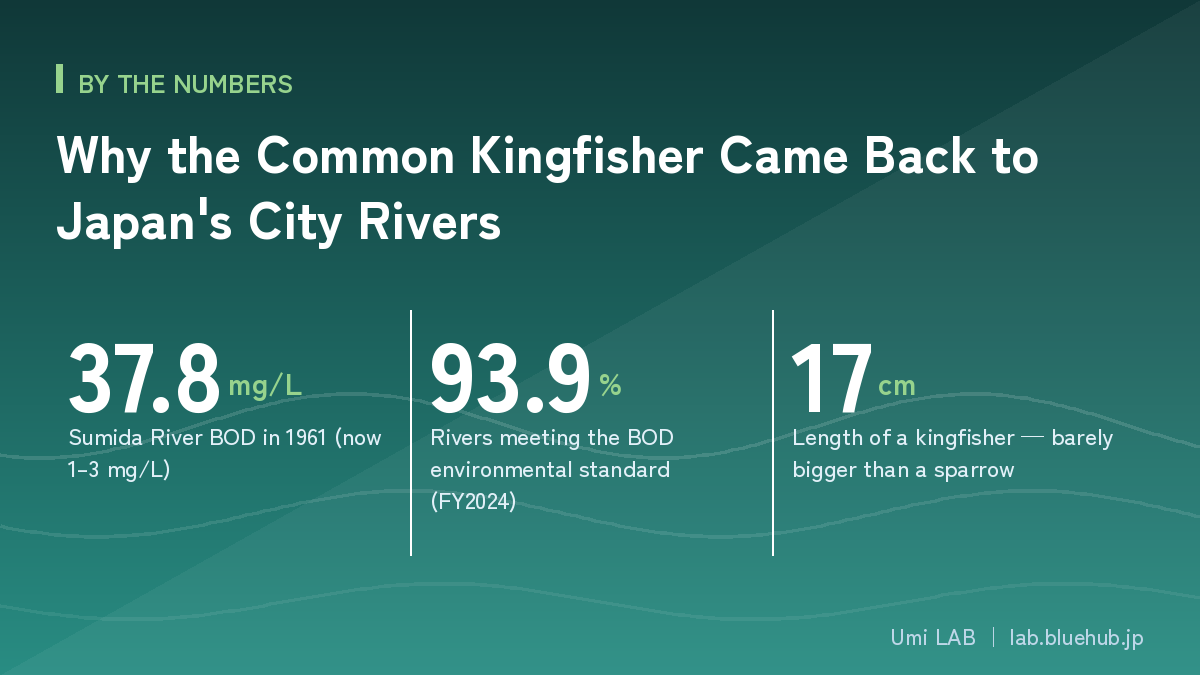
The 17 cm "flying jewel" is now breeding in central Tokyo. The Sumida River measured a BOD of 37.8 mg/L in 1961; today it runs at 1–3 mg/L. With 93.9% of rivers meeting the BOD standard and sewerage reaching 81.4% of the population, here is what actually brought the kingfisher back.
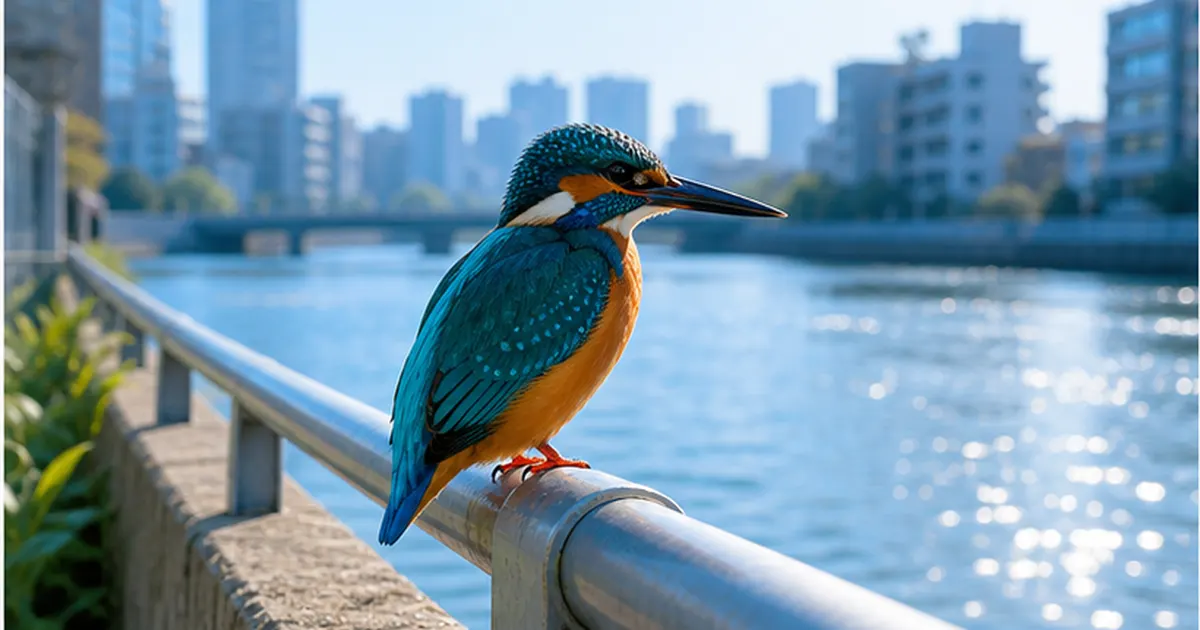
Blue and orange. A line drawn across concrete embankments with a highlighter pen. Almost everyone who sees a kingfisher for the first time on a city river does a double take. That colour simply does not belong to the ordinary Japanese landscape.
The common kingfisher is about 17 cm long — barely larger than a house sparrow. It was long treated as a symbol of clear mountain streams, and for a while it was called a "phantom bird" in cities. Yet in the 2020s, breeding has been confirmed in central Tokyo, including small rivers and ponds inside the Yamanote loop line. Sightings on urban rivers in Kanagawa, Osaka and Nagoya are no longer unusual.
This article asks why the kingfisher came back, starting from the water-quality numbers under our feet. "Because the rivers got cleaner" is only half the answer. Food, nest sites, topography and the distance the bird keeps from people all had to line up. And there is a harder point to make as well: the presence of a kingfisher does not automatically mean the river is rich.
What you will learn
- Why the kingfisher's blue is not pigment at all, but structural colour produced by nanostructures in the feather
- How rapid post-war growth drove the bird out of city rivers until it was called a "phantom bird"
- Primary data on how far water quality has actually recovered: Sumida and Tama river BOD, sewerage coverage
- The four conditions behind the urban comeback — water quality alone does not explain it
- What the kingfisher can and cannot tell you when used as a health check for a river
- How to find kingfishers in a city river, and the etiquette that keeps them there
What the "flying jewel" actually is
Start with the bird itself. Plenty of people know the name without being able to picture its size or its daily life accurately.
A body barely bigger than a sparrow
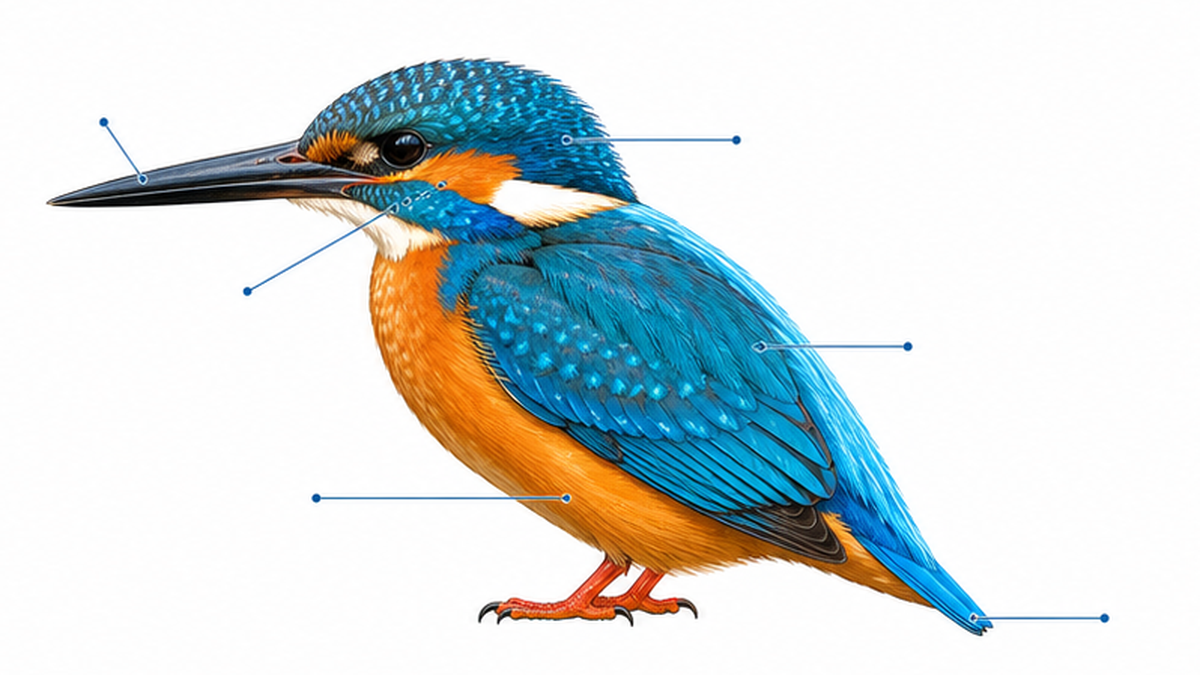
The common kingfisher (Alcedo atthis) belongs to the family Alcedinidae in the order Coraciiformes. It is roughly 17 cm long and weighs 20–40 g. A house sparrow is about 14 cm, so calling the kingfisher a small songbird-sized creature is entirely fair. It looks imposing in photographs only because it is shot with a long lens; nearly everyone who sees one in the flesh says the same thing — smaller than expected.
Within that small body the bill is disproportionately long, close to a quarter of the total length. The head is large, the tail short. This is not shaped for elegant flight but optimised for a single act: entering water to catch fish. Crossing from air into water means crossing between media of very different resistance, and the sharp, long bill cuts the surface first and disperses the impact.
In Japan the species breeds across almost the whole country, inhabiting rivers, ponds and lakes from lowlands to hills. Birds that breed in the north move to warmer regions in winter. It is not a rare bird — given the right conditions, it is a bird of everyday places.
That blue is not paint
The blazing blue of the back — the bird's defining feature — is not produced by blue pigment. It is structural colour, generated when fine nanostructures inside the feather interfere with and scatter light. That is why it reads as cobalt blue from one angle, turquoise green from another, and sometimes a dark indigo.
The science behind this became clear relatively recently. A turning point came in 1998, when R. O. Prum and colleagues applied Fourier analysis to electron-microscope images and showed that the spongy structure inside the feather barbs is quasi-ordered. On top of that, melanin deposited on the underside of the feather absorbs stray light and acts as a backing, making the blue seen from above far more vivid.
Structural colour in brief
- The blue comes from light interference and scattering in feather nanostructures, not from pigment
- It shifts between blue, green and indigo with viewing angle — pigment colours do not
- Melanin underneath acts like a sheet of black paper, deepening the blue
- Morpho butterfly wings and soap-bubble iridescence work the same way
How it hunts: ambush, hover, dive
Kingfisher hunting is fundamentally an ambush. The bird perches on a branch, stake or handrail overlooking the water and watches. When it spots prey, it plunges almost vertically into the surface and rises again with the fish clamped in its bill. Where there is nothing to perch on, it will hover — holding a fixed point in the air with rapid wingbeats — and dive from there.
The water surface reflects light, and because air and water have different refractive indices, a fish seen from outside is not where it appears to be. Kingfishers are thought to correct for this refraction as they strike, which means a fairly sophisticated computation is packed into a very small brain and eye.
Back on the perch, the bird beats the fish repeatedly against the branch or rail before swallowing it — both to avoid injury from bones and dorsal spines and to make sure the prey is dead. Besides fish it takes shrimp and aquatic insects. Because the body is small, metabolism runs hot: a kingfisher is said to need close to half its own body weight in food each day. So a river that can support kingfishers is a river with a reliable daily supply of small fish.
"Kingfisher" is not a single species
A note on naming. In Japanese, "kawasemi" almost always refers to this one species, Alcedo atthis. But the kingfisher family contains more than a hundred species worldwide, and several are recorded in Japan: the large crested kingfisher of mountain streams (about 38 cm), the ruddy kingfisher that arrives as a summer visitor, and the white-throated kingfisher, recorded as a vagrant in the southwestern islands.
What is interesting is that many members of the family barely depend on water at all, taking insects and lizards in forests. The idea that a kingfisher is by definition a fish-catcher comes from the habits of the one species Japanese people see most often. Read the other way round, this is a family with an unusually broad tolerance for different environments — and the move into urban rivers sits comfortably on that same continuum of flexibility.
| Species | Approx. length | Main habitat | Status in Japan |
|---|---|---|---|
| Common kingfisher | 17 cm | Rivers, ponds and lakes, lowland to hills | Breeds nationwide |
| Crested kingfisher | 38 cm | Mountain streams and reservoirs | Hokkaido to Kyushu, locally |
| Ruddy kingfisher | 27 cm | Forests and wooded streams | Summer visitor |
| White-throated kingfisher | 25 cm | Waterside, farmland, woodland edge | Vagrant; recorded on Ishigaki and Iriomote |
The kingfisher had disappeared from the city
Kingfishers may be a downtown sight now, but a few decades ago a kingfisher record in Tokyo or Osaka was headline news. Here is what happened, measured on the yardstick of water quality.
The Sumida, once called the river of death
According to Tokyo Metropolitan Government material, the Sumida River's BOD (biochemical oxygen demand) reached 37.8 mg/L in 1961. BOD is the oxygen microbes need to break down organic matter in water; the higher the figure, the dirtier the water. Given that a clean stream sits around 1 mg/L and the Type C environmental standard is 5 mg/L or less, 37.8 mg/L was extraordinary.
In summer the river reportedly gave off hydrogen sulphide, and passengers on boats wore masks. Where dissolved oxygen is exhausted, fish cannot live. Without fish there is nothing for a fish-eating bird. The absence of kingfishers was the consequence of a river ecosystem that had collapsed from the bottom — from the food up.
What drove the wildlife out
The damage done to urban rivers during the high-growth era had no single cause. At least four things overlapped.
- Untreated household wastewater: with sewerage undeveloped, domestic effluent flowed almost directly into rivers
- Industrial discharge: regulation was loose, and effluent containing organic matter and heavy metals was released untreated
- Three-sided concrete channelisation: prioritising flood control meant lining bed and banks with concrete, erasing aquatic habitat and the earthen banks kingfishers nest in
- Pesticides and chemicals: run-off from catchments reduced aquatic insects and small fish, and the loss travelled up the food chain
The third point is the one most often missed. Even in clean water, a kingfisher cannot breed in a river walled with vertical concrete, because the bird excavates a 50–100 cm horizontal burrow into an earthen bank with its bill. Bank engineering shut the kingfisher out by a route entirely separate from water quality.
The years of the "phantom bird"
So through the 1960s and 70s, kingfishers all but vanished from Japanese cities. For urban residents the kingfisher became a bird from field guides, a bird you had to travel to a mountain stream to see, and the labels "phantom bird" and "jewel of the clear stream" stuck. The bird's reputation as a symbol of pure water was, in fact, inseparable from the memory of having lost it.
Because of its degraded water quality, the Sumida River was once called the river of death.
― Tokyo Metropolitan Government Bureau of Construction, "#SumidagawaConnect" water quality and wildlife page
How clean did the rivers actually get?
"The rivers got cleaner" is usually said as an impression. Japan runs nationwide water-quality monitoring, so we can check it as a number instead.
93.9% of rivers meet the BOD standard
According to the Ministry of the Environment's FY2024 public water body quality survey, 93.9% of the 2,619 classified river bodies met the BOD environmental standard, up from 93.8% the previous year. River BOD compliance has stayed above 90% for 19 consecutive years since FY2006. Lakes, by contrast, reached only 50.8% for COD and coastal waters 78.2%, which lays out the situation plainly: rivers have improved; enclosed water bodies have not.
| Category | Compliance (FY2024) | Previous year | Indicator |
|---|---|---|---|
| Rivers | 93.9% | 93.8% | BOD |
| Lakes | 50.8% | 52.5% | COD |
| Coastal waters | 78.2% | 78.7% | COD |
| Health-related items (all) | 99.1% | 99.0% | 27 items incl. cadmium, lead, arsenic |
Compliance for health-related items — the 27 parameters covering human health — was 99.1%. Across 5,274 monitoring points and roughly 188,000 samples, exceedances were found at a cumulative 50 points. On the numbers alone, Japan's rivers have reached a level where toxicity is essentially not the problem.
Sewerage at 81.4%: the plumbing that changed the rivers
The single largest driver of that improvement was sewerage. National figures put the population served by public sewerage at about 101.28 million at the end of FY2023, a coverage rate of 81.4%. Counting septic systems, rural community wastewater facilities and the like, total wastewater treatment coverage reaches 93.3%.
In other words, roughly nine out of ten people in Japan live in homes whose wastewater is treated before it reaches a river or the sea. In the 1960s almost none of it was. The recovery of the rivers was less an environmental policy than an accumulation of pipework — and that is not an exaggeration.
What the Tama River's ayu tell us — and how much they wobble
The clearest living illustration is the ayu (sweetfish) of the Tama River. Tama BOD sometimes exceeded 10 mg/L in the 1970s; improvement followed, and by the 1990s the river was meeting the Type C standard of 5 mg/L or less.
Tokyo has surveyed ayu runs in the lower Tama since 1983. Recent estimates went from a weak 370,000 fish in 2020 and 320,000 in 2021 to roughly 2.5 million in 2022 and about 2.08 million in 2023 — a striking recovery. But 2024 came in at about 370,000 again, the second-lowest figure in recent years after 2021.
Read these numbers carefully
- Run size swings widely with water temperature, rainfall and conditions at sea
- One bad year does not prove the river has deteriorated again
- Equally, one spike does not prove full recovery
- What matters is the multi-decade trend line, not any single year
That volatility is worth keeping in mind whenever river wildlife is discussed. It behaves very differently in time from a problem like plastic, which accumulates and stays (related article: Plastic waste flowing from rivers to the sea).
Water quality is only part of why the bird came back
Here is the core of it. Cleaner water brought the kingfisher back — true, but only half true. In practice at least four conditions had to be met at once.
Condition 1: small fish and shrimp returned
What matters most to a kingfisher is whether there is something to eat today. In urban rivers with improved water quality, small fish such as pale chub, topmouth gudgeon and freshwater gobies came back, and shrimp and crayfish increased in the shallows. The interesting detail is that several of these species tolerate fairly dirty water. The kingfisher's dinner table was viable well before the river became anything like a clear stream.
A kingfisher needs close to half its body weight in food daily. Put the other way round, a river where kingfishers settle is not simply clean — it is highly productive of small fish. Clarity and productivity are different things, and there is no shortage of transparent rivers with very little life in them.
Condition 2: a substitute for the earthen bank
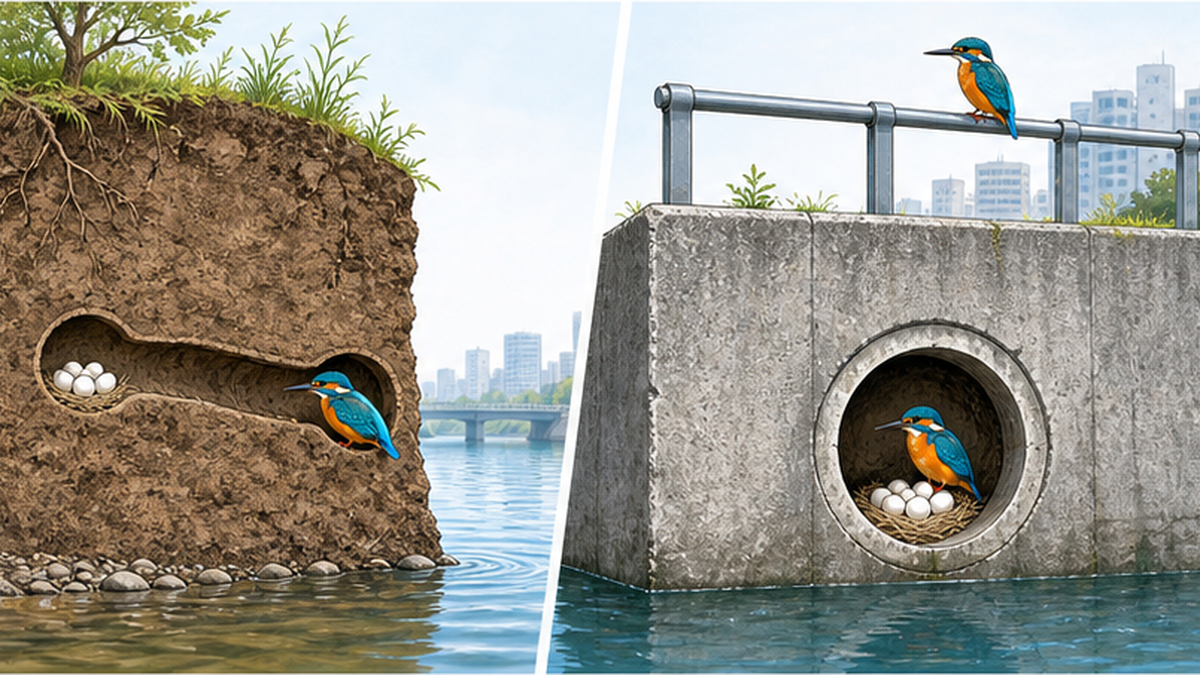
Kingfishers normally excavate a 50–100 cm burrow into an earthen bank beside water. The breeding season runs roughly from April to July; the female lays six or seven round white eggs, and both parents take turns incubating. In good conditions a pair may breed two or three times in a year — a reproductive rate worth noting when thinking about recolonisation of cities.
The problem is that concrete-lined urban rivers have no earthen banks. Yet urban kingfishers have been recorded nesting in the drainage holes built into revetments. A structure humans installed for flood control turned out, unintentionally, to work as a nest site: an artificial cliff that came into being inside the city.
The same substitution has happened with perches. Urban kingfishers use maintenance handrails, steps, stakes and fences in place of branches. This is adaptation that actively incorporates human structures.
Condition 3: an urban tolerance for people
Urban kingfishers will hunt calmly a few metres from a busy footpath. The species is naturally wary, so the likely explanation is that urban populations have learned to treat humans as harmless background. No hunting pressure, no feeding, just people passing by. That settled distance was a hidden precondition for urban colonisation.
The same shift shows in other waterbirds. Spot-billed ducks, little egrets, great cormorants and grey herons have all thickened the urban river avifauna over recent decades. Tokyo Metropolitan Government material records 23 fish species and 31 bird species on the Sumida River.
Condition 4: small catchments and green space stayed connected
The fourth condition is topography. Kingfishers do not live on rivers alone; they use park ponds, springs, irrigation channels and wooded slopes as a connected network of small water environments. Even central Tokyo retains small valleys called yato, cut into the Musashino Plateau, with springs and ponds at the bottom.
So the urban kingfisher is better understood not as having travelled back up the big rivers, but as having seeped in along the fine mesh of small water systems left inside the city. The next section takes up this "small catchment" perspective in detail.
The four conditions, summarised
- 1. Food: better water quality restored small fish and shrimp, securing a daily supply
- 2. Nest: drainage holes and similar structures replaced the earthen cliff
- 3. Distance: urban populations became tolerant of people
- 4. Terrain: park ponds, springs and small catchments formed a connected water network
Kingfishers raising chicks inside the Yamanote loop
The urban story is no longer a suburban one. It is happening in the middle of Tokyo.
What "Kingfisher City Tokyo" documented
In January 2024 Heibonsha published Kawasemi Toshi Tokyo (Kingfisher City Tokyo: Why the "Phantom Bird" Lives in Wealthy Residential Districts) by Hiroichi Yanase, a professor at Tokyo Institute of Technology (now the Institute of Science Tokyo) who previously worked as a journalist and editor at Nikkei BP.
What the book showed is that at multiple sites in central Tokyo — including locations inside the Yamanote loop line — kingfisher pairs were observed mating, excavating nests, raising chicks and seeing them fledge. Not "occasionally flies through the city centre" but completing a generation there. The difference matters.
The author reads the phenomenon not as nature simply returning but through "small catchment thinking". Many of Tokyo's wealthy residential districts sit on the edges of the Musashino Plateau or above yato valleys. Springs and ponds lie at the valley floor and greenery survives on the slopes. In a city centre with extreme land prices and development pressure, the affluent residential district ironically preserved exactly the terrain and vegetation the kingfisher needs.
Not old wilderness — new wilderness
The important point is that this is not old nature coming back. What these birds use are concrete handrails, drainage holes and artificially built park ponds. It is an ecosystem newly assembled on top of an environment humans rebuilt — the inhabitants of what might be called a new wilderness.
This echoes the logic of satoyama and satoumi: human involvement does not necessarily damage biodiversity, and appropriate engagement can sustain it (related article: What satoumi means: how human hands enrich the sea). The urban river kingfisher may be the city version of the same idea.
What the national breeding bird survey found
Beyond individual observations, national data helps. The National Bird Breeding Distribution Survey (2016–2021), run with the Ministry of the Environment's Biodiversity Center, was the first large-scale survey in about twenty years: 2,106 participants surveyed 2,344 sites nationwide, recorded 379 species and produced breeding distribution maps for 278.
What it revealed was not a uniform rise or fall but a reshuffling. Forest birds and non-native species expanded their ranges, while sparrows and barn swallows — the most familiar birds of farmland and open ground — declined. Birds that were close are receding; birds that were distant are moving in. The kingfisher's urban return is one frame of that larger rearrangement.
Is the kingfisher a health check for a river?
People often say a river with kingfishers is a good river. How far does that intuition hold? Consider it through the idea of an indicator species.
Where the kingfisher works well as an indicator
An indicator species is one whose presence or abundance reports on the state of an environment. The kingfisher has real strengths here.
- It sits high in the food chain: it cannot survive without abundant small fish, so the health of everything below is bundled into its presence
- It needs physical structure to nest: so it evaluates the diversity of the bank, not just the chemistry of the water
- It is conspicuous and easy to identify: non-specialists can record it reliably, so citizen data accumulates
- It is resident: using breeding rather than sighting lets you measure sustained quality rather than a moment
The last point deserves emphasis. Switching the indicator from "seen" to "bred here" sharpens the precision considerably. A bird that stopped over once while dispersing guarantees nothing about the site.
But a kingfisher does not certify a rich river
Reading too much into the bird's presence is a mistake, for three reasons.
First, several of the small fish kingfishers eat are quite pollution-tolerant. As noted, the food supply can work before the river resembles a clear stream. A kingfisher proves there are fish; it does not prove the water is clean.
Second, there is pollution that BOD and COD cannot see. Microplastics, pesticides, pharmaceutical residues and PFAS do not register on organic-matter indicators. A 99.1% compliance rate for health-related items is reassuring, but it means "few problems among the 27 parameters we measure" — it says nothing about what is not measured.
Third, the presence of one species cannot measure the quality of biodiversity. A river can hold kingfishers while native aquatic plants disappear, invasive species dominate and benthic species richness collapses. The kingfisher is a sensor reporting that one cross-section is sound — not a full diagnostic report on the river.
| What the indicator can tell you | What it cannot |
|---|---|
| Small fish are supplied reliably | The water is chemically clean |
| The bank retains nestable structure | The native aquatic community is intact |
| Human disturbance is not excessive | Invasive species are being held back |
| The food chain functions to mid-level | Overall ecosystem diversity is high |
The trap in "there are kingfishers, so we're fine"
The recovery of a charismatic animal is easy to narrate as a policy success, and easy for both administrations and citizens to grasp. That is not a bad thing in itself — but if the return of one species is taken as the resolution of the whole problem, less visible pollution and the erosion of diversity get left alone. The useful stance is to keep asking: the kingfisher came back, so what do we look at next?
Going to see one: how to look, and how to behave
If you are now wondering whether your local river has one, here is how to search — and what you must not do.
Where to look
Walking a riverbank at random is inefficient. Narrow the search to the conditions kingfishers prefer.
- Shallow water with a visible bottom: seeing fish from above is a precondition for the hunt
- A perch overlooking the water: overhanging branches, stakes, handrails, fences, sign edges
- Slow flow: below weirs, in backwaters, ponds, and where channels join
- Artificial water counts: park ponds, retention basins and moats are all strong candidates
- Under bridges and in shade: birds often rest out of direct sun
When and how to search
Early morning and late afternoon are the best windows: fewer people, more feeding activity. Spring and early summer bring active breeding behaviour and easy observation, though for reasons given below you must never approach a nest. Winter, with the vegetation died back and sightlines open, is arguably the easiest season for a beginner.
Use your ears before your eyes. Kingfishers call in flight with a thin, high "cheee" or "tsee". Learning that call raises your detection rate dramatically. Follow the direction of the sound just above the water surface and you will see the blue line cross.
Three things to do first
- Map the rivers and ponds near you and mark places that are shallow, slow-flowing and have perches
- Listen to the call a few times on your phone — this is the single biggest improvement to your search efficiency
- Get binoculars (around 8×). Before a camera, binoculars make observation far more enjoyable
Etiquette, especially in the breeding season
Precisely because the kingfisher is a popular subject, harm caused by observers and photographers has become a problem in many places. Please observe the following.
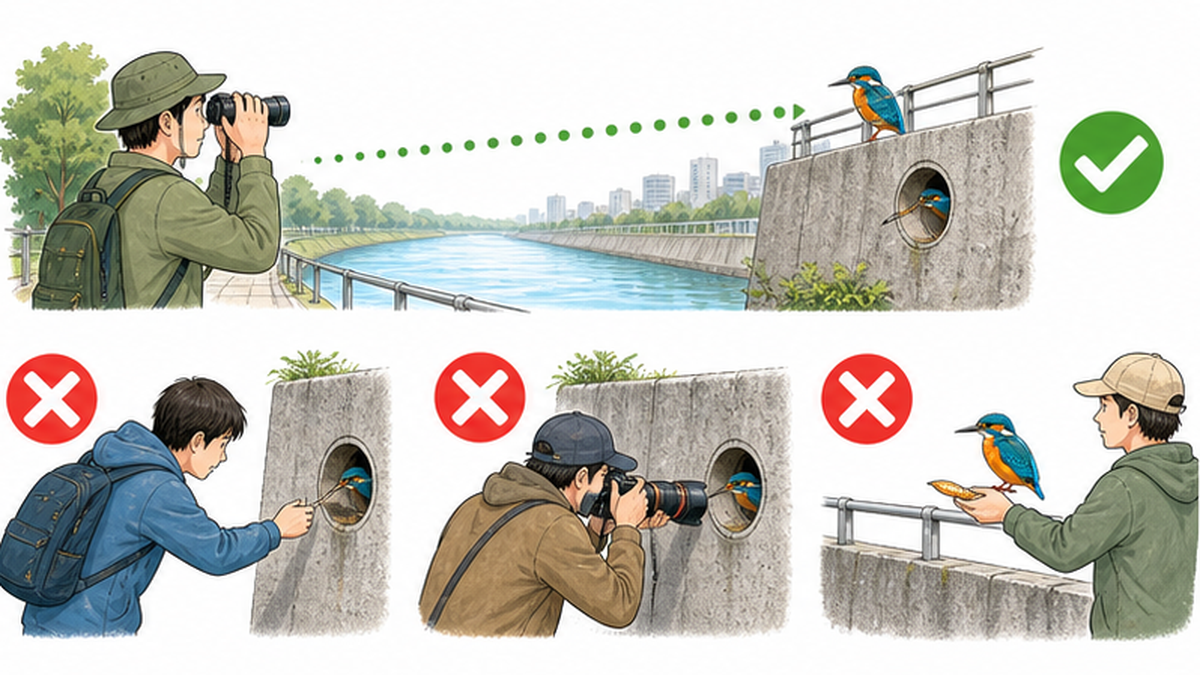
- Do not approach nest burrows, and do not publish their locations: this causes nest abandonment and attracts predators. Avoid geotagged social media posts as well
- Do not bait: releasing live fish to stage a photograph has been reported. It alters behaviour and affects other wildlife
- Do not modify the habitat: cutting branches or clearing vegetation around a perch because it obstructs your shot is indefensible
- No flash: strong light at dusk or night is a serious stressor
- Do not occupy a spot for hours: large groups staying long make birds abandon that stretch
- Stay out of private land and restricted areas: river structures also carry risks of falls and flash flooding
The basic rule of birdwatching is to protect the place where you found the bird. The fact that you could see it means the site still works. Leaving it in a state where the next person can see it too is the minimum responsibility of an observer. The same argument runs through stopover site conservation for migratory birds (related article: Shorebirds and the crisis of Japan's tidal flats).
Making city rivers richer than this
The kingfisher's recovery is a waypoint, not a destination. Where do the rivers go from here? Three directions.
1. Change what goes in — household wastewater
Sewerage coverage of 81.4% and total wastewater treatment coverage of 93.3% also mean that roughly 7% of the population is still not connected to any treatment. And treatment plants, while effective on organic matter, nitrogen and phosphorus, cannot remove every trace of cooking oil, pharmaceutical residue and microplastic put down a drain.
Do not pour cooking oil down the sink. Use only as much detergent as needed. Do not flush leftover drinks or medicines. It is unglamorous, but reducing the load on the plant directly reduces what escapes untreated. In practice, most of the work of cleaning a river happens in kitchens and bathrooms.
2. Change the bank — nature-oriented river works
Now that water quality has improved, the bottleneck for urban river biodiversity is shifting to physical monotony. A straightened, three-sided concrete channel offers little habitat however clean the water. Recent river engineering in Japan pursues "nature-oriented river works", retaining riffle-and-pool variation, waterside vegetation and earthen slopes while maintaining flood-control capacity.
For the kingfisher, this means the return of nestable earthen banks — moving on from making do with drainage holes. Bank refurbishment and river plans are frequently opened to public comment by local authorities, which leaves room for residents to shape them.
3. Record it — citizen eyes become data
Just as the national breeding bird survey depended on 2,106 volunteers, bird monitoring does not work without public participation. When, where, how many, doing what. Accumulating that plain record is the only evidence that will let anyone, decades from now, say how things changed.
The kingfisher is easy to identify and therefore a good fit for citizen science. Observation apps, local bird society reports and municipal wildlife surveys all offer an entry point (related article: What citizen science is: wildlife surveys anyone can join).
What you can do today
- Walk your local river or park pond once with binoculars — first find out whether the bird is there
- Keep oil and food waste out of the kitchen drain, consistently, to cut the treatment load
- Record what you see, but never publish nest locations
- Read your municipality's river plans and public comment notices, and check how the waterside is treated
- Join a local wildlife survey or clean-up, even once a year
What that blue line means
No single person brought the kingfisher back to the city. The people who laid the sewers, the people who drafted the discharge regulations, the people keeping treatment plants running, the people sampling river water every month, the people who argued to keep the waterside natural during works — and the countless ordinary people who simply did not pour oil down the sink. The sum of all that is why a 17 cm bird returned to a concrete river.
It is not, however, a completed recovery. As the swing in Tama River ayu runs shows, urban ecosystems sit on thin ice, and pollution our indicators do not measure remains. When the blue line crosses in front of you, what it offers is not reassurance but a fact — this much we managed to restore — and a question about everything we have not.
References
- Ministry of the Environment, Japan – FY2024 water quality survey of public water bodies and groundwater (river BOD compliance 93.9%)
- Tokyo Metropolitan Government, Bureau of Construction – "#SumidagawaConnect" water quality and wildlife (BOD 37.8 mg/L in 1961; now 1–3 mg/L; 23 fish and 31 bird species)
- Ministry of Land, Infrastructure, Transport and Tourism – Wastewater treatment coverage at the end of FY2023 (sewerage 81.4%, total treatment 93.3%)
- Ministry of the Environment, Japan – National Survey on the Natural Environment: National Bird Breeding Distribution Survey (2016–2021)
- Tokyo Metropolitan Islands Area Research and Development Center of Agriculture, Forestry and Fisheries – Summary of the 2024 ayu run survey on the Tama River
- Tokyo Metropolitan Government – An estimated 2.08 million ayu ran up the Tama River (2023 press release)
- Tokyo Metropolitan Government, Bureau of Construction – River wildlife guide: common kingfisher (morphology, ecology, breeding)
- Wild Bird Society of Japan, BIRD FAN – Common kingfisher (Alcedo atthis): distribution and ecology
- Heibonsha – Hiroichi Yanase, Kingfisher City Tokyo: Why the "Phantom Bird" Lives in Wealthy Residential Districts (Heibonsha Shinsho, January 2024)
- MLIT Water and Disaster Management Bureau – Overview of river water quality: measures and results in water quality improvement
* Ordered by reliability: government and academic institutions > peer-reviewed papers > specialist organisations > trusted media