⚡ In short
Antarctic krill, a crustacean just 6 cm long, sustain whales, penguins and seals with an estimated biomass of 379 million tonnes, and their sinking faecal pellets lock 20 million tonnes of carbon into the deep ocean each season. Drawing on primary sources, this article explains their biology, the 440 km poleward shift of their range, and why the 2025 fishing season hit its catch limit for the first time in history.
When people picture the Antarctic ocean, they usually think first of whales, penguins and seals. Yet what actually feeds those enormous animals is a small, translucent, shrimp-like crustacean barely six centimetres long. Its name is the Antarctic krill (Euphausia superba).
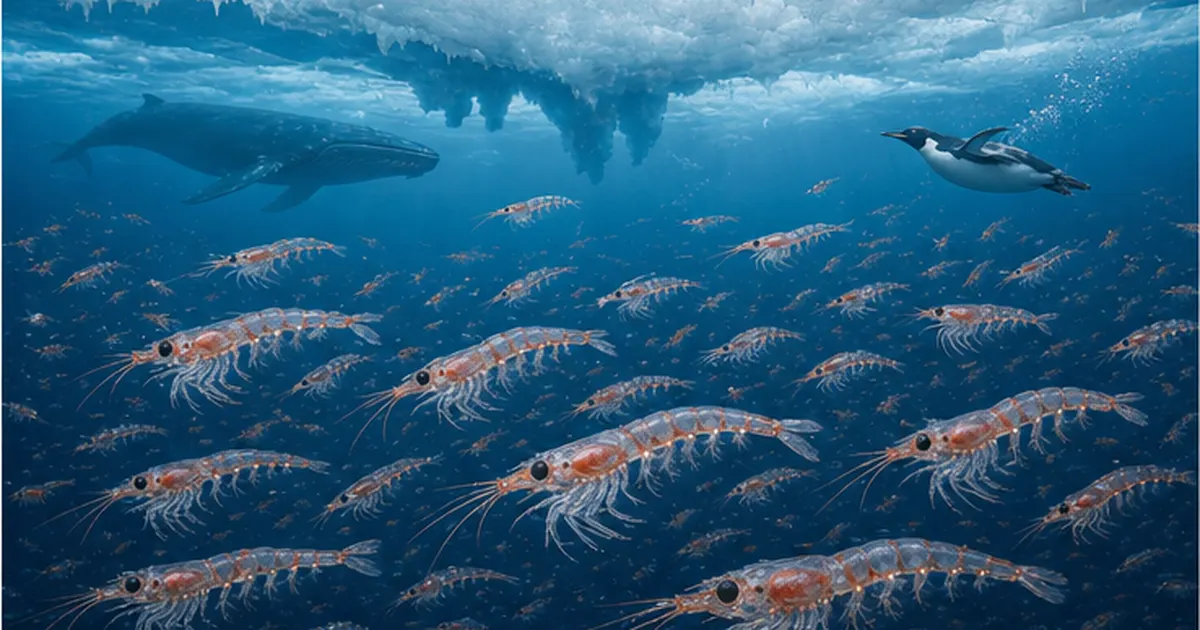
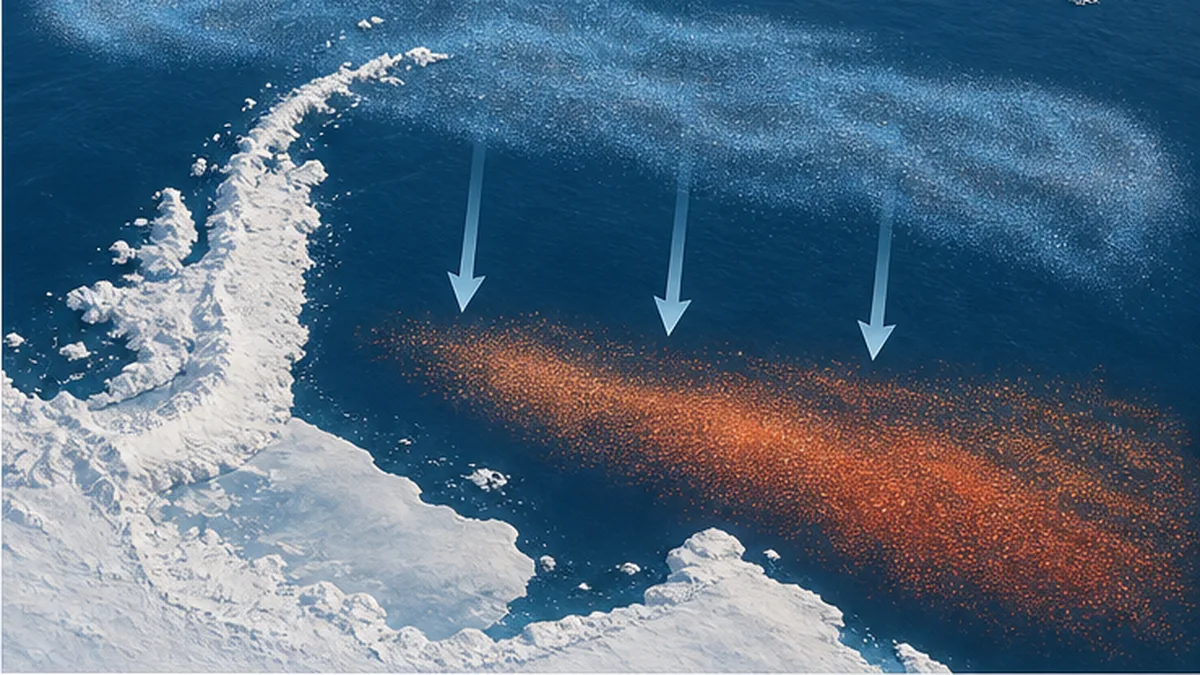
What makes this small creature remarkable is sheer number. A study that estimated total abundance across the Southern Ocean from long-term surveys arrived at a best estimate of around 379 million tonnes. Given that humanity's total annual wild catch from all the world's oceans is somewhere around 90 million tonnes, that is the order of magnitude we are talking about — for a single species. Dense swarms reach 10,000 to 30,000 individuals per cubic metre and can sometimes be seen from satellites as reddish bands on the sea.
In recent years, the situation surrounding this vast resource has begun to shift. As sea ice retreats, the distribution has been moving slowly southward, and in 2025 the fishery reached its designated limit for the first time in history. At the same time, we have learned that the amount of carbon krill carry to the deep sea in their faeces rivals that of mangrove forests and seagrass meadows. This article sets out both what makes Antarctic krill fascinating as animals and what is changing right now, drawing on public agencies and peer-reviewed research.
What you'll learn in this article
- The basics of krill as animals: body structure, lifespan and the scale of their swarms
- Why they are called the keystone species of the Southern Ocean, and where they sit in the food web
- A life cycle in which eggs develop while sinking, and juveniles overwinter beneath the sea ice
- How warming and sea-ice loss are changing their distribution and recruitment, and what remains uncertain
- How CCAMLR manages the fishery, and what it meant when the catch limit was reached for the first time in 2025
- Their role as an overlooked form of blue carbon, moving carbon to the deep sea through faecal pellets
What kind of animal is the Antarctic krill?
Let us start with the animal itself. Despite looking very much like a small shrimp, krill belong to neither the shrimps nor the mysids, but to an independent group of their own: the order Euphausiacea. About 85 species are known worldwide, and the flagship species of the Southern Ocean is the Antarctic krill.
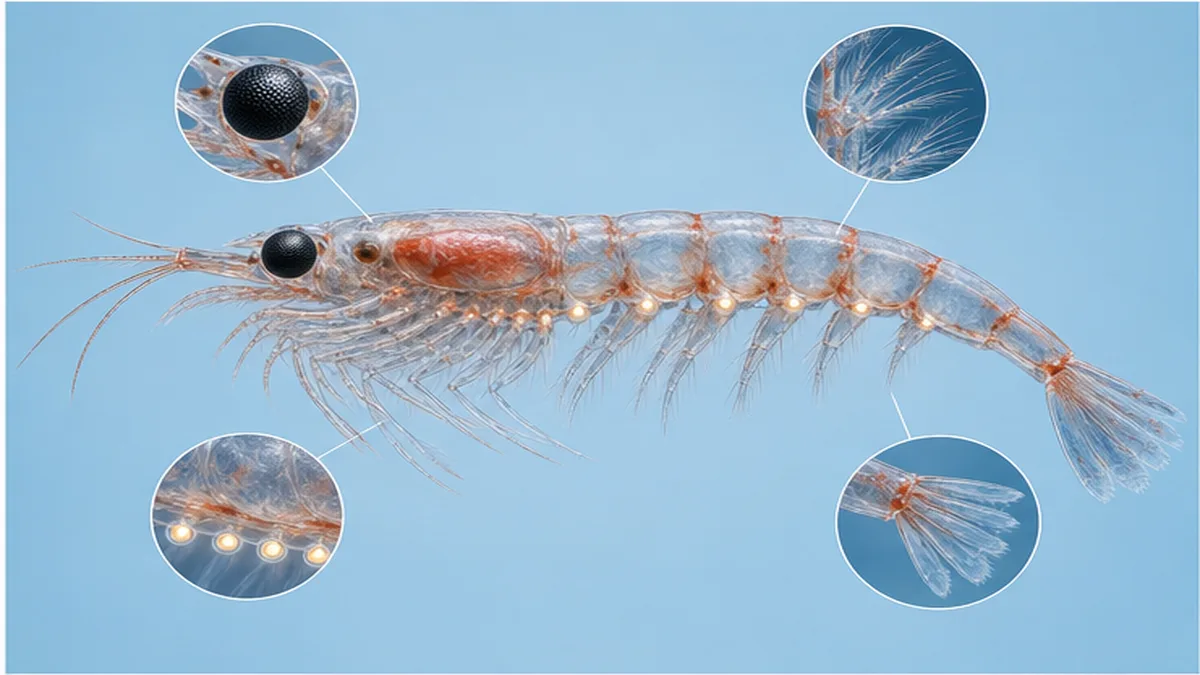
Six centimetres long, translucent, and studded with light organs
Adults measure roughly 5.0 to 6.5 centimetres and weigh about 2 grams on average, with females slightly larger than males. The body is semi-transparent, and pigments from the phytoplankton in their gut can sometimes be seen through it as a greenish tint. The head bears large black compound eyes, and the thorax carries a row of legs fringed with fine bristles for filtering food.
One striking feature is the photophores distributed across the body — on the abdomen and at the base of the eyes — which emit blue light. Their function is not fully understood, but they are thought to be used for counter-illumination, erasing the animal's silhouette against the light for predators looking up from below, and possibly for coordination within the swarm.
A long-lived plankton that survives five to seven years
The word plankton tends to conjure short-lived organisms that turn over in days or months. Antarctic krill are different. They live five to seven years, with reports of up to eleven, and take about two years to reach sexual maturity. Their capacity for long-distance swimming is limited and they are largely carried by currents, which classifies them as zooplankton — yet the timescale of their lives is closer to that of a small fish.
This longevity shapes how they behave as a resource. Because a cohort born in one year persists in the population for several years, a run of good recruitment years builds a thick stock, while poor years show up as effects several years later. It is one reason a single season of observation reveals so little about the whole picture.
About 85 species worldwide — including relatives in Japanese waters
Krill are not exclusively Antarctic animals. Roughly 85 species are distributed across the world's oceans, each occupying the middle of its local food web. Several occur around Japan, and the North Pacific krill (Euphausia pacifica, known locally as isada), caught off the Sanriku coast, is a familiar fishing bait and aquaculture feed. A good share of what is sold as "krill" in Japan is this species, not the Antarctic one.
In other words, the krill way of life — filtering phytoplankton directly, multiplying in vast numbers, and being eaten wholesale by animals above — is a model that has succeeded repeatedly across the world's oceans. What sets the Antarctic krill apart is the quantity of food the Southern Ocean provides, and the sheer scale of the answer they have given to predation: the swarm.
Swarm densities of 10,000 to 30,000 individuals per cubic metre
The defining characteristic of Antarctic krill is that they form extremely dense swarms. Densities reach 10,000 to 30,000 individuals per cubic metre, swarms can extend for kilometres, and total numbers run from billions into the trillions. On a ship's echo sounder they register as a dense return resembling the seabed, and this acoustic property is what makes stock surveys possible.
The composition of swarms is intriguingly uneven. Swarms consisting only of juveniles, only of females, or only of males have all been observed, suggesting some social structure rather than mere chance aggregation. The mechanism, however, remains unresolved.
| Item | Details |
|---|---|
| Common / scientific name | Antarctic krill / Euphausia superba |
| Classification | Phylum Arthropoda, subphylum Crustacea, order Euphausiacea |
| Size and weight | 5.0–6.5 cm as adults, about 2 g on average |
| Lifespan | 5–7 years (up to 11 reported); maturity at about 2 years |
| Distribution | Southern Ocean, circumpolar, mainly south of the Antarctic Circumpolar Current |
| Main food | Phytoplankton, ice algae growing under sea ice, small zooplankton |
| Swarm density | 10,000–30,000 individuals per cubic metre when dense |
| Estimated biomass | About 379 million tonnes (estimates range from 60 to 500 million) |
Why are there so many of them in the Southern Ocean?
A biomass of over 300 million tonnes concentrated in a single animal species is extraordinarily rare on Earth. Why the Southern Ocean? The answer lies in the unusual food-supply machinery this sea provides.
The ice-algae pasture on the underside of the sea ice
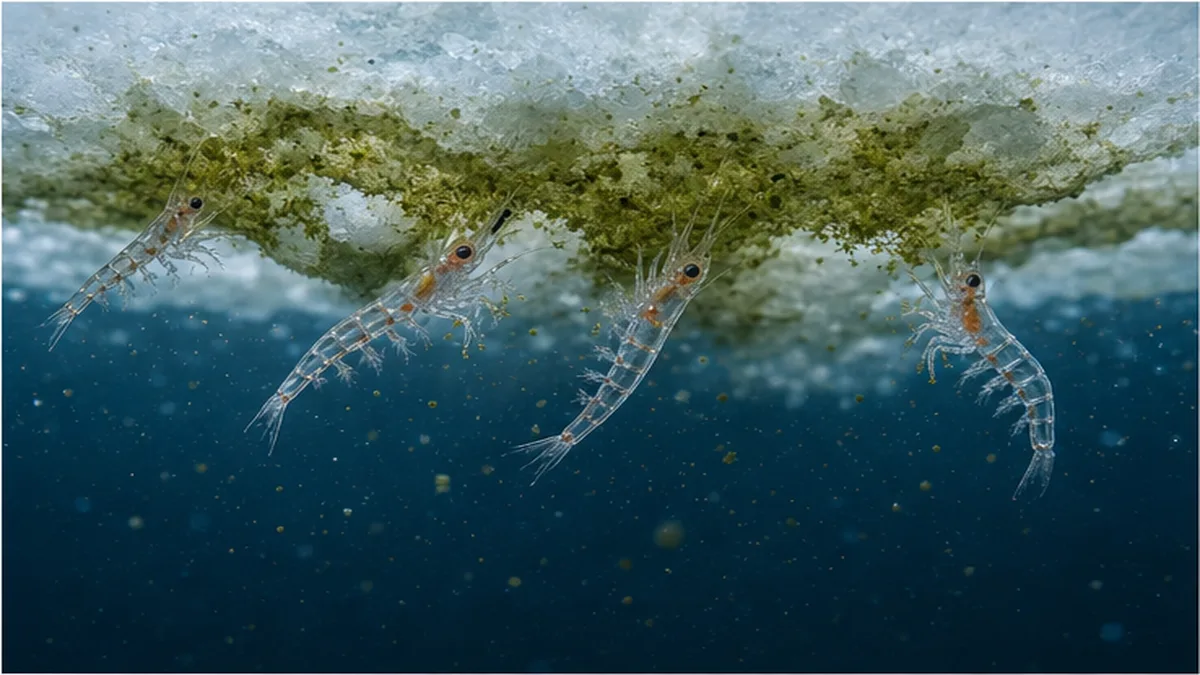
Antarctic sea ice is not simply a slab of frozen water. Within the ice and in the fine spaces along its underside live dense communities of algae, mostly diatoms, known as ice algae. The underside can be stained brown with them, and this becomes a vital feeding ground from winter into early spring.
For newly hatched larvae in particular, this pasture beneath the ice is the difference between life and death. Winter in the Southern Ocean offers little light, and phytoplankton in the water column barely grow. Only because sea ice acts as a refrigerated larder can young krill survive their first winter. This is the root of the relationship in which the extent and duration of sea ice govern how many krill there will be in following years.
Nutrients delivered by the Antarctic Circumpolar Current and upwelling
The Antarctic Circumpolar Current, which flows eastward endlessly around the Antarctic continent, is the largest ocean current on Earth. Along its path, nutrient-rich water wells up from the deep. When summer returns the sunlight and the sea ice melts, nutrients and light coincide and phytoplankton multiply explosively in a bloom.
Antarctic krill are positioned to exploit this burst of primary production almost exclusively. How phytoplankton underpin production on a planetary scale is explained in Phytoplankton produce half of Earth's oxygen.
The order of magnitude behind 379 million tonnes
Biomass estimates rest on a long research history. A reanalysis of standardised net-sampling data collected between 1926 and 2004 produced a best estimate of 379 million tonnes for the mean total biomass across the Southern Ocean. Methods and interannual variability differ widely, however, and the literature as a whole spans 60 million to 500 million tonnes.
Today, the biomass estimates that underpin catch limits come mainly from acoustic surveys using scientific echo sounders. A vessel follows predetermined transects while recording backscatter, which is combined with length composition from net samples to calculate abundance. Even so, the Southern Ocean is vast, much of it inaccessible behind ice, and the estimates carry unavoidable uncertainty.
Why "lots of biomass" does not mean "safe to fish"
- Biomass estimates vary greatly between years and areas, so a single year's figure cannot simply be projected forward
- Krill move little under their own power and are carried by currents, so a locally depleted patch is not quickly refilled
- Predators such as penguins and seals can only forage within tens of kilometres of their breeding colonies, and it is density within that narrow range that decides survival
- In short, "the total across the Southern Ocean" and "what the penguins on that island can actually eat" are two different questions
Their role as the keystone of the Antarctic food web
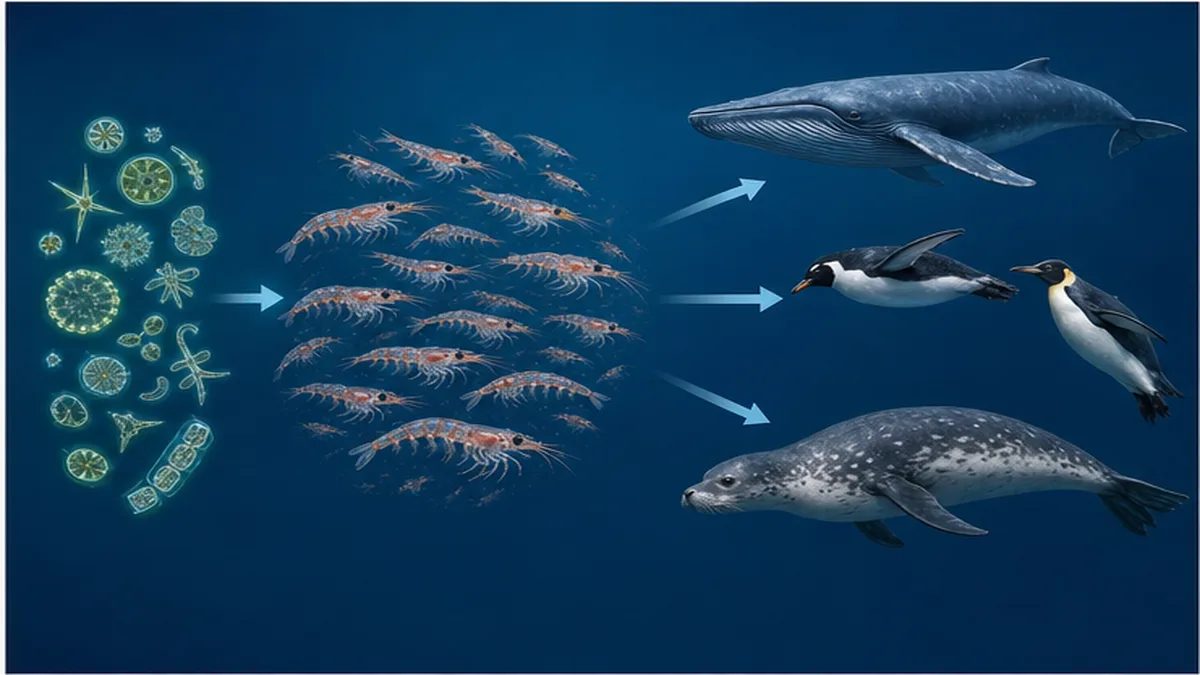
Antarctic krill are called a keystone species not simply because they are numerous, but because the Southern Ocean food web is structured around an extreme dependence on this one species.
Whales, seals and penguins — the animals that depend on krill
Baleen whales such as blue, fin and humpback whales swallow enormous quantities of krill during the Antarctic summer, storing a year's worth of fat. Why whales travel thousands of kilometres is covered in Why do whales migrate thousands of kilometres?.
Among seals, the crabeater seal stands out. Despite its name it does not eat crabs: more than 90 per cent of its diet is krill, and its teeth have evolved into an elaborate sieve of interlocking cusps that strains krill from mouthfuls of seawater. Its status as the world's most abundant seal is the reward for that specialisation.
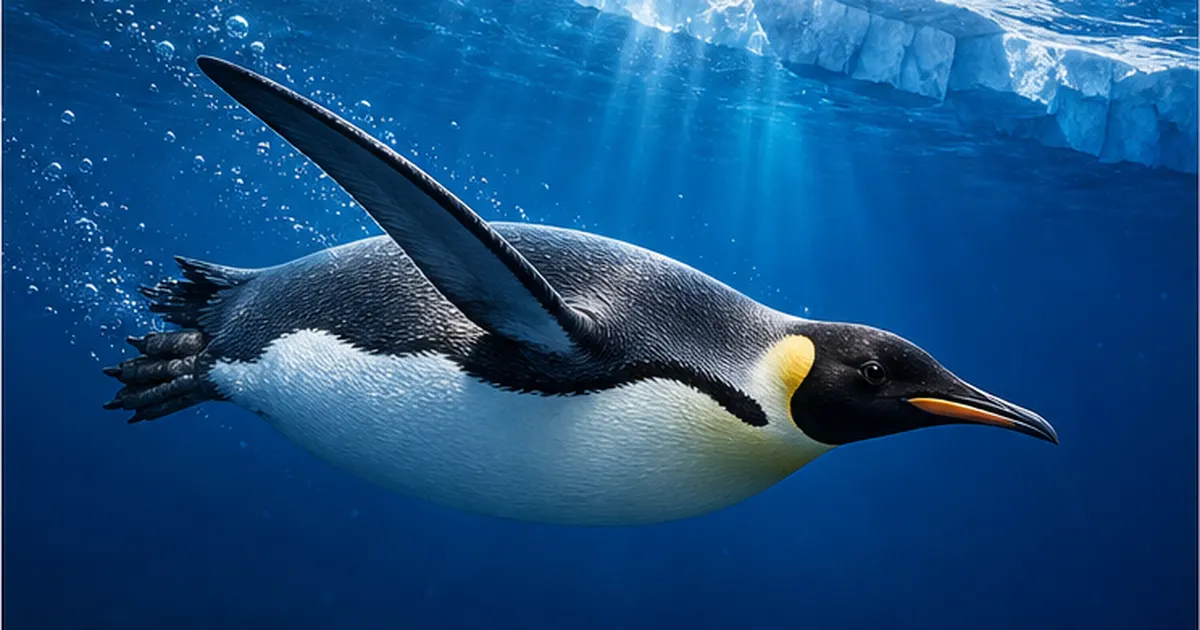
Among penguins, Adélie, chinstrap, gentoo and macaroni species all rely on krill as a principal food. For how penguins dive so deep and so long, see Why can penguins dive so deep and so long?. Fish, squid, seabirds, and in turn the orcas and leopard seals that eat them — almost every major animal of the Southern Ocean connects to krill, directly or indirectly.
Consumption by predators, in numbers
Estimates of how much krill predators consume annually vary widely, but there is enough to establish the order of magnitude. Baleen whales as a group are estimated at 34 to 43 million tonnes per year, and seals as a group at 63 to 130 million tonnes. A single blue whale eats krill numbering in the millions each day, and even one Adélie penguin takes around a kilogram daily.
| Predator | Degree of dependence on krill | Estimated annual consumption |
|---|---|---|
| Baleen whales (blue, fin, humpback and others) | Principal summer food | 34–43 million tonnes |
| Seals (mainly crabeater seals) | Over 90% of the crabeater seal's diet | 63–130 million tonnes |
| Penguins (Adélie, chinstrap, gentoo and others) | Staple during the breeding season | About 1 kg per bird per day |
| Fish, squid and seabirds | A principal food for many species | Estimates vary widely |
Recovering whales and a new competition over krill
There is also a difficult problem born of welcome news. Baleen whale populations in the Southern Ocean, decimated by twentieth-century commercial whaling, are recovering under protection. Reports of humpback and fin whales returning to waters around the Antarctic Peninsula have accumulated, and this in itself is a conservation success.
But more whales also means more mouths eating krill. A 2024 study in Nature Communications pointed out that whale recovery and the expansion of the krill fishery are increasingly overlapping in the same waters and the same seasons, creating a new dimension of human–wildlife conflict. The old "krill surplus hypothesis" held that whaling freed up krill for other animals; what is happening now is that process running in reverse.
The crucial point is that this competition plays out area by area. Even if the Southern Ocean as a whole has slack, whales, penguins and fishing vessels all converge on the same places where krill concentrate. That is why the focus of management has shifted from total volume to spatial allocation.
The richness — and fragility — of a short food chain
Part of the Southern Ocean food web is complete in just three steps: phytoplankton → krill → large predators. Because energy is lost heavily at every trophic step, fewer steps means greater efficiency. The blue whale, the largest animal in Earth's history, exists because of that shortness.
But efficiency is also fragility. With few substitutable species in the middle, any decline in krill transmits straight upward. Chinstrap penguin numbers have fallen sharply in parts of the Antarctic Peninsula, and links to changes in sea ice and krill have been suggested. Research that reads the state of the sea from changes in krill-eating animals is now advancing.
A life cycle of sinking eggs and winters under the ice
The life history of the Antarctic krill has taken a distinctive shape, moulded by its environment. The way the eggs develop and the way the animals pass the winter are both remarkable.
Developmental descent: eggs that grow as they sink
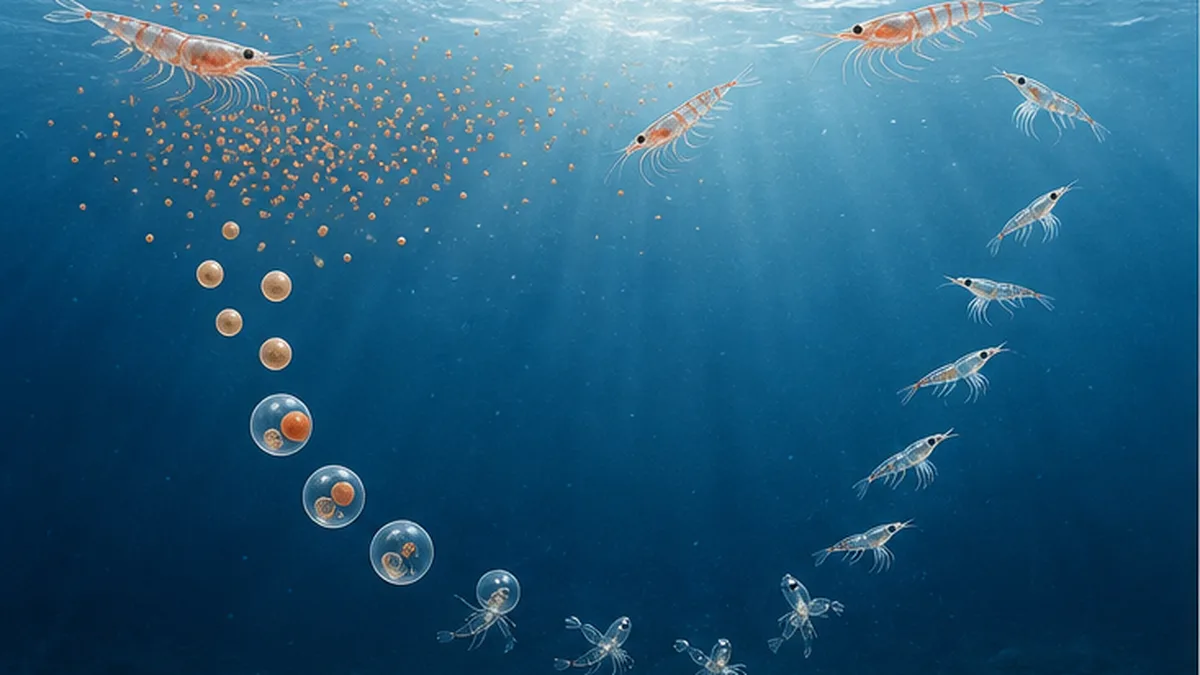
In summer, a female releases several thousand eggs at a time. Rather than staying near the surface, the eggs develop as they sink. Cell division proceeds as they descend from several hundred to around a thousand metres, and they hatch as nauplius larvae. The larvae then swim upward under their own power towards the food-rich surface. This sequence is known as developmental descent and ascent.
Why sink? The surface swarms with predators, and eggs there risk being carried by currents into unsuitable waters. Completing development quietly at depth appears to improve survival. Because hatched larvae make the several-hundred-metre climb without feeding at all, whether they complete that ascent in time is the first hurdle of their lives.
Surviving the first winter beneath the sea ice
Larvae that reach the surface pass through calyptopis and furcilia stages, changing form as they feed on summer phytoplankton. When autumn arrives, they gather on the underside of the sea ice and overwinter there, feeding on ice algae. The rough topography of the ice also provides refuge from predators.
In years with little sea ice, or when ice forms late and melts early, survival of the young is poor. This winter bottleneck is why krill recruitment — the number of new individuals joining the population — correlates so strongly with sea-ice conditions.
Shrinking when starved: using moults to get smaller
Antarctic krill possess one more unusual ability. Through the food-scarce winter, they shrink their bodies at each moult, reducing the energy they need. For most crustaceans moulting is a means of growth; krill also use it to contract.
Nor is shrinking the whole of it. While enduring starvation, krill lower their metabolism itself and slowly draw on stored lipids as they wait for spring. Months with almost no food in the winter Southern Ocean are survived through a three-part strategy: get smaller, run leaner, and scrape by on the sparse algae under the ice. As an adaptation to an extreme environment, it is simple yet highly refined.
Excellent as a survival strategy, this creates a real headache for research: the standard method of inferring age from body length breaks down. An individual of a given length might be two years old, or six. It is one reason the age structure and population dynamics of krill are so hard to pin down.
The life of an Antarctic krill, in brief
- In summer a female releases several thousand eggs, which develop while sinking several hundred to a thousand metres
- Hatched larvae swim up to the surface without feeding — the first hurdle of their lives
- They grow on phytoplankton through the summer, then move to the underside of the sea ice to overwinter
- Maturity comes at about two years; lifespan is five to seven years, with reports up to eleven
- When food is scarce they shrink at each moult, which makes age impossible to infer from body length
Warming and sea-ice loss are pushing krill southward
From here on, we turn to what is happening now. Because krill lives are so tightly bound to sea ice, Antarctic warming registers directly as a change in the foundation of their existence.
The centre of distribution has moved about 440 km south
A study analysing long-term data going back to the 1920s (Atkinson et al., 2019, Nature Climate Change) showed that in the southwest Atlantic sector the centre of the Antarctic krill distribution has shifted roughly 440 kilometres south, towards the pole. At the same time, swarms became less frequent along the northern edge of the range and densities there declined.
This is a region where Antarctic warming has advanced particularly fast, and the annual sea-ice season has been reported to have shortened by around three months. Declining recruitment of juveniles was observed over the same period, suggesting that environmental change and the population's response are linked.
2023: the lowest sea ice on record
Antarctic sea-ice extent hit a satellite-record low in February 2023, followed by record-low levels through the following winter from June to September. Unlike the Arctic, Antarctic sea ice long showed no clear declining trend, but low states have become conspicuous since around 2016.
The effects of ice loss are compound. Beyond the loss of overwintering habitat and ice algae for larvae, an exposed sea surface changes heat release from ocean to atmosphere and the influence of waves. A sea stripped of its lid is exposed to wind and swell, altering how the surface layer mixes and, in turn, how phytoplankton grow.
What is happening in sectors beyond the Antarctic Peninsula?
Most of the discussion of change concentrates on the southwest Atlantic sector, from the Antarctic Peninsula into the South Atlantic. It is where krill research is most heavily accumulated, and also where warming has been fastest. The krill fishery is likewise concentrated almost entirely there.
For other sectors — the Indian Ocean and Pacific sectors — surveys have simply been too infrequent to support statements about long-term trends. The Southern Ocean covers some 20 million square kilometres, much of it locked behind ice and heavy weather for most of the year. It is worth holding on to the premise that in this ocean, the gap between what is known and what has never been surveyed is unusually wide.
Why we cannot simply say "krill are declining"
Something needs stating honestly here. How much krill have declined across the Southern Ocean as a whole has not actually been settled. Figures such as "an 80 per cent decline since the 1970s" are sometimes quoted, but these rest on particular areas and particular methods, and researchers themselves differ over how to read them.
The difficulties are several. Survey methods shifted from net sampling to acoustics, making long-term comparison awkward; variability between areas and years was always very large; ice blocks access to some waters; and age cannot be read from body length. Many studies agree that the distribution is moving south and that recruitment has become more variable, but statements about total abundance require caution.
Separating change by how confident we can be
- Well supported: the centre of distribution in the southwest Atlantic sector has moved southward (consistent across long-term data)
- Well supported: the sea-ice season around the Antarctic Peninsula has shortened and recruitment of young krill has become unstable
- Well supported: some krill-dependent predators, such as chinstrap penguins, have declined
- Debated: how much total Southern Ocean biomass has declined over the long term (method differences and large variability)
- Largely unknown: how distribution and production will change under future warming (models diverge widely)
The krill fishery today: a 620,000-tonne trigger
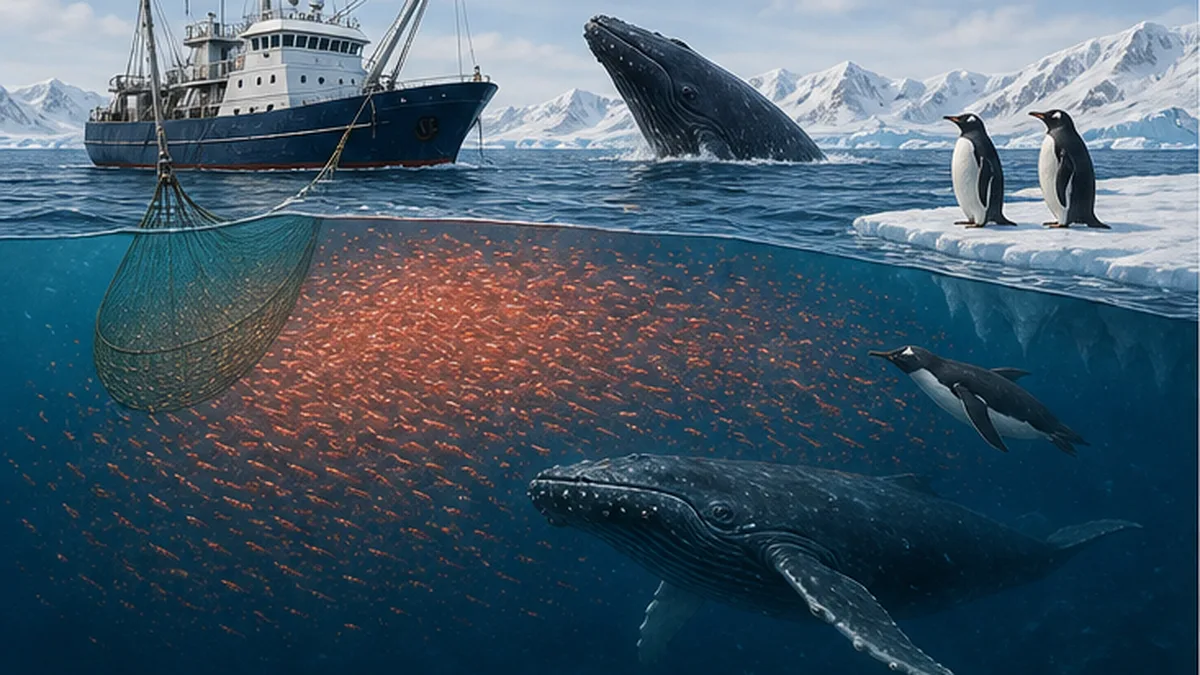
Antarctic krill are fished commercially. And in 2025, for the first time in its history, that fishery reached its designated ceiling. Let us follow what happened in order.
CCAMLR: the body that chose to manage a whole ecosystem
Living resources in the Southern Ocean are managed by the Commission for the Conservation of Antarctic Marine Living Resources (CCAMLR), established in 1982 under a convention adopted in 1980. The immediate impetus was alarm at the rapid expansion of krill fishing by the Soviet Union and others during the 1970s.
What made CCAMLR groundbreaking was that its convention explicitly adopted the principle of setting catches with regard not only to the target species but to its predators and the ecosystem as a whole — the ecosystem approach. It was advanced thinking for its time and remains a reference point for fisheries management worldwide.
A precautionary limit of 5.61 million tonnes and a trigger level of 620,000 tonnes
Area 48, the heart of the krill fishery running from the Antarctic Peninsula into the South Atlantic, carries two ceilings. One is a precautionary catch limit of 5.61 million tonnes, calculated from stock assessment and set in 2010. The other is a trigger level of 620,000 tonnes.
Why two? The 5.61-million-tonne limit is a total across an enormous area, and if vessels concentrated in one place, the penguins and seals there could be stripped of food. CCAMLR therefore installed a brake: the fishery shall not proceed beyond 620,000 tonnes until a mechanism for distributing catches spatially has been agreed. The figure of 620,000 tonnes was derived by summing the historical maximum catches from each subarea.
The instrument that allocated that 620,000 tonnes between subareas was Conservation Measure 51-07: no more than 25 per cent (155,000 t) from Subarea 48.1, no more than 45 per cent (279,000 t) from Subareas 48.2 and 48.3, and no more than 15 per cent (93,000 t) from Subarea 48.4. The percentages deliberately sum to more than 100 to leave operational flexibility.
2025: the season that hit the ceiling
At the 2024 meeting, consensus to extend Conservation Measure 51-07 failed for the fourth consecutive year, and the measure lapsed at the end of the 2024 season. From the 2025 season onward, only the combined 620,000-tonne limit across Subareas 48.1 to 48.4 remained, with no allocation between areas.
What followed was unambiguous. In 2025 the catch reached the trigger level for the first time in history and the season was closed, with roughly 358,000 tonnes taken in Subarea 48.1 alone — an area that had been held to around 155,000 tonnes for the previous sixteen years under 51-07. Subarea 48.1 includes the Bransfield and Gerlache Straits, where penguin breeding colonies and whale feeding grounds are concentrated. At CCAMLR's annual meeting in October and November 2025, no agreement was reached on new management measures or marine protected areas, and the situation persists.
| Year | Catch in Area 48 | Events |
|---|---|---|
| 2023 | About 424,000 t | 424,203 t across Subareas 48.1–48.3. Norway 67.2%, China 17.1%, Republic of Korea 8.4% |
| 2024 | About 498,000 t | Extension of Conservation Measure 51-07 fails for a fourth consecutive year; it lapses at year end |
| 2025 | 620,000 t (limit reached) | The trigger level is reached for the first time and the season closed; about 358,000 t from Subarea 48.1 alone |
Who fishes, and what is it used for?
The main fishing nations today are Norway, China and the Republic of Korea, accounting for 63.6, 17.1 and 11.4 per cent respectively of the cumulative catch from 2013 to 2023. Ukraine and Chile also operate.
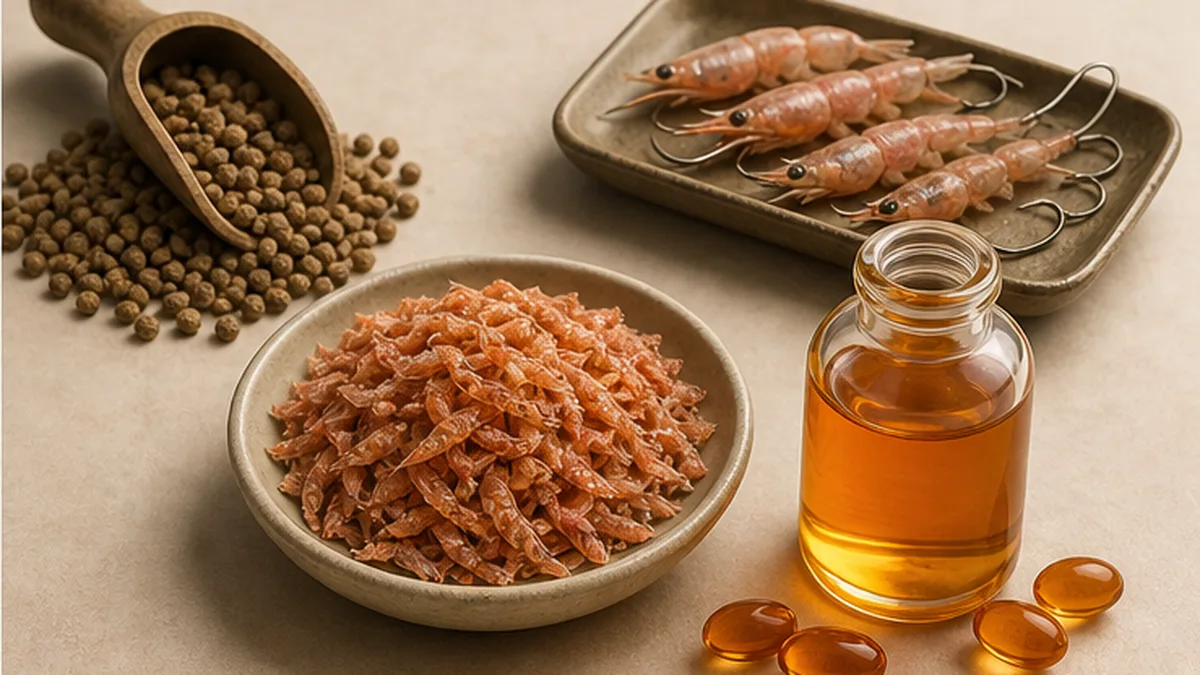
There are three broad uses: aquaculture feed (blended into feed for salmon and others, contributing to flesh colour), fishing bait, and health products such as krill oil. Krill contain omega-3 fatty acids including EPA and DHA, plus the red pigment astaxanthin, and demand as a supplement ingredient has grown. This expanding demand sits behind the rise in fishing pressure.
As for Japan, Nippon Suisan (now Nissui) became the first private company in the world to commercialise krill fishing in 1974, but it sold its vessels in 2012 and Japan has not fished for Antarctic krill since. Most of what circulates domestically as "krill" bait or food is the North Pacific krill caught off Sanriku and elsewhere.
Certification and voluntary industry measures
Alongside international management measures, two further layers surround the krill fishery: certification schemes and voluntary industry restraint. Part of the fishery, centred on Norway, holds Marine Stewardship Council (MSC) certification, which involves third-party assessment against three principles covering stock status, ecosystem impacts and management systems.
In addition, the industry association whose members include the main operating companies has established voluntary buffer zones in which vessels refrain from fishing near penguin colonies during the breeding season. These carry no legal force, but represent a practical attempt to avoid spatial competition with predators.
Such voluntary measures deserve credit, though their limits have also been noted: participation is optional, and the designation of areas and periods is less rigorous than official measures that have passed scientific review. That the catch in Subarea 48.1 more than doubled in 2025 suggests that an internationally agreed framework for spatial allocation cannot be replaced by voluntary measures.
The carbon krill carry: another kind of blue carbon
Recent research has revealed another major role for Antarctic krill: acting as a pump that carries atmospheric carbon into the deep ocean.
Sinking faecal pellets deliver carbon to depth
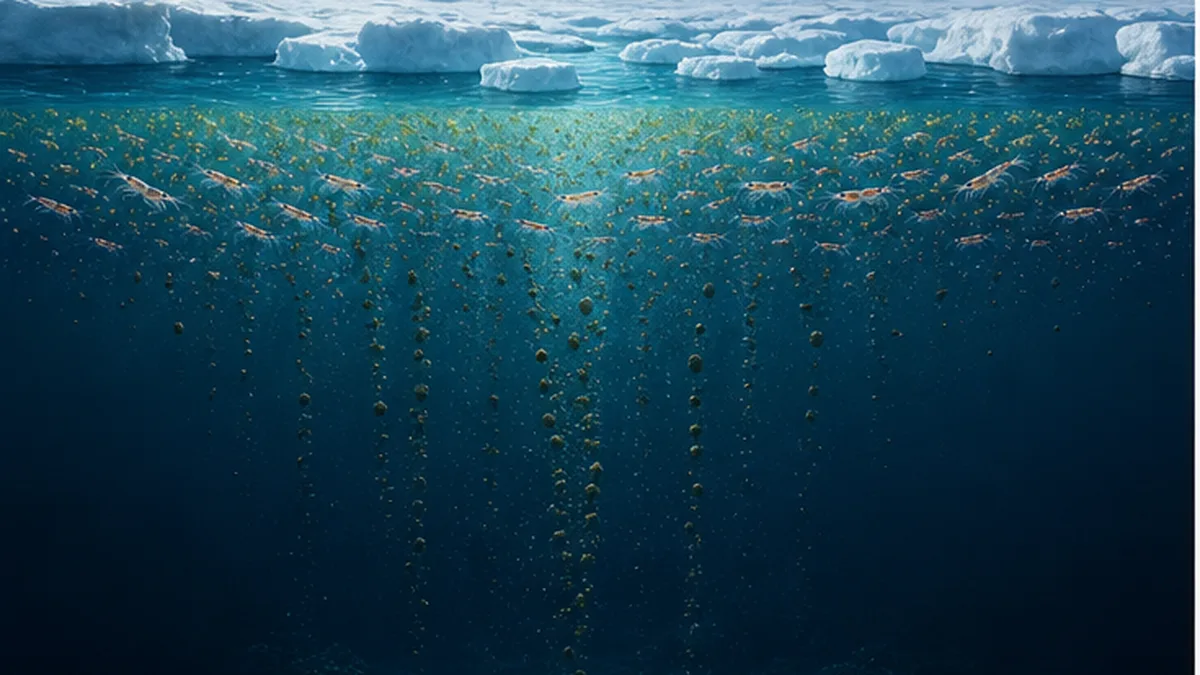
The mechanism works like this. Phytoplankton take carbon derived from atmospheric CO₂ into their bodies through photosynthesis. Krill eat them and excrete the residue. Because krill faecal pellets are large and dense, they sink far faster than scattered phytoplankton cells — reaching deep layers before they are fully broken down.
Once carbon reaches the deep, it does not return to the atmosphere for decades to centuries. Krill also perform diel vertical migration, descending by day and rising at night, so excreting and respiring at depth moves carbon downward as well.
Sequestration on a par with mangroves and seagrass meadows
A study published in Nature Communications in 2024 (by Cavan and colleagues) estimated that Antarctic krill faecal pellets sequester at least 20 million tonnes of carbon into the deep ocean per productive season, from spring to early autumn. The mean depth counted as sequestration was 381 metres, with storage assessed at over a hundred years.
That is comparable to the sequestration achieved by coastal blue carbon ecosystems such as salt marshes, mangrove forests and seagrass meadows. The study also put the economic value at 4 to 46 billion US dollars depending on the carbon price. The basic concept of blue carbon is explained in What is blue carbon?.
Does fishing also affect the carbon flow?
An obvious question follows: if krill are harvested, does that reduce the carbon carried to the deep? Researchers have begun raising exactly this point. An annual catch of around 500,000 tonnes is a small fraction of estimated biomass, but because fishing concentrates precisely where krill are densest, a simple proportional calculation cannot capture the effect.
We are not yet at a stage where anyone can state how many tonnes of sequestration have been lost to fishing. What is clear is that a climate axis of evaluation is being added to a framework that had considered only value as a fishery resource. Measuring what marine life does by yardsticks other than catch volume is a line of research now advancing rapidly.
Seeing krill as more than a resource
What this discovery challenges is how we measure value. Krill have long been discussed within the framework of a fishery resource: how many tonnes can be taken. In reality they feed the animals of Antarctica, carry carbon into the deep sea, and hold up the productive structure of the ocean itself. Their functions beyond being caught and sold may be larger even in monetary terms — that possibility has now come into view.
Japan and other countries have been building systems to assess and trade blue carbon in coastal seagrass beds and tidal flats, but carbon transport performed by open-ocean animals remains outside those institutions. Krill research is making that blank space visible.
What we can do — and how to enjoy krill
Antarctica is a distant place. Even so, our daily lives are genuinely connected to krill. To close, here is what can be done day to day, along with a perspective for finding this animal more interesting.
What to look for when buying supplements or farmed fish
When choosing a krill oil supplement, try checking where the raw material came from and under what management it was harvested. Part of the Antarctic krill fishery holds MSC certification, and packaging or company websites will say so. Certification is not a cure-all and does not resolve the problem of spatially concentrated fishing, but it does offer a way to tell whether a business discloses information at all.
The same applies to farmed salmon. More companies now publish what goes into their feed. How to read seafood certification labels is covered in What is the MSC blue fish label?.
Looking past "there's plenty of it"
Discussions of krill often feature the line that "with 379 million tonnes out there, a 500,000-tonne catch is only 0.2 per cent". The arithmetic is correct, but as this article has shown, the issue is not the total — it is where the fishing happens. A penguin raising chicks can travel only tens of kilometres and back. If density within that radius falls, a colony can suffer serious harm even at 0.2 per cent of the whole.
When you next see the word "sustainable" in a news story or an advertisement, distinguish whether it is talking about total volume or about place and season as well. That alone markedly changes the quality of what you take away.
Knowing and enjoying is itself a form of conservation
There has been a good deal about crisis here, but the Antarctic krill is first of all a startlingly interesting animal. Eggs that develop while sinking a thousand metres. Bodies that shrink when starved. Blue light. Swarms of trillions visible from space. An animal that feeds the largest creature on Earth. None of it is anything you would notice without being told.
Environmental concern does not last on a sense of duty alone. More people genuinely delighting in the ocean and the planet turns out to be the strongest force for conservation there is. Stopping in front of a krill display at an aquarium, or watching one documentary about Antarctica, is entrance enough.
Five things you can start today
- When buying krill oil or farmed fish, check once where the raw material came from and how it was managed or certified
- When you see the word "sustainable", distinguish total-volume claims from ones that account for place and season
- When krill or Antarctica come up in the news, look at one primary source such as CCAMLR or a fisheries agency document
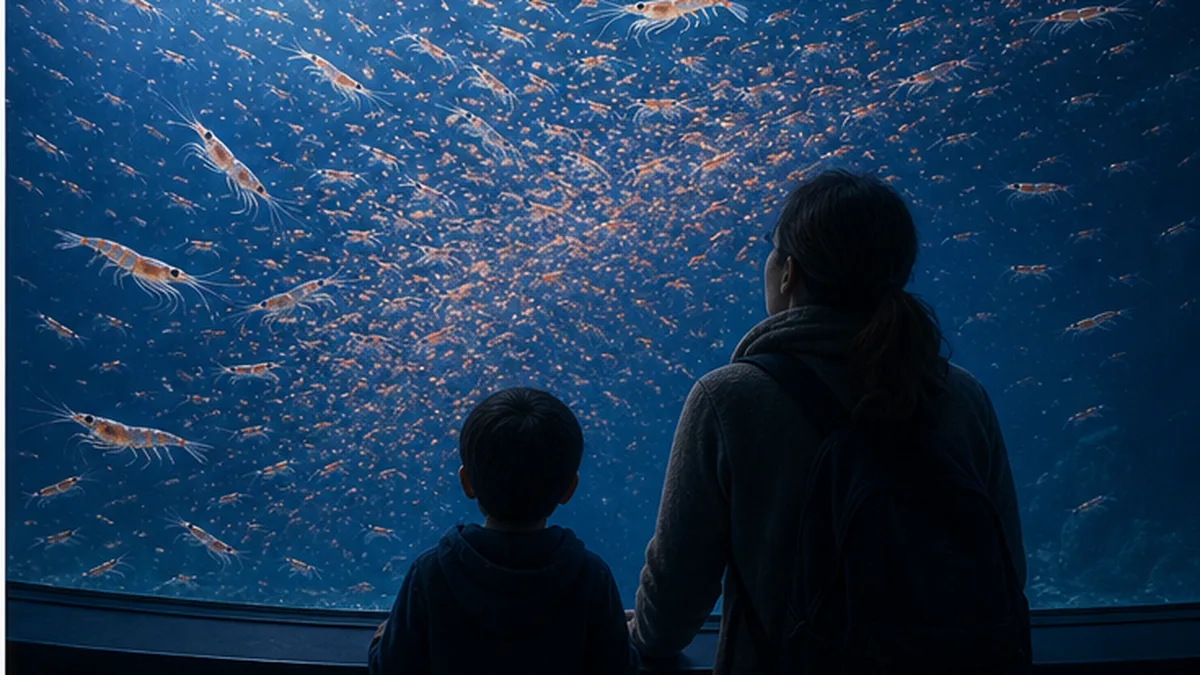
- Stop and look if an aquarium or science museum has a display on plankton or Antarctica
- Tell one person about something you found interesting; widening interest is what ultimately supports conservation
Summary of this article
- Antarctic krill are 6 cm crustaceans living five to seven years, with an estimated Southern Ocean biomass of about 379 million tonnes
- Ice algae beneath the sea ice and the summer bloom form the unusual food supply that sustains this vast biomass
- Whales, seals, penguins and other major Southern Ocean animals depend on krill, in a food web complete in three steps
- In the southwest Atlantic sector the centre of distribution has moved about 440 km south, with recruitment destabilised by sea-ice loss
- The fishery is managed by CCAMLR, but with Conservation Measure 51-07 lapsed, the limit was reached for the first time in 2025
- Carbon sequestration via faecal pellets amounts to 20 million tonnes a year, comparable to coastal blue carbon ecosystems
References and sources
- CCAMLR (Commission for the Conservation of Antarctic Marine Living Resources) – Krill fisheries and sustainability — official explanation of catch limits, the trigger level and the ecosystem approach
- CCAMLR Fishery Report 2025: Euphausia superba in Area 48 – The latest official report on the Area 48 krill fishery: catches, national breakdown and the evolution of management measures
- Fisheries Agency of Japan / Japan Fisheries Research and Education Agency – Status of International Fishery Resources, FY2024 edition: Antarctic Krill, Southern Ocean — official stock assessment in Japanese
- Atkinson et al. (2019) Nature Climate Change – "Krill (Euphausia superba) distribution contracts southward during rapid regional warming"
- Cavan et al. (2024) Nature Communications – "Antarctic krill sequester similar amounts of carbon to key coastal blue carbon habitats"
- Atkinson et al. (2009) Deep-Sea Research I – "A re-appraisal of the total biomass and annual production of Antarctic krill" — basis for the 379-million-tonne estimate
- Australian Antarctic Program – The Australian Antarctic Division's guide to Antarctic krill biology: size, lifespan, swarm density and more
- SCAR Krill Expert Group – Review of climate change impacts by the Scientific Committee on Antarctic Research's krill expert group
- PNAS (2025) – "Adjusting the management of the Antarctic krill fishery to meet the challenges of the 21st century"
- Nature Communications (2024) – "Whale recovery and the emerging human-wildlife conflict over Antarctic krill"
* Listed in order of reliability: government/academic institutions > peer-reviewed papers > specialized organizations > reliable media