⚡ The answer in 30 seconds
- Aquaculture sustainability depends on how five challenges are managed: feed, environment, juveniles, fish health and people.
- Nissui's Kurose Buri is closed-cycle farmed, and the ASC list introduces integrated production from 100% artificial seedlings as a strength.
- Data-driven improvements such as environmental monitoring and 3D body measurement are advancing.
Global seafood supply can no longer be discussed without aquaculture. So is aquaculture kind to the sea?
Using public information on the seafood major Nissui, this article explains efforts to raise the sustainability of aquaculture, such as closed-cycle aquaculture, ASC certification and environmental monitoring.
Because overall sourcing policy is covered in a separate article, we focus here on the aquaculture site.
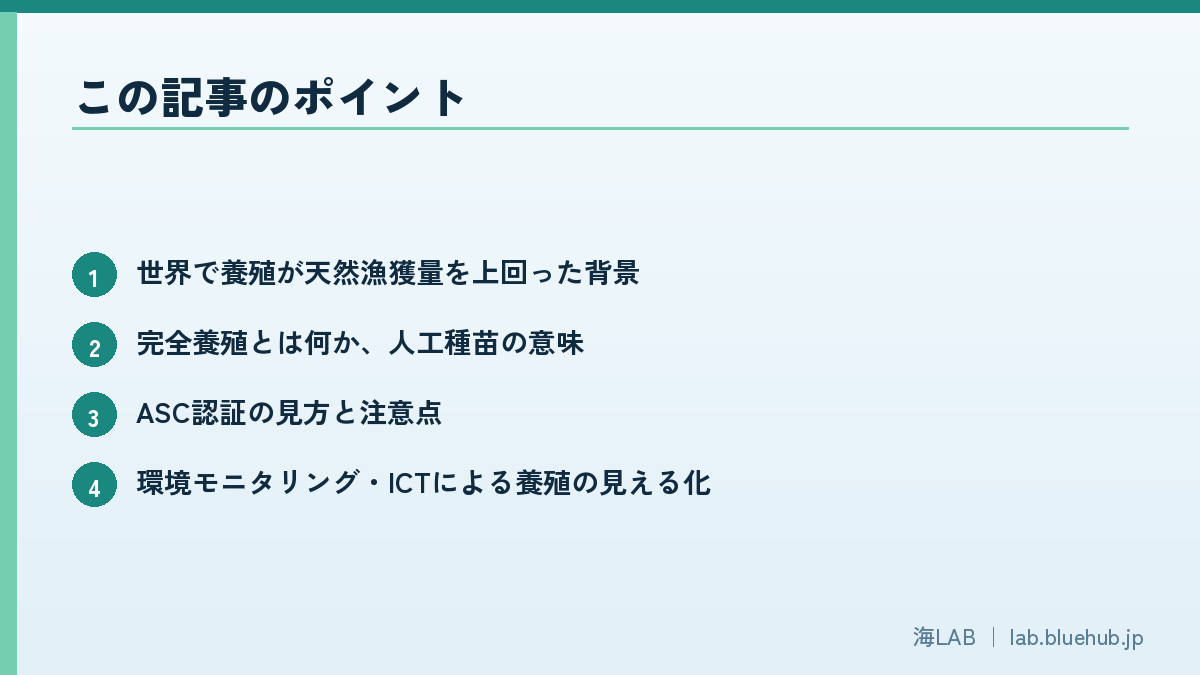
What you'll learn in this article
- Why aquaculture overtook wild capture worldwide
- What closed-cycle aquaculture and artificial seedlings mean
- How to read ASC certification and its caveats
- Visualizing aquaculture with environmental monitoring and ICT
- Wild resource management and international collaboration
- How consumers can choose
Aquaculture Now Underpins the World's Seafood Supply
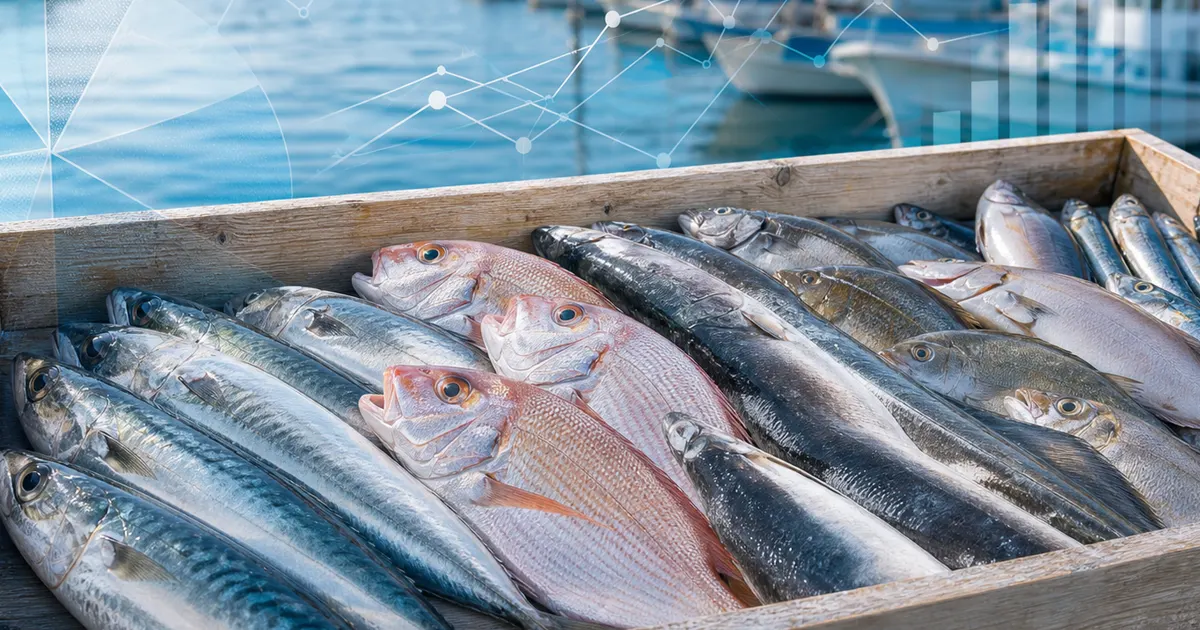
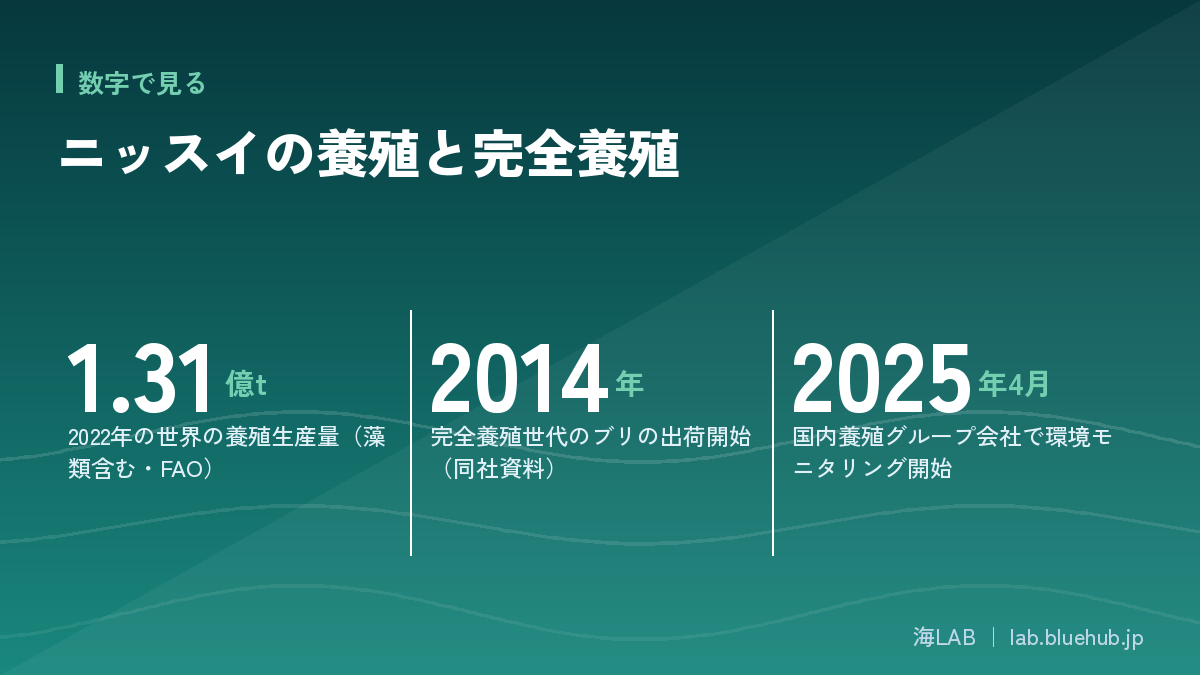
How much of the fish on our tables is farmed? According to the FAO's State of World Fisheries and Aquaculture (SOFIA) 2024, global aquaculture production exceeded wild capture for the first time in 2022. Aquatic animal production was about 185.4 million tonnes, of which about 94.4 million tonnes came from aquaculture. Total aquaculture output including algae was about 130.9 million tonnes.
Meanwhile, wild capture has stayed roughly flat at around 90 million tonnes since the late 1980s. As the population grows and fish consumption spreads, aquaculture has absorbed the extra demand. Whether seafood can be supplied sustainably therefore depends on how environmentally responsibly aquaculture is run.
Aquaculture as a way to ease pressure on wild stocks
Aquaculture is expected to supply fish without relying too heavily on wild resources. But it has its own challenges: feed sourcing, impacts on the marine environment, disease and drug management, and the effect of catching wild juveniles. It is not a question of which is better; both wild fisheries and aquaculture need appropriate management.
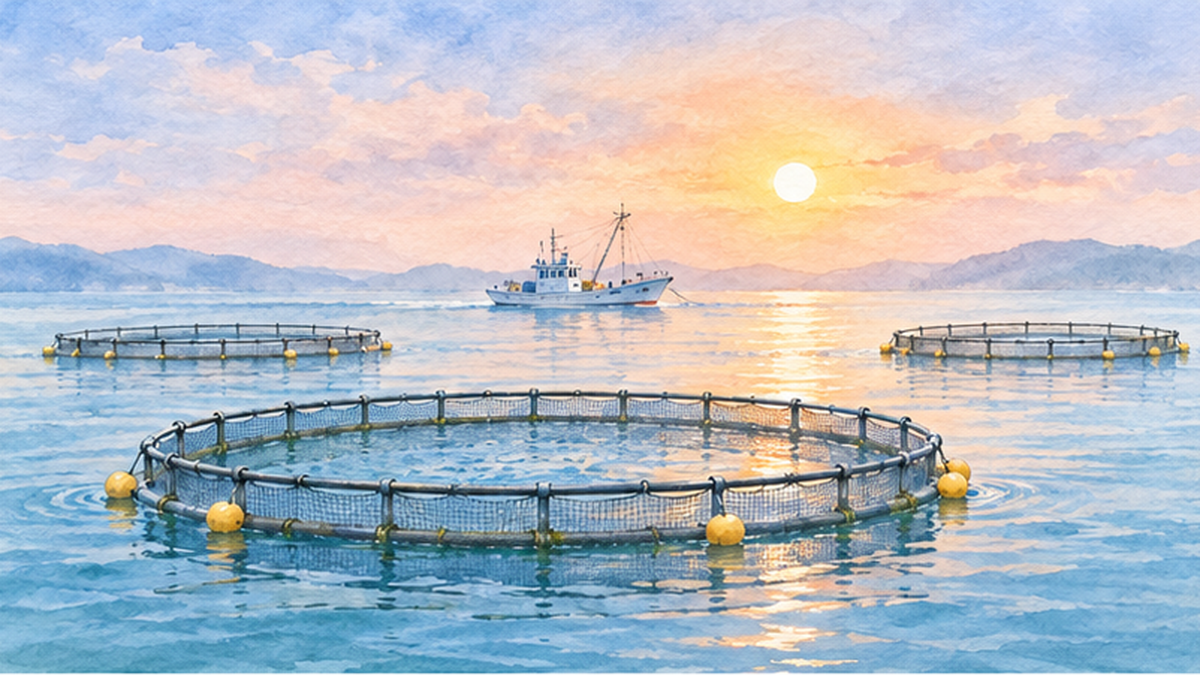
What this article covers
Using public information from the Japanese seafood major Nissui as a guide, this article sorts out how aquaculture relates to ocean sustainability. The company's overall sourcing policy is covered in Nissui's sustainable seafood sourcing; here we focus on the production site: aquaculture.
Please note
- This article is an explanation based on publicly available materials. It does not evaluate or endorse any company, and figures and certification status may change. Please check official announcements for the latest information.
Environmental Challenges Facing Aquaculture
Before looking at company efforts, let's review the environmental issues aquaculture generally faces. Knowing them makes it clear why each measure is needed. See also Environmental impact of aquaculture.
Feed sourcing and fishmeal / fish oil
Carnivorous farmed fish have been fed compound feed containing fishmeal and fish oil made from sardines and similar fish. Catching large amounts of small wild fish for farming puts pressure on other stocks. Research into alternative feeds based on plants, insects and microalgae is therefore advancing worldwide.
Feeding and impacts on the seabed and water quality
Uneaten feed and fish waste from net pens can affect the seabed and surrounding water quality. Where stocking density is too high or currents are weak, organic matter accumulates easily on the seabed. Appropriate stocking density, site review and environmental monitoring are therefore important.
Securing juveniles and genetic diversity
Japanese farmed yellowtail (buri) has long relied mainly on catching wild juveniles (mojako) and raising them. This depends on wild resources and the number of juveniles varies by year. Using "artificial seedlings" raised from eggs by people can reduce that dependence.
| Challenge | Details | Direction of countermeasures |
|---|---|---|
| Feed | Fishmeal and fish oil depend on wild small fish | Alternative ingredients, improved compound feed |
| Marine environment | Seabed and water quality impacts from leftover feed and waste | Stocking density control, environmental monitoring |
| Juveniles | Dependence on catching wild juveniles | Artificial seedlings, closed-cycle aquaculture |
| Fish health | Disease and drug use | Vaccines, better rearing environments, breeding |
| Labor and community | Labor shortages and coexistence with local communities | Labor saving, ICT, community cooperation |
Key point
- Aquaculture's challenges can be organized into five: feed, environment, juveniles, fish health and people. When looking at corporate efforts, it helps to ask which challenge each measure addresses.
Nissui's Kurose Buri and the Challenge of Closed-Cycle Aquaculture
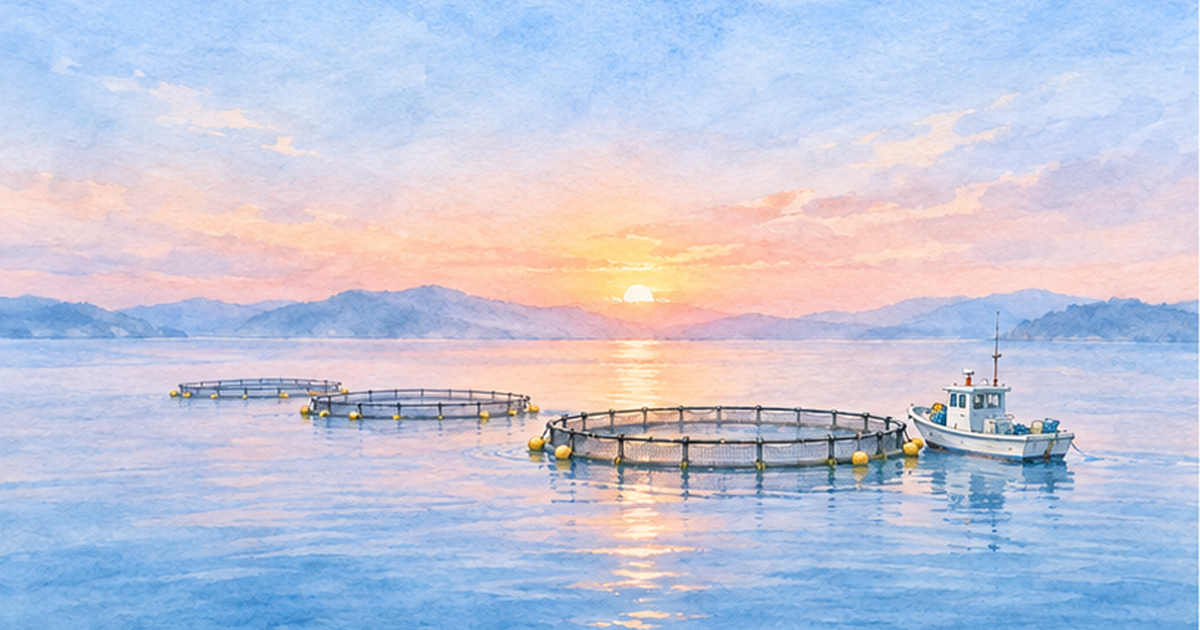
Nissui raises yellowtail through its group company Kurose Suisan, which operates in Miyazaki and Kagoshima prefectures among others. Its "Kurose Buri" is characterized by being produced with closed-cycle (full-cycle) aquaculture technology.
What is closed-cycle aquaculture?
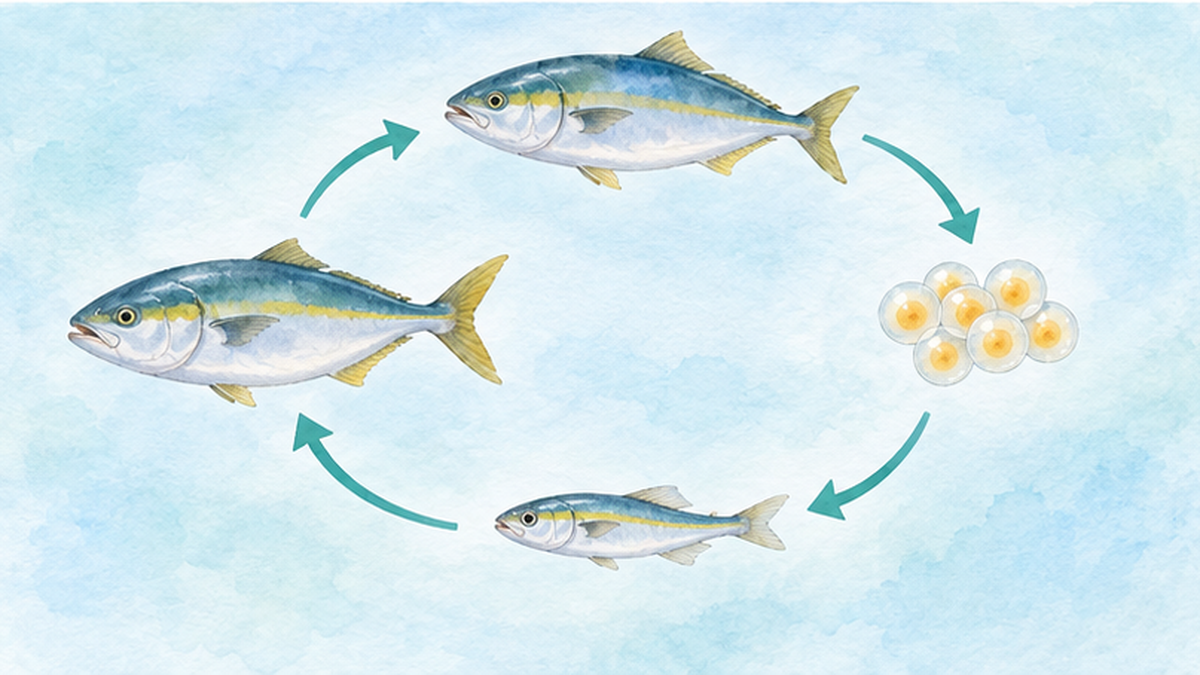
Closed-cycle aquaculture completes the whole cycle by human hands: eggs are taken from parent fish that were themselves raised from eggs, and those eggs are grown to market size. Unlike farming that raises caught wild juveniles, its major advantage is that it reduces dependence on wild resources.
- Collect eggs from mature parent fish
- Hatch the eggs and raise juveniles (artificial seedlings)
- Grow them in net pens to market size
- Select the next parent fish from those grown to market size
The history of breeding, from public materials
Materials published by Nissui describe the breeding of yellowtail as follows: egg collection from wild yellowtail began in 2005, a breeding program started in 2010, and shipments of closed-cycle generation fish began in 2014. In 2019, improved growth is described as raising body weight by more than 25%.
| Year | Event (according to public materials) |
|---|---|
| 2005 | Egg collection from wild yellowtail begins |
| 2010 | Breeding program starts |
| 2014 | Shipments of closed-cycle generation fish begin |
| 2019 | Body weight improved by more than 25% through better growth |
| December 2017 | Kurose Suisan's yellowtail obtains ASC certification (per the ASC list) |
Breeding is not only about "faster and bigger"
Breeding is often thought of as selecting fast-growing fish. In fact it also improves traits such as disease resistance, the ability to convert feed efficiently into growth, and tolerance to environmental change. Faster growth may reduce the time and feed needed to raise the same amount of fish. However, within the publicly available information we could not confirm quantitative figures on how much environmental improvement this brings.
The strength of 100% artificial seedlings
- In the ASC certified-farm list (August 2024 edition), Kurose Suisan's yellowtail is introduced as having integrated production from 100% artificial seedlings as a strength. Not relying on catching wild juveniles is one axis of its evaluation.
ASC Certification as a Standard for Responsible Aquaculture
ASC (Aquaculture Stewardship Council) certification is a mechanism for verifying, through a third party, the environmental and social consideration of aquaculture. While MSC certification covers wild fisheries, ASC covers farming. See What is ASC certification? and MSC certification.
Main items ASC certification looks at
- Legal compliance and consideration for local communities
- Management of impacts on the surrounding natural environment (water quality, seabed, biodiversity)
- Sourcing of feed ingredients and their sustainability
- Appropriate management of disease and drugs
- Ensuring workers' rights and safety
ASC standards are set for each species, and products from audited farms carry the certification label. In addition, CoC (Chain of Custody) certification is needed in processing and distribution so that certified products are not mixed with non-certified ones.
Certification does not always mean peace of mind
Certification is an important guide but not a cure-all. Standards are updated and audit results can bring conditions. The third-party evaluator FAIRR noted that Nissui is advancing ASC and MSC certification, while pointing out that evidence of the share of certified products in total sourcing is limited (this may be based on older reports). As consumers, it is important to check not only certification labels but also the numerical targets and progress companies publish.
How to read certification labels
- Certification indicates a product from a farm that met a certain standard. How much of a company's total handled volume is certified is a separate question. Check the trend of the "certification rate" in company reports.
Making Aquaculture Visible with Environmental Monitoring and ICT
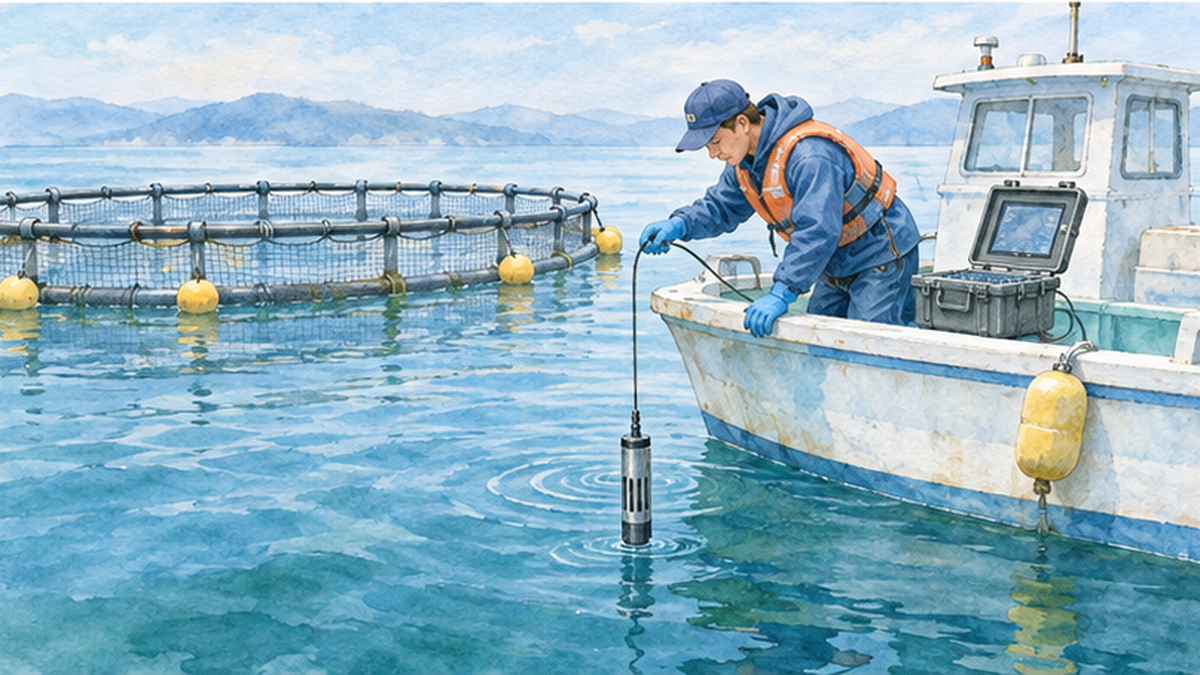
To reduce the environmental load of aquaculture, it is essential to measure the state of the sea continuously and notice changes early. Nissui says it began environmental monitoring at its domestic aquaculture group companies in April 2025 to reduce the burden on the marine environment.
What environmental monitoring looks at
Generally, environmental monitoring at a farm measures water temperature, dissolved oxygen and the condition of seabed sediments. Low dissolved oxygen weakens fish, and organic matter accumulating on the seabed changes the habitat for living things. Recording values and comparing them with standards can inform the placement of net pens, stocking density and feeding amounts.
3D body measurement and fish welfare
Nissui is introduced as working to improve fish welfare and reduce costs using a 3D fish body measurement system. If size and shape can be measured without hurting the fish, growth is easier to grasp, which helps decide feeding amounts and shipping times. Reducing wasted feed leads both to lower environmental load and more efficient management.
- Measuring more often places little burden on the fish
- Variation in growth can be grasped early
- Optimized feeding may reduce leftover feed
Measuring is the starting point of improvement
- Both environmental monitoring and body measurement are means of accumulating data to improve decisions. Smart aquaculture is spreading as an approach that benefits both the environment and management.
Thinking About Environmental Load Through Feed and Feed Efficiency
One of the biggest themes in aquaculture's environmental load is feed. How much feed is needed for fish to grow, and where do its ingredients come from? Checking these two shows why breeding and technology development matter.
Feed conversion efficiency
In aquaculture, an indicator such as feed conversion efficiency (or feed conversion ratio) shows how much the fish gained relative to the weight of feed given. The less feed needed to raise the same weight of fish, the smaller the volume of feed ingredients to procure and the smaller the load from leftovers and waste. Breeding to improve fish traits, improving feed formulation and adjusting the amount and timing of feeding are all means of raising this efficiency.
- Breeding: select strains that grow well on the same feed
- Formulation: look for combinations of ingredients fish digest easily
- Feeding management: adjust amounts to appetite and water temperature
- Measurement: know fish size and avoid giving more than needed
The spread of alternative ingredients
To reduce dependence on fishmeal and fish oil, various alternative ingredients are being researched and used: plant ingredients such as soy, by-products of food processing, microalgae and insect-derived ingredients. Each has its own challenges, however. Plant ingredients involve land and water use and transport energy, and nutrients fish need must be supplemented. The best ingredient varies with species, region and price.
| Feed ingredient | Expected benefits | Points to watch |
|---|---|---|
| Fishmeal / fish oil | Easy to supply needed nutrients | Dependence on wild small fish |
| Plant ingredients | Supply is relatively stable | Nutrient balance, land and water use |
| Food by-products | Effective use of waste | Stable supply and quality |
| Microalgae / insects | Research is advancing as new ingredients | Cost and production scale |
Feed is also connected to food loss
Feed, water and energy used to raise fish are wasted when food is left uneaten at the table or discarded in stores. The sustainability of aquaculture is continuous with distribution and household use, not just the production site. Related topics are covered in this media's food loss articles.
Think of breeding, feed and measurement as a set
- Breeding through closed-cycle aquaculture, feed improvement and ICT such as 3D body measurement are not separate efforts but share one goal: raising healthy fish with less feed and less environmental load.
Japanese Aquaculture and Its Ties to Local Communities
Surrounded by sea, Japan farms a diverse range of seafood and seaweed, including yellowtail, sea bream, oysters, nori and scallops. Aquaculture is also an industry that supports employment in fishing villages and local food culture.
Labor shortages and smart aquaculture
Aging and shortage of workers are challenges in fisheries and aquaculture. Labor saving and upgrading with ICT are advancing: automatic feeding, underwater cameras, environmental sensors and AI analysis. Automated body measurement is also a technology that reduces workload and supports data-based management.
Coexisting with local waters
Fishing grounds are often shared with other local fishers, and if the water environment worsens, aquaculture operators themselves are affected. Protecting the environment of fishing grounds is therefore coexistence with the community itself. For attempts to expand farms offshore, see Offshore aquaculture in Japan.
- Supports local employment and food culture
- If the fishing ground environment worsens, operators themselves are affected
- Labor saving through ICT may encourage younger people to enter
Sustainability is not only about the environment
- Consideration for the environment, workers' safety and rights, relations with the community and stable management: only when these come together can aquaculture become an industry that lasts. ASC standards include both environmental and social aspects.
Natural Resource Management and Joining International Collaboration
Sustainable aquaculture cannot ignore wild resources. If stocks of pelagic fish such as sardines and mackerel, the raw material for feed, are disrupted, the foundation of aquaculture is shaken. In June 2026 Nissui announced it had joined NAPA, an international industry collaboration promoting sustainable management of pelagic fish stocks in the Northeast Atlantic, with group companies in Europe and Japan cooperating.
Within the long-term vision "Good Foods 2030"
Nissui's long-term vision "Good Foods 2030" has two axes: strengthening portfolio management and promoting sustainability management. One target indicator is the "sustainable sourcing ratio," and its 2022 integrated report cited raising the rate of seafood certification and expanding handling of certified ingredients as challenges.
The materiality of "mainstreaming marine biodiversity"
Nissui lists "mainstreaming marine biodiversity" as one of its materiality issues and, in its Sustainability Declaration, says it strives to reduce environmental load and conserve the natural environment and biodiversity. On July 14-15, 2026 it participated for the first time in the international conference GLOBAL NATURE POSITIVE SUMMIT 2026 at Kumamoto Jo Hall (Kumamoto City), with a hands-on booth themed "Thinking about the Future Sea: Nissui's Challenge of Closed-Cycle Kurose Buri Aquaculture."
At the booth, live yellowtail juveniles and a plush toy replicating the weight of an adult fish were displayed, and visitors wrote on fish-shaped sticky notes what they can do so that we can still eat delicious fish in 2050. In the panel discussion, the head of the sustainability promotion department introduced technology development including closed-cycle aquaculture.
| Initiative | Timing | Overview (per public information) |
|---|---|---|
| Start of environmental monitoring | April 2025 | Carried out at domestic aquaculture group companies |
| Joining NAPA | June 2026 | Industry collaboration promoting management of pelagic stocks in the Northeast Atlantic |
| Exhibit at GLOBAL NATURE POSITIVE SUMMIT 2026 | July 2026 | Hands-on booth themed on closed-cycle Kurose Buri |
Summary of this chapter
- The sustainability of aquaculture is tied not only to the farm itself but also to the management of wild resources used as feed and to international cooperation. Companies joining industry groups and international conferences shows a trend toward advancing resource management across the whole supply chain rather than leaving it to individual firms.
Learning About the Future Sea and Aquaculture with Children
Nissui also held a workshop for elementary school students in Kumamoto City, "Protecting the Future Sea!? Secrets of Kurose Buri Aquaculture," with a talk by the director of its Oita Marine Research Center at the Central Research Laboratory. Telling children about aquaculture sites and technology is meaningful for nurturing interest in the sea.
Learning about aquaculture reveals the connections of the sea
Many factors lie behind raising a fish: feed, water temperature, currents, disease and human hands. Learning about aquaculture reveals the circulation of the sea behind a single fish and its link to human activity. It is also an easy theme for inquiry-based learning at school or summer projects.
- Buri is a "career-advancing fish" whose name changes as it grows (Wakashi, Inada, Warasa, Buri, depending on the region)
- In closed-cycle aquaculture, fish are raised by people from egg to shipment
- Try looking for products with certification labels
Let's investigate as a family
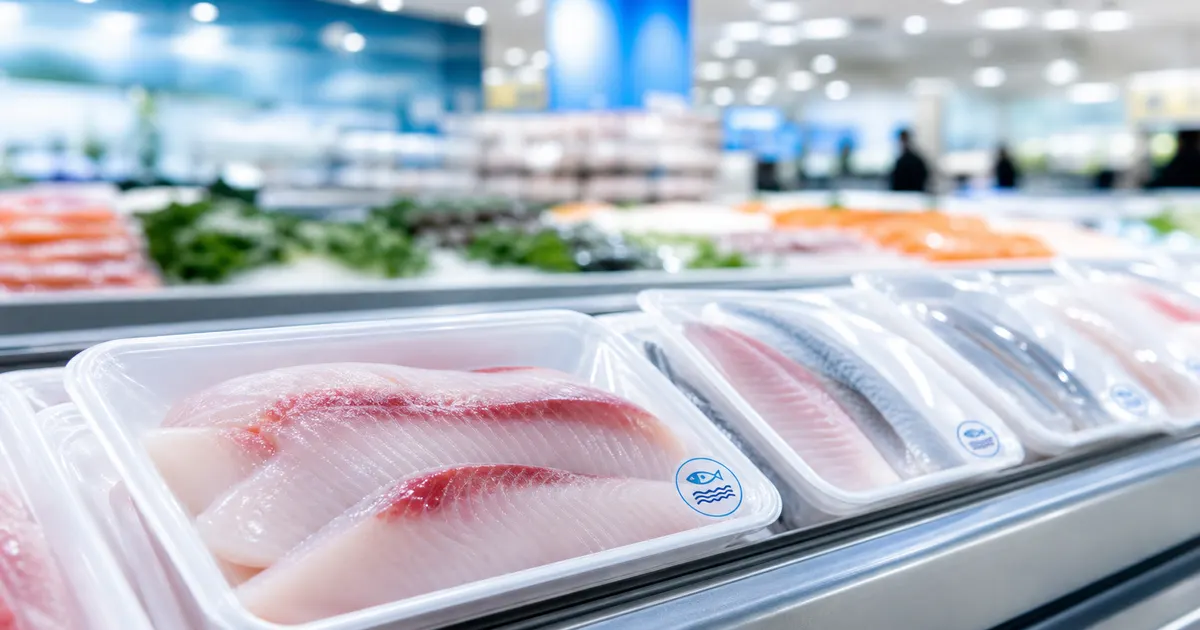
- At the supermarket fish counter, look for the origin, the farmed or wild label, and ASC and MSC labels. Just looking up what the labels mean is real learning about the sea.
What Consumers Can Do
Even if corporate efforts advance, sustainable seafood will not spread unless buyers' choices change. Here are everyday actions.
Choose using labels and information as clues
- Look for certification labels such as ASC and MSC
- Check the origin and farmed or wild labeling
- Choose seasonal and local fish, and don't favor particular species
Reduce leftovers
Feed, time and energy used for farming are wasted by leftovers. Not buying too much, using everything and finishing meals are the first step to reducing the load on the sea. Related topics are also introduced in Offshore aquaculture in Japan.
Pay attention to corporate disclosure
Integrated reports and sustainability pages list numerical targets and progress. Reading them, including whether targets were met and what challenges remain, gives a three-dimensional understanding of a company's stance.
Remaining Challenges and Outlook
Closed-cycle aquaculture and environmental monitoring are promising means of making aquaculture sustainable, but challenges remain.
Remaining challenges
- How far feed ingredients (fishmeal, fish oil) can be replaced
- Effects of rising sea temperatures from climate change on farmed fish and fishing grounds
- Production cost of artificial seedlings and the relationship with local juvenile-catching businesses
- Publishing certified-product shares and environmental indicators in an understandable way
Outlook: wild and farmed as two wheels
Strengthening management of wild resources, lowering the environmental load of aquaculture and disclosing that information transparently: when these three come together, a sustainable supply of seafood comes closer. Companies, government, researchers and consumers each need to play a role.
Summary
- Aquaculture output exceeded wild capture worldwide in 2022, making its sustainability important
- Nissui's Kurose Buri is closed-cycle farmed, and the ASC list introduces integrated production from 100% artificial seedlings
- Environmental monitoring started in April 2025, and 3D body measurement is also said to support fish welfare and efficiency
- It joined the international collaboration NAPA in June 2026 and is also involved in managing wild resources
- It is important to choose as a consumer while looking at both certification and corporate disclosure
References and Sources
- FAO, The State of World Fisheries and Aquaculture (SOFIA) 2024 – Global fisheries and aquaculture production and resource status
- Fisheries Agency of Japan: Aquaculture – Policies on Japanese aquaculture
- ASC (Aquaculture Stewardship Council) – Aquaculture certification scheme
- ASC certified farm list (Japan), August 2024 – Entry for Kurose Suisan's yellowtail certification
- Nissui Sustainability – The company's sustainability policy and initiatives
- Nissui Integrated Report 2022 – Good Foods 2030 and the challenge of seafood certification rates
- FAIRR assessment of Nissui Corporation – Third-party assessment of seafood traceability
- ELEMINIST: Nissui joins a nature-positive international summit for the first time – Exhibit at GLOBAL NATURE POSITIVE SUMMIT 2026
- MSC (Marine Stewardship Council) – Certification scheme for wild fisheries
* Listed in order of reliability: government and academic institutions > peer-reviewed papers > specialist organizations > reliable media