⚡ In short
In the Noto Peninsula Earthquake, 60 of Ishikawa's 69 fishing ports were damaged, with uplift up to about 4 m. Two-phase repair, dredging and quay lowering, and the status at end of March 2026, from public sources.
How are the fishing ports uplifted by the Noto Peninsula Earthquake being repaired? Of Ishikawa Prefecture's 69 fishing ports, 60 were damaged, and uplift of up to about 4 m was confirmed.
Ports turning into dry land was a problem that past disaster-recovery experience barely covered. The national and prefectural governments and fishers chose to repair in two phases: temporary and permanent repair.
Rather than recounting the damage, this article focuses on the technology and systems, organizing how recovery works and where it stands using public materials from the Fisheries Agency and Ishikawa Prefecture.
What you will learn
- What happened to fishing ports with uplift
- The two-phase idea: temporary and permanent repair
- Typical methods such as dredging and quay lowering
- Systems such as assessments and the reconstruction council
- Recovery status and challenges as of end of March 2026
What happened to fishing ports in the Noto Peninsula Earthquake: the big picture
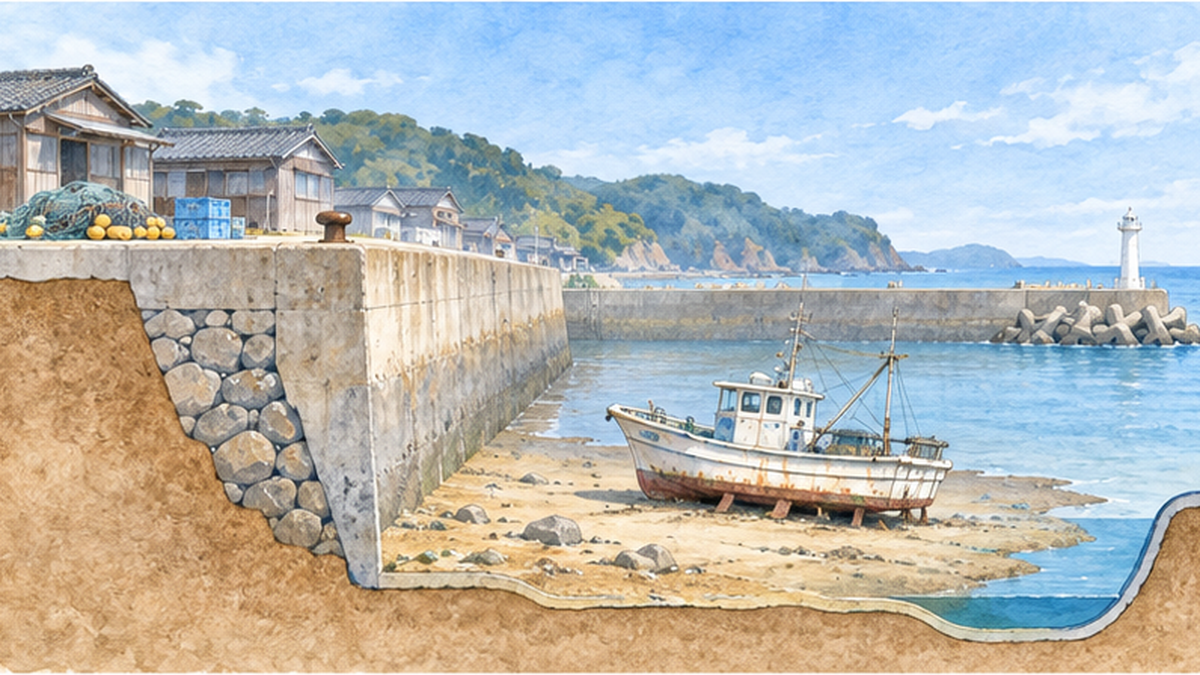
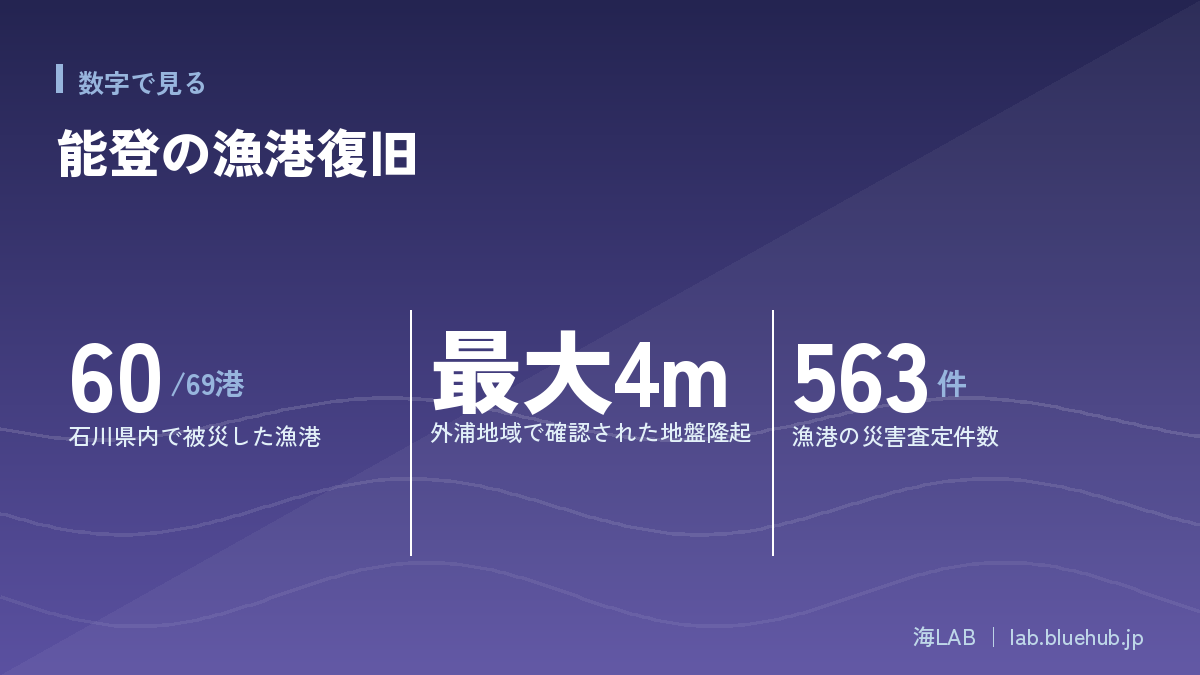
In the 2024 Noto Peninsula Earthquake that struck on January 1, 2024, fishing ports in Ishikawa Prefecture suffered shaking, tsunami and ground uplift all at once. According to the Fisheries Agency's technical review document, 60 of the prefecture's 69 fishing ports were damaged, and on the outer coast (the sea-facing side) of the Noto Peninsula in particular, ground uplift of up to about 4 m was confirmed.
A fishing port that should be a calm inlet suddenly becomes "land". This was an extremely unusual event that past disaster-recovery experience could not handle. This article focuses less on the story of the damage itself and more on how uplifted fishing ports are repaired—the technology and the systems.
Different damage on the outer and inner coasts
The Fisheries Agency materials divide the damage on the Noto Peninsula into two types. On the outer coast, the ground rose, the basins (the water where boats moor) became shallow, and boats could not be used. On the inner coast, shaking and tsunami caused structures themselves to be badly damaged, with revetments and quays (for unloading) subsiding, tilting or collapsing.
| Area | Main damage | Approach to repair |
|---|---|---|
| Outer coast (Wajima, Suzu, etc.) | Uplift made basins and channels shallow or dry land | Match depth and height by dredging and lowering quays |
| Inner coast (Nanao, etc.) | Subsidence, tilting, collapse, apron washout | Repair and rebuild using conventional disaster-recovery methods |
Uplift varies widely from port to port
Even on the outer coast, the amount of uplift differs greatly by port. In examples of prefecture-managed ports in the Fisheries Agency materials, uplift is recorded at about 2.0 m at Nagahashi, 3.4 m at Kuroshima, 1.2 m at Akagami and 0.8 m at Tsurugi. At Nagahashi and Kuroshima the basins and channels became dry land, while at Akagami and Tsurugi the planned depth was lacking and the tips of slipways were exposed above the water.
Understanding the damage in numbers
- Damaged ports: 60 of 69 in the prefecture (about 87%)
- Maximum uplift: about 4 m on the outer coast
- Examples of uplift: Nagahashi 2.0 m / Kuroshima 3.4 m / Akagami 1.2 m / Tsurugi 0.8 m
Because the damage differed from place to place, the same prescription could not be applied to every port. The national and prefectural governments therefore classified the degree of damage and built a framework for phased recovery. The following sections look at it in order.
Temporary and permanent repair: the two-phase basic policy
For fishing ports with severe damage such as ground uplift, the Fisheries Agency's technical review document set out a basic idea of dividing recovery into two phases: "temporary repair to restart livelihoods in the short term" and "permanent repair to improve functions in the medium to long term". Alongside this, it also aims to consider "reconstruction leading to a new image of fishing communities, such as promoting umi-gyo (sea-based industries)".
Why two phases?
What fishers need most is "to get boats out as soon as possible". But rebuilding a port properly takes a long time for design, budget and construction. So the order adopted was to first create a state where minimal mooring and landing is possible with gravel, steel plates and large sandbags (temporary repair), and then move to permanent works with an eye to the future (permanent repair).
| Phase | Purpose | Examples of main measures |
|---|---|---|
| Temporary repair (emergency) | Early restart of livelihoods | Dredging basins, temporary landing quays of large sandbags, temporary piers, emergency pavement repair |
| Permanent repair | Medium- to long-term functional improvement | Quay lowering, in-port excavation, offshore extension, earthquake and tsunami resilience |
Timeline in Ishikawa Prefecture
According to Ishikawa Prefecture, the damage survey took place in February 2024, deliberation on prefecture-wide and port-by-port policies began around April, temporary repair proceeded from around summer 2024, and permanent repair from around April 2025. On March 25, 2024, the "Council for the Reconstruction of Noto's Fisheries-Related Ports" (Reconstruction Council) was established, and fisheries stakeholders, the national and prefectural governments, municipalities and research institutions began discussions.
At its third meeting on August 30, 2024, the Reconstruction Council formulated a reconstruction policy based on three pillars: "rebuilding livelihoods", "maintaining and developing the fisheries industry" and "maintaining and developing fishing communities".
Key points of this section
- Recovery is in two phases: "temporary repair → permanent repair"
- Temporary repair aims to restart livelihoods; permanent repair aims at future functional improvement
- The Reconstruction Council set a three-pillar policy in August 2024
Repair technology for uplifted fishing ports: how were the options organized?
Because there was almost no experience with uplift, the Fisheries Agency set up an expert panel, the "Noto Peninsula Earthquake Fishing Community Recovery and Reconstruction Technical Review Committee". After three meetings between April and June 2024, it compiled the "Fishing Community Recovery and Reconstruction Technical Review Document" in July.
Classifying uplift as large, medium and small
Considering how differences in uplift affect fishing activity, the review document classified damage patterns into three: large, medium and small. For each pattern it then presented typical options for temporary and permanent repair.
| Phase | Option 1 | Option 2 | Option 3 |
|---|---|---|---|
| Temporary repair | In-port excavation using existing facilities | Piers installed offshore in deep water | Slipways installed to the sea surface |
| Permanent repair | In-port excavation | Offshore extension securing depth | Using adjacent water outside the port |
Options are chosen by "weighting the evaluation"
The review document asks readers to note that temporary and permanent repair are evaluated from different viewpoints. Speed matters for temporary repair, while future usability and maintenance matter for permanent repair. It therefore presents an approach of weighting evaluation items according to local conditions and users' needs.
Typical methods used on site
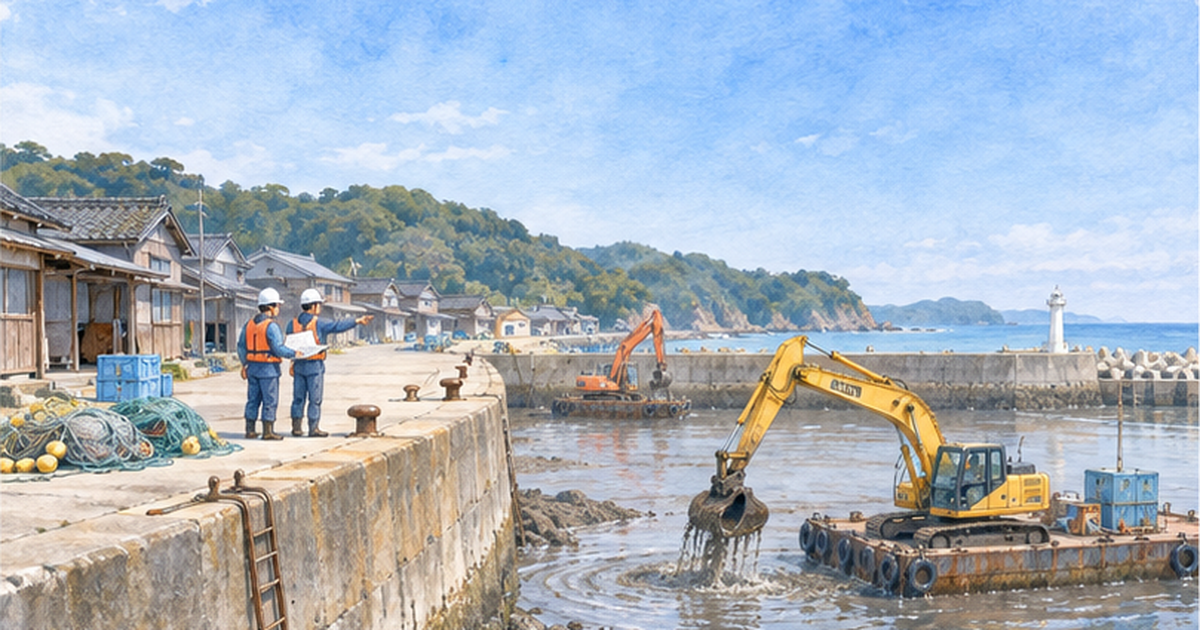
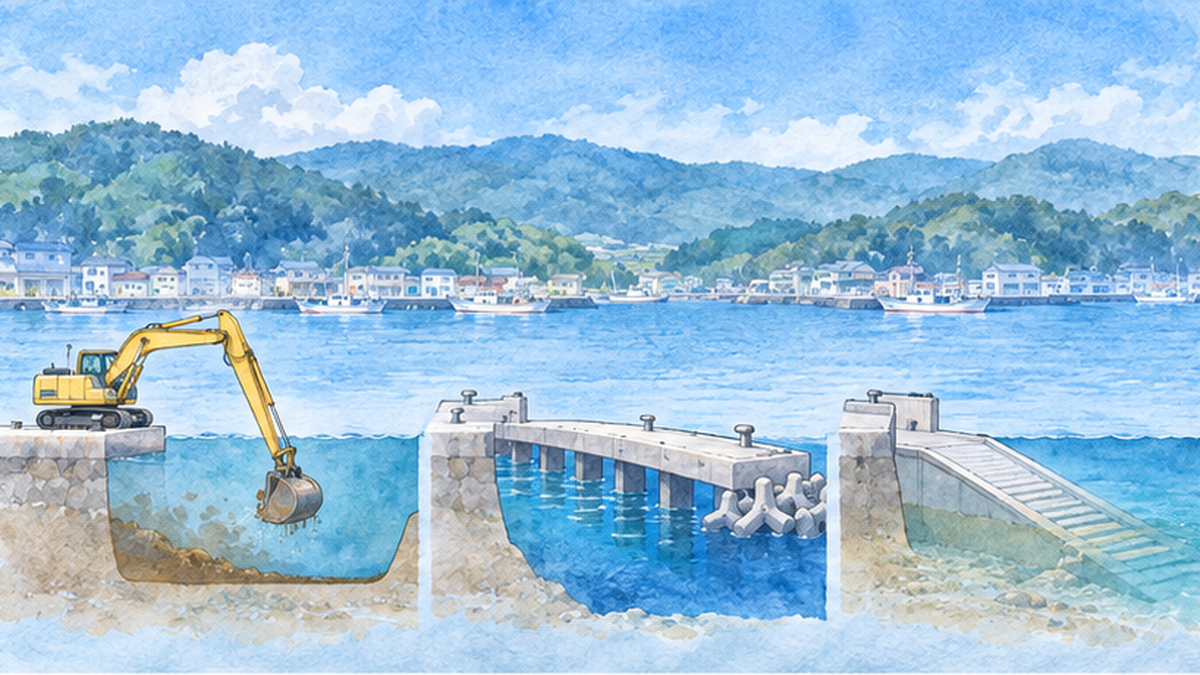
Ishikawa Prefecture's materials as of the end of March 2026 list actual emergency and permanent repair cases. At Kaiso Port, for example, a temporary landing quay and slipway of large sandbags were built in the uplifted basin to complete emergency repair. At ports such as Noroshi and Takojima, use resumed by dredging the basin and lowering the quay to remove the height gap with the sea. At Togi Port, permanent repair by lowering the quay has been completed.
- Dredging the basin: remove sediment from silted (shallowed) water to secure depth
- Quay lowering: cut down a quay raised by uplift to match boat height
- Temporary landing quay of large sandbags: create a temporary unloading place in the uplifted basin
- Toe extension (steel plates, etc.): extend a slipway to the water's edge so it can be used
- Temporary sheet piles and large sandbags: prevent flooding of back areas inundated by subsidence
Even for the same "uplift", the best method changes with water depth, quay height and boat size. That is why the review document shows "options and ways of evaluating them" rather than a single right answer.
Seen through systems: assessments, national proxy works and the council
Alongside technology, systems supported recovery. For disaster recovery of fishing ports, to receive national subsidies, one goes through a "disaster assessment" that fixes the work content and cost. This work normally takes a very long time, but efforts were made in Noto to proceed early.
Disaster assessments completed in December 2024
According to Ishikawa Prefecture, disaster assessments of fishing ports began in March 2024 and were all completed in December of the same year. The number of assessments was 134 for prefecture-managed ports and 429 for municipality-managed ports, 563 in total.
| Manager | Assessments carried out |
|---|---|
| Ishikawa Prefecture | 134 |
| Municipalities | 429 |
| Total | 563 cases |
National "proxy" works
Ishikawa Prefecture's materials describe Nobu Port (Noroshi district) as "direct national proxy" work. Where damage is large and technically difficult, a mechanism in which the national government carries out works on behalf of the manager is used, and the Fisheries Agency also provides support such as proxy works under the Large-Scale Disaster Reconstruction Act.
A Reconstruction Council that brings everyone to one table
The Reconstruction Council involved fisheries stakeholders, the national and prefectural governments, municipalities and research institutions. The results of the Fisheries Agency's technical committee were provided to the council and used in port-by-port policymaking. Another key point in the review document is to confirm the intentions of fishers, the users, at every stage, not only those of engineers.
Note: ports versus harbors
- Even among ports used for fishing, some, like Wajima and Ogi, are classified as "commercial harbors"
- Ishikawa Prefecture's materials report that permanent repair of the quay near the Wajima Port fish-handling facility (-4.0 m deep) and the Ogi Port quay (-4.5 m) was completed in March 2026
Where things stood at the end of March 2026: how far has recovery gone?
We organize the progress of recovery from materials compiled by Ishikawa Prefecture as of March 31, 2026. Figures are based on those materials.
| Category | Number of ports |
|---|---|
| Fishing ports in the prefecture | 69 ports |
| Ports damaged | 60 ports |
| Ports moved from emergency works to permanent repair | 39 ports |
| Ports handled by permanent repair only | 19 ports |
| Under consideration based on policy | 2 ports |
Of the 60 damaged fishing ports, 57 are usable after emergency works and so on, and of the prefecture's 69 fishing ports 66 are usable. Conversely, 3 ports still cannot be used. Recovery has advanced greatly, but full restoration has not yet been reached.
Before and after repair
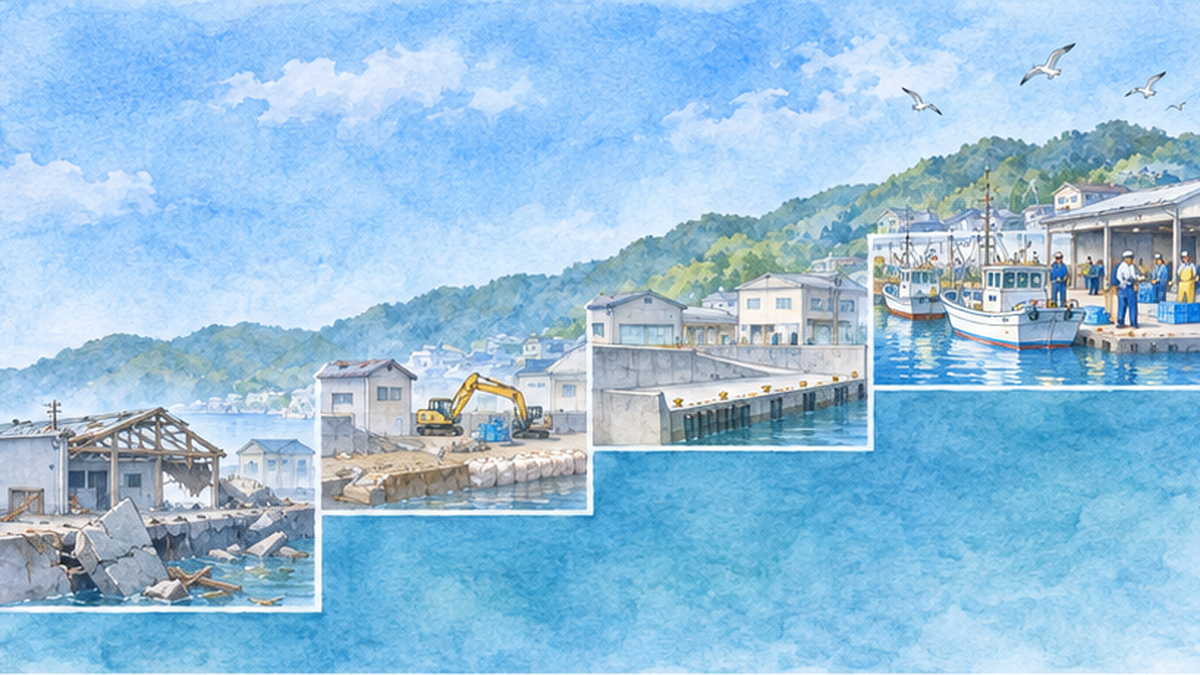
The same materials include many photographed before-and-after cases. At the Tomi Port quay, settlement of the apron and the road behind was fixed by removing and restoring pavement slabs, and use resumed. At Takakura Port, temporary repair used crushed stone, and at Ishizaki Port, flooding of the back area from ground subsidence was prevented with temporary sheet piles and large sandbags.
- Kaiso Port: use resumed with a temporary landing quay and slipway of large sandbags
- Takojima Port: use resumed after removing and restoring pavement slabs
- Noroshi Port: use resumed by dredging the basin and lowering the quay
- Funashi Port: use resumed by dredging the basin and extending the slipway toe
- Higashihama Port: permanent repair completed by repaving
What matters here is that "usable" and "back to the original level" are different. Even ports that became usable through temporary repair continue to face permanent repair and future planning.
From recovery to reconstruction: not just fixing fishing ports
The Fisheries Agency's review document lists seven important viewpoints for recovery and reconstruction. For recovery: (1) role-sharing among fishing ports and (2) facility development with the future in mind. For reconstruction: (3) ensuring unity of ports, villages and fishing grounds, (4) strengthening fisheries areas in light of the disaster, (5) strengthening distribution and production functions, (6) promoting umi-gyo using fishing ports and (7) using digital technology.
The idea of role-sharing
Restoring every fishing port to the same scale as before is not necessarily best. As population decline and labor shortages advance, the idea includes sorting out the roles of hub ports and small ports and concentrating investment. For aging fishers and succession, see Why the shortage of fishery workers is so serious.
What is umi-gyo?
Umi-gyo is an effort to use local resources of fishing ports and the seaside to develop direct sales of seafood, experiences, dining and tourism, increasing income and exchange in fishing villages. By overlaying plans to use port space for tourism and exchange on the opportunity of recovery, it seeks to draw a new image of fishing communities.
Read together with other articles
- When the Noto Peninsula Earthquake lifted fishing ports: where Noto's fishing livelihoods and recovery stand now
- Noto satoumi recovery: ama diving and seaweed beds returning in the uplifted sea
- Fisheries recovery 13 years after the Great East Japan Earthquake
Fishing-port recovery after the Great East Japan Earthquake mainly dealt with subsidence and tsunami, but in Noto the added factor of "uplift" changes the nature of the challenge. Both accumulated experience and new knowledge will be used in future disaster response.
Remaining challenges and what we can do
Even as repair works advance, rebuilding fisheries is not completed by ports alone. Boats and gear must be secured, markets and processing and distribution must resume, and above all fishers must be secured. In places where the seabed was exposed by uplift, habitats for abalone, turban shells and seaweed beds are also affected.
Three challenges
- Repair policy and process for ports that cannot be used (3 as of end of March 2026)
- Permanent repair and maintenance of facilities still used under temporary repair
- Securing fishers and sustaining fishing villages amid population decline and aging
What readers can do
Even from far away, actions such as choosing and eating seafood from affected areas, learning about the state of reconstruction from official information and supporting local ocean initiatives help support the rebuilding of fisheries. Always check the latest materials of public bodies such as the Fisheries Agency and Ishikawa Prefecture.
What you can do starting today
- Check the latest recovery pages of Ishikawa Prefecture and the Fisheries Agency
- Choose seafood and local products from Noto consciously
- As disaster preparedness, find out the tsunami and uplift risks in your own area
Summary
- In the Noto Peninsula Earthquake, 60 of the prefecture's 69 fishing ports were damaged and uplift of up to about 4 m was confirmed
- Recovery proceeds in two phases, temporary and permanent, using dredging of basins and lowering of quays
- As of the end of March 2026, 66 fishing ports in the prefecture are usable but 3 are not, and reconstruction is still under way
References and sources
- Fisheries Agency: Noto Peninsula Earthquake Fishing Community Recovery and Reconstruction Technical Review Document (summary) – July 2024
- Ishikawa Prefecture: fisheries recovery status (as of March 31, 2026) – Recovery status of fishing ports and harbors
- Ishikawa Prefecture: Noto Peninsula Earthquake fisheries recovery (August 2024) – Prefecture materials
- Ishikawa Prefecture: overview of the Reconstruction Council – Summary of reconstruction policy
- Fisheries Agency: disaster response for fishing ports and villages – Development and disaster prevention
- Fisheries Agency: technical review document (detailed version) – July 2024
* Listed in order of reliability: government and academic bodies > peer-reviewed papers > specialist bodies > reliable media