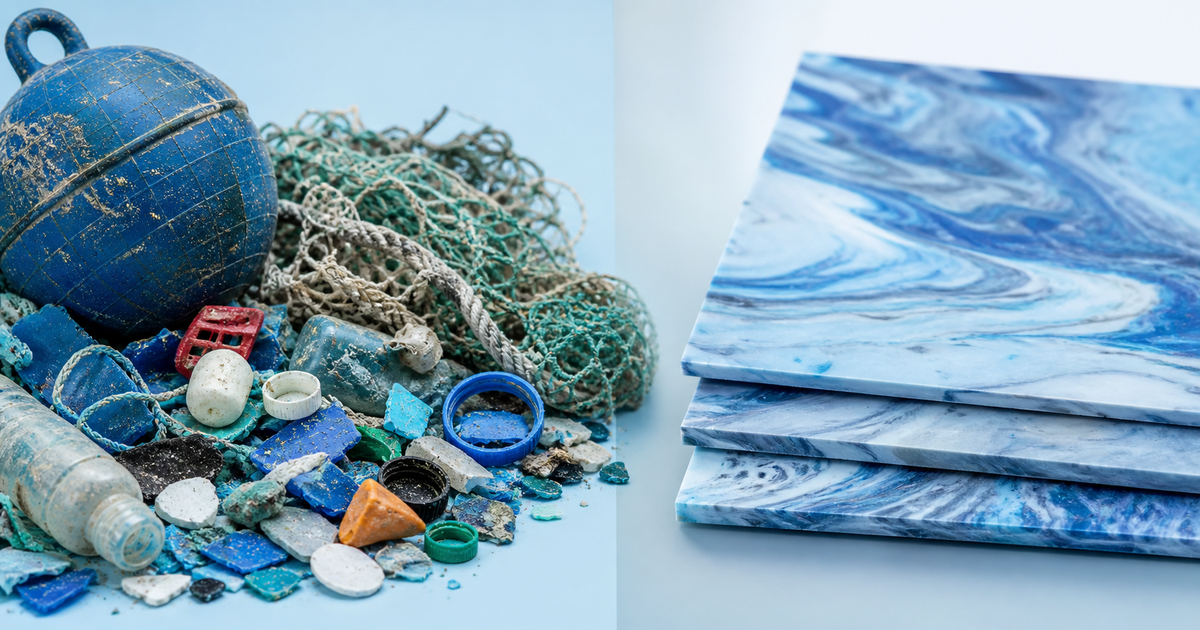
When most people see plastic waste floating in the ocean, they feel it's "dirty" or "sad." But one person looked at it and thought, "This is the best material there is." That person is Masasuke Mase, founder of REMARE Co., Ltd., born in Toba City, Mie Prefecture. REMARE is a materials company that revives ocean plastic and used fishing gear — waste that until now could only be incinerated or buried — into panels with a stone-like texture and one-of-a-kind marble patterns.
Around the world, roughly 8 million tonnes of plastic flow into the ocean every year, and at this rate, it's predicted that by 2050 the weight of plastic in the ocean could exceed the weight of fish. Meanwhile, a movement is slowly spreading to reconsider that waste as a "resource" and turn it into material for furniture, interiors, and spatial design. REMARE is one of the Japan-born startups standing at the forefront of that movement.
This article gently and carefully introduces what kind of company REMARE is, how it turns ocean waste into beautiful material, its products and mechanisms, and how we can get involved — drawing on data from reliable sources such as Japan's Ministry of the Environment and WWF.
What you'll learn in this article
- How serious ocean plastic waste is, both globally and in Japan, based on figures from the Ministry of the Environment and WWF
- What kind of company REMARE Co., Ltd. is, and why it was born in Toba City, Mie Prefecture
- The upcycling manufacturing process by which ocean waste is reborn as stone-textured panels
- The connection between "GYOG," a material made from regenerated discarded fishing gear, and the ghost gear problem
- How the circular business mechanism works, including reduced industrial waste disposal costs and suppressed CO2 emissions
- Where to see REMARE's products and how to bring them into daily life
What is REMARE? A Mie-born materials company turning ocean waste into a "resource"
REMARE Co., Ltd. is an upcycling company founded in 2021 that regenerates discarded plastic into circular resources. It originally set up a factory in Toba City, Mie Prefecture, manufacturing design-forward panels from ocean plastic and waste plastic generated by factories. Today its head office function has moved to Nagoya City, Aichi Prefecture; it has closed the former Toba factory and consolidated and expanded operations at its "Mie Factory" in Ise City, Mie Prefecture (with a branch office remaining in Toba).
The origin of the company name reflects its philosophy well. "RE" stands for Recycle, and "MARE" means "sea" in Italian. In other words, REMARE is a coined word carrying the wish to "bring the sea back again." Rather than disposing of ocean waste as a nuisance, the goal is to return it to society once more as valuable material. That stance is engraved in the name itself.
The trigger: a mass of waste floating in the Philippine Sea
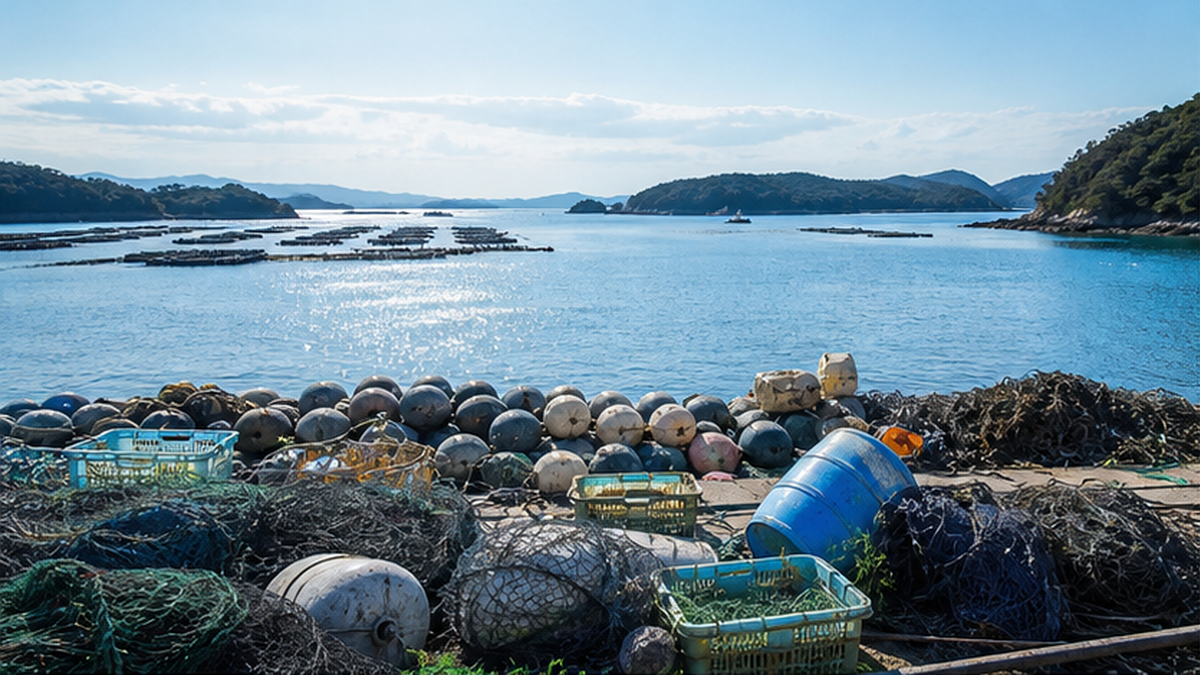
Masasuke Mase, who founded REMARE, was born in 1993 in Aichi Prefecture. He originally worked as a ship's navigator and engineer, sailing from Japan's coasts all the way to the Antarctic Ocean. The turning point came while he was sailing off the Philippine Sea. Seeing plastic waste covering the surface of the sea, Mase says he felt something different from the "something must be done" reaction most people have — he intuitively thought, "This could become the best material there is."
His experience of melting resin for fun during his free time on board also pushed this idea forward. "The globally serious problem of ocean plastic might be solvable if I combine it with my own hobby" — this seemingly outlandish thought became the starting point for the business now called REMARE. What makes this company distinctive is its attempt to solve a serious social problem not with a sense of tragedy, but with curiosity and creativity.
A third option, beyond "incinerate or bury"
Much of the plastic collected in Japan has, until now, been processed by incineration (burning) or landfill (burying). In particular, "composite plastics" mixed from multiple materials, and ocean waste soiled by seawater and sand, have been difficult to cleanly separate and recycle, and have tended to be disposed of rather than turned into resources.
What REMARE aims for is a "third option" beyond incineration and landfill. Using its own method, it deliberately avoids over-sorting mixed waste plastic and instead turns it into material, reborn as panels and products. This eliminates the cost that used to go into disposal, and it also curbs the carbon dioxide that would have been emitted through incineration. The idea at the core of REMARE is flipping waste disposal from a "cost" into "value creation."
REMARE is not just a recycling factory. It also has the character of a collective of creators, engaged widely in developing machinery and plants, architectural design, and product manufacturing. It handles everything itself, from material research through experimentation and development to material creation, pursuing the possibilities of new "resources" together with partner companies, brands, and government bodies. Because it holds both technology and design, it can elevate waste from something to be "thrown away" into something people "want to use."
REMARE in a nutshell
- A company that turns "mixed waste" such as ocean plastic and discarded fishing gear into material without over-sorting
- Makes 100% recycled panels with a stone-like texture and marble patterns
- Aims to cut disposal costs and CO2, flipping waste into a "resource"
- Also a collective of creators combining technology and design
Why is ocean plastic waste such a serious problem?
To understand REMARE's challenge, it helps to first know just how large a problem "ocean plastic waste" really is. Looking at the numbers makes the severity clear.
Roughly 8 million tonnes flow into the ocean every year
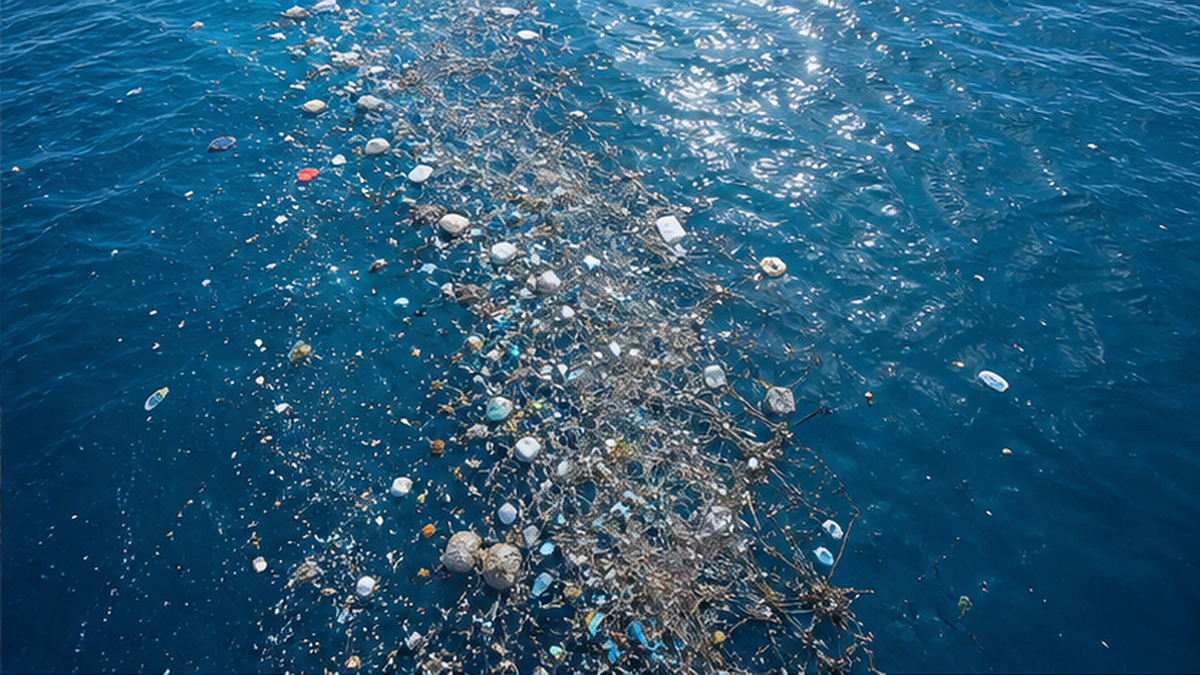
Worldwide, plastic waste flowing from land into the ocean was estimated, as of 2010, at roughly 4.8 to 12.7 million tonnes per year, with a median of about 8 million tonnes. That's a weight equivalent to tens of thousands of jumbo jets. Moreover, plastic barely decomposes in nature — it breaks into tiny fragments that become "microplastics," which enter the bodies of marine creatures and eventually make their way, round and round, onto our own dinner tables.
A 2016 report by the Ellen MacArthur Foundation and the World Economic Forum forecasts that, if production and disposal continue at this pace, by 2050 the weight of plastic in the ocean could exceed the weight of fish. These ocean environmental changes overlap with rising water temperatures too, and this kind of compound burden is not unrelated to the effects of rising seawater temperatures on fisheries.
The waste flowing out of Japan is not someone else's problem
It's easy to assume that "most ocean plastic comes from other countries," but Japan is not uninvolved. According to Japan's Ministry of the Environment's fiscal 2024 review results, the plastic waste flowing from Japan into the ocean is estimated, based on a bottom-up calculation by source and item, at roughly 13,000 to 31,000 tonnes per year. The figure has a range, but waste generated from our own daily lives is indeed flowing into the sea.
Waste that flows into the ocean also affects ecosystems. Seabirds and fish mistake plastic for food and eat it; sea turtles and marine mammals get tangled in fishing nets and lose their lives. This kind of damage is gradually chipping away at Japan's marine biodiversity itself.
| Aspect | Approximate scale | Source guideline |
|---|---|---|
| Plastic waste flowing into the ocean worldwide each year | About 8 million tonnes (median, 2010 estimate) | International research, WWF, etc. |
| The ocean's state in 2050 (forecast) | Possibility that plastic's weight will exceed fish's weight | Ellen MacArthur Foundation and World Economic Forum (2016 report) |
| Plastic waste flowing from Japan into the ocean | About 13,000-31,000 tonnes per year | Ministry of the Environment (fiscal 2024 review results) |
Why doesn't plastic "decompose"?
What makes plastic troublesome in the ocean is precisely its durability. Microorganisms in nature can't break plastic down effectively. As a result, plastic that reaches the ocean doesn't rot and return to soil — it merely breaks into smaller and smaller pieces through waves and ultraviolet light. Fragments 5 millimeters or smaller are called microplastics, and at that point recovery becomes almost impossible. That's exactly why it's decisively important to recover plastic before it flows into the ocean, or at an early stage after it does, and return it to the cycle as material.
Furthermore, once something is incinerated as waste, carbon dioxide is released from it. Reducing waste is directly connected to climate action as well as to protecting the ocean. The ocean environment and climate cannot be separated, and this is deeply connected to issues such as the impact of rising water temperatures on fisheries and the declining carbon-absorbing capacity of the ocean. REMARE's efforts are meaningful in that they address both of these issues at once.
Key point
Figures always carry a range and are not fixed values. Even so, the "scale of the problem" and the fact that "Japan too is a party to it" can be read consistently across every estimate. Because plastic that has entered the ocean becomes hard to recover, the key is "turning it into a resource before it flows out, or at an early stage."
From ocean waste to panels: REMARE's manufacturing process
So how, exactly, is ocean waste reborn as beautiful material? The defining feature of REMARE's manufacturing lies in the idea of "using it as it is, mixed together."
A reversed idea: don't over-sort
In ordinary plastic recycling, it's considered essential to cleanly sort material by type. If types get mixed, quality becomes unstable and it becomes difficult to regenerate. REMARE does the opposite: it deliberately molds together without over-sorting various types and colors of plastic — PET bottle caps, blue buoys, blue tarps, fishing nets, and more.
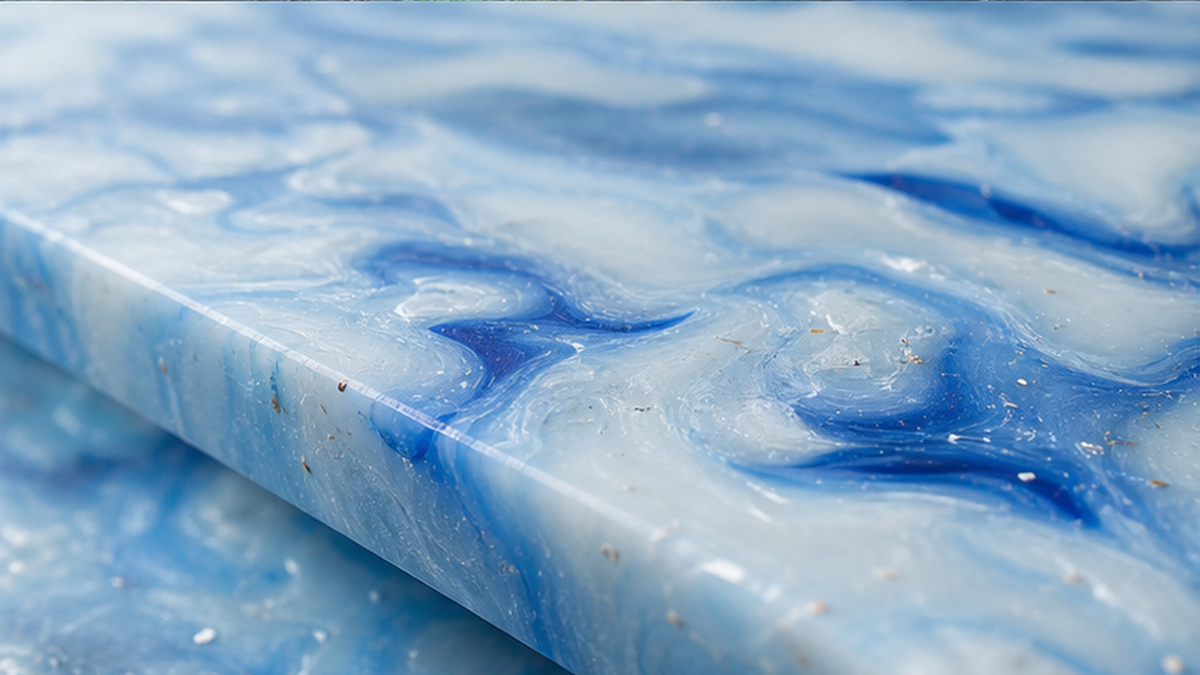
The result is a marble pattern, no two of which are ever the same. Chance overlaps of color that no human hand could design become the material's own personality. It's a beauty born precisely because it is waste — the exact opposite of the "uniform and perfect" ideal that industrial products chase. This is where REMARE's uniqueness lies.
Crush, wash, melt, press — a consistent process
The basic manufacturing flow is simple. Collected plastic is washed, crushed into small pieces, melted once, and then pressed to be molded into flat panels. Because the melting temperature and speed differ from material to material, the know-how of finely adjusting the crushed particle size and panel thickness determines the quality. The fact that everything from collection through washing, crushing, molding, and processing is done in-house is also one of REMARE's strengths.
What it can handle is a category called "thermoplastic resins" — plastics that soften when heated — excluding PVC (polyvinyl chloride). Within that range, a wide variety of waste plastic can be turned into its own unique material. What's interesting about this company is that even material soiled and degraded like ocean waste is embraced as a distinctive texture born of years passed, rather than being rejected.
- Collection: gather ocean plastic, factory waste plastic, discarded fishing gear, and more
- Washing: remove seawater, sand, and dirt
- Crushing: break material into pieces sized to suit it
- Melting and molding: melt with heat and press into panels
- Processing: cut and polish to finish into furniture, interiors, and products
Looks like stone, works like wood
The finished panel has a marble-like sense of weight in appearance, yet because it is actually plastic, it is lightweight and can be cut or shaved like wood — that's its defining feature. This combination of a "stone-like texture" with "wood-like workability" makes a wide range of uses possible, from furniture and interiors to store fixtures. The fact that the material itself is 100% recycled also carries major significance as environmental value.
When it comes to using ocean waste as material, the biggest enemies are "dirt" and "degradation." Salt and sand from seawater, and fading from long years of exposure, are things that lower quality in ordinary recycling. REMARE accepts this very dirt and degradation as "character," turning it instead into richer expression through its washing and molding techniques. It's a texture that carries the memory of time and the sea, something a uniform brand-new material never has — a value that virgin material (brand-new raw material) simply cannot imitate.
The heart of this process
- An idea that turns mixing from a "flaw" into "character"
- In-house control from collection to processing, for consistent quality and expression
- Washing and molding techniques that turn even dirt and degradation into "character"
- A stone-like texture x wood-like workability x 100% recycled, all in one
"GYOG," a material born from discarded fishing gear, and the ghost gear problem
Among REMARE's initiatives, the one most deeply connected to the sea is "GYOG," a material regenerated from used fishing gear. Named after "gyogu" (fishing gear), it is one of REMARE's signature materials. Precisely because it comes from the field of fishing itself, GYOG most vividly embodies REMARE's founding philosophy of "bringing the sea back again."
Fishing gear is indispensable to the practice of fishing. But precisely because it's durable and long-lasting, once it has served its purpose it becomes a "heavy burden" that's troublesome to dispose of. If it flows into the ocean, it harms living creatures; if it's processed on land, it costs money. For both users and those who discard it, it has been a vexing presence. GYOG is an attempt to untangle that knot of trouble into material with new value.
What is ghost gear?
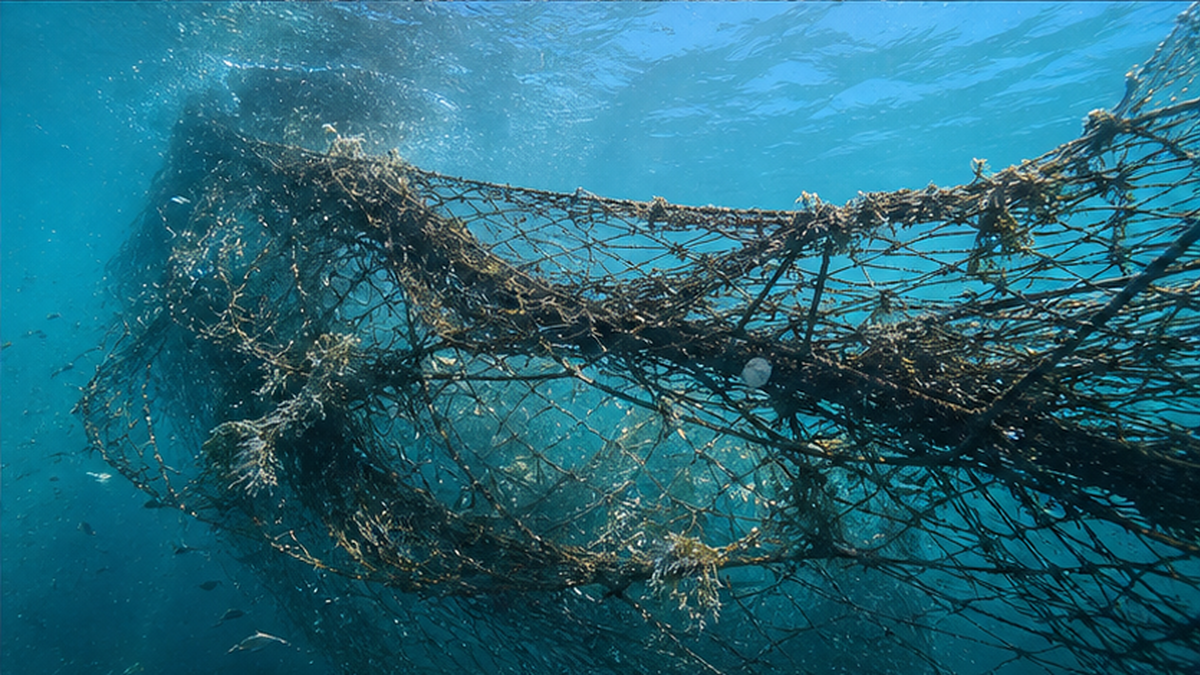
Fishing nets, ropes, fishing lines, and other gear that has flowed into the ocean or been abandoned there is called "ghost gear." Because it keeps entangling fish and sea turtles in the water even after leaving its owner's hands, it is also called "ghost fishing," causing serious harm to marine life. According to WWF and others, ghost gear accounts for at least about 10% of ocean plastic waste, and it's estimated that roughly 500,000 to 1.15 million tonnes of fishing gear flow into the ocean worldwide every year.
In particular, in the "Great Pacific Garbage Patch," where waste gathers in the open ocean, one survey found that roughly 46% of the drifting plastic was fishing nets. Fishing gear has long been a prime example of material that's difficult to recycle, being durable, bulky, and composed of mixed materials. In terms of impact on marine life, it's also an issue that can't be overlooked when it comes to protecting biodiversity.
Turning "low-value waste" into "valuable material"
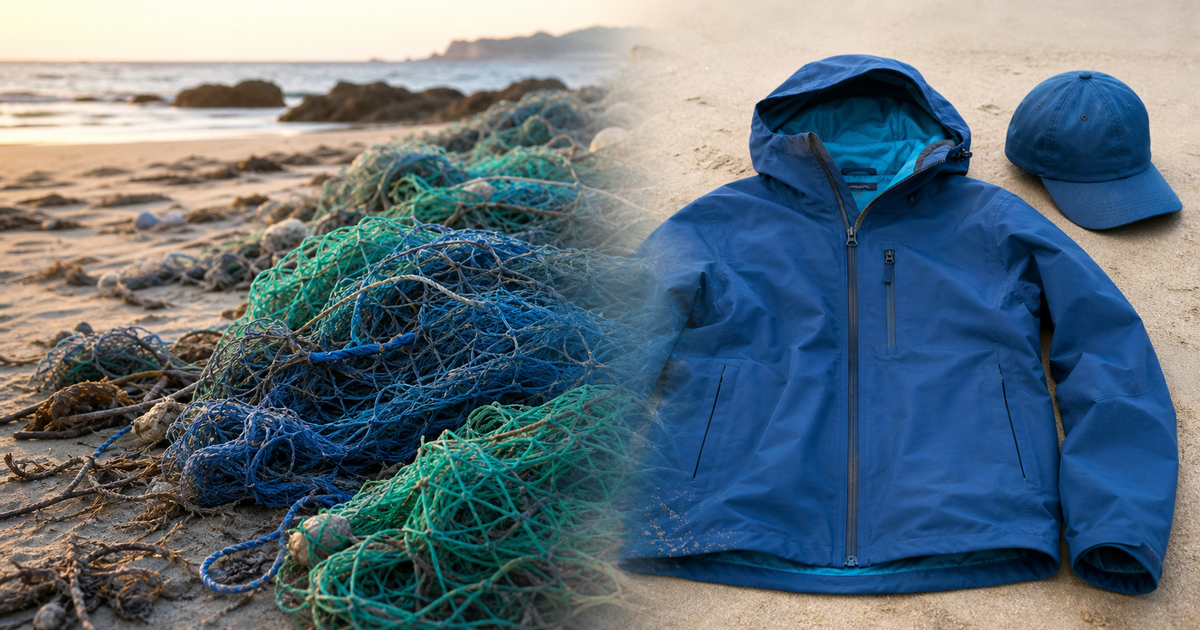
REMARE reconsiders this hard-to-handle discarded fishing gear not simply as waste but as material. Fishing gear that has spent long years in the sea carries a distinctive color and texture that can't be artificially produced, and that feeds directly into the richness of GYOG's expression. By handling collection, washing, crushing, molding, and processing all in-house, REMARE turns fishing gear that's difficult to manage into building materials, interior materials, furniture, and more.
In 2025, it introduced machinery dedicated to processing fishing gear, putting the upcycling of fishing gear into full swing. This theme also connects with the waste challenges faced by fishing communities across regions, including the Sanriku area, resonating with regional efforts such as the revival of Sanriku's fisheries industry.
Partnering with fishermen — the tie-up with Fisherman Japan
In October 2024, REMARE formed a business partnership with "Fisherman Japan," a group of young fishermen. By partnering directly with the fishermen who are the parties actually using and discarding fishing gear in the field, the initiative aims to stably collect quality discarded fishing gear and pursue both sustainable fishing and environmental protection at once. Those who generate the waste and those who turn it into material joining hands — this framework itself demonstrates one form a circular society can take.
There are reasons why fishing gear recycling hasn't progressed until now. Fishing nets are often composed of a combination of multiple materials such as nylon and polyethylene; they are durable and bulky, and sorting is difficult. There simply wasn't an outlet (a use) that justified the processing cost. REMARE's technology of "turning material into resource without over-sorting" is precisely what turns this weakness into a strength. Fishing gear, once a byword for difficulty, becoming raw material for design-forward building materials and furniture — for fishing communities, that's an event that turns the headache of waste disposal into hope.
Ghost gear by the numbers
- At least about 10% of ocean plastic waste originates from fishing gear
- About 46% of the plastic drifting in the Great Pacific Garbage Patch is fishing nets
- An estimated roughly 500,000 to 1.15 million tonnes of fishing gear flow into the ocean worldwide every year
- Some estimates put fishing-derived plastic at about 9.4% of all ocean plastic waste, or roughly 1.15 million tonnes per year
Toba, the oyster town that nurtured the idea of regional resource circulation
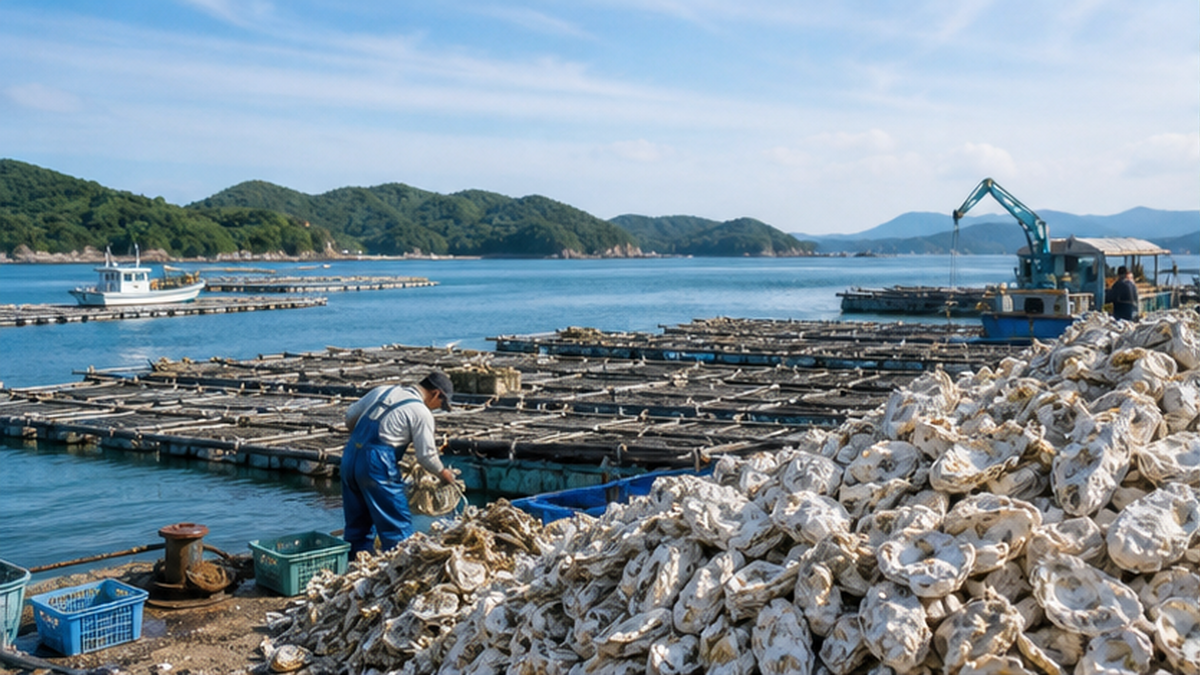
Toba City, Mie Prefecture, the location REMARE chose for its first base, is a coastal town known for oyster farming. Starting the business in this "oyster town" gave REMARE's philosophy a deep perspective on regional resource circulation.
Making things near where the material is born
One of the reasons Mase chose Toba was very practical. Transporting waste far away costs that much more in transportation and CO2. So the thinking goes: it's more rational to make things near the site where the material is generated. By manufacturing in the "production area of the material" — ocean waste and discarded fishing gear — the aim was to reduce wasted logistics and create a cycle that circulates resources within the community.
That said, it wasn't welcomed from the start. Fishermen dismissed the idea outright, saying "there's no way that's going to make money," and there were times his spirit nearly broke. Even so, Mase immersed himself in the community, sharing drinks with fishermen and even helping out with oyster farming, learning the real challenges faced on the ground at sea. Building relationships with people came before talk of materials. That gritty accumulation supports today's partnerships.
Oyster shells, too, are a local "resource"
An oyster town has its own oyster-specific circulation challenge. That is oyster shells. In Japan, roughly 140,000 to 200,000 tonnes of oyster shells are said to be generated every year, and much of it has become waste that's troublesome to process. Disposing of shells costs money, and in some areas the stockpile sites are full. On the other hand, oyster shells are rich in calcium carbonate, and their use as resources — for fertilizer, livestock feed, soil conditioner, water purification material, and more — is advancing. The circulation of oyster shells is covered in more detail in our article on oyster shell recycling initiatives.
Waste plastic and oyster shells — though the materials differ, the question of "how to return unwanted byproducts of marine activity to the community as resources" is shared between them. It's no coincidence that REMARE was born in an oyster town. A place that receives the sea's blessings is, at the same time, a place that must face the sea's waste. That on-the-ground sensibility keeps REMARE's manufacturing grounded in reality.
Workshops that involve the community
REMARE doesn't stop at making material — it also creates opportunities that involve local people and companies. Since 2025, it has been running workshops for businesses where participants can experience upcycling firsthand. The experience of seeing waste you yourself produced transform into material right before your eyes becomes a powerful trigger for treating environmental issues as "your own problem." Resource circulation in seaside towns is also continuous with efforts to protect tidal flats and seaweed beds, connecting with the conservation of natural environments such as tidal flat conservation.
Being rooted in a community also makes sense from the standpoint of securing a stable supply of material. Ocean waste and discarded fishing gear are materials whose timing, location, and quantity are hard to predict. By building trust with local fishermen and municipalities, a continuous supply of good-quality material can be gathered. The waste collection route itself becomes the foundation of the business. That's precisely why REMARE spent time on "building relationships with people" first, before machinery or money. Circular manufacturing is built not just on technology, but on ties with the local community.
The idea behind regional resource circulation
- Process waste near the "production area of the material" to reduce wasted transport
- Treat both waste plastic and oyster shells as "resources" that should be returned to the community
- Trust with the community leads to a stable supply of good-quality material
- Involve residents and companies through workshops, turning circulation into culture
REMARE's products and uses: ocean waste returning to our lives and spaces
In what actual forms is REMARE's material making its way into our lives and cities? Making use of the properties of panel material, its applications are expanding year by year.
From furniture and interiors to small everyday goods
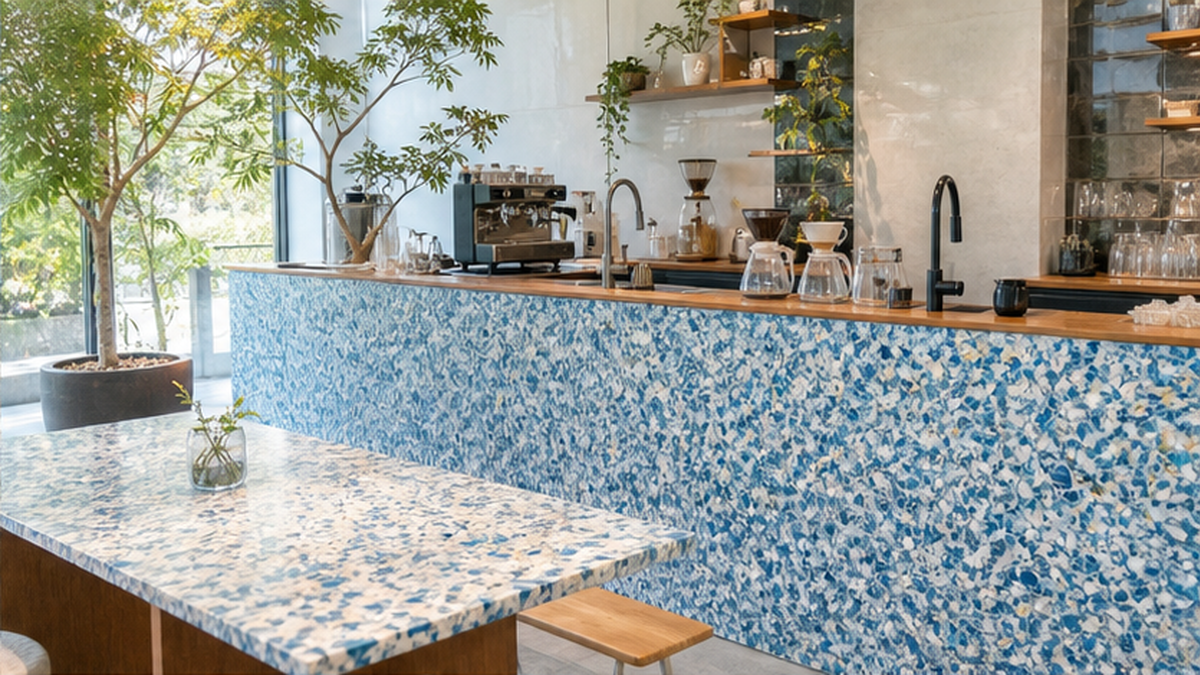
REMARE's panels are used as building and interior materials, such as tabletops, counters, store walls, and fixtures, as well as being developed into small goods and products like watches, ballpoint pens, and accessories. The fact that the same material can take on a wide range of forms, from large surfaces down to palm-sized items, is a strength unique to a panel material that's easy to process.
Especially in the field of spatial design, the value of the marble pattern as a one-of-a-kind piece is highly regarded. The story that "this counter is made from waste that came out of this local sea" becomes, for hotels, stores, and offices, a brand message in itself. This storytelling quality is one of the great appeals of REMARE's products.
Products born from collaborations with companies
REMARE also puts its material to use through collaborations with various companies. With Okamura Corporation, an office furniture maker, it has worked on tabletop development, and with Kanro Co., Ltd., a confectionery maker, it has undertaken an initiative to use the company's own confectionery packaging material as raw material. "Reviving a company's own waste plastic as its own products or fixtures" — this cycle becomes a means for companies to achieve environmental response and brand building at the same time.
| Use category | Concrete examples | Feature put to use |
|---|---|---|
| Building and interior materials | Walls, counters, fixtures | Stone-like texture, one-of-a-kind design |
| Furniture | Tabletops, office furniture | Lightness and ease of processing |
| Products and goods | Watches, ballpoint pens, accessories | Diverse expression in small lots |
| Space and art | Store and hotel space design | The storytelling and message the material carries |
"Buying" is participating in the cycle
Choosing REMARE's products is not just shopping. Waste recovered from the ocean becomes material, and it's only when someone uses it that the cycle is truly completed. Only when there are people to use it does waste become established in society as a resource. REMARE aims to make recycled material not something special, but "an ordinary material people choose as a matter of course," just like wood or stone.
Such "material with a story" is growing more prominent within corporate brand strategy alongside rising environmental awareness. There was once an image that "recycled material equals cheap, a compromise," but REMARE's products completely overturn that. If anything, precisely because of its one-of-a-kind marble pattern and the ocean story behind it, it holds higher value than ordinary material. Not "using it because it's good for the environment," but "using it because it's beautiful and cool — and it's good for the environment, too." That reversal in order is precisely the key to upcycling truly spreading through society.
Seeing ocean plastic not as mere garbage, but as the best material there is.
— From the thinking of REMARE founder Masasuke Mase
In spatial design settings, the "makes-you-want-to-explain-it appeal" of REMARE's panels is also treasured. A visitor can't help but ask, "What material is this wall made of?" From there, a conversation blossoms: "Actually, it's made from waste that came out of this local sea." The material itself becomes an entry point for communicating a commitment to the environment. For restaurants, hotels, and offices, this kind of conversation starter conveys a brand's stance more powerfully than any advertisement.
REMARE's business model: turning waste disposal into "value creation"
The reason REMARE draws attention isn't just the appeal of its material and design. The essence of this company lies precisely in a business mechanism where handling waste directly leads to solving problems for companies and society.
Making industrial waste disposal costs "unnecessary"
When a company disposes of plastic it no longer needs, it typically incurs processing costs as industrial waste. Under REMARE's model, that waste plastic is taken in and used as material, which can reduce the disposal costs borne by the company. Furthermore, by turning plastic that would have been incinerated into material instead of burning it, the corresponding CO2 emissions can be suppressed as well — another form of environmental value created.
In other words, for a company, partnering with REMARE can become a choice that pursues "cost reduction," "CO2 reduction," and "brand enhancement" all at once. Efforts that reduce waste and curb greenhouse gases can be seen as part of a broader movement to protect the planet from both the ocean and climate angles, alongside the conservation of blue carbon ecosystems, which store carbon through the power of the sea.
Paid purchasing: a reversed relationship
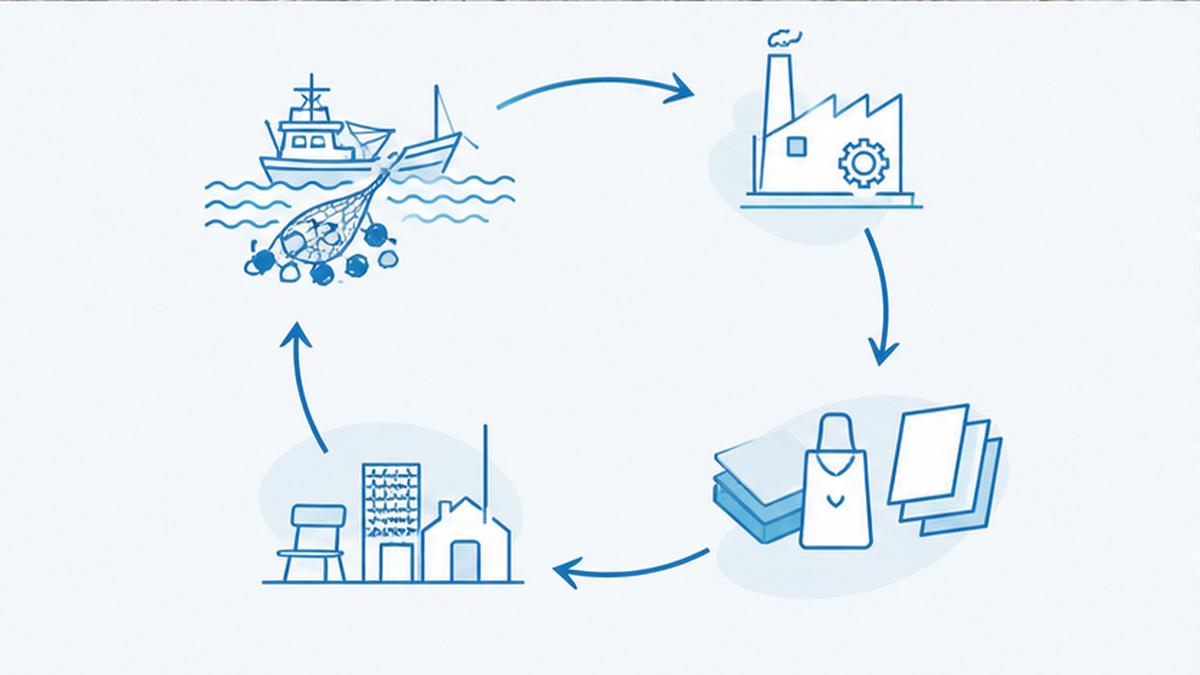
What makes REMARE unique also lies in the fact that it "buys discarded fishing gear and the like for a fee." Waste that fishermen and communities used to pay money to dispose of instead becomes a resource that generates money. That reversal of the relationship is a clear success story of the circular economy. REMARE currently processes plastic at a scale of roughly 100 tonnes per year, and is looking ahead to expanding this to a scale of 2,000 tonnes in the future.
Going global with a fully automated plant
The future REMARE envisions goes even further. It has a vision of developing a fully automated plant that takes in waste plastic and outputs panels, and rolling it out across regions. Under the plan, trial operation is set to begin in Gifu Prefecture in 2026, followed by nationwide rollout in 2027, and expansion into Southeast Asia — where ocean plastic problems are especially serious — by 2028. Incidentally, the factory equipment that regenerates ocean waste has had its mechanism and design recognized, winning a Good Design Award in 2023.
If this vision is realized, its significance becomes very large. Ocean plastic problems are especially serious in regions where waste collection and processing infrastructure isn't in place. If a small plant that "outputs panels when you feed in waste plastic" could be installed in such regions, it could turn waste locally into valuable material and even generate employment and income. Solving the waste problem and revitalizing the local economy at the same time — what REMARE envisions is nothing less than infrastructure for a circular economy, beyond a mere materials business. The challenge of one Japanese company is connected to the future of the world's oceans.
Three values of the REMARE model
- For companies: reduced industrial waste costs x reduced CO2 x enhanced brand
- For communities: paid purchasing of discarded fishing gear turns waste into income
- For society: a fully automated plant concept spreads the cycle worldwide
- For the future: solving the waste problem and revitalizing local economies at once
What we can do: building a "good relationship" with ocean waste
The challenge of a company like REMARE is reassuring, but the problem of ocean waste can't be solved by producers alone. The choices of users — that is, each and every one of us — are the final piece that keeps the cycle turning.
Start by encountering the "story of the material"
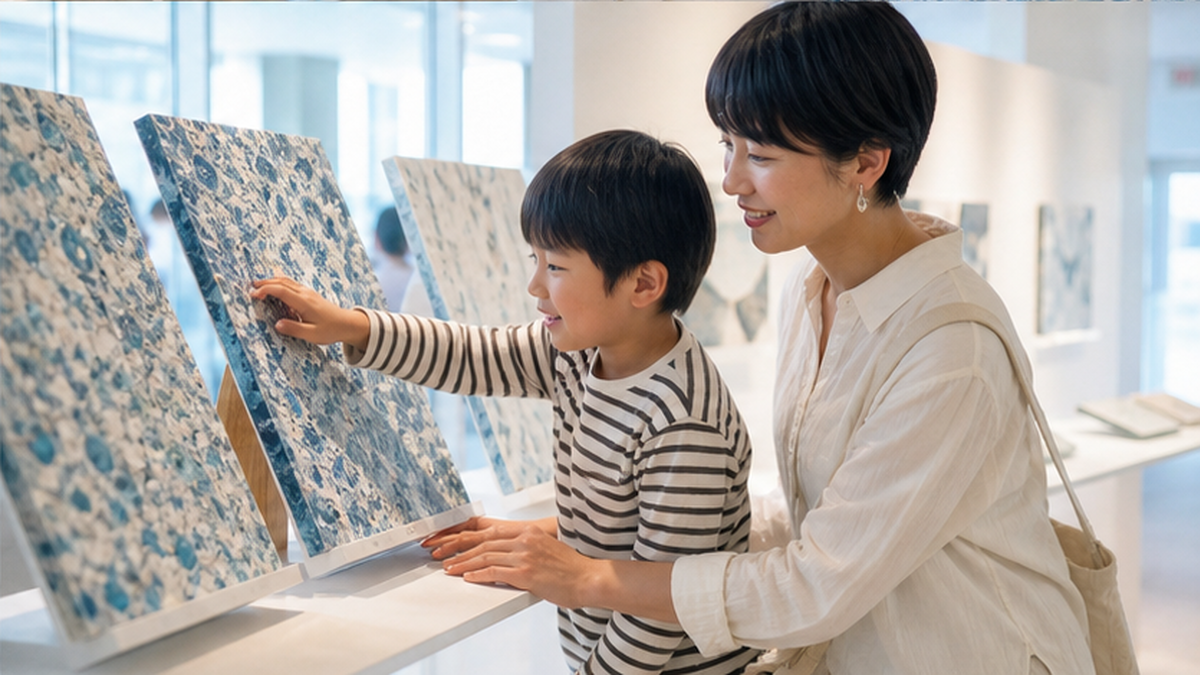
There's no need to overthink it. The first step is simply to actually encounter upcycled materials and products like REMARE's. Through exhibitions, pop-ups, its Toba base, or the products of partner companies, choosing something knowing that "this is made from ocean waste" quietly changes how you see waste. Knowing the story behind a material carries real significance as environmental education, too.
Small choices we can make in daily life
Beyond choosing upcycled products, there is much we can do. What matters is stacking up small, sustainable choices.
- Reduce single-use plastic and choose reusable items
- Try joining a beach or river cleanup
- "Deliberately choose" recycled and upcycled products
- Sort waste properly, putting it on the route back into resource circulation
- Learn about the ocean waste problem and talk about it with family and friends
Pause once before you "throw it away"
What REMARE's story teaches us is that what separates "waste" from "resource" is, in fact, our own way of seeing things. The very same fishing net can become troublesome waste or beautiful material, depending on how you look at it. Pause once before you throw something away, and ask yourself, "Is this really waste?" That small habit gradually turns our relationship with the ocean into something better.
The ocean waste problem looks so enormous that it's easy to feel "nothing changes no matter what one person does." But REMARE's journey began from a single person thinking that ocean waste was "material." When how we see things changes, our actions change. When actions change, they spread to the people around us. Us choosing one product made of recycled material, us sorting one piece of waste correctly — it's the accumulation of these small steps that finally lets ocean waste take root in society as a "resource." It doesn't need to be perfect. Let's start with what we can do.
Three actions you can start today
- Choose one recycled or upcycled product from around you
- Look into information on a nearby beach cleanup or environmental event
- Share this article to spread the word about ocean waste becoming a "resource"
Conclusion: the hope of turning ocean waste into "the best material"
REMARE Co., Ltd., born in Toba City, Mie Prefecture, is reviving ocean plastic and discarded fishing gear — waste that until now could only be incinerated or buried — into 100% recycled panels with a stone-like texture and marble patterns. The reversed idea of mixing without over-sorting, a stance rooted in the region where the material originates, and a business model that reduces disposal costs and CO2 — all of these make this company one of a kind.
The problem of ocean waste, with roughly 8 million tonnes flowing in worldwide every year, is so enormous it makes you want to look away. But REMARE's story teaches us that there is indeed a perspective that reframes this vast challenge not as a "tragedy," but as a "treasure trove of material." It is nothing but our own gaze that separates waste from resource.

Summary of this article
- REMARE is a Mie-born materials company that turns ocean plastic and discarded fishing gear into 100% recycled panels with a stone-like texture
- The idea of "mixing without over-sorting" produces marble patterns where no two are ever the same
- It tackles the ghost gear problem with its fishing-gear-regenerated material "GYOG," and regional resource circulation in the oyster town of Toba
- It reduces industrial waste costs and CO2, purchases discarded fishing gear for a fee, and envisions global expansion through a fully automated plant
- "Pause once before you throw it away" — it is our own way of seeing things that separates waste from resource
References and sources
- Ministry of the Environment, Japan - Estimate of ocean plastic waste outflow (fiscal 2024 review results)
- Ministry of the Environment, Japan - Fiscal 2024 review results: estimate of Japan's ocean plastic waste outflow (PDF)
- Ministry of the Environment, Japan - Guidelines for fishery waste processing (revised, May 2020)
- WWF Japan - About the ocean plastic problem
- WWF Japan - Let's eliminate "ghost gear," a serious cause of the ocean plastic problem
- REMARE Co., Ltd. - Official website (company overview, materials, products)
- Toba Chamber of Commerce and Industry (toba.or.jp) - Sustainability: the circular economy REMARE is leading
- WORK MILL - Changing the world with a business born from play: REMARE's adventure in finding new value in ocean plastic
- Fisherman Japan - News on the business partnership with REMARE
*Listed in order of reliability: government and academic institutions > peer-reviewed papers > specialized organizations > trusted media