⚡ In short
A golden tide is a massive bloom and stranding of brown Sargassum seaweed. The Great Atlantic Sargassum Belt stretched 8,850 km, and 2025 set an all-time record of roughly 38 million tons. We explain the causes, the damage, the Yellow Sea and Japan connections, and the race to turn the seaweed into building materials and fertilizer.
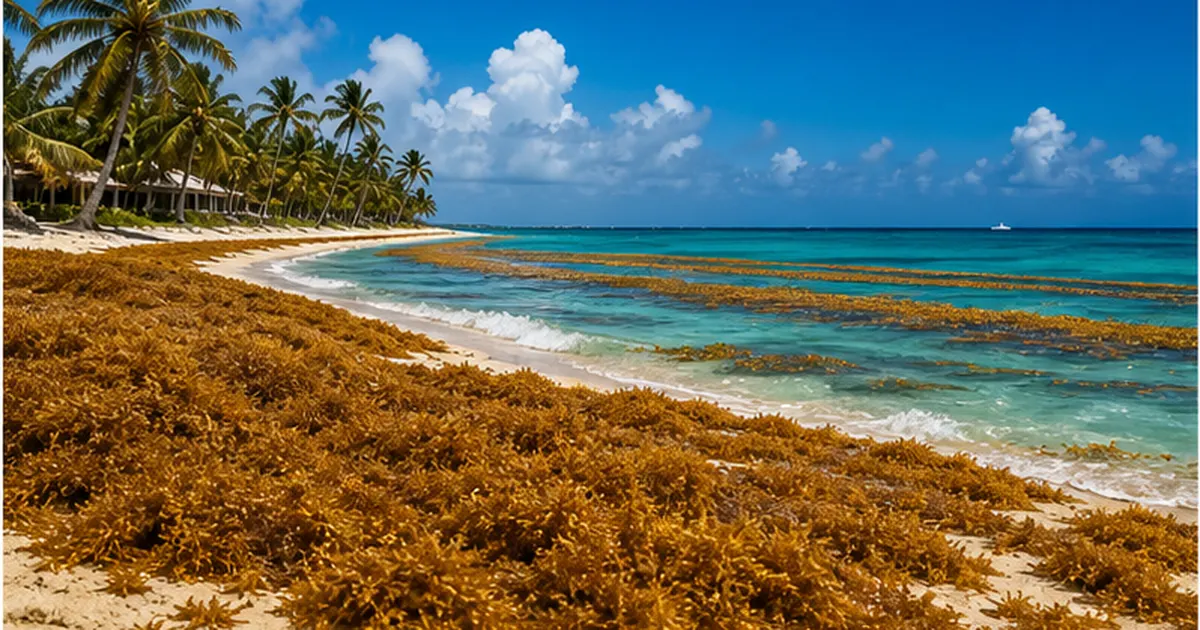
One morning, a white Caribbean beach is suddenly buried under mountains of brown seaweed. Scenes like this now repeat almost every year across the Atlantic. The invader is a brown alga of the genus Sargassum. Its massive blooms and strandings are called "golden tides" after the seaweed's color, and researchers worldwide warn that they have become a new marine environmental problem alongside red tides and green tides.
The scale is staggering. The "Great Atlantic Sargassum Belt" reported in Science in 2019 stretched 8,850 km from West Africa to the Caribbean Sea and the Gulf of Mexico. In 2025, the floating biomass reached roughly 38 million tons, the largest ever observed. Hydrogen sulfide from the rotting seaweed erodes residents' health, and the damage extends to the economy through beach closures and destroyed aquaculture facilities.
Yet drifting Sargassum is also, by nature, an "ocean nursery" that shelters juvenile yellowtail known as mojako and baby sea turtles. And in recent years, ventures have begun turning the stranded seaweed into building materials and fertilizer. This article explains golden tides from the ground up—what they are, why they happen, how they affect the world and Japan, and the frontier of turning the seaweed into a resource—based on primary sources.
What you will learn in this article
- The definition of a golden tide and how it differs from red and green tides
- The reality of the 8,850 km Great Atlantic Sargassum Belt and the record set in 2025
- The three drivers of mass blooms: nutrients, upwelling, and climate change
- The health risks of hydrogen sulfide from rotting seaweed and the economic damage to tourism and fisheries
- Nori farm damage in the Yellow Sea and the "ocean nursery" role of drifting seaweed in Japanese waters
- The frontier of uses in construction, fertilizer, and cosmetics—and the arsenic hurdle
What Is a Golden Tide? The True Identity of the "Golden Surge"
A golden tide is a phenomenon in which brown seaweeds of the genus Sargassum multiply and accumulate explosively at the sea surface, forming vast rafts of drifting seaweed that float across the ocean and wash ashore. The name comes from the way the golden-brown algae blanket the sea surface and coastline. It is a type of large-scale algal bloom—alongside red tides caused by plankton and green tides caused by sea lettuce—and it has intensified rapidly since the 2010s in the Atlantic and in East Asian seas.
How it differs from red tides and green tides
Each "tide" phenomenon has a different causal organism. Red tides are caused by microscopic phytoplankton, green tides by green algae such as sea lettuce (Ulva), and golden tides by large brown Sargassum seaweeds. All are commonly triggered by eutrophication—an oversupply of nutrients flowing into the sea—but Sargassum plants reach tens of centimeters to several meters in length, so the biomass per individual is orders of magnitude larger, making the physical impact of a stranding especially severe.
| Phenomenon | Causal organism | Appearance | Typical areas |
|---|---|---|---|
| Red tide | Phytoplankton (dinoflagellates, diatoms, etc.) | Sea turns reddish brown | Seto Inland Sea, Ariake Sea, coastal waters worldwide |
| Green tide | Sea lettuce and related green algae | Green algae cover the sea surface and shore | Yellow Sea (off Qingdao, China, etc.) |
| Golden tide | Sargassum (brown algae) | Golden-brown seaweed rafts drift and strand in bands | Tropical Atlantic, Caribbean, Yellow and East China Seas |
For a deeper look at red tides and eutrophication, see our related article "Everything About Red Tides, Blue Tides, and Eutrophication".
The lead actor: Sargassum, a large seaweed that floats on air bladders
The defining feature of Sargassum is its air bladders (pneumatocysts)—small gas-filled floats on its body. According to the Japan Fisheries Research and Education Agency, the buoyancy of these bladders holds the plant upright in the water, and even after being torn from the rocks it can go on living afloat at the surface. This "power to float" is exactly what enables the long-distance drifting—as drifting seaweed rafts—that other seaweeds cannot manage.
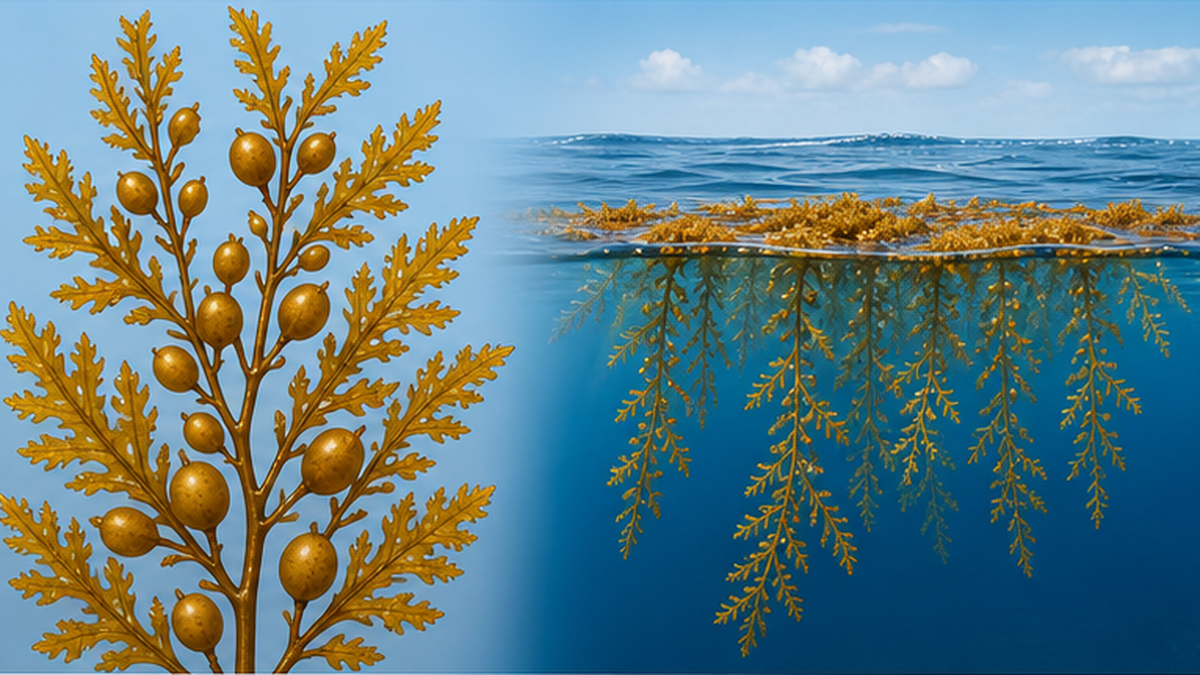
Two Atlantic species in particular (Sargassum natans and Sargassum fluitans) are holopelagic—they spend their entire lives afloat, never attaching to the seabed, a rare way of life. The Sargasso Sea, whose name means "sea of seaweed," was named for these floating seaweed masses back in the age of exploration. Because the algae never sink as they multiply, they can accumulate without limit when conditions align.
A "new tide" reported around the world
The term "golden tide" entered international use in the 2010s. In 2013, algal scientists Smetacek and Zingone warned in a Nature review that mass blooms of brown seaweed—golden tides—were increasing along coasts worldwide, together with green tides. Behind the trend lie two changes common to the whole planet: coastal eutrophication and ocean warming. From around this time, the scientific community became keenly aware that drifting seaweed, once a feature of rich, healthy seas, was being transformed by human activity into an uncontrollable mass of biomass.
There is not yet a single established translation of the term in Japanese, where it is sometimes rendered as "kin-cho" (golden tide). This article uses the internationally recognized name "golden tide." It is worth remembering as the "fourth tide," after red, blue, and green tides.
Drifting seaweed itself is actually a familiar sight on Japanese shores. Walk a beach from spring to early summer and you will often find golden-brown seaweed with air bladders washed up on the sand. That familiar drift seaweed swelling to tens of millions of tons on the other side of the world and becoming a social problem—that is the scale of the golden tide issue.
Key points
- Golden tide = a mass bloom and stranding of Sargassum seaweed
- A type of large-scale algal bloom, alongside red tides (plankton) and green tides (sea lettuce)
- Its air-bladder buoyancy carries huge amounts of seaweed to distant coasts
The World's Largest Seaweed Belt: The Great Atlantic Sargassum Belt
What thrust golden tides into the global spotlight was a gigantic band of seaweed that appeared in the Atlantic. In 2019, Dr. Mengqiu Wang of the University of South Florida and colleagues named it the "Great Atlantic Sargassum Belt" in a paper published in Science. It is the largest macroalgal bloom in the world.
The 8,850 km reality revealed in Science
According to this study, which analyzed 19 years of satellite observations, at the belt's peak in June 2018 drifting seaweed stretched 8,850 km from off West Africa to the Caribbean Sea and the Gulf of Mexico, with an estimated total weight of more than 20 million metric tons. A "seaweed belt" longer than one-fifth of Earth's circumference was crossing the tropical Atlantic.
Crucially, this phenomenon began abruptly in 2011. Before then, Atlantic Sargassum stayed mostly around the Sargasso Sea, and large blooms were almost never observed in the tropical Atlantic. But from 2011 onward the belt has formed almost every year, and the research team suggests it has "likely become the new normal."
Records keep falling: about 38 million tons in 2025
As predicted, the belt has kept growing. According to estimates by the University of South Florida's Optical Oceanography Lab, which maintains satellite monitoring of Sargassum, the floating biomass reached roughly 38 million tons in May–June 2025, the largest ever observed. The Caribbean hit record levels in June, and the Gulf of Mexico saw nearly double its previous record.
What's more, in 2025 scientists confirmed for the first time that Sargassum is not just being carried in by currents but is growing on its own within the Caribbean and the Gulf of Mexico. It is a sign that the source regions are spreading, and researchers warn that large strandings will remain unavoidable.
How is it measured? Satellites that count seaweed
No ship could count seaweed spread across thousands of kilometers. Instead, researchers detect the infrared reflectance characteristic of floating algae (a floating algae index) in sea-surface reflectance spectra captured by NASA Earth-observing satellites, calculate the area covered, and convert it to weight (standing biomass) using formulas based on field surveys. This method has produced a monthly time series of Sargassum abundance across the entire Atlantic since 2000, allowing objective comparison of when, where, and how much the seaweed has grown.
The belt has a clear seasonal rhythm. In a typical year growth accelerates in spring, peaks in early to mid summer, and declines sharply in winter. In recent years, however, more winters have ended with large leftover populations, leaving abundant "seed" stock for the next year's bloom and making chain reactions of mass blooms more likely.
A length of 8,850 km rivals the straight-line distance from Tokyo to the east coast of Africa. That said, the belt is not a solid carpet of seaweed; in reality countless patches and streaks of algae are scattered across a band-shaped stretch of ocean. Even so, the total adds up to tens of millions of tons—far more biomass than all the seaweed humanity harvests for food each year, appearing in the Atlantic annually.
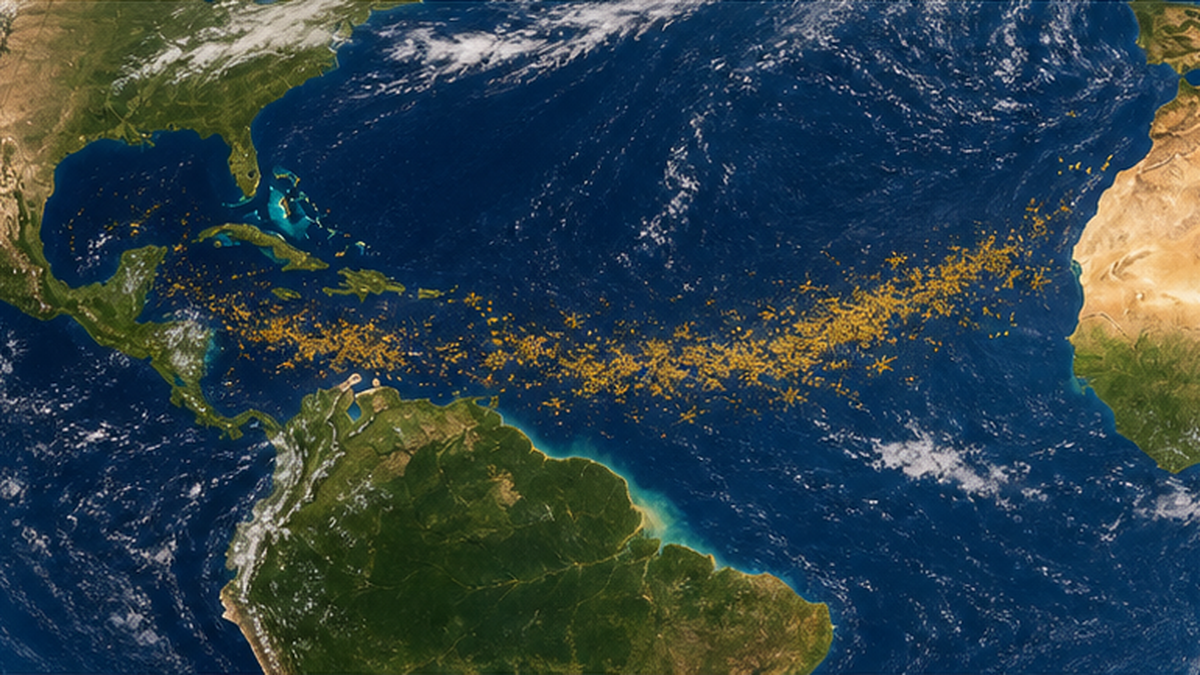
- 2011: First large bloom in the tropical Atlantic; recurring almost every year since
- June 2018: 8,850 km long, over 20 million tons (estimate published in Science)
- 2023: Mass strandings on Florida beaches make national news in the U.S.
- May–June 2025: Record high of about 38 million tons; in-basin growth confirmed for the first time
The Sargasso Sea and the Sargassum Belt are different things
The Sargasso Sea is a "sea of seaweed" enclosed by the North Atlantic gyre, where Sargassum has gathered naturally since ancient times. The Sargassum Belt, by contrast, is a phenomenon that newly appeared to its south in the tropical Atlantic from 2011, differing in both scale and mechanism. The former is a precious ecosystem; the latter is considered an abnormal proliferation linked to human activity.
Why Do the Blooms Happen? Three Triggers
Why did Sargassum suddenly start exploding in the Atlantic from 2011? Research, including the Science paper, points to the convergence of three factors: nutrients from land, ocean upwelling, and climate change.
1. Nutrients pouring in from the Amazon River
Seaweed growth requires nutrients such as nitrogen and phosphorus. The suspected source on the belt's western side is the world's largest river, the Amazon. As farmland expansion and deforestation have advanced in its basin, fertilizer-derived nitrogen and phosphorus have flowed into the Atlantic in large amounts via the river. The Science paper shows that the bloom's spring-to-summer expansion tracks the Amazon's discharge and suggests that land-use change in the basin may be fueling the growth.
The same process of land nutrients transforming coastal ecosystems is happening in Japan. See our related article "Where Do Nitrogen and Phosphorus Enter the Sea?".
2. Upwelling off West Africa and nutrients from the air
On the belt's eastern side, winter upwelling off West Africa—nutrient-rich deep water rising to the surface—strengthens and is thought to support the algae's initial growth. Researchers are also examining the hypothesis that dust carried from the Sahara over the Atlantic supplies trace nutrients such as iron to the sea surface, aiding growth. "Fertilizer" arrives from three directions: land, sea, and air.
3. Warming and shifts in ocean circulation
A leading candidate for the trigger is the major anomaly in the North Atlantic Oscillation (NAO)—a large-scale pressure pattern—in the winter of 2009–2010. That year, exceptional wind patterns carried large amounts of Sargasso Sea seaweed into the tropics, where it met abundant nutrients and warm water and took hold—one analysis holds that this seeded the consecutive blooms from 2011 onward. Rising sea temperatures also push growth rates higher in the tropics. For more on how ocean warming affects ecosystems, see "What Is a Marine Heatwave?".
Still, the full picture remains under study. Bloom size varies greatly from year to year—2013, for example, saw almost no bloom. The Science team found that bloom magnitude can largely be explained by the combination of the "seed" population carried over from the previous year and that year's nutrient supply. In other words, there is no single culprit: blooms explode in years when land, sea, and atmospheric conditions align—and climate change is raising the odds that they do.
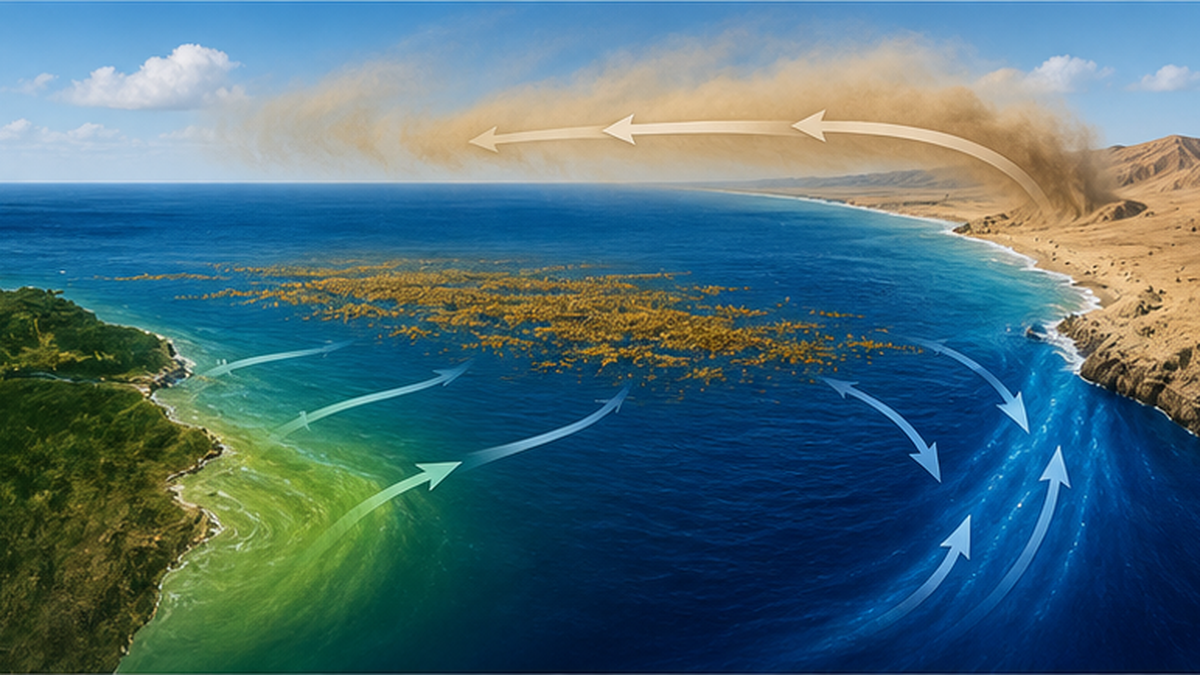
Golden tides are likely a human-driven phenomenon
- Nutrient runoff from deforestation and agricultural expansion fuels the blooms
- Warming seas accelerate growth in the tropics
- Once started, the bloom self-seeds and recurs yearly as a "new normal"
The Damage from Mass Strandings: Tourism, Health, Daily Life
Floating Sargassum is carried by currents and wind until it piles onto coastlines. On Caribbean islands and Mexican resort coasts, deposits over a meter thick can run on and on along the shore, and the damage spans tourism, health, and infrastructure.
The blow to tourism
Many Caribbean nations depend on tourism. When white-sand beaches turn brown with seaweed and the smell of decay hangs in the air, beaches close and marine activities stop. Increased booking cancellations, closed beachfront restaurants, and staff layoffs have been reported across the region. In Cancun and other Mexican resorts, hotels clear the seaweed every morning with heavy machinery and manual labor, and the cleanup cost itself has become a permanent business burden.
Hydrogen sulfide from decay and residents' health
The health impacts are more serious. Stranded Sargassum begins to rot in about 48 hours, releasing hydrogen sulfide (H2S)—with its rotten-egg smell—and ammonia. Even at low concentrations these gases irritate the eyes, nose, and throat and cause headaches and nausea, and people with asthma or other respiratory conditions are especially vulnerable.
The toll shows up in the numbers. In 2018, a year of massive strandings, doctors on the French islands of Martinique and Guadeloupe reported 11,402 cases of acute exposure to hydrogen sulfide. Research into links between long-term exposure and neurological and respiratory effects is ongoing, and the U.S. Environmental Protection Agency (EPA) treats Sargassum inundation events as a public health concern.
The scale of damage keeps ratcheting upward. Records have continued to fall since the "worst ever" strandings of 2018: in 2023, mass strandings on Florida beaches made national news in the U.S., and in 2025 the largest belt on record kept emergency responses running across the Caribbean. In Mexico, the navy has deployed offshore barriers and collection vessels—stranding response has become a matter of national policy.
There is also damage that numbers barely capture. Corrosive gases from the rot cause refrigerators, televisions, and wiring to fail one after another; the stench keeps windows shut; headaches and sleepless nights drag on—these are the voices of residents in stranding zones. In Guadeloupe, schools were reportedly closed temporarily during periods of intense odor. Coastal communities that cannot move away from the beach have no escape, bearing the double burden of lost tourism income and health risks.
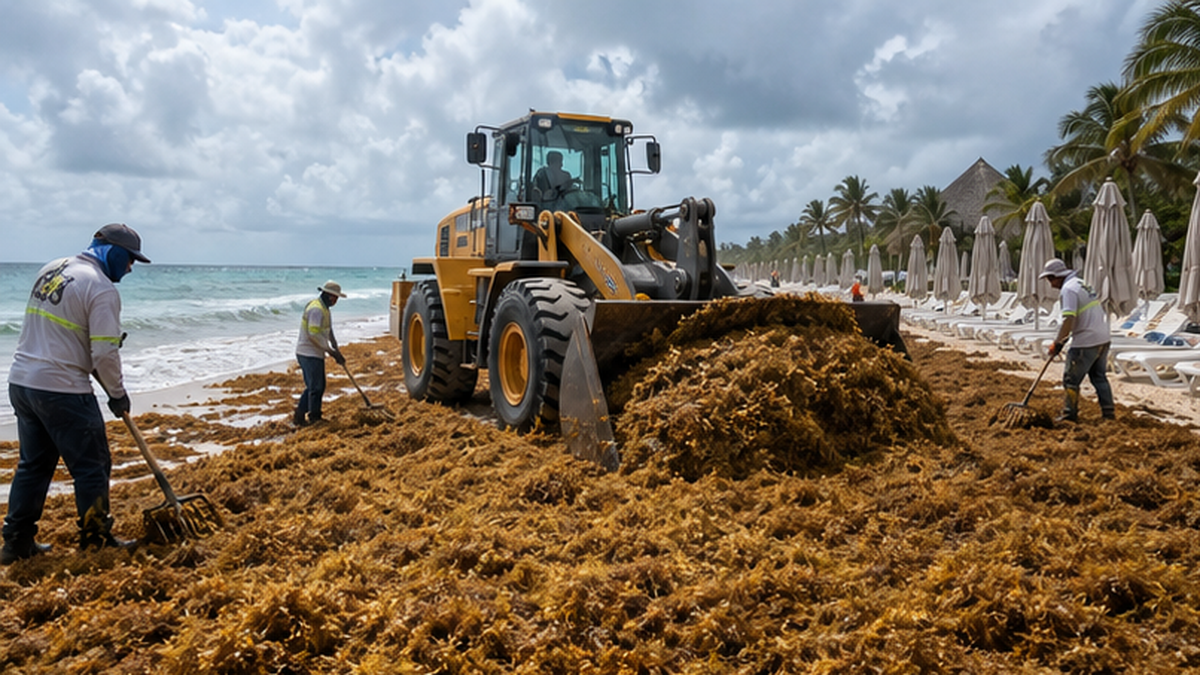
Impacts on infrastructure and fisheries
The damage reaches onshore facilities too. Because the decay gases corrode metal, failures of electronics and home appliances near the coast have been reported, and intakes at power plants and desalination plants have been clogged by the seaweed. In fisheries, boats cannot go out because the algae foul propellers and gear, and nets are swept away—hitting the livelihoods of small-scale fishers directly.
| Sector | Main damage |
|---|---|
| Tourism | Beach closures, booking cancellations, permanent cleanup costs, knock-on effects on employment |
| Health | Eye and throat irritation, headaches, and respiratory symptoms from hydrogen sulfide and ammonia (11,402 cases on two French islands in 2018) |
| Infrastructure | Clogged water intakes; electronics and appliance failures from corrosive gas |
| Fisheries | Fouled gear and propellers, inability to sail, damaged aquaculture facilities |
What Happens Underwater: A Double-Edged Ecosystem Role
Sargassum is not merely a nuisance. While drifting offshore it supports a rich ecosystem, yet the moment it surges en masse onto the coast it becomes a destroyer—this duality is what makes the golden tide problem so difficult.
Offshore, a "drifting oasis"
The open-ocean surface is naturally a "marine desert" with few hiding places. Floating seaweed rafts there are precious shelter and feeding grounds for small creatures. The Sargasso Sea's drifting rafts host diverse fish, crabs, and shrimp—including specialists like the sargassum fish (a frogfish relative)—while juveniles of large fish such as tunas and mahi-mahi and newly hatched sea turtles also take refuge among the fronds as they grow. The seaweed rafts are sometimes called a "golden floating rainforest," a hotspot of open-ocean biodiversity.
Near shore, it turns into a threat
Mass strandings on the coast, however, show a completely different face. Thick piles of seaweed block sea turtles from coming ashore to nest and prevent hatchlings from reaching the water. In shallow seas, dense mats cut off sunlight, weakening seagrass beds and corals, and the decay process consumes oxygen, creating hypoxic conditions that lead to mass deaths of fish and shellfish. "Sargassum brown water"—coastal water clouded by nutrients and brown pigments leaching from rotting seaweed—is also being studied as a stressor on coral reefs.
In the right amounts, beached seaweed feeds the shore
To avoid misunderstanding: seaweed washing ashore is a normal process that nature has repeated forever. Moderate amounts of beach-cast seaweed feed small beach creatures and seabirds, decompose into nutrients for coastal plants, and even help stabilize the sand and soften erosion. The problem is purely one of quantity. Strandings that far exceed what the ecosystem can process turn a blessing into a disaster. Here too lies the responders' dilemma: excessive removal with heavy machinery damages beach ecosystems and topography.
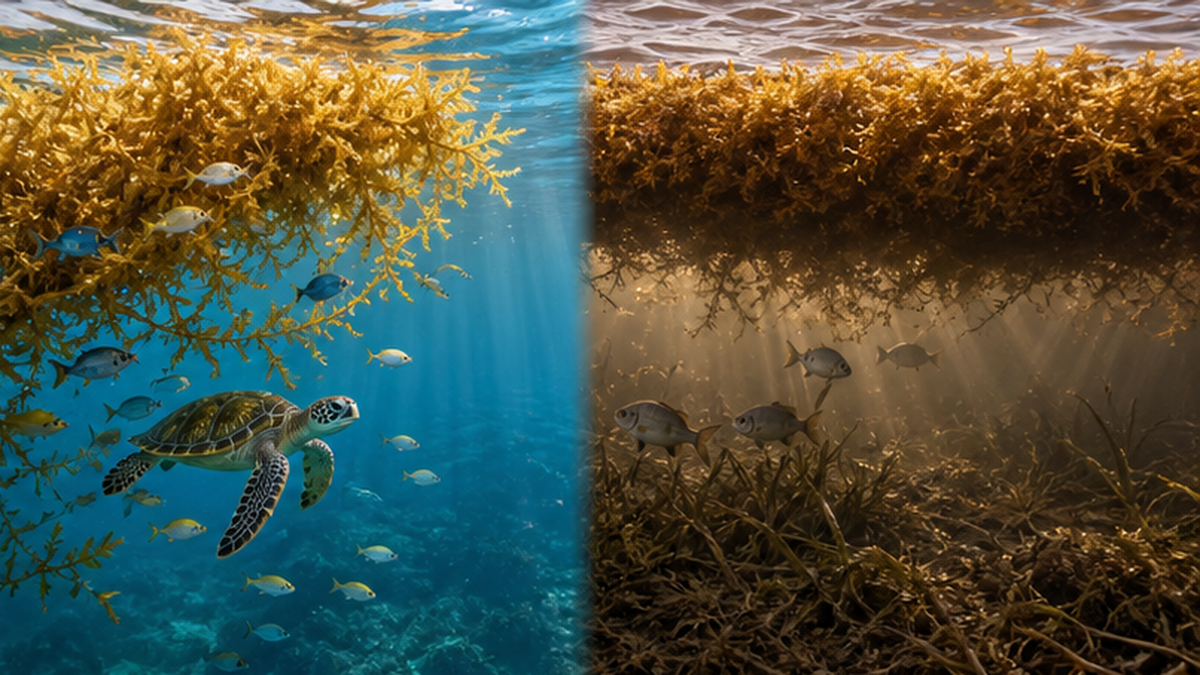
The Caribbean is a vital nesting ground for several sea turtle species, including green turtles and hawksbills. If walls of seaweed cover the beach in nesting season, mother turtles lose their landing sites, eggs in the sand suffer from decay heat and leachate, and hatchlings become entangled in the seaweed and never reach the sea. Sea turtle conservation groups now rescue hatchlings by hand in heavy stranding years—golden tides have added a new burden to saving endangered species.
"Quantity" flips the value
Moderate drifting seaweed is an irreplaceable support for open-ocean biodiversity. But when human activity pushes the amount of algae beyond what ecosystems can absorb, the cradle turns into a threat. A golden tide is not "bad seaweed"—it is an alarm telling us the ocean's balance has broken.
It Happens in Asia Too: Yellow Sea Golden Tides and Japan's Drifting Seaweed
Golden tides are not confined to the Atlantic. They have also grown large-scale in the Yellow and East China Seas since the 2010s, and for Japan they are no longer someone else's problem.
Sargassum horneri struck nori farms in Jiangsu, China
In the Yellow Sea, alongside the world's largest green tides of sea lettuce (famously the 2008 bloom off Qingdao around the Beijing Olympic sailing venue), golden tides of Sargassum horneri, a Sargassum species known in Japan as akamoku, have become frequent in recent years. From December 2016 to May 2017, huge rafts of drifting seaweed surged into nori (Pyropia) aquaculture grounds along the coast of Jiangsu Province, China, destroying cultivation rafts one after another and inflicting economic losses of more than 500 million yuan (about 8 billion yen at the time) on the nori industry. Genetic analysis confirmed that the drifting biomass was almost entirely this single species.
Ironically, akamoku is a seaweed whose popularity as a nutritious food is growing in Japan. The same seaweed can be a local specialty or a disaster depending on the sea area and the quantity—here again, "quantity flips the value."
Incidentally, akamoku has long been eaten in Japan—called "gibasa" in Akita Prefecture and "gimbaso" in Yamagata Prefecture—and its sticky texture, pleasant bite, and abundant dietary fiber and fucoidan have won it space in supermarkets nationwide. Just as a seaweed once scorned by fishers as a nuisance became a favorite on dinner tables, a change of perspective can turn a nuisance into a resource—a point that connects to the utilization story below.
Some of the drifting seaweed born in the East China Sea rides the Tsushima Warm Current into the Sea of Japan and the Kuroshio Current along the Pacific side. Japan's Fisheries Research and Education Agency and others are studying drift dynamics by combining satellites with drift simulations, and if seaweed production changes at the East Asian scale, the amount and timing of drift seaweed reaching Japan's coasts could change too. The Yellow Sea's golden tides are a neighboring phenomenon that Japan's fisheries should watch closely.
In Japanese waters, drifting seaweed is an ocean nursery
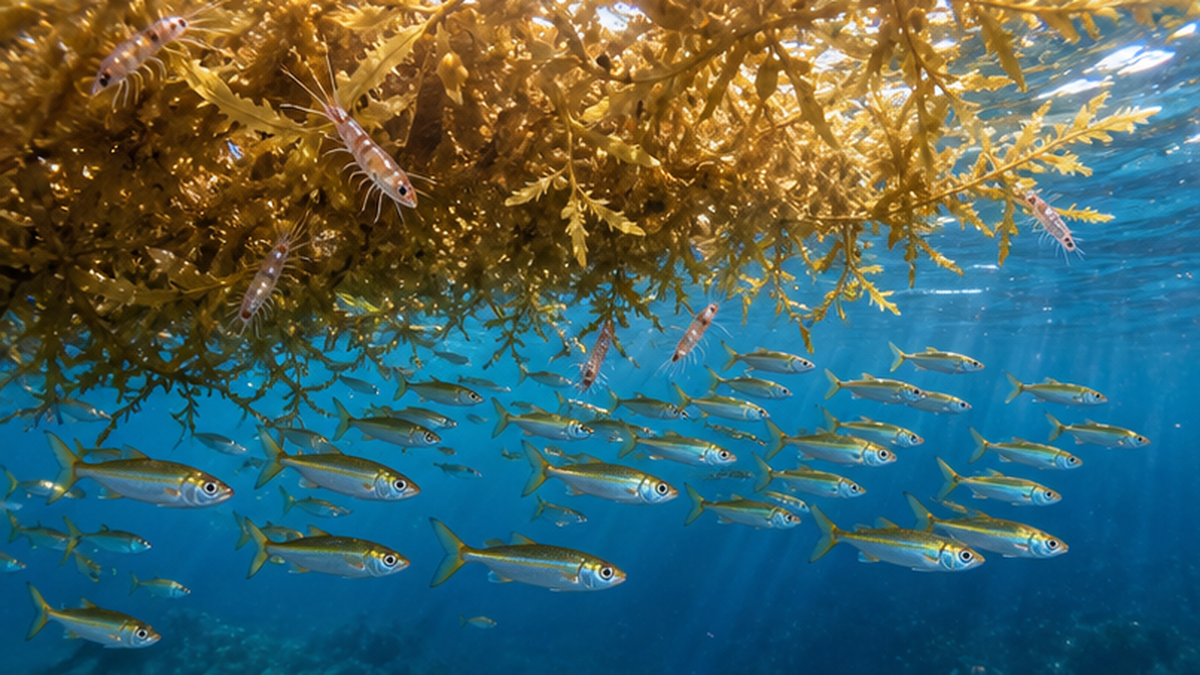
Japan's coasts have so far seen no catastrophic damage like the Caribbean's. On the contrary, drifting Sargassum has long been indispensable to Japanese fisheries. Yellowtail (buri) spawn mainly in the East China Sea in spring, and once the juveniles reach about 3 cm they shelter beside drifting seaweed, hiding from predators while feeding on the small shrimp and crabs that live on the rafts. These juveniles are called "mojako," and the spring mojako fishery has supplied the seed fish that support Japan's yellowtail aquaculture.
Beyond yellowtail, drifting seaweed serves as spawning substrate for halfbeaks and flying fish and as a refuge for many juvenile fish. The Sargassum beds that grow attached along the coast (garamo beds) are an "ocean nursery" on par with eelgrass meadows. For more on how seaweed and seagrass beds work, see our related article "The Biodiversity of Eelgrass Meadows, the Ocean's Cradle".
Implications for Japan
- Yellow Sea golden tides of Sargassum horneri are a neighboring problem that could affect aquaculture and set nets in the Tsushima Warm Current region
- Warming seas and shifting nutrient balances could also change the amount of seaweed beds and drift seaweed along Japan's coasts
- Japan needs a perspective that combines monitoring of overgrowth with protection of the seaweed's original blessings
From Nuisance to Resource: The Frontier of Utilization
Tens of millions of tons of Sargassum appear every year—could it be used as a resource instead of being landfilled? Around the Caribbean, businesses built on this reversal of thinking are springing up one after another.
Seaweed becomes housing: Mexico's Sargablock
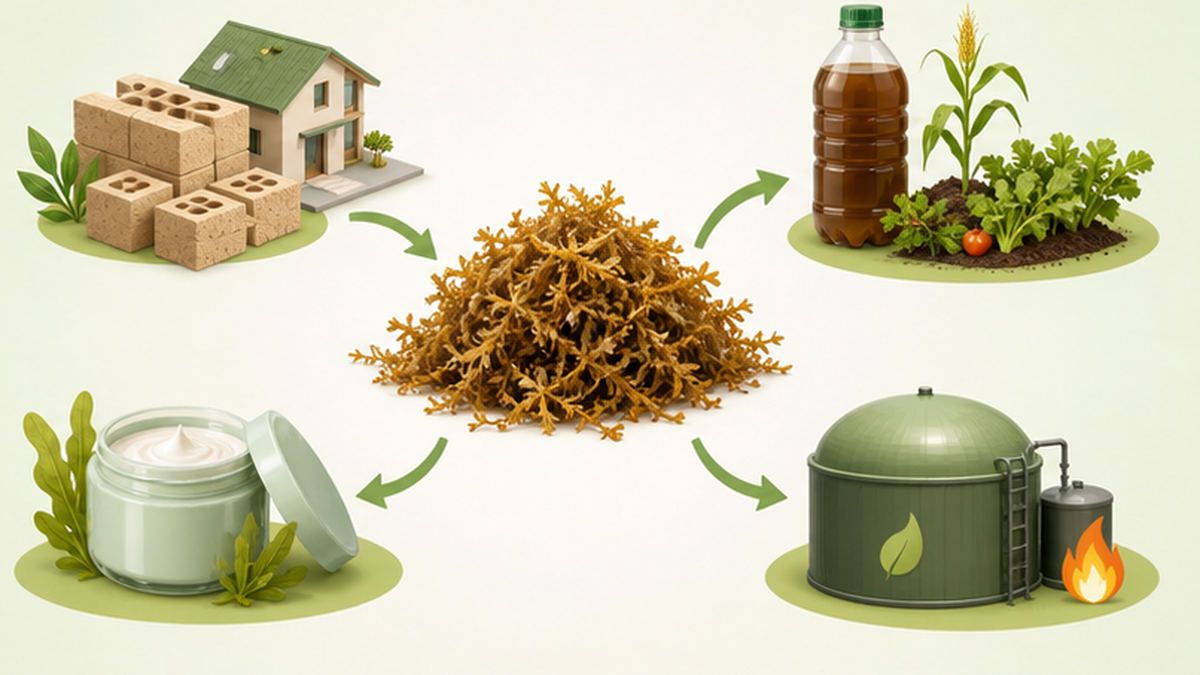
In 2018, Omar Vázquez Sánchez, a plant nursery owner in Mexico's Riviera Maya, invented "Sargablock," a construction block made by drying and grinding beach-cast Sargassum and compacting it with limestone and other materials. About 40% of each block is Sargassum, and because the blocks cure in the sun, they cost less to make than conventional blocks. Vázquez has built more than ten houses for low-income families with the blocks, and the first house he built has endured multiple hurricanes and tropical storms and is still in use. The initiative has been featured by the United Nations Development Programme (UNDP) and drawn worldwide attention.
Vázquez originally made his living clearing the invading seaweed while selling the dried algae as garden fertilizer. Sargablock grew out of that same idea of "turning disaster into work." By employing local people in cleanup and production, the project is also praised for pairing damage response with job creation.
Fertilizer, cosmetics, vegan leather: Carbonwave's challenge
The startup Carbonwave, based in the U.S. and Puerto Rico, is developing multiple high-value materials from collected Sargassum: a liquid agricultural input called "Sarga Ag," a seaweed-based cosmetic emulsifier called "SeaBalance," and even vegan leather (a synthetic leather free of animal materials). The company raised five million dollars in 2023 and aims to establish a biomaterials industry with the "nuisance seaweed" as feedstock.
Visit this companyCarbonwaveThe official site of the U.S.-born startup that collects bloom Sargassum and upcycles it into agricultural inputs, a cosmetic emulsifier, vegan leather, and more.🔗 carbonwave.comBeyond these, trials are advancing worldwide: fermenting the seaweed to produce biogas (methane) for power generation, carbonizing it into biochar for soil improvement, and composting. Seen as "biomass delivered to the coast in bulk," Sargassum is also a promising resource.
The obstacles: arsenic and unstable supply
Utilization, however, faces hurdles that cannot be ignored. The best-known problem is arsenic. Sargassum readily accumulates arsenic from seawater, which imposes safety constraints on food, feed, and large-scale application to farmland. Testing and removal or dilution steps are essential for every use. In addition, supply is unstable because bloom volumes swing widely by year and season, and the cost of removing salt and sand is another barrier to commercialization.
A third path: sink it to sequester carbon
An approach distinct from product-making has also emerged. The UK startup Seaweed Generation is developing "AlgaRay," a device that collects Sargassum offshore and sinks it into deep water, sequestering the carbon the algae absorbed for the long term. The idea is to lock away in the deep sea the carbon that would return to the atmosphere as greenhouse gases if the seaweed stranded and rotted on shore. However, the effects of sinking large volumes of seaweed on deep-sea ecosystems are still poorly understood, and careful verification is required.
Making utilization a genuine solution
- Safety standards that manage arsenic and heavy-metal content by use
- Offshore harvesting before stranding to secure high-quality raw material
- Partnerships between municipalities and companies that convert cleanup costs into resource-procurement costs
Monitoring, Forecasting, and What We Can Do
There is currently no way to stop golden tides completely. That is exactly why efforts to predict "when, where, and how much" and to minimize damage are advancing worldwide.
Satellites watching the seaweed belt
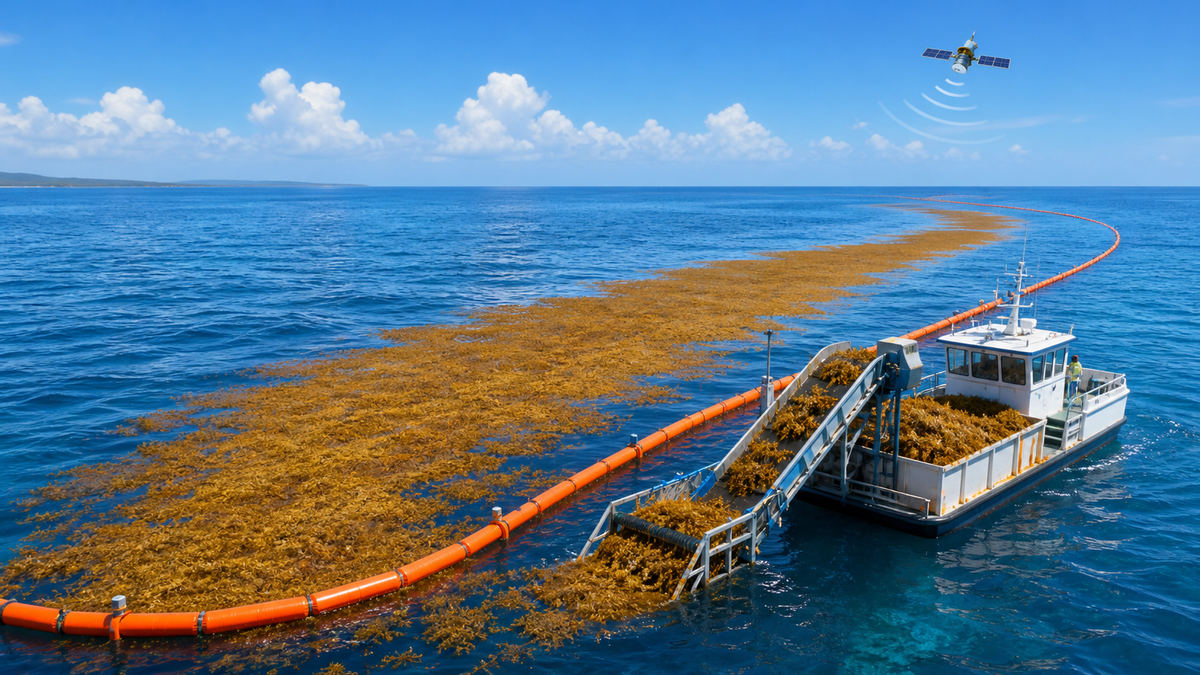
The University of South Florida's Optical Oceanography Lab analyzes Sargassum distribution and abundance from satellite data every month and publishes the results as monthly bulletins (Sargassum outlooks). Hotels, fishers, and municipalities use this information to prepare cleanup crews and tourism plans. NOAA (the U.S. National Oceanic and Atmospheric Administration) also provides information on stranding risk, and satellite monitoring is becoming part of the Caribbean coast's "weather forecast."
Forecast accuracy is improving too. Because the belt's movement is governed almost entirely by currents and wind, locating the offshore seaweed by satellite makes it possible to estimate stranding risk weeks in advance. Caribbean nations are building regional networks to share observations, and a "prepared reception" posture is spreading—hotels installing offshore barriers in advance, and cleanup crews scheduled to match predicted stranding dates.
Offshore harvesting and stranding countermeasures
Collecting the seaweed with heavy machinery after it strands scoops up sand as well, accelerating beach erosion, and the mixed-in sand and litter make the material harder to use. So trials are under way in many places of floating barriers, like oil booms, strung offshore to corral and collect the algae, and of harvesting at sea by dedicated collection vessels. Recovering fresh seaweed before it rots prevents the stench and hydrogen sulfide while raising its value as feedstock.
What we in Japan can do
The root causes of golden tides—eutrophication and climate change—are continuous with Japan's own problems of red tides, barren seafloors, and marine heatwaves. Rather than treating them as distant events, actions like these ultimately help protect the ocean's algal balance.
- Reduce food waste and choose products and municipal initiatives that support proper fertilization and wastewater treatment (cutting nutrient runoff)
- Cut CO2 emissions through energy saving and renewable choices (curbing sea-temperature rise)
- Bring domestic seaweeds like akamoku to the table and nurture a culture of using seaweed
- Join or donate to beach cleanups and seaweed-bed conservation efforts
What golden tides are telling us
Golden tides are not a curiosity from distant lands. Fertilizer used on land runs down rivers, feeds explosive seaweed growth in a warming ocean, and that seaweed then threatens the health and livelihoods of people on another country's shores—no phenomenon shows more clearly that Earth's material cycles connect across borders. At the same time, it teaches us about the life-nurturing power drifting seaweed naturally holds, and the possibility that human ingenuity can turn a nuisance into a resource. Treat the ocean's anomalies as a "quantity alarm," and act on the root causes—eutrophication and warming. That is the surest answer to the golden tide.
Summary of this article
- A golden tide is a mass bloom and stranding of Sargassum seaweed that has intensified rapidly in the Atlantic and East Asia since 2011
- The Great Atlantic Sargassum Belt spans 8,850 km; 2025 set an all-time record of about 38 million tons
- The causes are a combination of nutrient inflows, upwelling, and climate change—with human activity as the likely trigger
- Rotting seaweed emits hydrogen sulfide and severely damages tourism, health, and fisheries, while offshore rafts remain nurseries for juvenile fish and turtles
- Uses in construction, fertilizer, and cosmetics have begun, but arsenic management and stable supply remain challenges
- Satellite monitoring and offshore harvesting must work in tandem with the fundamental cures: tackling eutrophication and warming
References and Sources
- Wang, M. et al. (2019) The great Atlantic Sargassum belt, Science – The original paper that named and quantified the Great Atlantic Sargassum Belt (8,850 km, over 20 million tons)
- USF College of Marine Science – Commentary on Sargassum satellite monitoring, the monthly bulletins, and the record 2025 bloom
- U.S. EPA: Sargassum Inundation Events—Impacts on Human Health – Official explanation of mass strandings and the health effects of hydrogen sulfide and ammonia
- Japan Fisheries Research and Education Agency: Structure and Basic Form of Sargassum – A Japanese research institution's explanation of Sargassum air bladders, morphology, and drift-seaweed ecology
- Liu, F. et al. (2018) Insights on the Sargassum horneri golden tides in the Yellow Sea, Limnology and Oceanography – The paper identifying Sargassum horneri as the causal species of Yellow Sea golden tides and reporting nori-farm losses in Jiangsu (over 500 million yuan)
- Xing, Q. et al. (2021) Golden seaweed tides accumulated in Pyropia aquaculture areas, Science of the Total Environment – The paper showing golden tides have become routine in the Yellow Sea's nori aquaculture areas
- Kagoshima Prefectural Fisheries Technology Development Center: Mojako and Drifting Seaweed – A Japanese fisheries research document on juvenile yellowtail (mojako), drifting seaweed, and the mojako fishery
- PBS News: "Huge blankets of seaweed are smothering coastlines" – Reporting on the record 2025 strandings and damage in the Caribbean and Mexico
- Carbonwave (official site) – The company upcycling Sargassum into fertilizer, a cosmetic emulsifier, and vegan leather
※ Ordered by reliability: government and academic institutions > peer-reviewed papers > specialist organizations > trusted media