⚡ In short
SDG 14 is the only SDG dedicated entirely to the ocean. This article covers the three crises of overfishing, marine plastic, and acidification, the 2026 entry into force of the BBNJ Agreement, MPA expansion, Japan's progress, and what individuals and businesses can do.
Of the 17 Sustainable Development Goals adopted by the United Nations in 2015, Goal 14, "Life Below Water," is the only goal devoted entirely to the ocean. Covering about 70% of the Earth's surface, the ocean produces more than half the oxygen we breathe, absorbs nearly 30% of the carbon dioxide humans emit, and supports the livelihoods of more than 3 billion people through fisheries. Yet the ocean continues to receive far less funding and attention than land-based goals, and as of 2026 it remains one of the SDGs with the lowest progress worldwide.
The 10 targets under Goal 14 cover nearly every challenge the ocean faces: preventing overfishing and illegal fishing, reducing pollution including marine plastic litter, addressing ocean acidification, protecting coastal ecosystems, and designating 30% of the ocean as protected areas under the "30by30" initiative. January 2026 also marked a major milestone: the entry into force of the BBNJ Agreement, a new treaty protecting biodiversity on the high seas.
This article organizes Goal 14's 10 targets, presents the latest data on the three crises of overfishing, plastic pollution, and acidification, reviews Japan's progress, and outlines what individuals and businesses can do, based on primary sources.
What you'll learn in this article
- The 10 targets of SDG 14 and the three crises facing the ocean: overfishing, plastic pollution, and acidification
- How the BBNJ Agreement, which entered into force in January 2026, changes protection of biodiversity on the high seas
- Global progress on marine protected areas (MPAs) and the gap to the "30by30" target
- The current state and challenges of Japan's fisheries resource management (TAC and IQ systems)
- Actions individuals can take, and concrete examples of what businesses are doing
What Is SDG 14, "Life Below Water"?
SDG 14 formally calls for conserving and sustainably using the oceans, seas, and marine resources for sustainable development, and consists of 10 specific targets (14.1 through 14.7, plus 14.a through 14.c). According to the United Nations Information Centre, although the ocean is the largest ecosystem supporting life on Earth, it has repeatedly been described as a "neglected goal" because it receives less international funding and policy priority than climate action or land-based development goals.
Overview of the 10 targets
| Target | Summary |
|---|---|
| 14.1 | By 2025, significantly reduce marine pollution, particularly from land-based activities (nutrients, litter, etc.) |
| 14.2 | By 2020, sustainably manage and protect marine and coastal ecosystems to build resilience |
| 14.3 | Minimize the impacts of ocean acidification and strengthen scientific cooperation |
| 14.4 | By 2020, regulate harvesting and end illegal, unreported and unregulated (IUU) fishing and destructive fishing practices |
| 14.5 | By 2020, conserve at least 10% of coastal and marine areas (through MPAs, etc.) |
| 14.6 | By 2020, prohibit subsidies that contribute to overcapacity and IUU fishing |
| 14.7 | By 2030, increase the economic benefits of sustainable fisheries, aquaculture and tourism management for small island states and least developed countries |
| 14.a–14.c | Increase scientific knowledge, support small-scale fishers, and strengthen implementation of ocean and marine resource conservation under UNCLOS |
Many targets had a 2020 deadline
Targets 14.2, 14.4, 14.5 and 14.6 originally had a 2020 deadline, but as of 2026 none has been achieved globally. Many areas face a real risk of missing the final 2030 deadline as well.
Why the ocean needs its own goal
All 17 SDGs are interconnected, but the ocean has a distinctive character. Most of the ocean — the high seas — belongs to no nation and is a "global commons" that no single country can manage alone. In addition, ocean change tends to unfold gradually over years or decades, making it harder to perceive as an "extreme event" the way climate change often is, which structurally lowers its political priority. The UN created Goal 14 as a standalone target in part to change this dynamic, in which "no one is responsible, so no one protects it."
The scale of what the ocean provides us
The ocean also regulates the climate. It absorbs most of the sun's energy, keeping Earth's heat balance in check, and stores the majority of the heat in the climate system, functioning as the planet's largest heat reservoir. Fish and seafood account for nearly half of animal protein intake in some regions, and fisheries are a direct source of livelihood in many small island states and coastal developing countries. In Japan too, fisheries and aquaculture are core industries in coastal regions, and when related processing and distribution industries are included, their impact on employment and local economies extends far beyond catch volumes alone.
Links to other SDGs
Goal 14 does not stand alone; it is closely linked to many other goals. Climate action (Goal 13) addresses the root causes of ocean acidification and warming; ending hunger (Goal 2) and reducing poverty (Goal 1) are inseparable from the sustainability of fish stocks that underpin global food security. Waste management and sustainable cities (Goals 11 and 12) are directly tied to reducing the sources of marine plastic pollution, and partnerships (Goal 17) are essential for protecting the high seas, which no single country can manage alone. The ocean's challenges should be understood not as a single environmental issue but as a cross-cutting problem spanning the economy, food security, and climate change.
Crisis 1: Overfishing — more than 30% of stocks are "overexploited"
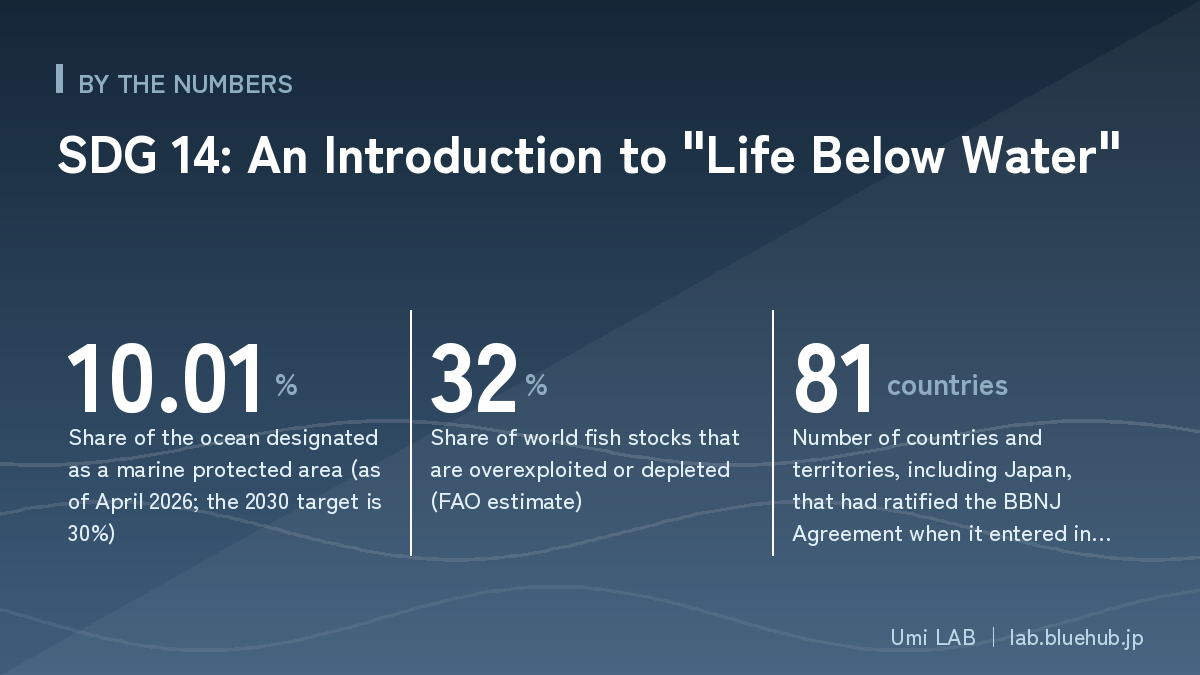
According to stock assessments by the UN Food and Agriculture Organization (FAO), 32% of the world's marine fish stocks are overexploited or depleted, and the share of stocks within biologically sustainable levels has continued to decline over the long term. In many parts of the world, fish are being caught faster than they can reproduce.
IUU fishing: "invisible" overfishing
Behind overfishing lies illegal, unreported and unregulated (IUU) fishing, which evades regulation. Illegal operations that ignore catch limits, and unreported fishing with no reporting obligations, make accurate stock assessment difficult and hollow out resource management as a result. Some estimates put the catch lost to IUU fishing worldwide at tens of millions of tons per year, squeezing the businesses of legitimate operators and distorting the basic data used for stock assessments. In recent years, analysis of satellite vessel-tracking data (AIS) and stronger seafood traceability — tracking catch from the sea to the market — have become important technical tools for detecting and deterring illegal operations.
Japan's resource management: TAC and MSY
Japan's Fisheries Agency has progressively expanded the number of species managed under the Total Allowable Catch (TAC) system and has set targets to raise the share of marine catch covered by TAC management. It has also incorporated the concept of maximum sustainable yield (MSY) — the largest catch that can be taken indefinitely without depleting a stock — into its assessments, aiming to keep stock levels above the MSY threshold. Even so, for species such as Pacific saury and Japanese flying squid, a combination of shifting distribution due to warming waters and continued fishing pressure has led to poor catches that resource management alone cannot fully explain.
Key mechanisms to prevent overfishing
- TAC (Total Allowable Catch) system: sets an annual ceiling on total catch for each species
- IQ (Individual Quota) system: allocates catch quotas to individual fishers or vessels to curb the "race to fish"
- MSC and ASC certification: third-party certification of sustainable fisheries and aquaculture that lets consumers make informed choices
The downside of the "race to fish"
Under TAC systems that rely solely on overall catch limits, an "Olympic-style" race to fish often emerges, as fishers rush to catch as much as possible before the quota is exhausted. Concentrated landings in a short period depress prices and destabilize fishers' income, and can also encourage unsafe operations or shift fishing pressure to less-regulated seasons or areas. To prevent this, more countries are adopting IQ systems that allocate quotas to individual fishers or vessels, or transferable ITQ (Individual Transferable Quota) systems, and Japan has gradually expanded the species covered. Countries such as Norway and New Zealand, which adopted ITQ systems early, are often cited as examples where fishers began to view stocks as a long-term asset of their own, achieving both reduced overfishing and more stable fishing businesses.
Subsidies and "hidden" overfishing
SDG target 14.6 calls for prohibiting subsidies that contribute to overcapacity and IUU fishing. Policies that appear to support fishers — such as fuel subsidies or shipbuilding grants — can end up putting more vessels and gear on the water than necessary, fueling overfishing; this has long been flagged as a problem internationally. The World Trade Organization (WTO) continues to discuss an agreement to curb harmful fisheries subsidies, underscoring the need to consider resource management and fisheries policy together rather than separately.
Crisis 2: Marine plastic pollution — a one-way trip from land to sea
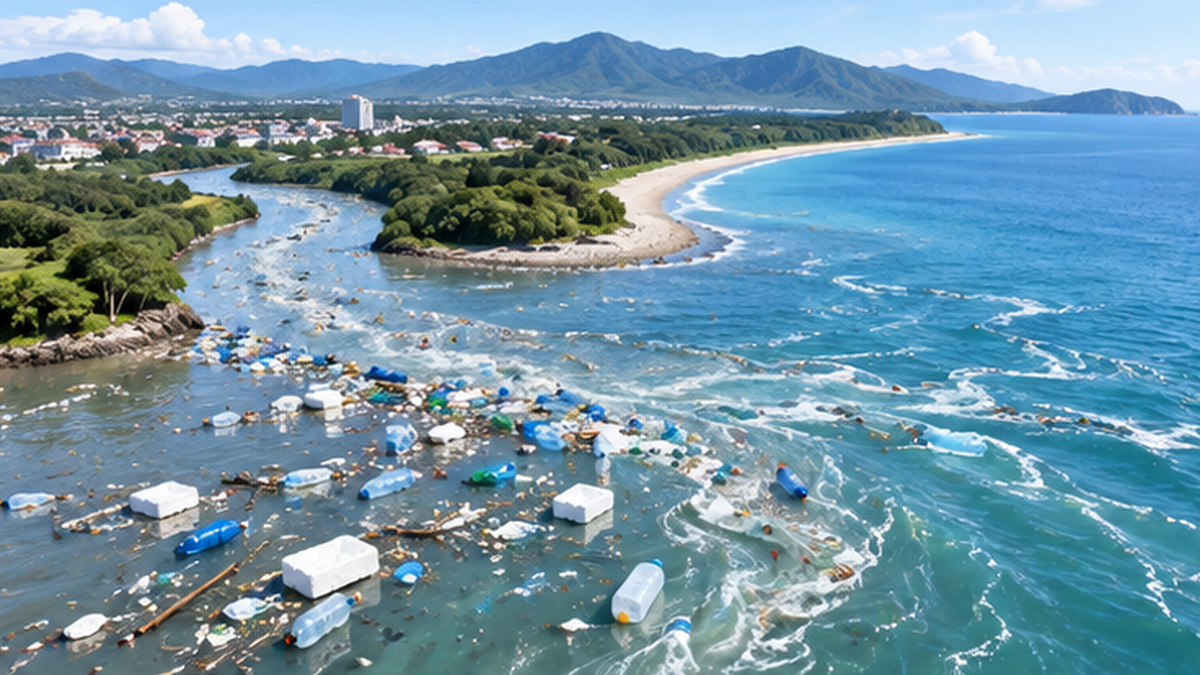
Most marine plastic pollution originates not at sea but on land, and reaches the ocean via rivers. Japan's Ministry of the Environment continues to publish estimates of the volume of plastic waste flowing into the sea from Japan, based on surveys of the standing stock of litter on beaches, and has progressively advanced source-reduction measures such as mandatory charging for plastic shopping bags (from July 2020) and a shift away from plastic straws. Much of the plastic that reaches the ocean travels via rivers, meaning that littering and inadequate waste management far upstream ultimately affect marine ecosystems downstream.
The idea of "stopping it at the river"
Once waste reaches the ocean, collecting it is difficult and expensive. As a result, efforts have increasingly focused on stopping litter before it reaches the sea — for example, by installing river litter traps and tackling littering in urban areas.
Impact on marine life
Ingestion and entanglement in fishing nets cause serious harm to seabirds, sea turtles, and marine mammals. Reports indicate that the majority of seabirds have ingested plastic, and microplastics — tiny fragments broken down from larger debris — spread through the food chain, raising concerns about long-term impacts across entire ecosystems.
Where the international plastics treaty talks stand
Because plastic pollution is a transboundary problem that no single country can solve alone, negotiations have continued, based on a UN Environment Assembly (UNEA) resolution, toward a legally binding international treaty commonly known as the "plastics treaty." A gap remains between countries that prioritize reducing production and those that favor a focus on recycling and waste management, and talks have proven difficult — but there is growing international agreement on addressing plastic across its entire lifecycle, from production through use to disposal. The negotiations symbolize how marine plastic pollution is a challenge that extends beyond waste management to production and distribution. Japan enacted its Act on Promotion of Resource Circulation for Plastics in 2022, establishing a domestic framework that addresses the full chain from product design to disposal and recycling, and is positioned to share this experience in international talks.
The overlooked source: fishing gear
When people think of marine plastic pollution, everyday consumer items often come to mind first. But by weight, a significant share of marine plastic debris consists of abandoned or lost fishing nets and lines — so-called "ghost gear." Because fishing gear is often made of materials that resist natural decomposition, it can remain in the ocean for a long time, continuing to entangle fish and marine mammals. This calls for measures distinct from those used for household waste, including formal collection systems, a shift to biodegradable materials, and extended producer responsibility schemes.
Crisis 3: Ocean acidification and warming — invisible chemical change
The ocean is estimated to have absorbed roughly a quarter to nearly a third of the carbon dioxide emitted by humanity, and this is gradually altering seawater chemistry through a process called ocean acidification. As seawater absorbs CO2, its pH falls, making it harder for organisms such as shellfish, corals, and plankton that build shells or skeletons from calcium carbonate to form them.
Warming seas and shifting fish distribution
Rising sea temperatures not only cause coral bleaching but are also pushing fish distributions northward. In Japanese waters, warm-water species such as yellowtail and Spanish mackerel are being caught farther north, while poor catches continue for cold-water species such as Pacific saury and Japanese flying squid, directly affecting fishing communities. As the mix of species caught changes, fishing vessels, gear, and local processing industries all need to adapt, meaning the impact on regional economies goes well beyond fluctuations in stock volume alone.
Acidification and warming continue to advance
Global reports indicate that ocean acidification and eutrophication continue to worsen, with little sign of improvement. Because these are structural problems, ocean-side measures alone cannot solve them — they must be addressed together with climate action to cut CO2 emissions.
Marine heatwaves and coral bleaching
The increasingly frequent "marine heatwaves" — periods of unusually high sea temperatures — can devastate coral reefs. Corals derive most of their nutrition from symbiotic algae (zooxanthellae), but under heat stress they expel these algae, causing bleaching. Prolonged bleaching kills corals, eliminating habitat for the diverse marine life that depends on reefs. Large-scale bleaching events have repeatedly been reported on coral reefs in Japan, including in Okinawa, and research is underway on selecting and transplanting heat-tolerant coral strains for reef restoration. Coral reefs are not only hotspots of biodiversity but also act as natural breakwaters, significantly dampening wave energy to protect coastlines from storm surges and tsunamis — meaning their loss is a serious blow to coastal disaster resilience as well as to ecosystems.
Eutrophication and "dead zones"
When nitrogen and phosphorus from agricultural fertilizer and domestic wastewater flow into the sea via rivers, phytoplankton can proliferate abnormally — a process called eutrophication. As this excess plankton decomposes, it rapidly consumes oxygen in the water. Areas where oxygen levels fall extremely low are known as "dead zones," and their expansion has been reported along coastlines worldwide, rendering these waters uninhabitable for fish and other marine life. Warming-driven stratification of seawater, in which temperature differences make it harder for water layers to mix, is also thought to contribute to this deoxygenation.
Marine protected areas and the BBNJ Agreement: expanding the ocean under protection
The gap between "30by30" and reality
As of April 2026, 10.01% of the ocean is protected through more than 18,200 marine protected areas (MPAs) and 199 "other effective area-based conservation measures" (OECMs). This is only about a third of the way to the "30by30" target of protecting 30% of the ocean by 2030, meaning protected area coverage must expand dramatically over the remaining four years to reach that goal.
January 2026: the BBNJ Agreement finally enters into force
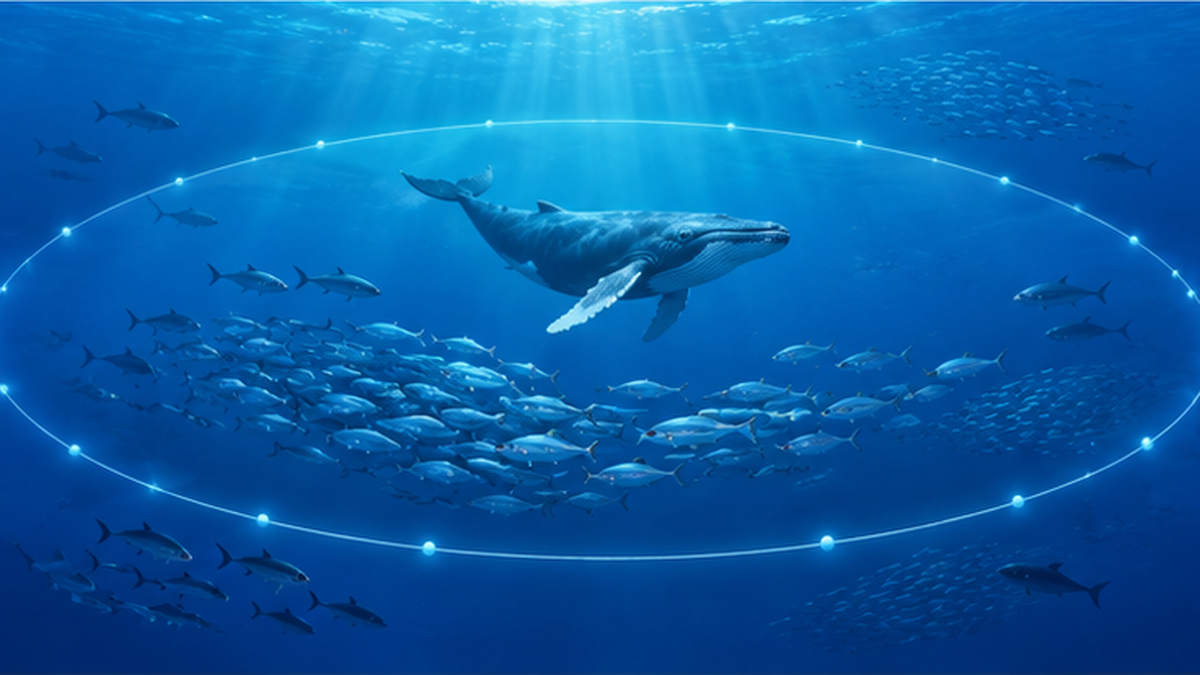
On January 17, 2026, the BBNJ Agreement — the first legally binding international treaty to protect biodiversity on the high seas and the deep seabed, formally the Agreement on Biodiversity Beyond National Jurisdiction — entered into force. This treaty, which complements the UN Convention on the Law of the Sea (UNCLOS), covers the high seas, which make up more than two-thirds of the world's ocean area, and centers on four pillars: access and benefit-sharing for marine genetic resources, the designation of area-based management tools including MPAs on the high seas, environmental impact assessments, and capacity building and technology transfer for developing countries. At the time it entered into force, 81 countries and territories, including Japan, had ratified it; Japan deposited its instrument of accession at UN Headquarters in New York in December of that year. The emergence of an international protection framework for the high seas — long managed loosely as "no one's ocean" — is regarded as a major step forward for Goal 14.
The "paper park" problem
Expanding the area of marine protected areas means little without effective enforcement. International assessments have repeatedly flagged the existence of so-called "paper parks" — areas that are designated on paper but lack adequate monitoring of illegal fishing or where fishing regulations change little in practice. Increasingly, effectiveness is being reinforced not just by expanding area but by combining designation with technologies such as satellite vessel-tracking (AIS) analysis. How a protected area is "zoned" — combining no-take zones with areas where fishing is allowed under resource-management conditions — is also a key practical factor in whether local fishing communities understand and cooperate with the designation.
How the BBNJ Agreement changes the rules on the high seas
Until now, the high seas were governed mainly by UNCLOS provisions such as freedom of navigation, without concrete international rules for biodiversity conservation. The entry into force of the BBNJ Agreement establishes, for the first time, a procedure for multiple countries to jointly designate marine protected areas on the high seas, and it also requires environmental impact assessments before large-scale development or research on the deep seabed. The agreement also includes a mechanism to fairly share the benefits from marine genetic resources — such as compounds derived from deep-sea organisms used in pharmaceuticals — with developing countries that have limited financial capacity, and is expected to serve as a framework preventing the high seas from becoming a "lawless" zone.
Japan's progress on SDG 14
International assessments such as the Sustainable Development Report continue to classify Japan's progress on Goal 14 as facing "major challenges." Despite being a maritime nation surrounded by ocean on all sides, Japan's efforts on curbing overfishing, expanding marine protected areas, and tackling plastic pollution all remain works in progress. As one of the world's leading fishing and seafood-consuming nations, Japan is seen as having a responsibility not only to strengthen domestic resource management but also to help lead international rules governing distant-water and international-waters fishing.
What resource management has achieved, and what remains
Japan's Fisheries Agency has expanded the scope of TAC management and enriched MSY-based stock assessments, gradually raising the share of marine catch covered by TAC. Even so, many stocks remain below MSY levels, and a lack of assessment data — many species are simply not yet covered by formal stock assessments — remains a persistent challenge. Compounding this, a decline in the number of fishers and an aging workforce mean that fewer people remain on the water to enforce resource-management rules in practice — a structural problem in its own right.
Progress on marine plastic countermeasures
Systems to curb the generation of plastic waste are taking shape, including mandatory charging for plastic bags and legislation requiring more rational use of single-use plastics. Japan's Ministry of the Environment continues to survey litter washed up on beaches and to estimate the volume of marine plastic waste flowing out of Japan, strengthening its ability to track the effectiveness of countermeasures with data.
Domestic marine protected area designations
Japan has advanced marine conservation through a combination of systems, including marine park districts designated under the Natural Parks Act and the Nature Conservation Act, and voluntary protected areas led by fishing communities under common fishery rights. Efforts to expand marine areas of national parks and designate conservation zones for seagrass beds and tidal flats are also underway, but relative to the international "30by30" benchmark, Japan — like many other advanced economies — still has room to expand further.
Japan's response to the BBNJ Agreement
Having ratified the BBNJ Agreement, Japan will now take part alongside other countries in international procedures for designating marine protected areas and conducting environmental impact assessments on the high seas. Japan's Ministry of Education, Culture, Sports, Science and Technology held briefing sessions for researchers and relevant institutions to coincide with the agreement's entry into force, and domestic preparations related to deep-sea research and access to marine genetic resources are now getting underway.
What you can do in daily life
1. Choose sustainable seafood
Choosing seafood labeled with the MSC "Blue Fish" ecolabel or ASC certification at supermarkets and restaurants is a concrete way to select fish and shellfish that are not overfished, or that come from lower-impact aquaculture. Japan's National Federation of Consumers' Co-operatives (Co-op) has been expanding its range of MSC- and ASC-certified CO-OP branded seafood products.
2. Reduce and avoid plastic waste
- Carry a reusable bag and bottle to reduce the amount of single-use plastic you accept
- Take part in beach and river cleanups — putting the "stop it at the river" idea into practice
- Never abandon or dump fishing line or gear (helps prevent ghost gear)
3. Learn about the ocean and talk about it
The ocean's crises are often invisible. Simply staying informed about climate change and resource-management news, and discussing it with family and friends, helps raise the issue's priority across society.
4. Be mindful of the ocean while traveling
Small choices matter when visiting places like Okinawa's coral reefs: avoid touching corals or marine life while snorkeling or diving, and choose reef-friendly sunscreen with ingredients less harmful to coral. These small acts of care add up to help protect the marine ecosystems that make such destinations special, and travel itself can be an opportunity to better understand the state of the ocean.
5. Small standards for choosing everyday products
Everyday items such as detergent and shampoo can also be chosen with an eye toward packaging volume, the availability of refill options, and the use of more biodegradable ingredients. Choosing products from manufacturers that promote refill packaging and set targets to reduce plastic use — such as Kao's plastic-reduction initiatives — is a way to use purchasing decisions to support corporate progress.
Three things you can do today
- Try choosing one product with a "Blue Fish" ecolabel on your next shopping trip
- Look up beach cleanup opportunities near you or at your next travel destination
- Share news about SDG 14 or ocean issues with family and friends
What business can do: corporate case studies
Achieving SDG 14 requires more than consumer choices alone — it also depends on companies rethinking their supply chains. Real examples of such efforts include the following.
Changing seafood supply chains
Japan's National Federation of Consumers' Co-operatives has been expanding MSC (wild-caught) and ASC (farmed) certification across its CO-OP branded products, making it easier for members to routinely choose sustainable seafood. As supermarkets and restaurant chains expand their range of certified seafood, this creates an incentive for fishers and fish farmers to pursue certification as well, potentially generating a virtuous cycle of sustainability awareness across the entire supply chain.
Blue carbon: linking climate action with ocean conservation
Mechanisms that convert the CO2 absorbed by mangroves and seagrass beds into tradable credits, such as Japan's "J Blue Credit" scheme, are also gaining traction. Based on the idea that protecting marine ecosystems is itself a form of climate action, participation by companies and local governments is increasing.
Investing in fisheries and aquaculture technology
Making resource management effective also requires change on the water itself. Smart fisheries technology — using IoT sensors and AI image analysis to track catch volumes and fish size in real time — is spreading as a way to fish efficiently while avoiding overfishing. Efforts to improve the fuel efficiency of fishing vessels and shift toward electrification are also gaining attention as a way to advance both SDG 14 and climate action (Goal 13) simultaneously.
The investor and financial-sector perspective
In recent years, "blue finance" frameworks that evaluate companies' ocean-related risks and initiatives have also expanded. Assessing companies on their sourcing of sustainable seafood and efforts to address marine plastic pollution, and factoring this into loan terms or ESG investment decisions, is beginning to function as external pressure encouraging companies to change their behavior.
Investment in plastic alternatives
Consumer goods and food manufacturers are developing products that reduce plastic use overall, including thinner packaging, wider refill options, and a shift toward biodegradable materials. Manufacturers such as Kao continue to set ongoing targets for reducing packaging in household products, while other initiatives recycle abandoned fishing nets into materials such as regenerated nylon yarn (ECONYL) used in apparel and accessories — an approach that combines "keeping plastic out of the ocean" with "turning what's already there into a resource."
Key takeaways from this section
- Expanding the availability of certified seafood gives consumers a way to actively choose sustainability
- Blue carbon advances ocean conservation and climate action at the same time
- Smart fisheries technology and vessel decarbonization support resource management on the water
- Corporate initiatives ultimately depend on consumer demand — the choices we make matter too
References and Sources
- United Nations Information Centre, "Goal 14: Life Below Water" – Official explanation of SDG 14
- United Nations, "Goal 14: Life Below Water" – Official UN page on SDG 14
- Ministry of Foreign Affairs of Japan, "Sustainable Development Goals (SDGs)" – Official information on Japan's SDGs promotion
- Japan Fisheries Agency, "White Paper on Fisheries" – Official report on Japan's fisheries resource management and TAC system
- Ministry of the Environment, Japan, "Estimates of marine plastic waste outflow" – Official survey on Japan's marine plastic pollution countermeasures
- United Nations Information Centre, "A landmark ocean treaty enters into force" – Explanatory article on the BBNJ Agreement's entry into force
- WWF Japan, "Welcoming the entry into force of the BBNJ Agreement" – Explanation of the content and significance of the BBNJ Agreement
- Ministry of Foreign Affairs of Japan, "The international legal order of the oceans and UNCLOS" – Official information on UNCLOS and related treaties
Sources are listed in order of reliability: government and academic institutions > peer-reviewed papers > specialized organizations > trusted media