⚡ In short
Japan generates roughly 750,000 tons of fish byproducts (heads, bones, skin, guts) every year. This once-discarded waste is now being transformed into collagen, fish sauce, leather, pet food, and fertilizer.
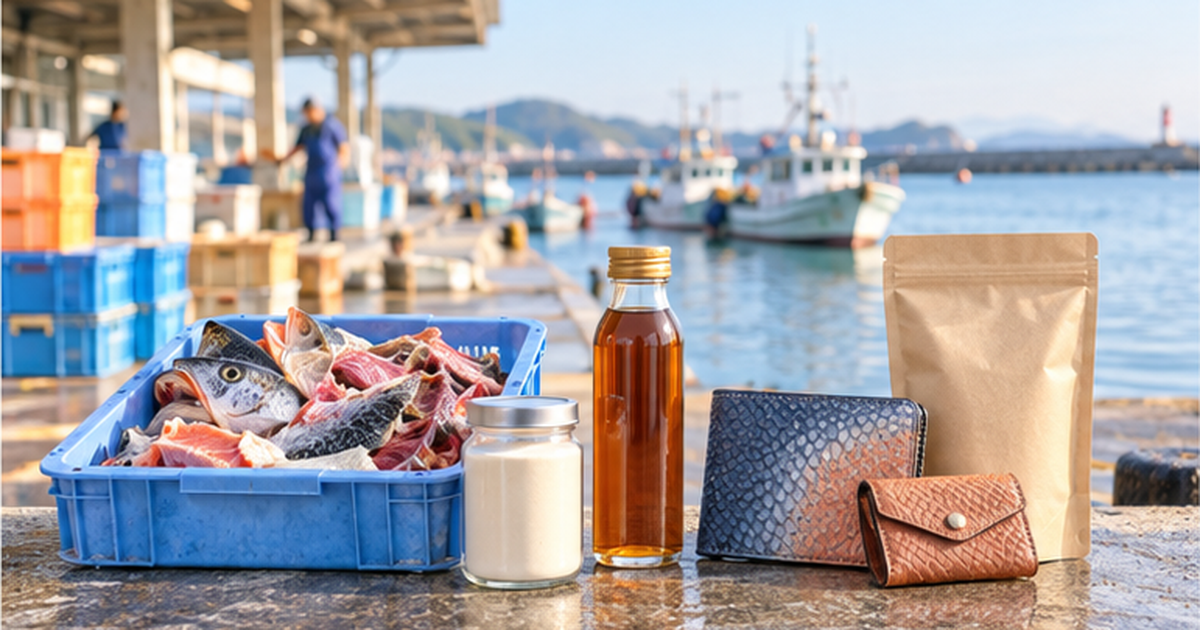
Only about half of a landed fish becomes sashimi, fillets, or dried fish. The rest — bones, heads, skin, and innards, collectively called "ara" — has long been discarded as waste, often at a processing cost. In recent years, however, businesses across Japan have begun turning these inedible parts into collagen, fermented seasonings, leather goods, and pet food.
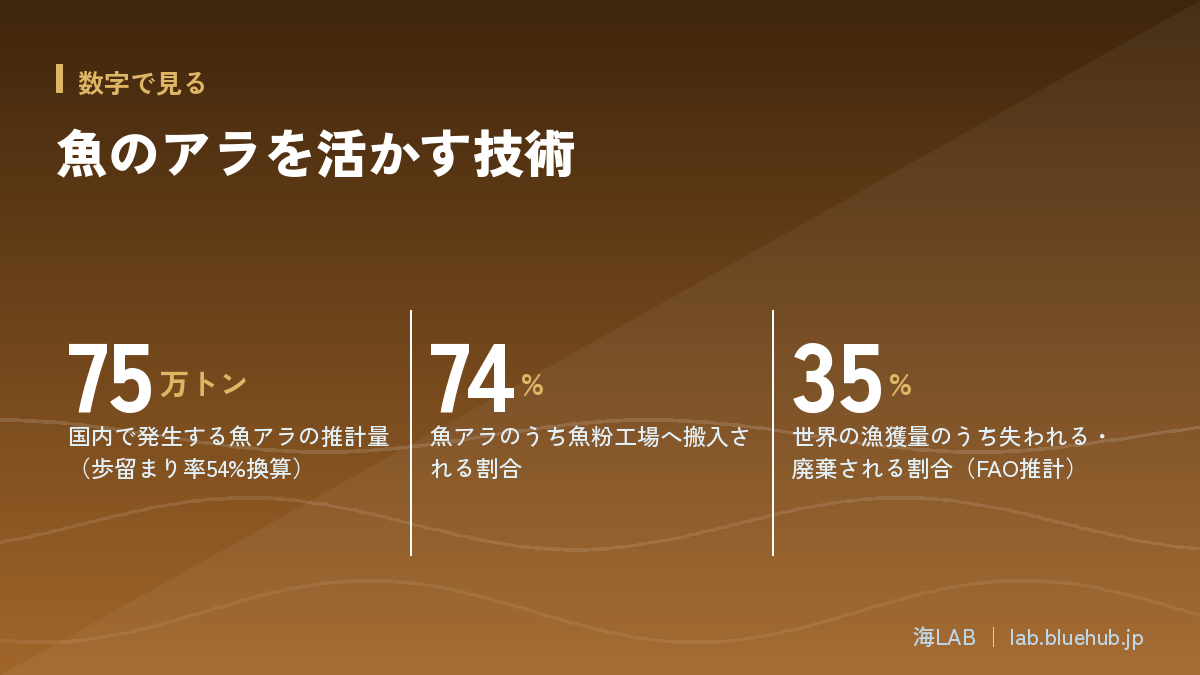
According to an estimate published in a newsletter by the Ocean Policy Research Institute of the Sasakawa Peace Foundation, roughly 750,000 tons of fish byproducts are generated domestically each year. Globally, the FAO (Food and Agriculture Organization) estimates that 35% of the world's catch is lost or wasted after harvest, showing that seafood "mottainai" (waste) is not just a Japanese issue. At the same time, a growing number of small and mid-sized companies and startups in Japan are working to lift these byproducts beyond feed and fertilizer into higher-value cosmetic ingredients and leather products — an "upcycling" movement.
This article looks at how fish byproducts are being turned into valuable products, drawing on statistics and real-world examples, while also touching on broader food loss issues in the seafood industry.
What you'll learn in this article
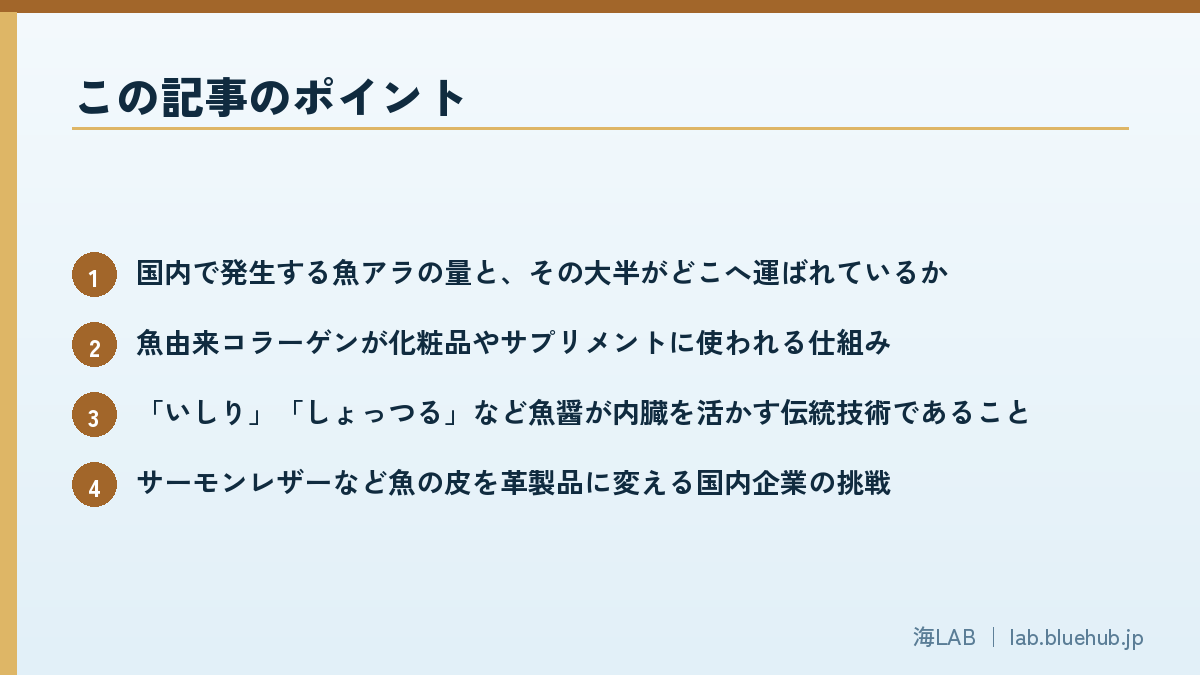
- How much fish byproduct Japan generates, and where most of it goes
- How fish-derived collagen is used in cosmetics and supplements
- How fish sauces like "Ishiri" and "Shottsuru" are a traditional way of using fish innards
- How Japanese companies are turning fish skin into salmon leather and other leather goods
- How bones and heads become fertilizer, feed, and pet food — and what challenges remain
- The freshness, cost, and regulatory hurdles that still limit upcycling
What Exactly Is Left Over After Filleting a Fish?
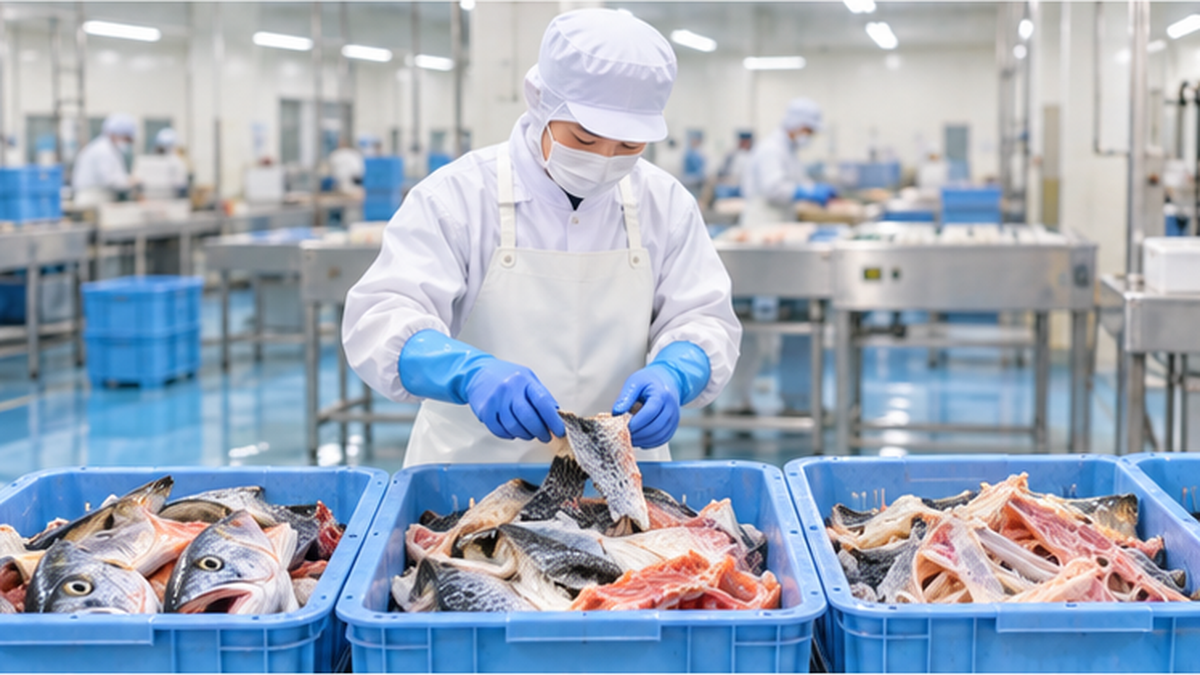
Only part of a landed fish becomes sashimi, fillets, or dried fish. The rest — heads, bones, guts, skin, fins, scales, and dark muscle — is collectively called "ara" (inedible parts), generated in huge volumes daily by fishmongers and seafood processing plants. The same thing happens at home when you buy a whole fish, just on a far smaller scale.
What kinds of inedible parts are there?
- Heads and bones — used for stock, and ground into fishmeal or fertilizer
- Innards — fermented into fish sauce, or mixed into feed and fertilizer
- Skin — tanned into fish leather, or used as a collagen source
- Scales and fins — used to extract collagen, or in washi paper and crafts
- Dark muscle and trimmings — strong in color and odor, so usually blended into fish paste products or feed
Edible vs. inedible parts: the concept of yield rate
The proportion of a fish that is edible is called the "yield rate." For seafood (excluding shellfish and seaweed) distributed in Japan, the yield rate is about 54%, meaning the remaining 46% becomes inedible byproducts such as heads, bones, guts, and skin. This rate varies greatly by species and processing method — filleting or "round" processing (removing the head and guts) can lower the yield further. Farmed and wild fish also differ in byproduct ratio depending on fat content and skeletal size.
Breaking down the 750,000-ton figure
According to an author's estimate published in a Sasakawa Peace Foundation Ocean Policy Research Institute newsletter, based on 2024 statistics, the domestic supply of seafood (excluding shellfish and seaweed) is about 1.62 million tons, with a yield rate of roughly 54%. From this, byproducts are estimated at roughly 750,000 tons annually. Much of it comes from processing plants making kamaboko, canned goods, and fillets, and the cost of processing and transporting this byproduct is itself a management challenge for processing clusters near fishing ports.
Where does it all go?
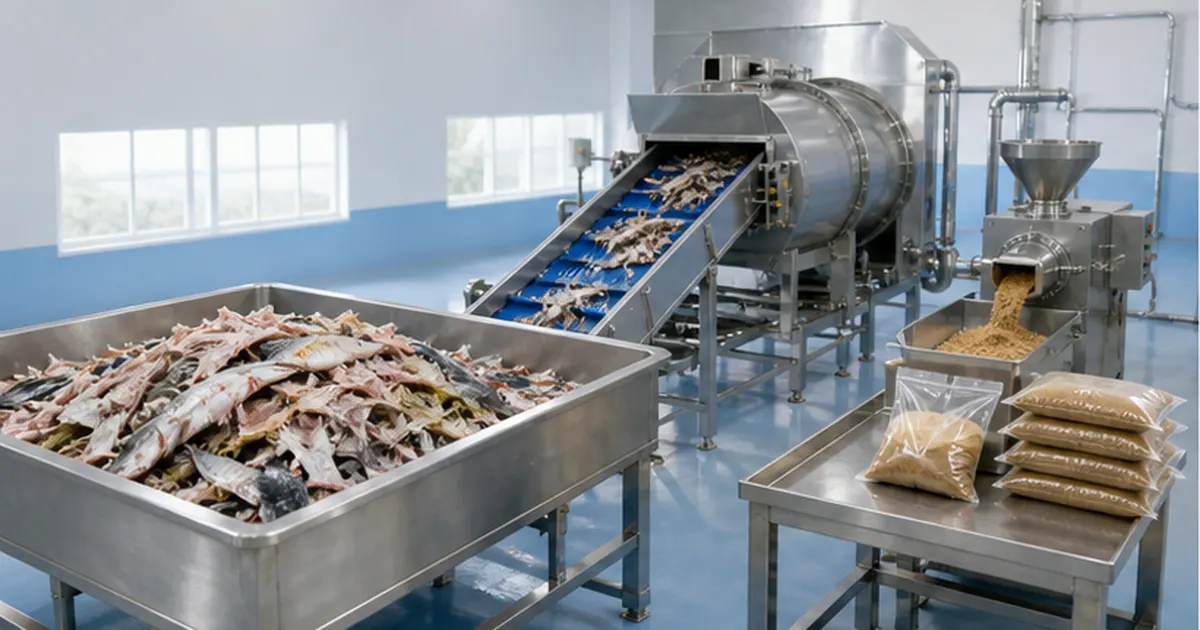
Per the same estimate, about 74% of the fish byproducts generated are delivered to fishmeal companies, becoming raw material for aquaculture feed and fertilizer. The rest is discarded as food waste, or processed into higher value-added products such as collagen, fish sauce, leather, and pet food. Expanding this "other" portion is exactly what the upcycling movement spreading across Japan is about. Turning seafood processing residue into fishmeal and fish oil is already widespread domestically — this article focuses on the higher-value products that go a step further.
The other side of the coin: disposal costs
Fish byproducts are a valuable resource, but if left unused they become industrial waste requiring costly disposal. As they decay, they cause odor and wastewater problems, making prompt removal and processing a business concern for processing plants. Delivering byproducts to fishmeal or fertilizer companies is the most basic way of turning this disposal cost into revenue; higher value-added uses like collagen and fish sauce are a further step beyond that.
In some port towns with clusters of seafood processing plants, a system exists to collectively gather and process byproducts from multiple factories. Volumes too small for a single factory to be profitable become viable when pooled regionally, ensuring stable supply to fishmeal plants and freeing up room for small-batch, high-value uses like collagen and fish sauce.
"Mottainai" Is a Global Problem Too
The movement to make use of fish byproducts isn't limited to Japan. Seafood waste and loss are a significant issue worldwide, though the causes differ by region.
35% of the world's catch is lost or wasted
The FAO (Food and Agriculture Organization) estimates that about 35% of the seafood produced by global fisheries and aquaculture is lost or wasted after harvest. In regions without adequate cold-chain and transport infrastructure, spoilage immediately after landing (food loss) accounts for a large share, while in developed countries including Japan, the underutilization of byproducts generated during processing (food waste) is the main issue. Even though both are labeled "35%," developed and developing regions require very different countermeasures.
Byproducts make up 30–70% of a fish's body
According to FAO materials, byproducts from seafood processing — heads, bones, guts, scales, and so on — account for 30% to 70% of a fish's total body weight. This wide range shows how much the byproduct ratio differs between large-boned species like tuna and small species like sardines that are more often used whole.
A shift underway in fishmeal and fish oil production
In recent years, the use of these byproducts as raw material for fishmeal and fish oil has been spreading globally. As of 2022, byproducts accounted for 34% of global fishmeal production and 53% of global fish oil production. The FAO projects that by 2025, fishmeal made from fish byproducts will make up 38% of global fishmeal production, up steadily from an average of 29% in 2013–2015. Rather than turning whole small pelagic fish (such as anchovies) into fishmeal, increasing the share made from processing byproducts is considered an important shift from a marine resource management perspective.
| Period | Share of fishmeal production from fish byproducts |
|---|---|
| 2013–2015 average | 29% |
| 2025 (FAO projection) | 38% |
Research into fermented "fish silage" feed
The FAO is researching "fish silage" technology — fermenting fish byproducts into a liquid form for use as livestock and aquaculture feed — in countries such as Bangladesh, the Philippines, and Thailand. Compared to conventional fishmeal production, which requires drying and heating, fermentation-based methods are considered easier to adopt at small-scale processing facilities, making them a promising option for byproduct utilization in regions where large capital investment is difficult.
What comparing Japan and the world reveals
The estimate that 74% of Japan's domestic fish byproducts go to fishmeal plants represents a relatively high utilization rate by global standards. On the other hand, the FAO's figure that "35% of the world's catch is lost or wasted" includes more fundamental losses occurring during transport and storage after landing. In other words, Japan's challenge is mainly "how to add more value to inedible parts," while regions with inadequate infrastructure face the more basic challenge of "how to deliver the edible parts before they spoil." Even when the headline number is the same, the underlying problem to solve differs by region — a point that's easy to overlook.
Reborn as Collagen and Gelatin
Among inedible parts, collagen found abundantly in skin, scales, and bones is one of the highest value-added upcycling destinations, used as a raw material for cosmetics and supplements. If raw fish byproducts trade for tens of yen per kilogram, refined collagen peptides can fetch thousands of yen per kilogram — a field with a large gap in added value depending on processing.
The odor problem that once held fish collagen back
Beef and pork skin were long the mainstream sources of collagen, but interest in fish-derived collagen grew following the mad cow disease (BSE) scare of the 2000s, which raised concerns about bovine-derived materials. However, fish-derived collagen had a drawback: it tended to retain a distinctive odor, making it difficult to use in cosmetics and food.
The trick: low-temperature extraction
Nippi, Japan's largest collagen manufacturer, developed "Nippi Collagen 100 Fish Type," an odorless collagen product made by extracting collagen from fish scales at low temperatures over an extended period and refining it to a high degree. Scales once discarded as waste have been reborn as an odorless raw material. Higher extraction temperatures increase yield but also tend to advance odor compounds and protein denaturation, so this seemingly inefficient low-temperature, long-duration process is what determines quality.
From cosmetics to supplements
"Collagen peptides," made by breaking collagen down into smaller molecules for easier absorption, are used in a wide range of products, from health drinks and powdered supplements to skincare cosmetics. Fish-derived collagen is said to have a molecular structure closer to human skin, driving demand in the beauty sector. Beyond Japan's aging domestic market, export demand from beauty-conscious markets across Asia is also fueling growth in the fish collagen market.
The reality of Japan's domestic market share
Nippi markets itself as Japan's No. 1 collagen ingredient supplier, while Nitta Gelatin holds the domestic No. 1 share for gelatin and No. 2 for collagen peptides; together, industry sources say the two companies hold nearly 80% of the domestic collagen market. Market research firms estimate the global fish collagen peptide market at roughly $790 million in 2025, with continued growth expected. The shift of raw materials from beef and pork to fish is drawing attention from the perspective of adding value to inedible byproducts as well.
Behind this trend is not only rising health and beauty consciousness amid an aging population, but also a segment of consumers who avoid beef- and pork-derived ingredients for religious reasons or allergies. Fish-derived collagen serves as an alternative for this diverse demand, valued not just as "recycled waste" but as a product that broadens the range of raw material choices.
How collagen and gelatin differ
Collagen and gelatin are made from the same protein, but differ in degree of processing. Gelatin is collagen that has been heated and denatured, and is used in a wide range of foods and pharmaceuticals, from jelly and gummies to capsule coatings. Fish-derived gelatin melts at a lower temperature than beef- or pork-derived gelatin; while it sets less firmly at room temperature, this property is being put to use in confectionery that benefits from a smoother melt-in-the-mouth texture.
- Beauty and health foods — collagen peptide drinks, powdered supplements
- Cosmetics — an ingredient in moisturizing creams and serums
- Food — used as gelatin for the texture of jelly, gummies, and confectionery
- Pharmaceutical and medical fields — capsule coating material, among others
Fish Sauce: Traditional Wisdom for Fermenting Innards
If collagen represents new technology, fish sauce represents "upcycling of innards" that has continued for centuries. Traditional seasonings made by fermenting fish innards and bones still remain in regions across Japan.
Noto's "Ishiri" — a seasoning born from squid innards
"Ishiri" (or "Ishiru"), from the Noto region of Ishikawa Prefecture, is a fish sauce made by salting and fermenting the innards left over from processing squid landed at Uchiura Port. It is believed to have already been made by the late Edo period, and also uses mackerel bones and innards, and sardines as raw material. It has long been enjoyed locally as a dipping sauce for hot pot dishes and sashimi.
See this shopIshiri (Ishiru) | Kaneishi Co., Ltd.A long-established maker of Noto's traditional "Ishiri" fish sauce, carrying on the fermentation method of using squid innards.🔗 kaneishi.comAkita's "Shottsuru" — the power of fermenting sailfin sandfish
Akita Prefecture's "Shottsuru" (salted fish sauce) is a fish sauce made by salting and fermenting sailfin sandfish and sardines, still produced and sold by several local makers. The traditional wisdom of not wasting bones and innards lives on today as a regional seasoning essential to hot pot dishes.
A fermentation technique found around the world
The technique of fermenting fish innards and bones into a seasoning is not unique to Japan. Vietnam's "nuoc mam" and Thailand's "nam pla" share the same basic principle as "Ishiri" and "Shottsuru": salting fish and letting them ferment via self-digesting enzymes. Ancient Rome is said to have had its own fish sauce called "garum." The wisdom of turning inedible fish parts into a long-lasting seasoning through fermentation developed independently in regions across the world.
- Ishiri/Ishiru (Noto, Ishikawa) — mainly squid innards, mackerel bones and innards
- Shottsuru (Akita) — mainly sailfin sandfish and sardines
- Ikanago shoyu (Kagawa) — mainly sand lance
- Nuoc mam (Vietnam) / Nam pla (Thailand) — mainly small marine fish
The shared mechanism behind them
"Ishiri," "Shottsuru," and Kagawa Prefecture's "ikanago shoyu" are often collectively called Japan's three great fish sauces. All share the common feature of using the self-digesting enzymes found in fish and shellfish to ferment and age innards and bones over a long period. Fish sauce can be seen as one culmination of fermentation techniques developed by our predecessors to avoid wasting inedible parts.
It is said to have originated from the wisdom of everyday life — not wasting bones and innards.
― Ministry of Agriculture, Forestry and Fisheries, "Encyclopedia of Japanese Traditional Foods"
From local dish to modern table
Fish sauce was once used mainly in local hot pot dishes and pickles, but in recent years it has been increasingly adopted as an umami seasoning in non-Japanese cooking as well. Adding a small amount in place of salt is known to deepen flavor, and it is being reevaluated as a seasoning that can be applied at home — in pasta sauces, dressings, and as a hidden flavor booster in stir-fries.
- Add a few drops to pasta or soup to boost umami
- Use to finish stir-fried vegetables or yakisoba
- Mix into dressings or sauces to add depth of flavor
Small breweries keeping tradition alive
Much of the "Ishiri" and "Shottsuru" produced today comes not from major food manufacturers but from small, regionally rooted breweries. Fermented foods requiring long aging don't lend themselves to industrial mass production, and sourcing the fish innards and bones used as raw material is closely tied to local fisheries. This small-scale structure preserves a flavor character that mass-produced seasonings lack, but it also faces challenges such as a shortage of successors and unstable raw material supply.
Brewing requires months to over a year of fermentation and aging, with the result affected by weather and temperature, making it ill-suited to the standardized production lines of major manufacturers. Even so, breweries across the regions continue to preserve their methods because fish sauce making has functioned as a way to pass on the innards and bones from local seafood processing to the next generation without waste, rather than discarding them.
Turning Skin into Leather: Fish Leather
Fish skin is thin, and the difficulty of processing it has led much of it to be discarded. In recent years, however, "fish leather" — made by tanning this skin into leather goods — has been spreading gradually in Japan and abroad.
Why fish skin has long been discarded
Compared to cow or pig hide, fish skin is thin and its fiber direction is uneven, requiring advanced temperature and chemical control during tanning. The small area obtainable per skin, relative to the effort required, is one reason its use hasn't advanced further until now.
A challenge spreading from Kochi — Shinki Hikaku and Ocean Leather
Shinki Hikaku, based in Himeji City, Hyogo Prefecture, began a trial effort to make leather from the skin of salmon processed for food after being approached by a food processing company. The skin is thin yet durable, and features the distinctive scale pattern unique to fish. Ocean Leather, based in Kochi Prefecture, also sources fish skin discarded during processing to manufacture and sell salmon leather and other fish leather, stating that it does not catch fish solely for the purpose of making fish leather.
See this brandSalmon Leather | Ocean LeatherA Kochi-based fish leather brand that tans fish skin discarded during processing.🔗 oceanleatherforbusiness.com
The rough outline of the tanning process
- Washing and degreasing — carefully removing remaining flesh and fat from the skin
- Tanning — stabilizing the skin's proteins with agents such as tannin, making it resistant to decay
- Dyeing and drying — coloring as needed and drying over time
- Finishing — smoothing the surface into a usable material for wallets, bags, and other goods
Beyond salmon: other fish species in use
Domestic fish leather often uses salmon skin, but since the firmness and pattern of the skin vary by species, attempts using the skin of cod, sea bass, tilapia, and other fish landed regionally have been reported around the world. Because leather can be made directly from skin generated by local seafood processing, the range of applicable species is expanding beyond salmon.
A character cowhide doesn't have: pattern and thinness
Because fish leather is thinner and lighter than cowhide, it suits wallets, small goods, and accent parts for bags. The distinctive pattern created by scale traces is valued as a one-of-a-kind character that mass-produced cowhide goods lack.
Technical hurdles still to overcome
Fish skin has more fat content than cow or pig hide, making it prone to odor and decay. In the tanning process, thorough temperature control combined with careful degreasing and tanning steps such as tannin tanning produces leather durable enough for practical use. Securing a stable supply of raw fish skin also remains a challenge for expanding the business.
An environmental advantage: no new livestock needed
Cowhide is a byproduct of the livestock industry, inseparably tied to the land, feed, and greenhouse gas emissions required to raise new cattle. Fish leather, by contrast, uses fish skin from fish already landed for food — an already-existing processing residue. In the sense that no new animals need to be raised or caught to make the leather, it draws attention from an environmental impact perspective as well.
That said, fish leather has not yet reached the scale of mass production and distribution seen with cowhide, and tends to be more expensive than cowhide goods. Brands are expanding their market from small items such as wallets, card cases, and accessories, positioning the rarity of small-batch production as a brand value in itself.
Bones and Heads Become Fertilizer and Feed
Bones, heads, and innards that can't be processed into collagen or leather are mostly turned into fishmeal and fish oil, used as raw material for fertilizer and feed. In terms of volume, this remains the largest upcycling destination for fish byproducts.
Fishmeal supporting organic fertilizer
Fishmeal is rich in minerals and amino acids, and is a representative raw material for organic fertilizer alongside oilseed meal and chicken manure. Organic fertilizers made from fish meal generated during the processing of sardines, tuna, and other species are also manufactured and sold domestically. The Ministry of Agriculture, Forestry and Fisheries has compiled a "Case Study Collection on the Use of Domestic Resource-Derived Fertilizers," introducing 29 cases involving food residues, including fish byproducts.
Growing demand as aquaculture feed
Fishmeal and fish oil are also the main raw material for compound feed used in aquaculture. As global demand for naturally sourced fishmeal rises, increasing the proportion of fishmeal made from discarded byproducts also matters for curbing overfishing of small wild fish such as anchovies. Some international certification schemes for seafood exist to trace the sourcing of fishmeal and fish oil, reflecting a broader move in the feed industry toward clarifying the origin of raw materials. For aquaculture operators too, choosing byproduct-derived fishmeal is becoming one indicator of sustainable feed sourcing.
Domestic initiatives in the Ministry's case studies
The case study collection compiled by the Ministry of Agriculture, Forestry and Fisheries reports initiatives by companies and organizations across Japan to turn seafood processing residue into fertilizer. It is also drawing attention as a model of "regional circulation," returning byproducts generated in a region to that region's agriculture.
The idea of circulating resources locally
Initiatives that return seafood processing residue to local farmland are valued for reducing the cost of purchasing chemical fertilizer from afar while putting marine nutrients to use in local soil-building. This idea of "regional circulation" — reconnecting fishing and agriculture as resources rather than waste — is considered easier to put into practice in rural areas where fishing ports and farmland are close together than in transport-cost-heavy metropolitan areas.
| Use | Main raw material | Main application |
|---|---|---|
| Feed | Heads, bones, innards | Main ingredient of compound feed for aquaculture |
| Fertilizer | Bones, innards | Mineral-rich organic fertilizer |
| Collagen | Skin, scales | Cosmetics, supplements |
| Leather | Skin | Wallets, bags, and other leather goods |
| Seasoning (fish sauce) | Innards | Fermented seasoning |
| Pet food | Flesh, bones (including unused fish) | Dog food and more |
Unused Fish Meets Pet Food
Beyond fish byproducts, "unused fish" that never reach the market is another underused seafood resource. In recent years, pet food development using these unused fish has drawn attention as a possible solution to environmental problems.
Why rudderfish that devour seaweed beds become dog food
Rudderfish (Kyphosidae) and rabbitfish are considered a leading cause of "isoyake" — the phenomenon in which seaweed beds are devoured and disappear — but their distinctive odor has made them unpopular as food, leaving much of them as unused fish that goes to waste. Because these fish feed mainly on seaweed, their flesh tends to develop a distinctive flavor, considered one reason demand for them as food hasn't grown.
Ocean Repair, a Ritsumeikan University startup
Ocean Repair Co., Ltd., based in Fukuoka City, was founded in 2024 as a startup from Ritsumeikan University. It developed a premium dog food called "Ocean Harvest," using rudderfish and rabbitfish as its main ingredients, and launched it in September 2024. By using processing technology to suppress the compounds responsible for the odor, the company has achieved practical use of these fish as pet food.
See this companyOcean Repair Co., Ltd.A Ritsumeikan University startup that developed the "Ocean Harvest" dog food made mainly from unused fish.🔗 oceanrepair.co.jp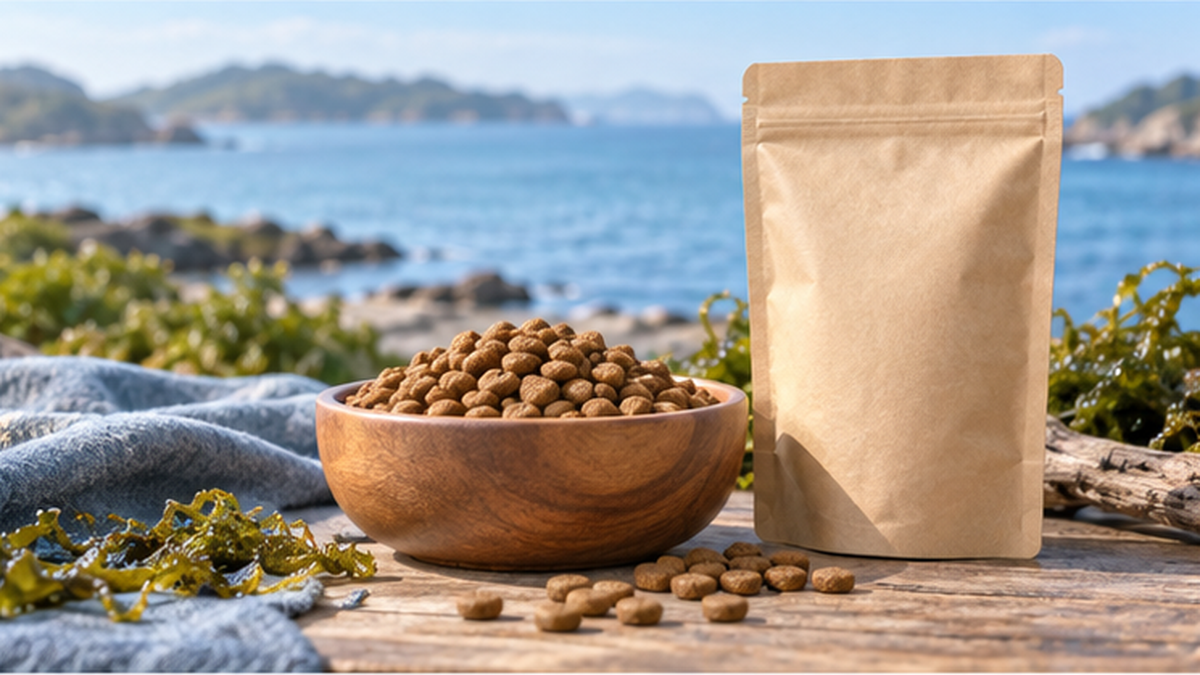
A double environmental benefit
This initiative aims for a double environmental benefit: reducing food loss by putting unused fish to good use, while also helping restore seaweed beds by removing the fish responsible for damaging them. As a model that advances marine ecosystem conservation and resource utilization at the same time, expansion to other regions is also anticipated.
The background: seaweed beds disappearing ("isoyake")
"Isoyake" refers to the phenomenon in which seaweed beds — where kelp, wakame, and other seaweed grow thick — disappear for various reasons, leaving bare rock exposed. In addition to poor seaweed growth caused by rising water temperatures, an increase in seaweed-eating organisms such as rudderfish, rabbitfish, and sea urchins is considered one factor. Because seaweed beds also play an important role as a nursery ground for juvenile fish, the progression of isoyake raises concerns for the fishing industry as a whole.
A tailwind from the growing premium pet food market
In Japan, as more households welcome dogs and cats as family members, spending on "premium pet food" that emphasizes ingredients and origin has been growing. Products made mainly from unused fish or fish byproducts are positioned within this market as options that can appeal on "ingredient transparency" and "environmental consideration," beginning to carry product value beyond simply addressing waste.
The agility that only a startup can offer
Using unused fish is a field where the species and volume available can vary significantly from year to year depending on catch conditions, creating uncertainty that makes mass production as a standard product difficult for major manufacturers. Small businesses, like university-affiliated startups, have the agility to work directly with local fishing communities and flexibly adjust product design to match whatever species were caught that year. Cases like Ocean Repair are able to succeed precisely because of this kind of nimble business model.
The Challenges Ahead for Upcycling
The technology for turning fish byproducts into valuable products is steadily spreading, but several hurdles remain before it can become an established business.
The hurdle of freshness and odor control
Fish byproducts lose freshness quickly and are prone to causing odor. In collagen and fish skin processing, quality is determined by shortening the time from landing to processing and thoroughly maintaining cold storage. The farther a factory is located from the fishing port, the higher this freshness-management hurdle becomes.
Cost and supply stability
The volume and species of byproducts fluctuate easily depending on catch conditions, making stable procurement of raw materials a challenge for business expansion. Building a system to collect seafood processing residue — which tends to come in small quantities of many different types — at a consistent quality is also essential.
Regulations for food and cosmetics
Using fish byproducts as raw material for food or cosmetics requires compliance with regulations on raw material hygiene management and labeling. In particular, when selling collagen as a food or supplement, it must meet the same standards as ordinary food, including disclosure of raw material origin and allergen labeling. Even starting from the same raw material — fish byproducts — the hygiene standards required for feed and fertilizer use differ greatly from those required for food and cosmetic use, which is also a hurdle for businesses entering the field.
A field small businesses can enter too
While collagen refining and large-scale fishmeal plants require substantial capital investment, brewing fish sauce or small-batch fish leather processing are fields that can be started with relatively small facilities. This accessibility for local seafood processors and individual entrepreneurs to develop new products is one reason the base of upcycling continues to broaden.
The small choices consumers can make
Ultimately, it is consumer choice that drives these technologies and businesses forward. Picking up a fish-collagen supplement, choosing a fish leather accessory, buying a processed product made from unused fish — each of these small purchasing decisions helps create new markets for resources that were once discarded.
The collagen, fish sauce, fish leather, pet food, and fertilizer introduced in this article are all different outlets branching from the same resource: fish byproducts. No single technology alone solves the fish byproduct problem, but as multiple uses expand simultaneously, the outlets available for inedible parts that once had nowhere to go but the trash are steadily increasing.
What consumers can do
- Try choosing products that make use of inedible parts, such as fish-derived collagen or fish sauce
- Learn about small domestic brands working with fish leather
- Try pet food or processed products made from unused fish
- Rediscover local fish sauces and fermented seasonings as part of regional food culture
References
- Sasakawa Peace Foundation Ocean Policy Research Institute, "Making the Most of the Sea's Bounty: Where Fishery Waste Goes" (Ocean Newsletter) – Estimate of Japan's fish byproduct volume, yield rate, and fishmeal-plant delivery rate
- Japan Fisheries Agency, "Fisheries Statistics" – Seafood supply and production statistics
- Ministry of Agriculture, Forestry and Fisheries, "2024 Fisheries and Aquaculture Production Statistics" – Domestic supply volume data
- FAO, "Fish By-Products Utilization" – Explanation of seafood processing byproduct utilization
- FAO, "Food Loss and Waste in Fish Value Chains" – Overview of global seafood loss and waste
- FAO, "Fish waste management: an assessment on potential production and utilization of fish silage" – Research on fermented fish silage feed
- Ministry of Agriculture, Forestry and Fisheries, "Encyclopedia of Japanese Traditional Foods: Ishiri, Ishiru" – History and method of Noto's fish sauce
- Ministry of Agriculture, Forestry and Fisheries, "Case Study Collection on the Use of Domestic Resource-Derived Fertilizers (Food Residues, etc.)" – Case studies of fertilizer made from seafood processing residue
- Nippi Collagen Cosmetics official website – Explanation of fish-derived collagen products
- Senken Shimbun, "Shinki Hikaku manufactures leather from edible salmon skin" – Domestic fish leather initiatives
- Ocean Repair Co., Ltd. official website – Development of pet food using unused fish
※ Sorted by reliability: government/academic institutions > peer-reviewed papers > specialized organizations > trusted media