⚡ In short
Canned tuna and mackerel carry the blue label too. What MSC and ASC certification mean, which cans and shelf-stable products you can actually buy in Japan, a three-step in-store check, and why certified goods are still scarce — set out neutrally, from a shopper's point of view.
The canned-food aisle of a supermarket is usually a quiet place. Tuna and mackerel from a couple of hundred yen, sardines in oil and canned yakitori beside them, sometimes heaped in a discount bin. Lately, though, cans carrying a blue oval mark have started appearing in the pile — the one with a fish cut out in white.
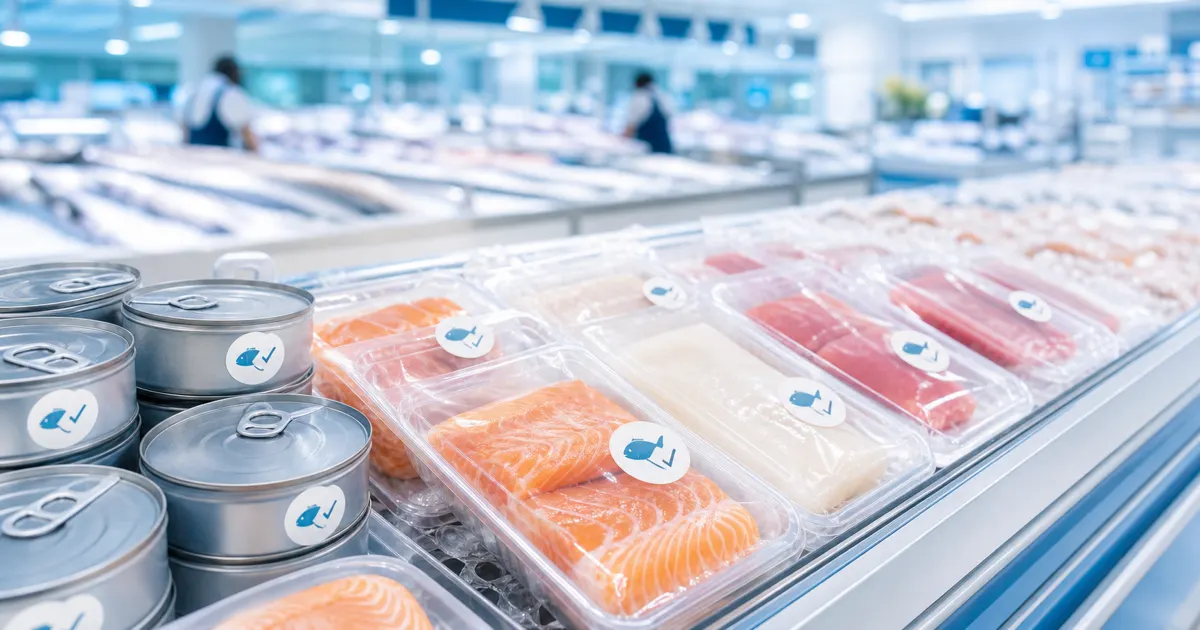
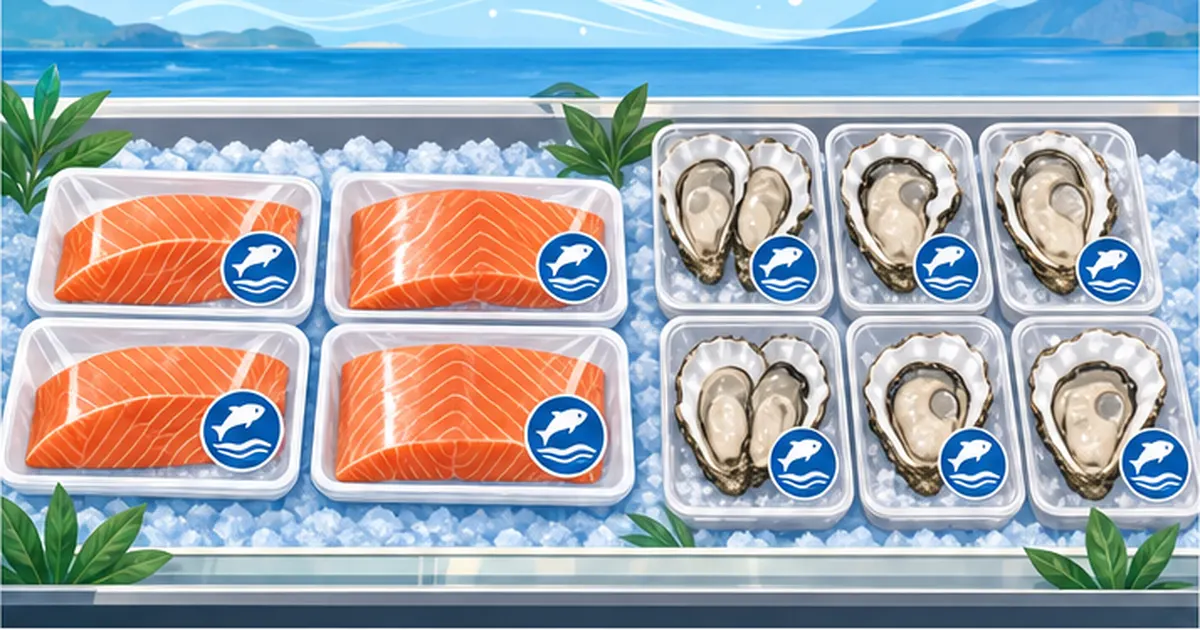
That is the MSC blue label, an international certification indicating wild-caught seafood from a fishery managed with regard for fish stocks and the environment. There is an aquaculture equivalent, the ASC label. Many people have seen them on sashimi or fillets at the fresh counter; less obvious is that they are steadily reaching shelf-stable processed goods as well.
This article narrows in on seafood that sits on the shelf at room temperature — cans, retort pouches, fish sausage — and sets out what the marks mean, which products you can actually buy in Japan and how to spot them in store. The schemes themselves are covered in What is the MSC blue label? How to spot sustainable seafood in the supermarket and What is ASC-certified aquaculture? A neutral guide to salmon, oysters and yellowtail, so here the focus is on the moment the tin goes into the basket.
What you'll learn in this article
- The difference between MSC (wild) and ASC (farmed), and which one applies to canned and processed goods
- Concrete MSC-certified cans and shelf-stable products you can buy in Japanese supermarkets and co-ops
- A three-step in-store check, and what the certification number (MSC-C-…) guarantees
- Why "pole-and-line" and "domestic" claims are not the same thing as a certification mark
- What the canned format itself offers: shelf life, less waste, more edible portion, recyclable containers
- Why certified products remain scarce, and a realistic way to choose without condemning uncertified goods
Can the canned-food aisle really change the ocean?
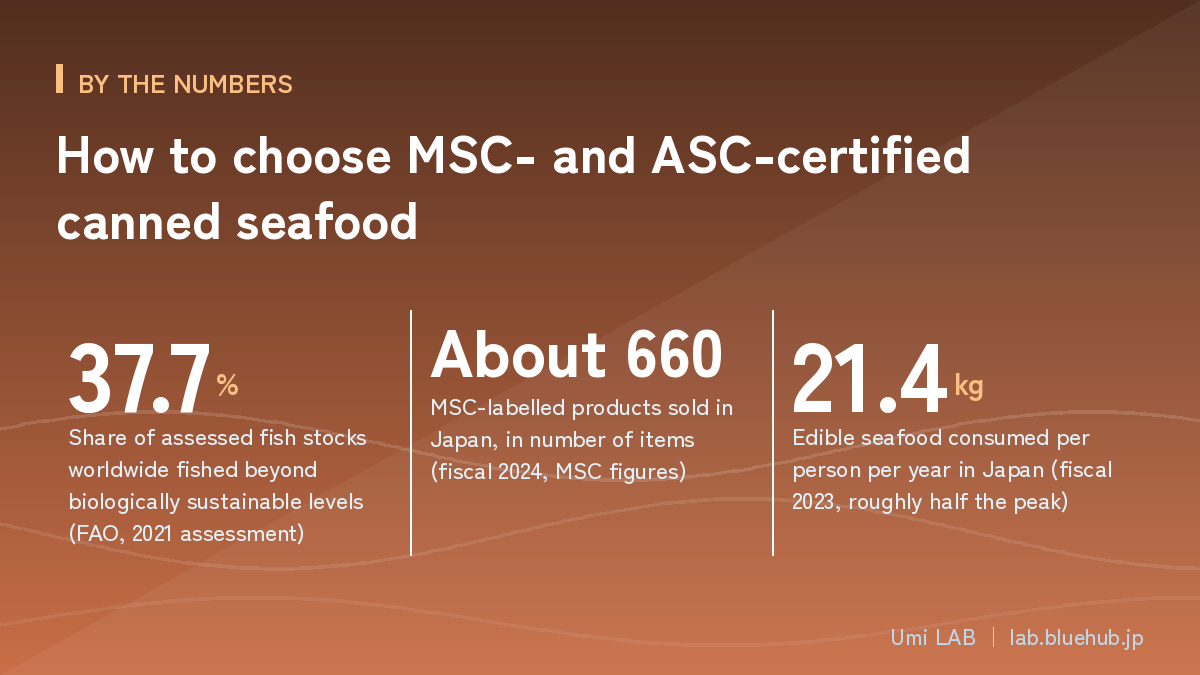
Told to "choose sustainable seafood," most people picture the fresh fish counter. Follow what households actually eat, though, and the picture gets more complicated. Annual per-capita consumption of edible seafood in Japan peaked at 40.2 kg in fiscal 2001 and has fallen ever since, reaching 21.4 kg in fiscal 2023 — roughly half the peak. Since fiscal 2011 it has stayed below meat consumption (Fisheries Agency, FY2024 White Paper on Fisheries).
Canned seafood, meanwhile, has stayed in everyday life. It needs no cooking, keeps at room temperature for years and has a predictable price. Even as fish consumption fell, canned tuna and canned mackerel survived as a circuit through which people keep eating fish at all. That is exactly why it matters whether certified products reach this shelf — as much as the fresh counter, and arguably more.
Fresh, frozen and shelf-stable are judged in completely different ways
Even within "buying fish," what a shopper can actually judge differs sharply by aisle. Fresh fish is chosen by origin label, appearance and price; almost nothing at the counter tells you which fishery caught it, or what state that stock is in. Cans are the opposite: they come with a printed surface, a fixed place to carry information. That is why they suit certification marks so well.
| Aisle | What the shopper can judge | Fit with certification labels |
|---|---|---|
| Fresh (chilled whole/fillet) | Origin, species, freshness, price. Gear type and stock status are hard to see | △ At best a small line on the origin sticker, easily missed |
| Frozen / chilled processed | Origin, ingredients, processing site. The bag offers plenty of label space | ○ Room to display certification clearly |
| Cans and retort pouches (shelf-stable) | Ingredients, raw-material origin, manufacturer, best-before date. Keeps for years | ◎ Fixed print surface, and repeat purchases make the effect compound |
Tuna and mackerel are the leads
Look at production volumes for canned seafood in Japan and two categories dominate: tuna (skipjack and tuna species) and mackerel. In the domestic production statistics compiled by the Japan Canners Association, canned tuna runs in the range of five million cases a year, while canned mackerel has held its place as a staple since the health boom. In other words, whether certified raw material enters those two categories largely determines the picture for shelf-stable seafood as a whole.
As it happens, canned tuna moved first in Japan. Skipjack and tuna species are managed and assessed under international regional fisheries management organisations (RFMOs), which made MSC certification structurally easier to obtain.
What the canned-mackerel boom left behind
In the late 2010s, canned mackerel sold explosively after health programmes and social media picked it up. Talk of EPA and DHA spread, and mackerel held the top spot in canned-seafood production for years. At times it vanished from shelves entirely. What the boom demonstrated is that canned goods move on "a reason to buy," not on flavour.
If health could move that much volume, resources could too — which may be too optimistic, since health pays you back in your own body while stock status pays back somewhere far away. Still, one thing became clear: shelves turn over faster than you would think. Behind the boom, debate also opened up about the stock status of mackerel and the degree of dependence on imported raw material. Precisely because cans are ordinary, they are an easy place to raise the question of resources.
Key points of this section
- Japan's seafood consumption has halved from its peak, to 21.4 kg per person in fiscal 2023
- Within that decline, canned tuna and mackerel survive as an everyday route to eating fish
- Cans have a fixed print surface and are bought repeatedly, so certification labels work well on them
MSC and ASC — what the two labels actually guarantee
The certification marks you see in the canned aisle fall into two families: MSC, for wild-capture fisheries, and ASC, for aquaculture. The names are similar and both are described as "sustainable seafood," so they get confused — but what they audit is fundamentally different.
The MSC blue label — auditing wild fisheries
The Marine Stewardship Council (MSC), founded in 1997, is an international non-profit that runs a fishery certification for wild-capture seafood. Assessment rests on three principles.
- Principle 1: Sustainable fish stocks — is the catch set so that overfishing is avoided and the stock is not depleted? If a stock is already down, is there a working mechanism to rebuild it?
- Principle 2: Minimising environmental impact — including bycatch and seabed damage, does the fishery maintain the structure, diversity and productivity of the ecosystem it depends on?
- Principle 3: Effective management — does it comply with local, national and international rules, and can it adapt how it fishes as stock conditions change?
Behind these three principles lies the state of the world's fisheries. According to FAO's The State of World Fisheries and Aquaculture 2024, 37.7% of assessed stocks were being fished beyond biologically sustainable levels (2021 assessment), up steadily from 10% in 1974. Weight the figure by production, however, and sustainable stocks account for 76.9% of landings. The reality is closer to a split between well-managed large stocks and unmanaged small ones. Certification is the market-side lever for growing the former.
Assessment is carried out by independent certification bodies and typically takes one to one and a half years. Certification is renewed every five years, with annual surveillance audits in between. It is not a permanent badge: if stock status deteriorates, certification can be suspended. More than 570 fisheries worldwide hold MSC certification (MSC figures).
ASC — auditing farms, their environment and their people
The Aquaculture Stewardship Council (ASC), founded in 2010, covers farmed seafood. There is no "overfishing a wild stock" question, so the standard looks at farm-specific issues instead: water pollution and impacts on surrounding ecosystems, the use of antibiotics and other chemicals, the sourcing of fishmeal for feed, and — distinctively — working conditions and relations with local communities.
In canned terms, ASC arrived earlier in fresh salmon, frozen shrimp and seaweed, and remains scarce among shelf-stable products. It is growing steadily, though, in oyster and mussel preparations and in retort-pouch seafood dishes.
See the aquaculture standardAquaculture Stewardship Council (ASC), Japan siteOfficial site covering the farm standards for responsible aquaculture, certified farms in Japan and how to read the label.🔗 jp.asc-aqua.orgChain of Custody — the invisible plumbing behind the label
Here is the part that is surprisingly little known: a certified fishery or farm alone does not put a label on a product. Every business between the catch and the shelf — processing, distribution, retail — must hold Chain of Custody (CoC) certification, proving it can keep certified and non-certified product from being mixed.
For processed goods like canned fish, the length of that plumbing is the difficulty. A single certified chain has to run from vessel to landing port, raw-material trader, cannery, distribution centre and retail logistics; if one company in the line is missing, no label. Read the other way, the certification number printed on the can is proof that the plumbing connects end to end. MSC reports that mislabelling of labelled products, checked by DNA testing and other means, stays below 1%.
| Item | MSC blue label | ASC label |
|---|---|---|
| Scope | Seafood from wild-capture fisheries | Farmed seafood |
| Founded | 1997 | 2010 |
| Main criteria | Stock status / ecosystem impact / management system (three principles) | Water and ecosystems / chemicals / feed sourcing / labour and community |
| Examples in shelf-stable goods | Canned tuna, fish sausage, mackerel preparations | Oyster and mussel products, retort dishes (still few) |
| Shared prerequisite | Every processor and distributor holds CoC certification | Same |
Common misunderstandings
- "MSC marks an eco-friendly gear type" — it assesses stock status, ecosystems and management as a whole, rather than gear alone
- "ASC means chemical-free farming" — it does not require zero treatments, but demands that use be controlled and recorded
- "Once certified, always certified" — there are five-yearly renewals and annual audits, and suspension is possible if stocks deteriorate
MSC-certified cans and shelf-stable products you can actually buy in Japan
Now to the practical part. Understanding the scheme changes nothing if you cannot answer "so what do I buy, and where?" Below are shelf-stable seafood products that are — or have been — on ordinary Japanese shelves, limited to those verifiable in published material.
AEON's Topvalu — swapping the canned tuna for a certified one
The clearest shelf-stable case is Topvalu, the private brand of AEON. On 17 June 2020, AEON launched "Topvalu Green Eye Natural, eco-friendly MSC-certified light flake skipjack in olive oil" across roughly 1,200 stores including AEON and AEON Style outlets. It uses MSC-certified skipjack, finished with Spanish pure olive oil, vegetable extract and salt (AEON Co., Ltd. press release).
AEON began selling MSC-certified seafood back in 2006, starting with fresh salmon and tuna and extending into processed goods; this certified can sits at the end of that line. Its official pages list certified items with their certification numbers, including MSC-certified "pole-and-line skipjack" and ASC-certified "breaded shrimp" and "mussels in tomato and garlic."
See this brandTopvalu | MSC/ASC certified seafoodAEON's private brand explains its MSC- and ASC-certified products, complete with certification numbers.🔗 topvalu.netHagoromo Foods — bringing MSC to the "Sea Chicken" brand
Hagoromo Foods, whose "Sea Chicken" is synonymous with canned tuna in Japan, also sells MSC-certified product. "Sea Chicken Smile Mild (MSC)" 50 g, launched in 2022, restricts its raw material to pole-and-line caught skipjack and carries MSC certification. It comes in a single-serve pouch rather than a can, but as a shelf-stable product it occupies the same position on the shelf.
The company explains on its official site that longline gear risks catching fish that are still small, whereas pole-and-line lets you target the fish you want. One caution, though: the words "pole-and-line" are a gear description, not a certification. The same company sells pole-and-line products that are not MSC certified, so you have to go by the label.
See this manufacturerHagoromo Foods | Working toward a sustainable societyThe manufacturer's own page on its use of pole-and-line raw material and its MSC-certified product line.🔗 corp.hagoromofoods.co.jpCO-OP — fish sausage and canned tuna
Japan's consumer co-operatives have been among the main drivers of the MSC-labelled market. Among shelf-stable goods, "CO-OP & Hagoromo Sea Chicken Mild, in water, 50 g" — co-developed with Hagoromo Foods — is listed as MSC certified. So is "CO-OP Fish Sausage," made with Alaska pollock, a staple in children's lunchboxes and snacks.
The co-ops' advantage is the catalogue: a sales floor that can explain itself. Unlike a supermarket shelf that gets a few seconds of attention, a catalogue can set out what certification means before the order is placed. For a scheme like this, that difference is not small. The Japanese Consumers' Co-operative Union began handling MSC-certified products around 2007, reportedly starting with products made from Norwegian mackerel, and has widened into fresh, frozen and processed lines since.
Imports and specialist shops as an alternative
Beyond domestic manufacturers, imported MSC-certified cans also circulate. Europe adopted the blue label early, and in Portugal and Spain MSC-certified canned tuna and sardines are ordinary supermarket goods. In Japan they turn up in imported-food shops and online stores. Prices sit above mass-market domestic cans, but as a "try one tin" entry point they work well.
The check is the same for imports: look for the MSC label and a certification number on the pack. In English packaging the cues are the words "Certified Sustainable Seafood" and "MSC" next to the blue fish mark. Even with no Japanese text, the mark and the number are universal.
See the certified productsCO-OP products | MSC certificationThe Japanese Consumers' Co-operative Union's official page on its MSC-certified items and how Chain of Custody works, with a link to the full product list.🔗 goods.jccu.coop| Product | Sold by | Format | Certification | Published evidence |
|---|---|---|---|---|
| Green Eye Natural, eco-friendly MSC-certified light flake skipjack in olive oil | AEON (Topvalu) | Can | MSC | Launched 17 June 2020 across about 1,200 stores |
| MSC-certified pole-and-line skipjack | AEON (Topvalu) | Processed | MSC | Listed with certification number on the official site |
| Sea Chicken Smile Mild (MSC) 50 g | Hagoromo Foods | Pouch (shelf-stable) | MSC | Launched 2022, made from pole-and-line skipjack |
| CO-OP & Hagoromo Sea Chicken Mild, in water, 50 g | Japanese Consumers' Co-operative Union | Can | MSC | Listed on the CO-OP MSC-certified product page |
| CO-OP Fish Sausage | Japanese Consumers' Co-operative Union | Fish sausage (shelf-stable) | MSC | Described as made with Alaska pollock |
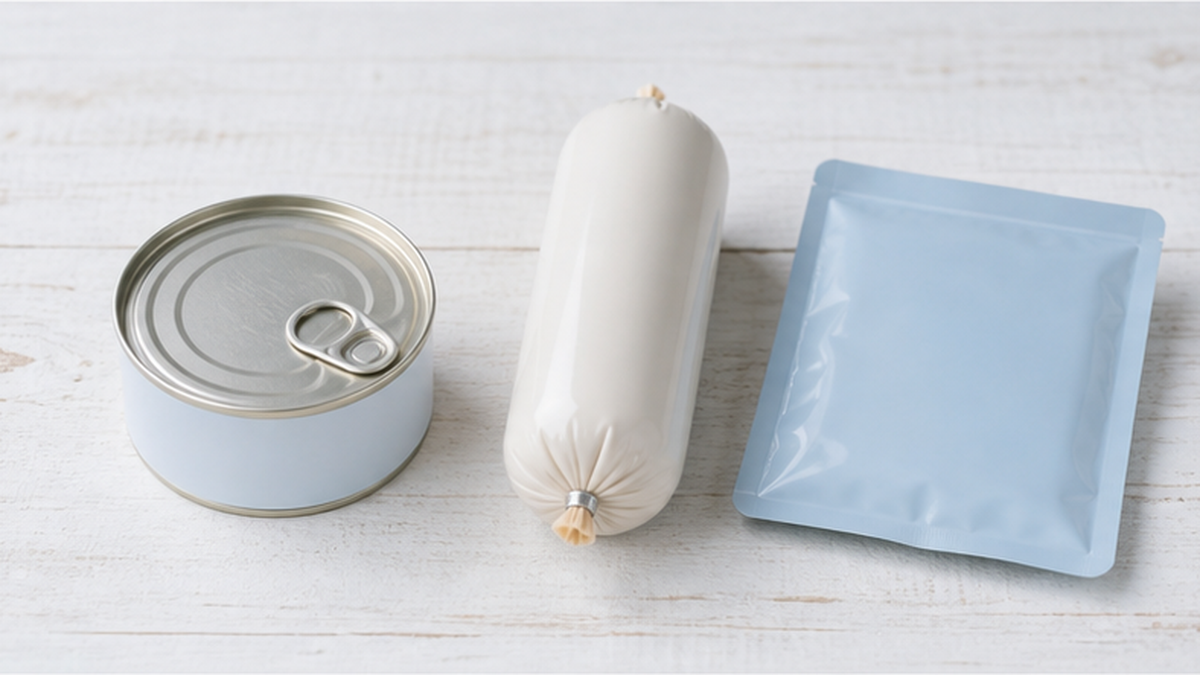
A note on product information
- Line-ups, stocking stores and packaging change over time. What is listed here reflects published material at the time of writing
- Within the same brand, certified and non-certified products coexist. Judge by the label, not the brand name
- Availability differs store by store; check the manufacturer's or retailer's official site if you want to be sure
How to spot them in store — a three-step check
Choosing certified products takes no special knowledge. It takes the few seconds it costs to pick up a can and turn it over. Three steps.
Step 1: learn the shape of the mark
The MSC blue label is a white fish silhouette inside a blue oval, usually with wording alongside it. The ASC label is predominantly green. On cans it tends to sit low on the front label or on the side; on pouches, on the back. Fix those two shapes in your mind and a single sweep of the shelf narrows the candidates.
Step 2: check the certification number
Near the label you will find a certification number in the form "MSC-C-□□□□□". This is the Chain of Custody number, showing that the businesses that handled the product hold the processing-and-distribution certification. Numbers can be looked up in the official database; Topvalu's official pages, for instance, publish them per product.
In practice you do not need to look one up every time. Simply checking whether a number is printed beside the mark is a useful way to tell a genuine certification from vague green messaging.
Step 3: separate it from lookalike claims
Canned seafood packaging carries plenty of language about the environment and quality. None of it is certification. Here are the most common claims that are not certifications.
- Gear descriptions such as "pole-and-line" or "stick-held dip net" — genuinely lower-impact gear, but not in itself a certification
- Origin claims such as "domestic" or "Sanriku" — origin guarantees neither stock status nor management
- "Dolphin safe" — a separate scheme addressing bycatch, not a full assessment of stock sustainability
- "Wild," "additive-free," "BPA-free" — properties of the raw material or the container, unrelated to fishery management
- In-house wording such as "sustainable" or "kind to the planet" — may not have passed any third-party audit
To be clear, none of this is meaningless. Pole-and-line really does produce less bycatch, and origin labelling matters to shoppers. But it helps to hold onto one line: only the certification mark indicates that a third party has assessed stocks, ecosystems and management.
Searching online is easier
Online beats the shelf for efficiency. Search "MSC," "ASC" on an online supermarket or co-op ordering site and you get a list of certified products only. Product pages usually carry an explanation of the certification, giving you more to go on than a shelf ever will. Save it to your shopping list once and you never have to choose again.
The other entry point is the official sites. MSC's Japanese site lists companies handling certified seafood; ASC's site lists certified farms in Japan. Checking whether the shop near you stocks them before you set out saves a wasted trip — and it means you are reading the primary source.
What you can do on your next shop
- In the canned aisle, look for the blue oval (MSC) and the green mark (ASC)
- If you find one, check for a number beginning "MSC-C-" beside the mark
- If the shelf has nothing certified, do not hunt for it. Continuing matters more than any single purchase
- When you find one you like, make it your repeat buy — decide once and stop deliberating
Certification is growing in Japanese waters too
Certified seafood may sound like an import story, but Japanese fisheries have been steadily certified as well — and, relevant here, largely in the skipjack and tuna species that fill cans.
MSC — scallops, skipjack and tuna
The MSC Japanese site lists domestic certified fisheries including the following.
- Hokkaido Federation of Fisheries Co-operative Associations — scallop hanging culture and dredge fishery
- Meiho Gyogyo Co., Ltd. (Miyagi) — skipjack and albacore pole-and-line fishery
- Maruto Suisan Co., Ltd. — oyster hanging culture
- Usufuku Honten Co., Ltd. — Atlantic bluefin tuna longline fishery
- Owase Bussan Co., Ltd. — albacore longline fishery
- Kyowa Suisan Co., Ltd. and Meiho Gyogyo Co., Ltd. — skipjack and yellowfin purse seine fishery
- Taiyo A&F Co., Ltd., Fukuichi Gyogyo Co., Ltd., Katsuo Ippon-tsuri Gyogyo Co., Ltd. and ITOCHU Corporation — purse seine and longline fisheries for skipjack and tuna species
Meiho Gyogyo is the most telling case. The company was established in 2012 after the Great East Japan Earthquake left its parent processing company unable to secure a stable supply of skipjack, and in 2016 it obtained MSC fishery certification for skipjack and albacore pole-and-line fishing — Japan's third certified fishery, and the country's first for albacore. A crisis became the reason to go out and prove its resource management.
The scallop fishery at the top of that list is not unrelated to cans either. Scallops have long been exported as canned product, and what earned international recognition was a management system combining hanging culture with dredging — including a four-year rotational seeding cycle across sea-floor blocks. Management built up by Japanese fishers over decades became the basis for certification.
ASC — it started with the oysters of Tokura
On the aquaculture side, oyster farming at the Tokura district of the Shizugawa branch of the Miyagi Prefecture Fisheries Co-operative obtained Japan's first ASC farm certification in March 2016. After the tsunami swept away their facilities, the farmers restarted with far fewer rafts than before — and the lower density made the oysters grow faster and improved quality. A decision to "farm less to grow better" ended up meeting an international standard. We cover this in more depth in our article on ASC-certified aquaculture.
Coverage has widened since: in 2018, Aqua Farm of the Maruha Nichiro group (Oita Prefecture) obtained ASC certification for yellowtail. Farmed fish rarely ends up in shelf-stable cans, though, so shoppers mostly meet ASC in fresh, frozen and chilled form.
| Category | Representative examples | Notes |
|---|---|---|
| MSC (wild, domestic) | Hokkaido federation's scallops; Meiho Gyogyo's pole-and-line skipjack and albacore | Includes species that can become canned product |
| MSC (wild, distant-water) | Purse seine and longline for skipjack, yellowfin, albacore and bigeye | Feeds directly into canned tuna supply |
| ASC (farmed, domestic) | Oysters at Tokura, Shizugawa, Miyagi (2016, Japan's first); yellowtail in Oita (2018) | Mostly distributed fresh or frozen rather than shelf-stable |
Why certified products are still scarce in Japanese shops
You may by now be thinking there are fewer than you expected. There are. MSC-labelled products sold in Japan numbered about 660 in fiscal 2024 (MSC figures). Against more than 22,000 worldwide, that is small for the size of the market. Several reasons overlap.
The cost and time of assessment
MSC certification takes a fishery one to one and a half years on average. On top of assessment fees come stock-assessment data to assemble, bycatch monitoring to run and record-keeping to systematise — a heavy load for a small co-operative or an owner-operated fishery. Japan's coastal fisheries are largely small and dispersed, and that structure is itself the barrier.
Segregation, and what it means on the ground
As Chain of Custody implies, certified product cannot be mixed with non-certified. Yet Japanese seafood distribution is multi-tiered: landings from many vessels are pooled at producing-area markets, pass through consuming-area markets and then reach processors. Asking a system that became efficient by mixing to stop mixing is not trivial. At the plant, running certified raw material means either a separate line or the labour of cleaning and changeover.
Awareness, and price
Then there is the buyer's side. If the meaning of the mark is unknown, the price gap decides. From the manufacturer's view, the cost of certification risks never coming back as sales. It is a chicken-and-egg problem that only starts to move once certified products sit on shelves long enough for shoppers to grow used to them. That is precisely what MSC Japan's consumer campaigns — such as its June 2025 campaign urging shoppers to choose the MSC label — are aimed at.
Certification costs are not only assessment fees; there are also licence fees for using the label. All of it ends up in the price. Even a difference of tens of yen feels large in a weekly shop — and canned goods are a discount-aisle staple where price competition runs hard.
There is a road that is not "certify or nothing"
A fishery that falls short is not simply dropped. Internationally there are Fishery Improvement Projects (FIPs), which measure a fishery against the standard, identify the gaps and work through them over several years toward certification. If data is missing, build the recording system; if bycatch is high, change the gear. Buyers — retailers and food service — support the process itself.
In Japan, the hard part is communicating that in-between state. No label can be applied, yet the improvement work is real. With few ways to say so at the shelf, it tends to be visible only in a retailer's sourcing policy or sustainability report. As we noted in our article on the MSC blue label, certification captures one point on a gradient rather than sorting the world into black and white — which is worth remembering, so you neither over-expect nor over-despair.
| Barrier | What it involves | Responses already under way |
|---|---|---|
| Assessment cost and time | One to one and a half years, plus data preparation and fees | Staged approach via Fishery Improvement Projects (FIPs) |
| Segregation | Certified and non-certified mix easily in multi-tiered distribution | Retail private brands fixing sourcing routes and arranging CoC certification across the chain |
| Consumer awareness | The mark's meaning is unknown, so price decides | In-store education and campaigns by retailers, co-ops and NGOs |
| Species bias | Concentrated in internationally managed skipjack and tuna | Growing certifications in domestic stocks such as scallops and oysters |
The domestic policy backdrop
- The revised Fisheries Act took effect in December 2020, placing total allowable catch (TAC) management at the core of resource management
- The Fisheries Agency is expanding the number of assessed species and raising the share of catch managed under TAC
- The better domestic management gets, the easier it becomes to satisfy MSC's principles 1 and 3
What the can itself has going for it
Set the label aside for a moment and look at the can as a format. Quite apart from certification, it has several advantages.
Years at room temperature — good for stockpiling and for waste
Canned seafood typically carries a best-before date around three years from production. Needing no refrigeration, it consumes no energy in storage or transport. That is valuable as household emergency stock — and at the same time it lowers the odds of throwing food away. Fresh fish gives you two or three days from purchase; a can keeps.
Seafood waste is dominated by spoilage and by discards of off-spec product. We cover that structure in our article on reducing seafood food loss, but it is worth noting that shelf-stable processing can act as a catchment for what would otherwise be lost.
Bones you can eat — more food from the same fish
Canned mackerel and sardines are cooked at high temperature and pressure, which softens the backbone enough to eat. That is usually discussed as nutrition — calcium — but it matters for resources too. It means more of each fish actually becomes food. Parts that filleting would discard survive as food in a can.
The simplicity of "fill it and heat it"
In principle, canning is extremely simple: pack the raw material, seal it, then heat it under high temperature and pressure to sterilise. That is why it keeps for years without preservatives, and why so many canned seafood products can claim to be additive-free. No cold chain to maintain, no electricity used in transport or storage. Across seafood distribution as a whole, that difference is not negligible.
It is not all upside, of course. Canning uses energy at the processing stage, and can-making uses resources. Some products carry a lot of salt or oil in the packing liquid. "Canned is automatically green" is too simple; the fair reading is that on three counts — shelf life, edible portion and container — it is sometimes better placed than the alternatives.
Steel cans and recycling
Steel, the material of the can, has long sustained a high recycling rate in Japan. Because it can be separated magnetically, collection and sorting are efficient, and it returns repeatedly as recycled steel. With marine plastic leakage a live problem, that is a practical strength of the format.
| Aspect | Cans and shelf-stable products | Notes |
|---|---|---|
| Storage | Keeps at room temperature for years (around three for canned seafood) | No refrigeration or freezing energy required |
| Food waste | Does not spoil in the cupboard; rotated stock gets eaten | Lower discard risk than fresh |
| Edible portion | Some products soften the bones enough to eat | Raises utilisation per fish |
| Container | Steel is a well-established recycled material | Magnetic separation makes collection efficient |
| Watch out for | Salt and oil in the packing liquid; check raw-material origin labelling | Read the nutrition panel as well as the mark |
Reasons to look again at cans
- Around three years at room temperature, so emergency stock and everyday eating can be the same thing
- Products with edible bones increase the usable portion of each fish
- Steel is easy to recycle, keeping the container's footprint down
- On the other hand, salt and oil vary widely by product, so read the nutrition panel too
Five habits you can start today, without strain
Finally, let us bring this down to the shop floor. The key is not to try to replace everything with certified products. Given how limited the choice still is, aiming for perfection is how people give up.
- Scan the canned aisle once — look for the blue oval and the green mark. It takes seconds
- Make just one staple a certified one — pick either canned tuna or canned mackerel and make that your repeat buy, so you never deliberate again
- Search "MSC" and "ASC" on online supermarkets and co-op catalogues — easier to find than in store, and you get an explanation
- Do not worry on days when you find nothing — choosing seasonal local fish, or buying only what you will finish, counts too
- Say out loud why you bought it — awareness is the bottleneck, and this is what shifts it
"Uncertified" does not mean "bad"
This is easily misread, so let us be explicit. A fishery or product without certification is not thereby unsustainable. Certification is something a third party has assessed and attested; plenty of unassessed fisheries have managed their stocks carefully for generations. Japan's coastal fisheries in particular have a long history of setting their own seasons, gear rules and closed areas to protect stocks.
The point of certification is not to sort the good from the bad but to make visible, through outside assessment, information a shopper has no way of verifying. Choosing certified products is therefore closer to endorsing that approach. Framed that way, it is easier to keep doing.
The lag between your choice and the shelf
Saying that individual shopping changes the ocean is, frankly, a stretch. One person swapping one can does nothing to Pacific skipjack. But shelves move. Sales data is the only language retail speaks: if certified products sell, orders rise; if orders rise, manufacturers change their sourcing; if sourcing changes, more fisheries seek certification. The chain is slow, but it has actually happened.
It took fourteen years from AEON starting to sell MSC-certified seafood in 2006 to a certified can reaching about 1,200 stores. The co-ops' work, begun with Norwegian mackerel, took about as long to widen into cans and fish sausage. On a ten-year view, the shelves have unmistakably changed. Seen as one part in tens of thousands of that, today's tin is at least not meaningless.
A realistic line to hold
If price is the sticking point, adjust the frequency rather than the principle. Not every time — a few times a month. Or split it: the regular product when you are feeding a family and need volume, the certified one for your own lunch. Sustainability tends to be discussed in all-or-nothing terms, but being able to re-choose, slightly, each time you stand at the shelf is what tells over the long run.

In summary
- MSC covers wild fisheries and ASC covers aquaculture; in both cases a label only appears once Chain of Custody links the whole supply chain
- Among shelf-stable seafood you can verify Topvalu's MSC-certified canned tuna (launched 2020), Hagoromo Foods' Sea Chicken Smile Mild (MSC) and CO-OP's Sea Chicken Mild in water and Fish Sausage
- In store, check in three steps: the shape of the mark, the certification number, then lookalike claims
- Domestic certification is spreading too — Hokkaido scallops, Meiho Gyogyo's skipjack and albacore, and the Tokura oysters that were Japan's first ASC farm
- Japan had about 660 labelled products in fiscal 2024; assessment cost, segregation and awareness are the bottlenecks
- There is no need to reject uncertified products. Picking one staple and sticking with it is what works
References and sources
- Marine Stewardship Council (MSC) – What the blue MSC label means: the three principles, how assessment works, and the number of certified fisheries worldwide
- MSC Japan – Press release on the June 2025 consumer campaign encouraging shoppers to choose the MSC label
- Marine Stewardship Council (MSC) – List of MSC-certified fisheries in Japan
- ASC Japan (Aquaculture Stewardship Council) – ASC farm standards
- FAO (Food and Agriculture Organization) – The State of World Fisheries and Aquaculture 2024 — The status of fishery resources (source of the 37.7% figure)
- Fisheries Agency of Japan – FY2024 White Paper on Fisheries, Trends in seafood consumption (21.4 kg per person per year)
- Ministry of the Environment, Japan – Environmental labelling database entry for the MSC blue label
- AEON Co., Ltd. – Press release: Topvalu Green Eye Natural launches canned tuna made with MSC-certified skipjack (June 2020)
- Japanese Consumers' Co-operative Union – CO-OP products site: MSC certification
- Japan Canners Association – Domestic production statistics for canned seafood
* Listed in order of reliability: government and academic institutions > peer-reviewed papers > specialist organisations > reliable media