⚡ In short
Traceability lets us track where, when, and by whom the fish we buy was caught. This guide explains Japan's Fisheries Distribution Act, catch certification, real cases of origin fraud, and how consumers can choose sustainable seafood.
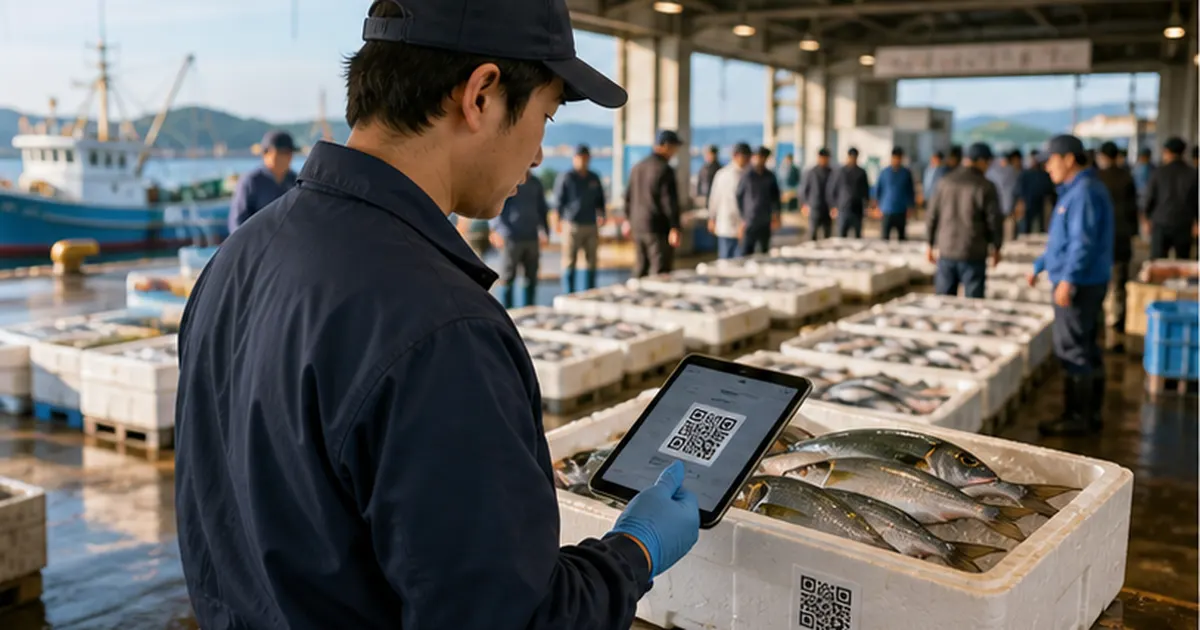
When we buy tuna sashimi or mackerel fillets at the supermarket, we rarely know when, where, or by whom the fish was caught. Even the origin label on the package offers little way to verify whether it's accurate.
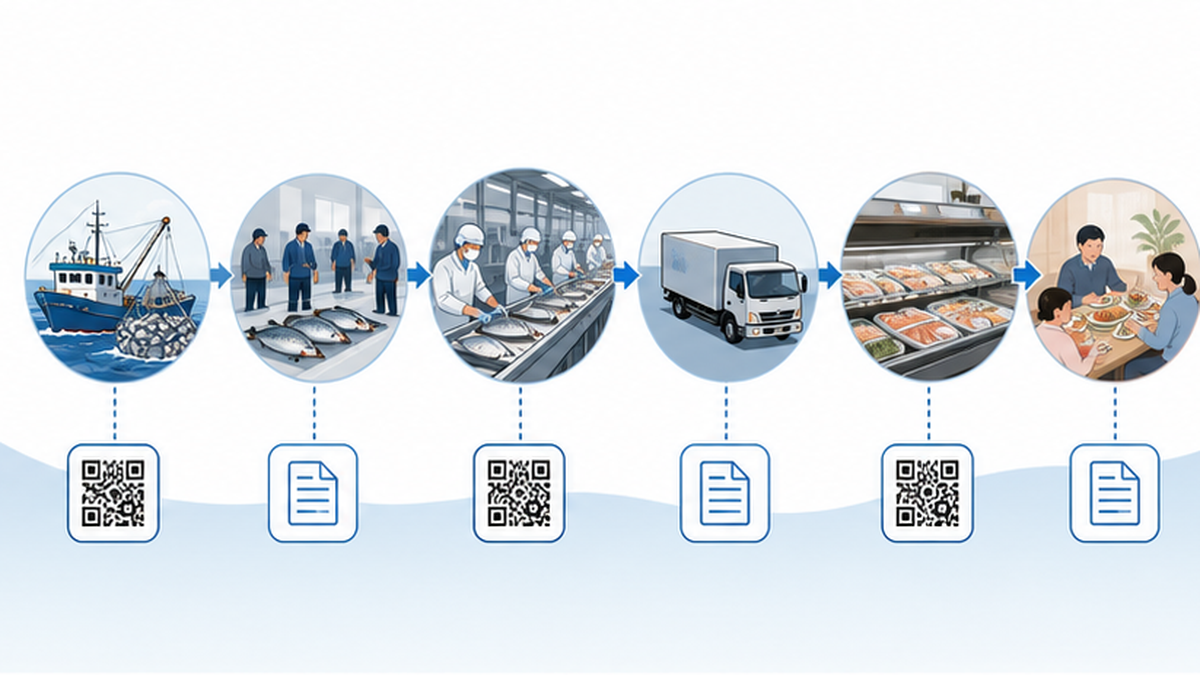
The system that makes it possible to trace the route seafood takes "from catch to table" is called seafood traceability. It's more than a quality-control concept — it's a social mechanism, now being built out worldwide, to keep illegally caught fish (IUU fishing) out of the market, protect fish stocks, and shield consumers from mislabeled origins.
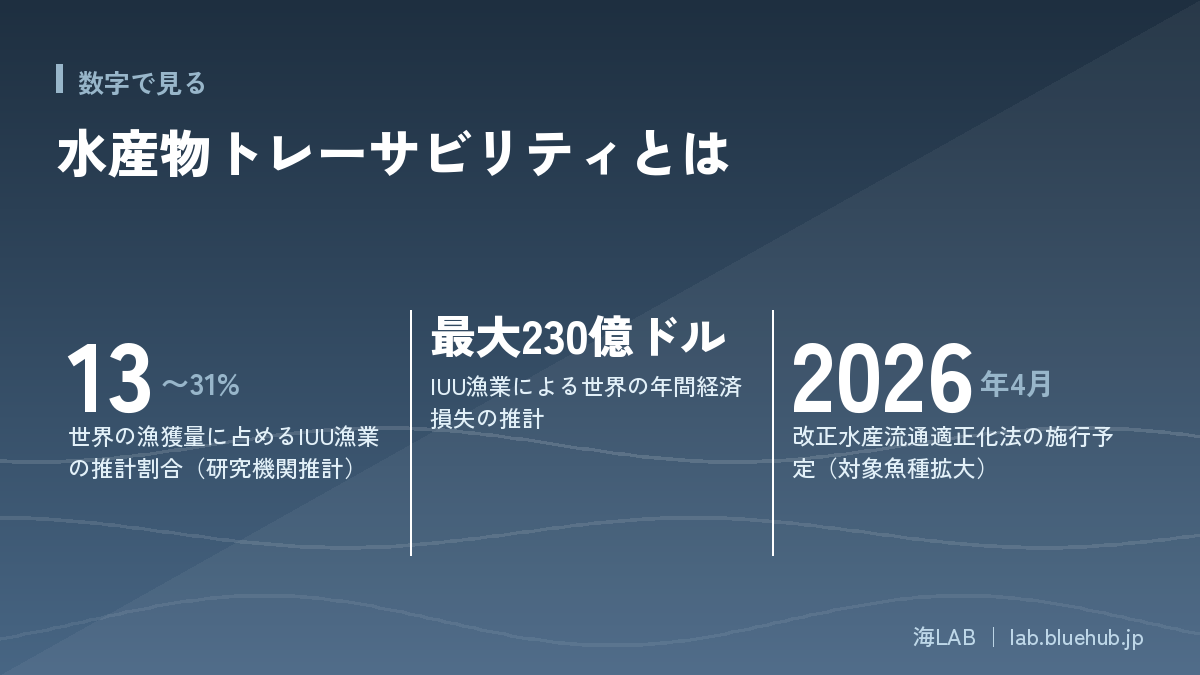
In Japan, the "Act on Ensuring the Proper Domestic Distribution of Specified Aquatic Animals and Plants" (commonly known as the Fisheries Distribution Act) took effect in 2022, and its scope will expand further from April 2026. This article draws on primary sources to walk through the basics of traceability, Japan's and the world's regulatory systems, real cases of origin fraud, the latest digital tracking initiatives, and practical steps consumers can take today.
What you'll learn in this article
- What seafood traceability is and why it's needed
- How Japan's Fisheries Distribution Act and catch certification system work
- The resource and human-rights problems caused by IUU (illegal, unreported, unregulated) fishing
- How origin fraud actually happens, with concrete enforcement cases
- The latest digital tracking efforts, including blockchain
- Practical ways for consumers to choose sustainable seafood at supermarkets and restaurants
What Is Seafood Traceability?
Traceability refers to recording the path a product takes from raw material through processing, distribution, and sale so it can be tracked after the fact. For seafood, this centers on recording and passing along catch information — who caught the fish, when, where, and by what method. Unlike beef, which is tracked animal-by-animal with individual ID numbers, seafood is typically tied to information at the level of a "lot" — a batch from a single catch.
Three reasons traceability is needed
- Resource protection: if illegally or unreported-caught fish (IUU fishing) enters the market, catch-quota-based resource management stops functioning
- Consumer protection: shields consumers from origin fraud and false labeling, creating a market people can trust
- Human rights protection: international bodies have flagged forced labor and human trafficking in some IUU fishing operations, so tracing the source of a catch also helps improve labor conditions
In the West, the EU's IUU Regulation and the US Seafood Import Monitoring Program (SIMP) took the lead from the 2010s, requiring catch documentation for imported seafood. Japan built its own domestic system to keep pace with this trend — partly out of concern that failing to meet export-destination standards could shut Japanese seafood out of international markets.
Two directions traceability secures
Traceability has two directions: "trace-back" and "trace-forward." Trace-back means working backward from a product on the shelf to its source, used to investigate origin fraud or food-safety incidents. Trace-forward means anticipating which stores and regions a given catch will reach as it moves through the supply chain, which helps with fast recalls if a problem is discovered. Only when both directions function does traceability become truly effective.
Challenges unique to seafood
Compared with livestock and crops, securing traceability for seafood comes with distinctive challenges. Fishing vessels move across multiple fishing grounds during a single voyage, so one landing often mixes fish caught in different waters on different days — and unlike aquaculture, no one fully controls the growing environment. Because seafood must move quickly through distribution before freshness degrades, spending too much time on record-keeping creates a tension between freshness and accuracy. These factors make the design of seafood traceability systems more complex than for land-based foods.
On top of that, distant-water fishing often crosses multiple countries' exclusive economic zones (EEZs) and the high seas, making it complicated to determine which country's jurisdiction and regulations apply. Because more parties are involved in recording and passing along catch information than in coastal fishing, securing traceability for distant-water fishing is considered one of the most difficult areas of system design.
Japan's Fisheries Distribution Act and Catch Certification System
Japan's "Act on Ensuring the Proper Domestic Distribution of Specified Aquatic Animals and Plants" (commonly known as the Fisheries Distribution Act) took effect in December 2022. To prevent the distribution of illegally caught aquatic animals and plants, it requires businesses to pass along catch-number, species, quantity, and weight information to one another, and to create and retain transaction records. A distinctive feature is that it covers the entire supply chain — not just fishers, but wholesalers, processors, and import/export businesses as well.
Phased expansion of covered species
| Timing | Covered species (specified Type-1 aquatic animals/plants) | Notes |
|---|---|---|
| From Dec. 2022 | Abalone, sea cucumber | Mandatory transmission of catch numbers through domestic distribution |
| From Dec. 2025 | Glass eel (juvenile Japanese eel) | Added as a countermeasure against overfishing and poaching of eel stocks |
| From April 2026 | Species requiring internationally coordinated resource management (planned expansion) | Amended law takes effect; coverage to be broadened in stages |
The system rests on two pillars. One is "domestic distribution compliance" — passing along and recording catch numbers and other information between domestic businesses. The other is "import/export compliance" — requiring documentation proving lawful capture to be attached at the time of import or export. Violations, following amendments to the Fisheries Act, carry severe penalties of up to three years' imprisonment or a fine of up to 30 million yen. This is paired with administrative measures such as seizure of illegally caught goods and suspension of trading, designed to strengthen the economic deterrent.
Practical obligations for fishers and businesses
When fishers land a covered species, they must issue a "catch number" and record it on the shipping slip. The distribution business that receives that number must carry it forward — even when the product's form changes through processing or repackaging — and pass it on to the next party in the chain. Transaction records must be retained for a set period so they can be verified during government inspections. For small-scale fishers and independent shops, the added administrative burden — moving from paper slips to dedicated systems — has been flagged as a challenge.
Importers face additional requirements. They must attach documentation such as a "certificate of lawful catch" issued by the exporting country's government, proving the catch was lawfully taken; cargo lacking proper documentation cannot clear customs. This effectively makes it difficult to import from origins where the exporting country lacks a traceability system, indirectly encouraging those countries to build up their own systems.
The path to creating the system
The Fisheries Distribution Act grew out of a long-running problem: poaching of abalone and sea cucumber. Sea cucumber in particular, traded as a high-end food item, saw a surge in poaching driven by rising export demand to China, and Diet sessions repeatedly raised concerns that this was funding organized crime. Until then, poaching had mainly been policed through prefecture-by-prefecture fishing coordination rules, but these had limits when it came to wide-area smuggling routes crossing prefectural borders. After debate concluded that national-level distribution regulation was needed, the law was enacted in 2020 and took effect in December 2022.
Why start with abalone, sea cucumber, and eel?
- Abalone and sea cucumber have been repeatedly flagged as species with especially heavy poaching, allegedly funding organized crime groups
- The Japanese eel is listed as endangered on the IUCN Red List, and illegal capture and smuggling of glass eels (juveniles) is considered one factor behind its population decline
- Species that are scarce and command high prices carry a stronger economic incentive for poaching, making them an easier testbed for verifying whether the system actually works, which is why they were introduced first
What Is IUU Fishing, and How Serious Is It Globally?
IUU stands for Illegal, Unreported, and Unregulated fishing — a catch-all term for operating without a country's permission, falsifying catch reports, and unregulated fishing on the high seas beyond any jurisdiction's reach. We cover the full picture in What Is IUU Fishing? The Reality of Illegal Fishing Stealing 26 Million Tons of Fish a Year, Satellite Monitoring, and Regulation; here, we focus specifically on its relationship to traceability.
Scale and economic loss
Research estimates suggest IUU fishing accounts for 13–31% of the world's catch, with economic losses estimated at up to $23 billion a year. In regions with weak governance, such as parts of coastal West Africa, IUU fishing is said to account for more than 40% of the catch. The losses extend well beyond lost income for fishers — they include unfair price competition against legitimately operating businesses and lost tax revenue for coastal states.
How traceability prevents IUU fishing
Fish sourced from IUU fishing is characterized by catch records that are missing or falsified. If importing countries require a "catch certificate" to be attached and allow catch numbers to be cross-checked at every stage of domestic distribution, fish of unknown origin becomes far harder to slip into the legitimate market. The EU has banned imports of seafood lacking catch certificates under its IUU Regulation since 2010, and the US has required data entry for 13 species groups under SIMP since 2018. Japan's Fisheries Distribution Act was built to follow this same international framework.
Risks specific to the Japanese market
Japan is one of the world's largest seafood importers, and depending on the fisheries management systems of the countries and regions it imports from, it has repeatedly been flagged as being at risk of unintentionally bringing in IUU-sourced seafood. International environmental NGOs have repeatedly noted that a certain share of seafood flowing into the Japanese market is likely linked to high-IUU-risk fishing, which is part of the backdrop driving calls to strengthen import controls under the Fisheries Distribution Act.
The link between IUU fishing and human rights
IUU fishing isn't only a resource-management issue — it's deeply tied to the working conditions of crew members. The International Labour Organization (ILO) and human-rights groups have reported serious abuses on some distant-water vessels, including long working hours, unpaid wages, and forced labor. Vessels with opaque catch information also tend to be harder to verify from the outside when it comes to labor conditions, so strengthening traceability is expected to serve not only as resource protection but also as a safety net for the human rights of fishing crews.
IUU fishing near Japan's own waters
IUU fishing isn't just a distant-water problem. Japan's Coast Guard and Fisheries Agency continue to confirm illegal operations by foreign vessels near Japan, including unauthorized fishing within Japan's exclusive economic zone (EEZ). In recent years, illegal operations by foreign vessels around the Yamatotai area of the Sea of Japan have become a recurring issue, prompting repeated warnings and seizures by enforcement vessels. Strengthening domestic traceability systems also matters for reducing the risk that catches from this kind of illegal operation slip into the domestic market.
How Does Origin Fraud Actually Happen?
A lack of traceability isn't just a resource-management problem — it also amounts to direct deception of consumers. Japan's Food Labeling Act requires origin labeling on seafood, yet violations continue to be reported.
Real enforcement cases
- A case in which Mexican bluefin tuna was printed on purchase slips as "farm-raised bluefin, Nagasaki," misleadingly implying a Nagasaki origin (a corrective-instruction case from Japan's Ministry of Agriculture, Forestry and Fisheries and Consumer Affairs Agency)
- A case in which frozen bigeye tuna from China was falsely labeled as originating from Taiwan
- Shellfish rules allow the location of short-term "fattening" (culturing) to be labeled as the place of origin, a structural quirk that has been flagged for creating labels that diverge from the actual catch location
Selling food with a false origin label in violation of food labeling standards carries a penalty under the Food Labeling Act of up to two years' imprisonment or a fine of up to 2 million yen. However, most violations are discovered only after the product has already reached the market — many cases could likely have been prevented, or caught earlier, with a properly functioning traceability system.
Structural factors behind fraud
Origin fraud doesn't stem only from isolated bad actors — it also arises from structural factors like price gaps, supply-demand imbalances, and the complexity of labeling rules. The larger the price gap between domestic and imported fish of a given species, the stronger the incentive to mislabel, and when fish from multiple origins are purchased and blended during processing, label accuracy tends to erode. Products that pass through more processing steps along the way — such as culturing or pre-slaughter handling — also tend to have more ambiguity about which stage's information should count as the "origin."
Government monitoring systems
Proper origin labeling is jointly monitored and enforced by Japan's Consumer Affairs Agency and Ministry of Agriculture, Forestry and Fisheries. Regional agricultural administration offices under the ministry conduct regular inspection rounds at supermarkets and retailers, requesting explanations from businesses when labeling appears questionable. In serious cases, businesses first receive a private "instruction" to improve without their name being disclosed; if improvement doesn't follow, or if the fraud is clearly intentional, an "order" is issued and the business's name is made public. Even so, these inspections only sample a small fraction of overall distribution volume, so an automated, traceability-based cross-checking system is seen as a necessary complement to improve the system's real-world effectiveness.
Watch out for shellfish "origin" labels
- Live shellfish can be labeled by their short-term culturing location as the place of origin
- A label like "from Sanriku" may be accurate even when most of the seeding and rearing happened in different waters
- If it matters to you, look for stores and brands that disclose ingredient sourcing and supplier information for greater certainty
Blind spots in restaurants and processed foods
Unlike a fresh fillet at the supermarket, restaurant menus and processed foods (fish cakes, fried products, canned goods, etc.) sometimes carry only limited origin-labeling obligations, making it structurally harder for consumers to verify origin. When fish from multiple origins are blended during processing, accurately tracking what proportion came from which origin becomes technically difficult. These "hard-to-see routes" are exactly the areas where digital traceability is seen as having the greatest potential impact.
How Digital Technology Is Changing Seafood Tracking
Paper-based record-keeping and transmission has limits — recording errors, tampering risk, and the hassle of storage and retrieval — so demonstrations of digital traceability technology have been advancing in Japan and abroad in recent years. QR codes, RFID tags, cloud-based recording systems, and blockchain are all starting to be used, often in combination.
Proving origin with blockchain
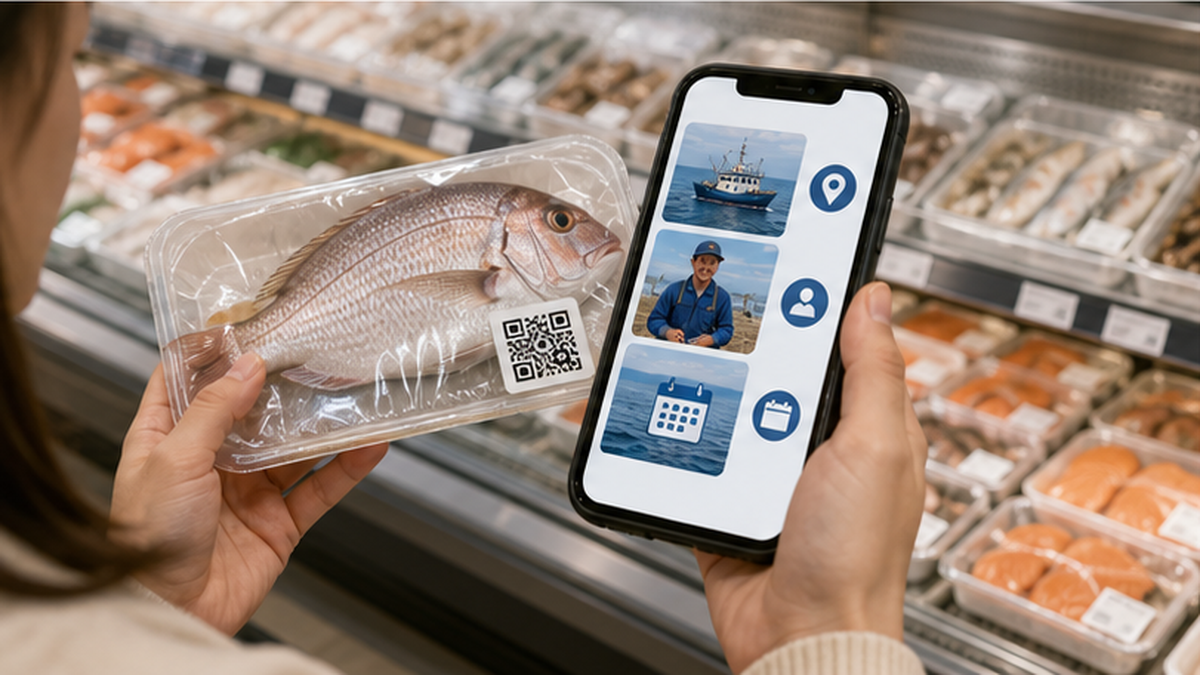
In 2020, a seafood business in Ishinomaki, Miyagi Prefecture, ran a pilot project using blockchain technology to build a traceability system proving the origin and freshness of sea squirt (hoya). The system lets consumers check supply-chain records — landing date, fisher information, and more — from a terminal in-store or on their smartphone. Blockchain's key trait is that its records are extremely difficult to tamper with, which makes it well suited to fighting origin fraud. Similar projects are underway both in Japan and abroad, such as "Ocean to Table," which aims to connect fishers to consumers via blockchain in order to reduce overfishing and opaque trading.
The Fisheries Agency's digitalization efforts
Japan's Fisheries Agency has published model case studies, under its "Fisheries Value Chain Building" initiative, of digitizing transaction records at local fish markets and export certification documents. Compared with the traditional approach of mailing or faxing paper certificates, digitalization is expected to enable both real-time record sharing and stronger tamper resistance. That said, some local markets and small businesses still lack the digital equipment and internet infrastructure to keep up, so nationwide digitalization is expected to take more time.
The cost and challenges of adopting technology
While the benefits of digitalization are significant, the cost of introducing and running new systems can be a burden for fishers and small-to-midsize distribution businesses. Government support for adoption and shared platforms built by industry associations are likely to shape how quickly these technologies spread. Blockchain in particular offers strong tamper resistance but requires specialized knowledge and cost to build and maintain, making it a high hurdle for local fishery cooperatives or small processors to adopt on their own. Efforts are underway in various regions to build shared infrastructure through partnerships among government, universities, and IT companies, lowering the barrier to participation.
Combining AI and satellite technology
Traceability isn't limited to passing along records — it's increasingly being combined with technology that monitors fishing grounds themselves. Using AI to analyze satellite imagery and data from AIS (automatic identification system) vessel-tracking devices to detect suspicious operating patterns — such as prolonged stops outside authorized fishing zones — is said to have produced measurable results in deterring IUU fishing. We cover satellite monitoring in more detail in What Is IUU Fishing? The Reality of Illegal Fishing Stealing 26 Million Tons of Fish a Year, Satellite Monitoring, and Regulation. Combining "monitoring at the fishing ground" with "traceability at the distribution stage" is expected to further narrow the gap through which illegal catches can enter the market.
One remaining challenge is that fishing-ground monitoring and distribution-stage records are often kept in separate databases — so even when illegal operations are detected, it can be impossible to trace which distribution route the resulting catch actually followed. If satellite monitoring data and catch-certification databases were linked in the future, automatically flagging the catches of suspect vessels, it could connect monitoring and distribution regulation into a single, unbroken chain.
Eco-Labeling Systems Worldwide and Adoption in Japan
Beyond the traceability record itself, seafood eco-labels let consumers judge at a glance whether a product was caught or farmed sustainably. The best known are MSC (for wild-caught seafood) and ASC (for farmed seafood); we cover both in detail in What Is the MSC Blue Fish Label? How to Spot Sustainable Seafood at the Supermarket and What Is ASC-Certified Aquaculture? A Neutral Guide to Choosing Salmon, Oysters, and Yellowtail.
The process of getting certified
Both MSC and ASC use a two-stage structure: a primary certification (fishery or aquaculture certification), in which the fishery or farm itself is assessed against criteria such as resource management, environmental impact, and traceability, and a secondary certification — Chain of Custody (CoC) certification — in which processors and distributors are assessed on keeping certified seafood separate from uncertified product. A product only earns the right to display an MSC or ASC label after passing through both stages. Assessments are conducted by third-party bodies and require periodic renewal, which underpins the credibility of the certification.
Because CoC certification itself requires creating lot-by-lot inbound and outbound records and physically separating certified from uncertified seafood at every stage of storage and processing, a product carrying the MSC or ASC label is, in effect, a working example of traceability in practice. The flip side is that the bar for certification includes not just a fishery's or farm's resource-management capability but also a business's record-keeping and management systems — one reason certification can be a hurdle for small and midsize operators.
Adoption status in Japan
| Certification | Status in Japan |
|---|---|
| MSC (wild-caught) | The number of businesses holding CoC certification (distribution/processing) passed 400 in October 2025 — the third-highest level worldwide, after China and the US |
| ASC (farmed) | As of 2023, 187 companies held CoC certification (up 10% year over year), with 576 domestically produced ASC-certified products (also up 10%) |
While certification numbers are steadily climbing, eco-labeled products are still less common on Japanese supermarket shelves than in Europe. Certification and its upkeep involve real costs, which tend to be passed on in price, and consumer awareness remains a work in progress. In recent years, more businesses handling tuna and skipjack have pursued certification, with major seafood companies eyeing export markets leading the way.
Trustworthy signals beyond certification marks
Beyond international certifications like MSC and ASC, more Japanese seafood companies are publishing their own sustainable-sourcing policies, disclosing which species they handle and where they source them. Examples include major seafood companies that continuously survey the sustainability of hundreds of species and set improvement targets with deadlines, and major retailers expanding MSC/ASC-certified products under their private-label brands. Even without a certification mark, a company that publishes its sourcing policy and supplier fishery information on its website offers consumers another useful signal.
What Consumers Can Do Starting Today
Beyond waiting for systems and technology to catch up, individual consumer choices are also a force that can shift the market. The more that certified, traceable products get chosen, the stronger the incentive for businesses to keep investing in these efforts.
- Check the package for certification marks such as MSC or ASC
- Get in the habit of checking origin and fishing-method labels (such as set-net or purse-seine) at the fresh fish counter
- Choose fishmongers and restaurants that actively disclose sourcing and fisher information
- For unusually cheap imported seafood, stay alert to whether it has gone through proper catch certification
- Choose fish that are in season and avoid over-concentrating on a few origins, to spread fishing pressure across different stocks
Efforts in restaurants and school meal programs
Beyond choices individuals make, sourcing policies at restaurant chains and school meal programs also shape the market as a whole. Airlines adopting MSC/ASC-certified seafood for in-flight meals, and major restaurant chains doing the same, are drawing attention as a way to expand sustainable sourcing even in settings where consumers rarely choose directly.
Don't forget underutilized fish and domestic products
When people think about choosing sustainable seafood, they tend to focus on certification marks on imported products, but actively eating "underutilized fish" — catch that's off-spec and rarely reaches the market — is also an effective way to reduce waste of the resource. Making full use of what's caught tends to favor domestic, local fish with shorter transport distances, which in turn simplifies the distribution route and makes traceability easier to secure. More municipalities and businesses are actively incorporating underutilized fish into school meal programs and as hometown-tax-donation gifts.
Buying direct from producers and local markets
Buying at direct-sale outlets attached to fishing ports, or through online shops run directly by fishers, is another effective option from a traceability standpoint. The fewer intermediary steps in distribution, the more directly information about origin, fishing method, and landing date flows from the fisher, structurally shrinking the risk of fraud. Stopping at a direct-sale outlet while traveling or visiting family, or using an online store run by a local fishing cooperative, are simple ways to choose seafood with a visible producer behind it.
In recent years, more municipalities have offered hometown-tax-donation gifts that name the fisher and landing port, and choosing these is another way to indirectly support seafood with a visible producer. It's worth knowing as an option that lets you support local fisheries while enjoying fish with secured traceability.
Three things to check before you shop
- Check for certification marks (MSC/ASC)
- Get in the habit of reading origin and fishing-method labels
- Ask store staff about sourcing if something catches your interest
Traceability Systems Abroad and Where Japan Stands
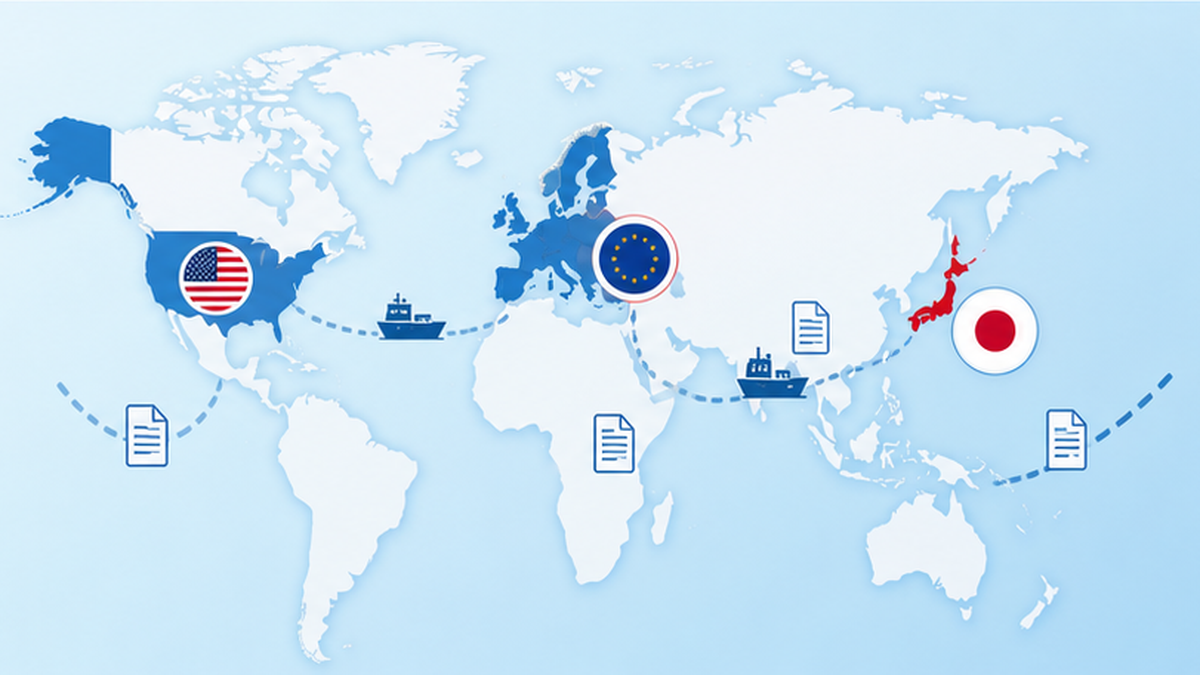
The design of seafood traceability systems varies by country and region — in scope and in strictness. To understand where Japan's Fisheries Distribution Act stands, let's compare the systems of major importing countries and regions.
Comparing the EU, US, and Japan
| Country/region | System | Scope characteristics |
|---|---|---|
| EU | IUU Regulation (since 2010) | Requires a catch certificate for nearly all imported seafood; seafood without a certificate is banned from import |
| United States | SIMP — Seafood Import Monitoring Program (since 2018) | Requires data entry and record retention for a set period for 13 species groups considered high-risk for IUU fishing |
| Japan | Fisheries Distribution Act (since 2022) | Started with species where domestic poaching had become a problem, such as abalone and sea cucumber, with coverage expanding in phases |
Where the EU and the US placed "all imported seafood, or a broad range of species" under regulation from the outset, Japan has taken a phased approach, starting with species carrying the highest risk of poaching or stock depletion. This difference reflects the fact that Japan, while a major seafood consumer heavily dependent on imports, has proceeded cautiously to gauge the impact a sudden system rollout would have on businesses at home and abroad.
International standards that affect Japan's exports too
Traceability systems don't just function as import controls — they also matter when Japan exports seafood. Businesses exporting to the EU or the US are required to submit catch certificates meeting the destination country's standards, which means building up domestic traceability is an unavoidable task for Japan's fishing industry as it seeks to grow exports.
Moves across Asia
Asian countries with strong seafood trade ties to Japan — South Korea, Thailand, Indonesia, and others — are also increasingly building out their own traceability systems in response to tightening EU and US regulations. Southeast Asia in particular is a major global seafood-exporting region, but it has also faced international criticism over opaque labor conditions and catch reporting in distant-water fishing, and system-building there has largely proceeded in response to demands from export markets. For Japan too, the state of trading partners' systems directly affects the transparency of the seafood entering the domestic market.
Thailand, for example, received a "yellow card" warning from the EU in 2015 over shortcomings in its IUU fishing countermeasures. That triggered a rapid push to strengthen vessel registration and labor-condition oversight, and the card was later lifted. Cases like this show that an importing country's system can push an exporting country to improve its fisheries governance — and it raises the question of what influence Japan's Fisheries Distribution Act might eventually have on the systems of its trading partners.
Remaining Challenges and the Road Ahead
The Fisheries Distribution Act still covers only a limited set of species — abalone, sea cucumber, and glass eel among them — and has yet to reach the full range of seafood distributed in Japan. Coverage will expand when the amended law takes effect in April 2026, but this remains a phased expansion compared with the broader scope adopted by other countries.
Key issues going forward
- Balancing further expansion of covered species with reducing the practical burden on small and midsize fishers and distributors
- Standardizing digital records (differing systems across businesses increase the burden of cross-checking)
- Expanding disclosure to consumers (broadening mechanisms, such as QR codes, that let ordinary consumers access catch information directly)
- Mutual recognition with international catch-certification systems (reducing duplicate import/export procedures)
The importance of international cooperation
Because IUU fishing crosses borders, no single country's system alone can fully address it. If major importing countries — the EU, the US, Japan, and others — align their catch-certification standards and make it possible to cross-check information with one another, the loopholes are expected to shrink. International organizations and environmental NGOs also play a role in verifying how effective each country's system is in practice and pushing for improvement.
Being mindful of small-scale fishers
In debates over strengthening the system, striking a balance between rigor — preventing poaching and mislabeling — and reducing the burden on legitimately operating small-scale fishers is also an important issue. Requiring the same level of digital record-keeping from small coastal fishers as from large corporations risks accelerating business closures and the shortage of successors. Government support for record-keeping, and the provision of simplified recording systems that multiple fishers can share, are being discussed as ways to scale system operation to fit the size of the business.
Japan's fishing workforce continues to age and shrink, and the capacity to adapt to new systems varies by region and generation. Making traceability truly effective requires not just deterrence through penalties but also building mechanisms that let fishers on the ground participate without undue strain. Going forward, tools such as easy-to-use smartphone apps and systems where fishing cooperatives handle record-keeping on fishers' behalf are expected to spread further, reducing the burden at the front line.
Traceability isn't something you build once and forget — it works only when businesses, government, and consumers keep checking and using the information. Only when the three gears of regulation, technology, and consumer awareness mesh together does the room for illegal catches and fraudulent labeling to slip through start to shrink. The next time you choose a fish, pausing to look at the label on the package is a small step that helps support a sustainable fishing industry.
References and Sources
- Fisheries Agency of Japan, "Act on Ensuring the Proper Domestic Distribution of Specified Aquatic Animals and Plants" – Overview of the system, covered species, and penalties
- House of Representatives, "Act Amending the Fisheries Act and the Act on Ensuring the Proper Domestic Distribution of Specified Aquatic Animals and Plants" – Text of the amended law, effective April 2026
- WWF Japan, "About IUU Fishing" – Definition of IUU fishing and its international dimensions
- Fisheries Agency of Japan, "On the EU's IUU Fishing Regulation" – The EU's catch-certification system and its impact on Japan
- Consumer Affairs Agency, "On Monitoring Country-of-Origin Labeling" – Materials on the origin-labeling monitoring system
- Fisheries Agency of Japan, "Building the Fisheries Value Chain — Best-Practice Case Studies" – Domestic case studies in digitalization and traceability
- MSC Japan press release, "Number of Businesses Holding MSC CoC Certification in Japan Surpasses 400" – Adoption status of MSC certification in Japan
- Marine Stewardship Council, "IUU and Destructive Fishing" – The international context of IUU fishing
*Sources are ordered by reliability: government/academic institutions > peer-reviewed research > specialist organizations > trusted media