⚡ The answer in 30 seconds
- Technologies that use seaweed polysaccharides to wrap liquids in edible films or to line paper containers are beginning to reach practical use
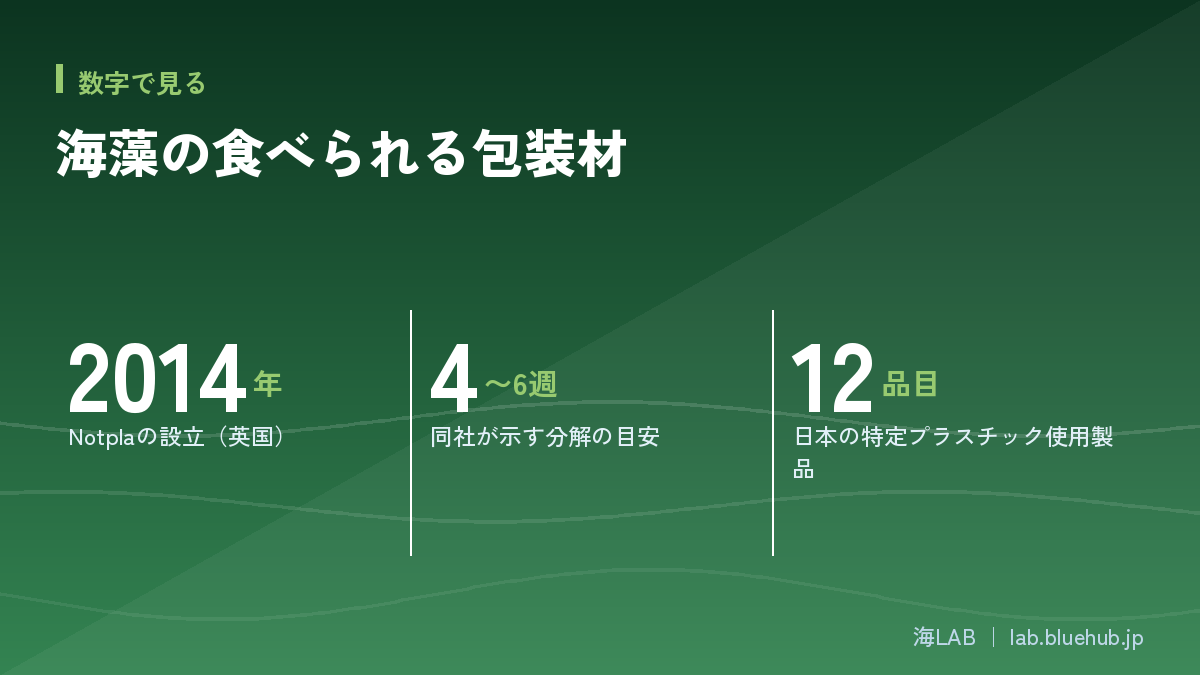
- UK-based Notpla has commercialized seaweed-coated containers, while in Japan the work remains mostly basic research
- Challenges include water resistance, cost, hygiene, raw material supply and decomposition conditions; reduce first, then choose materials
Packaging that you can eat after use, or that returns to nature within weeks. Packaging made from seaweed is drawing worldwide attention as a new answer to the plastic problem.
However, it is not that simple to say "seaweed means eco-friendly." Understanding how the material works, real examples and challenges changes how you read the news.
This article walks through seaweed packaging, from its mechanism and global examples to its potential in Japan.
What you will learn
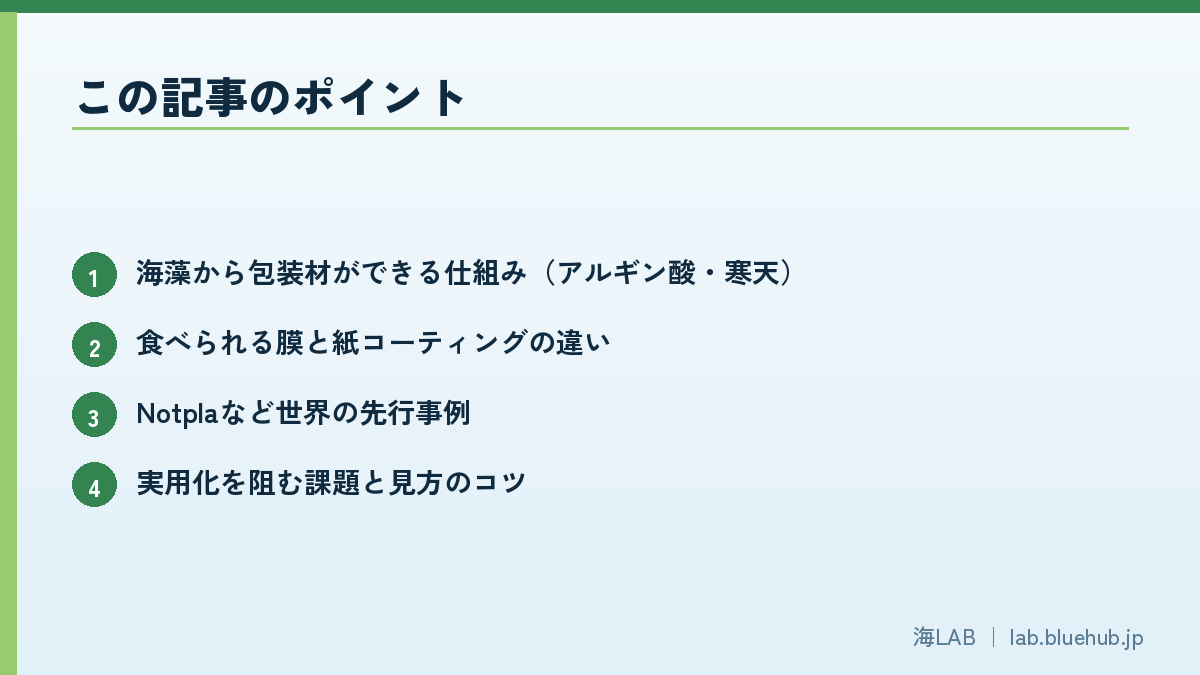
- How packaging is made from seaweed (alginate and agar)
- The difference between edible films and paper coatings
- Leading global examples such as Notpla
- Challenges to practical use and how to read the claims
- Research trends and policy in Japan
- How we can choose wisely
Why seaweed packaging is drawing attention: where the plastic problem stands
Three problems with single-use packaging
Packaging for food and drinks is essential for protecting and transporting contents. Yet once used, it becomes waste within minutes to hours, and much of it is made from petroleum-based plastic. According to reports by the United Nations Environment Programme (UNEP) and others, global plastic production is on the order of 400 million tonnes per year, and less than 10% is recycled. The rest is incinerated, landfilled or leaks into the environment.
Plastic that flows into the sea is broken into small pieces by ultraviolet light and waves, becoming microplastics that enter the food chain. This issue is also covered in detail in our articles "How Does Ocean Plastic Degrade?" and "Microplastics and Human Health." Looking at countermeasures from the packaging side, the problems fall into three groups.
- Resources: relies on petroleum and emits CO2 during manufacturing
- Disposal: used briefly, yet takes decades to hundreds of years to break down in nature
- Leakage: what is not collected is carried by rivers to the sea
"Plant-based" and "biodegradable" are not the same
When considering alternative materials, terms must be sorted out first. Bioplastics made from biomass are made from biological resources such as plants, but do not necessarily decompose naturally. Biodegradable plastics are broken down by microorganisms into water, carbon dioxide and other substances, and some are made from petroleum. The conditions needed for decomposition (temperature, humidity, number of microorganisms) differ by material, so be careful: "decomposes even in the sea" is not guaranteed.
Glossary
- Biomass plastic: made from plants, etc. Decomposability depends on the material
- Biodegradable plastic: broken down by microorganisms. Check the decomposition conditions
- Compostable: said to decompose in composting facilities or home compost
- Edible packaging: packaging made only from food-safe materials
Why seaweed?
This is why materials made from seaweed are drawing attention. Seaweed needs neither farmland nor fresh water, and grows on nutrients in seawater without fertilizer. It also grows fast and can be harvested stably through aquaculture. The viscous polysaccharides in seaweed (alginate, agar, carrageenan and others) have long been used as thickeners and gelling agents in food, giving a foundation for making film-like or gel-like membranes.
The relationship between seaweed farming and carbon dioxide is introduced in "Seaweed Farming and Carbon in Japan." This article focuses on the idea of using that seaweed as packaging, looking in turn at mechanism, examples, challenges and potential in Japan.
How seaweed becomes packaging: alginate, agar and carrageenan
Seaweed's sliminess becomes a material
The characteristic sliminess that appears when you boil kelp or wakame comes from polysaccharides contained in the cell walls and between cells. These polysaccharides hold water to form a gel (a jelly-like mass) and become a thin film when dried. The main components differ by type of seaweed, and so do the uses.
| Type of seaweed | Main polysaccharide | Main uses and features |
|---|---|---|
| Brown algae (kelp, wakame, mozuku, etc.) | Alginate | Gels when it reacts with calcium. Artificial salmon roe, food thickeners, gel membranes |
| Red algae (tengusa, ogonori, etc.) | Agar | Forms clear, strong gels. Food, culture media, film research |
| Red algae (kirinsai types, etc.) | Carrageenan | Stabilizer for jellies and dairy. Film research is also advancing |
Wrapping liquid in a gel film: spherification
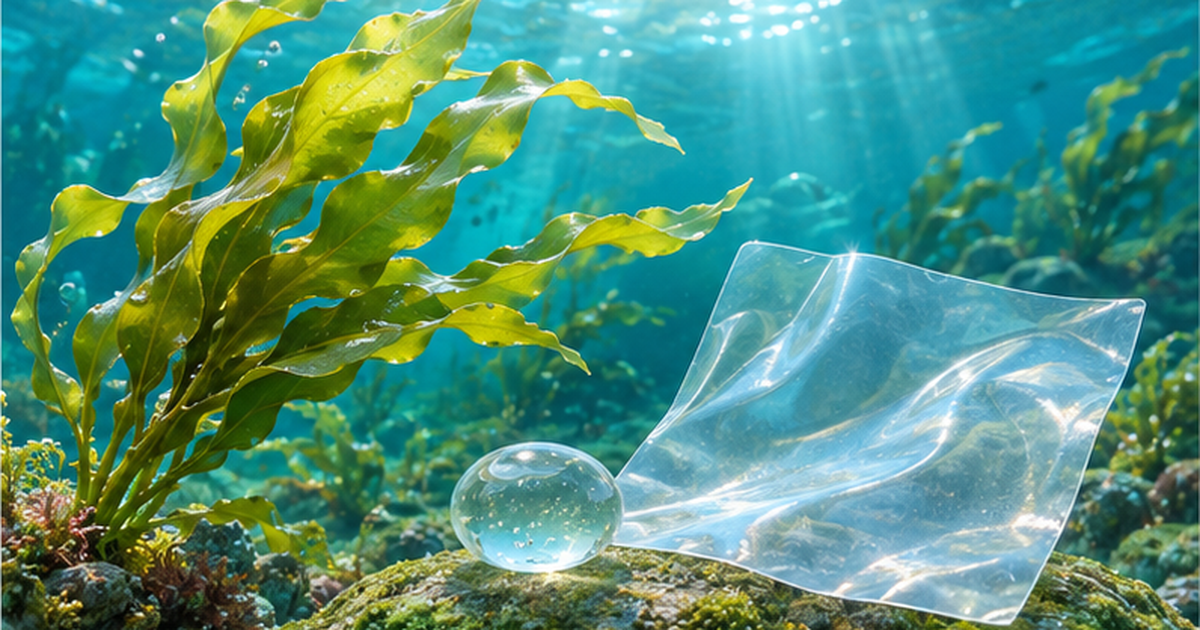
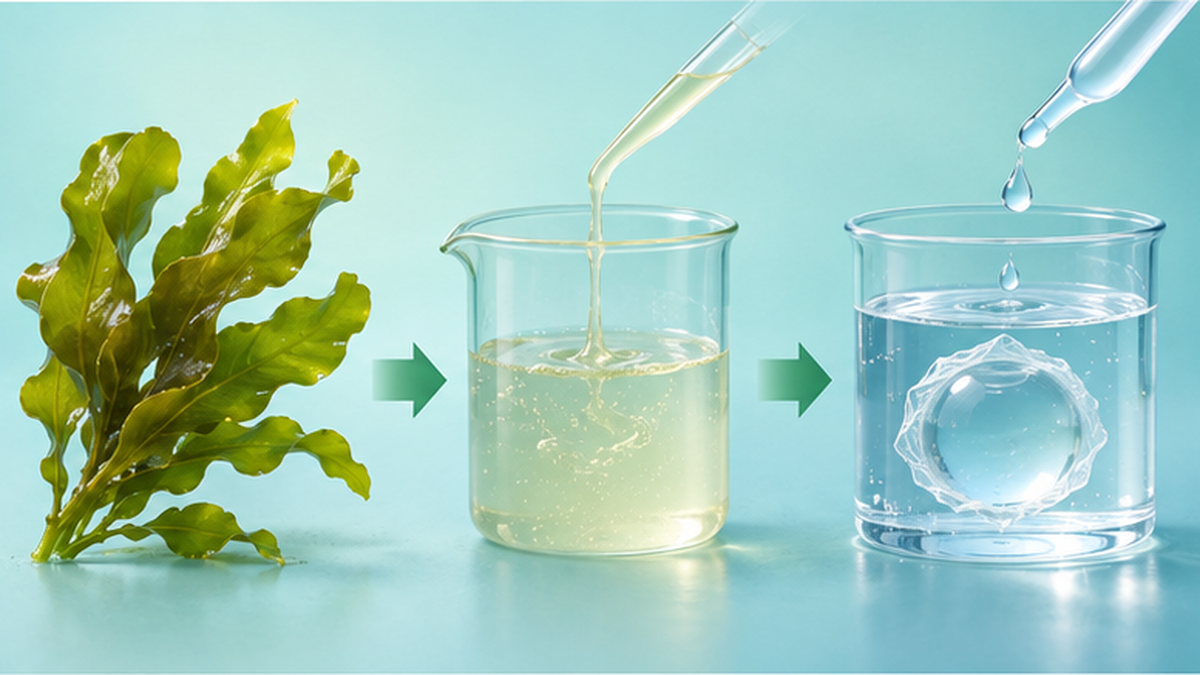
When a sodium alginate solution is dropped into a solution containing calcium, a thin gel film forms only on the surface. This "spherification" is known in cooking for artificial salmon roe and similar dishes. Because the liquid inside can be wrapped completely in a film, it led to the idea of "wrapping a drink without a container."
Another use: coating paper
Besides edible films, seaweed-derived materials can also be applied to the surface of paper or cardboard. Takeaway paper containers have generally been lined with plastic film or treated with fluorine-based chemicals to prevent oil and water from seeping through. This lining is considered a factor that makes paper container recycling difficult. Seaweed-derived coatings aim to take over that role.
Point
- Seaweed packaging has two types: making the film itself to be eaten, dissolved or composted, and using it as a protective coating on paper.
Leading global examples: Notpla, Evoware and research institutions
UK's Notpla: "Ooho" drink spheres and paper container coatings
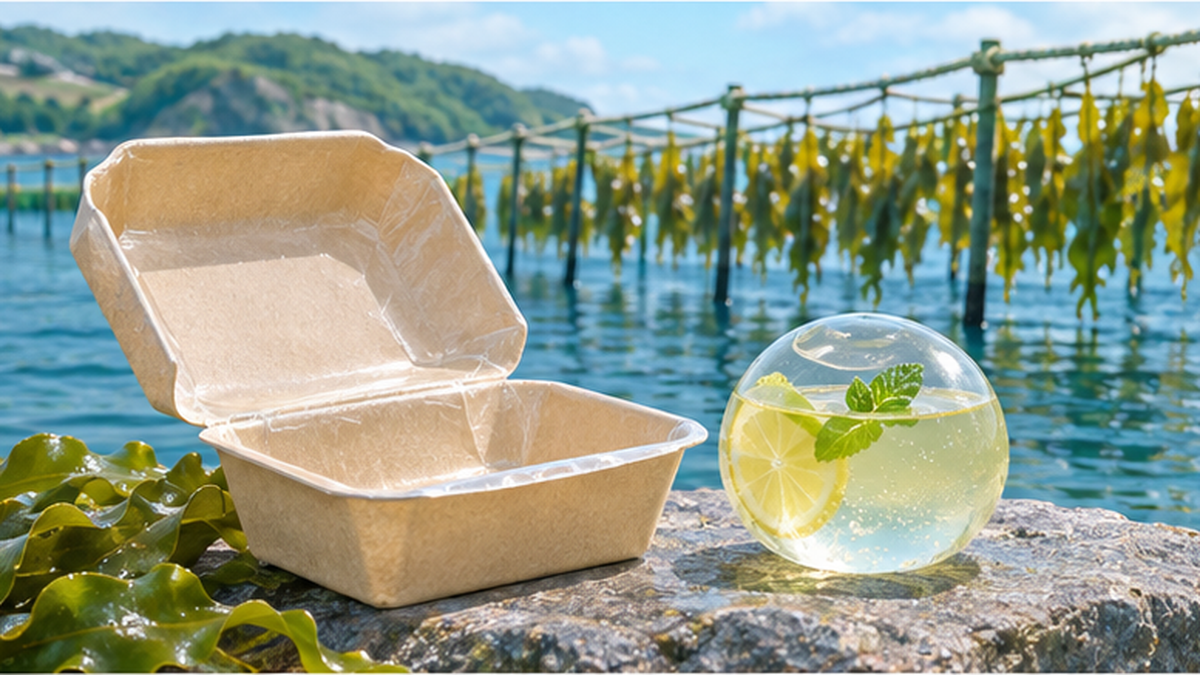
The best-known example is the London-based startup Notpla. According to reports, the company was founded in 2014 by Rodrigo Garcia Gonzalez and Pierre Paslier, who were university students at the time. Its first product was "Ooho," an edible gel sphere that wraps drinks such as water, juice and sports drinks. At the 2019 London Marathon, Ooho filled with electrolyte drink was reportedly used to hydrate runners.
The company's business expanded from Ooho to seaweed-based coatings for paper containers. With the UK food delivery company Just Eat Takeaway.com, after trials of around 30,000 boxes, takeaway containers were reportedly rolled out commercially to several hundred UK restaurants. Reports say the company produced more than one million containers in 2022. These figures come from company and trade media announcements, not independent verification.
Notpla's claims and how to evaluate them
- The company says its containers can be composted at home and break down within weeks (reported as 4–6 weeks). However, decomposition conditions vary with temperature and environment, so whether buyers can actually reproduce them is another matter. It is important to separate a company's own claims from third-party evaluation.
The 2022 Earthshot Prize
In 2022, Notpla was reportedly chosen as one of the winners of the Earthshot Prize, the environmental award founded by Prince William and others, receiving £1 million. It was recognized under the theme of building a waste-free world, and became one of the triggers that brought seaweed-based packaging into mainstream environmental conversation.
Indonesia's Evoware: edible pouches
Evoware of Indonesia has also been featured in trade media as a company making food packaging from seaweed. Uses introduced include seasoning sachets for instant noodles and burger wrappers that can be eaten along with the contents. Southeast Asia is a major seaweed-farming region, and being able to source raw materials locally is considered a strength.
Film development at research institutions
Research is progressing not only at companies but also at universities and institutes. In the UK, research on making clear, flexible films from alginate has been introduced, and a US university is studying water-resistant films that combine agar with chitosan (derived from crab and shrimp shells). Researchers in India have also reported making biodegradable film from red algae. In every case, bridging the gap from laboratory to mass production remains the challenge.
Benefits of seaweed packaging: environmental and social aspects
Environmental benefits
The expectations for seaweed packaging can be summarized in three points. First, the raw material grows easily. Seaweed grows by photosynthesis and its farming needs no fresh water, fertilizer or farmland. Second, easy handling after use. If it is designed to be edible or compostable, the burden of sorting and washing for recycling is smaller. Third, if plastic linings of paper containers can be eliminated, paper may become easier to recycle.
Seaweed farming is also expected to bring side effects such as absorbing nutrients along the coast and providing hiding places for young fish. See "Seaweed Aquaculture and the Recovery of Seaweed Beds" for the functions of seaweed beds.
Social benefits
- It may become a new market for fishers and farmers beyond food use
- In aging coastal areas, seaweed processing and materials industries may create jobs
- The experience of "edible" packaging may raise consumer interest in the plastic problem
Do not take the environmental benefits at face value
- "Made from seaweed" does not always mean environmentally friendly. Energy is used at every stage of farming, drying, transport and processing, so it can only be evaluated by comparing whole-life-cycle CO2 emissions with conventional materials. Published comparison data are still limited.
Obstacles to practical use: cost, water resistance, hygiene and raw materials
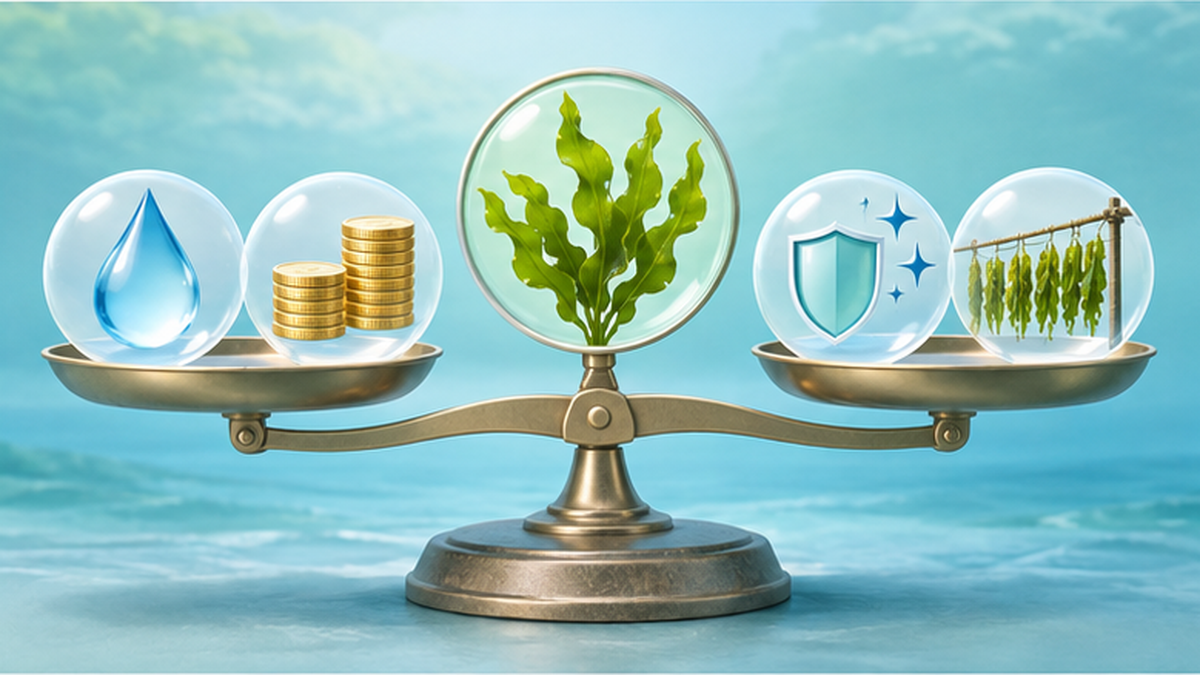
The barrier of water resistance and storage
Seaweed-derived polysaccharides have a strong affinity for water. This is the flip side of being "water-soluble and edible," and is a weakness for moist foods and long-term storage. Films may become sticky in humid places or crack when dry. In research, attempts are advancing to combine agar with chitosan and natural pigments to improve antibacterial properties and strength.
Cost and production scale
Petroleum-based plastic is produced extremely cheaply in large facilities. Seaweed materials are produced on a small scale, so unit costs tend to be high. Notpla's move into paper container coatings likely also aims to reach mass production in a form that fits existing paper container production lines.
| Challenge | Details | Main directions for response |
|---|---|---|
| Water resistance | Film weakens with moisture | Combination with other natural materials, surface treatment |
| Cost | Small production scale, high unit price | Integration into existing lines, mass-production facilities |
| Hygiene and safety | Edible packaging must meet food standards | Material selection and control in line with the Food Sanitation Act |
| Raw material supply | Needs stable farming volume and quality | Expanding farming, using unused seaweed |
| Decomposition conditions | Decomposition speed varies with environment | Labeling rules and third-party certification |
Cautions about being "edible"
Edible packaging is treated as food, so hygiene control is important. Packaging unusual to ordinary packaging requires care, such as the concern that dirty packaging may be eaten as is during storage, allergen labeling, and management of heavy metals (some seaweeds readily accumulate iodine and arsenic). A realistic approach is to design it as "edible but not required to be eaten," with natural decomposition also assumed.
Securing seaweed as a raw material
If demand grows, securing raw materials becomes a problem. Uncontrolled harvesting burdens seaweed beds, so planned supply through aquaculture is a prerequisite. In Japan, while demand for food use is falling, some regions see seaweed beds decline due to rising water temperatures and grazing. Research is also under way in fisheries on using unused seaweed and seaweed washed ashore as materials.
Potential in Japan: research, policy and everyday use
Research trends in Japan
Research on seaweed-based materials is also advancing in Japan. A research team at Nagasaki University announced that in September 2025 it published in an international journal a study on food packaging film combining red-algae-derived agar with chitosan and the natural pigment curcumin. Using a low-energy, low-impact method to extract agar is also noted as a feature.
The Japan Fisheries Research and Education Agency also has research on turning fish-processing waste and washed-up large algae into materials as unused resources, including methods that treat kelp and sea lettuce with enzymes and ferment them. However, these are at the stage of basic research and material development, not mass production of packaging film. Within the scope of this survey, no mass-produced seaweed packaging from Japanese companies could be confirmed.
Relation to Japanese policy
In April 2022, Japan's Plastic Resource Circulation Act came into force, requiring providers to rationalize (reduce) the use of 12 "specified plastic products" such as straws, spoons and forks. Switching to paper, wood and biomass materials as alternatives is progressing, and seaweed materials could become one of the candidates.
Tips for everyday use
- What you can do now: use your own bottle or container, and choose products with less packaging.
- When choosing new materials: check whether they state "what percentage is seaweed-derived" and "under what conditions they decompose."
Connection to marine litter measures
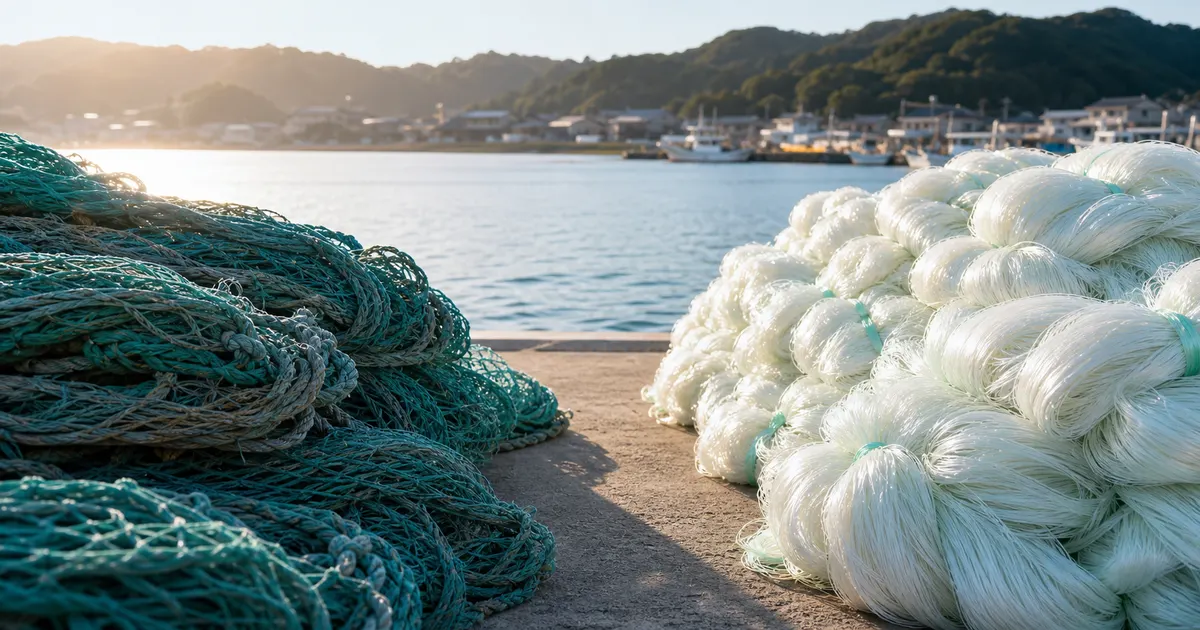
Even if seaweed materials spread, litter that has already flowed into the sea will not disappear at once. Collection and recycling of marine litter such as fishing nets are still needed (see "Recycling Fishing Nets"). The basic order of thinking is reduce at the source, reuse repeatedly, and then replace the material.
Summary: seaweed packaging and our choices
Key points of this article
Seaweed-based packaging uses polysaccharides such as alginate and agar, and has begun to reach practical use as gel films that wrap liquids and as substitutes for paper container linings. UK-based Notpla has commercialized containers with seaweed coating and was reported to have won the Earthshot Prize in 2022. Challenges remain, however, including water resistance, cost, hygiene control, raw material supply and labeling of decomposition conditions. In Japan, basic research is advancing at universities and research institutes, and no mass-production cases by companies could be confirmed in this survey.
A question for readers
New materials are not a "magic solution." They work best when combined with questioning whether packaging is needed, using things repeatedly, and choosing materials. When you see "eco-friendly packaging" in the news, make a habit of checking three points: the raw material, the decomposition conditions and the burden over the whole life cycle. That leads to better choices.
Summary
- Seaweed packaging has two types: "edible film" and "paper coating"
- Challenges: cost, water resistance, hygiene, raw materials and decomposition conditions
- Japan is at the basic research stage; policy supports alternative materials
- Reduce first before using; replacing the material comes next
References and sources
- Notpla (official) – UK company developing seaweed-based packaging
- The Earthshot Prize – Introduction of 2022 winners
- UNEP Plastic pollution – Overview of the plastic problem by the UN Environment Programme
- Ministry of the Environment, Japan: Plastic resource circulation – Plastic Resource Circulation Act and more
- Fisheries Agency, Japan – Information on seaweed farming and seaweed beds
- Nagasaki University News & Research – Agar-based food packaging film research
- Packaging Dive – Trends in edible packaging such as Notpla and Evoware
- Ingenia: Edible packaging – Explanation of edible packaging
- Green Queen: Just Eat × Notpla – Trials of seaweed-coated containers
* Listed in order of reliability: government agencies > academic institutions > peer-reviewed papers > specialist organizations > reliable media