⚡ The answer in 30 seconds
- Autumn sightings of Asiatic black bears depend heavily on the mast (nut crop) of beech and oak; in poor years bears roam wider and come into human areas more often.
- FY2023 recorded a record 23,669 sightings and 197 injury cases (218 people). In FY2025, a poor nut crop in Tohoku and other factors led to a record 12 deaths.
- Behind this are a range expansion (about 1.4 times) and changes in satoyama; measures combine forecasting, attractant management, zoning and culling.
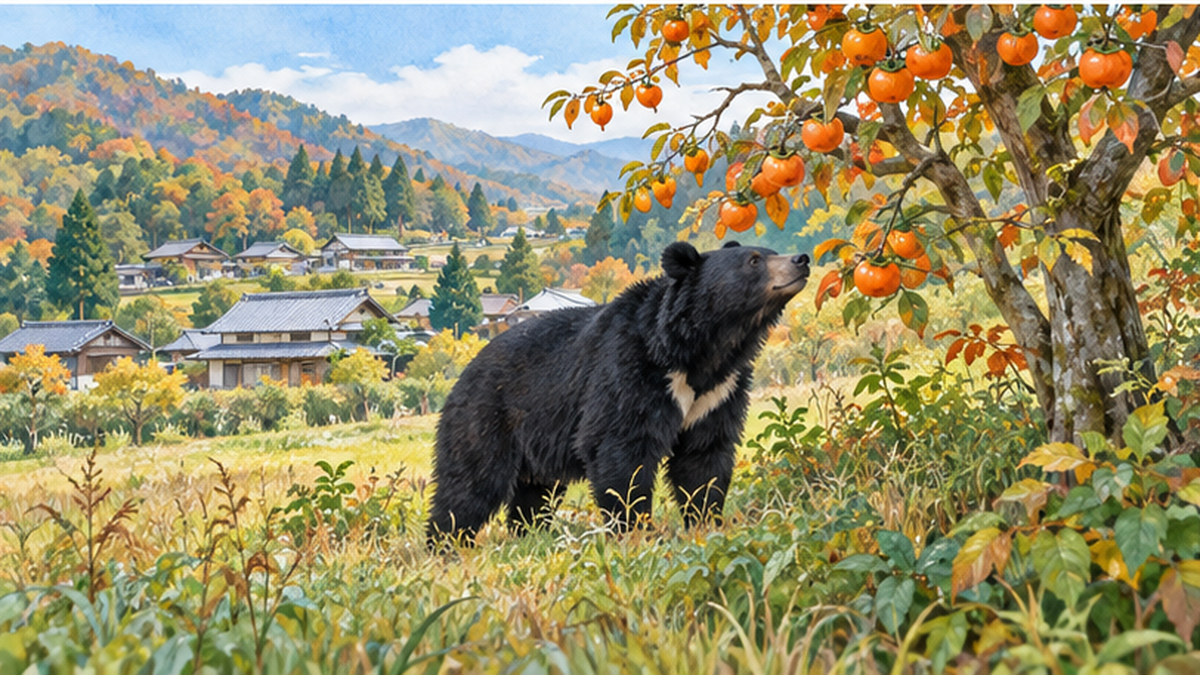
Sightings of Asiatic black bears change greatly depending on how well beech and Mizunara oak trees fruit in autumn. In poor-crop years, bears preparing for hibernation come down to human settlements in search of food.
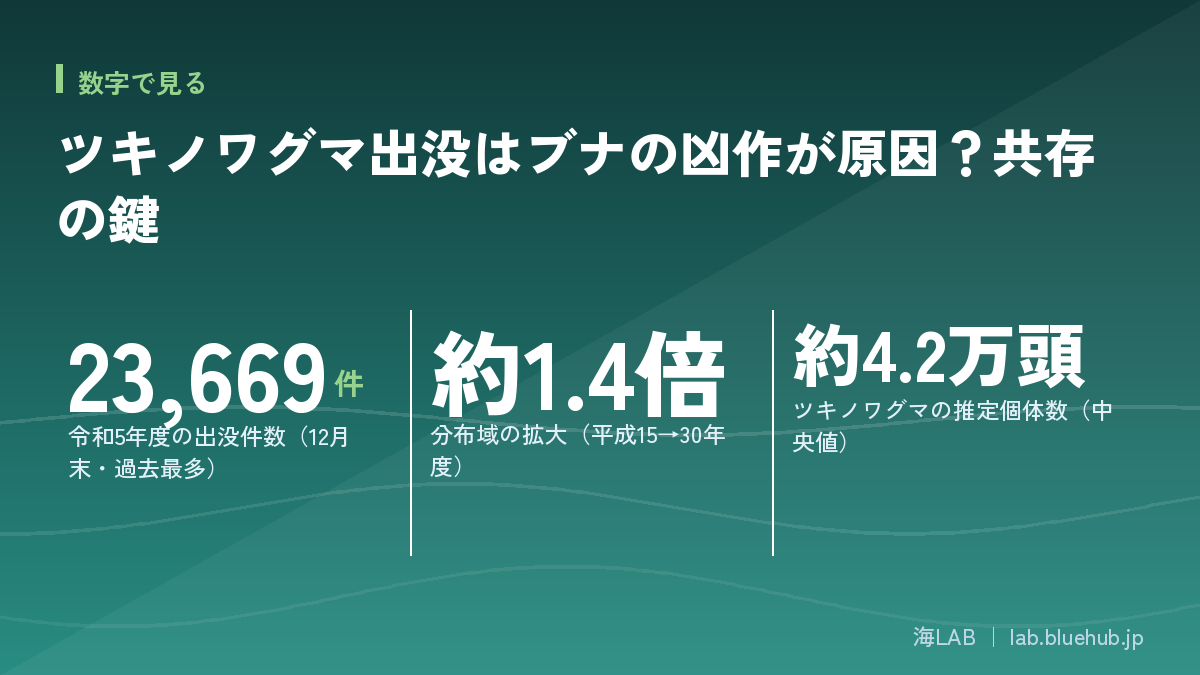
According to the Ministry of the Environment, FY2023 recorded 23,669 sightings and 197 injury cases (218 people), both record highs. In FY2025 as well, a poor nut crop in Tohoku and other factors pushed the number of deaths to a record high.
This article uses primary sources such as the Ministry of the Environment to explain the mast cycle and forecasting surveys, the structural background of changing satoyama, and the front line of management for coexistence.
What you will learn
- Bear diet and why nuts matter in autumn
- How beech and oak mast cycles work (a great crop is followed by a great failure)
- How nut crops are surveyed to forecast sightings
- Sighting and injury figures for FY2023 and FY2025
- Coexistence measures such as zoning and attractant management
What Is the Asiatic Black Bear? The Largest Mammal of Japan's Forests
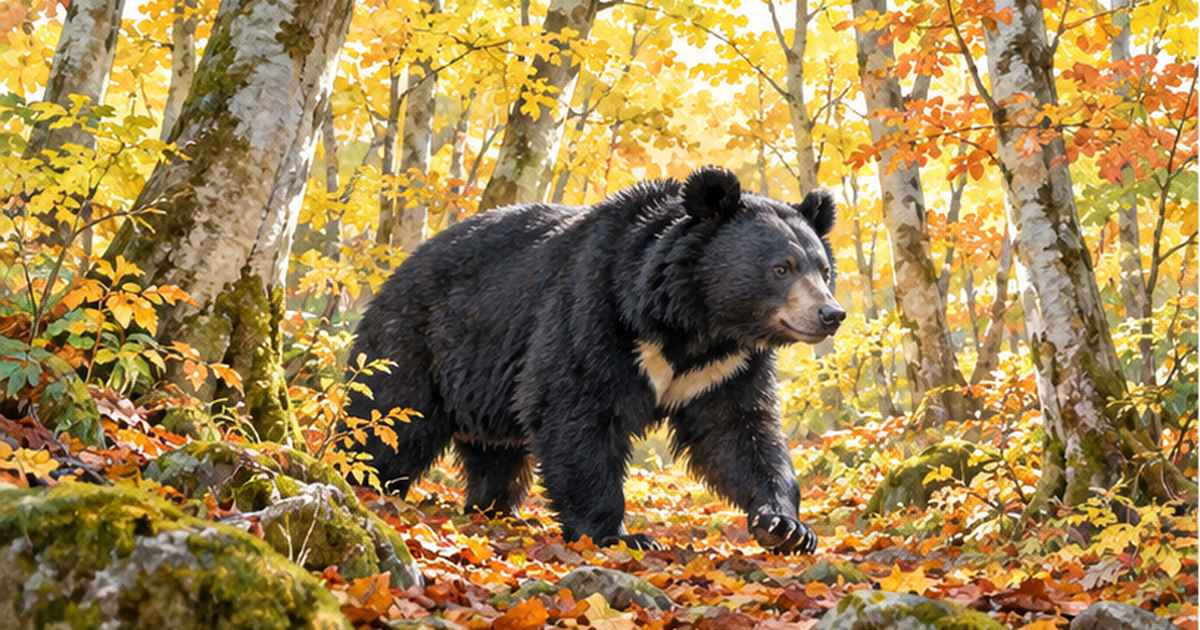
The white crescent on the chest, in Honshu and Shikoku
The Asiatic black bear is a subspecies found only in Honshu and Shikoku, named for the white crescent-shaped mark on its chest. According to the Ministry of the Environment, it is permanently distributed in 33 prefectures. It was judged extinct in Kyushu in 2012, and the Shikoku population is at high risk of extinction. Adult males weigh roughly 80–150 kg and females about 40–100 kg, making it one of Japan's largest land mammals.
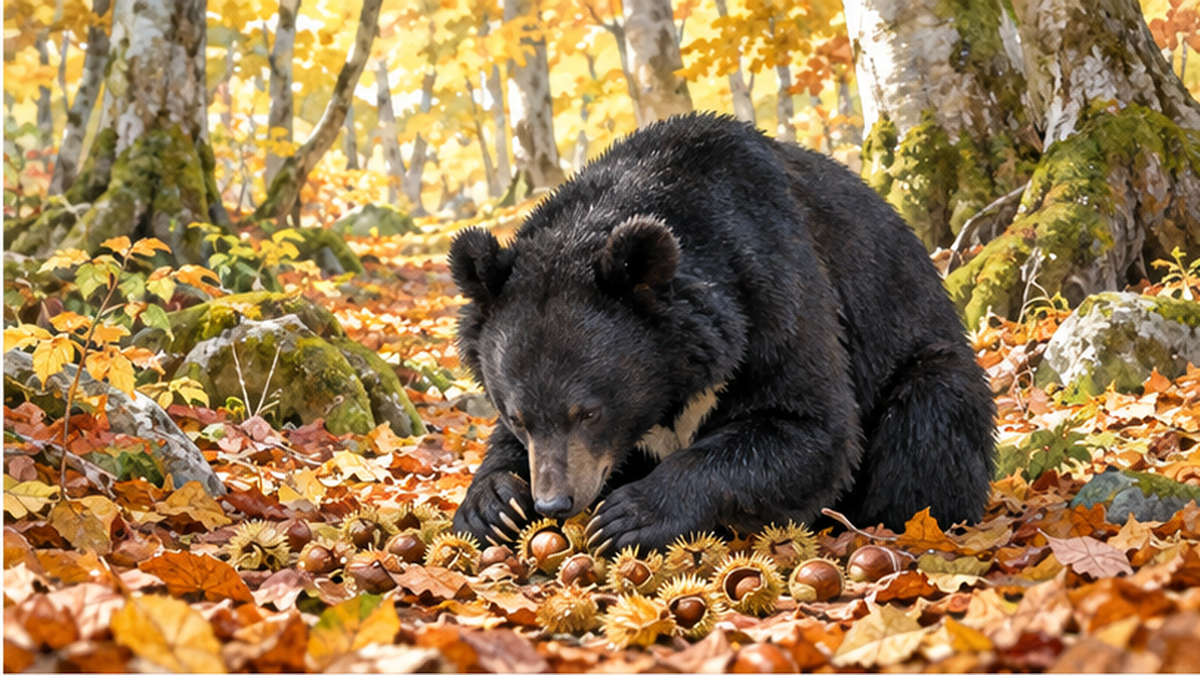
Although it looks like a carnivore, most of its food is plant matter. It eats new shoots and grasses in spring, ants and bee nests in summer, and in autumn large amounts of acorns and other beech-family nuts, chestnuts and wild grapes to build fat for hibernation. The success or failure of this "autumn staple" is the main subject of this article.
Why beech and Mizunara oak get attention
Nuts of the beech family are nutritious and can ripen in huge quantities, making them the most important pre-hibernation food for bears. The Ministry of the Environment's policy ("Measures to Prevent Damage by Bears," February 2024) states that autumn sightings are strongly influenced by the amount of key autumn foods, starting with beech-family nuts.
Key points
- The Asiatic black bear is a Japan-endemic subspecies living in 33 prefectures of Honshu and Shikoku
- Mostly plant-eating; beech-family nuts are the main autumn food before hibernation
- The Ministry also says autumn sightings are strongly affected by nut availability
Beech and Oak "Mast Cycles": Why the Crop Differs Every Year
How good and poor years alternate
Beech and Mizunara oak do not produce the same amount of nuts every year. Some years bring a heavy crop (good year) and some bring almost none (poor year); this is called "masting." A great beech crop occurs only once every few years, and Miyagi Prefecture materials note a tendency that a great crop is followed by a great failure the next year.
Why does such a cycle arise? Researchers often cite the "resource budget" idea: a tree that produces a huge crop uses up its stored nutrients and needs time to recover the next year. Another idea is that when trees in an area fruit or fail in unison, seed-eating animals cannot eat everything — the "predator satiation hypothesis": animal numbers fall in lean years, and in bumper years more nuts than they can eat remain.
Note: why does synchronization occur?
- Weather conditions such as temperature are similar over wide areas
- Pollination success tends to be similar within a region
- The mechanism is still being studied and varies by region, so it is presented here as a hypothesis
Mast cycles are an "unexpected swing" for people
Autumn is when bears save up for the year. In good years they can eat enough in the mountains and need not come down to settlements. In poor years there is little food, so they widen their range and descend to lowland villages, farmland and places with persimmon or chestnut trees. Ministry materials explain that in years of sharply reduced food, not only males but also resident females expand their autumn home ranges.
| Nut crop | Bear behavior | Impact on settlements |
|---|---|---|
| Good | Feeds sufficiently in the mountains; small home range | Fewer sightings |
| Average | Feeds mainly in the mountains | Normal |
| Poor | Home range expands in search of food, to lowlands and villages | Sightings and injuries tend to rise |
Please note
- Mast varies with weather and the previous year's crop, so perfect prediction is difficult
- A poor crop does not always mean mass sightings; other foods (chestnuts, berries), population size and distance from human areas also matter
Forecasting Sightings: Counting Beech Nuts
Counting nuts on branches with binoculars
To prepare for poor years, prefectures and forest offices survey nut amounts to forecast sightings. In Miyagi Prefecture, sample trees (3–4 each) are set at 17 beech sites and 8 Mizunara oak sites. Observers count nuts with binoculars from 3 directions, 6 times, within a fixed time (15 seconds for beech, 30 seconds for Mizunara), compute the density of fallen nuts per square meter, and rate the crop on three levels: poor, average or good.
By comparing these painstaking surveys with past capture numbers, officials build rules of thumb such as "with this nut level, expect this level of sightings."
In 2023, a "great failure in all prefectures" was forecast in Tohoku
In July 2023, the Tohoku Regional Forest Office announced beech fruiting forecasts for five Tohoku prefectures excluding Fukushima. Surveys at 139 sites in total in May–June found a "great failure" in every prefecture, reported as the first since flowering surveys began in 2004. Beech nuts are a key pre-hibernation food, so increased sightings in settlements were feared.
Indeed, sightings surged that autumn, mainly in Tohoku. Let us look at the numbers in the next section.
Key points
- Forecasts are built from the link between "nut counts on sample trees" and "past capture numbers"
- In 2023, the first-ever "great failure" forecast in all five Tohoku prefectures (excluding Fukushima)
Mass Sightings in Numbers: FY2023 and FY2025
FY2023: far above the previous record
According to the Ministry of the Environment, FY2023 saw 23,669 Asiatic black bear sightings (as of end of December) and 197 injury cases (218 people) (as of end of January), both far above previous records. Damage was concentrated in Tohoku, with Akita and Iwate accounting for over half of Honshu's total. From September on, many injuries occurred in human living areas such as towns, near houses and farmland. Permit-based captures of brown and black bears combined reached a record 8,733 nationwide (as of end of December).
FY2025: again due to a poor nut crop in Tohoku
According to a government document dated October 30, 2025, in FY2025 bears appeared in urban areas in autumn due to poor nut crops in Tohoku and other factors; deaths reached a record 12 (as of October 29), and injuries were at the same level as FY2023, the previous record.
| Fiscal year | Sightings (Apr–Aug) | Injured people (Apr–Sep) | Deaths (Apr–Oct) |
|---|---|---|---|
| FY2023 | 10,705 | 109 | 6 |
| FY2024 | 13,774 | 67 | 3 |
| FY2025 | 16,213 | 108 | 12 |
The prefectures with the most sightings in April–August FY2025 were Iwate (3,453), Akita (3,089), Aomori (1,386), Yamagata (972) and Niigata (815).
How to read the numbers
- Injured people means the total of injured and dead
- Hokkaido does not publish sightings, so sightings are totals excluding Hokkaido
- Interim figures during a fiscal year may be revised later
Beyond Mast Cycles: Structural Reasons Bears Approach Villages
Range expansion and population growth
According to the Ministry, the range of the Asiatic black bear expanded by about 1.4 times nationwide between FY2003 and FY2018. The population is also increasing; a government document (October 2025) estimates over about 42,000 black bears (sum of prefectural estimates, medians), and about 12,000 brown bears.
Changing satoyama: fewer people, closer bears
The Ministry's policy cites the following changes in the background.
- Fewer people work in forests (forestry, hunting, satoyama use), so bears are chased less and grow less wary of humans
- Depopulation and aging reduce human activity in hilly and mountainous areas and satoyama use shrinks
- Abandoned farmland expands and unharvested fruit trees (persimmon, chestnut) increase
- Riverside forests, terrace forests, windbreaks and urban parks form green corridors from forest to town that bears use
In other words, a poor crop is the "trigger," while human living areas becoming easier for bears to enter is the "foundation." The Ministry also notes sightings at low elevations and even on coasts, and individuals appearing in villages even without attractants such as unharvested fruit or garbage. For the makeup of satoyama, see also our article on satoyama landscapes.
Link to the sea: forest bounty reaches the ocean through rivers
Bears are also agents of the forest's material cycle. Their role in dispersing seeds by eating nuts is introduced in our article on seed dispersal by animals. Forest health connects to coastal seas through rivers, so changes among forest animals matter to Umi LAB too. For changes in understory vegetation and soil loss due to increasing deer, see our article on deer overpopulation and soil loss.
Avoiding Encounters: Zoning and Attractant Management
The national "separation" concept
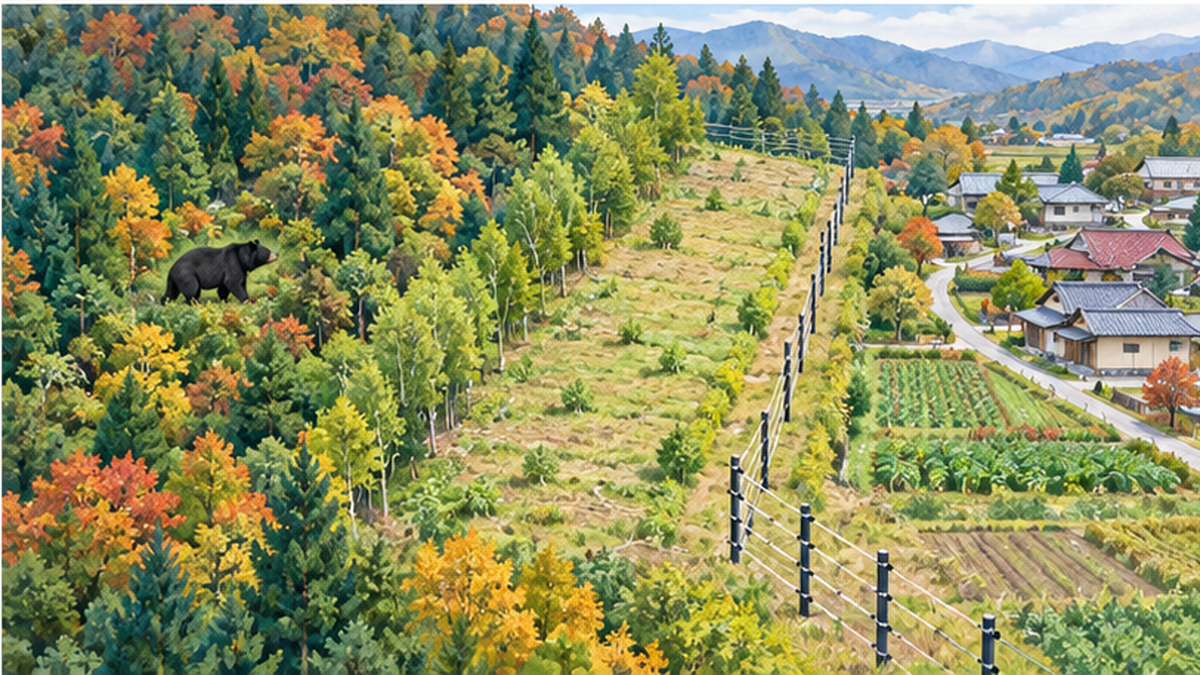
The Ministry's "Measures to Prevent Damage by Bears" (February 2024) centers on zoning management, which spatially separates human living areas from bear habitat.
| Zone | Basic policy | Main measures |
|---|---|---|
| Human living areas (towns, farmland) | Do not let bears live there; human safety first | Remove and manage attractants, clear brush, promptly remove intruding bears |
| Buffer zone | Prevent intrusion into human living areas | Habitat management such as felling and brush clearing, capture, forestry damage control |
| Priority conservation area (deep mountains) | Maintain regional populations stably and conserve habitat | Awareness raising to avoid surprise encounters at tourist sites |
Attractant management we can do
- Pick or cut down persimmon and chestnut trees you do not harvest
- Do not leave garbage, compost, crop residue or rice bran outdoors
- Clear brush around villages and farmland to improve visibility
- Install and maintain electric fences correctly (grass touching the lower wires reduces effectiveness)
- Check sighting information on municipal apps and websites
If you meet a bear in the mountains
When entering the mountains to pick wild vegetables or mushrooms or to hike, let bears know you are there with a bell or radio, and take extra care in early morning, evening and fog. If you see a bear, the commonly advised response is not to run, keep your eyes on it and back away slowly. If you see a cub, a mother is probably nearby, so leave immediately. Check the latest guidance from your municipality and the Ministry of the Environment for specifics.
What you can do today
- Check unharvested fruit trees and garbage at home and in the garden
- Find out how to get sighting information from your municipality
- Use a bell or radio in the mountains and avoid going alone
Management Today: Designated Wildlife and Emergency Shooting
Rules moved fast in 2024–2025
As damage grew, the system changed quickly. According to government documents, the main steps are as follows.
- April 2024: ministries drew up the "Bear Damage Countermeasure Package" and designated bear populations other than Shikoku as Designated Wildlife for Management
- August 2024: bear measures added to the subsidy for designated wildlife management projects
- April 2025: an amendment to the Wildlife Protection and Management Act allowing emergency shooting in people's daily living areas passed (in force September 2025)
- October 2025: support for municipalities using the supplementary budget and securing and training hunters (government hunters) announced
Emergency shooting makes it possible, at a municipality's decision, to shoot in emergencies to prevent harm to life and body in areas such as residential districts where shooting was generally prohibited. Operation, however, requires securing residents' safety, coordination with police and sound on-site judgment.
Capture alone is not the answer
The Ministry's policy says that sightings in human living areas are hard to prevent by stronger capture alone, and that attractant removal, electric fences, hazing and buffer zones must be combined. It also notes that mass sightings in poor years can sharply increase captures and affect regional populations, so management units for each regional population (18 for Asiatic black bears) must carry out adaptive management (revising plans through monitoring and review) based on monitoring.
Reference: difference from brown bears
- According to Ministry materials, the fatality rate of victims in incidents is 24% for brown bears and 2.3% for Asiatic black bears (FY2008 to end of January 2024)
- Even so, black bears pose major challenges because of the number of incidents and appearances in urban areas
Toward Coexistence: Outlook and Our Role
Combining forecasts and preparation
People cannot change nut mast cycles. That is why it matters to survey nut amounts, forecast sightings and prepare for dangerous years. The Ministry asks that high-risk locations be identified in advance from past sightings and that environmental work and attractant management proceed in normal times. According to Miyagi Prefecture materials, FY2025 was a poor year for both beech and Mizunara, and given the "good year followed by poor year" cycle, the possibility of mass sightings next year is forecast to be low. But forecasts are only a guide, and complacency is risky.
Between "reducing bears" and "living with bears"
The basis of the Ministry's policy is to strengthen measures against human injury while securing the survival of regional bear populations. Bears are part of the forest ecosystem and play roles such as seed dispersal. At the same time, people's safety comes first. What is needed is a balance of population management, creating environments that keep people and bears apart, training personnel and each person's management of attractants.
The bear issue is tied to broad currents in Japanese society: swings in climate and forest crops, changes in satoyama and population decline. Knowing what happens upstream of rivers that flow to the sea is also the first step in protecting the sea. As an entry point to people's relationship with forest animals, we also recommend our article on the Japanese macaque.
Summary
- Beech and Mizunara mast cycles are the biggest natural factor behind autumn sightings
- Satoyama change and range expansion are the "foundation," and damage surfaces in poor years
- Measures combine forecasting, attractant management, zoning and capture
References and Sources
- Cabinet Secretariat: Bear Damage Countermeasures (Oct. 30, 2025) – Bear damage and countermeasures in FY2025
- Ministry of the Environment: Measures to Prevent Damage by Bears (Feb. 2024) – Zoning, causes of sightings, capture status
- Ministry of the Environment: Status of Bear Habitat and Damage – Habitat and damage status
- Ministry of the Environment: Status of Bear Habitat and Damage (interim report) – FY2023 sightings and damage
- Ministry of the Environment: FY2024 1st Inter-ministerial Meeting on Bear Damage Countermeasures – Bear damage countermeasure package
- Miyagi Prefecture: Nut Mast Survey for Forecasting Asiatic Black Bear Sightings – Beech and oak survey methods
- Kahoku Shimpo: Beech Nuts Forecast as 'Great Failure' in Five Tohoku Prefectures – Tohoku Forest Office 2023 forecast
- Gunma Prefecture: Nut Mast Surveys and Their Effect on Bear Sightings – Mast and sightings
* Listed in order of reliability: government and academic institutions > peer-reviewed papers > specialized organizations > reliable media