⚡ The answer in 30 seconds
- Ayu are an annual "amphidromous" fish: born in rivers, overwintering at sea and returning in spring, spending close to half their lives in the ocean.
- Newly hatched larvae are 5–7 mm and drift to sea within 1–2 days. They return in spring at 5–10 cm, then eat stone algae and defend territories in summer.
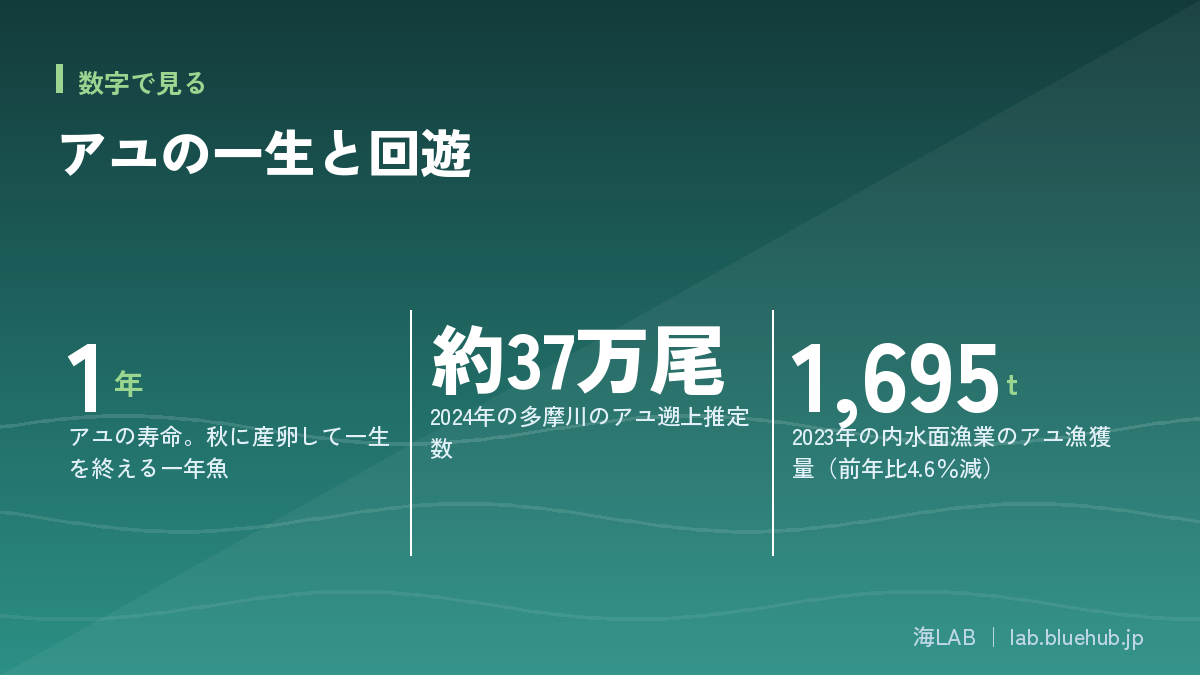
- Runs and catches are declining: the 2023 inland-fishery catch was 1,695 t, and the 2024 Tama River run was estimated at about 370,000 fish.
- The decline has multiple causes—dams and weirs, sea temperature, disease and predation—but fishway improvements have increased runs in some cases.
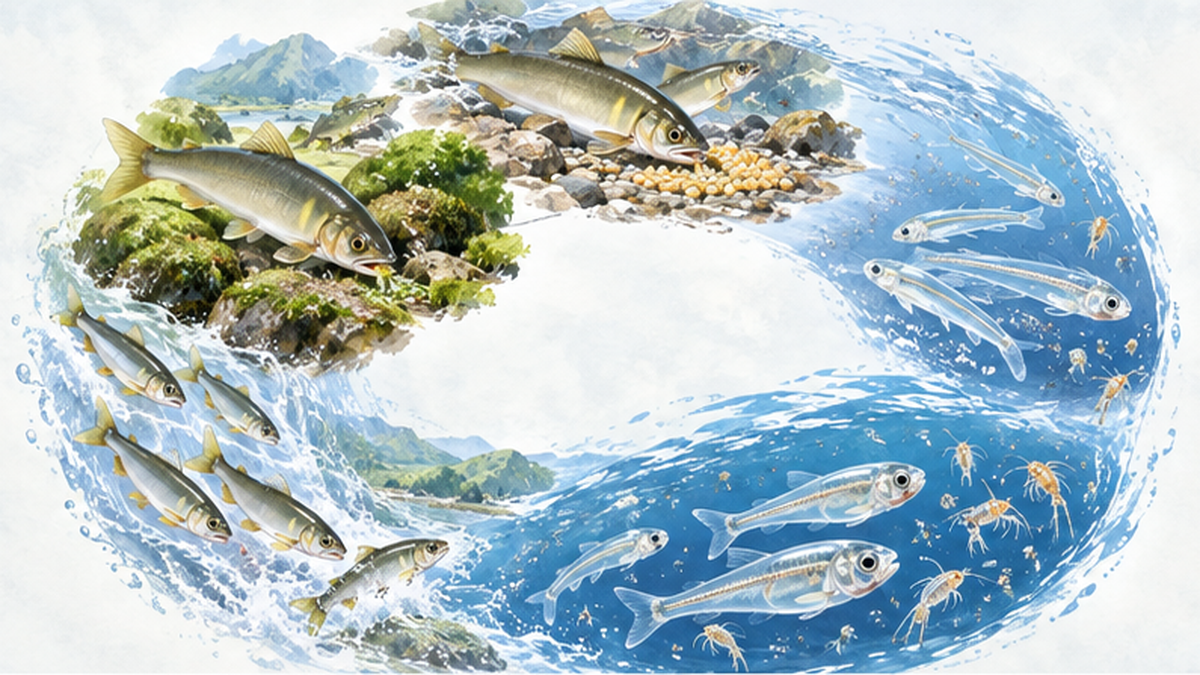
Ayu are often thought of as "river fish," but they actually spend close to half their lives at sea. Larvae born in rivers in autumn drift straight to the sea, overwinter there, and swim back up the river in spring to grow.
Their lifespan is just one year. In that short time they live in two worlds, river and sea, in a way known as "amphidromy." If any part of this journey is cut off, ayu cannot leave a next generation.
This article follows the ayu through spawning, downstream drift, winter at sea, the upstream run and summer in the river, and explains Tama River run surveys, national catch data, the effects of dams, weirs and fishways, and what we can do, based on primary sources.
What you'll learn in this article
- The ayu life cycle and how "amphidromy" works
- How larvae drift to sea and return upstream in spring
- Key biological numbers: water temperature, body length and more
- Latest data on Tama River run counts and fish catch
- How weirs, dams and fishways affect ayu
- What we can do for ayu in rivers and the sea
What Is an Ayu? Why It Is Called an "Annual Fish"
A symbol of Japan's clear streams
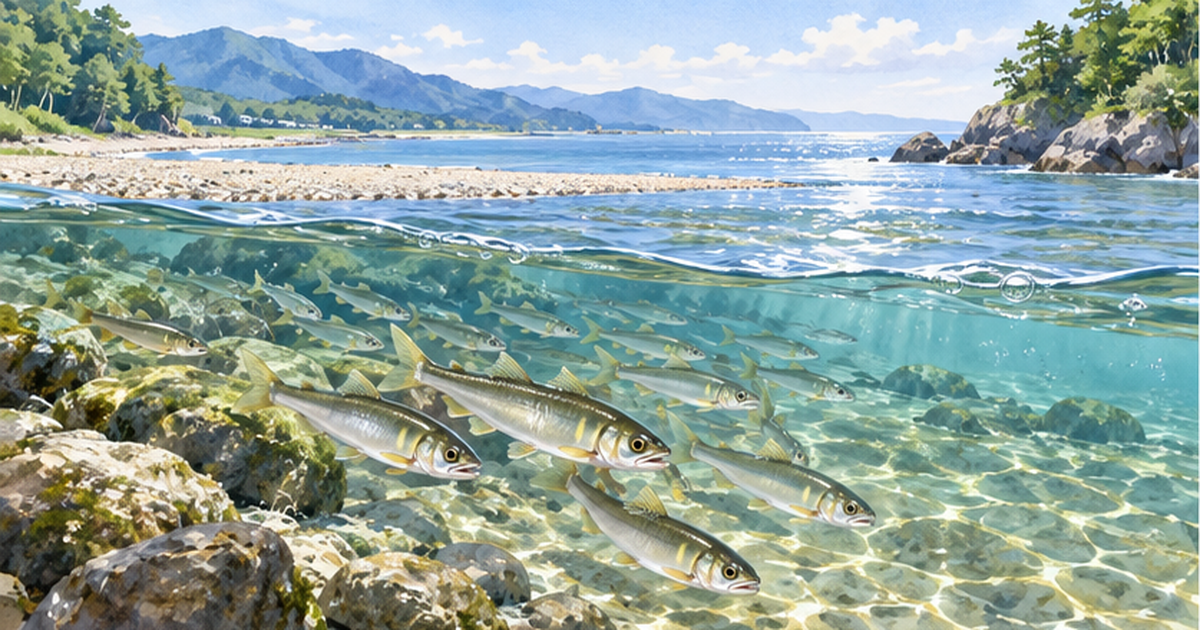
The ayu (Plecoglossus altivelis) is a smelt-order fish found from western Hokkaido to Kyushu and along the coasts of Korea and China. In Japan it is a summer favorite, enjoyed salt-grilled, through cormorant fishing and "tomo-zuri" decoy angling, and is nicknamed the "queen of clear streams." According to the Ministry of the Environment, it occurs throughout Japan, from the Teshio River in western Hokkaido to Okinawa.
Many people think of ayu as a "river fish." In fact, ayu spend close to half their lives at sea. Born in a river, they head to sea almost immediately, overwinter there, and return to the river in spring. This back-and-forth life between sea and river is the key to understanding the ayu.
A one-year life: the origin of "annual fish"
An ayu lives basically one year. Fish born in autumn spawn the following autumn and die. Besides the usual character 鮎, ayu are also written 年魚 ("annual fish") because of this single-year life. Even the 10–30 cm adults you see in a river were born the previous autumn.
Larvae that hatch in autumn are only 5–7 mm long. Within about a year they grow to nearly 30 cm at most, leave the next generation, and die. This way of life—using both sea and river within a short life—is distinctive among fishes.
The ayu life in a nutshell
- ['Autumn: spawn in the river; the parents die', 'Autumn–winter: larvae go to sea and feed on plankton', 'Spring: juveniles swim upstream', 'Summer: eat algae on river stones and hold territories', 'Autumn: mature, move downstream and spawn']
What is "amphidromy"?
Fish that move between rivers and the sea are called migratory, and the type that moves between fresh and salt water for growth rather than for spawning is called "amphidromous." Besides ayu, some goby groups such as Rhinogobius also live this way.
| Migration type | Spawning site | Representative fish | Features |
|---|---|---|---|
| Amphidromous | River (fresh water) | Ayu, Rhinogobius gobies | Born in rivers, grow at sea, return to rivers to grow and spawn |
| Catadromous | Sea | Japanese eel | Grow in rivers, go to sea to spawn |
| Anadromous | River (fresh water) | Salmon, cherry salmon | Grow at sea, swim up rivers to spawn |
Eels are "catadromous," spawning at sea and growing in rivers; salmon are "anadromous"; ayu are amphidromous. For eels, see The Mystery of Eel Spawning Grounds; for salmon, see Salmon Homing Migration.
Born in Rivers, Raised at Sea: From Spawning to the Larval Journey
Autumn spawning in riffles of the lower reaches
The main ayu spawning season is October to December, earlier in the north (from September in Hokkaido) and later in the south. Spawning takes place in shallow, gravelly riffles at the boundary between the middle and lower reaches. Ayu grow in the upper reaches in summer; in autumn, sensing shorter days, they mature and move downstream in groups.
Spawning is triggered by falling water temperature: spawning behavior generally starts when water drops to around 20°C and becomes active at 15°C or lower. Females lay sticky eggs on gravel and males release sperm. The eggs are under 1 mm in diameter and hatch in about two weeks at 15–20°C.
Newly hatched larvae head straight for the sea
Newly hatched larvae are 5–7 mm long with a yolk sac and a transparent body. They are carried downstream to the sea within about 1–2 days of hatching. This "downstream drift" takes place mainly at night, apparently a time when predators are less likely to spot them.
Speed and distance of the drift
- ['Larvae are only 5–7 mm long and are carried by the current rather than swimming down on their own', 'Depending on river length, reaching the river mouth from the hatching site can take several days', 'If flow is weak, larvae risk using up their yolk before they reach the sea']
For this reason, river flow is vital for ayu. If water stops behind dams and weirs, or if river water is reduced by withdrawals, larvae may fail to reach the sea.
Winter at sea: the "shirasu" stage
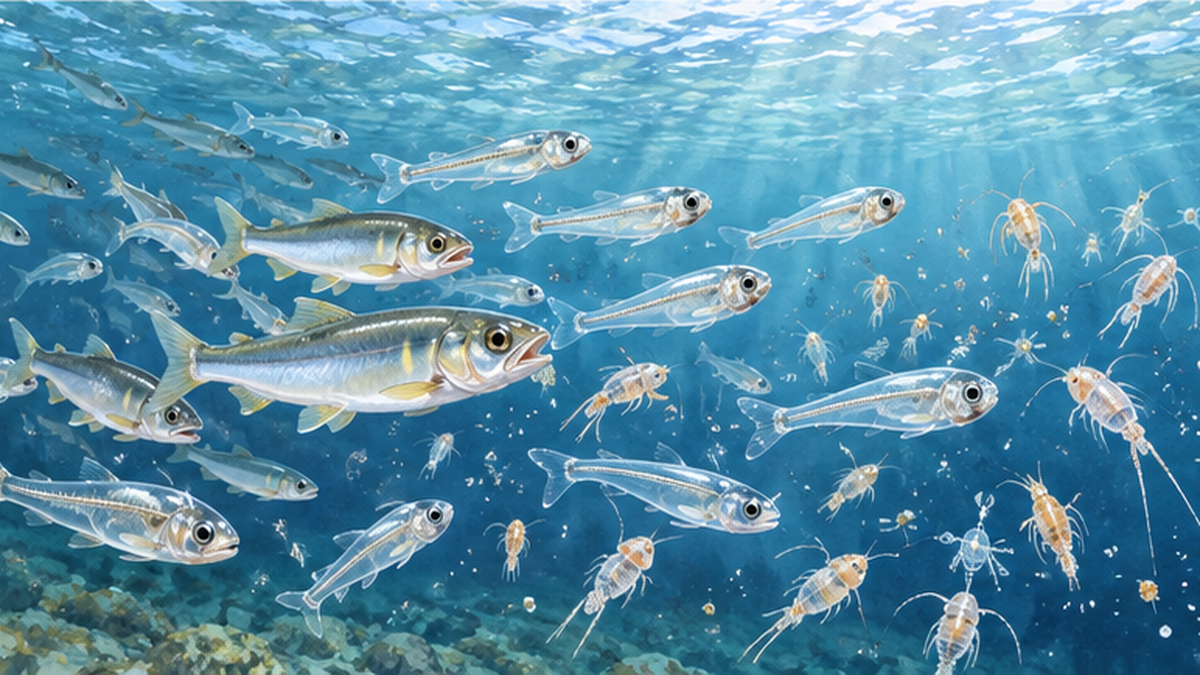
Larvae that reach the river mouth grow at sea feeding on zooplankton. At this stage ayu are semi-transparent and slender, looking nothing like the ayu seen in rivers; they are also called "shirasu."
Ayu spend about half a year at sea, from autumn to the following spring. Larvae are widely distributed in shallow coastal waters within a few kilometers of the river mouth, reportedly staying near the bottom by day and moving near the surface at night. They select areas of low salinity and suitable water temperature, so the waters around river mouths act as an important "nursery."
Survival at sea depends on water temperature
Water temperature is thought to strongly affect the survival of ayu overwintering at sea. Research reports show that larval survival falls when they move into seawater at high temperatures. Ayu overwintering at sea are said to depend on relatively warm seas (around 12–15°C) influenced by the Kuroshio and Tsushima currents, so marine temperature conditions affect survival.
Changes in the marine environment are a shared challenge for all migratory fish that pass through the sea. The relationship between migratory fish and water temperature is covered in Ocean Warming and Fisheries.
Key points of this chapter
- ['Spawning takes place in autumn on gravel riffles in the lower reaches', 'Eggs are under 1 mm and hatch in about two weeks; larvae are 5–7 mm', 'Larvae drift to sea in 1–2 days and spend winter in coastal waters near river mouths']
Spring Run: The Great Migration of Young Ayu from Sea to River
Water temperature is the trigger for the run
Juvenile ayu that overwintered at sea gather at river mouths in spring and start swimming up. Timing varies by region but is generally March to May. The trigger is river water temperature: they start entering rivers when it exceeds 8–10°C, and run actively at about 14–17°C.
Body length during the run is about 5–10 cm. Ministry of the Environment materials describe juveniles of around 5–6 cm entering rivers. Fish that were 5–7 mm larvae half a year earlier return more than ten times larger.
| River | Typical run speed (per day) |
|---|---|
| Nagara River | About 1.7–2.5 km |
| Kano River | About 3–4.3 km |
| Yoshino River | About 2 km |
| Hino River | About 0.3–0.5 km |
Run speed differs greatly by river. Conditions unique to each river, such as current strength, the presence of weirs and water temperature, are thought to be reflected.
From sea fish to river fish: body and diet change
At sea, ayu eat zooplankton, but once in the river their diet changes completely. Young ayu begin to eat periphyton (the "moss" or algae on stones). Ayu teeth are comb-shaped and suited to scraping algae from stone surfaces.
During the run, the body also changes to suit river life. From a fairly transparent sea form, the fish takes on the look of a typical river ayu.
What do ayu have to overcome during the run?
- ['Estuary barrages and tidal weirs', 'Water-intake weirs, erosion-control dams and other structures with drops along the way', 'Shallow riffles with little water, or inflows of snowmelt too cold for them', 'Predation by cormorants, herons and large fish']
As the following chapters show, crossing structures along the route can be the biggest barrier to ayu migration.
What Ayu Do in Summer: Territories and Grazing on Algae
A one-square-meter territory: why ayu can be caught by decoy angling
Young ayu that reach the middle and upper reaches set up a territory of about one square meter around a feeding stone and defend the algae on it like their own "field." They ram intruding ayu to drive them away.
Japan's traditional "tomo-zuri" decoy angling exploits this territorial behavior. A live ayu (the decoy) is set swimming; an ayu defending its territory attacks it and is hooked on the trailing hook. It is a rare kind of fishing that uses the fish's own habits.
Grazing marks tell the health of a river
The marks left on stones where ayu have grazed algae are called "hami-ato" (feeding marks), seen as oval or V-shaped scars. A river with many feeding marks is a sign of many ayu and abundant algae.
Interestingly, it has been reported that the algal species ayu eat change as grazing increases: as feeding pressure rises, algae shift from diatom-dominated to cyanobacteria-dominated. Ayu can be called "gardeners of the river," reshaping the ecosystem on stones.
Day length is the signal for maturation
- ['Ayu sense that "the days have become shorter" and begin to mature', 'Growth is the priority through summer; spawning preparation advances as autumn days shorten', 'Mature ayu are called "ochi-ayu" or "sabi-ayu," darkening in color into breeding coloration']
That is the broad outline of the ayu life. The following chapters examine the recent declines in run counts and catches and the changes in rivers and the sea behind them.
Ayu That Never Go to Sea: Landlocked Types and Lake Biwa's Koayu
Landlocked ayu that live their whole lives in a lake
Some ayu never go down to the sea and spend their whole lives in a lake. The best-known example is the ayu of Lake Biwa, called "koayu." Larvae born in the inflowing rivers in autumn drift into the lake rather than the sea and overwinter there. When a fish that would normally move between sea and river completes its life cycle entirely in fresh water such as a lake, it is called landlocked.
Research has shown that landlocked Lake Biwa ayu and sea-going migratory ayu differ in their ability to adapt to seawater: landlocked fish tolerate seawater poorly, while migratory fish retain seawater tolerance. This suggests that over a long period the lake population adapted to a life that does not use the sea.
Lake Biwa koayu have a long history of being released as juveniles into rivers across Japan. Ministry of the Environment materials note that released lake-origin ayu tend to establish territories earlier and grow faster than natural ayu, although they are known to differ in nature and behavior from migratory (sea-run) ayu.
| Type | Where they grow | Features |
|---|---|---|
| Migratory (sea-run) | Overwinter at sea, run up rivers in spring | Tolerate seawater and gather at river mouths for the run |
| Landlocked (lake-origin) | Overwinter in a lake, move into rivers in spring | Lake Biwa koayu are typical; also used as juveniles for stocking |
The Ryukyu ayu, an endemic subspecies of the Ryukyu Islands
Okinawa and Amami have a separate subspecies, the "Ryukyu ayu." It lives in rivers on Amami-Oshima and is listed in the Ministry of the Environment's Red List as a species at extremely high risk of extinction. It once lived on Okinawa Island too but is said to have disappeared in the 1970s, and local efforts to reintroduce it are under way.
The Ryukyu ayu also basically lives between rivers and the sea. In warm subtropical rivers its spawning season and growth timing differ from those of mainland ayu. Such regional differences also make up the diversity of ayu.
Diversity of ayu
- ['Migratory ayu from Honshu southward: grow at sea and run upstream in spring', 'Landlocked ayu such as those of Lake Biwa: live their whole lives in a lake', 'Ryukyu ayu of Amami and Okinawa: an endemic subspecies of the southern islands']
Even within one species, way of life changes with where fish are born and raised. Protecting ayu diversity also means protecting the diversity of seas, rivers and lakes.
Ayu and the Japanese People: Cormorant Fishing, Decoy Angling and Food Culture
A fish loved since ancient times
The ayu is a special fish for the Japanese. The character 鮎 is said to come from an old legend in which a deity fished for ayu to divine fortune, and ayu appear in the Nihon Shoki and Kojiki. Because of its one-year life it is called 年魚 ("annual fish"), and for its distinctive scent 香魚 ("fragrant fish").
The fragrance is said to derive from the algae ayu eat and is sometimes likened to watermelon or cucumber. Because flavor and aroma change with river water quality and the algae eaten, "which river the ayu came from" has long shaped the value of the dish.
Cormorant fishing and decoy angling: fishing that uses ayu habits
Across Japan, distinctive ayu fishing methods and cultures have taken root. Cormorant fishing on the Nagara River, in which trained cormorants catch ayu, is a well-known traditional method and a summer tradition. Decoy angling (tomo-zuri), as described earlier, uses the ayu's territorial behavior: an ayu that rams the decoy is hooked.
- Cormorant fishing: at night, a fire lights the water and cormorants catch swimming ayu
- Decoy angling (tomo-zuri): fishing that exploits the aggressiveness of territorial ayu
- Weir (yana) fishing: traps catch ayu ("ochi-ayu") moving downstream to spawn
These fisheries are the crystallized wisdom of people who knew ayu's habits of moving up and down rivers and holding territories. Other examples of sea-and-river life shaping culture are introduced in Japan's Traditional Fishing Culture.
Telling "wild" and "farmed" ayu apart
Most of the ayu we eat is farmed, but in some areas you can enjoy wild running ayu. According to Ministry of Agriculture, Forestry and Fisheries statistics, the 2023 inland aquaculture harvest of ayu was 3,387 t, about twice the inland-fishery catch of 1,695 t. Farmed ayu offers stable supply, while wild ayu is prized for flavor and aroma that reflect the river environment.
Protecting wild ayu means protecting culture
- ['Ayu fishing and river play culture exist only because wild ayu run upstream', 'If the river environment changes, the taste of ayu and the livelihoods of fishing communities change too', 'Knowing about local run surveys and stocking efforts is the first step in conservation']
Reading the Run Surveys: The Technique and Limits of Counting Ayu
How do we count ayu?
The number of young ayu moving upstream cannot be counted directly. Many surveys therefore count ayu in fixed nets set near river mouths or at fishway entrances and estimate the total run from those counts. In the Tama River survey, a net is set 11 km from the river mouth and the number caught is recorded every 24 hours.
The idea is simple. If you know the capture rate—what percentage of all fish enter the net (5.4% on the Tama River)—dividing the cumulative catch by that rate gives the total run. With 19,881 fish netted and a rate of 5.4%, the estimated run is about 370,000.
Three perspectives for reading the numbers
- Year-to-year variation: run counts swing widely with river flow and sea conditions
- Body size: even when numbers are low, a year of larger fish may mean good growth at sea
- Long-term trend: look at trends over several years to decades, not one year's rise or fall
The 2024 Tama River run was small in number but had a large average length of 6.5 cm. How feeding and water-temperature conditions at sea affect numbers and size is an important theme in ayu research.
Limits of the numbers
- ['The capture rate varies with river flow and survey year, so estimates carry a margin', "One river's survey cannot be generalized to the whole country", 'Stocked and wild ayu can be hard to tell apart by appearance']
Ayu run surveys do more than count fish; they also act as a "yardstick" for whether river and sea environments are changing. Rivers with long records make changes easier to notice.
Run estimates are only a clue to the present state of rivers and the sea. By looking at not only the rise and fall of numbers but also how many years a survey has run and how it counts, you can read changes in ayu more accurately. If results for a nearby river are published, take a look.
Efforts to protect ayu migration also help other migratory animals that use the same river, such as eels, Rhinogobius gobies and mitten crabs. Being able to see the links among a river's creatures through one fish is one of the ayu's great appeals.
The Data Today: Run Counts and Catches
Tama River: a survey running for more than 40 years
Ayu run counts are surveyed river by river. The Tama River ayu run survey, continued by Tokyo Metropolis, has run since 1983 and is a valuable dataset. The 2024 survey ran from March 12 to May 28 and estimated numbers from catches in a fixed net set 11 km from the river mouth.
| Item | Tama River, 2024 |
|---|---|
| Survey period | March 12 – May 28 |
| Cumulative catch | 19,881 fish |
| Capture rate (used in estimate) | 5.4% |
| Estimated run | About 370,000 fish |
| Average body length of run fish | 6.5 cm |
The estimate is calculated as "cumulative catch ÷ 5.4% capture rate." The 2024 figure of about 370,000 was lower than the previous year and the second lowest in recent years after 2021, the lowest. Even so, the average length of 6.5 cm was the second largest in ten years: a year when fewer but larger fish ran upstream.
National decline
The decline in runs is not unique to the Tama River. Prefectural fisheries stations, including Fukui, have reported low runs across Japan in recent years; in Fukui Prefecture, runs are said to have fallen sharply since 2017.
Catches show a declining trend too. According to Ministry of Agriculture, Forestry and Fisheries production statistics, the 2023 ayu catch from inland fisheries (rivers and lakes, including stocked fish) was 1,695 t, down 81 t (4.6%) from the previous year. The inland aquaculture harvest of ayu was 3,387 t, down 8.0%.
Ayu catches are said to have declined over the long term since the early 1990s; some summaries state they have kept falling since 1992.
Cautions when reading the data
- ['Run counts are "estimates" derived from fixed nets and other methods, and vary widely from year to year', 'Catch figures include stocked ayu, so they are not wild ayu alone', 'The trend in one river does not necessarily apply to others']
Weirs and Dams That Cut Migration Routes: Do Fishways Reach?
The effect of crossing structures on migratory fish
Ayu do not just go up rivers; in autumn they go down to spawn, and larvae drift to the sea. The river must therefore allow passage both up and down for the life cycle to be completed. Yet Japan's rivers have a great many crossing structures: intake weirs, bed-stabilization works, erosion-control dams and hydropower dams.
Surveys indicate that dams and weirs limit the length of river that fish can ascend and have greatly reduced ayu habitat. Reduced flow also lengthens the time autumn-born larvae need to reach the sea. For larvae carrying only a yolk sac, this can be fatal.
What is a fishway?
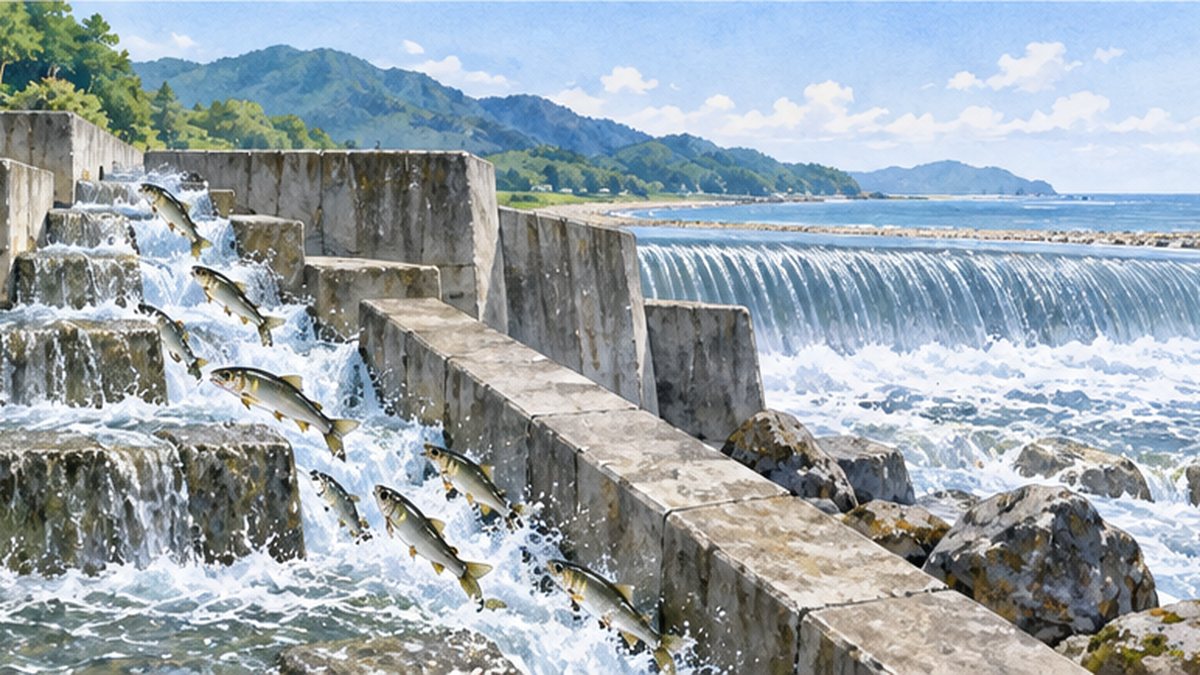
A fishway is a passage for fish provided at crossing structures such as weirs, bed-stabilization works, dams and erosion-control dams. There are many forms, including stepped, gentle-slope (ramp-type) and small-channel types. Its purpose is to let fish go upstream even when gates are closed.
Cases where fishways worked
Ministry of Land, Infrastructure, Transport and Tourism materials show cases where fishway improvements greatly changed run counts. At one weir (Shinroku weir), only 13 fish were recorded in 2008 before a gentle-slope fishway was built, but 1,572 in 2009 after it was completed; since then counts have ranged from 51 to 999 depending on the year.
The Tama and Akigawa rivers were designated in March 1992 as pioneering model rivers under the "Fish-Friendly River Promotion Model Project," and improvement of crossing structures and construction or upgrading of fishways have proceeded systematically.
- A fishway does not work if there is not enough water
- If a fishway entrance is hard to find, fish cannot enter
- Not only upstream passage but also the downstream passage of larvae and spent adults must be considered
River restoration in general is covered in River Restoration in Japan, and the effect of dams on the coast in Dams and Sediment Supply to the Coast.
Why Are Ayu Declining? Overlapping Factors in Rivers and the Sea
Not a single cause
The reasons ayu are declining cannot be narrowed to one. Prefectural fisheries stations and researchers say several factors overlap, which fall broadly into "river problems," "sea problems" and "human-activity problems."
| Category | Main factors | Effect on ayu |
|---|---|---|
| River | Obstruction of upstream and downstream passage by dams and weirs, degraded spawning grounds, reduced flow from withdrawals, water pollution | Habitat shrinkage; larvae fail to reach the sea |
| Sea | Changes in winter sea temperature and coastal environment | Lower survival of larvae and juveniles |
| Organisms and people | Diseases such as cold-water disease, overfishing, predation by birds such as cormorants | Mass mortality of adults; fewer fish |
Sea-side factor: water temperature and survival of larvae and juveniles
Even when river conditions are the same, run counts vary greatly from year to year. One factor drawing attention is the winter environment at sea. Research shows that larval survival falls when they enter seawater at high temperatures. If ocean warming continues, the winter coastal sea where ayu grow may change, possibly affecting run counts.
In the Nahari River in Kochi Prefecture, the "return rate" of released artificial ayu (the share of released fish that return upstream) normally varies widely from year to year in a range of 1/700 to 1/4500, and the lowest, in 2014, was reported at 1/4500. It is an example showing that even in the same river with the same stocking conditions, survival at sea varies greatly by year.
To see the link between sea and river
- ['Ayu stocks cannot be protected by protecting only the river or only the sea', 'Whether larvae survive at sea depends on water temperature, food and salinity around the river mouth', 'Changes in run counts could also serve as an "indicator" of environmental change in the sea']
How fish distribution and catches are shifting with sea temperature is also covered in Northward Shift of Fish Species.
Human-activity factors: disease, overfishing and predation
Factors cited for the decline of ayu include river degradation (dam construction and water pollution), overfishing and mass deaths from cold-water disease. Cold-water disease is a serious bacterial disease of ayu that tends to occur in cool seasons and has been a problem in aquaculture and stocking. An increase in fish-eating birds such as cormorants is also said to affect ayu in rivers.
However, how much each factor contributes differs by river. It is important not to decide "this is the cause" but to investigate river by river and choose countermeasures.
Reconnecting Sea and River: What We Can Do
On the river side: connect, let it flow, let them spawn
Efforts to increase ayu start with improving the river environment. The Ministry of Land, Infrastructure, Transport and Tourism has promoted "fish-friendly river" projects, building fishways and improving existing ones. The Public Works Research Institute also introduces a "simple improvement method" to make existing fishways easier to ascend.
- Connect: provide fishways at weirs and drop structures to secure both upstream and downstream passage
- Let it flow: secure the necessary flow so that intake and power generation do not reduce river water too much
- Let them spawn: conserve and restore gravel riffles (spawning grounds) in the lower reaches
Don't rely on stocking alone
Ayu stocks are also supported by juvenile stocking in rivers nationwide. Stocking of Lake Biwa koayu and artificially produced seed has long continued. However, released ayu can differ in nature from naturally running ayu, including in territory formation and migratory behavior. Stocking is an effective tool, but it is important to treat it together with restoring the river environment that supports natural runs.
What each of us can do
Three things you can do from today
- ['Look at news about "ayu runs" and your municipality\'s run survey results', 'When you eat ayu in summer, think about where it came from and whether it is wild or farmed', 'Join a river clean-up or waterside observation event and experience that rivers and the sea are connected']
River water quality and flow are connected from upstream to the sea. Care in domestic, agricultural and industrial wastewater, and reducing litter in rivers, ultimately help protect ayu life. For plastic flowing from rivers to the sea, see Plastic Flowing From Rivers to the Sea.
Summary: ayu are a health check for sea and river
Ayu are born in the river, raised at sea, grow in the river and die there, living a one-year journey. If any single part of that journey is cut, the life cannot be completed. Changes in run counts and catches also reflect what is happening to river structures, flow, water quality and the sea environment.
Turning our eyes to the ayu life in familiar rivers is the first step toward thinking of sea and river as one.
Summary of this article
- ['Ayu are an annual amphidromous fish: they spawn in rivers, larvae overwinter at sea and run upstream in spring', 'Run counts and catches show a long-term decline (2023 inland-fishery catch 1,695 t; 2024 Tama River run estimated at about 370,000)', 'Weirs and dams cut migration routes, though fishway improvements have restored runs in some cases', 'Causes combine river, sea and human activity; river-by-river surveys and conservation that includes the sea are key']
References and Sources
- Ecology of Ayu and Wakasagi | Ministry of the Environment – Ayu ecology materials
- Ayu | Setouchi Net (Ministry of the Environment) – Ayu distribution, spawning and run
- 2024 Ayu Run Survey Summary | Tokyo Metropolis – Estimated run in the Tama River
- 2023 Fishery and Aquaculture Production Statistics | MAFF – Ayu in inland fisheries and aquaculture
- Life History of Ayu | Takahashi River Biology Office – Spawning and run temperatures and speeds
- The Declining Ayu Stocks | Takahashi River Biology Office – Factors in stock decline
- Why Are Ayu Runs Low? | Fukui Prefecture – Explanation of decline in runs
- Fish Runs in the Tama River | Ministry of Land, Infrastructure, Transport and Tourism – Fish-friendly river projects
※ Listed in order of reliability: government and academic institutions > peer-reviewed papers > specialist organizations > reliable media