⚡ In short
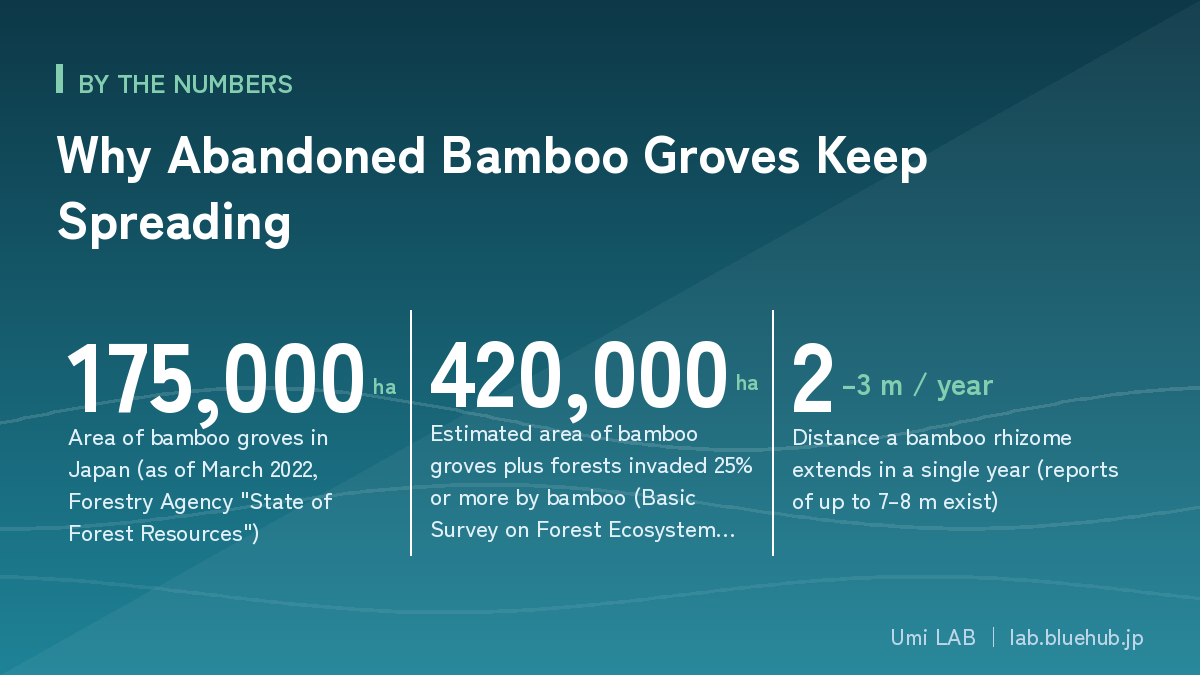
Japan has about 175,000 hectares of bamboo groves, and roughly 420,000 hectares once you count forests where bamboo has taken over 25% or more. This article uses primary sources to explain how rhizomes advancing 2–3 metres a year swallow satoyama woodlands, the 6.7-fold average expansion measured over 30 years in Chiba Prefecture, the effects on landslides and biodiversity, and the "reduce it by using it" solutions of paper, menma and power generation.
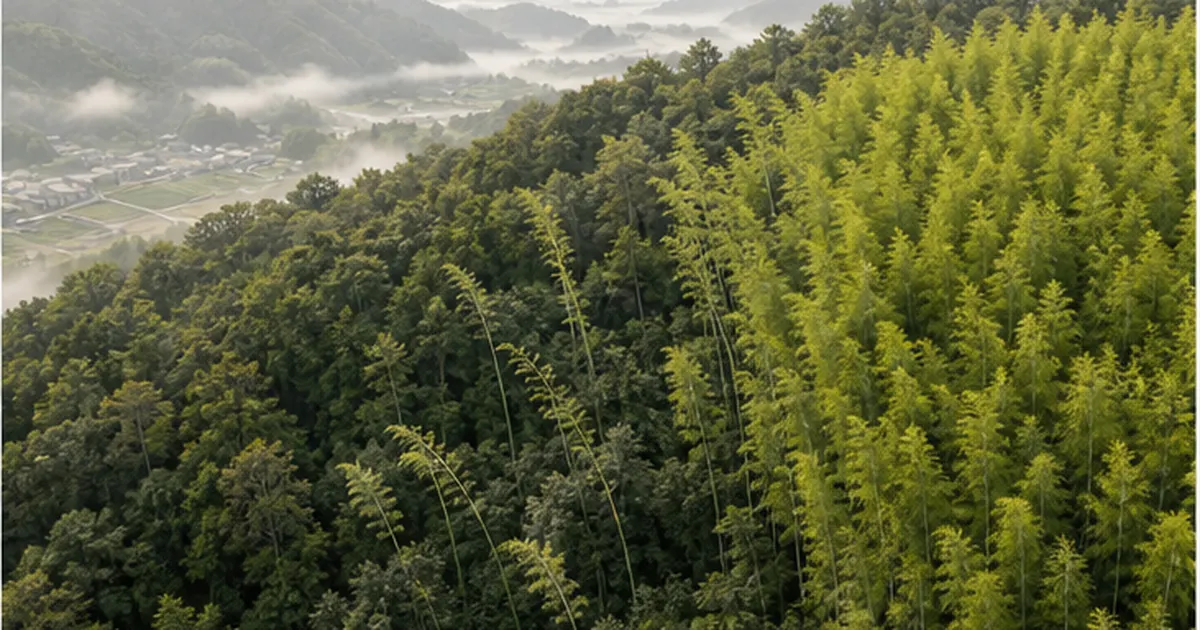
Have you ever noticed a pale yellow-green band spreading across a hillside in the mountains in spring? It rises a step above the surrounding broadleaf woodland, and the whole mass bends together when the wind blows. In most cases that is an "abandoned bamboo grove" that nobody maintains any more — and also an "expanded bamboo grove" that is quietly pushing into the forest around it. As of the end of March 2022, Japan's bamboo groves covered about 175,000 hectares. That is only 0.7% of the country's 25.02 million hectares of forest, but this 0.7% differs from all other forest in one decisive way. Bamboo walks.
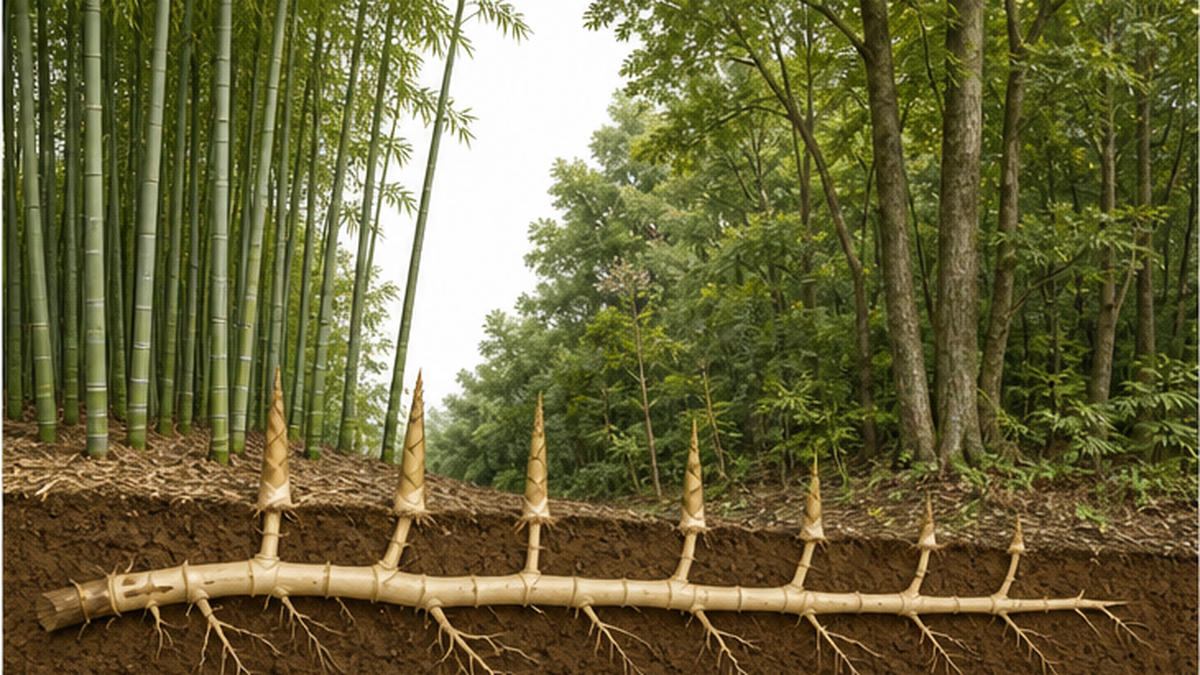
Bamboo spreads because the rhizomes woven through the soil extend two to three metres every year — seven or eight metres under good conditions. Shoots emerge from the advancing tip and, in a matter of months, become culms twenty metres tall. Once bamboo grows taller than the surrounding trees, those trees lose their light and decline, and no successor saplings can grow. Step by step, the broadleaf woodland is replaced by bamboo. When Chiba Prefecture tracked thirty years of aerial photographs, bamboo grove area had increased between 4.0-fold and 10.6-fold, with an average of 6.7-fold.
This article works through the social background of why groves came to be abandoned, the physiology of bamboo as a plant, the speed of its advance, its effects on satoyama landscapes and the coast, the practical costs of cutting, herbicides and root barriers, and finally the attempts to "reduce bamboo by using it" as paper, food and energy — all drawn from primary sources including Japan's Forestry Agency, the Forest Research and Management Organization, and prefectural governments. The bamboo problem is not one to simply despair over. Wherever a use has been found, bamboo groves have genuinely shrunk.
What you'll learn
- The difference between "abandoned", "expanded" and "mixed tree-bamboo" groves, and how to set priorities for action
- How moso bamboo invades satoyama woodlands through its rhizomes, and the expansion rates actually measured
- How bamboo expansion affects biodiversity, shallow landslides and water retention, and the data behind those claims
- The link between bamboo groves and the coast: sediment that slides downhill reaches the sea through rivers
- The labour and cost of cutting, herbicide treatment and root barriers, in real yen-per-hectare figures
- Real examples of "reducing bamboo by using it" — bamboo paper, domestic menma, biomass power — and the profitability barrier they face
What is an abandoned bamboo grove? The background behind Japan's "bamboo damage"
The Japanese term chikugai, "bamboo damage", is not an old one. Bamboo was once a precious resource used everywhere in daily life: baskets, colanders, washing poles, the lath behind earthen walls, tea ceremony utensils, even the floats used in nori seaweed farming. Precisely because it was a resource in use, groves were cut every year, their density was managed, and their boundaries were kept clear. The problem is not that bamboo increased; it is that we stopped using bamboo.
About 175,000 hectares — a mere 0.7% of Japan's forests
According to the Forestry Agency's "State of Forest Resources", the national bamboo grove area as of 31 March 2022 was 174,839 hectares. Japan's total forest area is 25.02 million hectares, so bamboo accounts for roughly 0.7% of it. Ten years earlier, in 2012, the figure was about 160,000 hectares, so a gentle long-term upward trend continues.
But this figure of 175,000 hectares is only the land classified as bamboo grove. What actually causes problems is bamboo working its way into land that was originally forest. The Basic Survey on Forest Ecosystem Diversity, which sets plots at roughly 16,000 points nationwide, estimates that bamboo groves plus forests invaded 25% or more by bamboo total about 420,000 hectares nationwide — 2.4 times the statistical bamboo area. That is the scale over which bamboo is exerting its influence.
Why were the groves abandoned? Imports, plastics and an ageing workforce
The Forestry Agency's report "Towards Promoting the Use of Bamboo" (2018) sets out the sequence in stages. First, in the late 1960s and early 1970s, a synchronised mass flowering of madake bamboo caused widespread die-off. Domestic bamboo supply collapsed, and imports from Southeast Asia and China rose to fill the gap. In the same period, baskets and colanders were being replaced by plastic products. Then, from the mid-1970s, imports of bamboo shoots increased as well, and shoot production also stopped paying.
The production figures tell the story starkly. In 1960 domestic bamboo material production was 13.47 million bundles (one bundle converted at 30 kg); by 2010 it had fallen to 960,000 bundles — about one fourteenth in fifty years. Since 2011 the use of bamboo for paper pulp has taken hold in some regions and output has recovered to around 1.2 million bundles a year, but that is still under a tenth of its peak.
Finally, the owners of both the groves and the surrounding forests grew old. Producing bamboo material requires a kiriko, a specialist with the eye to select culms suited to each product; the trade is said to take "three years to learn hauling, five years to learn cutting". Those specialists are dwindling year by year. When both the skilled hands and the economic reason to use them disappeared, groves became abandoned groves.
What is easily overlooked is that the surrounding forests were abandoned at the same time. From the late 1950s onwards, satoyama woodlands that had been maintained by cutting firewood and charcoal wood fell out of use as fuel switched to oil and gas and chemical fertiliser replaced leaf compost. Previously, undergrowth clearing and cutting also took place on the woodland side, so any bamboo that crept in was removed as it appeared. When people withdrew from both the grove and the forest, nothing was left to hold the boundary. The essence of "bamboo damage" is less a problem of bamboo than the disappearance of boundary management.
"Abandoned" and "expanded" groves are not the same thing
Anything that looks unkempt tends to get called an abandoned grove, but the distinction matters when planning action. The Forestry Agency proposes four categories.
| Category | Condition | Priority for action |
|---|---|---|
| Managed grove | Density is properly managed for bamboo material or shoot production | Maintain (not letting go is the best prevention) |
| Abandoned grove | Formerly managed, but no longer maintained | Medium (resuming management can restore the original grove) |
| Expanded grove | Land that was never a bamboo grove but has been taken over by bamboo | High (the original vegetation is in decline) |
| Mixed tree-bamboo forest | Land that was not a grove, where bamboo is part-way through invading | High (easiest to reverse if caught early) |
Key points
- Statistically there are 175,000 ha of bamboo groves, but bamboo affects an estimated 420,000 ha of forest
- The cause of abandonment is not that bamboo increased, but that we stopped using it
- Priority belongs to expanded groves and mixed tree-bamboo forests — not to every unkempt grove
Moso bamboo: the physiology of a "grass" that grows a metre a day
To grasp how fast bamboo groves expand, you need to know that bamboo lives by a completely different mechanism from a tree. Bamboo is not wood; it is a perennial, essentially herbaceous plant in the subfamily Bambusoideae of the grass family. There are more than 1,400 species of Bambusoideae worldwide, and 131 taxa distributed or established in Japan alone.
No secondary thickening — so it does not get fatter, it multiplies instead
Trees have a cambium and thicken their trunks year by year, laying down rings. Bamboo has no cambium. A shoot that emerges above ground becomes a mature culm within months and thereafter grows neither taller nor thicker. So where do the products of subsequent photosynthesis go? Every bit of it is stored in the rhizome. The rhizome uses that store to extend and to send up new shoots. Instead of individuals growing larger, the colony expands its area — that is bamboo's strategy.
This difference goes straight to the heart of why control is hard. Cut a tree and the individual dies; cut a bamboo culm and the rhizome lives on. As long as that shared savings account exists underground, shoots will keep coming the following year and the year after.
Growth rate: a shoot can extend a metre in a single day
The elongation rate of bamboo shoots is exceptional even among plants. Records reported in 1963 by Dr Koichiro Ueda, a leading bamboo researcher, give 121 cm in one day for madake and 119 cm for moso. Peak growth of over a metre a day has become the shorthand for bamboo's speed. It takes about a month for all the sheaths to fall away and roughly two months to reach around twenty metres, at which point growth stops.
What matters is that this elongation is funded not by that year's photosynthesis but by reserves accumulated in the rhizome in previous years. That is why bamboo can reach full size even on a dark forest floor with little light. The ability to grow in the shade of surrounding trees is exactly what makes invasion of forest possible.
Rhizomes extend 2–3 m a year, up to 7–8 m at most
The Forestry Agency records that rhizome elongation is "about 2 to 3 m in one year, with reports of up to 7 to 8 m at the maximum". That figure sets the real-world speed of grove expansion. At two metres a year, that is 20 m in a decade and 60 m in thirty years. Abandon boundary management for one generation and the neighbouring forest is replaced by bamboo on a scale of tens of metres.
Bamboo culms live at most about thirty years, and rhizomes about ten. Rhizomes are most productive of shoots in their third and fourth years and decline after the fifth. Inside a grove, old rhizomes are constantly dying and new ones extending — a continuous turnover.
Japan's three main species: madake, moso and hachiku
| Species | Culm height and diameter | Node feature | Main uses and production areas |
|---|---|---|---|
| Madake (Phyllostachys reticulata) | Reaches 20 m tall, 15 cm across | Double ridge | Excellent bending strength, elasticity and splitting quality; used for bamboo craft and traditionalcrafts. Produced in Oita and Yamaguchi |
| Moso (Phyllostachys edulis) | Reaches 20 m tall, 20 cm across | Single ridge | Prized for its edible shoots. Bamboo material comes mainly from Kagoshima and Kumamoto |
| Hachiku (Phyllostachys nigra var. henonis) | Reaches 20 m tall, 15 cm across | Double ridge | Fine and easy to split; the material for tea whisks. Bends in strong wind and does not spring back |
The properties of the material differ too. Madake excels in bending, tension, elasticity and splitting, and has long been the material of choice for bamboo crafts and traditionalcrafts. Moso is thick-walled and broad, and spread as a food crop because its shoots taste good. Hachiku is fine and splits easily, making it the material for tea whisks. Because the vascular bundles run parallel along the culm, bamboo is strong along the grain and splits cleanly along those bundles — a highly convenient property for craftwork. The skin is hard, dense and waxy, so it also resists water. It is no surprise that bamboo permeated every corner of daily life before plastics arrived.
The species that most often leads an expanded grove is moso. It prefers moist conditions and in mountainous country grows along valley bottoms; its distinctive form, with the tip drooping in a gentle curve, is recognisable from a distance. It was planted widely because its shoots commanded a good price — and when that price was undercut by imports, it was simply left where it stood. That is the typical history of an expanded grove.
How fast does bamboo actually invade satoyama woodland?
If rhizomes advance two or three metres a year, how has the landscape actually changed? Studies comparing aerial photographs across the decades have produced answers in several regions.
Chiba Prefecture: an average 6.7-fold increase in 30 years, up to 10.6-fold
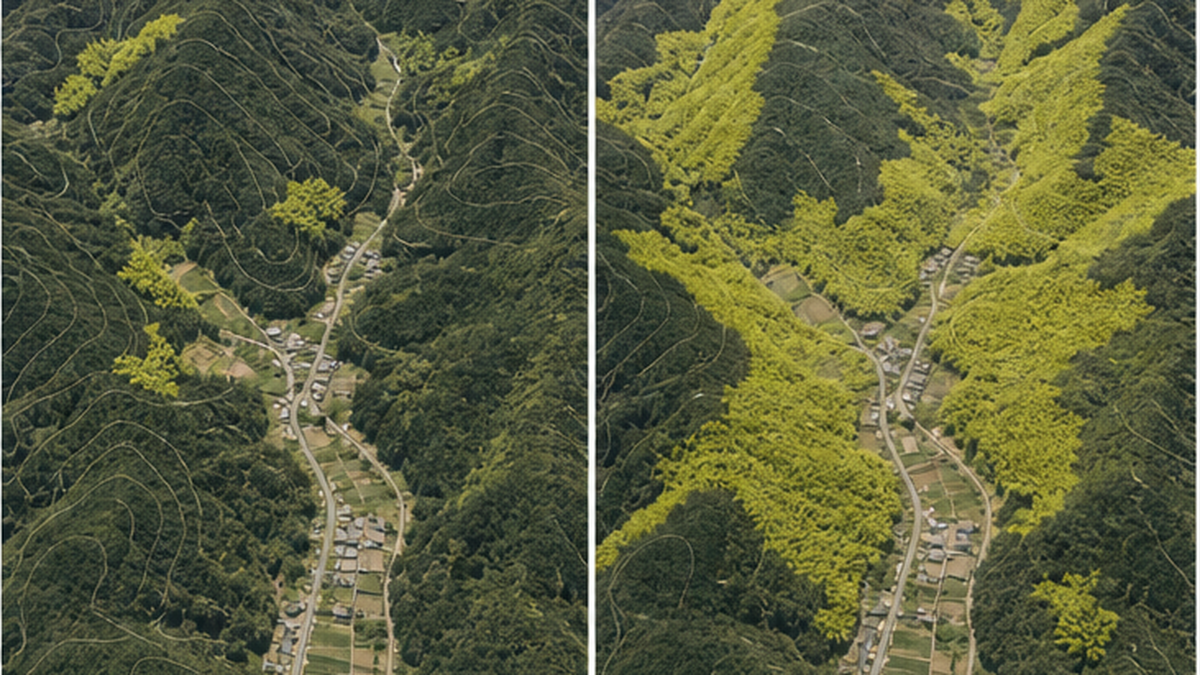
In "Preventing Bamboo Grove Expansion — A Guide to Managing Abandoned Groves", published by the Chiba Prefectural Agriculture, Forestry and Fisheries Technology Council, seven sites in the prefecture where expansion was a problem were surveyed using past aerial photographs over a thirty-year span. The result was unambiguous: bamboo increased continuously at every site, expanding 4.0- to 10.6-fold (an average of 6.7-fold) over the thirty years. Overlaying the 1975 and 2005 grove boundaries shows small scattered patches merging until they cover an entire slope.
Sanuki City, Kagawa Prefecture: 1.7-fold in eight years
There are shorter-term observations too. In satoyama areas of Sanuki City, Kagawa Prefecture, total bamboo grove area was reported to have expanded roughly 1.7-fold in just the eight years from 1992 to 2000 — around 7% a year by simple arithmetic. When residents say "it spread before we noticed", they are not exaggerating.
Expansion is not random. It is shaped by topography and by the adjacent vegetation: slope angle, position on the slope, surrounding land use, and above all whether anyone is there to manage it. Abandoned farmland and orchards are the easiest targets of all.
Why are bamboo groves concentrated in western Japan?
Bamboo groves are not spread evenly across the country. They cluster in western Japan, especially Kyushu and the Chugoku region; for bamboo material forest specifically, Kyushu accounts for roughly 70% of the national area. In production by prefecture, Kagoshima — where paper demand exists — produces about 60% of the national total, with other Kyushu prefectures filling out the top ranks.
There are two main reasons for the bias. One is climate: moso prefers warm, humid conditions, and its rhizomes are vulnerable to frost damage in cold regions. The other is history: the areas where shoot production and the bamboo trade flourished are the ones where the most bamboo was planted, and where it was simply left standing once the industry declined. The map of bamboo groves is a map of climate and, at the same time, a map of a former industry.
Climate change is pushing suitable bamboo habitat northwards
Bamboo expansion is now discussed in the context of climate adaptation as well. The Climate Change Adaptation Information Platform (A-PLAT), run by Japan's National Institute for Environmental Studies, cites 2017 research by Tohoku University, the Nagano Environmental Conservation Research Institute and others predicting that the area of eastern Japan suitable for moso and madake will expand from 35% today to 61–67% under 3°C of warming.
In other words, the assumption that bamboo damage is a western Japan problem is breaking down. Groves are still concentrated in Kyushu and Chugoku, but as warming proceeds the range in which bamboo can establish and expand across eastern and northern Japan will nearly double. For regions with few groves today, this is not the kind of change you can afford to think about after it arrives.
Putting the expansion rate in perspective
- Seven sites in Chiba over 30 years: 4.0- to 10.6-fold (average 6.7-fold)
- Sanuki City, Kagawa over eight years: roughly 1.7-fold
- Rhizomes extend 2–3 m a year, up to 7–8 m. Thirty years of neglect moves a boundary by tens of metres
- Under 3°C of warming, suitable habitat in eastern Japan is predicted to grow from 35% to 61–67%
Four problems bamboo expansion brings to satoyama
What is the harm in more bamboo? Several concrete losses of function have been documented, well beyond "it looks untidy".
1. It monopolises the light, and plant diversity is lost
An abandoned grove retains its dead culms as well, so density climbs above 10,000 culms per hectare. For comparison, a moso grove managed purely for shoot production runs at 2,000–3,000 culms per hectare, and 4,000–5,000 where shoots and material are combined — so an abandoned grove is two to five times as dense as a managed one. Abandoned madake groves can reach 10,000–20,000 culms per hectare including dead culms.
| Condition of the grove | Culm density (per hectare) |
|---|---|
| Moso, managed purely for shoot production | 2,000–3,000 |
| Moso, shoots plus bamboo material | 4,000–5,000 |
| Madake, large-diameter material production | about 6,000 |
| Moso, management abandoned | 10,000–12,000 (including dead culms) |
| Madake, management abandoned | 10,000–20,000 (including dead culms) |
At that density the interior is dim even at midday and hard to walk through. Too little light reaches the ground for herbaceous plants or tree seedlings to grow. Trees shorter than the bamboo are suppressed and decline, no successors establish, and bamboo dominance becomes locked in. The Forestry Agency states plainly that "in forests dominated by bamboo, plant species diversity is greatly impaired". Fewer plants means fewer insects that depend on them, and fewer birds that eat the insects. The living layers of satoyama grow thin.
2. Shallow roots — a higher risk of slope failure
Bamboo's weakness lies in the shallowness of its roots. Rhizomes are generally distributed only 10 to 30 centimetres below the surface, and the layer in which the rhizome network develops is limited to roughly the top 50 centimetres. With no deep vertical taproot as a tree has, bamboo offers almost no resistance to any slip deeper than that.
Research presented at the Japan Society of Civil Engineers' Western Branch has examined the relationship between heavy-rain slope failures in bamboo groves and the rhizome network, and a 2017 study by Akihiro Miyagi and Iwao Miyoshi reassessed bamboo's slope-stabilising effect and proposed an equation for the conditions under which bamboo slopes fail. The practical implication is clear: valley landforms with thick unstable soil layers, and larger slopes, are the most likely to be destabilised by bamboo invasion. Large groves in valley terrain should therefore be tackled first.
The old saying that bamboo roots hold the soil against landslides is not wrong for flat riverbanks or for the very shallowest layer. But as protection against deeper slips on the steep terrain typical of Japan's satoyama, it cannot be relied upon.
3. Reduced water retention
Shallow roots also affect infiltration. Because bamboo root systems sit higher in the soil than those of other forests, rainwater penetrates less readily into deeper layers, and a decline in water retention has been pointed out. Research findings also indicate that the more bamboo roots there are in an expanded grove, the lower the soil's water-holding capacity. The water source conservation function of forest — storing rain in the soil and releasing it slowly — may be weakened by conversion to bamboo.
That said, this is not an argument that bamboo groves are inherently bad. A properly managed grove lets light reach the floor, supports undergrowth, and yields both food and material every year. Rather than treating bamboo as an enemy, it is far more productive to separate the two real problems: excessive density, and spread beyond the boundary.
4. Falling culms, wildlife damage and everyday life
- Falling culms: dead culms, or culms snapped by snow and wind, topple onto roads, houses and power lines. In areas where wide swathes of hachiku have died after mass flowering, this has become a live concern
- A refuge for wildlife: dense groves with poor sightlines make good hiding places and travel corridors for wild boar and deer, encouraging incursions into farmland
- Invasion of farmland: rhizomes push into fields and orchards and disturb the root zone of crops. Abandoned field boundaries are the easiest to breach
- Landscape and local memory: the bright coppiced woodland that once supplied firewood and charcoal disappears, and the scenery a community grew up with changes
From bamboo grove to sea: forest, village, river and coast are one system
It may seem odd to find bamboo groves discussed in an ocean publication. But what happens in the satoyama always reaches the coast by way of the rivers. Bamboo expansion is not a problem that stays inland.
Sediment from a slope failure travels down the river to the sea
When a slope fails, the sediment runs down the valley and enters the river. In moderate quantities, sediment is essential material that supplies sand to the coast and maintains beaches. That the loss of that supply behind dams and revetments is a major reason Japan's beaches are thinning is explained in detail in our article on dams and coastal erosion.
The issue is quantity and timing. Sediment supplied slowly and steadily nourishes the coast; large volumes of fine sediment flushed out at once during heavy rain cloud river mouths and inshore waters, settle on the seabed and bury benthic life, and degrade the light environment of seagrass beds and coral reefs. More shallow slope failures from bamboo conversion means more of that sudden pulse of sediment.
Tending the satoyama sustains the richness of the coast
Japan has a long tradition of the idea that caring for the upstream forest enriches the downstream sea: fishers planting broadleaf trees, the "forest–village–river–sea" concept that treats a whole watershed as one system, and the philosophy of satoumi, in which moderate human care raises coastal productivity. All of them rest on the same premise — that land and sea should not be managed separately.
Seen in that light, tending a bamboo grove means something different. Cutting bamboo is not merely tidying up the scenery; it is work that keeps sediment moving gently and keeps the water of a watershed in order. Preserving the diversity of satoyama life is also part of the terrestrial conditions that support the richness of Japan's seas — the marine biodiversity often called among the world's greatest.
Bamboo was also a tool of the sea
It is easily forgotten that bamboo was long a material of fisheries and aquaculture. The Forestry Agency's report lists "nori poles" and "fish reefs" among traditional uses of bamboo material, and includes a photograph of "floats for nori seaweed farming". Bamboo is light, resists water, is easy to work, and eventually returns to the soil when it breaks. Before plastics arrived, a good share of the working equipment of the coast was bamboo.
Today, in response to the marine plastic problem, there are efforts in many places to consider returning fishing and aquaculture gear to natural materials. The possibility that abandoned bamboo — a surplus domestic resource — could meet the demand for plastic alternatives is far from zero. As discussed below, though, the cost of harvesting bamboo is high, and securing price competitiveness remains the greatest obstacle.
Connecting land and sea
- Shallow failures in bamboo slopes increase the sediment flushed out all at once during heavy rain
- Sudden turbidity and deposition degrade river mouths, seagrass beds and coral reefs
- Bamboo was itself a coastal tool — floats for nori farming, fish reefs and more
- Tending the satoyama is work that sets the conditions for the coastal environment, by way of the watershed
How to reduce bamboo: cutting, herbicides and barriers, with real costs
From here the discussion turns practical. Reducing bamboo is, frankly, not easy, because cutting the above-ground part leaves the rhizome alive. The labour and cost involved, however, are documented in remarkably concrete numbers.
Cutting: twice a year for seven years
Drawing on findings from the Forest Research and Management Organization (2018), A-PLAT states that "eradicating bamboo down to the rhizome requires cutting the above-ground parts twice a year, continuously for seven years". The Forestry Agency likewise notes that even where cutting is carried out every year, regrowth continues for several years, and substantial numbers of new culms can still appear in the sixth year after cutting began.
The awkward part is the nature of the regrowth. The new culms tend to be smaller, but they carry plenty of leaves and are, if anything, better at photosynthesising and banking reserves in the rhizome. Stop after a few years and the rhizome recovers its strength and returns to where it started. The seven-year figure is the time needed to exhaust the rhizome's savings.
There is a knack to timing as well. It is best to avoid the spring-to-early-summer window, from when shoots are swelling underground until the emerged culms have matured, and to cut from autumn into winter instead.
Labour and money: 140 culms a day for four people; about ¥2.3 million per hectare
As a guide to work rates, the Kochi Prefectural Forest Technology Center (2007) gives a figure of about 140 culms per day for a team of four. Remembering that abandoned groves exceed 10,000 culms per hectare, a single pass over one hectare requires more than 70 person-days.
For costs, the Forest Research and Management Organization (2018) offers the following reference figures.
| Method | Approximate cost | Notes |
|---|---|---|
| Manual cutting (all culms, every year for four years) | about ¥2.3 million/ha | Continuity is essential; interrupt it and the rhizome recovers |
| Herbicide, injection into the culm | about ¥1.09 million/ha | Drill the culm between June and November and inject 5–10 mL of undiluted solution. Death follows in about six months |
| Herbicide, injection into the stump | about ¥1.33 million/ha | Injected into each cut stump individually |
| Herbicide, soil application | about ¥1.13 million/ha | Also kills in about six months, with a recognised suppressive effect on regrowth |
Glyphosate-based and chlorate-based herbicides are registered in Japan for killing bamboo. They may be injected into individual culms or stumps, or applied to the soil, and both routes are recognised as suppressing regrowth. But use demands compliance with the registered conditions and application standards, and careful attention to water sources and to surrounding vegetation and wildlife. Always consult your prefecture's forestry extension officer or agriculture and forestry office before use.
Work planning also has a large effect on productivity. Above roughly 20 degrees of slope, moving around and cutting become harder — but cut culms slide down of their own accord, which makes extraction easier. At a steep site in Ehime Prefecture, this natural sliding was used to avoid yarding machinery altogether, producing the lowest costs of any case studied. Conversely, a gentler site that used winch uphill yarding suffered low productivity and high costs. "Steeper means harder" does not necessarily hold in bamboo work — one of its more interesting quirks.
Barriers: stopping the rhizome physically
If the goal is narrowed to "stop it spreading any further", there is a far more practical option: bury a barrier such as corrugated sheeting along the boundary between the grove and the land you want to protect, to a depth of about a metre that accounts for rhizome depth, and block the rhizomes physically. The Chiba guide gives the following installation figures.
- Burial depth: 1.12 m below ground, with 0.1 m above ground
- Material cost: ¥12,600 per 10 m
- Labour: 1.4 person-days per 10 m
- With sturdy sheeting properly installed, the barrier can be expected to work for about ten years
Stopping bamboo along a line is overwhelmingly cheaper than eradicating it over an area. If the farmland, houses or treasured woodland you want to protect are already defined, the rational order is to fix the boundary first, then reduce the bamboo inside it on a planned schedule.
A realistic sequence
- 1. Decide the boundary you will defend and stop the rhizomes with a barrier (material cost ¥12,600 per 10 m)
- 2. Inside it, plan for cutting twice a year over several years — stopping part-way returns you to square one
- 3. On slopes above 20 degrees, letting cut culms slide naturally lowers extraction costs
- 4. If using herbicide, check the registered conditions and application standards and consult your prefecture's forestry extension officer
- 5. Large groves on valley terrain carry the highest failure risk and should be tackled first
"Reduce it by using it": the frontier of bamboo utilisation and the profitability barrier
Eradication costs money. But if bamboo has a price, the picture changes. In regions where bamboo utilisation has taken hold, grove management has advanced of its own accord. Here are four directions.
Make paper: 100% domestic bamboo paper, perfected in Kagoshima
Paper made from bamboo has properties between softwood paper, with its long fibres, and hardwood paper with short ones, and it is familiar in China and Southeast Asia. In Japan it never took hold as a pulp material: bamboo is hollow, hard and bulky, groves are small and scattered, and cutting, extraction and chipping are all inefficient compared with timber.
The company that broke through this barrier is Chuetsu Pulp & Paper, which has a mill in Satsumasendai, Kagoshima Prefecture. According to the Forestry Agency, the company began trial production of paper blending 10% bamboo pulp with wood pulp in 1998, and established the technology for 100% bamboo paper in 2009. In Kagoshima, a major bamboo shoot producing region, this created a flow in which growers carry bamboo cut during grove maintenance to a nearby chip mill, where it becomes raw material for paper.
See this initiativeChuetsu Pulp & Paper, "Takegami" bamboo paperProduces paper made from 100% domestic bamboo in Satsumasendai, Kagoshima Prefecture. The company buys harvested bamboo from growers, linking paper-making to bamboo grove management.🔗 chuetsu-pulp.co.jpThe Forestry Agency's analysis of why Kagoshima's bamboo production rose is refreshingly candid. The company set up a scheme that buys at a fixed unit price without limiting when or how much growers may deliver, and municipalities support extraction costs. Kagoshima now accounts for about 60% of national bamboo material production by prefecture. The condition that moved grove management was simple: a buyer who buys at any time, at the same price.
Eat it: the conceptual leap of domestic menma
There is another solution from an entirely different angle: menma, the fermented bamboo shoot topping. Almost all menma sold in Japan is imported, but efforts to cut chest-high young culms from abandoned groves and ferment them into domestic menma are spreading nationwide.
See this projectPure Domestic Menma Project — tidy up bamboo groves by eating wellA nationwide network that turns young culms from abandoned bamboo groves into fermented menma. Since its kick-off in December 2017 it has spread to 40 prefectures.🔗 japan-menma.comThe Pure Domestic Menma Project is a national organisation that held its kick-off meeting in Kyoto in December 2017. Under the slogan "tidy up bamboo groves by eating well", it aims to turn abandoned groves into a resource through products such as domestic menma, thereby supporting grove maintenance and the public-benefit functions of forests. It supports member regions through twelve nationwide blocks, and its activities now reach 40 prefectures.
The elegance of this approach is that the thing that needs cutting and the thing that becomes a product are one and the same. What causes trouble in an abandoned grove is the endless supply of new culms driving up density. Cut them while they are still soft and young, and density falls while food is produced. Because there is no need to haul out heavy mature culms, the extraction burden is small too. Being food — something everyone understands — also makes it easy to involve local schools, volunteer groups and credit unions.
Burn it: the hard problem of bamboo biomass power
Bamboo can be used for energy, but there is a technical sticking point. Bamboo contains a great deal of potassium, so burning it in a large boiler melts the ash, which solidifies into masses known as clinker inside the furnace. Its chlorine content is high as well, readily corroding refractories and heat transfer tubes. With conventional technology, bamboo was considered unsuitable as a biomass power fuel.
Attempts continue nonetheless. Faced with visible grove expansion, Yamaguchi Prefecture combined airborne laser surveying with forest GIS to pin down grove locations accurately and ran demonstration projects on low-cost extraction. A company that took note of this work moved into Sanyo-Onoda City and, jointly with a German firm, developed a special furnace that suppresses clinker formation; construction proceeded on a 1,999 kW bamboo-only biomass power plant. In Nankan, Tamana District, Kumamoto Prefecture, a combined heat and power project using bamboo has also been developed, processing culms and residues unsuited to construction material into fuel chips.
Bamboo charcoal, bamboo vinegar and other material uses
Bamboo charcoal contains far more minerals such as potassium and sodium than wood charcoal, and its porosity gives it excellent soil-improving and deodorising properties. Domestic production, however, has thinned: output in 2016 was 411 tonnes, and imports account for about 95% of consumption. Bamboo vinegar, collected from the smoke during carbonisation, declined after a 2003 revision of the Agricultural Chemicals Regulation Act removed it from pesticide designation, and has run at around 200 kilolitres a year in recent years.
The biggest barrier is the cost of getting bamboo out
The utilisation stories are encouraging, but they share one wall: harvesting and extraction cost too much. In Forestry Agency trials at sites in Ehime, Ibaraki and Yamaguchi prefectures, productivity ranged from 0.7 to 3.8 wet tonnes per day and costs from ¥6,000 to ¥46,000 per wet tonne — a more than sevenfold spread depending on conditions. By process, chipping the crown was the single most expensive operation.
What is interesting is that more machinery does not mean lower cost. The Ehime case that let culms slide down a steep slope and used no yarding machinery came in under ¥10,000 per wet tonne, while the Yamaguchi case using multiple large swing yarders achieved high productivity but heavy machinery costs pushed the total up. At a few tens of kilograms per culm, bamboo is simply too light for forestry machinery. Combining the smallest possible machines suits bamboo better.
Bamboo does have an advantage forestry lacks. Cut it and it regenerates naturally from the rhizome, with no risk of being suppressed by other plants, so there is no replanting or tending cost. The vigorous reproduction that makes bamboo a problem child is, seen as a resource, a sustained supply capacity. How to turn that double-edged trait to account is the crux of bamboo utilisation.
A flowering once in 120 years, and how to live with bamboo from here
Finally, a word about an extremely rare phenomenon now unfolding across Japan: the synchronised flowering of bamboo.
Hachiku flowered for the first time in 120 years — and set no seed
Bamboo flowers only once in several decades to more than a century, and then dies. The flowering cycle of hachiku is thought to be about 120 years, and the previous large-scale event was recorded between 1902 and 1908. From the late 2010s, reports of hachiku flowering began arriving from across the country.
The Forest Research and Management Organization conducted follow-up surveys at five sites from Shikoku to the Kanto region and published the results in 2021. No mature seed was found. Meiji-era literature likewise records that no mature seed was observed, and none was seen in this survey either. At flowering, roughly 60% of the nitrogen and phosphorus in the above-ground parts had been allocated to the reproductive organs. All of those resources went into flowers, and no next generation of seed remained.
So will hachiku disappear? No. It has been confirmed that some rhizomes and culms survive, avoiding the risk of the grove vanishing altogether. Small culms about a metre tall have emerged from the surviving rhizomes, and in flowering stands a portion of the non-flowering culms also survives. Bamboo carries itself forward not through seed but through copies of itself, in the form of rhizomes.
The new problems left behind by dead groves
For local communities, the phenomenon carries a different meaning. Hachiku culms that have died together snap easily in wind and rain, raising concerns about culms falling onto roads and houses and about a deteriorating landscape. Meanwhile, some municipalities have no subsidy scheme applicable to clearing dead groves, and reports suggest the response has not kept pace.
Seen another way, mass flowering is also one of the few opportunities to change what a bamboo grove is. At the moment when bamboo's vigour is at its lowest, trees can be planted to return the land to forest, or density can be reset for management as a working grove. How to use a moment that comes once in 120 years is the question. Follow-up surveys of post-flowering stands by Hiroshima University and other institutions are underway as a clue to the puzzle of bamboo regeneration.
What we can do
The bamboo problem cannot be solved by government and research institutions alone. Many groves have owners nobody can identify, and the people who can actually act are those who live nearby. It need not be complicated. As with citizen science, where the act of recording is itself valuable, there is plenty to do in a bamboo grove.
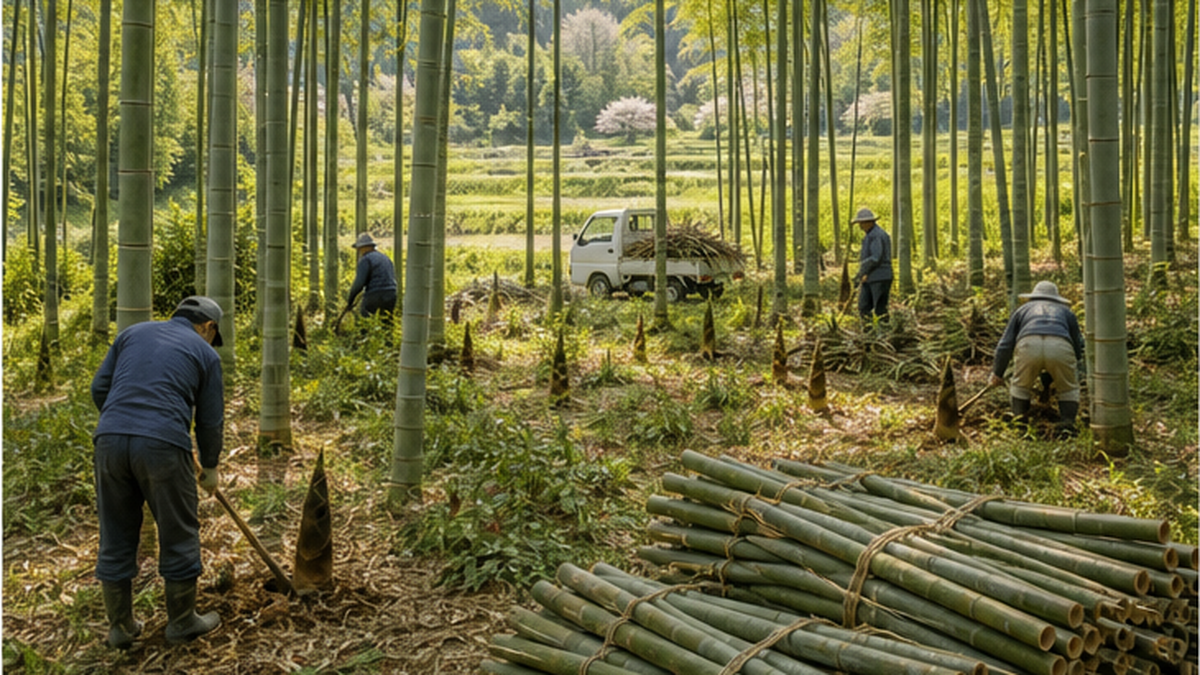
- Dig shoots in spring: the simplest and surest form of density management. A shoot that is dug never becomes a culm
- Cut young culms in early summer: culms cut at chest height can become the raw material for menma
- Go and look at the boundary: checking the line between your land and the grove once a year is enough to catch invasion early
- Photograph it: shooting the same spot from the same angle each year creates a record that shows the rate of expansion
- Choose bamboo products: buying paper, food and household goods made from domestic bamboo circulates the money that pays for grove management
Summary of this article
- Japan's bamboo groves cover about 175,000 ha (end of March 2022); including forests invaded 25% or more by bamboo, an estimated 420,000 ha nationwide
- Bamboo spreads 2–3 m a year through rhizomes (up to 7–8 m). In Chiba it expanded an average 6.7-fold in 30 years
- Abandoned groves exceed 10,000 culms per hectare, monopolising light and impairing plant diversity
- Rhizomes sit only 10–30 cm below the surface, raising failure risk on valley terrain and large slopes, which need priority attention
- Eradication needs cutting twice a year for seven years; four years of manual cutting runs about ¥2.3 million/ha. Blocking the boundary with a barrier is cheaper
- Outlets such as bamboo paper, domestic menma and bamboo biomass power are what actually drive grove management forward
- Hachiku flowered for the first time in about 120 years and set no seed, but survives through its rhizomes — and the moment is also an opportunity to change what a grove is
References and sources
- Forestry Agency, Japan – Towards Promoting the Use of Bamboo (October 2018)
- Forestry Agency, Japan – State of Forest Resources (as of 31 March 2022)
- Forestry Agency, Japan – Basic Survey on Forest Ecosystem Diversity
- Climate Change Adaptation Information Platform (A-PLAT, National Institute for Environmental Studies) – Infographic: Expansion of Bamboo Groves
- Chiba Prefectural Agriculture, Forestry and Fisheries Technology Council – Preventing Bamboo Grove Expansion — A Guide to Managing Abandoned Groves
- Forest Research and Management Organization (FFPRI) – Hachiku bamboo, flowering en masse for the first time in some 120 years, produced no seed
- Japan Society of Civil Engineers, Western Branch – Failure of bamboo grove slopes under heavy rainfall and the influence of the rhizome network
- Forestry Agency, Japan – The Story of Forests that Nurture Water (water source conservation function)
- Ministry of Agriculture, Forestry and Fisheries, Japan – The expanding possibilities of bamboo: new uses (aff, March 2021)
- Chuetsu Pulp & Paper Co., Ltd. – About Takegami (paper made from 100% domestic bamboo)
- Pure Domestic Menma Project – Tidy up bamboo groves by eating well
- Hiroshima University – Hachiku flowers for the first time in 120 years: the first post-flowering follow-up survey in Higashihiroshima
* Listed in order of reliability: government/academic institutions > peer-reviewed papers > specialist organisations > reliable media