⚡ In short
Crown-of-thorns starfish outbreaks account for 42% of the Great Barrier Reef's 27-year coral decline and have repeatedly devastated Okinawa's reefs since the 1970s. A science-based guide to the competing causes — nutrient runoff and predator loss — the front lines of culling such as single-shot vinegar injections, and the challenges of reef conservation.
A coral reef spreading beneath crystal-clear water turns into a "dead reef" of bare white skeletons in just a few months. The culprit is not rising water temperatures or pollution, but a single starfish about 30 cm across. The crown-of-thorns starfish (scientific name: Acanthaster planci), a specialist coral predator, eats its way through roughly 10 m² of coral per individual per year once an outbreak begins — and swarms of hundreds of thousands can devour an entire reef.
The damage is not limited to Japan. On Australia's Great Barrier Reef, the world's largest coral reef system, coral cover halved from 28.0% to 13.8% over the 27 years from 1985 to 2012, and 42% of that decline is estimated to have been caused by crown-of-thorns starfish predation (De'ath et al. 2012, PNAS). In Okinawa, prefecture-wide outbreaks in the 1970s wiped out corals across the region, and waves of outbreaks have kept returning ever since.
What makes this so vexing is that the crown-of-thorns starfish is, by nature, a legitimate member of the coral reef ecosystem. Why does this normally quiet "resident" suddenly turn into a horde that destroys reefs? This article explains the starfish's biology, the scientific debate over what causes outbreaks, the front lines of control — from single-shot vinegar injections to robots — and what each of us can do, all based on primary sources such as Japan's Ministry of the Environment, Okinawa Prefecture, and AIMS (the Australian Institute of Marine Science).
What you will learn in this article
- The biology of the crown-of-thorns starfish and how it "digests" coral by everting its stomach
- The reality of repeated outbreaks in Okinawa since the 1970s and the damage to the Sekisei Lagoon and the Great Barrier Reef
- The three main hypotheses for outbreaks (nutrient runoff, predator loss, natural fluctuation) and the latest combined-factors view
- How control technology evolved from sodium bisulfate injections to single-shot vinegar injections and culling robots
- Where Japan's countermeasures stand today — the Ministry of the Environment, Okinawa Prefecture, and local divers
- What we can do for coral reefs in an era of combined stress from bleaching and predation
What Kind of Creature Is the Crown-of-Thorns Starfish? A Coral Predator Covered in Venomous Spines
The crown-of-thorns starfish (scientific name: Acanthaster planci) is one of the largest starfish in the world, widely distributed across tropical and subtropical coral reefs from the Indian Ocean to the Pacific. In Japan, its main habitat is the coral reef zone stretching from the Amami Islands through Okinawa to the Yaeyama Islands, and individuals carried by the Kuroshio Current are occasionally found along the southern coast of Honshu (Wakayama, Kochi, and elsewhere). Its English name, "crown-of-thorns starfish," refers to its spine-covered body; the abbreviation COTS is used as-is in international research papers and Australia's management program.
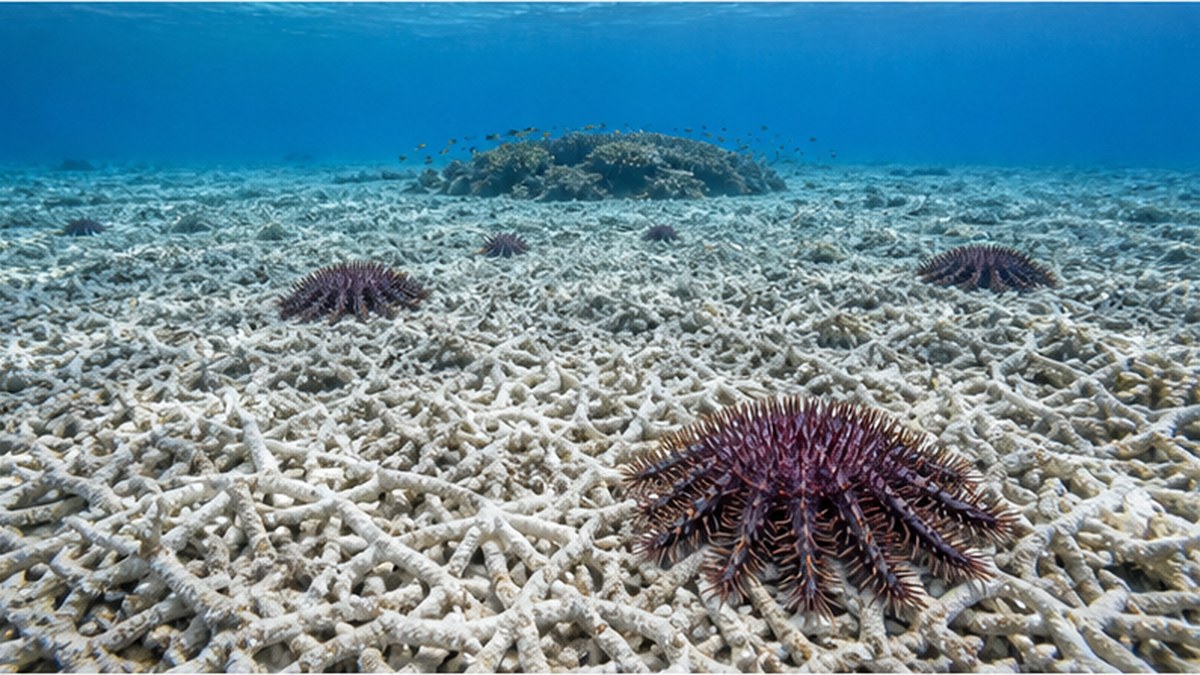
Under normal conditions the crown-of-thorns starfish is an inconspicuous animal, hiding in reef crevices and rock shadows and moving at night. Its density on a healthy reef is very low, and divers rarely encounter one. But once an outbreak begins, the starfish swarm openly over corals in broad daylight, and the seafloor becomes an eerie landscape blanketed with masses of spines as far as the eye can see. "Normal when present, a disaster when abundant" — this dual nature is the starting point for understanding the problem.
A Body Worthy of the Name "Demon" — Anatomy
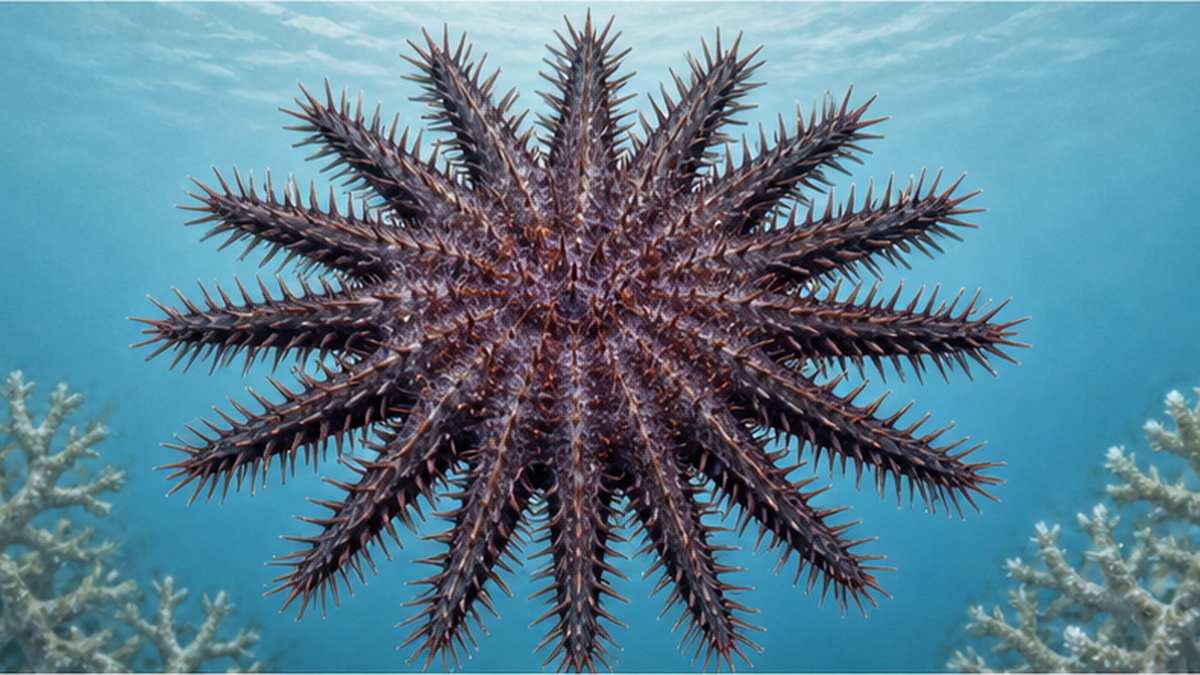
Adults are about 30 cm in diameter, with large individuals reaching nearly 60 cm. While ordinary starfish have five arms, the crown-of-thorns has 10 to 20 arms, and its entire surface bristles with sharp spines 2–3 cm long. This menacing appearance earned it the Japanese name "oni" (demon) starfish. Body color varies widely among individuals, from grayish brown to reddish purple to bluish hues.
The spines carry a protein-based venom; a sting causes intense pain and swelling that lasts for days. People stung repeatedly risk anaphylactic shock (an acute allergic reaction), so culling work demands thick gloves and extreme caution. Okinawa Prefecture's materials strongly warn never to touch one with bare hands. The spines break easily, and fragments left in the skin prolong inflammation, so the rule is to seek medical care rather than attempt self-treatment after a sting.
Astonishing Fecundity — Tens of Millions of Eggs per Female
The starfish's most defining trait is its fecundity. In Okinawa, around June and July each year, males release sperm and females release eggs into the water for external fertilization. A single female carries several million to tens of millions of eggs (Okinawa Prefecture Nature Conservation Division). Fertilized eggs hatch in 20–24 hours, drift on ocean currents through a planktonic larval stage of two to six weeks, and only those that reach a coral reef settle and begin life on the seafloor.
Settled juveniles first feed on crustose coralline algae before switching to a coral diet. In about two years they grow to roughly 20 cm in diameter and join the breeding population. Larval survival is normally extremely low, but if something nudges that survival rate even slightly upward, the next generation's numbers leap by orders of magnitude — this is the true source of an outbreak's "explosive power."
Moreover, during the spawning season the starfish gather and release eggs and sperm in synchrony, and fertilization rates rise with density. In other words, a positive feedback loop operates: once numbers start to grow, growth becomes even easier. Responding after an outbreak has begun tends to be too late, which is why the early detection and early culling described later are considered paramount.
Crown-of-Thorns Starfish: Basic Facts
- Scientific name: Acanthaster planci (genus Acanthaster). Distributed on Indo-Pacific coral reefs
- Adults are about 30 cm in diameter (up to around 60 cm), with 10–20 arms and venomous spines all over the body
- One female carries several million to tens of millions of eggs; spawning in Okinawa occurs in June–July
- Larvae drift for 2–6 weeks; maturity is reached in about 2 years at around 20 cm
How It Eats Coral — The Everted-Stomach Feeding Mechanism
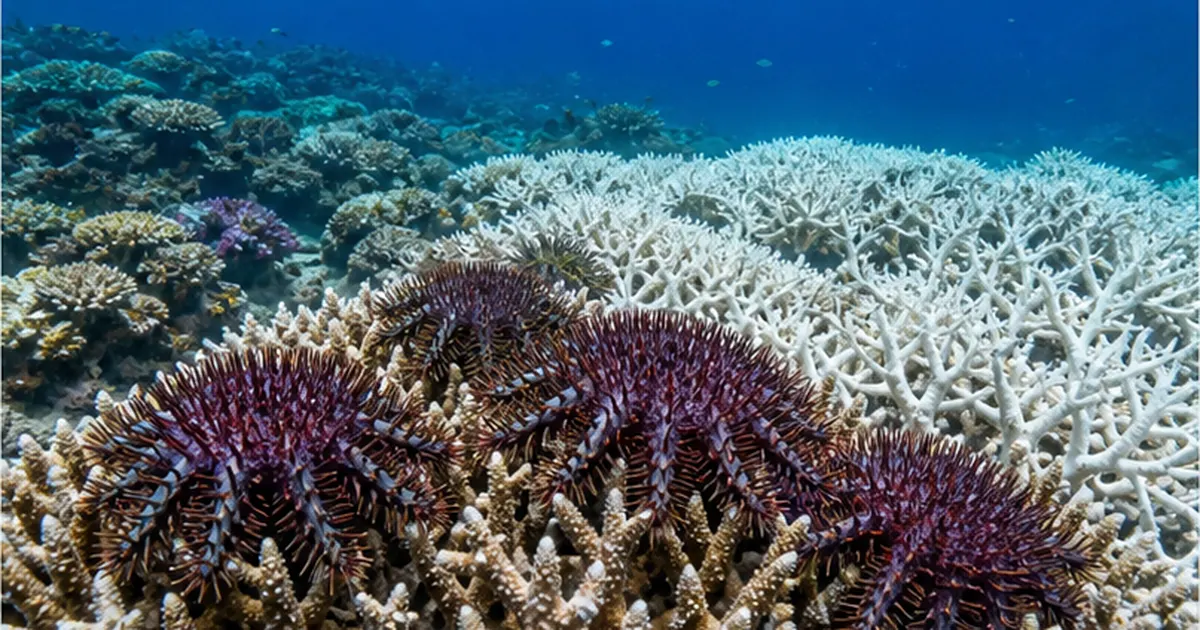
The crown-of-thorns starfish feeds in a peculiar way. Climbing onto a coral, it pushes its stomach out through its mouth, turning it inside out, and presses it against the coral surface. Digestive juices dissolve and absorb only the coral's soft tissue (the polyps), and the starfish moves on a few hours later. What remains is nothing but a stark-white calcium carbonate skeleton stripped of living tissue. These white "feeding scars" are a key warning sign of an outbreak.
Many starfish species pry open bivalves to feed, but the crown-of-thorns preys on corals that cannot move, so it needs neither ambush nor pursuit. It does not even have to crush the hard skeleton — it simply drapes itself over the coral and digests externally. Living atop the vast food supply of a coral reef, with few predators and tens of millions of eggs — the conditions for population explosions are almost too well aligned in this animal.
About 10 m² per Year per Starfish — Hundreds of Thousands Can Erase a Reef
By estimates from Australia's reef authorities and others, one adult consumes roughly 5–13 m² of coral per year. One starfish is no great threat, but during outbreaks tens of thousands to hundreds of thousands concentrate on a single reef. In the outbreak that began around Okinawa Island in 1969, corals across nearly the entire island were damaged within about a year and a half. There are records of entire areas being stripped of coral in three to six months.
Favorite Corals, Corals Left for Later
The starfish has dietary preferences, favoring fast-growing branching and table corals such as Acropora and Montipora. Massive corals such as Porites tend to be left for later. As a result, on a damaged reef the branching corals that shape the seascape disappear first, fish lose their shelter, and the whole ecosystem rapidly simplifies.
During large outbreaks, the swarms also move on once they have eaten an area bare. Groups that exhaust their coral food travel along the reef edge, spreading damage far beyond a single reef, following currents and topography across whole regions. The outbreak that began at Onna Village in 1969 spread to almost all of Okinawa Island by the end of the following year — likely a combination of this movement and new local outbreaks.
How Do You Tell Bleaching from Feeding Scars?
A freshly eaten skeleton is brilliantly white, with the polyp pores clearly visible on its surface. Within weeks, algae colonize the skeleton, turning it a dingy brown before it eventually crumbles. Bleaching caused by high water temperature, by contrast, means the coral has lost its symbiotic algae but its tissue is still alive; up close, a thin film of tissue and faint color remain. Field monitoring distinguishes bleaching from predation using the "freshness" of the white areas and the bite marks along scar edges, along with the presence of the starfish themselves.
| Item | Details |
|---|---|
| Feeding method | Everts its stomach outside the body and dissolves only the coral's soft tissue with digestive juices |
| Feeding scars | Leaves a pure-white skeleton stripped of living tissue (a clue for outbreak monitoring) |
| Consumption | Roughly 5–13 m² per adult per year (estimates by Australian authorities and others) |
| Preferences | Prioritizes fast-growing corals such as Acropora and Montipora |
| Speed of damage | Records exist of entire areas eaten bare in 3–6 months during major outbreaks |
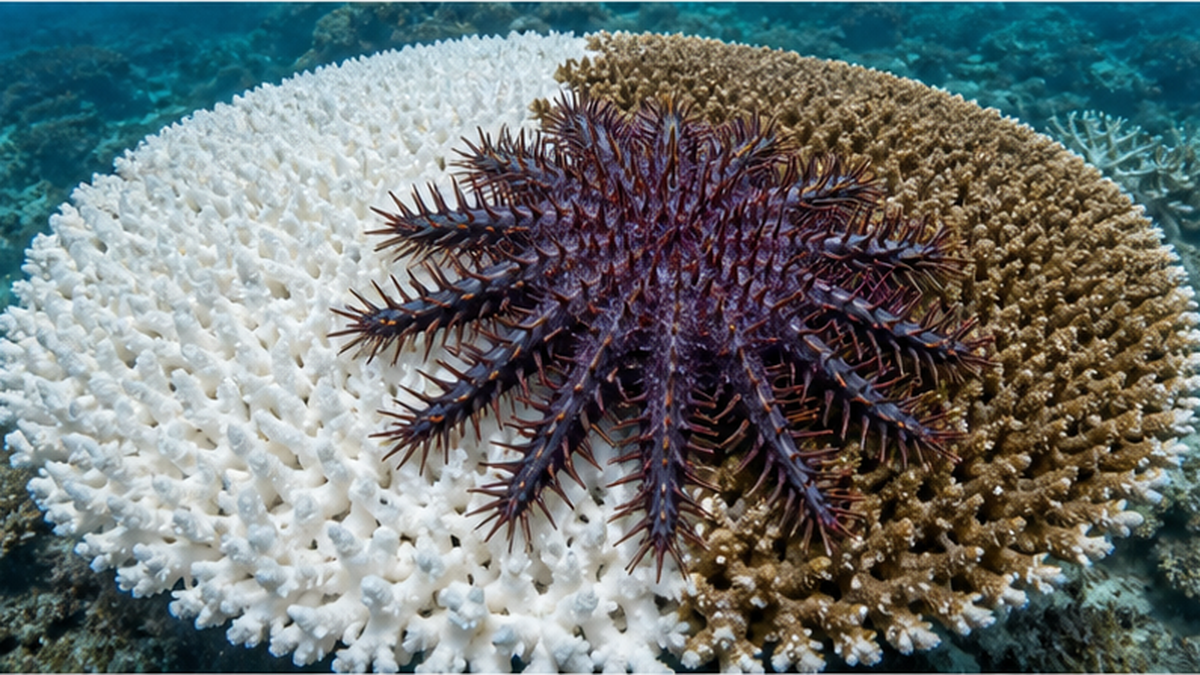
From a distance, white feeding scars resemble heat-driven bleaching, but the mechanisms are entirely different. In bleaching, the coral loses its symbiotic algae yet its tissue remains alive; in predation, the polyps themselves are digested, so the coral dies with no chance of recovery. The mechanism of bleaching is explained in detail in our article "Why Does Coral Bleaching Happen?".
A History of Outbreaks — Damage Records from Okinawa and the Great Barrier Reef
Crown-of-thorns outbreaks have long been known, but the damage became a global issue only in the latter half of the 20th century. In Japan, outbreaks have been recorded repeatedly in the Ryukyu Islands since around 1957, with prefecture-scale outbreaks in the 1970s and 1980s (Okinawa Prefecture Nature Conservation Division). There is no universal strict definition of an "outbreak," but in practice it refers to densities at which predation outpaces coral growth — the level at which a reef's coral visibly begins to decline — and Australia's management program sets its culling target densities on this same principle.
Okinawa — The Nightmare That Began in Onna Village in 1969
In 1969 an outbreak began along the coast of Onna Village on the central west shore of Okinawa Island, and by the end of 1970 corals across nearly the entire island had been eaten and killed. The wave of outbreaks spread north and south through the Ryukyus; on Yoron Island in Kagoshima Prefecture, about 309,000 starfish were culled in fiscal 1973 alone. Around 1980 the wave reached the Yaeyama Islands, and in the Sekisei Lagoon (between Ishigaki and Iriomote Islands), Japan's largest coral reef area, the lagoon's corals were almost completely wiped out, except for areas such as northern Kohama Island that culling managed to defend (Ministry of the Environment, Sekisei Lagoon Nature Restoration Master Plan).
Since then, coral recovery and outbreak waves have alternated. In 1996 a high-density aggregation appeared off Onna Village, and the fisheries cooperative culled about 180,000 individuals. In the Yaeyamas, another mass outbreak struck in 2008–2014, followed immediately by the large-scale bleaching of 2016 driven by high water temperatures, and corals declined sharply across the entire island group (Ministry of the Environment, Kyushu Regional Environment Office).
| Period | Area | Event |
|---|---|---|
| c. 1957– | Ryukyu Islands | Outbreak records begin appearing across the region |
| 1969–1970 | Okinawa Island | Outbreak spreads from the Onna Village coast; by the end of 1970 corals killed across nearly the entire island |
| FY1973–1975 | Yoron Island | About 610,000 culled over three years (about 309,000 in FY1973 alone) |
| c. 1980 | Sekisei Lagoon / Iriomote | Outbreak devastates the lagoon's corals (except areas such as northern Kohama Island) |
| 1996 | Onna Village | High-density outbreak; fisheries cooperative culls about 180,000 |
| 2008–2014 | Yaeyama Islands | Renewed mass outbreak; combined with the 2016 mass bleaching, corals decline sharply |
Damage Across the Globe — A Shared Indo-Pacific Challenge
Mass outbreaks are not unique to Japan and Australia. In the late 1960s an outbreak advanced along the coastline of Guam, shocking coral reef researchers. Outbreaks have since been recorded across wide areas of the Indo-Pacific, including Fiji and the Maldives, with each country scrambling to cull and monitor. Because the larvae can ride ocean currents for weeks, an outbreak in one area may seed outbreaks in other areas connected by currents — making cross-border sharing of monitoring data an ongoing challenge.
The Great Barrier Reef — Coral Halved in 27 Years, 42% of It Due to the Starfish
On Australia's Great Barrier Reef (GBR), waves of outbreaks have been recorded at intervals of roughly 15 years since the 1960s (AIMS). In a study analyzing survey data from 214 reefs and 2,258 surveys, the Australian Institute of Marine Science found that GBR-wide coral cover fell 50.7%, from 28.0% to 13.8%, over the 27 years from 1985 to 2012, with the causes estimated as cyclones 48%, crown-of-thorns predation 42%, and bleaching 10% (De'ath et al. 2012, PNAS). A single species of starfish ranks alongside — indeed rivals — typhoons and bleaching as one of the greatest threats.
These numbers carry an important implication. Humans cannot directly stop cyclones or rising sea temperatures, but crown-of-thorns predation can genuinely be reduced through culling. The AIMS research team noted that if losses to the starfish could be curbed, coral cover could turn toward recovery — and this analysis became part of the scientific rationale for the Australian government's expansion of its large-scale control program.
For the full picture of damage and countermeasures in Okinawa, see also "Protecting the Coral Reefs of Okinawa and the Southwest Islands".
Why Do Outbreaks Happen? Three Competing Hypotheses
Why does a starfish normally numbering just a few per reef suddenly become a horde of hundreds of thousands? Half a century of research has produced no decisive answer, and several hypotheses continue to be tested. The three leading ones are as follows.
Hypothesis 1: Nutrient Runoff (More Food for Larvae)
The most widely supported idea is that nutrients (nitrogen and phosphorus) flowing from land into the sea pull the trigger. When fertilizer from farmland and household wastewater wash into the ocean during heavy rains, phytoplankton multiply. Phytoplankton are the staple food of crown-of-thorns larvae, so more food sharply raises the survival of larvae that would normally mostly die. Given that one female spawns tens of millions of eggs, even a slight improvement in larval survival makes the population explode. On the GBR, outbreaks following heavy rain and floods have been reported and are considered supporting evidence (AIMS).
Furthermore, new AIMS research reported in 2026 suggests that in addition to runoff from land, upwelling at the edge of the continental shelf — nutrient-rich water rising from the deep sea — may also be boosting larval food supplies. A more complex picture is emerging in which "both the land and the deep sea" can trigger outbreaks.
Hypothesis 2: Loss of Predators
This hypothesis holds that the starfish's predators — the giant triton snail and large fishes — have declined through overharvesting and fishing, removing the brakes. On the GBR, reefs in no-take zones where fishing is restricted show a tendency toward less frequent outbreaks, cited as one line of evidence for predation pressure. The next chapter examines this in detail.
Could Warming Seas Also Be a Tailwind?
In recent years, the possible influence of climate change has entered the debate. Because larval development is temperature-sensitive, changing sea temperatures may alter the length of the larval period, survival rates, and the northern limit of the species' range. In Japan, sightings of crown-of-thorns starfish have been reported along Honshu coasts where reef-building corals historically did not flourish, tracking the northward shift of coral distribution — making outbreak patterns in a warming era an important research theme.
Hypothesis 3: Natural Fluctuation
This view holds that mass outbreaks are an intrinsic property of the species, occurring periodically long before modern human activity. Indeed, numerous crown-of-thorns skeletal fragments have been found in sediments thousands of years old, so outbreaks themselves are likely a natural phenomenon. Even so, natural fluctuation alone is thought insufficient to explain the apparent increase in outbreak frequency in recent decades.
The Current Scientific Consensus
A study by GBR researchers that comprehensively evaluated the hypotheses (Babcock et al. 2016, PLOS ONE) concluded that outbreaks are most likely driven not by a single cause but by a combination of natural factors, predator loss, and increased nutrients acting together. "There is no single culprit" — that is where the science stands today.
Predicting Outbreaks — Larval Monitoring and Environmental DNA
Alongside work on causes, research into detecting outbreaks in advance is progressing. Okinawa Prefecture, through its Comprehensive Crown-of-Thorns Countermeasures Program, has explored ways to forecast mass outbreaks years ahead from larval abundance and juvenile occurrence. In Australia, development is under way on environmental DNA (eDNA) techniques that detect the presence of larvae from trace DNA drifting in seawater. The goal is an "early warning system" that allows action before adults visibly multiply — the stage at which culling is most effective.
Prediction matters because of the outbreak's time lag. It takes about two years from spawning until the starfish begin feeding on coral as adults. This year's ocean nutrient conditions determine the scale of predation two to three years from now. Conversely, catching the signs at the larval or juvenile stage buys time to organize culling before damage occurs.
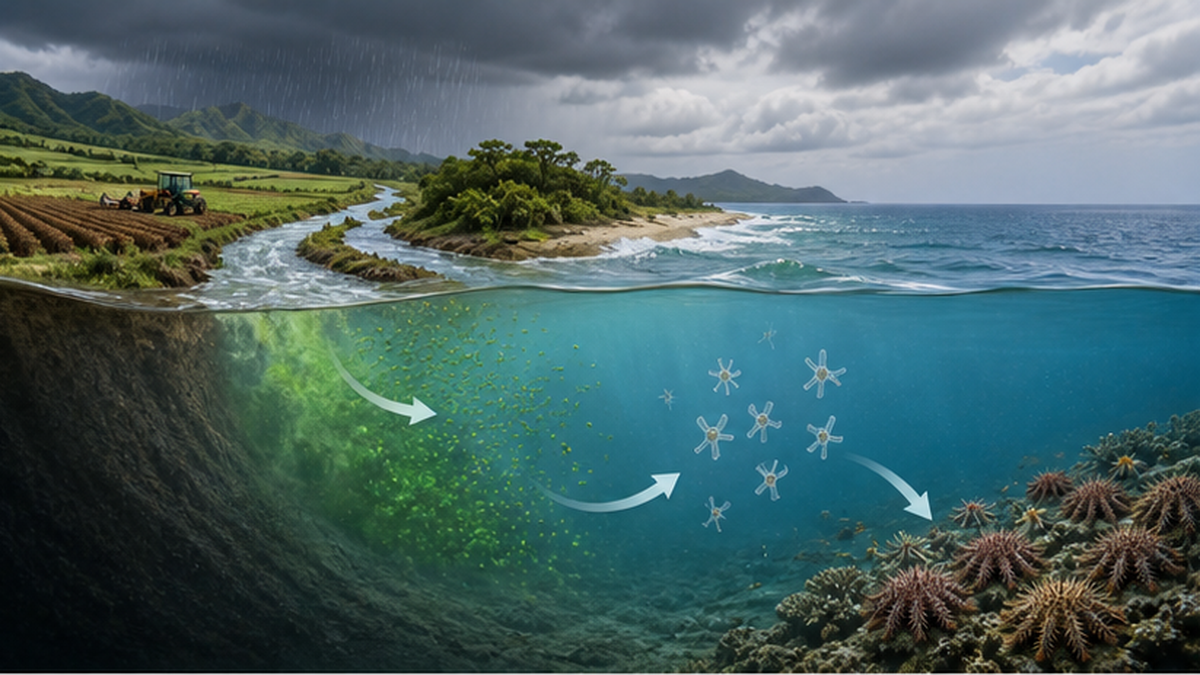
The relationship between nutrients and the sea is explained in detail in "Where Do Nitrogen and Phosphorus Enter the Sea?". Controlling red-soil and fertilizer runoff matters not only for red tides but also as a crown-of-thorns countermeasure.
Are There No Natural Enemies? The Truth About the Giant Triton Overharvesting Theory
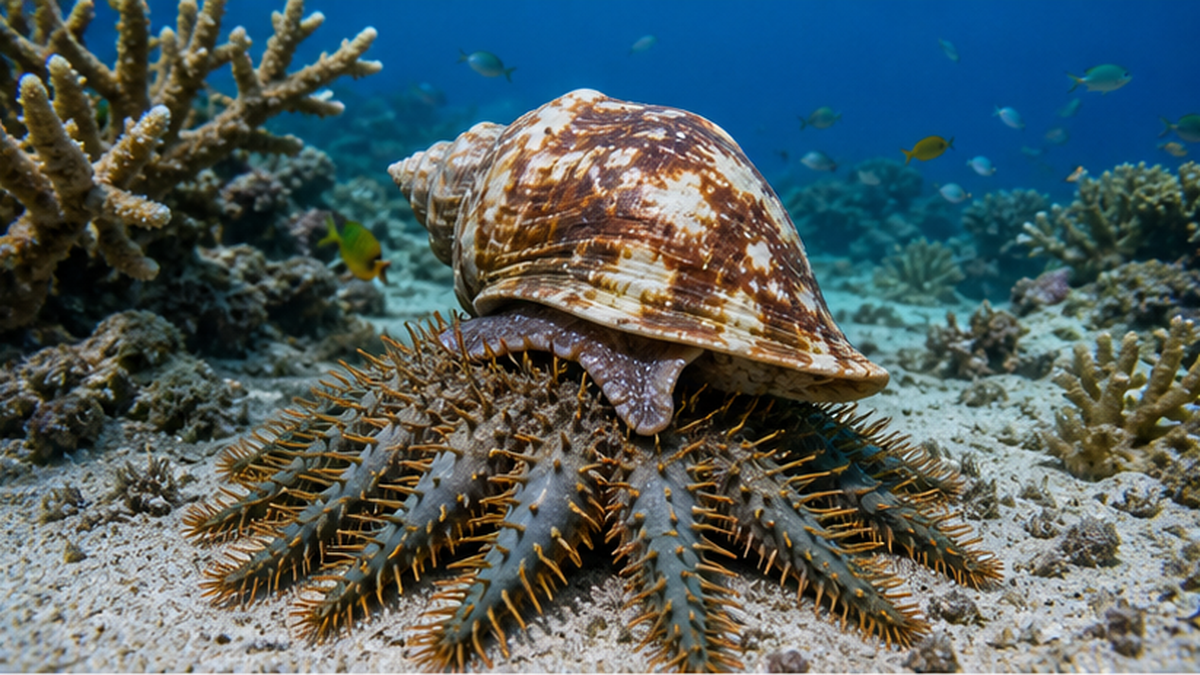
Even a starfish armored in venomous spines has natural enemies. The most famous is the giant marine snail known as the giant triton. Growing to 40 cm in shell length, it is one of the few predators that specializes in hunting starfish, devouring crown-of-thorns undeterred by their spines. Other known predators of adults or juveniles include the harlequin shrimp (a starfish-eating shrimp), triggerfish, pufferfish species, groupers, and certain reef crabs (Okinawa Prefecture materials).
- Giant triton — a large snail that specializes in hunting starfish; the crown-of-thorns' greatest enemy, but depleted by shell collecting
- Harlequin shrimp — a beautiful small shrimp that eats starfish; a predator of juveniles
- Triggerfish, pufferfish, groupers — fishes capable of crushing hard prey; sometimes bite through spines and all
- Reef crabs and fireworms — eat tiny newly settled juveniles, influencing survival in the earliest stage
Did Overharvesting the Giant Triton Pull the Trigger?
At the center of the predator-loss hypothesis is the giant triton. Its beautiful large shell has been prized worldwide as an ornament and as a ceremonial trumpet, and it has been collected around the globe. The storyline: overharvesting depleted the triton, raising crown-of-thorns survival and enabling outbreaks. Fishing pressure on large fishes that eat juveniles may likewise be helping young starfish survive.
The Reality That "Predators Alone Cannot Stop It"
However, Okinawa Prefecture's materials point out that giant tritons and harlequin shrimp are naturally scarce and do not feed exclusively on crown-of-thorns, so predators alone can hardly prevent an outbreak. A single triton is said to eat only about one starfish per week — hopelessly outmatched by a horde of hundreds of thousands. Protecting predators matters for restoring long-term ecological balance, but against an outbreak already under way, human culling remains essential.
Intriguingly, predators may help in ways beyond eating. Australian research has confirmed that crown-of-thorns starfish flee when they merely sense a triton's scent nearby, drawing attention to a "fear effect" that scatters aggregations and disrupts spawning gatherings — potentially more useful than predation itself. Institutions including AIMS have also worked on captive breeding of giant tritons, exploring whether predators could someday help suppress outbreaks. All of this, however, remains at the research stage and is not yet in practical use.
Cautions for Travelers
- Buying shell products from large snails such as the giant triton may contribute to predator decline
- Never touch a crown-of-thorns starfish with bare hands — its venomous spines can pierce even thick gloves
- If stung, warm the wound in 40–45°C water and seek medical care promptly; anaphylaxis is a real risk
The Front Lines of Culling — From 10–25 Injections to a "Single Shot of Vinegar"
Once an outbreak has begun, culling is the only way to save the coral. But safely dispatching a spine-covered venomous animal underwater — by the hundreds of thousands — is no simple matter. In 1970s Okinawa, large-scale culling campaigns absorbed enormous labor and expense yet failed to stop the outbreak waves, and "how to kill reliably with less effort" remained a technical challenge for half a century. Culling technology has evolved dramatically through that struggle.
Cut It and It Multiplies? Early Trial and Error
Early methods included cutting starfish apart underwater or hauling them onto boats with hooks for disposal on land. Because starfish have strong regenerative powers and fragments can regrow depending on how they are cut, underwater cutting was discouraged, while hauling ashore demanded excessive labor. The method that then became mainstream — sodium bisulfate injection — required 10 to 25 injections per animal, a heavy burden on divers.
How Culling Operations Actually Work
- Preliminary survey: assess density and feeding-scar distribution by manta tow (visual survey while towed behind a boat) and dive surveys, and choose priority areas
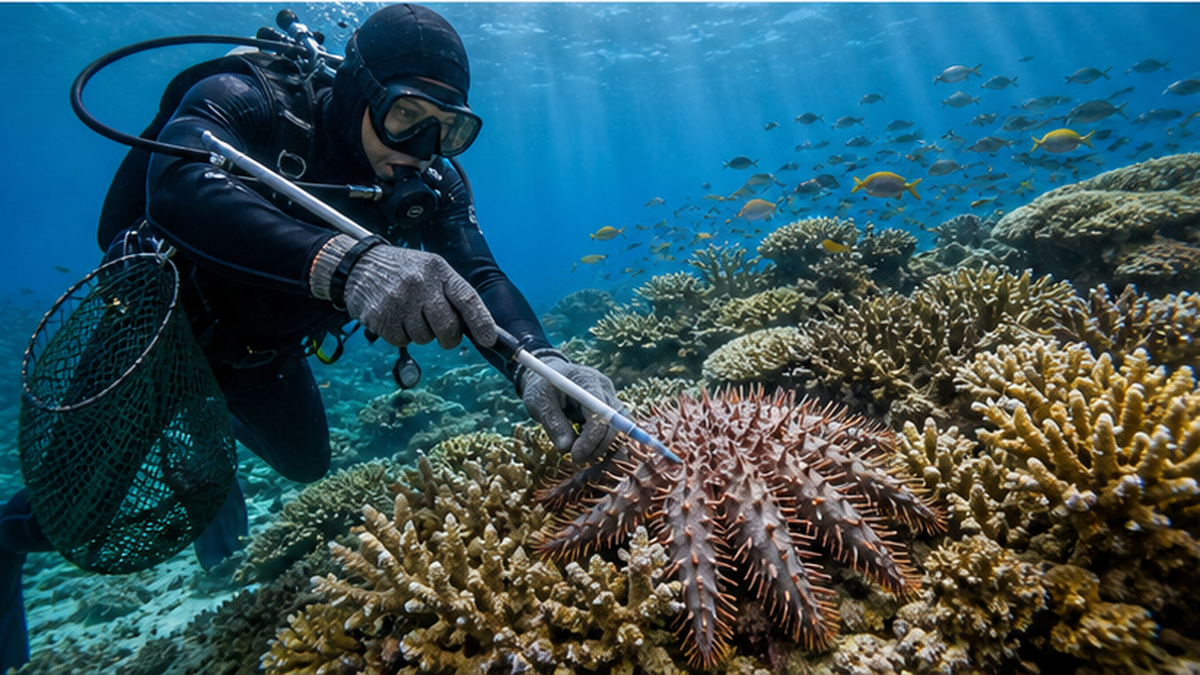
- Culling dives: teams of two or more take assigned zones and inject every starfish found (using injection poles to avoid touching the spines)
- Recording: log the number, size, and location of culled animals to track density changes
- Repetition: one pass never catches them all, so the same area is culled repeatedly until density falls
It is unglamorous, repetitive work — but this accumulation alone is what has actually preserved coral on the reefs chosen for defense. Northern Kohama Island's corals survived the Sekisei Lagoon outbreak around 1980 precisely because intensive culling there never let up.
The Revolutionary "Single Shot" — Bile Salts and Household Vinegar
The turning point came in the 2010s. A method was established to kill with just one injection of bovine bile salts, achieving roughly ten times the efficiency of the old approach. Research at James Cook University and elsewhere then confirmed that a single injection of ordinary household vinegar (acetic acid) is also highly lethal to the starfish while causing no harm to surrounding corals or other marine life. Six-week follow-up monitoring found no change in coral cover or disease, and no abnormalities in fish that ate injected starfish. With cheap, easily obtained vinegar as a weapon, culling became realistic for field programs worldwide, including in developing countries.
| Culling method | Effort per animal | Features / issues |
|---|---|---|
| Underwater cutting / hauling ashore | High | Risk of regeneration; heavy labor. The earliest methods |
| Sodium bisulfate injection | 10–25 injections | Reliable but slow, with a heavy burden on divers |
| Single-shot bile salts | 1 injection | About 10× more efficient; the agent is costly and hard to obtain |
| Single-shot household vinegar (acetic acid) | 1 injection | Cheap and readily available; confirmed harmless to corals and other organisms |
An Organized Fight — The GBR Control Program and Robots
In Australia, the Great Barrier Reef Marine Park Authority (Reef Authority) runs the world's largest culling program with a dedicated vessel fleet, selecting high-priority reefs where divers systematically suppress numbers to "levels the coral can withstand." Field trials are also advancing for technologies in which AI visually identifies the starfish and injects them automatically, such as the culling robot "COTSbot" and its successor "RangerBot" developed at Queensland University of Technology. In 2025, James Cook University published research showing that injection technique itself can decide culling success — evidence that field-level innovation continues today.
Even So, Culling Is a Race Against Time
However advanced the technology, culling faces fundamental limits. The starfish often hide beneath corals and in rock shadows by day, so divers find only a fraction per dive. Individuals lurking in deeper water stay beyond reach and become a source of reinvasion. And the ocean is simply vast. That is why field practice adheres to three principles: (1) strike early in an outbreak, when numbers are still small and culling is most efficient; (2) concentrate on selected reefs; and (3) cull the same sites repeatedly to keep density low. Starting from the cold-eyed premise that "we cannot save everything" has, in the end, saved the most coral.
Visit the official siteCrown-of-thorns starfish Control Program (Great Barrier Reef Marine Park Authority)The world's largest crown-of-thorns management program, where dedicated diver fleets protect the reef with single-shot vinegar and bile-salt injections.🔗 gbrmpa.gov.au See the researchCauses of crown-of-thorns starfish outbreaks (Australian Institute of Marine Science, AIMS)A primary-source page explaining the outbreak hypotheses — nutrients, predator loss, natural fluctuation — with the latest research.🔗 aims.gov.auJapan's Countermeasures — The Ministry of the Environment, Okinawa Prefecture, and Local Divers
In Japan too, a coordinated surveillance and culling system links the national government, the prefecture, municipalities, fisheries cooperatives, and dive operators.
Ministry of the Environment — Surveillance, Culling, and Monitoring in National Parks
The Ministry of the Environment conducts surveillance and culling in 15 marine park zones of Iriomote-Ishigaki National Park, and the Ishigaki Ranger Office has carried out annual outbreak surveys and culling in the Sekisei Lagoon and around Ishigaki Island since 2001. By surveying juvenile starfish, the aim is to catch the signs early and suppress an outbreak before it becomes full-blown. The International Coral Reef Research and Monitoring Center on Ishigaki Island serves as the hub for this research and public information.
The ministry's nationwide ecosystem survey "Monitoring Sites 1000" also records crown-of-thorns numbers annually alongside coral cover at reef sites across the country, providing baseline data for detecting outbreak signs at the national scale. In the Sekisei Lagoon, which endured devastation around 1980, the Sekisei Lagoon Nature Restoration Council was established in 2006 under the Nature Restoration Promotion Act, and comprehensive restoration continues, combining starfish control with coral transplanting and red-soil runoff countermeasures.
Visit the official siteInternational Coral Reef Research and Monitoring Center (Ministry of the Environment)The ministry's coral reef conservation hub on Ishigaki Island, publishing information on crown-of-thorns surveys, culling, and reef monitoring.🔗 kyushu.env.go.jpOkinawa Prefecture — Control Guidelines and the "Choose Which Reefs to Protect" Strategy
In 2007 Okinawa Prefecture formulated its Crown-of-Thorns Countermeasure Guidelines, systematizing science-based culling. Crucial here is a prioritization mindset that faces the reality that not every reef can be saved. To achieve results with limited hands and budget, reefs important as spawning sources or of high tourism and fisheries value must be selected, with culling effort concentrated there to hold densities down continuously. Half a century of experience has taught that thin, widely spread culling yields little for the labor invested.
The Divers Who Hold the Front Line
Those actually gripping the injectors underwater are local fisheries cooperatives, dive operators, and volunteer divers. Onna Village's cooperative culled about 180,000 starfish during the high-density outbreak of 1996, and patrols and early culling continue today. Onna, which has declared itself a "Coral Village," also pursues coral farming and outplanting alongside culling — a local model protecting the sea with both wheels: "lose less" and "grow more." Sightings reported by visiting recreational divers also help detect outbreaks early.
What Happens to Culled Starfish?
Injected starfish decompose where they lie and are eaten by fish, crabs, and other animals, returning to the ecosystem. In the era of hauling ashore, there were attempts to use the collected masses of starfish as compost and soil amendment. Research into productive uses of culled animals continues, but challenges such as the cost of processing the venomous spines mean low-cost underwater injection remains the mainstream today.
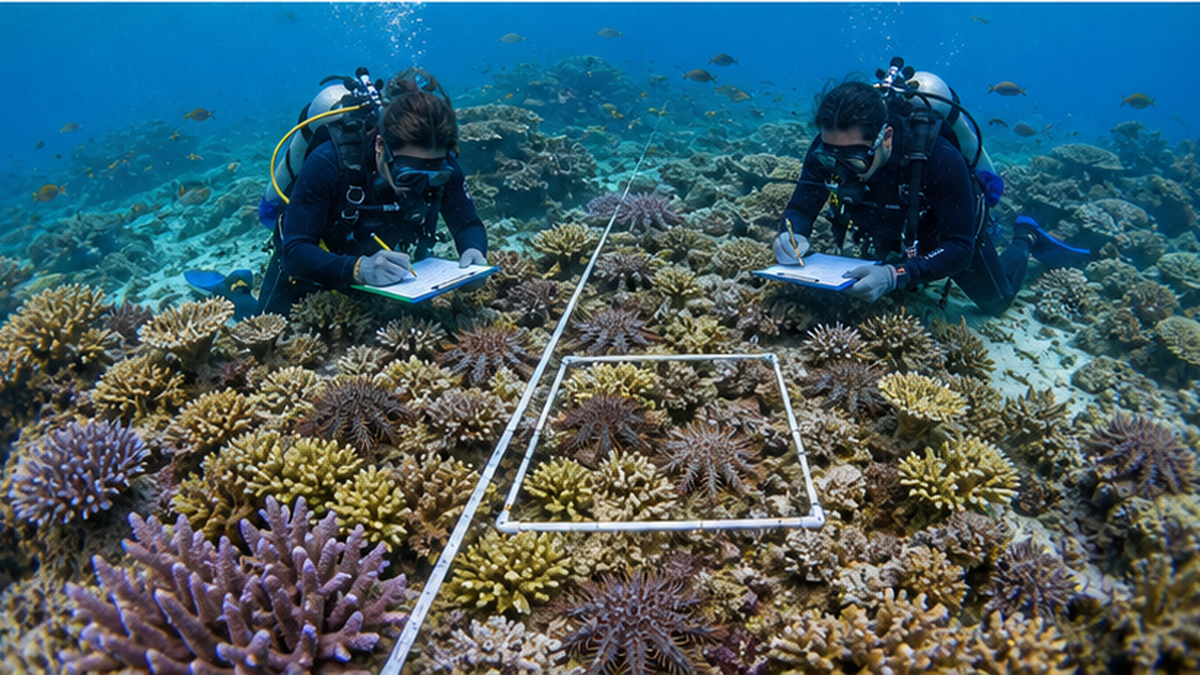
Reefs defended through culling become the "seed stock" for later coral recovery. Just as northern Kohama Island's corals — protected through the Sekisei Lagoon outbreak around 1980 — became a foothold for subsequent regeneration, culling is not mere extermination but an investment in future resilience. Techniques for growing coral back are covered in detail in "Coral Reef Restoration Technology".
The Future of Reefs That Coexist with the Starfish — What We Can Do
Finally, a change of perspective: is the crown-of-thorns starfish a "villain"? As long as it lives at low density, it moderately thins fast-growing corals, leaving room for slower-growing species — in other words, there is a view that it is a member of the ecosystem that maintains reef diversity (AIMS). If fast-growing Acropora alone blanketed the reef, other corals would be robbed of light and space. A moderate predator may play a role like forest thinning, sustaining community diversity. The problem is not the starfish's existence but the abnormal frequency and scale of outbreaks in which human activity may be implicated.
That is why the goal of countermeasures is not eradication. What Australia's program and Japan's culling alike aim for is holding densities to where coral growth outpaces predation — not removing the species from the sea. A native creature, not an invader, whose rampages human activity may have provoked: understanding this framing supports science-based conservation beyond the emotional tug-of-war between "exterminate them" and "poor creatures."
An Era of Combined Stress with Bleaching
Today's coral reefs face multiple stresses at once: heat-driven bleaching, ocean acidification, red-soil and nutrient runoff, and the crown-of-thorns starfish. As in the Yaeyamas — where the 2008–2014 outbreak was followed immediately by the mass bleaching of 2016 — overlapping stresses rob corals of the time they need to recover. Put another way, culling is one of the few stresses humans can reliably reduce, buying corals time until climate action takes effect.
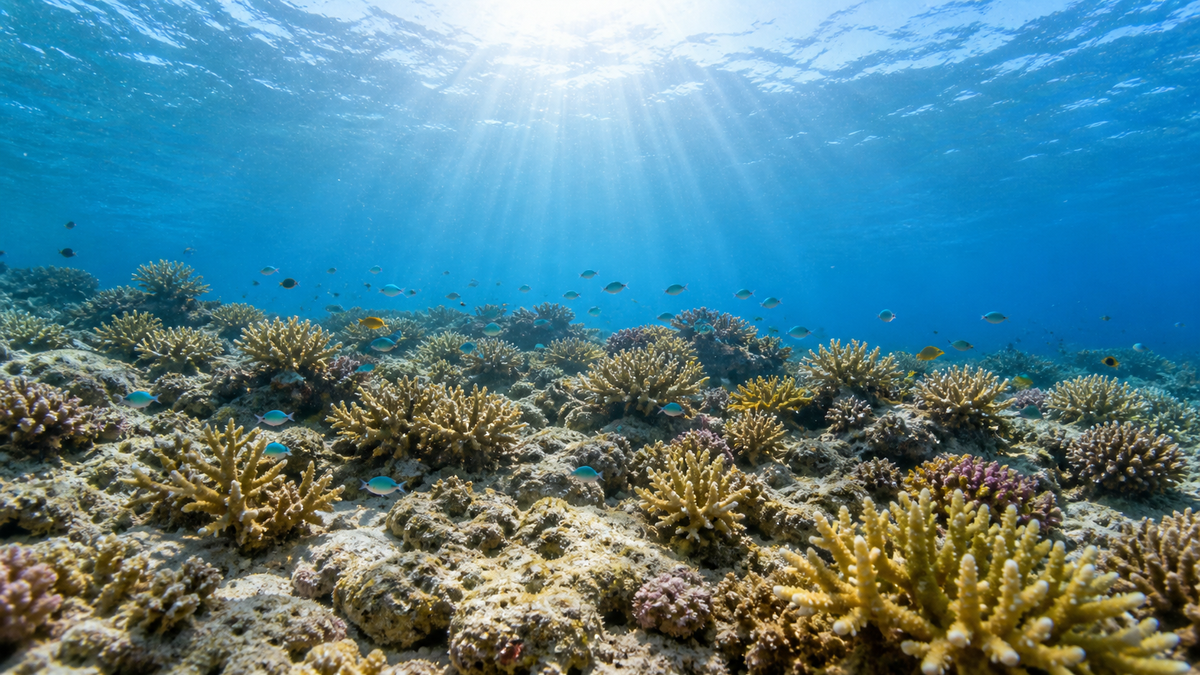
Reef recovery takes time. Even with fast-growing Acropora, restoring a reef's seascape takes on the order of a decade, and a mature reef ecosystem far longer. Yet bleaching intervals have been shrinking, and combined with starfish outbreaks, some areas can barely secure any "recovery window" at all. That is precisely why defending healthy reefs that serve as spawning sources determines the resilience of entire regions.
Learning and Visiting Are Also Contributions
In Okinawa, dive shops and NPOs host culling experiences and reef observation tours open to the public. Seeing a real crown-of-thorns starfish and its feeding scars underwater makes the numbers in the news suddenly tangible. Tourist sightings have led to early outbreak detection, so simply "telling locals what you saw in the sea" is a genuine contribution. Reef tourism itself economically sustains the communities that keep protecting the sea — provided visitors follow good practice, going to see the coral sea is conservation's ally, not its enemy.
What Those of Us Far Away Can Do
What We Can Do About Crown-of-Thorns Outbreaks
- Manage fertilizer and household wastewater properly — reducing nutrients is the fundamental way to suppress larval booms
- Don't buy shell products from large snails such as the giant triton — don't deplete the predators
- If you see a large, spine-covered starfish in Okinawan waters, don't touch it — report it to a dive shop or the local authority
- Donate to or volunteer with reef conservation groups' culling and monitoring programs
- Act on climate (save energy, choose renewables) — reduce the combined stress with bleaching
A creature with the explosive power of tens of millions of eggs can never be fully controlled by humans. What we can do is avoid adding triggers for outbreaks, decide which reefs to defend, and keep culling. Technologies like the single-shot vinegar injection, born of half a century of trial and error, and the steady work of surveyors and divers who descend into the sea year after year are, even now, buying time for the world's coral reefs.
Summary of This Article
- The crown-of-thorns starfish is a large coral-eating starfish. One female spawns several million to tens of millions of eggs, so even a slight rise in larval survival makes the population explode
- In Okinawa, the outbreak beginning in 1969 killed corals across nearly all of Okinawa Island, and around 1980 the Sekisei Lagoon was devastated. On the GBR, 42% of 27 years of coral decline is attributed to the starfish
- Causes appear to be a combination of nutrient runoff, predator loss, and natural fluctuation, with deep-sea upwelling now also reported as a contributor alongside land-based nutrients
- Culling evolved from 10–25 sodium bisulfate injections to single-shot bile-salt and vinegar injections — roughly 10× more efficient — with robotic culling in field trials
- The Ministry of the Environment, Okinawa Prefecture, and local divers maintain surveillance and culling; contributions from afar include nutrient reduction and climate action
References
- Okinawa Prefecture Nature Conservation Division – The Story of the Crown-of-Thorns Starfish (2nd ed.), March 2004
- Okinawa Prefecture Nature Conservation Division – Crown-of-Thorns Starfish Countermeasure Guidelines, March 2007
- Ministry of the Environment, Kyushu Regional Environment Office – Crown-of-Thorns Survey (Ishigaki Area) (2021; outbreak surveys and culling in the Sekisei Lagoon)
- Ministry of the Environment, Nature Conservation Bureau – Sekisei Lagoon Nature Restoration Council: Project Site Overview (records of the outbreak damage around 1980)
- De'ath, G. et al. (2012) PNAS – The 27-year decline of coral cover on the Great Barrier Reef and its causes (42% of coral loss attributed to the starfish)
- Australian Institute of Marine Science (AIMS) – Causes of crown-of-thorns starfish outbreaks
- Babcock, R. C. et al. (2016) PLOS ONE – Assessing Different Causes of Crown-of-Thorns Starfish Outbreaks (the combined-factors view)
- Great Barrier Reef Marine Park Authority (Reef Authority) – Crown-of-thorns starfish Control Program
- James Cook University (JCU) – Injection method critical to controlling Crown-of-thorns starfish (2025; injection technique research)
* Ordered by reliability: government agencies / academic institutions > peer-reviewed papers > specialist institutions > trusted media