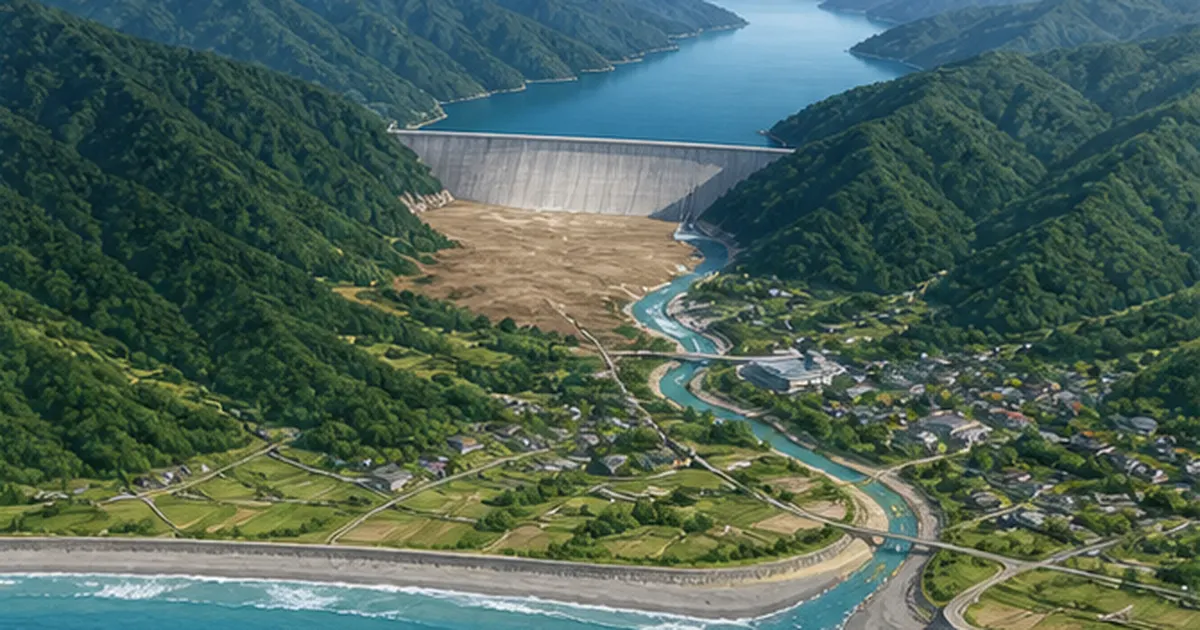
Smartphones and EVs (electric vehicles) alike depend on metals such as cobalt, nickel, and rare earths. As a new source of these materials, the world is now turning its attention to the deep seabed at depths of 4,000–6,000 m, where sunlight never reaches. Plans to send robots to gather the "manganese nodules" scattered across the seafloor are just one step away from becoming reality.
In 2023, however, records of 5,578 species were reported from the prime candidate mining area off Hawaii, and about 90% of them turned out to be unknown creatures without even scientific names. Furthermore, at the site of a mining simulation experiment conducted in 1989, the scars on the seafloor remained clearly visible 26 years later, and research found that microbial activity had recovered to only about half its original level. The deep sea is a world that, once damaged, does not recover on human timescales.
This article carefully explains what deep-sea mining is, why it is gaining momentum now, how it could affect deep-sea ecosystems, and the current state of international rule-making and Japan's activities—all based on primary sources. Use it as material to decide for yourself: should we mine, or should we not?
What you will learn in this article
- The characteristics and distribution of the four types of mineral resources on the deep seabed (manganese nodules, cobalt-rich crusts, seafloor massive sulfides, and rare-earth mud)
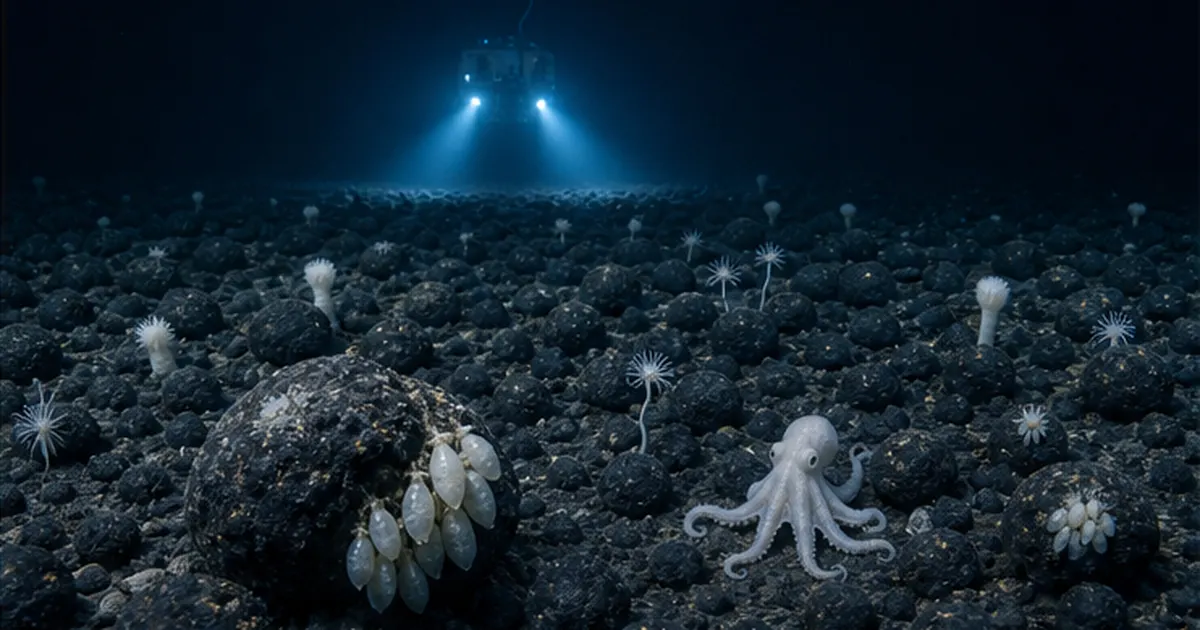
- The 5,578 species found in the Clarion-Clipperton Zone (CCZ), the candidate mining area, and the story of the "octopus that lays eggs on nodules"
- How the DISCOL experiment—whose traces remain 37 years on—revealed the deep sea's poor capacity to recover
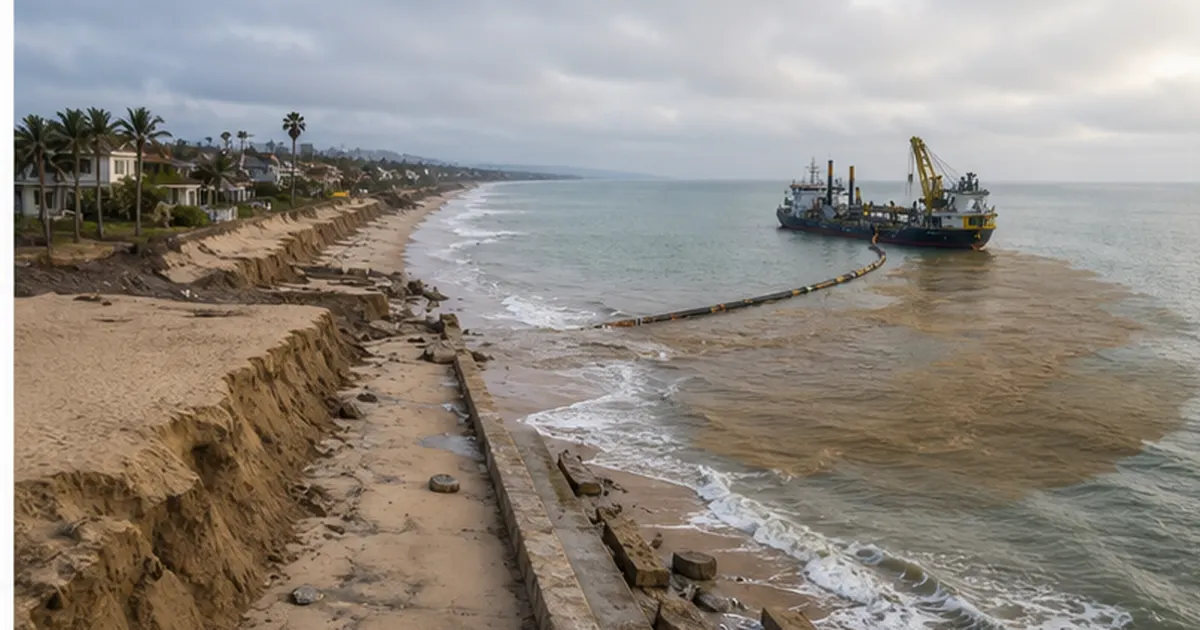
- How sediment plumes (clouds of turbidity) spread impacts beyond the mining sites
- The latest international developments: the collapse of International Seabed Authority (ISA) negotiations, the moratorium movement, and the United States' unilateral course
- Japan's technology trials off Okinawa and Minamitorishima, and what we can do as consumers
What Is Deep-Sea Mining? Four Mineral Resources Sleeping on the Seabed
Deep-sea mining is the industrial activity of extracting mineral resources from the bottom of the deep ocean. The first thing to understand is that as of 2026, commercial deep-sea mining has not yet begun anywhere in the world. What is happening now is limited to resource exploration and technology demonstration tests, and the very rules on whether full-scale extraction should be allowed are still in the midst of international negotiation.
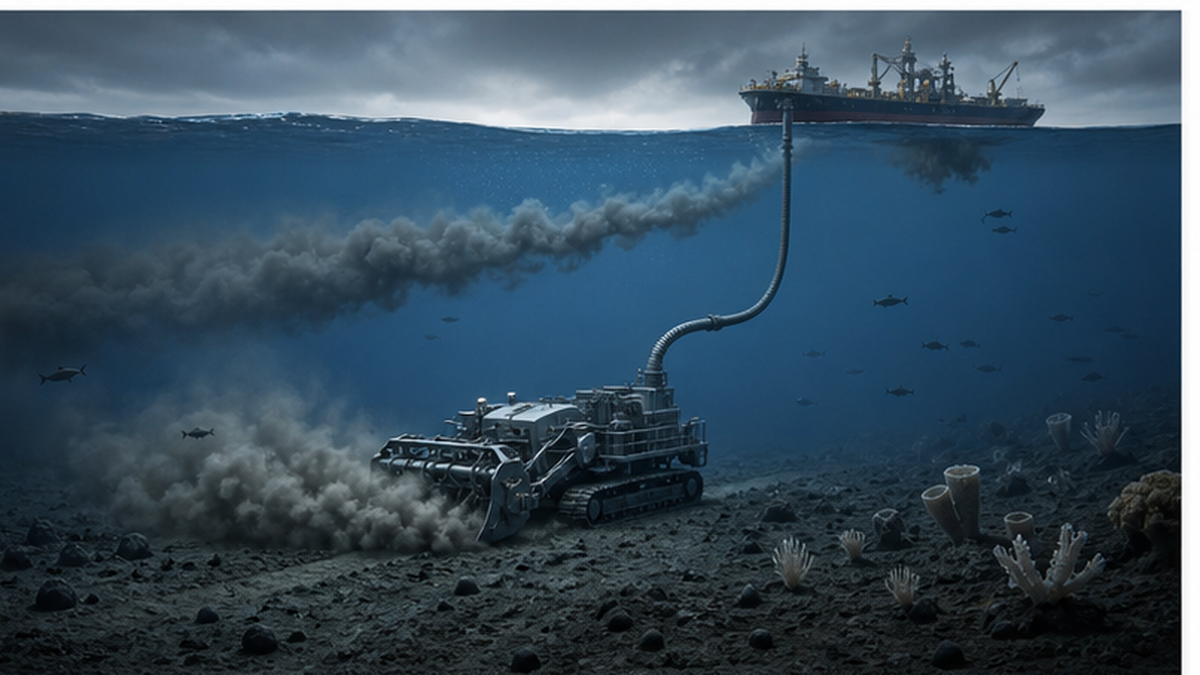
Here is how mining would work. For manganese nodules, a large tracked collector robot would drive across the seabed at depths of around 5,000 m, vacuuming up nodules and sending them through a riser pipe several thousand meters long to a mother ship on the surface. On board, ore is separated from sediment; the ore goes ashore by carrier vessel, while the unwanted muddy water is discharged back into the sea—a colossal feat of ocean engineering utterly unlike a mine on land. Seafloor massive sulfide deposits would require excavators that crush hard ore bodies, while cobalt-rich crusts would demand technology to strip the crust layer off bedrock.
Four types of resources are the targets
Deep-sea mineral resources come in four distinct types. Each contains different metals, occurs in different places, and requires different extraction methods.
| Resource type | Main metals | Location / depth | Characteristics |
|---|---|---|---|
| Manganese nodules | Nickel, cobalt, copper, manganese | Abyssal plains at 4,000–6,000 m | Potato-like black lumps scattered across the seafloor. They grow only a few millimeters per million years—an ultra-slow pace |
| Cobalt-rich crusts | Cobalt, nickel, platinum | Seamount slopes at around 800–2,400 m | Crust-like deposits coating seamount bedrock like asphalt |
| Seafloor massive sulfides | Copper, zinc, gold, silver, lead | Hydrothermal vent fields at around 700–2,000 m | Formed when metals dissolved in hot vent fluids precipitate. They build chimney-like structures |
| Rare-earth mud | Rare-earth elements | Seafloor sediments at 5,000–6,000 m | High-concentration mud layers discovered off Japan's Minamitorishima Island, drawing global attention |
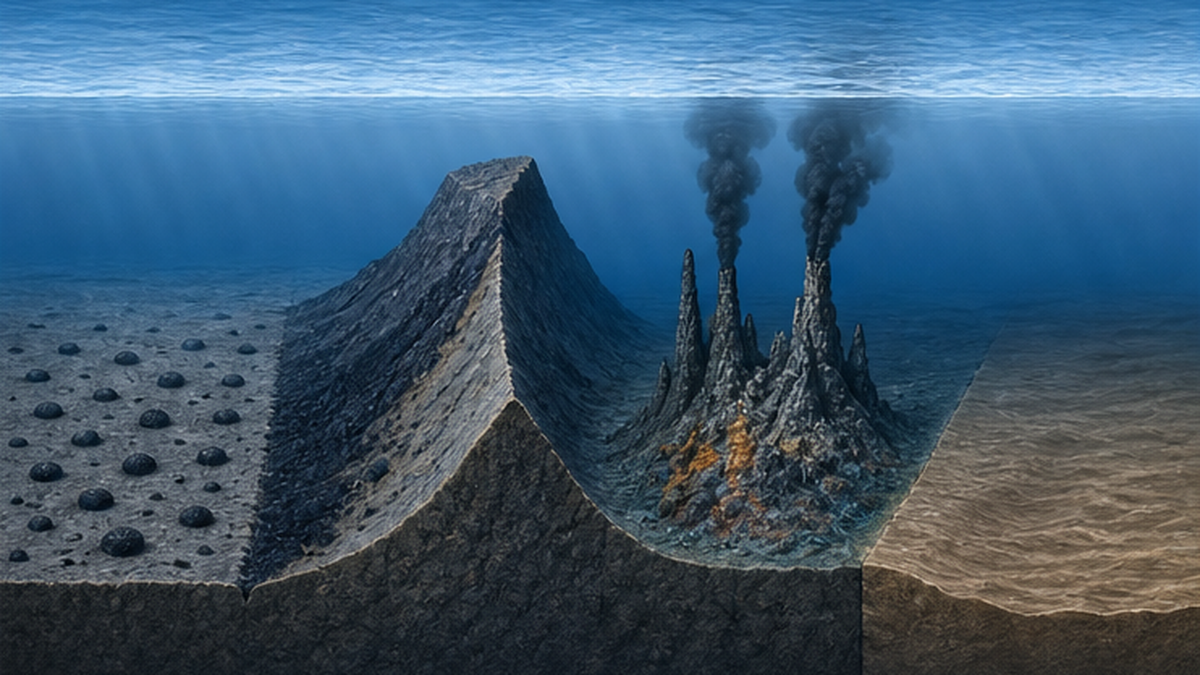
Manganese nodules are thought to form as metals from seawater and sediments slowly accrete around a nucleus such as a shark tooth or rock fragment. Their growth rate is a few millimeters per million years—a nodule 10 cm across is a "tree ring of the deep sea" that took several million to more than ten million years to grow. Seafloor massive sulfides, by contrast, form when seawater that has seeped beneath the seabed is heated by magma to several hundred degrees Celsius, leaches metals from the rock, and precipitates them around vents. Because unique chemosynthetic biological communities flourish around hydrothermal vents, the ore deposits and the ecosystems literally overlap in the same place—which is precisely what makes them so problematic.
The main battleground of the global development race is the manganese nodules spread across the high seas of the Pacific. Because nodules contain both nickel and cobalt—key materials for EV batteries—they are sometimes called "battery rocks of the seabed." Within Japan's exclusive economic zone (EEZ), meanwhile, surveys and technology development are under way for seafloor massive sulfides, cobalt-rich crusts, and rare-earth mud.
Key points
- Deep-sea mining is still on the eve of commercialization; full-scale extraction has not begun anywhere in the world
- There are four resource types (manganese nodules, crusts, massive sulfides, rare-earth mud), each in different places requiring different methods
- Manganese nodules grow only a few millimeters per million years—once taken, they are effectively a non-renewable resource
Why Is the Deep Sea Being Targeted Now? The EV Shift and the Scramble for Rare Metals
Decarbonization, ironically, is driving deep-sea development
The biggest reason deep-sea mining has surged onto the agenda is the rapid growth in rare-metal demand accompanying the transition to a decarbonized society. EV lithium-ion batteries use nickel and cobalt, while the powerful magnets in wind turbines and EV motors use rare earths. The International Energy Agency (IEA) has repeatedly projected that demand for these critical minerals will grow substantially over the coming decades as clean energy technologies spread. Ironically, the very technologies meant to halt climate change are putting development pressure on the untouched deep sea.
Land-based mining has its own problems. The bulk of the world's cobalt supply depends on a single country—the Democratic Republic of the Congo—where human rights issues such as child labor and political instability have long been flagged. Declining ore grades and the deforestation and water pollution caused by mine development are also serious. "Isn't mining the sea better than mining the land?" has become a standard argument of deep-sea mining proponents.
The prime candidate: the Clarion-Clipperton Zone (CCZ)
The world's largest concentration of manganese nodules lies in the Clarion-Clipperton Zone (CCZ), a stretch of Pacific high seas southeast of Hawaii. Across this vast abyssal plain of about 6 million km²—roughly 16 times the land area of Japan—bounded by two fracture zones, nodules rich in nickel and cobalt are densely distributed.
The deep seabed beneath the high seas belongs to no single country; the United Nations Convention on the Law of the Sea designates it "the common heritage of mankind." Its resources are managed exclusively by the International Seabed Authority (ISA), discussed below, and 21 contractors under agreement with the ISA are conducting a total of 30 exploration projects worldwide (19 for manganese nodules, 7 for seafloor massive sulfides, 4 for cobalt-rich crusts). Japan's Deep Ocean Resources Development Co. (DORD) is one of the contractors holding an exploration area in the CCZ.
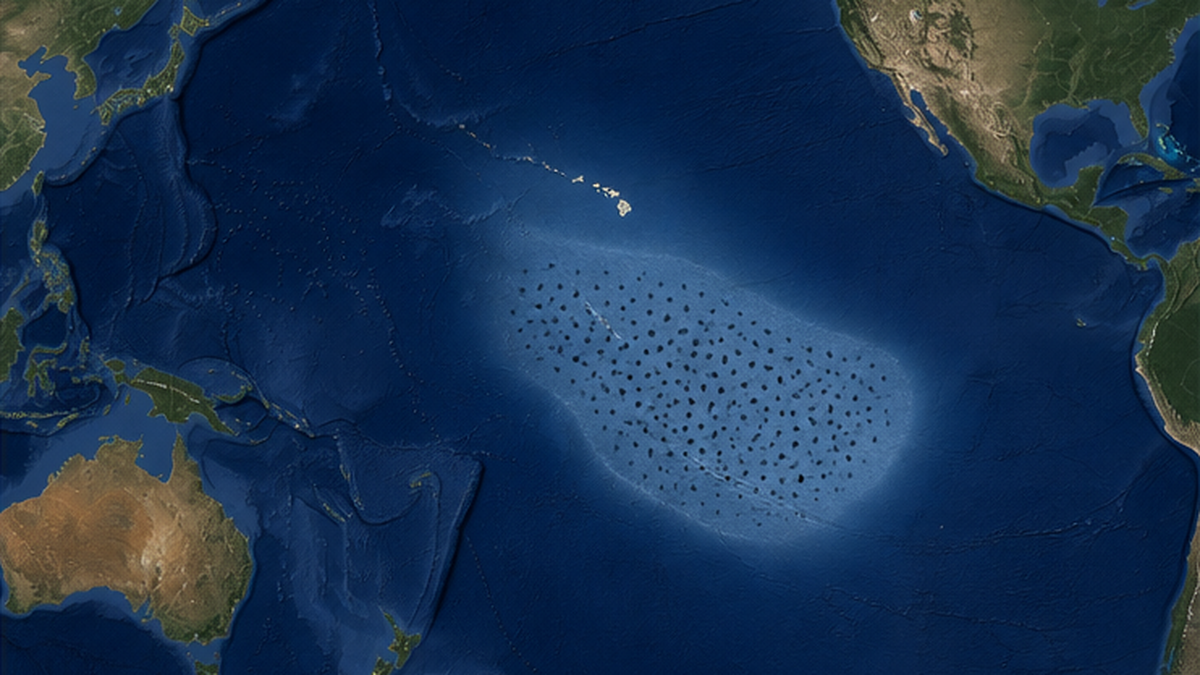
While permitting exploration, the ISA has established a Regional Environmental Management Plan (REMP) for the CCZ, designating a network of conservation zones (Areas of Particular Environmental Interest) excluded from mining to protect biodiversity. However, scientists continue to debate whether these conservation zones truly represent the ecosystems of the areas slated for mining, and whether their size and placement are adequate.
- Demand-side pressure: nickel, cobalt, and rare-earth demand is projected to surge with the spread of EVs and renewables
- Supply-side issues: declining ore grades on land, concentration in particular countries, human rights and environmental problems
- Maturing technology: collector robots and lifting systems operating at 6,000 m depth have reached the demonstration stage
- Security concerns: nations want to secure critical-mineral supply chains of their own
Who Lives in the Deep Sea? Ninety Percent Are "Nameless Creatures"
"Surely nothing much lives on the dark, cold deep-sea floor"—that was once the common assumption. But the more surveys advance, the more the opposite proves true. In 2023, a research team including London's Natural History Museum published a study in Current Biology tallying the species records confirmed to date in the CCZ: the count reached 5,578 species, of which about 88–92% were undescribed species without scientific names (effectively new to science). Humanity is preparing to mine a place without even knowing what lives there.
Manganese nodules are "apartment blocks" for living things
The manganese nodules targeted for mining are themselves the foundation of an ecosystem. On abyssal plains of nothing but mud, nodules are among the few "hard footholds" available. Sessile organisms such as sponges, sea anemones, and sea pens attach to them, and small crustaceans and fish gather around. In 2016, researchers reported an octopus nicknamed "Casper" for its ghostly white body laying and guarding its eggs on the stalks of sponges attached to nodules. Stripping away the nodules means wholesale destruction of these animals' spawning grounds and homes.
The mud around the nodules teems with life as well. The most abundant creatures found in CCZ surveys are small animals such as nematode worms, polychaetes (bristle worms), and amphipods. On the sediment surface, translucent sea cucumbers up to tens of centimeters long slowly graze on organic matter, while glass sponges with skeletons of glassy fibers quietly filter the water. Although the number of individuals per square meter is lower than in shallow seas, species diversity is extremely high—this is the picture of the CCZ painted by the latest deep-sea research.
Endemic species of hydrothermal vents
Around the hydrothermal vents where seafloor massive sulfide mining is envisioned, unique ecosystems thrive on chemical energy rather than sunlight (see our article on hydrothermal vent ecosystems for details). The scaly-foot snail, a gastropod armored in iron scales, lives in only a handful of vent fields in the Indian Ocean; in 2019 it was listed as Endangered (EN) on the IUCN Red List, chiefly because of the threat of deep-sea mining. It was the first animal ever assessed as threatened primarily due to deep-sea mining risk.
Deep-sea organisms generally grow slowly, live long, and reproduce infrequently (see also our article on deep-sea creatures' adaptation strategies). Once their populations take a hit, recovery is extraordinarily slow—making these ecosystems among the most vulnerable to mining impacts.
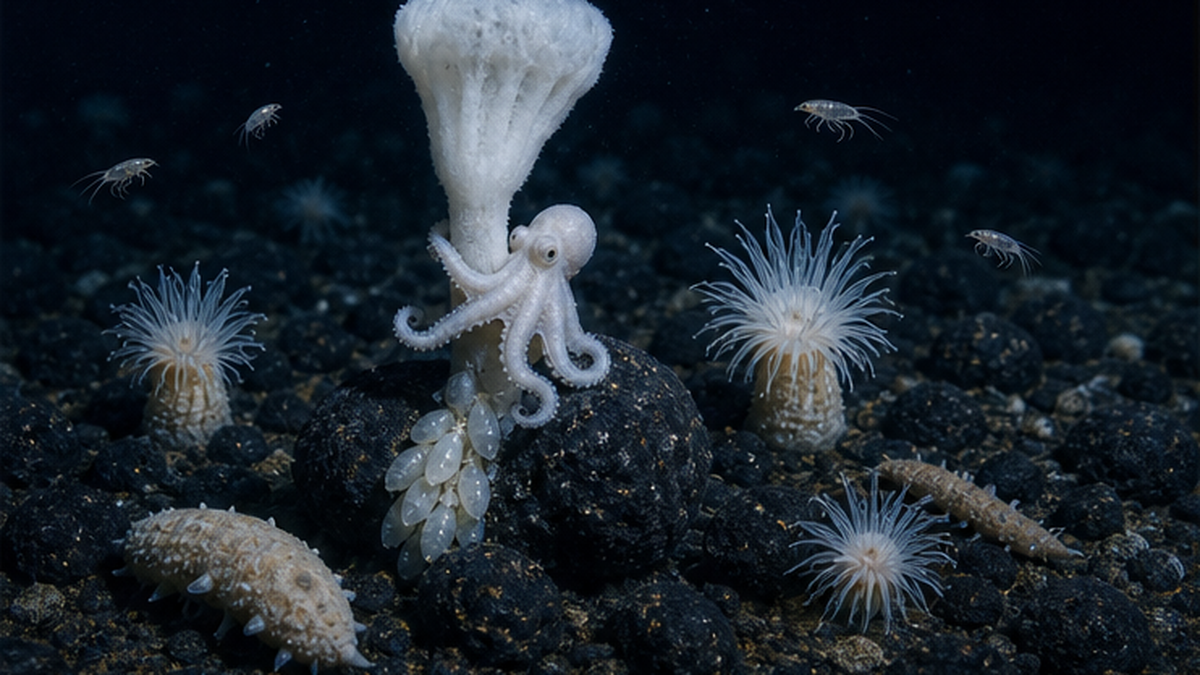
CCZ biodiversity by the numbers
- Species records confirmed: 5,578 (2023, Current Biology)
- Of these, undescribed species (no scientific name): about 88–92%
- Dominated by arthropods, annelids, and nematodes, with many sea cucumbers, corals, and glass sponges
- Researchers estimate the CCZ's total species count could exceed 6,000–8,000
Scars That Never Fade: The DISCOL Experiment and the "Unrecovering Deep Sea"
"Won't the seafloor recover with time, even if we mine it?" The most important answer to this question lies in the deep sea off Peru. In 1989, a German research team conducted a large-scale disturbance study known as the DISCOL experiment in the Peru Basin at a depth of about 4,000 m. They repeatedly ploughed roughly 11 km² of seafloor with a harrow-like device to observe, over the long term, how manganese nodule mining would affect the seabed.
Twenty-six years later, the scars remained sharp
When a European research project revisited the site 26 years later in 2015, the plough tracks remained etched into the seafloor as if made yesterday. According to an analysis published in Science Advances in 2020, microbial cell numbers within the tracks were still reduced by about half, and microbial functions such as organic matter breakdown (biogeochemical functions) had fallen to as little as one-quarter in places. The research team estimated that full recovery of microbial functions would take more than 50 years.
The same holds for visible megafauna. A 2019 study in Scientific Reports found that even 26 years after the disturbance, communities of sessile animals that use nodules as footholds—sponges, sea anemones and others—had not recovered to the levels of undisturbed reference areas. Where the nodules themselves were removed, recovery is effectively impossible on human timescales, given that nodules grow only a few millimeters per million years.
What must not be forgotten is that DISCOL was merely a "small" experiment of about 11 km². Envisioned commercial operations would have a single contractor collecting nodules from hundreds of square kilometers of seabed per year—an impact area tens to hundreds of times larger than DISCOL. If even an experiment leaves scars like these, what would commercial-scale mining leave behind? This is why so many ocean scientists are sounding the alarm.
The biogeochemical functions performed by seafloor microbes had still not fully recovered 26 years after the disturbance. Our estimates suggest that complete recovery will require at least 50 years.
— Paraphrased from the conclusions of Vonnahme et al. (2020), Science Advances
Why is deep-sea recovery so slow?
- Cold and nutrient-poor: water temperatures of 1–4°C and only a trickle of organic matter sinking from the surface mean all life processes run in slow motion
- Life-history traits: slow growth, long lifespans, and low reproduction mean populations need decades to centuries to recover
- Loss of footholds: the nodules and chimneys—the very "structures" of the habitat—are carried away as resources, physically erasing the environment
- No immunity to disturbance: abyssal plains are stable over millennia, so their ecosystems are simply not built for large-scale disturbance
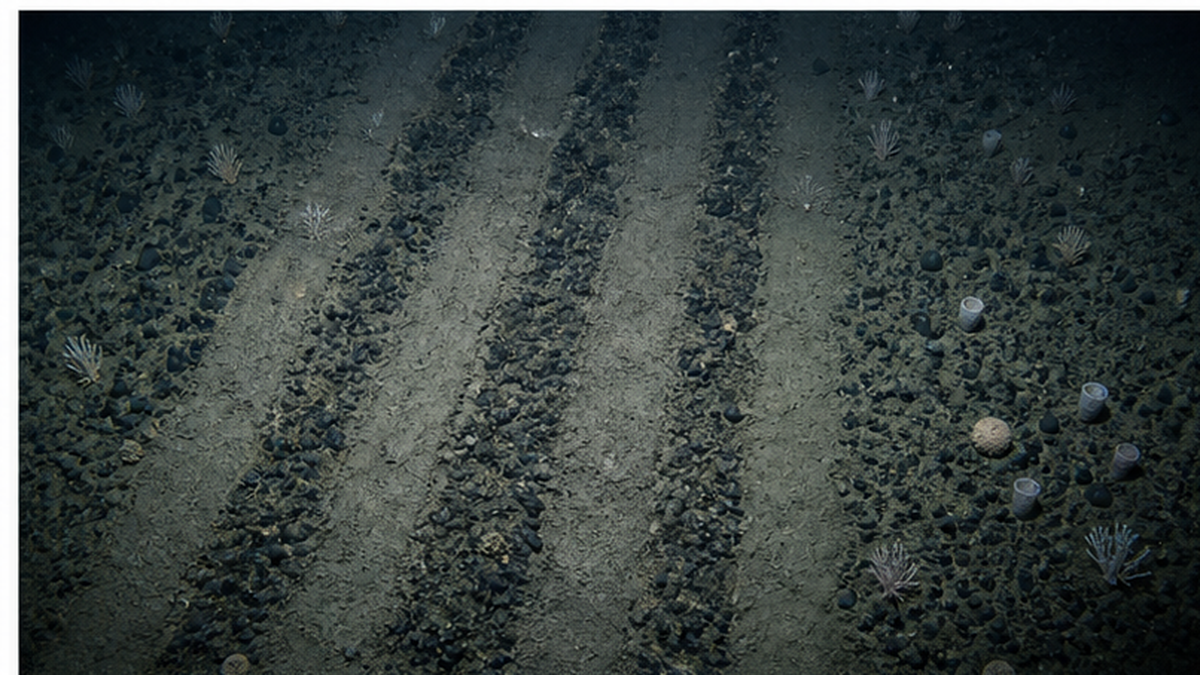
What the DISCOL experiment tells us
- Even a single experimental disturbance left physical and biological scars lasting 26 years and counting
- Full recovery of microbial functions is estimated at 50+ years—at commercial scale the impacts would be orders of magnitude greater
- Never judge the deep sea's "resilience" by human timescales
The Cloud of Turbidity Called the "Sediment Plume": Impacts Spread Beyond the Mining Site
The environmental impacts of deep-sea mining are not limited to the area the machines physically destroy. What experts worry about most is the sediment plume—the "cloud of turbidity" generated by mining operations.
There are two kinds of plumes
- Benthic plume: created when the collector vehicle stirs up surface sediment as it drives along the seabed sucking up nodules. It drifts near the bottom and spreads into the surroundings
- Discharge plume: created when the muddy water left over after the nodules are separated aboard the ship is released back into the sea. Depending on the discharge depth, midwater ecosystems can also be affected
What happens when turbidity enters the crystal-clear deep sea
The deep sea is by nature an exceptionally clear, still world. If vast quantities of suspended particles are scattered into it, the filtering organs of animals that strain food from the water—sponges, bivalves and others—could become clogged. Many deep-sea creatures also communicate through bioluminescence, and turbidity could rob them of their "vision." Resettling sediment may bury seafloor organisms in surrounding areas, and researchers are also studying the risk of heavy metals leaching from the mud and entering the food chain.
Beyond turbidity, there are also problems of noise and light. The operating sound of collector vehicles and the vibration of lifting pumps would echo through the silent deep sea around the clock. Some researchers worry about impacts on large animals that use the deep ocean, such as whales, which communicate by sound. The powerful lights used for operations are likewise an unknown stress for deep-sea organisms that have never seen sunlight in their lives. Deep-sea mining could thus affect ecosystems through multiple channels—not just "mud" but sound, light, and vibration.
How far a plume spreads depends heavily on currents, particle size, and discharge methods, and there is still no definitive answer. Numerical models and field experiments suggest that turbidity impacts could extend beyond the mining block on scales of several to tens of kilometers, and it is becoming clear that this is not simply a matter of "limit the mining area and you limit the impact."
Not knowing is itself the risk
Because baseline data on deep-sea ecosystems are so scarce, impact predictions inevitably carry large uncertainties. This uncertainty is exactly why scientists invoke the precautionary principle—"survey first, mine later, if at all." In an environment where damage cannot be undone, "trying it and seeing what happens" is not an option.
No International Rules Yet: ISA Negotiations, the Moratorium, and Unilateral US Action
Under the United Nations Convention on the Law of the Sea, the mineral resources of the deep seabed beneath the high seas are "the common heritage of mankind," managed exclusively by the International Seabed Authority (ISA), headquartered in Jamaica. The ISA has approved exploration contracts, but the regulations needed to permit commercial mining—commonly called the Mining Code—remain unfinished amid disputes over environmental standards and benefit-sharing.
Official informationAbout the International Seabed Authority (ISA) — Ministry of Foreign Affairs of JapanThe Japanese Foreign Ministry's official page explaining the role and organization of the international body that manages deep-sea mineral resources, and Japan's involvement.🔗 mofa.go.jpISA decision-making entangles the interests of developing and developed countries, of states eager to mine and states urging caution. Pacific island nations such as Nauru and Tonga sponsor mining contractors, while fellow Pacific nations such as Palau, Fiji, and Vanuatu lead the moratorium movement—even the "peoples of the sea" are split down the middle. For island nations whose livelihoods depend on the ocean, mining could be a precious source of income, or a threat to their fisheries and culture.
The trigger: the "two-year rule"
It was the Pacific island nation of Nauru that broke the deadlock. In June 2021, Nauru invoked a treaty provision demanding that the mining regulations be completed "within two years"—the so-called two-year rule. This created a situation in which mining applications could be reviewed even without finished regulations, sending shockwaves through the international community. But the July 2023 deadline passed with no agreement, and the negotiations have grown more fraught with each passing year.
The 2025 talks also collapsed; moratorium support grows to about 40 countries
At the ISA's 30th session in Kingston in July 2025, the gaps over environmental standards, monitoring regimes, and benefit-sharing again proved unbridgeable, and the Mining Code went unadopted, with negotiations carried over into 2026. Meanwhile, the number of countries supporting a moratorium—no mining until sufficient scientific knowledge is in hand—has grown to about 40. Major nations including France, Germany, and the United Kingdom have been joined by some Pacific island states, as well as financial institutions and corporations voicing support.
The disputes go beyond the environment. Because the deep seabed is "the common heritage of mankind," profits from mining must be shared equitably with the international community, including developing countries. Yet royalty levels and distribution methods, liability mechanisms for environmental damage, and monitoring and inspection regimes all remain to be settled. "Even setting a single environmental threshold lacks the scientific data to justify it"—this is the fundamental reason the negotiations drag on.
The US's unilateral course—a new flashpoint
On April 24, 2025, US President Trump signed an executive order to expedite permits for deep-sea mineral exploration and development. Because the United States has not ratified the UN Convention on the Law of the Sea and stands outside the ISA framework, it asserts it can independently authorize mining in international waters under its own law (the Deep Seabed Hard Mineral Resources Act). The US subsidiary of Canadian firm The Metals Company (TMC) duly applied to the National Oceanic and Atmospheric Administration (NOAA) for a commercial mining permit in the CCZ. This raises a fundamental question—can one nation's permit authorize mining of "the common heritage of mankind"?—and has drawn strong international backlash.
| Year | Event |
|---|---|
| June 2021 | Nauru invokes the "two-year rule," pressing for completion of the mining regulations |
| 2022 | TMC conducts a collector test in the CCZ, recovering about 3,000 tonnes of nodules |
| July 2023 | The two-year deadline arrives—but the Mining Code remains unfinished |
| April 2025 | US executive order; TMC applies to NOAA for a mining permit under US law |
| July 2025 | ISA's 30th session closes without adopting the Code; moratorium support reaches about 40 countries |
| 2026– | ISA negotiations continue; whether commercial mining will be allowed remains undecided |

Japan's Moves: World-First Trials and Minamitorishima's Rare-Earth Mud
For resource-poor Japan, the marine mineral resources sleeping in its vast exclusive economic zone (EEZ) have long been positioned as a trump card for "domestic resources." At the core of these development efforts is the Japan Organization for Metals and Energy Security (JOGMEC).
Official informationSpotlight on Rare-Earth Mud! Japan's Marine Mineral Resources (JOGMEC)JOGMEC explains Japan's offshore mineral resources and the state of their development, including the rare-earth mud off Minamitorishima.🔗 jogmec.go.jpJapan's string of world-first technology trials
Japan is in the world's leading pack for deep-sea mining technology. In 2017, the Ministry of Economy, Trade and Industry and JOGMEC succeeded in the world's first pilot test of excavating seafloor massive sulfide ore and continuously lifting it to a ship from a depth of about 1,600 m off Okinawa. In 2020, Japan also achieved the world's first excavation test of cobalt-rich crusts on the Takuyo-Daigo Seamount off Minamitorishima (at a depth of about 900 m). At the same time, the comprehensive evaluation report on seafloor massive sulfide development compiled by METI and JOGMEC in 2023 shows that challenges remain in resource assessment, mining technology, economic viability, and environmental impact evaluation alike—commercialization is still some way off.
Minamitorishima rare-earth mud: the world's first lifting trial in 2026
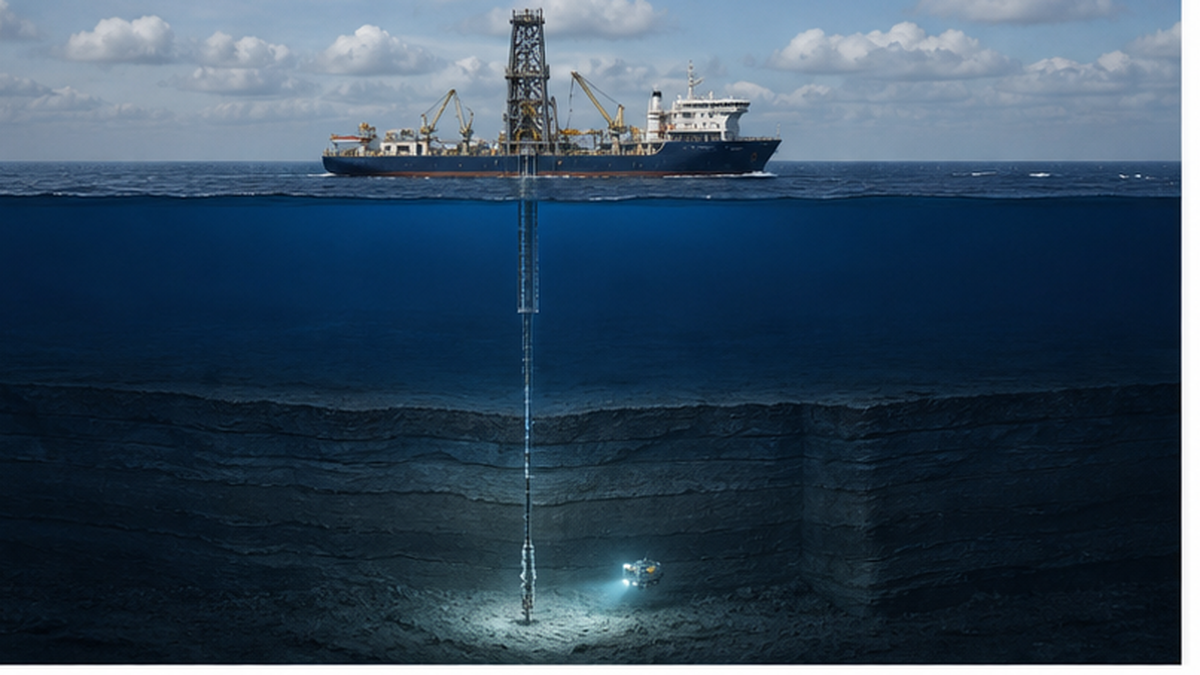
The greatest attention now centers on the rare-earth mud off Minamitorishima, Japan's easternmost island. Surveys by the University of Tokyo and others have revealed layers of mud rich in rare earths—indispensable for high-tech products—spread across the seabed at depths of 5,000–6,000 m within the EEZ. Rare-earth production today is dominated by China, and Japanese manufacturing has been shaken every time export restrictions arise. Some estimates suggest the mud off Minamitorishima contains rare earths equivalent to several centuries of global demand for certain elements, and development is being fast-tracked as national policy on economic security grounds. Testing by the deep-sea drilling vessel Chikyu began in January 2026, and in February of that year it succeeded in the world's first trial of continuously lifting rare-earth mud from the seabed at a depth of about 6,000 m. The trial also included environmental monitoring of the surrounding area using small deep-sea probes.
Development within the EEZ falls outside the International Seabed Authority's jurisdiction—Japan can proceed at its own discretion. That is precisely why the question becomes whether Japan can guarantee the rigor of its own environmental impact assessments. How will long-term monitoring of the deep-sea environment be built? How much impact will be deemed acceptable? Whether Japan can advance environmental rule-making with the same fervor as mining technology will be the true test.
Milestones in Japan's deep-sea resource development
- 2017: World's first pilot mining and lifting test at seafloor massive sulfide deposits off Okinawa
- 2020: World's first excavation test of cobalt-rich crusts at Takuyo-Daigo Seamount off Minamitorishima
- 2023: Comprehensive evaluation report on seafloor massive sulfide development published; commercialization still faces challenges
- January–February 2026: Chikyu achieves world's first rare-earth mud lifting trial from about 6,000 m off Minamitorishima
Is There an Alternative to Mining? Recycling, New Technologies, and What We Can Do
"Decarbonization needs rare metals, so we have no choice but to mine the deep sea"—is that really true? In fact, options for "getting by without mining the deep sea" are growing rapidly on both the demand and supply sides. The deep-sea mining debate tends to look like a binary choice between environment and economy, but it is really also a question of timing: how much scientific understanding do we require before deciding?
Urban mining and the circular economy
Used smartphones and EV batteries are concentrated stores of cobalt, nickel, and lithium. Recycling technology for recovering metals from this "urban mine" improves every year, and processes that can recover most of the key metals from spent batteries are being commercialized around the world. If the circular economy—using products longer and keeping resources in circulation—takes hold in earnest, dependence on new extraction can be reduced accordingly.
The technology shift toward "cobalt-free batteries"
The demand side is moving too. In EV batteries, adoption of lithium iron phosphate (LFP) batteries—which use no cobalt or nickel—is expanding worldwide, transforming the material composition of batteries themselves. With next-generation technologies such as sodium-ion batteries also advancing, the premise that "the EV shift cannot happen without deep-sea nodules" is beginning to waver under technological progress.
Companies and consumers making their positions known
Companies including BMW, Volvo, Google, and Samsung SDI support a deep-sea mining moratorium and have pledged not to use deep-sea minerals in their products for the time being. Some financial institutions are likewise refraining from investing in or financing deep-sea mining. Behind these corporate stances lie concerns about environmental risk—and the watchful eyes of consumers and investors. In other words, each of our choices becomes a "vote" on the future of the deep sea.
And above all—getting to know the deep sea
There is one point on which everyone in the deep-sea mining debate agrees: "We still know far too little about the deep sea." About half of Earth's surface is seabed deeper than 3,000 m, yet only a fraction of it has been mapped in detail, and biologically surveyed areas are fewer still. Investment in deep-sea research is the foundation for judging the merits of mining scientifically—and at the same time, a quest for "resources" beyond minerals, from drug candidates to clues about the origin of life. Know before you dig—whether we can keep that order straight is the question now before us.

Actions you can take today
- Use phones and appliances longer, and when replacing them, hand them in at municipal or in-store small-appliance collection points (a first step toward urban mining)
- Follow deep-sea mining news and learn about ISA negotiations and the moratorium movement—more informed people means policies can change
- Pay attention to companies and brands that declare their stance on deep-sea minerals, and factor it into your choices
- Learn about ocean environmental issues and talk with family and friends about whether the deep sea should be mined
Summary of this article
- Deep-sea mining is on the eve of commercialization, targeting four resources: manganese nodules, crusts, massive sulfides, and rare-earth mud
- 5,578 species (about 90% undescribed) have been confirmed in the candidate CCZ area; the nodules themselves are habitat
- The DISCOL experiment left scars still visible after 26 years; microbial recovery needs 50+ years—the impacts are effectively irreversible
- Sediment plumes can spread impacts beyond the mining blocks; the sheer uncertainty is itself a risk
- The ISA's mining regulations remained unadopted through 2025: about 40 moratorium-supporting countries versus a unilateral US course
- Japan is stacking up world-first trials off Okinawa and Minamitorishima; recycling and alternative batteries are widening the "option not to mine"
References and Sources
- Ministry of Foreign Affairs of Japan – Overview of the International Seabed Authority (ISA) and Japan's involvement
- JOGMEC (Japan Organization for Metals and Energy Security) – Spotlight on rare-earth mud: an explainer on Japan's marine mineral resources
- Agency for Natural Resources and Energy (METI) / JOGMEC – Comprehensive Evaluation Report on the Seafloor Massive Sulfide Development Program (November 2023)
- Deep Ocean Resources Development Co. (DORD) – About deep-sea mineral resources and the International Seabed Authority (ISA)
- Rabone et al. (2023), Current Biology – How many metazoan species live in the world's largest mineral exploration region? (tally of 5,578 species in the CCZ)
- Vonnahme et al. (2020), Science Advances – Effects of a deep-sea mining experiment on seafloor microbial communities and functions after 26 years (DISCOL microbial impacts)
- Simon-Lledó et al. (2019), Scientific Reports – Biological effects 26 years after simulated deep-sea mining (DISCOL megafauna impacts)
- IISD Earth Negotiations Bulletin – Summary of the ISA Council's 30th session, Part 1 (March 2025)
- Ocean Policy Research Institute, Sasakawa Peace Foundation — Ocean Newsletter – The International Seabed Authority's journey and outlook
※ Ordered by reliability: government and academic institutions > peer-reviewed papers > specialist organizations > trusted media